


Dr. Sony Sherpa (MBBS)
In addition to her clinical experience, Dr. Sherpa is a published medical researcher and holistic health advocate. Her dual expertise in emergency care and alternative therapies brings a unique lens to medically reviewed content—ensuring it is both accurate and accessible.
In the world of assisted reproductive technology, the “gold standard” has long been conventional in vitro fertilization, or IVF. For decades, you have probably heard that high-dose hormonal stimulation is an essential and often exhausting hurdle on the path to parenthood. If you are already feeling anxious about weeks of injections, high medication costs, and the physical risks of overstimulating your ovaries, you are not alone in worrying about the “what-ifs” and possible undesirable scenarios that can arise during treatment, especially if your care team suggests a high-intensity instead of a low-stim protocol.
If you are wondering whether there is another path, there is. In vitro maturation (IVM) offers a different approach. Instead of pushing your ovaries with high doses of fertility drugs, IVM focuses on collecting immature eggs and allowing them to finish maturing in the lab. In experienced centers, cumulative success rates now reach about 35% to 40%, while medication costs often drop by 30% to 50% compared with standard IVF. For many, this balance of safety, cost, and success deserves a closer look.
IVM used to be considered as an experimental or “last resort” treatment, but that label no longer fits. In 2021, the American Society for Reproductive Medicine (ASRM) removed the experimental tag and recognized IVM as a supported alternative. If you have PCOS, a high ovarian reserve, or need urgent fertility preservation, your doctor may now discuss IVM as a clinical reality rather than just an intriguing idea.
In vitro maturation, or IVM, is a gentler fertility treatment where your doctor collects mostly immature eggs with little or no stimulation and your lab team matures them outside your body before fertilization. Treatment usually takes about one week, medication costs are often 30 to 50 percent lower than standard IVF, and cumulative pregnancy rates in experienced centers reach about 35 to 40 percent, with essentially zero risk of ovarian hyperstimulation from the IVM protocol itself.
If you have PCOS, high ovarian reserve, or need fast fertility preservation, ask your specialist whether IVM 2.0 fits your situation.
What the latest research and guidelines say
Recent studies and ASRM guidance show that modern IVM can offer reassuring pregnancy outcomes for well-selected patients, especially those at high risk of ovarian hyperstimulation syndrome or those who need to move quickly before cancer treatment. Updated lab protocols have brought miscarriage rates into the same general range as standard IVF and have improved embryo quality compared with older IVM methods.
All research citations in this guide include PMID numbers so you can review the original studies on PubMed if you wish.
In This Guide
IVM: 0 to 500 IU FSH
IVF: 2,000 IU or more
IVM: about 1 week
IVF: 2 to 3 weeks
30 to 50 percent lower
medication costs with IVM
Quick facts: how IVM differs from traditional IVF
If you are trying to decide how IVM compares to standard IVF, it helps to look at the basics side by side. Here are some of the clearest differences.
- Hormone load: IVM usually uses 0 to 500 IU of FSH, while conventional IVF often uses 2,000 IU or more. That means far fewer injections and lower hormone swings for your body.
- OHSS risk: Because IVM relies on little or no stimulation, the risk of ovarian hyperstimulation syndrome from the treatment itself is essentially zero.
- Treatment timeline: An IVM cycle often finishes in about one week, while standard IVF usually takes 2 to 3 weeks from the start of stimulation to egg retrieval.
- Monitoring burden: With IVM, you have fewer early morning clinic visits. Ultrasound scans and blood tests are kept to what your doctor feels is truly necessary.
- Cost impact: IVM can reduce your overall treatment costs by about 30 to 50 percent, mainly because you are not paying for large amounts of stimulant drugs.
- Efficiency: A single immature egg has about a 1.1 percent chance of leading to a live birth, but when you look at a full IVM cycle in experienced centers, including frozen transfers, cumulative success rates now reach about 35 to 40 percent.
- Global experience: IVM is still a specialized technique, but clinics around the world have already reported thousands of healthy babies since the first IVM pregnancy in 1991.
Latest Research Insights
14.3% miscarriage rate – reassuring early outcomes: A 2024 study of updated IVM lab protocols found that about 14 in 100 early pregnancies ended in miscarriage, and twin pregnancies occurred in about 11 in 100 cases. These rates sit in the same general range as many IVF programs, which suggests that modern IVM can offer reassuring pregnancy outcomes in experienced centers. Source: Medicina (PMID: 38200424).
13,000 plus IVF cycles – real-world backup plan: An analysis of more than 13,000 IVF cycles in women with low egg counts showed that adding IVM eggs helped make up for the small number of mature eggs from standard IVF. For you, this means that immature eggs from small follicles can still turn into extra embryos and more chances at a baby when your clinic uses rescue IVM. Source: Reproductive Biomedicine Online (PMID: 38100829).
Comparable live birth rates in PCOS – with less medication: Randomized trials in women with polycystic ovary syndrome found that IVM can reach live birth rates similar to standard IVF when doctors use modern protocols and select patients carefully. These cycles used far fewer stimulation drugs, which reduces side effects and clinic visits. Source: Human Reproduction (PMID: 32974672).
Unstimulated or mild cycles – less hormone load, real results: A 2023 study of women with PCOS or very high follicle counts used IVM after little or no stimulation and still reached encouraging cumulative live birth rates over several transfers. This shows that even with a gentle approach, your eggs can still mature and lead to healthy pregnancies. Source: Journal of Ovarian Research (PMID: 36821006).
These findings come from peer-reviewed research. Your personal chances depend on your age, diagnosis, and clinic experience, so always talk through the numbers with your fertility specialist.
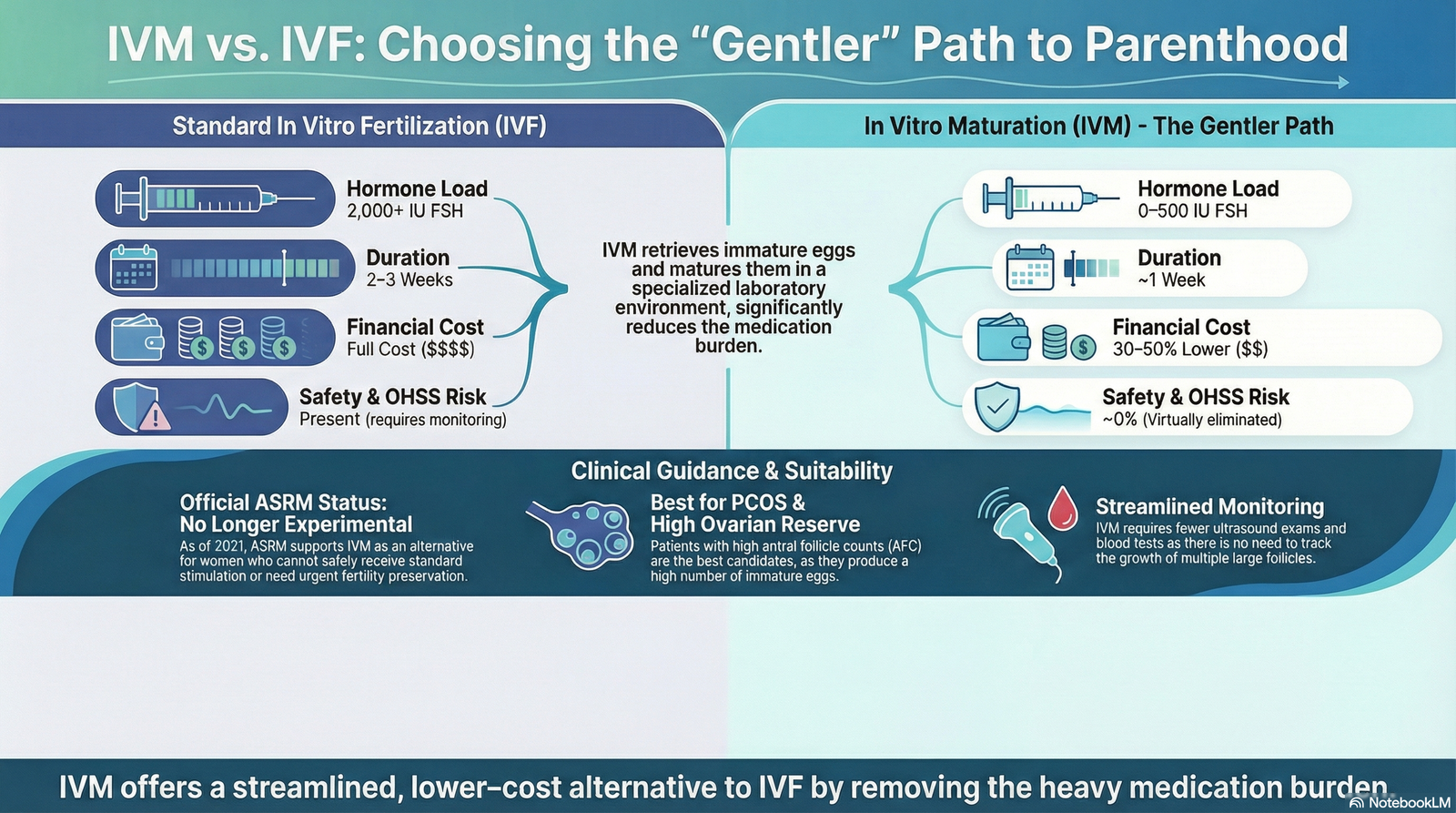
IVM vs. IVF at a glance: hormone use, timeline, and cost impact in a single snapshot.
| Treatment | Typical Hormone Dose | Cycle Length | Medication Cost Impact | Cumulative Live Birth Rate |
|---|---|---|---|---|
| IVM (modern protocols) | 0 to 500 IU FSH | About 1 week | 30 to 50 percent lower than IVF | Around 35 to 40 percent |
| Conventional IVF | 2,000 IU FSH or more | 2 to 3 weeks | Full cost of stimulation drugs | Around 45 to 50 percent in similar groups |
How IVM protocols have evolved
If you feel lost in the different versions of IVM, you are not alone. The truth is that IVM has grown from a simple lab technique into a family of protocols that doctors tailor to your specific situation. Understanding the main types helps you ask better questions at your consultation.
Standard unstimulated IVM
Standard, or unstimulated, IVM is the original version. Your doctor collects immature eggs, called germinal vesicle stage oocytes, from small antral follicles that measure about 2 to 10 millimeters. You do not receive prior hormone treatment, apart from basic cycle timing if needed.
Once the eggs are in the lab, they often restart their maturation process on their own in culture. Because these eggs are collected before they are fully mature, some have lower developmental potential than eggs that finish maturing inside the body. This is one reason why researchers moved on to primed and biphasic protocols.
Primed IVM, also called truncated cycle IVM
To narrow the gap between standard IVM and IVF, many clinics now use primed IVM. In this approach, you may take a short course of low-dose FSH for three to six days or receive a single injection of human chorionic gonadotropin about 36 hours before egg retrieval.
This priming step nudges your eggs to start maturing while they are still inside your ovaries. When your doctor retrieves the eggs and the lab takes over, they are already partway through the process. Studies show that primed IVM improves the rate of egg maturation and often leads to better quality embryos than fully unstimulated IVM.
The breakthrough: biphasic or CAPA IVM, often called IVM 2.0
If you hear your clinic talk about IVM 2.0, they often mean biphasic or CAPA IVM, short for capacitation IVM. This is a two-step lab protocol that gives your eggs more time to complete important internal preparation before final maturation.
In the first step, your eggs sit in a pre-maturation culture for about 24 hours. This culture contains C-type natriuretic peptide, which keeps them in a resting state and allows their internal machinery to prepare properly. You can picture the process like letting a firm, green tomato sit in the sun until it reaches the right ripeness instead of forcing it to change too quickly.
In the second step, your lab team moves the eggs into a maturation medium that contains epidermal growth factor-like peptides. This combination triggers the final step toward full maturity. In some patient groups, CAPA IVM has doubled the number of usable embryos compared with older IVM methods.
Rescue IVM inside standard IVF cycles
During a standard IVF cycle, about 15 percent of collected eggs are still immature at the time of retrieval. In the past, clinics often discarded these eggs. Rescue IVM changes that story.
With rescue IVM, your embryology team keeps these immature eggs and matures them overnight in the lab. The next day, they can fertilize the eggs that reached maturity and add those embryos to your treatment plan. In women with low egg numbers, this strategy has improved cumulative live birth rates across more than 13,000 analyzed cycles. In simple terms, rescue IVM means more eggs, more embryos, and more chances from a single round of stimulation.
The safety profile and child health data
If you are considering IVM, you may find yourself returning to one question, even if you do not say it out loud. Will my baby be safe? That concern is completely valid, and it is one reason researchers have paid close attention to the health of children born after IVM.
Pregnancy and miscarriage rates
A 2024 study that looked at updated IVM lab protocols reported a miscarriage rate of 14.3 percent. This number sits in the same general range as miscarriage rates in many standard IVF programs. In the same study, about 11 out of 100 pregnancies after IVM were twins.
Clinics can lower the twin rate through elective single embryo transfer. That means your team transfers one embryo at a time, which keeps your risk of twins and the complications that come with twin pregnancies as low as possible.
Epigenetic and developmental health
Another key concern is whether maturing eggs in the lab changes the way genes are switched on or off. Scientists call this epigenetic programming. To answer this question, several large studies have examined DNA methylation patterns in the placenta, cord blood, and cheek cells of children born after IVM.
These studies have not found meaningful changes in important developmental genes when they compare IVM children with children conceived after standard IVF. Researchers have also followed IVM-conceived children up to about seven and a half years of age. So far, they have not seen differences in growth, physical health, or neurocognitive development when compared with IVF children.
We do not yet have data for IVM children in their twenties or thirties, simply because the technique is still relatively young. The information we do have from pregnancy, birth, and early childhood is encouraging and offers real reassurance to many families.
Safety, guidelines, and future directions
Zero OHSS risk from IVM itself – a key safety edge: Reviews of IVM in women at high risk of ovarian hyperstimulation syndrome report that IVM can be done with minimal or no stimulation, which removes the classic OHSS risk linked to high-dose IVF drugs. If you have PCOS, very high AMH, or a history of OHSS, this drug-light approach protects your health while still aiming for a baby. Source: Reproduction and Fertility (PMID: 39716455).
ASRM 2021 opinion – official support for IVM: The American Society for Reproductive Medicine states that IVM is a reasonable option for women who are at high risk for OHSS or who cannot safely receive standard stimulation, including some patients with PCOS or cancer who need urgent fertility preservation. For you, this means IVM is not a fringe experiment; it sits within professional guidelines for carefully chosen cases. Source: ASRM Committee Opinion on In Vitro Maturation, 2021.
Improved lab methods – better egg and embryo quality: Newer IVM protocols that add a pre-maturation step and use optimized culture media show higher rates of eggs maturing and forming good-quality embryos than older methods. This helps narrow the success gap between IVM and IVF, especially in clinics that have invested in IVM 2.0 techniques. Sources: Reproduction and Fertility and International Journal of Molecular Sciences (PMID: 39716455; PMID: 33396559).
Fertility preservation – an option when time is short: Reviews of fertility preservation highlight IVM as a way to collect immature eggs quickly, without waiting for a full IVF stimulation cycle. If you need to start chemotherapy or surgery soon, IVM lets your team bank eggs or embryos in days instead of weeks. Source: Journal of Ovarian Research and related reviews (PMID: 36821006).
These insights come from peer-reviewed research and professional guidelines. They can inform your questions and options, but your own doctor will help you weigh them against your medical history.
IVM for PCOS and OHSS prevention
If you have polycystic ovary syndrome, you probably already know that your ovaries do not behave like textbook ovaries. You may have a high antral follicle count and many small follicles on each ovary. That can make you a strong responder to standard IVF stimulation drugs.
In a typical IVF cycle, this high follicle count raises your risk of ovarian hyperstimulation syndrome. OHSS can cause abdominal pain, bloating, nausea, and in severe cases, fluid shifts that affect your lungs and other organs. It is a complication that fertility teams work hard to prevent.
A clear safety advantage for high responders
Standard IVF protocols for PCOS patients carry an OHSS risk of roughly 8.2 to 11.2 percent, depending on the exact protocol and your hormone levels. With IVM, the picture looks different. Because IVM uses little or no stimulation, the risk of OHSS from IVM itself is essentially zero.
For you, this means that if you have PCOS or a very high ovarian reserve, IVM can protect your health in a way that high-dose IVF often cannot. You still work toward pregnancy, but you avoid pushing your body into the same hormone extremes.
Comparable success rates in PCOS
Randomized trials in women with PCOS show that IVM can reach live birth rates in a similar range to standard IVF when clinics use modern protocols and select patients carefully. Some studies report clinical pregnancy rates around 40 percent per transfer for PCOS patients using unstimulated IVM cycles.
If you feel uneasy about high-dose fertility drugs or if you have had a rough time with stimulation in the past, this is important. You may not have to choose between safety and success. In the right hands, IVM can offer a gentler route that still gives you a real chance at a baby.
IVM for fertility preservation when time is short
If you have just received a cancer diagnosis, fertility may be one of many worries on your mind. You may also feel that you are racing the clock. Chemotherapy or surgery often needs to start quickly, and waiting several weeks for a full IVF stimulation cycle can feel impossible.
Speed and flexibility for urgent situations
IVM gives your team another way to protect your future fertility on a short timeline. Because your doctor can collect immature eggs at almost any point in your cycle, even in the luteal phase, you do not have to wait for your next period to start treatment.
This flexibility means your care team can often schedule an IVM retrieval within days, not weeks. Your lab can then freeze mature eggs or embryos before you go on to cancer treatment. For many patients, that speed makes the difference between preserving options for a future family and losing that chance.
Innovative retrieval techniques
IVM also supports newer surgical strategies. In cases where doctors need to remove an ovary, such as an oophorectomy for cancer or other conditions, they can sometimes collect immature eggs directly from the ovary after it has been removed. The lab then matures those eggs using IVM and freezes them as eggs or embryos.
Reports describe successful live births even five years after this type of ex vivo IVM and freezing. For young girls who have not reached puberty, IVM often stands as the only realistic option to protect fertility. They cannot undergo standard ovarian stimulation, but their ovarian tissue may still contain immature eggs that can be matured later.
Maturation rates in very young children are lower, around 4.9 percent for those under age five in some reports. Even so, this approach can act as a vital insurance policy for a future they have not yet had a chance to imagine.
Advanced lab strategies to support egg quality
Modern IVM is not just about when your doctor retrieves your eggs. It is also about what your lab team does with them afterwards. Scientists are constantly investigating the signals and conditions that help eggs mature healthily.
Optimized culture media
The culture medium, the fluid that surrounds the egg in the lab, plays a key role. Newer IVM protocols use media that include energy sources like pyruvate and a balanced mix of amino acids. These ingredients support the egg’s metabolism as it matures.
Some research has tested adding supplements, such as coenzyme Q10, to the maturation media. In older women, coenzyme Q10 has improved maturation rates and reduced chromosomal errors, also called aneuploidy. For you, that translates into a higher chance that a mature egg will be healthy enough to become a strong embryo.
Mimicking the natural follicle environment
Inside your body, each egg develops inside a follicle, surrounded by supporting cells that communicate with it constantly. Once the egg leaves that environment, it loses that support system. This is one of the main challenges in IVM.
To bridge this gap, some labs use three-dimensional co-culture systems made from materials like alginate or collagen. These gels give the egg structural support and help recreate the feel of a natural follicle. Other teams add your own follicular fluid, the liquid that surrounds your eggs in your ovaries, to the culture. That fluid carries growth factors and signals that seem to promote faster and more successful maturation.
All of these tweaks share one goal. They try to bring the lab as close as possible to the natural conditions inside your ovaries so that your eggs have the best possible start.
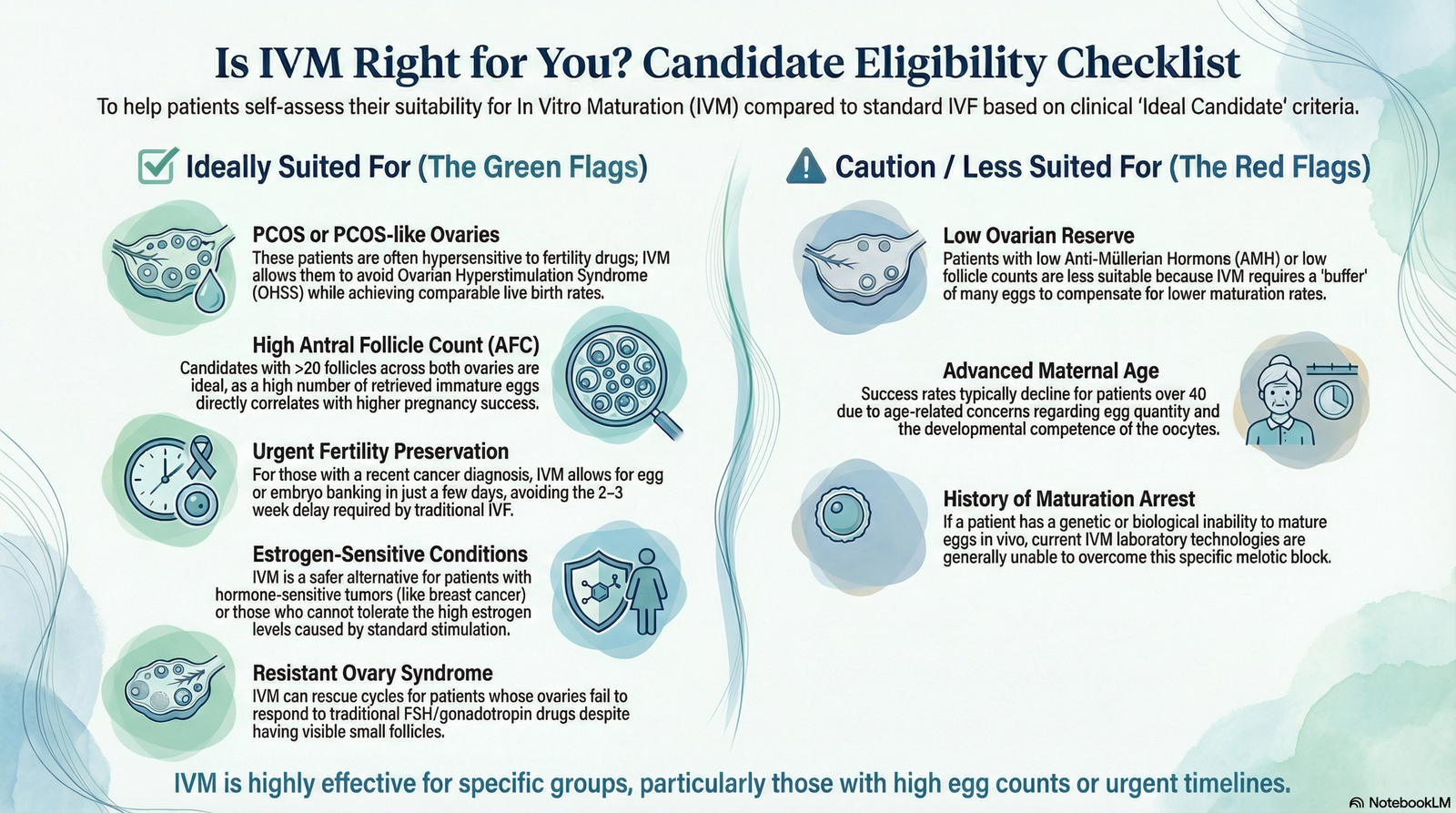
Who IVM is best suited for and how it compares with standard IVF in a single visual guide.
Success rates and how the gap with IVF is closing
If you are comparing IVM with IVF, success rates are central to that decision. It is normal to ask whether this approach will truly work for you, especially when you already feel that time, money, and energy are limited.
Historically, IVM implantation rates were lower than those of IVF. Implantation rates for IVM often fell between 5.5 and 21.6 percent, while standard IVF hovered around 36.9 percent in many reports. That gap is the reason many clinics stayed cautious about using IVM outside of special cases.
Over the past several years, newer protocols and smarter transfer strategies have started to narrow that gap.
The freeze-all strategy
Today, many leading IVM programs use a freeze-all policy. In standard IVF, high estrogen levels from stimulation can throw off the timing between your developing embryo and your uterine lining. With IVM, hormone levels are lower, but the timing between the lab and your natural cycle can still be imperfect.
By freezing all embryos and planning transfer in a separate, well-prepared cycle, clinics gain more control over the timing. One study showed that clinical pregnancy rates rose from 9.4 percent in fresh IVM transfers to 31.8 percent in frozen-thawed transfers. That is more than a threefold jump simply from changing when the transfer happens.
Cumulative success, not just single-cycle results
It is easy to focus on the result of the first transfer, especially when you feel tired or discouraged. Still, cumulative success is what matters most. This means looking at your chance of a live birth after you have used all embryos from a single egg-collection cycle.
In women with high antral follicle counts, the cumulative live birth rate after one IVM cycle, including transfers of all frozen embryos, has reached 39.3 percent in some studies. Conventional IVF in similar groups sits around 49.8 percent.
So while IVM still trails IVF by a margin, the difference is smaller than it used to be. When you factor in the safety benefits, lower costs, and shorter timeline, that smaller gap can feel like a reasonable tradeoff for many patients.
Is IVM right for you?
If you are reading this and asking whether IVM really fits your story, that is the right question to ask. IVM is not a universal replacement for IVF, but it can be an excellent match for certain situations and diagnoses.
You are an ideal candidate for IVM if:
- You have PCOS or PCO-like ovaries and want to avoid the risks of OHSS.
- You have a high antral follicle count, usually 20 or more follicles across both ovaries.
- You need urgent fertility preservation because of a cancer diagnosis and cannot wait weeks for stimulation.
- You have estrogen-sensitive tumors, such as some breast or endometrial cancers, where high hormone levels from IVF drugs are not safe.
- You have experienced resistant ovarian syndrome, where your ovaries do not respond well to high doses of stimulation drugs.
IVM may not be the best choice if:
- You have a low ovarian reserve, with low AMH or a very low antral follicle count. In that case, you may not have enough immature eggs to overcome the lower maturation efficiency of IVM.
- You are older, often over 40. Egg quality falls with age, and standard IVF with full stimulation may give you a better chance of finding a healthy egg in fewer cycles.
- You have persistent oocyte maturation arrest, a rare genetic condition in which eggs fail to mature even under optimal lab conditions.
The best way to know where you stand is to sit down with your fertility specialist, share your lab results and medical history, and ask directly whether IVM fits your profile. You deserve a clear, honest answer so you can move forward with more confidence.
Want help comparing clinics and costs?
If this feels like a full-time job, and honestly it often does, our advisors can collect clear, itemized quotes from verified clinics and map out your likely timeline at no cost to you.

Why trust this guide? The OVU commitment
You are probably juggling hope, timelines, and a lot of tabs open in your browser. And you deserve clear, current, human advice. At OVU, we review clinic protocols, compare real quotes, and talk to people who have done this - intended parents and gestational carriers - so we can give you practical steps, not just theory. If you want help comparing options without sales pressure, we will gather itemized quotes and success data that match your exact situation. You decide, we will bring the info to your table.
Frequently Asked Questions
Is IVM still considered experimental?
No, IVM used to carry that label, but the ASRM committee opinion now describes it as a reasonable, non-experimental option, especially for high-risk patients and those who need urgent fertility preservation. Your clinic may still reserve it for specific situations, but it no longer sits in the experimental category in professional guidelines.
How much cheaper is IVM than IVF?
With IVM, the cost of stimulation drugs drops sharply because you use little or none. For many patients, this translates to savings of several thousand dollars in pharmacy costs. Overall, an IVM cycle often ends up about 30 to 50 percent less expensive than a fully stimulated IVF cycle, though exact numbers depend on your country and clinic.
Does IVM always require ICSI?
In many programs, yes. Eggs matured in the lab can develop a slightly firmer outer shell, called the zona pellucida. To make sure sperm can still reach the egg, clinics often use intracytoplasmic sperm injection, or ICSI, where an embryologist injects a single sperm directly into the egg. If sperm numbers and movement look normal, some clinics still use standard insemination, but ICSI remains common with IVM eggs.
Does IVM take more time in the lab than IVF?
Yes. In standard IVF, eggs are usually ready for fertilization shortly after retrieval. With IVM, your eggs need an extra 24 to 48 hours in culture to finish maturing before fertilization. This extra time happens in the lab, not in your body, so your day-to-day experience mostly involves waiting for updates from your team.
Is the egg retrieval for IVM more painful?
No. The retrieval procedure itself feels similar. In IVM cycles, the procedure can take a bit longer, around 22 minutes compared with about 15 minutes for IVF, because your doctor is working with many small follicles instead of fewer larger ones. Pain scores reported by patients are very similar between IVM and IVF.
Can I use IVM if I also have male factor infertility?
Yes. IVM is compatible with many forms of male factor infertility. Doctors have used it successfully in couples where the male partner has very low sperm counts or nonobstructive azoospermia that requires surgical sperm retrieval, such as testicular sperm extraction. In these cases, IVM is combined with ICSI to give each egg the best chance of fertilization.
Are there more twins with IVM?
Some IVM programs report twin rates around 11 percent. The twin rate depends less on IVM itself and more on how many embryos your clinic transfers. Because most centers now aim for elective single embryo transfer, especially in good-prognosis patients, your chance of a singleton pregnancy is high if you and your doctor agree to transfer one embryo at a time.
Reference List 10 sources
Journal Article (Research): Fekete F, Tóthné Kovács E, Murber Á, et al. The Effect of In Vitro Maturation (IVM) Protocol Changes on Clinical Outcomes. Medicina (Kaunas). 2024;60(1):8. PMID: 38200424. Available from: https://pubmed.ncbi.nlm.nih.gov/38200424/
Journal Article (Research): Bartolacci A, et al. Cumulative live birth rates among over 13,000 poor ovarian responders. Reproductive Biomedicine Online. 2023;47(6):103593. PMID: 38100829. Available from: https://pubmed.ncbi.nlm.nih.gov/38100829/
Journal Article (Research): de Vos M, et al. In vitro maturation of oocytes versus conventional IVF in women with polycystic ovary syndrome. Human Reproduction. 2020;35(10):2185-2195. PMID: 32974672. Available from: https://pubmed.ncbi.nlm.nih.gov/32974672/
Journal Article (Research): Grynberg M, et al. Cumulative live birth rate after oocyte in vitro maturation with a pre-maturation step. Journal of Ovarian Research. 2023;16(1):21. PMID: 36821006. Available from: https://pubmed.ncbi.nlm.nih.gov/36821006/
Journal Article (Review): Marchante M, et al. Advances in human oocyte in vitro maturation: current status and future perspectives. Reproduction and Fertility. 2024;5(1):E12. Available from: https://pubmed.ncbi.nlm.nih.gov/39716455/
Committee Opinion (Guidance): ASRM Practice Committee. In vitro maturation: a committee opinion. Fertility and Sterility. 2021;115(6):1415-1420. Available from: https://www.asrm.org/practice-guidance/practice-committee-documents/in-vitro-maturation-a-committee-opinion-2021/
Journal Article (Review): Walls ML, Hart RJ. In vitro maturation of oocytes. International Journal of Molecular Sciences. 2021;22(1):5. PMID: 33396559. Available from: https://pubmed.ncbi.nlm.nih.gov/33396559/
Journal Article (Research): Al-Sunaidi M, et al. Repeated pregnancies and live births after in vitro maturation treatment. Fertility and Sterility. 2007;87:1212.e9-12. Available from: https://pubmed.ncbi.nlm.nih.gov/17197116/
Journal Article (Research): Son WY, et al. Pregnancies and deliveries after transfer of human blastocysts derived from in vitro matured oocytes. Fertility and Sterility. 2007;87:1491-1493. Available from: https://pubmed.ncbi.nlm.nih.gov/17462652/
Journal Article (Comparative Study): Vuong LN, et al. Hormone-free versus follicle-stimulating hormone primed infertility treatment of women with PCOS using biphasic IVM. Fertility and Sterility. 2025;123:253-261. Available from: https://www.fertstert.org/
Final thoughts
IVM is no longer a shadow of conventional IVF. It has grown into a careful, science-based option that can be safer, less expensive, and faster for the people who need it most. If you live with PCOS, face a cancer diagnosis, or simply want a lower drug approach to fertility treatment, IVM offers a real alternative instead of just a theoretical one.
We understand that every choice in fertility treatment carries emotional weight. You are trying to balance hope, fear, time, money, and your health, often all at once. IVM shifts some of that burden. By focusing on lab quality instead of high drug doses, it gives you another way to move toward parenthood with fewer physical risks and, often, a lighter financial load.
If you think your situation might fit what you have read here, bring up IVM 2.0 with your fertility specialist. Ask how often they use IVM, what their outcomes look like, and whether they feel you are a suitable candidate. The more you understand your options, the more confident you can feel about the path you choose.