


Dr. Sony Sherpa (MBBS)
In addition to her clinical experience, Dr. Sherpa is a published medical researcher and holistic health advocate. Her dual expertise in emergency care and alternative therapies brings a unique lens to medically reviewed content—ensuring it is both accurate and accessible.
For many same-sex female couples, the dream of starting a family feels both exciting and overwhelming, sometimes even embarrassing and anxious at the same time. You might be asking questions: “Which of us should carry the baby?” or “Is there a way for both of us to be physically involved?” Beyond the physical roles, the search for a biological connection adds another layer of contemplation. You might ask: “Should we involve a known donor so our child can grow up knowing their heritage, or perhaps someone who resembles a beloved family member?”
Reciprocal IVF (RIVF), also known as Co-IVF or the ROPA method, offers a powerful answer to these dilemmas. It allows two moms to be truly part of the pregnancy story, not just one of them. In this process, one partner provides the eggs while the other carries the pregnancy. Beyond the emotional connection, this shared approach is highly effective; studies show live birth rates of around 57% per transfer, significantly higher than the 30% seen in many standard IVF cycles for similar women.
Leading associations like The American Society for Reproductive Medicine (ASRM) and the European Society of Human Reproduction and Embryology (ESHRE) support equal access to fertility care for lesbian couples. That means co-IVF is not a fringe idea. It is a recognized option that many clinics use every day to help two moms build a family together in a way that feels fair and medically sound.
Co-IVF, or reciprocal IVF, lets one partner provide the eggs and the other partner carry the pregnancy. A typical cycle takes 4 to 6 weeks once testing is done. In recent research, pregnancy rates often range between 50 and 79 percent per cycle, depending on age and clinic. Costs start around $5,000 to $11,000 in parts of Europe and $19,000 to $30,000 or more in North America.
Next step: Decide who will give eggs, who will carry the pregnancy, and which country or clinic best fits your medical, legal, and budget needs.
What the Latest Research Shows
Recent studies of co-IVF in lesbian couples have compared shared motherhood cycles with standard IVF and donor insemination. In one Spanish study, live birth rates reached 57 percent per transfer with co-IVF versus 30 percent with standard IVF using the patient’s own eggs. When all fresh and frozen transfers were counted, about two-thirds of co-IVF treatments resulted in a baby.
A large systematic review in 2024 pooled more than 1,400 shared IVF cycles and found that overall pregnancy and live birth outcomes were similar to, or sometimes higher than, standard IVF in comparable women. Safety data for singleton pregnancies are reassuring, with most extra risk coming from twin pregnancies rather than the co-IVF method itself.
In This Guide
50–79% per cycle in recent studies, depending on age and clinic.
4–6 weeks for a standard cycle once testing is complete.
From under $11,000 in parts of Europe to $19,000–$30,000+ in North America.
What Co‑IVF Shared Motherhood Actually Is
Co-IVF is a type of IVF where you deliberately split the roles. One of you provides the eggs, the other carries the pregnancy. You both go through testing, you both show up for scans and decisions, and you both have a clear, visible link to your child’s story.
Clinically, co-IVF looks like normal IVF with donor sperm. Legally and emotionally, it often feels very different. When people ask who the real mother is, you can simply say, “We both are. One of us gave birth, and the other gave the eggs”.
Why Couples Choose Co‑IVF
Sharing the Experience Instead of Watching From the Side
If you choose co-IVF, you both accept some discomfort and medical treatment. One of you deals with hormone shots and egg retrieval. The other goes through the physical load of pregnancy and birth. Many couples say this balance matters to them. Neither of you feels like a passive spectator. You both remember injections, scans, and the first time you saw the embryo that became your child.
Using Each Partner’s Medical Strengths
Co-IVF also lets you use each partner’s medical strengths. If one of you has a strong egg reserve but a uterus that is less suited to carrying a pregnancy, you can still use her eggs. If the other partner has a healthy uterus and overall good pregnancy profile, she can carry the baby even if her own eggs are not ideal.
Latest Research Insights
57% vs. 30% – Shared IVF Advantage: In one Spanish study of lesbian couples, embryos transferred in shared motherhood IVF led to live birth in 57 out of 100 transfers, compared with 30 out of 100 with standard IVF using your own eggs. When all fresh and frozen transfers were counted, about 66 out of 100 shared motherhood treatments ended in a baby, versus 43 out of 100 with standard IVF. This suggests that when you can choose the partner with the best egg reserve and the partner with the best uterus, you give yourselves a real advantage. Source: LGBT Health (PMID: 34061679).
79% vs. 58% – When Both Partners Join In: Another clinic followed 129 female couples and found that about 79 out of 100 couples using shared motherhood IVF took home a baby, compared with 58 out of 100 couples who used standard IVF, where only one partner’s eggs and uterus were involved. In that same study, donor egg IVF had a similar success rate to shared motherhood IVF. This means that co-IVF can sometimes give you donor egg-style success without using an outside egg donor. Source: Revista Brasileira de Ginecologia e Obstetrícia (PMID: 35668678).
45% vs. 22% – Faster Path Than Insemination: In a ten-year review of more than 5,000 cycles in lesbian couples, about 45 out of 100 shared motherhood IVF cycles resulted in a pregnancy, compared with about 22 out of 100 intrauterine insemination cycles with donor sperm. If you already desire higher odds and shared biology, co-IVF can expedite the process compared to multiple rounds of insemination. Source: Human Reproduction (PMID: 37009817).
These numbers describe group outcomes. Your own chances depend on your age, health, sperm quality, and the clinic you choose.
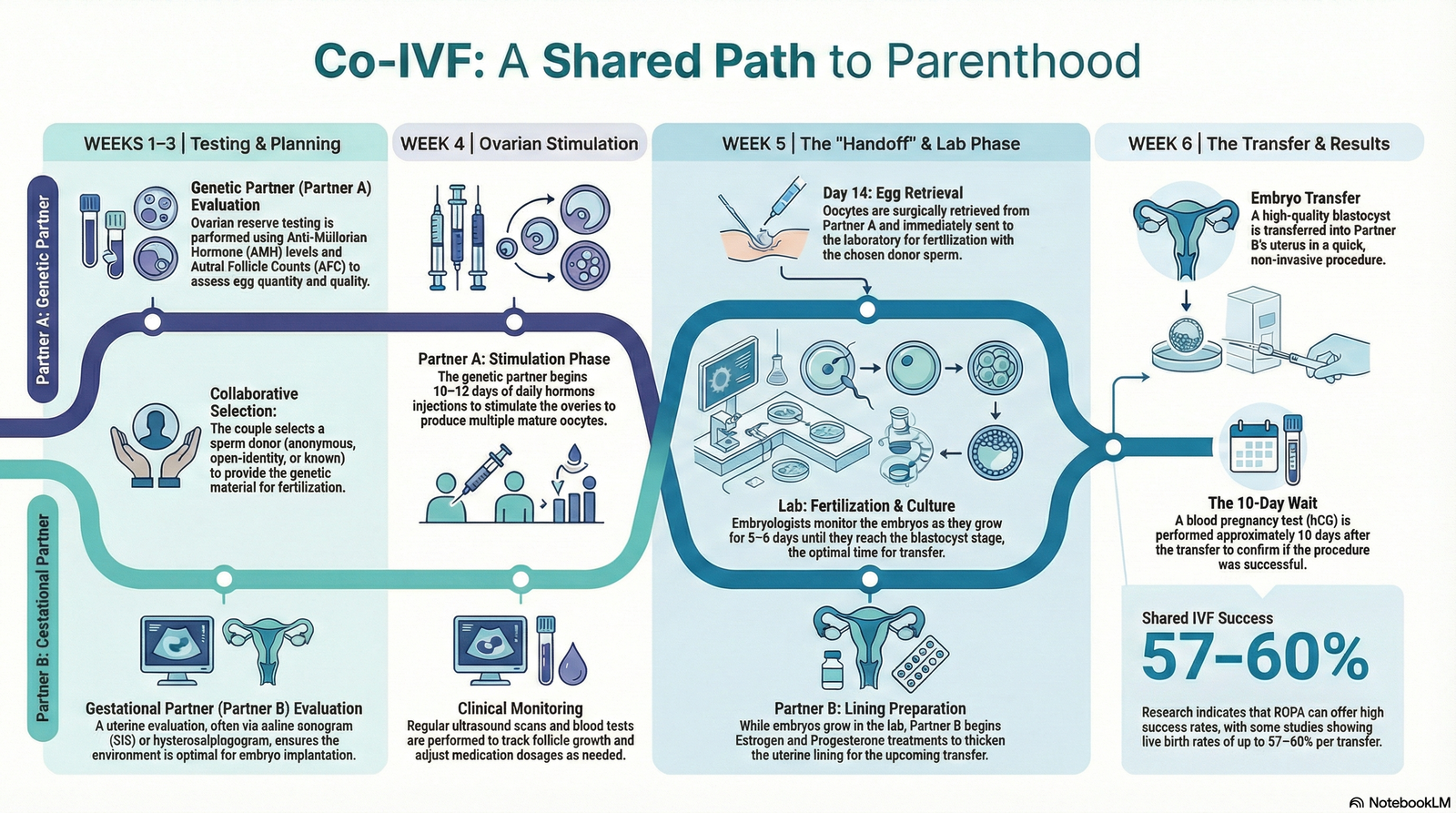
Co–IVF timeline: from testing and donor choice to egg collection, fertilization, and embryo transfer in about 4 to 6 weeks.
Costs and Hidden Fees in Co‑IVF
Understanding the money side helps you plan without constant surprises. You will usually pay a base fee to the clinic, then add medications, donor sperm, genetic testing, and storage. Travel and legal costs can add more expenses if you go abroad.
| Region | Basic Co‑IVF Cost | Premium or All Inclusive |
|---|---|---|
| USA | $19,000 – $25,000 | $39,000+ |
| Canada | $10,000 – $20,000 | $30,000+ |
| Europe (average) | Under $11,000 | $15,000+ |
| Mexico | $7,000 | $11,900 |
| Argentina | $4,900 | $7,900 |
| Cyprus | €4,000 | €5,750+ |
On top of these base numbers, you also need to set aside money for:
- Medication: often $3,000 to $8,000 per cycle.
- Sperm vials: around $1,000 per vial from many banks.
- Legal fees: second-parent adoption, contracts, and court orders vary widely by country.
- Genetic testing (PGT-A): often around $5,500 for one cycle of testing.
- Annual embryo storage fees: if you have embryos left for future transfers.
Step-by-Step: How Co‑IVF Works
Step 1: Testing and Planning for Both of You
You start with blood tests and ultrasound scans. The partner who plans to carry the pregnancy has a pelvic ultrasound scan and often a dye test to check the uterus and tubes. She also has hormone blood tests. The partner who will give eggs has hormone blood tests and an antral follicle count test. These results guide which stimulation protocol your doctor suggests.
Step 2: Choosing Your Sperm Donor
Next, you choose a sperm donor from a bank or a known donor if your clinic and laws allow it. You will see details such as medical history, education, physical traits, and whether the donor is anonymous or identity-released. Donor sperm is heavily screened so that only samples with healthy counts of moving sperm reach patients.
Step 3: Ovarian Stimulation and Egg Retrieval
The genetic mother then starts daily hormone injections to grow several oocyte-containing follicles. The clinic tracks her progress with regular blood tests and ultrasound scans. Once follicles are ready, if you are a genetic mom, you have a trigger shot. Around 36 hours later, the egg collection happens under light anesthesia. A doctor passes a thin needle through the vagina into each ovary and collects the fluid with eggs.
Step 4: Fertilization and Embryo Growth
In the lab, an embryologist facilitates fertilization by combining your eggs with donor sperm. Many clinics use the intracytoplasmic sperm injection (ICSI) technique, where a single, healthy sperm is injected directly into each mature egg to increase the chances of success. Over the next several days, the embryology team monitors the developing embryos as they grow toward the blastocyst stage, typically reached on day five or six. At this point, the lab “grades” the embryos based on their physical quality. If you have opted for preimplantation genetic testing (PGT-A), a few cells are carefully biopsied from the embryo’s outer layer to screen for chromosomal health before the final transfer.
Step 5: Preparing the Uterus and Transferring the Embryo
While the embryos grow, the gestational mother takes estrogen and progesterone to build a receptive uterine lining. Some clinics perform a mock transfer to map the cervix and uterus before the real transfer day. When the lining looks ready and you know which embryo to use, the doctor gently passes a soft catheter into the uterus and transfers one embryo, or sometimes two. You then rest for a short time at the clinic and go home the same day.
Success Rates and Safety in Co‑IVF
Recent research on co-IVF in lesbian couples has given a clearer picture of what you can expect. Overall, shared motherhood IVF has performed at least as well as standard IVF in similar age groups, and sometimes better.
- In one study, live birth per transfer was 57 percent with co-IVF and 30 percent with standard IVF using the patient’s own eggs.
- Across all transfers in that study, about 66 percent of co-IVF treatments led to a baby, compared with 43 percent of standard IVF.
- When researchers pooled 1,405 shared IVF cycles from several studies, they found that clinical pregnancy and live birth rates were in the same range as standard IVF in similar women.
Age still matters a lot:
- Under 35: Cumulative live birth rates with good frozen embryo use can reach around 89 percent.
- Age 35 to 39: Some data still show cumulative rates around 88 percent when multiple transfers are counted.
- Age 40 and above: Cumulative live birth chances tend to fall, but can still reach about 72 percent in some carefully selected patients.
Risks, Especially With Twins
Most of the extra risk in co-IVF comes from twin pregnancies rather than from the technique itself. In one study of lesbian couples, twin pregnancies after co-IVF had a much higher rate of pregnancy-related high blood pressure compared with twins from donor insemination. Singleton pregnancies looked similar between groups for birth weight, prematurity, and mode of delivery.
How Shared IVF Fits Into the Bigger Picture
1,405 Cycles Reviewed – The Overall Verdict: A 2024 systematic review pulled together results from 1,405 shared motherhood IVF cycles across eight studies. Overall, shared IVF cycles had pregnancy and live birth outcomes that matched or sometimes beat standard IVF in similar women. Larger, more diverse studies are still needed, but current data are reassuring if you want both of you involved biologically. Source: Fertility and Sterility (PMID: 39260536).
31%–79% Live Births – Wide but Encouraging Range: A 2023 review of the ROPA method reported live birth per couple ranging from roughly 31 percent up to 79 percent, depending on age, fertility factors, and number of cycles. These are strong numbers for IVF in general. Source: Porto Biomedical Journal (PMID: 37152625).
43% Live Births per Couple – Early US Experience: An early United States case series followed 80 female couples using partner eggs. About 43 percent of couples had a live birth, and another 24 percent had an ongoing pregnancy at the time of follow-up, even though many had prior fertility issues. Source: LGBT Health (PMID: 26790119).
136% Faster Start After Insurance Reform: After New York changed its law so same-sex female couples did not have to prove infertility with many inseminations first, they were 136 percent more likely to start IVF within a year of their first visit. The time to the ongoing pregnancy also dropped by several months. Source: LGBT Health (PMID: 39930870).
These findings describe patterns in large groups. Your own path still needs a personal plan with your fertility team.
Best Countries and Clinics for Co‑IVF
Once you know that co-IVF feels right for you, the next big question is where to do it. You need to balance clinic quality, legal safety for both parents, costs, logistics, and travel stress.
Canada
Canada has federal rules that ban discrimination in access to assisted reproduction, and many clinics are comfortable working with lesbian couples.
- Costs: Usually around $10,000 to $20,000 per cycle before medications and extras are added to the core bundle of medical services.
- Clinics often chosen by LGBTQ+ patients: First Steps Fertility, Anova Fertility, ReproMed Fertility, and TRIO Fertility.
United States
In the United States, state law matters a lot. Some states offer clear paths for both of you to be on the birth certificate from day one. Others still need second-parent adoption or a court order.
- Costs: The base fees are around $19,000 to $25,000 per cycle, with total costs often above $30,000 when you add medication and testing.
- Examples of well-known IVF groups: New Hope Fertility, HRC Fertility, CCRM Fertility, and Pacific Fertility Center Los Angeles.
Spain and Portugal
Spain and Portugal are popular for co-IVF because clinics there have extensive experience with international patients and LGBTQ+ family building.
- Spain: Many clinics require you to be married to use ROPA. Laws guiding the legal parentage have changed over time, so you should always ask for current legal advice.
- Portugal: Co-IVF is available to married and unmarried couples under current rules.
- Costs: €5,000 to €7,900 for a single cycle, depending on the clinic and add-ons.
- Clinics often mentioned: Instituto Bernabeu, Clinica Tambre, Ferticentro, Ginemed.
Other Destinations
- Mexico: Some clinics offer co-IVF packages tailored to foreign patients starting around $9,000 to $11,900.
- Argentina: Known for strong LGBTQ+ rights, with starting prices around $4,900 for basic programs.
- Cyprus: Some centers offer guaranteed surrogacy-related co-IVF packages, with unlimited attempts within the program, often in the €55,000 to €71,000 range for full surrogacy plans.
Expert Guidance When Choosing Where To Go
Equal Access as Official Policy: The American Society for Reproductive Medicine states that clinics should offer fertility treatment without regard to marital status, sexual orientation, or gender identity. This includes options like reciprocal IVF. Source: Fertility and Sterility (PMID: 33906744).
European Ethics Support: An ESHRE ethics task force has said that assisted reproduction is appropriate for lesbian and gay couples on the same basis as for heterosexual couples, with attention to safety and fairness. This guidance supports co-IVF access across many European countries. Source: Human Reproduction (PMID: 25052011).
What This Means For You: If you ever feel that a clinic is blocking you because of who you are, you can point to this guidance and look for a centre that aligns with modern professional standards.
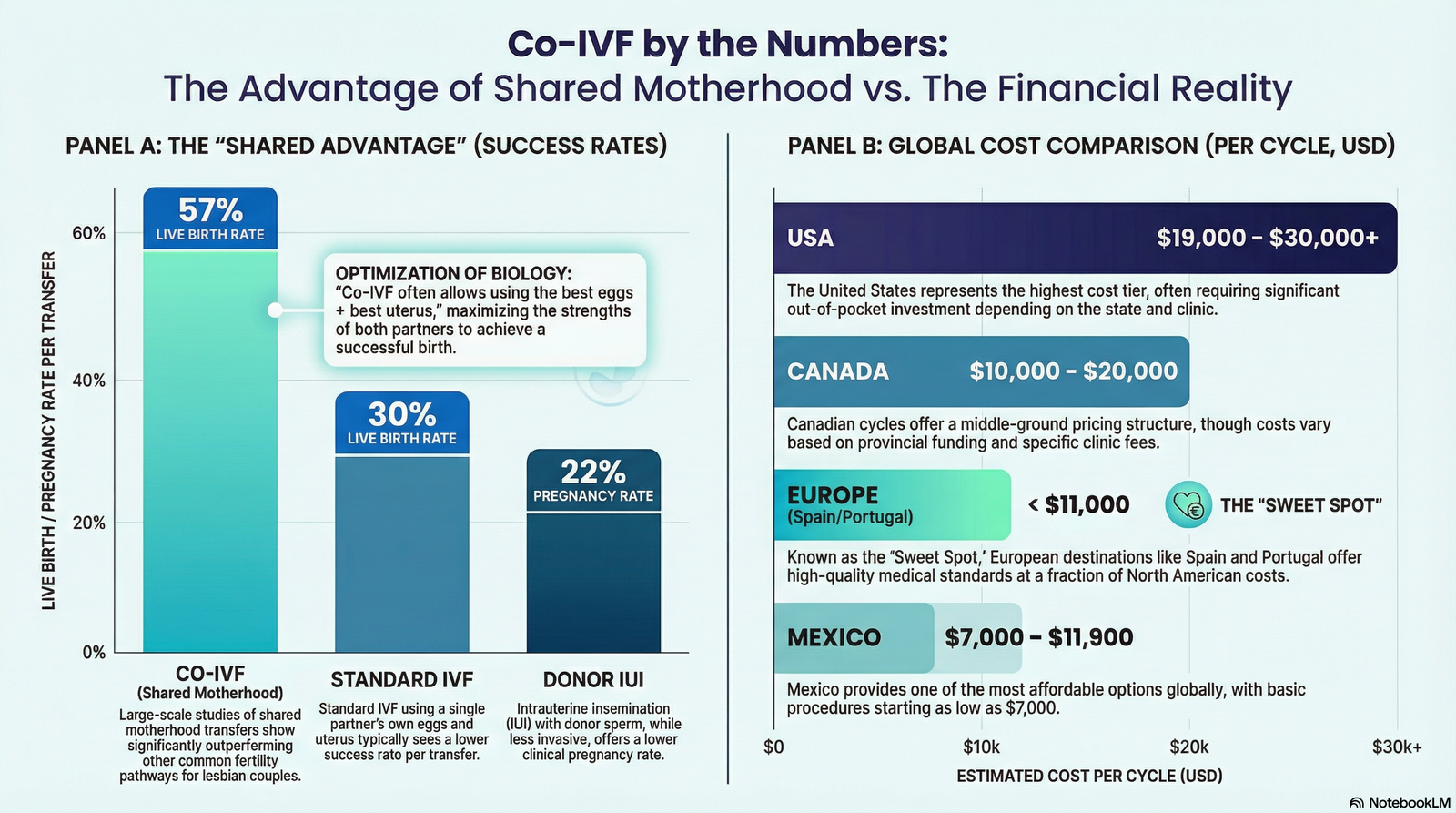
Shared IVF in context: how success rates and costs compare across countries, and why picking the right clinic and legal setting matters.
Legal Points You Need To Cover
Protecting both of you as legal parents is just as important as choosing your protocol. Even when you are both clearly involved biologically, the law does not always keep up.
- Parentage and adoption: In many places, the non-gestational mother still needs a second-parent adoption or court order, even if she provided the eggs. This extra legal step helps protect your family if you move or if something happens to one of you.
- Local quirks: In some countries, co-IVF patients are recorded as single women rather than recognized as a couple. That can leave the non-gestational mother with no clear rights without an adoption process.
- Marital status rules: Laws in countries like Spain and France have changed over time regarding who can access treatment. Always confirm the current rules before you lock in a clinic.
- Donor identity: In some countries, such as Sweden and the United Kingdom, donors must be identity-released. In others, donors can still be listed as anonymous, although consumer DNA testing now makes true anonymity harder to guarantee.
Other Paths If Co‑IVF Does Not Feel Right
Co-IVF is one option, not the only one. If it does not match your finances, medical situation, or emotional needs, you still have real alternatives.
- Intrauterine insemination (IUI): Uses donor sperm placed directly into the uterus around ovulation. It is less invasive and usually less expensive per attempt, often $2,000 to $4,000, depending on monitoring and medication.
- Concurrent IVF: Both partners go through stimulation and that same cycle, sometimes hoping to be pregnant together, often with at least one of you carrying an embryo created from the other partner’s eggs.
- Egg donation or double donation: Uses donor eggs with donor sperm when neither partner’s eggs are suitable. One of you can still carry the pregnancy, or you can use a gestational carrier.
- Embryo adoption: Lets you adopt embryos left from another couple’s IVF. This can lower the cost while still giving you the experience of pregnancy and birth.
- Gestational surrogacy: If neither of you can safely carry a pregnancy, a gestational carrier can carry an embryo created from your eggs or donor eggs and donor sperm.
Want help comparing co-IVF clinics and costs?
If this already feels like a full-time job, you are not alone. Our advisors can gather clear, itemized quotes from vetted clinics, explain the legal basics for each country, and help you sketch a realistic timeline at no cost to you.

Why trust this guide? The OVU commitment
You are probably juggling hope, timelines, and a lot of tabs open in your browser. And you deserve clear, current, human advice. At OVU, we review clinic protocols, compare real quotes, and talk to people who have done this - intended parents and gestational carriers - so we can give you practical steps, not just theory. If you want help comparing options without sales pressure, we will gather itemized quotes and success data that match your exact situation. You decide, we will bring the info to your table.
Frequently Asked Questions
How long does the full co-IVF process usually take?
From your first clinic visit to an embryo transfer, most couples can expect a timeline of 6 to 12 weeks. A straightforward ROPA cycle can often be completed in as little as 6 weeks once the initial testing and planning are finalized. However, more advanced protocols, such as DuoStim (two stimulations within one cycle) or Preimplantation Genetic Testing (PGT-A), can add several weeks to the schedule. Additionally, unforeseen factors like the need for extra surgeries, fertilization failure, or embryonic arrest may require a new cycle, extending the timeline further.
What happens if our first transfer does not work?
Many couples plan for more than one attempt from the start, as the first embryo transfer often fails. If you have frozen embryos remaining, a frozen embryo transfer (FET) is significantly shorter and physically easier than a full new cycle, as it bypasses the egg retrieval and fertilization steps. To help manage the journey, many clinics offer multi-cycle packages to help spread the costs over several attempts.
Will our child be able to learn who the sperm donor is?
This depends on the specific donor program and the country where your treatment takes place. With an identity-release donor, your child can usually request the donor’s contact information once they reach a legal age, typically 18. While anonymous donor profiles are designed to remain private, it is important to note that consumer DNA tests (such as 23andMe or Ancestry) often make it possible for donor-conceived individuals to find biological links later in life, regardless of the original paperwork.
Are babies from co-IVF at higher medical risk?
For singleton pregnancies, current research is reassuring. Birth weights, early birth rates, and birth defect rates look similar to those seen in standard IVF or donor insemination pregnancies. The main extra risk comes from twin pregnancies, which carry higher rates of high blood pressure, diabetes in pregnancy, and early delivery, no matter how the pregnancy began.
What is a vanishing twin, and how common is it?
Sometimes more than one embryo implants initially, and early scans may show two gestational sacs or two heartbeats. However, by around week 9, it is possible for only one heartbeat to remain; this is known as a vanishing twin or vanishing embryo. This occurs in approximately 10% to 20% of pregnancies that begin as twins. Because it often happens early in the first trimester, many people only learn about it because of a very early ultrasound.
Can we choose the sex of our baby with co-IVF?
Preimplantation genetic testing can show the chromosomal sex of embryos. In some countries, clinics only allow you to use this information to avoid serious genetic diseases. In others, sex selection for non-medical reasons is also allowed. You need to follow both the law in the country where you are treated and your clinic’s own policies.
Do we need to see a counsellor before starting co-IVF?
Many clinics recommend or require at least one counselling session for co-IVF, sperm donation, and egg donation. This is not a test that you pass or fail. It is a chance to talk through topics such as what you will tell your child about their conception, how you both feel about your different roles, and how you want to handle questions from family and friends.
Reference List 10 sources
Journal Article (Research): Núñez A, García D, Giménez Bonafé P, Vassena R, Rodríguez A. Reproductive outcomes in lesbian couples undergoing reception of oocytes from partner versus autologous in vitro fertilization/intracytoplasmic sperm injection. LGBT Health. 2021;8(5):367–371. PMID: 34061679. Available from: https://pubmed.ncbi.nlm.nih.gov/34061679/
Journal Article (Research): Brandão P, Ceschin N, Cruz F, Sousa Santos R, Reis Soares S, Bellver J. Similar reproductive outcomes between lesbian shared IVF (ROPA) and IVF with autologous oocytes. Journal of Assisted Reproduction and Genetics. 2022;39(9):2061–2067. PMID: 35819575. Available from: https://pubmed.ncbi.nlm.nih.gov/35819575/
Journal Article (Research): Brandão P, Ceschin N, Gómez VH. The pathway of female couples in a fertility clinic. Revista Brasileira de Ginecologia e Obstetrícia. 2022;44(7):660–666. PMID: 35668678. Available from: https://pubmed.ncbi.nlm.nih.gov/35668678/
Journal Article (Research): Matorras R, Pérez Fernández S, Hubei A, Ferrando M, Quintana F, Vendrell A, et al. Perinatal outcomes in lesbian couples employing shared motherhood IVF compared with those performing artificial insemination with donor sperm. Human Reproduction. 2023;38(5):895–907. PMID: 37009817. Available from: https://pubmed.ncbi.nlm.nih.gov/37009817/
Journal Article (Systematic Review & Meta Analysis): Dubois B, Naveed H, Nietsch KS, Band IC, Brandão P, Estevez SL. A systematic review of reproductive technologies for shared conception in same sex female couples. Fertility and Sterility. 2024;122(5):774–782. PMID: 39260536. Available from: https://pubmed.ncbi.nlm.nih.gov/39260536/
Journal Article (Review): Brandão P, Ceschin N. Lesbian shared IVF: the ROPA method: a systematic review. Porto Biomedical Journal. 2023;8(2):e202. PMID: 37152625. Available from: https://pubmed.ncbi.nlm.nih.gov/37152625/
Journal Article (Research): Yeshua A, Lee JA, Witkin G, Copperman AB. Female couples undergoing IVF with partner eggs (Co IVF): pathways to parenthood. LGBT Health. 2015;2(2):135–139. PMID: 26790119. Available from: https://pubmed.ncbi.nlm.nih.gov/26790119/
Journal Article (Research): Ertel MM, Maroney MR, Becker A, Paschen Wolff MM, Blankenau A, Hoffman S, Tross S. After insurance reform, same sex female couples initiate IVF more rapidly: a New York City experience. LGBT Health. 2024; ahead of print. PMID: 39930870. Available from: https://pubmed.ncbi.nlm.nih.gov/39930870/
Committee Opinion (Guidance): Ethics Committee of the American Society for Reproductive Medicine. Access to fertility treatment irrespective of marital status, sexual orientation, or gender identity: an Ethics Committee opinion. Fertility and Sterility. 2021;116(2):326–330. PMID: 33906744. Available from: https://pubmed.ncbi.nlm.nih.gov/33906744/
Ethics Committee Opinion: De Wert G, Dondorp W, Shenfield F, Barri P, Devroey P, Diedrich K, et al. ESHRE Task Force on Ethics and Law 23: medically assisted reproduction in singles, lesbian and gay couples, and transsexual people. Human Reproduction. 2014;29(9):1859–1865. PMID: 25052011. Available from: https://pubmed.ncbi.nlm.nih.gov/25052011/
Final Thoughts
Co-IVF shared motherhood is not a magic fix, but it is a very real way for both of you to be woven into your child’s story from the very beginning. One of you carries the pregnancy to term. The other passes on their genes. You share the stress of early morning blood tests, the nerves on transfer day, and the first time you see a tiny heartbeat on the screen.
You will still face choices about money, travel, law, and medical risk. Those parts can feel overwhelming. You do not have to figure them out alone. A good clinic team and, if you wish, an independent advisor can help you break a huge project into a series of clear steps.
If you decide that co-IVF fits your family, you are not just choosing a treatment. You are choosing a story you can tell your child later about how both of you worked, hoped, and showed up to bring them into the world.
Ready to explore shared IVF with real clinics?
You can speak with an OVU advisor to match with clinics that already work with co-IVF couples, request itemized quotes, and understand the legal steps in your country, so you can move from research to an actual plan.