


Dr. Sony Sherpa (MBBS)
In addition to her clinical experience, Dr. Sherpa is a published medical researcher and holistic health advocate. Her dual expertise in emergency care and alternative therapies brings a unique lens to medically reviewed content—ensuring it is both accurate and accessible.
Are you considering using a sperm or egg donor to build your family? You may have reached a point where natural conception feels like a closed door, and you are looking for a clear and safe way forward. The questions on your mind are heavy: Who will be the legal parent? Will the donor ever seek contact? Can my child find out their genetic history?
In 2026, donor egg IVF and double donation can offer pregnancy rates that approach 90 to 99 percent over several transfers, but those hopeful numbers only matter if your legal rights are secure. Laws governing parentage, donor identity, and embryos vary significantly between countries and even within states. When you understand these rules, you protect your future family and the child you hope to welcome.
Your path to parenthood is rarely simple, but clear information gives you real power. This guide breaks down common terminology, the main types of donor arrangements, and the medical, psychological, and legal frameworks involved. Our goal is to ensure you can make a decision that feels both personally and legally secure. Whether you are a same-sex couple, a single parent by choice, or a heterosexual couple facing infertility, your path is valid, and your rights deserve protection.
In most legislative systems, the woman who gives birth is recognized as the legal mother, while clinic protocols are designed to protect donors from future financial claims. Clear, pre-conception contracts are essential for definitively defining parental rights. While true anonymity is fading because of DNA testing, you can still choose between open ID and non-identified (anonymous) donor arrangements. Costs vary widely, from around $1,600 for basic embryo donation to $35,000–$65,000 for fresh donor eggs in the United States, with cumulative success rates reaching as high as 99% over three cycles.
Next steps: To blueprint your path and minimize legal risks, such as shifting legislative frameworks, nuances in donor anonymity, or the misinterpretation of rights and obligations, follow these four steps regardless of where you choose to begin your treatment:
- Consult a fertility lawyer: Before any medical procedures begin, work with a specialist to draft or review contracts that clearly define parental rights and donor obligations.
- Verify clinic protocols: Ensure your chosen clinic’s policies regarding donor identity and embryo storage align with your long-term goals.
- Research jurisdictional laws: If you are pursuing a cross-border donation, confirm that the laws in both the donor’s country and your home country recognize your legal parentage.
- Align your team: Confirm that your legal counsel, medical clinic, and agency are all in communication to protect the future of the family you are building.
What the Latest Guidance Emphasizes
Professional bodies, such as the American Society for Reproductive Medicine (ASRM) and regulators in Europe, emphasize three pillars in donor conception: clear parentage rules, strict donor screening, and honest information for donor-conceived individuals. Modern guidelines now recognize that long-term anonymity is fragile due to direct-to-consumer DNA testing. Consequently, donors, recipients, and children alike require realistic expectations from the start. This guide focuses on the structure of these rules so you can discuss with your lawyer and clinic how they apply within your specific jurisdiction.
This guide outlines these legal frameworks so you can discuss with your lawyer and clinic how they apply in your country.
In This Guide
- Quick Facts for 2026
- Who Is a Parent in Donor Conception?
- Anonymity, DNA Tests, and Identity Rights
- How Donor Matching and Screening Work
- Embryo Donation vs. Embryo Adoption
- Costs, Countries, and Funding Options
- Common Emotional and Ethical Concerns
- Your 8-Step Path to Donor Conception
- Frequently Asked Questions
Most legal frameworks recognize the person who gives birth (the birth mother) as the legal parent (mother) of the child, regardless of whether the pregnancy was achieved using donor eggs or their own.
Clinic donors rarely have parental rights or duties.
Open ID is becoming the legal standard in many jurisdictions.
True lifelong anonymity is no longer a guarantee due to the prevalence of direct-to-consumer DNA testing.
Donor egg cycles in the United States: $35,000–$65,000.
Cumulative success rates can reach 90%–99%.
Who Is a Parent in Donor Conception?
One of the most important things you need to understand is that legal parenthood is not the same as a biological link. Donors recruited through fertility clinics, agencies, or banks rarely retain parental rights or obligations. Before the process begins, donors sign binding contracts to provide their gametes (commercially or altruistically), ensuring that parental rights are transferred to the intended parents. In many countries, the law recognizes your clear intent to parent as the primary factor, prioritizing your role as a parent over genetic connections (even if donor DNA is involved) from the moment of birth.
The Role of Intent and Marriage
In jurisdictions like California, the law states that the legal parent of a child born through assisted reproduction is the person who intended to raise the child. If you are married or in a civil partnership, the birth mother is the legal mother, and her spouse is usually treated as the second legal parent. This remains true even if the husband did not provide the sperm, as long as he consented to the treatment in writing.
Protections for Unknown Donors
When you use an unknown donor through a licensed clinic, that donor is not recognized as a parent-in-law. The donor is shielded from legal claims, including child maintenance and inheritance. This structure exists so you can move forward without worrying that the donor will suddenly step into a parental role later. The donor stays a donor, not a legal mother or father.
The Risks of Informal Settings
This is where you need to be especially careful. If a donor provides sperm informally (at home) without a licensed clinic or a clear legal agreement, the legal outcome can become very complex. If the birth mother is unmarried and the donation happens outside a clinic, the donor can end up recognized as a second legal parent and can face claims for child support. You also risk disputes about decision-making and contact.
Why Formal Donor Agreements Matter
When you work through a licensed clinic, formal consent and national rules usually make it clear that you – not the donor – hold all legal parental rights. Informal arrangements do not give you that protection. One set of poorly worded messages or a home insemination can blur the line between a donor and a co-parent. A brief consultation during a short meeting with a fertility lawyer before you start the treatment cycle often prevents years of stress later.
Get specialist legal advice before conception and put a clear agreement in place that defines who will hold parental status and who will not.
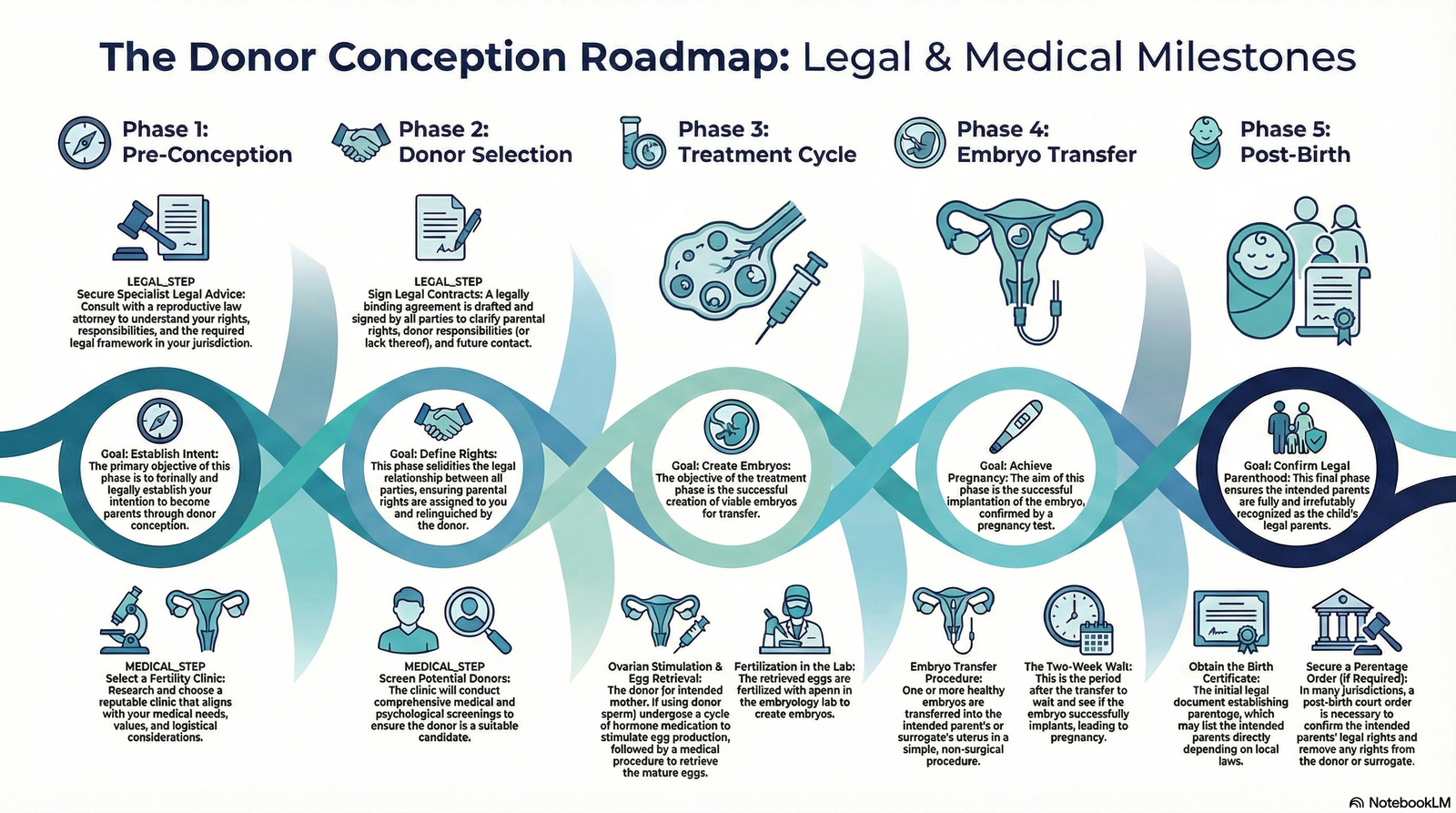
Key legal and medical milestones in a donor conception treatment plan.
Anonymity, DNA Tests, and Identity Rights
Deciding on a donor’s level of identity disclosure is one of the most personal steps for intended parents. For decades, donor conception was hidden or whispered about. Modern testing has transformed that world for the better.
The End of “Anonymous” Donation
In 2022, the American Society for Reproductive Medicine replaced the word “anonymous” with “non-identified”. This updated term reflects the reality you live with now. Direct-to-consumer DNA kits, social media, and donor registries make it easier than ever for donor-conceived individuals to find genetic relatives.
One widely shared example involved a teenager in 2005 who identified his biological father using only a mail-order DNA kit and online searches, even though the donor had signed up under an anonymity agreement. Stories like this are now common enough that you should assume long-term anonymity is fragile at best.
Global Shifts in Identity Access
- United Kingdom: Since 2005, clinics have not accepted anonymous donors. At 18, your child can request the donor’s name, date of birth, and last known address.
- Sweden: Sweden removed donor anonymity in 1984. Donor-conceived people can access identifying information when they reach “sufficient maturity”, often treated as about 16.
- Spain and Mexico: These countries still use anonymous donors in law. In Spain, authorities only reveal a donor’s identity in exceptional situations, for example, when a child’s life or health is seriously at risk.
- Portugal: After a 2018 Constitutional Court ruling, new donations require non-anonymity, and children can access identifying details.
This aspect of your journey centers on choice and transparency. You must decide between an Open ID donor, who consents to the release of identifying information once the child reaches adulthood, or a non-identified donor. In the latter case, the clinic does not share the donor’s identity, yet you proceed with the realistic understanding that DNA testing may uncover genetic connections in the future.
How Donor Matching and Screening Work
Choosing a donor is a deeply personal step. You are deciding who will provide half of your child’s genes, and it is normal to feel pressure and doubt as you scroll through profiles.
Phenotypic and Genetic Matching
Most clinics begin the selection process by considering phenotype to help aspiring parents achieve a sense of visual continuity. This involves evaluating a donor’s physical features to find characteristics similar to your own or your partner’s, such as height, build, eye and hair color, and skin tone. This helps the child align visually within your family, which many parents find comforting.
Many clinics also use a Genetic Compatibility Test (GCT). Donors are screened for hundreds to thousands of hereditary diseases, such as cystic fibrosis or spinal muscular atrophy. The goal is to avoid pairing a donor who carries the same serious condition as the other genetic parent.
Screening Standards
Good programs follow strict criteria. At some leading centres, screening is intense and only a minority of applicants get through. One report notes that only 22 percent of female applicants and 9 percent of male applicants pass the full psychological, medical, and genetic checks.
- Egg donors must be healthy and between the ages of 21 and 29 in premium programs, though broader clinical guidelines may include donors up to age 34.
- Sperm donors must have high sperm count and movement, and clinics quarantine samples for at least 180 days, then retest for infections before release, as the FDA requires.
That work does not show on the profile page, but you are paying for those hidden safety steps when you pay donor fees.
Embryo Donation vs. Embryo Adoption
“Embryo adoption” and “embryo donation” are often used interchangeably, but they are not. The term you choose dictates the legal framework, costs, and timelines of your journey.
The Difference Between Donation and Adoption
- Embryo donation treats embryos as a gift of genetic material, governed by contract and property law. Clinics usually facilitate this as a “non-identified” transfer. There is no “home study” required; instead, the process functions as a medical procedure supported by legal contracts.
- Embryo adoption frames the embryo as a child-in-law. You undergo a formal adoption-style screening, including a home study (costing approximately $2,000–$3,500). The matching process can take 8–14 months, and you will work closely with specialized agencies and lawyers to align with family law requirements.
Legal Personhood Challenges
Some U.S. states, such as Louisiana, give embryos a form of legal personhood and limit what clinics and parents can do with them. Destroying embryos is not allowed, and contracts must respect that status. In most other U.S. states, embryos fall into an in-between category. They are not full legal persons, but the law recognizes their potential for life and gives them special respect.
For you, this usually translates into cost and flexibility. Embryo donation is often the most affordable route, with costs generally ranging from $1,600 to $10,000 depending on the program. Adoption of one blastocyst is less expensive than adopting two embryos, however, if you desire having siblings via one round (transferring two blastocysts for conceiving twins) or two rounds (transferring one embryo per time), investing in a bundle of two blastocysts may be a priority to secure a sibling at a fixed cost. Success rates of transfer are strong, often in the 56 to 70 percent range per cycle.
How Embryo Donation Fits into Your Options
Embryo donation usually costs less than creating new embryos from donor eggs and sperm and often has success rates similar to or better than standard IVF in older age groups. You give up some control over the exact genetic match and detailed family history, but you may gain faster access to treatment and lower financial pressure. The right choice depends on whether cost, control, or timing matters most to you.
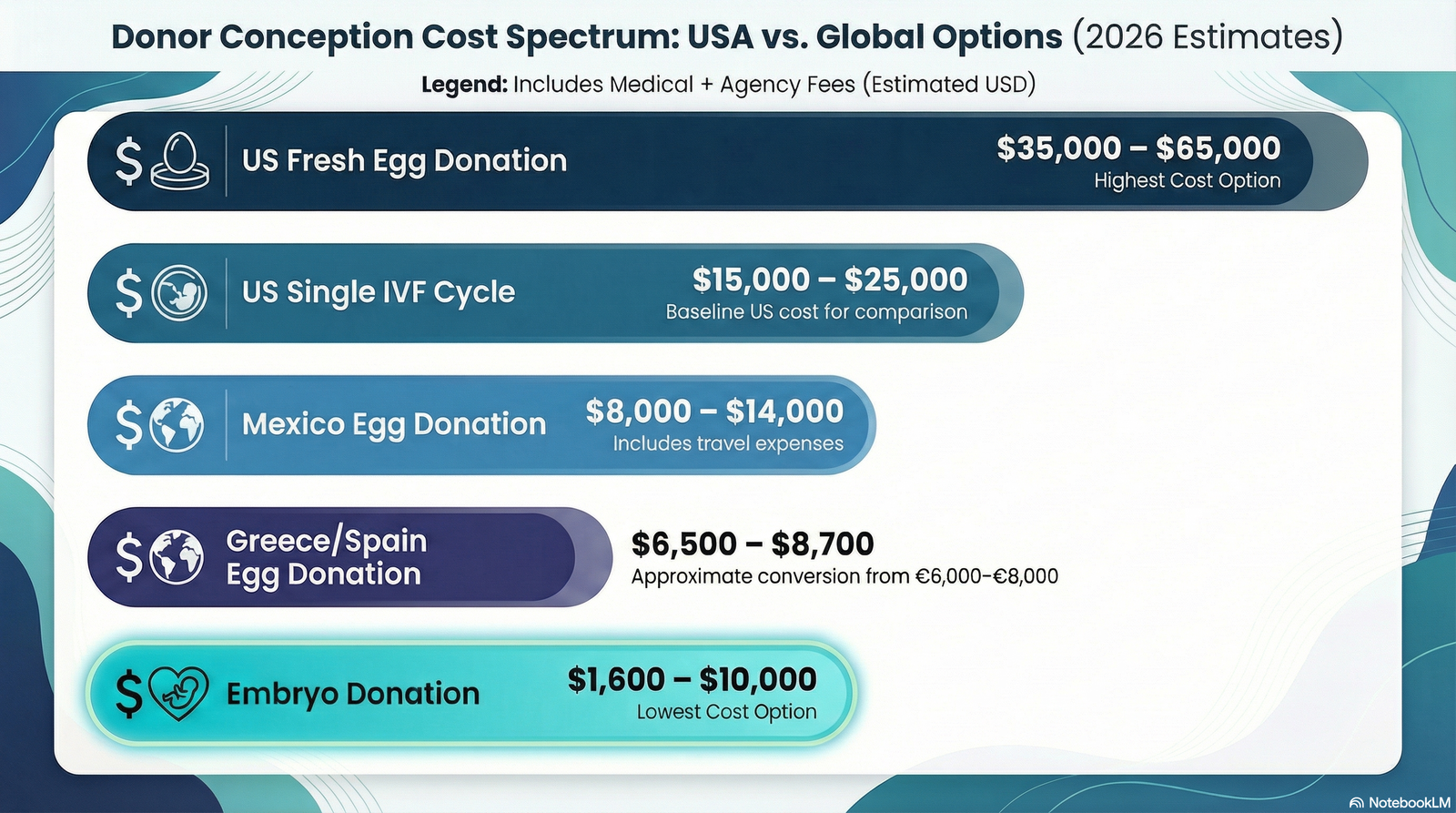
Estimated cost ranges for donor eggs, standard IVF, and embryo donation in different regions.
Costs, Countries, and Funding Options
Money stops more treatment plans than biology does. Many couples and single parents stop, not because treatment failed, but because the bills feel endless.
The Cost Spectrum in 2026
These figures help you compare broad price ranges, not exact quotes from a specific clinic.
| Location | Treatment | Cost (Est.) | Included Services |
|---|---|---|---|
| USA | Fresh Egg Donation | $35,000 – $65,000 | Donor agency fees, screening, retrieval, lab work, and transfer |
| USA | Single IVF Cycle | $15,000–$25,000 | Monitoring, retrieval, fertilization, and fresh transfer |
| Mexico | Egg Donation | $8,000–$14,000 | Often includes clinic fees; some bundles include travel and accommodation |
| Spain | ICSI IVF | €4,300–€4,995 | Monitoring, lab, ICSI, and transfer |
| Greece | Egg Donation | €6,000–€8,000 | Donor matching, fertilization, and transfer |
| Albania | Stimulated IVF | €3,500–€6,669 | Monitoring, egg retrieval, ICSI, and transfer |
Some of these prices include only the medical side and exclude flights, hotels, time off work and medication. Others bundle several of those costs. Always ask clinics and agencies for a full written breakdown, so you know what you are really comparing, before committing to the specific bundle of services.
Reading Cost Quotes like a Pro
When you compare donor egg or embryo programs, focus on three numbers, not one headline price. Look at the cost per transfer, the number of transfers included, and the realistic cumulative success rate. A slightly higher package price that includes two or three transfers can be more cost-effective per live birth than a low-cost single cycle that you need to repeat several times to achieve a viable pregnancy.
Public Funding Lifelines
Some European countries offset these costs through public funding. For example, Slovenia covers several IVF cycles in full for eligible citizens. North Macedonia offers coverage for multiple attempts to achieve a live birth, however, this funding is typically reserved for citizenship holders.
In the United States, most intended parents pay out-of-pocket, though a growing number of employers partner with specialized fertility benefit providers, such as Progyny or Carrot, to offer package-style coverage. It is worth asking your HR team to explain exactly what your plan offers for IVF, donor eggs, donor sperm, and embryo donation.
Common Emotional and Ethical Concerns
“I am worried about the lack of genetic connection.”
Many intended parents struggle with the reality that they will not share a genetic link with their children when using donor germ cells or embryos. It is important to hear this: you are not selfish or shallow for valuing a genetic connection. You are simply human. Wanting to see yourself reflected in your child’s features is natural, and acknowledging that doesn’t make you any less of a parent.
Research on donor-conceived children shows that a genetic link is not required for strong parenting. In several studies, donor-conceived families report more parental warmth and involvement than some natural conception families. Parents often become very intentional about bonding, honesty, and emotional care.
The science of epigenetics may help you here. As the birth mother, your body still shapes how your child’s genes switch on and off. Your diet, stress levels, and environment influence your baby’s development in the womb. You are not just a carrier. You are actively building that baby’s biology day by day.
“Will there be a bidding war for donors?”
This is a real fear when you see premium profiles and agency marketing. Ethical guidance from ASRM pushes back against that model. Compensation should reflect the donor’s time, discomfort, and medical risk, not their looks, test scores, or social background.
In the United Kingdom, sperm donors receive a fixed expense payment of about £35 per donation. In the United States, sperm donors usually receive around $100 per donation. Egg donors receive more because the process is longer, invasive, and requires time off work and recovery, but the principle is the same: pay for effort and risk, not for designer traits.
“Can a donor sue me for rights, or can I sue them for support?”
When you work through a licensed clinic and sign proper consents, donors sign away both rights and obligations. They cannot claim legal parent status, and you cannot ask them for child support. Clinics use unique donor codes in records to protect everyone’s privacy.
Things look very different if conception happens through sexual intercourse rather than assisted insemination. In that case, in most jurisdictions, the law recognizes the man as a legal parent with all associated rights and obligations, regardless of any private verbal agreement. That is why you should always use medical and legal supervision if you want a donor, not a co-parent.
Turning Worries into Clear Decisions
Your fears about genetics, money, or future contact often shrink once you see your options in plain language. A joint session with a fertility counsellor and a lawyer can turn a vague worry into a clear plan. You stay in charge when you name your concerns, write them into your contracts, and choose clinics that share your values.
Your 8-Step Path to Donor Conception
Donor conception follows a fairly predictable protocol once you get underway. Understanding these steps in advance can provide peace of mind and help you effectively plan for the necessary travel, time away from work, and the scheduling of key procedures, such as donor selection, medical screening, and the transfer itself.
- Consultation (Day 1): You meet a fertility specialist, go through your medical history, and review test results. You discuss donor options, timelines, and realistic success rates.
- Matching (1 to 3 Months): You will review comprehensive donor profiles, filtering by phenotype (such as hair and eye color, height, and skin tone), ethnicity, and educational background. Beyond the data, this period allows you to find a donor whose personal values and characteristics feel like a natural fit for your family’s unique story.
- Legal (2 to 4 Weeks): A reproductive lawyer drafts and finalizes contracts that confirm you as the intended parents and set rules on embryo use and future contact.
- Stimulation (8 to 12 Days): Your donor starts hormone injections to grow multiple eggs. At the same time, you may take estrogen to build up your uterine lining for transfer.
- Retrieval (Day 0 of retrieval): The clinic retrieves the donor’s eggs in a short procedure under sedation. In the lab, the team fertilizes them with sperm using IVF or ICSI.
- Culture (Days 3 to 5 post-retrieval): Following fertilization, embryos develop in the lab under highly controlled conditions. They are typically cultured until they reach the blastocyst stage (usually by Day 5 or 6). At this advanced stage of development, embryos have a significantly higher potential for successful implantation.
- Transfer (Day 5 or 6 post-fertilization): The doctor places a single embryo into the uterus using a thin, flexible catheter. This procedure is usually quick and performed without anesthesia, as it is non-surgical and involves minimal discomfort. Some clinics also perform a “mock” embryo transfer before the actual procedure to map the anatomy and ensure the most precise placement possible.
- The Wait (Day 14 post-transfer): About two weeks later, you have a blood test, called beta hCG, to see if the embryo has implanted and you are pregnant.
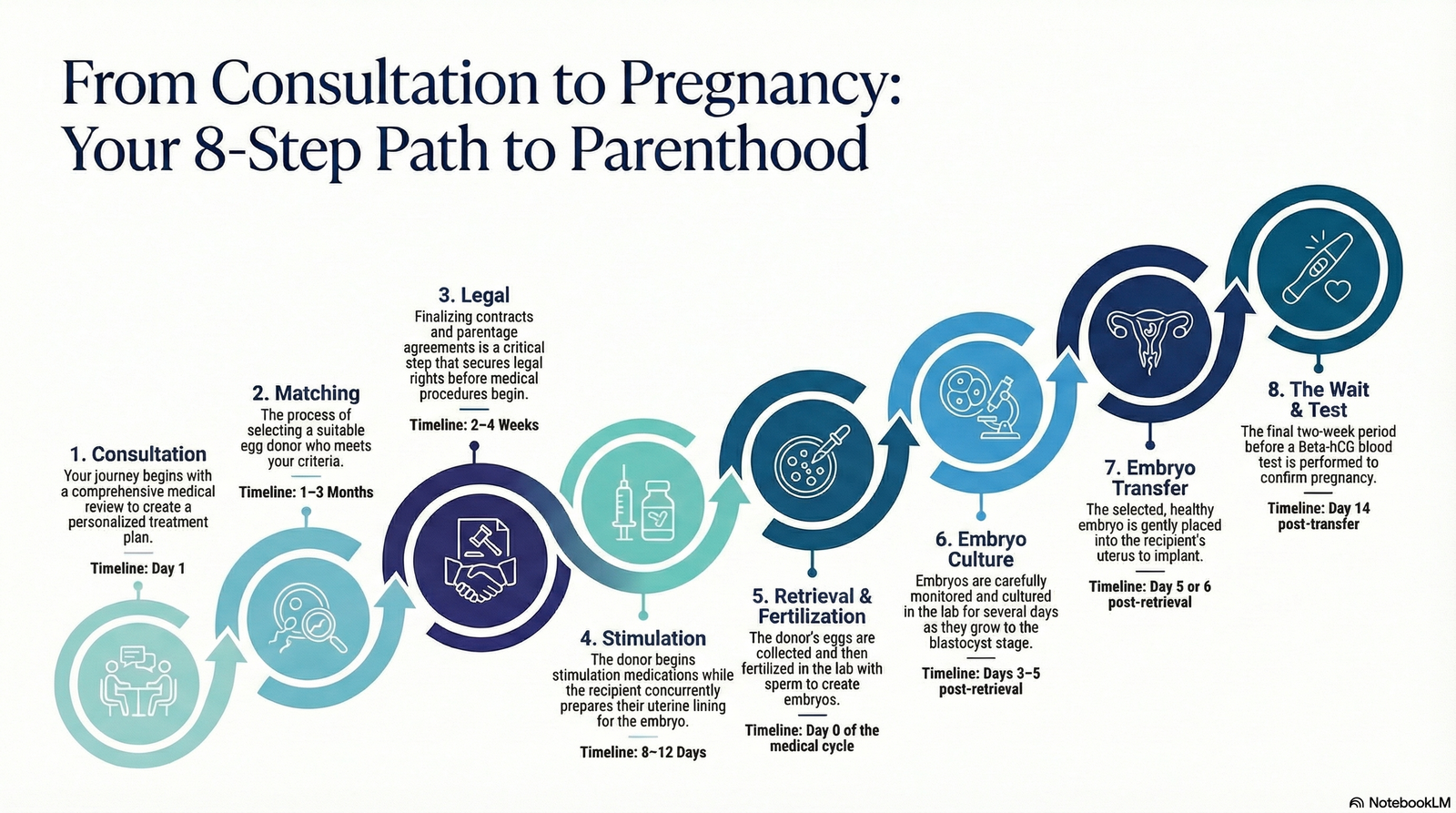
The 8-step path from first consultation to pregnancy test in donor conception.
Want help comparing clinics and costs?
If this feels like a full time job, and it often does, our advisors can collect clear, itemized quotes from verified clinics and map your timeline at no cost to you.

Why trust this guide? The OVU commitment
You are probably juggling hope, timelines, and a lot of tabs open in your browser. And you deserve clear, current, human advice. At OVU, we review clinic protocols, compare real quotes, and talk to people who have done this - intended parents and gestational carriers - so we can give you practical steps, not just theory. If you want help comparing options without sales pressure, we will gather itemized quotes and success data that match your exact situation. You decide, we will bring the info to your table.
Frequently Asked Questions
How much should I budget for medications?
Medication costs are a significant variable often excluded from initial clinic quotes. In the United States, a full cycle of stimulation hormones typically costs between $3,000 and $7,000. In Spain and throughout much of Europe, these same medications are often lower, ranging from €1,000 to €2,000. Note: If you are pursuing embryo donation or a frozen transfer, your medication costs will likely be much lower, often under $1,000, as these cycles require hormonal support for the uterine lining rather than intensive egg stimulation.
Can I choose a donor of a specific ethnicity?
Yes. Ethnicity and heritage are primary filters in most donor databases. You can typically search for donors of Asian, Black, Hispanic, Middle Eastern, and European backgrounds, as well as specific mixed-heritage profiles. However, availability varies; while European donors are often more numerous, many agencies now utilize traveling donors to help intended parents find a specific ethnic match. These donors are willing to travel to your clinic, allowing you to prioritize a specific cultural or physical heritage while utilizing fresh eggs rather than frozen.
What is the success rate of donor egg IVF?
Donor egg IVF is one of the most effective fertility treatments available. For recipients under 35, a single fresh transfer often leads to pregnancy in about 60 to 69 percent of cycles. When you include frozen embryos from the same donor cycle, cumulative success across three transfers often reaches 90 to 98 percent.
Are donors notified of birth outcomes resulting from their donation?
Policies vary by agency and jurisdiction. Most banks require intended parents to report a birth so they can track “family limits” (ensuring one donor doesn’t have too many offspring). While many agencies provide donors with non-identifying “outcome data” upon request, such as the year of birth and the sex of the child, they typically do not share the identity of the family to protect the privacy of all parties. In an era of open-identity donation, donors often know that a child may contact them once they reach adulthood, but day-to-day updates during the child's minority are rare unless a “known donor” arrangement is in place.
What happens if I have surplus embryos?
If you have more high-quality embryos than you intend to use immediately, you have four paths. You can cryopreserve (freeze) them for your own future use, donate them to another infertile individual or couple, contribute them to scientific research (where permitted), or request their compassionate disposal in accordance with local laws. Note that storage is an ongoing commitment; clinics typically charge annual fees ranging from $300 to $1,000 to maintain cryopreserved embryos.
Can I select the gender of my baby?
The ability to choose the sex of an embryo depends entirely on the laws of the country where you receive treatment. Sex selection through preimplantation genetic testing (PGT-A) is legal and widely available in the United States, Mexico, and the UAE. Conversely, in many European countries, including the UK, France, and Spain, clinics are legally prohibited from using sex selection for “family balancing” or personal preference. In these countries, the technology can only be used to prevent serious sex-linked genetic diseases.
Is double donation better than embryo adoption?
The “better” choice depends entirely on your priorities. In a double donation cycle, you create new embryos using donor eggs and donor sperm. This path offers maximum control over phenotypic traits and allows you to choose your own clinic and donor bank. It often yields multiple embryos, providing a high cumulative success rate for future siblings.
Conversely, embryo donation (sometimes referred to as embryo adoption) is typically more cost-effective and involves a less invasive timeline, as the embryos have already been created and cryopreserved. The right path for you will depend on your budget, your desire for specific donor selection, and your personal values.
Reference List 4 sources
Committee Opinion (Guidance): Practice Committee of the American Society for Reproductive Medicine; Practice Committee for the Society for Assisted Reproductive Technology. Gamete and embryo donation guidance. Fertility and Sterility. 2024;122(5):799-813. Available from: https://www.asrm.org/practice-guidance/practice-committee-documents/guidance-regarding-gamete-and-embryo-donation/
Committee Opinion (Guidance): Practice Committee of the American Society for Reproductive Medicine. Guidance regarding gamete and embryo donation. Fertility and Sterility. 2021;115(6):1395-1410. Available from: https://pubmed.ncbi.nlm.nih.gov/33838871/
Committee Opinion (Guidance): Human Fertilisation and Embryology Authority. Donor conception and information for donor conceived people. HFEA Website. 2023. Available from: https://www.hfea.gov.uk/donation/donor-conceived-people-and-their-parents/
Website/Report: European Society of Human Reproduction and Embryology. Cross border reproductive care in Europe: legal framework and patient guidance. ESHRE Website. 2024. Available from: https://www.eshre.eu
Final Thoughts
Choosing donor conception asks a great deal of you. You are simultaneously experiencing anxiety (the weight of potential failure), grief (the loss of a genetic connection), and fear (wondering how your child will feel when you have those open conversations about their origins and lack of physical resemblance). You are doing all this while mastering a medical vocabulary and managing legal safeguards. If you feel overwhelmed, just know that this reaction is not a sign of weakness; it is a healthy and human response to this profound new chapter of your life.
The legal frameworks guiding donor conception in 2026 might seem cold on paper, but their purpose is to protect your child, your rights, and your family’s future. When you partner with a reputable clinic, work with an experienced fertility lawyer, and give yourself space to ask the hard questions, you are building a secure foundation for your family.
You are not merely a “recipient” or a “social parent.” You are the parent who will get up in the middle of the night, share the quiet moments, attend the school meetings, and hold this child when they are scared. Science provides the genetic blueprint, but your daily love and presence turn that blueprint into a life.
Ready to explore your donor options?
You do not have to decode laws, clinic offers, and donor databases on your own. Talk with an OVU advisor to map a donor conception plan that fits your budget, legal needs and values.