


Dr. Sony Sherpa (MBBS)
In addition to her clinical experience, Dr. Sherpa is a published medical researcher and holistic health advocate. Her dual expertise in emergency care and alternative therapies brings a unique lens to medically reviewed content—ensuring it is both accurate and accessible.
If you are thinking about preserving your fertility at 27, 36, or 40, you may feel the pressure of time and wonder if you’ve waited too long. Perhaps you are focusing on your career, still looking for the right partner, or dealing with a diagnosis that could affect your fertility. It is normal to feel like a bundle of nerves, torn between your life today and the family you might want in a few years. This is where egg freezing comes in as a way to pause that clock.
Technically known as planned oocyte cryopreservation, this process lets you store eggs from a younger age to use later. Studies show that when eggs are frozen before 35, and you store around 15–20 mature eggs, your chance of at least one live birth can reach about 70–80%, though success is still possible and commonly practiced well into your late 30s and early 40s. Professional bodies like the American Society for Reproductive Medicine (ASRM) now consider planned egg freezing an acceptable option for both medical and non-medical reasons when you understand the limits, costs, and risks.
This guide walks you through what egg freezing actually involves: how long the process takes, how success rates change with age, what the costs look like in different countries, and what decisions you will face along the way. The goal is simple: provide clear, practical information so you can decide whether egg freezing fits your life, budget, and plans for a future family.
Egg freezing usually takes 4–6 weeks from your first consultation to the retrieval. For those under 35, freezing 15–20 mature eggs can offer roughly a 70–80% chance of at least one live birth later.
While one cycle in the USA often costs $10,000–$20,000 including medications and storage, clinics in Europe, Mexico, and Turkey offer significantly more affordable options, allowing you to purchase two oocyte vitrification cycles or a Double Stim round (two retrievals within one menstrual cycle) for a core cost of less than $10,000 for a bundle. Additionally, for those who prefer a premium experience, including comprehensive medical services and 2–5 years of storage, the cost in European, Asian, and Middle Eastern countries is typically under $13,000.
Next Steps:
- Check Your AMH: Before choosing a “Double Stim” bundle, get an AMH (Anti-Müllerian Hormone) test to see if your body is a good candidate for back-to-back retrievals.
- Verify Medication Costs: Confirm if the “less than $13,000” premium price includes the stimulant drugs, as these are the most variable expenses in any cycle.
- Review Storage and Transport Laws: Different countries have different legal limits on how long eggs can remain frozen (ranging from 10 years to indefinitely). Additionally, legal frameworks for the international transport of vitrified oocytes vary significantly; some jurisdictions strictly regulate or even prohibit the shipment of genetic materials across borders. Always check the specific export and import rules for your chosen destination to ensure your eggs can move with you.
- Map Your Timeline: Decide if you have the 4–6 weeks of flexibility required for an international trip, or if a local “swift start” is a better fit for your current career schedule.
What Recent Research Shows
A 2024 review of 8,750 women who froze eggs for age-related reasons found that women who froze at 35 or younger reached a 52% live birth rate per patient when they later used their eggs, compared with 19% for those who froze their unfertilized oocytes at 40 or older. Another meta-analysis of 27 studies reported that 29% of those who came back to use their frozen eggs had a live birth, and that only 11% of all women who freeze eggs ever return to use them.
Modern vitrification (ultra-swift cryopreservation) techniques now yield egg survival rates of 90–100% in high-quality labs. To date, data show that pregnancy and neonatal outcomes for babies conceived from frozen eggs are similar to those from fresh IVF cycles.
In This Guide
- How Age and Egg Numbers Shape Your Chances
- Egg Freezing Step-by-Step: From Consult to Storage
- When Egg Freezing Is Medically Important
- Global Cost Comparison and Hidden Expenses
- Cycle and Day-by-Day Timeline
- Key Decisions: When, Where, and How Many Eggs
- Country and Clinic Options
- Frequently Asked Questions
Under 34: about 74% success per IVF cycle
38–40: about 18%; 41–42: about 2%
15–20 eggs under 35 can give a 70–80% chance of 1 live birth
25–30 eggs are often needed at 38–40 for similar odds
USA: $10,000–$20,000 per full cycle
Europe/Mexico: often 30–65% lower
How Age and Egg Numbers Shape Your Chances
If you are deciding whether to freeze your eggs this year or wait, age is the first factor to consider. It is not fair, but it is honest: age at retrieval is the strongest single driver of your chances with frozen eggs later.
Large IVF databases show how success per cycle falls with age when you use your own eggs:
| Age at Egg Retrieval | Approximate Success Rate per IVF Cycle | Clinical Note |
|---|---|---|
| Under 34 | About 74% | The best time for a biological pregnancy, fewer eggs are needed to create a healthy embryo. |
| 35–37 | About 55% | Good outcomes, but fertility decline has already started, leading to more chromosomal defects in the oocytes, which can reduce the number of healthy embryos and increase the risk of miscarriage. |
| 38–40 | About 18% | Lower egg quality, more eggs are required to make an embryo. |
| 41–42 | About 2% | Very low odds with own eggs; therefore, donor eggs are often advised to create a chromosomally normal embryo with correctly imprinted genes to eliminate the high risk of miscarriage and chromosomal disorders. |
Latest Research Insights
52% vs. 19% – Age-at-Freezing Payoff: In a 2024 analysis of 8,750 women who froze eggs for age-related reasons, those who froze at 35 or younger reached about a 52% live birth rate per patient when they later used their eggs, compared with 19% for women who froze at 40 or older. This shows why bringing egg freezing forward, even by a few years, can have a major impact on your future options. (PIMD: 38654466).
28–29% – Real-World Live Birth Rate: Across 27 studies and 13,724 women who froze eggs socially, about 29% of those who returned to using their frozen eggs had a live birth. This does not make egg freezing a guarantee, but it does turn “no chance” in your 40s into a realistic possibility for many women. (PMID: 38964588).
46% vs. 13% – The 15-Egg Threshold: Several cohorts, including UK data, show a clear gap: women who stored 15 or more eggs had around a 45–46% live birth rate when they came back, while those with fewer than 15 eggs had about a 13% live birth rate. Setting a target egg number with your doctor can help you decide whether one cycle is enough or another round makes sense. (PMID: 37445218).
90–100% – Survival with Modern Freezing: With modern vitrification, most good-quality eggs survive the freeze-thaw process, often in the 90–100% range in experienced labs. Babies from frozen eggs have similar birth defects and pregnancy outcome rates compared with babies from fresh eggs. (PMID: 34148587).
These numbers describe groups of patients, not individuals. Your medical and fertility history, age, ovarian reserve, and partner’s sperm all play a role, but the expertise of your clinic and the quality of its embryology lab also significantly shape your personal odds. Use these statistics as a framework for a detailed, personalized consultation with your fertility doctor.
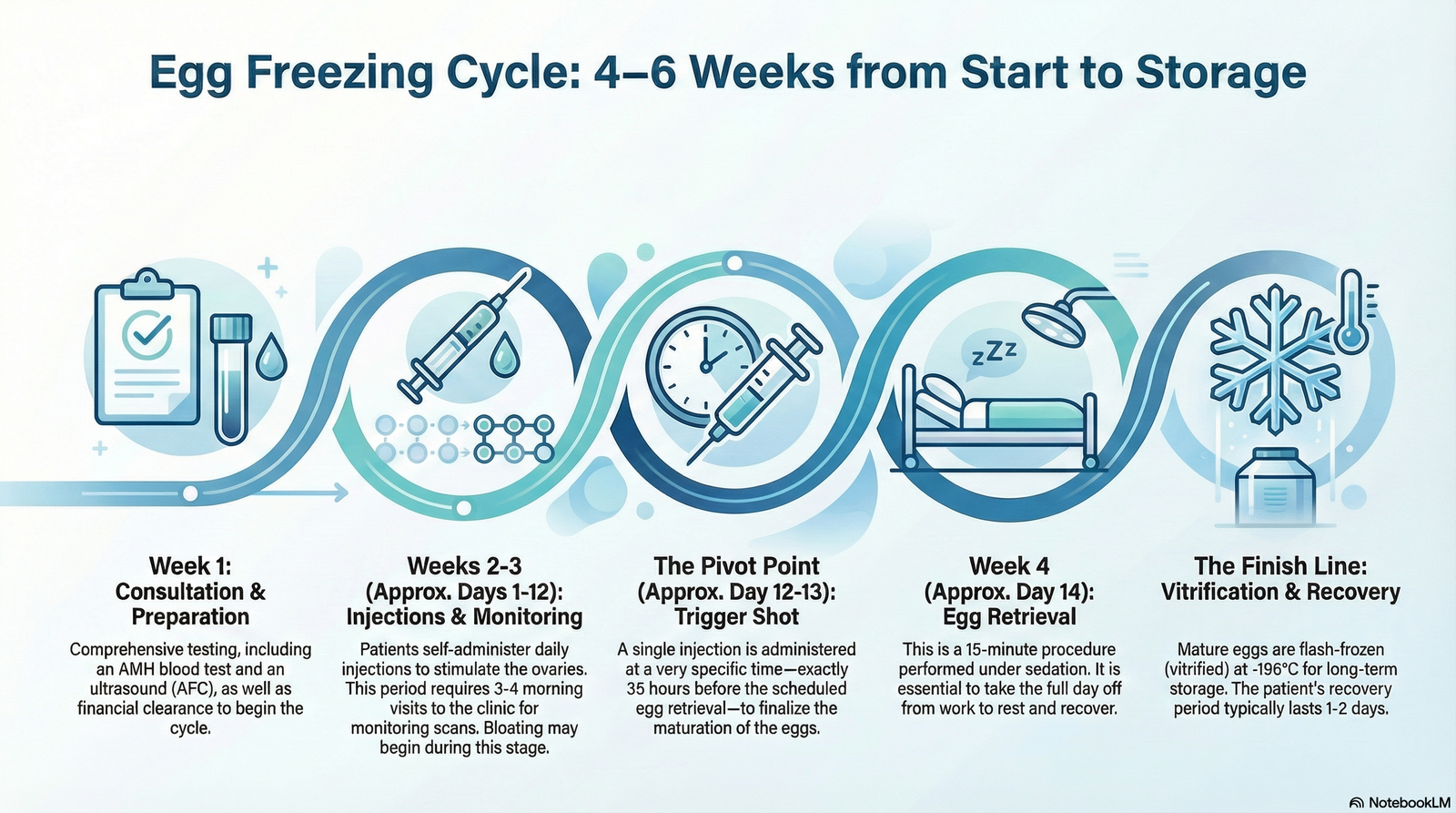
Egg freezing cycle timeline from first consult to storage – how the 4–6 week process fits into your schedule.
The role of egg numbers
Age is not the only lever. How many mature eggs you manage to freeze also matters a lot. Think of each mature egg as one lottery ticket with odds that depend on your age at retrieval.
- For women under 35, freezing around 15–20 mature eggs often yields a 70–80% chance of at least one live birth.
- At 38–40, you may need 25–30 eggs to reach a similar overall probability.
- With fewer than 10 eggs, the chance of a baby being born from those eggs alone is clearly lower, especially above 37–38.
In practice, this often means one cycle may be enough for someone in their early 30s, while someone close to 40 may need two or more cycles to reach their target egg count.
| Age at Freezing | Target Eggs for ~70% Chance of 1 Live Birth | Typical Number of Cycles |
|---|---|---|
| 30–34 | About 14–20 eggs | Often 1–2 cycles |
| 35–37 | About 15–24 eggs | Often 1–2 cycles, sometimes 3 |
| 38–40 | About 25–30 eggs | Often 2–3 cycles |
Egg Freezing Step-by-Step: From Consult to Storage
If you are trying to picture how egg freezing would fit around work, travel, or family commitments, it helps to see the whole cycle laid out. From the initial call to a fertility clinic to the final follow-up consultation with your doctor once your unfertilized oocytes are vitrified, most people complete the cycle within 4–6 weeks.
Step 1: Initial consultation and testing
Your first visit focuses on understanding your current fertility and your goals. The clinic team will usually:
- Take a detailed medical and reproductive history.
- Run blood tests that include AMH (Anti‑Müllerian Hormone) and often FSH, LH, and estradiol.
- Perform a transvaginal ultrasound to measure your uterus and count antral follicles (small resting follicles that may produce eggs during stimulation).
These results give a rough picture of how many eggs you might produce per cycle and how aggressive your medication plan should be. They also help you and your doctor decide on a realistic egg target and number of cycles.
Step 2: Ovarian stimulation (about 8–12 days)
Once you decide to go ahead, you start daily hormone injections. Most protocols use:
- Follicle-stimulating hormone (FSH) and sometimes human menopausal gonadotropin (HMG) to grow multiple follicles.
- A second medication, later in the cycle (an antagonist), to stop you from ovulating too early.
You inject these medicines at home, usually at the same time each day. Common side effects include bloating, breast tenderness, and mood swings. Many people keep working during this phase, but may feel more worn out than usual.
Step 3: Monitoring visits
During stimulation, you go to the clinic for several early morning visits. At each one, you will have:
- Ultrasound scans to measure follicle sizes on each ovary.
- Blood tests to track hormone levels, especially estradiol.
Your doctor uses these results to adjust your dose and decide when to schedule your retrieval. The goal is to grow several follicles to a suitable size without overstimulating your ovaries.
Step 4: Trigger shot
When several follicles reach about 18–20 millimeters, you receive a final injection called the trigger shot. This drug finishes the last stage of egg maturation. The timing of this shot is very precise, because:
- Egg retrieval is scheduled about 34–36 hours after the trigger.
- If you ovulate before retrieval, eggs are lost into the pelvis and cannot be collected.
Step 5: Egg retrieval
On the day of retrieval, you arrive fasting. The procedure:
- Lasts around 10–20 minutes.
- Uses intravenous sedation so you are asleep or very drowsy.
- Involves a thin needle passed through the vaginal wall under ultrasound guidance to drain each follicle.
The lab team immediately checks the fluid from each follicle for eggs. You usually spend 1–2 hours in recovery and then go home with a support person. Cramping and bloating for a day or two are common.
Step 6: Vitrification and storage
In the lab, embryologists:
- Assess how many eggs were retrieved and how many are mature (Metaphase II).
- Prepare the mature eggs in vitrification solutions.
- Rapidly cool the eggs in liquid nitrogen to about –196°C.
Frozen eggs are stored in labeled straws or vials in cryotanks. While frozen, they do not age. Years later, when you are ready, the lab thaws the eggs, fertilizes them (usually with ICSI), grows embryos in the incubator, and then transfers embryos into your uterus or a gestational carrier.
When Egg Freezing Is Medically Important
Many people first hear about egg freezing in the context of careers and partner timing. For some, it is also a key medical tool that protects the option of genetic parenthood when treatment or disease threatens fertility.
Oncofertility: protecting fertility during cancer treatment
Chemotherapy and radiation can damage or destroy eggs and push ovaries into early menopause. If you have just been told you need cancer treatment, you are already carrying a lot. Adding fertility decisions on top can feel like too much, but acting quickly can make a difference.
- Fertility clinics now use random-start protocols, so they do not have to wait for a period to begin stimulation.
- Stimulation and retrieval can often be completed within about 7–14 days of referral.
- Your oncology and fertility teams coordinate to avoid significant delays in cancer treatment.
Endometriosis
Endometriosis can reduce egg reserve and egg quality over time. Surgery on endometriomas can also remove healthy ovarian tissue by accident. For younger women with significant endometriosis, many specialists suggest:
- Discussing egg freezing before repeated ovarian surgeries.
- Using AMH and antral follicle counts to watch for early decline in reserve.
If your AMH is already low in your twenties or early thirties, your doctor may advise moving sooner on egg freezing, even if you are not ready to try for pregnancy yet.
Transgender men
For transgender men, testosterone therapy and some surgical steps can stop or remove egg production. If you want the option of a genetic child later, you can:
- Freeze eggs before starting long-term testosterone, or
- Pause testosterone temporarily under medical supervision to go through a cycle.
This involves balancing your transition goals, your mental health, and your family-building hopes. A good clinic will include both fertility and gender-affirming care specialists in the conversation.
Turner syndrome and other conditions with early ovarian failure
In mosaic Turner syndrome and some other genetic conditions, ovarian reserve can drop very early, sometimes in the teens or twenties. In these cases, doctors may recommend:
- Early fertility counseling and testing.
- Egg freezing when AMH and AFC numbers are still reasonable, even if pregnancy is many years away.
Global Cost Comparison and Hidden Expenses
The price of egg freezing is one of the biggest barriers and sources of stress. Costs include the procedure itself, medications, and yearly storage. It is also important to budget for future expenses, such as devitrification, ICSI fertilization, and embryo transfer, for when you are ready to use your eggs.
Headline costs by country
| Region | Approximate Cycle Cost (Procedure Only) | Medications | Yearly Storage |
|---|---|---|---|
| The USA (High-end clinics) | $12,000–$15,000 | $3,000–$6,000 | $500–$1,000 |
| The USA (Lower range) | $6,000–$10,000 | $3,000–$6,000 | $500–$1,000 |
| Mexico | $5,000–$6,600 | $1,500–$3,500 | $500–$800 |
| United Kingdom | £3,500–£12,380 | Often billed separately | Varies by clinic |
| Spain | €1,800–€3,000 | Paid to the pharmacy | €200–€330 |
| Czech Republic | €1,000–€2,800 | €600–€2,000 | €150–€200 |
| Slovakia | €1,300–€2,500 | Around €1,000 | €120–€150 |
| Bulgaria | €750–€1,600 | €300–€1,000 | €180–€300 |
| Turkey | €2,000–€3,800 | Often lower than Western Europe | Around €255 |
| Canada | 5,000–6,000 CAD | Extra | Varies |
Cost and Outcome Insights
10–20k USD – Typical US Spend: When you add procedure fees, medications, and a few years of storage, many women in the USA spend between $10,000 and $20,000 for one or two cycles. Choosing a lower-cost country can reduce this core fee by 30% to 65% for those who are comfortable traveling for cross-border fertility care.
11% – How Many Women Use Their Eggs: Across large cohorts, only about 10–11% of women who freeze eggs ever come back to use them. This means the majority carry egg freezing as a backup that they never need to trigger. When you weigh costs, remember you are paying for an option, not a guarantee you will use. (PMID: 38964588).
$4,000–$9,000 – Future Use Costs: When you return to use eggs, you face new costs for thawing, ICSI, embryo culture, and transfer. In many countries, this totals another $4,000–$9,000, or the local equivalent, on top of what you paid to freeze.
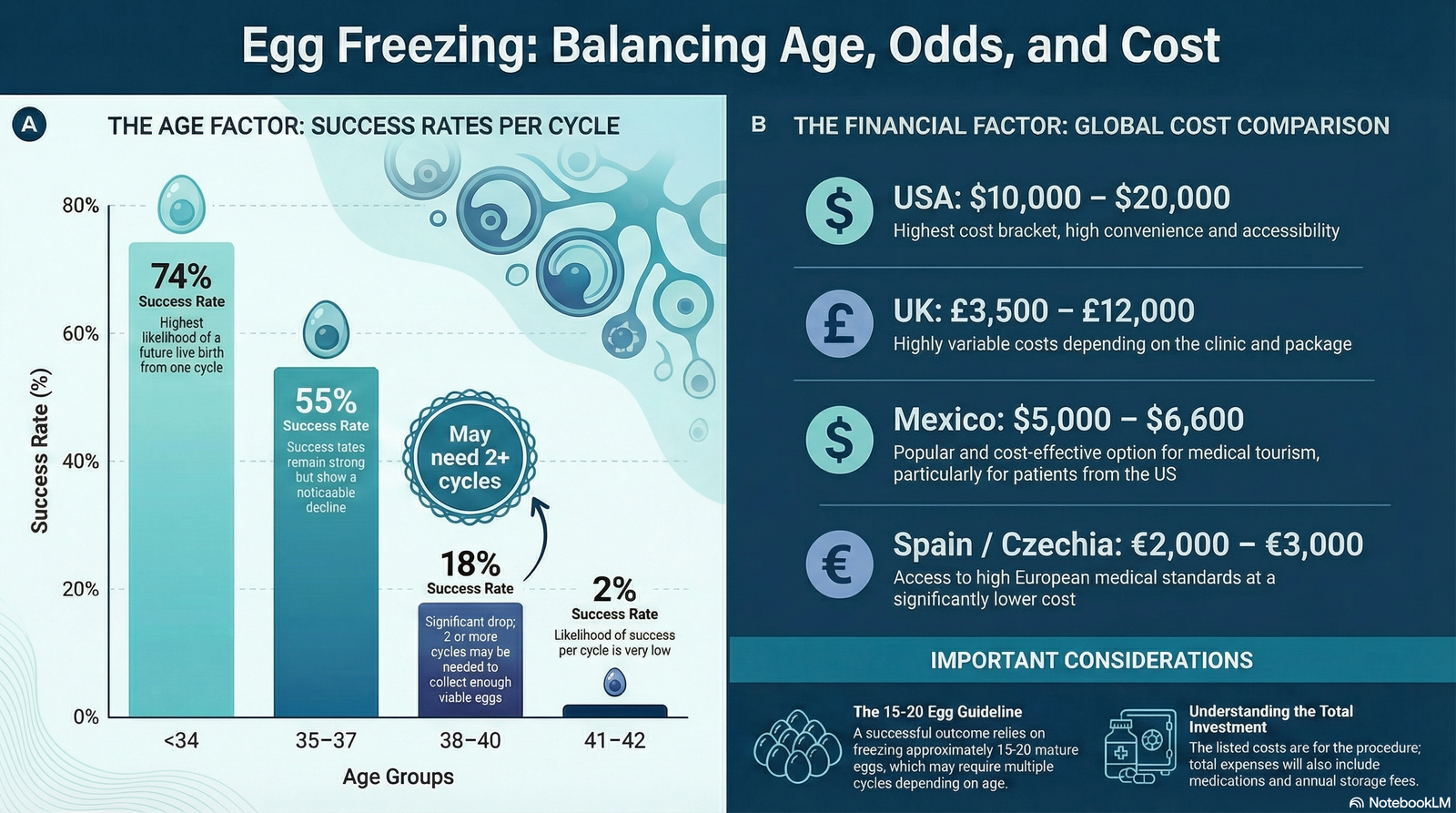
Costs and age-related success rates at a glance. Use this as a quick reference when you compare clinics and countries.
| Cost Component (USA Example) | Typical Range | Notes |
|---|---|---|
| Initial consultation and testing | $300–$1,000 | Sometimes credited toward cycle fee |
| Egg freezing procedure | $6,000–$15,000 | Includes monitoring, retrieval, lab, and first year of storage in some packages |
| Medications | $3,000–$6,000 | Billed separately by pharmacies, the exact spending depends on the dose and your ovarian response to the medication |
| Yearly storage | $500–$1,000 | Often charged per year or in multi-year installments |
| Future thaw and ICSI | $2,000–$5,000 | Paid when you come back to use your eggs |
| Future embryo transfer | $2,000–$4,000 | Per-transfer fee; charged as extra if you freeze additional embryos |
Cycle and Day-by-Day Timeline
If you are trying to squeeze an egg freezing cycle around work, travel, or surgery dates, it helps to look at a typical day-by-day outline.
- Day 1: Period starts. You notify the clinic.
- Day 2–3: Baseline ultrasound and blood work. You usually start hormone injections.
- Days 4–9: Continue injections. You attend 2–4 early morning monitoring visits.
- Days 10–12: Dose adjustments based on scans. The trigger shot is scheduled.
- Day 11–13: Trigger shot about 34–36 hours before retrieval.
- Day 13–14: Egg retrieval under sedation. Same-day discharge.
- Following days: Bloating and cramping settle. Most people return to normal activity within a day or two.
Key Decisions: When, Where, and How Many Eggs
By this point, you have seen that timing, egg numbers, and costs differ hugely between ages and locations. The main decisions most people face are:
- When to freeze: Do you move now, in the next year, or wait and repeat testing first?
- How many eggs to aim for: Are you trying to keep the door open for one child, or possibly more than one?
- Where to have treatment: Do you value the convenience of a local clinic more, or lower costs abroad?
- How long to store: Are you freezing for a likely pregnancy in a few years or more of a “just in case” safety net?
Making the Numbers Work for You
90–100% – Survival, Not Guaranteed: High thaw survival with vitrification is reassuring, but survival is only one step. From each egg, you still need fertilization, embryo development, a successful transfer, and a healthy pregnancy.
Age at Freezing, Not Age at Use: Your chance of a live birth from frozen eggs is tied to your age when those eggs were retrieved, not when you use them. This is why freezing at 32 and using eggs at 40 can look more like a 32‑year‑old IVF cycle, not a 40‑year‑old one.
Egg Freezing Is an Option, Not a Promise: Around 9 in 10 women who freeze eggs never come back to use them, either because they conceive naturally, use other paths to parenthood, or change their plans. When you pay for egg freezing, you are paying for an option your future self can choose to use or ignore.
Country and Clinic Options
Once you understand your own numbers and budget, the next step is comparing clinics. Your choices include:
- Local high-cost clinics with strong reputations and easier logistics.
- Regional centres that charge less but still have solid experience in egg freezing.
- International clinics that attract many patients with lower prices and more inclusive package deals.
When you compare clinics, look beyond the headline price:
- Ask how many egg-freezing cycles they perform per year and how long they have been vitrifying eggs.
- Request itemized quotes that separate procedure, medications, and storage fees.
- Check whether they report outcomes for egg thaw cycles, not just fresh IVF.
- Clarify their policies for unused eggs, storage duration, and what happens if you move countries.
How OVU Advisors Can Help You Compare
Different clinics and countries can look overwhelming on paper, especially when prices and success rates are not presented in the same way. A neutral advisor used to reading between the lines can help you:
- Turn advertised prices into real, bottom-line costs.
- Compare clinics that match your age, diagnosis, and egg-freezing goals.
- Understand what you can realistically expect from a cycle in your specific situation.
You do not have to sort through all of this alone or during your lunch break while you juggle work.
Want help comparing clinics and costs?
If this feels like a full-time job, and many people say it does, our advisors can collect clear, itemized quotes from verified clinics and map out realistic timelines and egg targets with you at no cost.

Why trust this guide? The OVU commitment
You are probably juggling hope, timelines, and a lot of tabs open in your browser. And you deserve clear, current, human advice. At OVU, we review clinic protocols, compare real quotes, and talk to people who have done this - intended parents and gestational carriers - so we can give you practical steps, not just theory. If you want help comparing options without sales pressure, we will gather itemized quotes and success data that match your exact situation. You decide, we will bring the info to your table.
Frequently Asked Questions
How long can my eggs stay frozen?
For practical purposes, they can stay frozen for many years. Studies indicate that eggs frozen for more than 10 years perform similarly to those frozen for shorter periods. The egg’s biological age is your age when it was retrieved, not how long it was stored. Legal storage limits vary by country, so ask your clinic what rules apply where you live.
Will the egg retrieval procedure hurt?
You are under intravenous sedation for the retrieval itself, so you do not feel the needle or the follicles being drained. Afterwards, you may have bloating and period-like cramps for a day or two. Most people describe it as uncomfortable rather than very painful and are back to normal activities within a couple of days.
Can I freeze my eggs if I have PCOS?
Yes. Many women with PCOS actually produce a high number of eggs with stimulation. The main risk is ovarian hyperstimulation syndrome, where the ovaries respond too strongly. Your doctor reduces that risk with lower drug doses, careful monitoring, and specific trigger medications. Egg freezing can be a reasonable way to bank eggs while you are younger if PCOS is part of your picture.
How many egg-freezing cycles will I need?
On average, women complete about two cycles to reach egg numbers that line up with their family goals. If one cycle yields 15–20 mature eggs at age 32, your doctor may say that is enough for at least one child. If you are closer to 40 and one cycle gives only 6–8 eggs, you may want another round to bring your total closer to 25–30 eggs, depending on your plans.
Does insurance cover egg freezing?
Most public and private plans do not yet cover egg freezing for social reasons yet and treat it as elective. Coverage is more common when you face a medical threat to fertility, such as cancer treatment. Some employers, especially large companies in tech and finance, now include egg freezing as a benefit. It is worth checking both your health insurance and your workplace benefits.
Does freezing damage the eggs or increase birth defects?
With older slow-freeze methods, egg survival and quality were more of a concern. Modern vitrification is much faster and has survival rates around 90–100% in experienced labs. So far, studies do not show higher rates of chromosomal problems, birth defects, or pregnancy complications in babies born from vitrified eggs compared with babies from fresh IVF eggs.
Is there an upper age limit for egg freezing?
Legally, this varies by country, but many clinics set their own upper limits. Some stop offering egg freezing with your own eggs around 42–45, because egg quality and odds of success are very low by then. Above about 40, clinics often talk more seriously with you about donor eggs. If you are in your late thirties and still thinking about egg freezing, it makes sense to seek advice sooner rather than later.
Reference List 9 sources
Journal Article (Systematic Review & Meta-Analysis): Hirsch A, Hirsh Raccah B, Rotem R, Hyman JH, Ben-Ami I, Tsafrir A. Planned oocyte cryopreservation: a systematic review and meta-regression analysis. Human Reproduction Update. 2024;30(5):558-568. PMID: 38654466. Available from: https://pubmed.ncbi.nlm.nih.gov/38654466/
Journal Article (Research): Loreti S, Darici E, Nekkebroeck J, Drakopoulos P, Van Landuyt L, De Munck N, et al. A 10-year follow-up of reproductive outcomes in women attempting motherhood after elective oocyte cryopreservation. Human Reproduction. 2024;39(2):355-363. PMID: 38145619. Available from: https://pubmed.ncbi.nlm.nih.gov/38145619/
Journal Article (Systematic Review & Meta-Analysis): Kirubarajan A, Patel P, Thangavelu N, Salim S, Sadeghi Y, Yeretsian T, Sierra S. Return rates and pregnancy outcomes after oocyte preservation for planned fertility delay: a systematic review and meta-analysis. Fertility and Sterility. 2024;122(5):902-917. PMID: 38964588. Available from: https://pubmed.ncbi.nlm.nih.gov/38964588/
Journal Article (Research): Kakkar P, Geary J, Stockburger T, Kaffel A, Kopeika J, El-Toukhy T. Outcomes of social egg freezing: a cohort study and a comprehensive literature review. Journal of Clinical Medicine. 2023;12(13):4182. PMID: 37445218. Available from: https://pubmed.ncbi.nlm.nih.gov/37445218/
Journal Article (Research): Goldman RH, Racowsky C, Farland LV, Munné S, Ribustello L, Fox JH. Predicting the likelihood of live birth for elective oocyte cryopreservation: a counseling tool for physicians and patients. Human Reproduction. 2017;32(4):853-859. PMID: 28166330. Available from: https://pubmed.ncbi.nlm.nih.gov/28166330/
Journal Article (Research): Doyle JO, Richter KS, Lim J, Stillman RJ, Graham JR, Tucker MJ. Successful elective and medically indicated oocyte vitrification and warming for autologous in vitro fertilization, with predicted birth probabilities for fertility preservation according to number of cryopreserved oocytes and age at retrieval. Fertility and Sterility. 2016;105(2):459-466.e2. PMID: 26604065. Available from: https://pubmed.ncbi.nlm.nih.gov/26604065/
Committee Opinion (Guidance): Practice Committee of the American Society for Reproductive Medicine. Evidence-based outcomes after oocyte cryopreservation for donor oocyte in vitro fertilization and planned oocyte cryopreservation: a guideline. Fertility and Sterility. 2021;116(1):36-47. PMID: 34148587. Available from: https://pubmed.ncbi.nlm.nih.gov/34148587/
Ethics Committee Opinion: Ethics Committee of the American Society for Reproductive Medicine. Planned oocyte cryopreservation to preserve future reproductive potential: an Ethics Committee opinion. Fertility and Sterility. 2018;110(6):1022-1028. Available from: https://www.asrm.org/practice-guidance/ethics-opinions/planned-oocyte-cryopreservation/
Journal Article (Review): Moaya M, Shahali S, Lamyian M, Azin SM, Milanifar A. Exploring the fertility needs of women before and after oocyte freezing for medical and non-medical reasons: a scoping review. International Journal of Women’s Health. 2025;17:3361-3374. DOI: 10.2147/IJWH.S546534. Available from: https://doi.org/10.2147/IJWH.S546534
Final Thoughts
If you are reading this while managing a demanding job, a complicated relationship situation, or a new diagnosis, it is understandable if you feel pulled in several directions at once. You may resent the fact that biology is forcing a decision before the rest of your life feels ready. You are not alone in feeling that way.
Egg freezing cannot promise a guarantee of having a baby in the future. What it can do is give your future self more than one path to consider. For some people, that is worth every clinic visit, injection, scan, and invoice. For others, the costs or emotional load do not feel right, and they choose different ways to think about family or remain child-free. Both paths are valid.
True fertility care means having access to transparent data and a team that treats you as an individual, not a set of deadlines. Take this data, bring your questions to a fertility specialist you trust, and decide what trade-offs you are and are not willing to make. Your fertility story is still yours, even if the timeline looks different from what you expected and the decision about timing feels urgent.
Ready to talk through your own numbers?
If you want personalized projections based on your age, AMH and budget, you can speak with an OVU advisor who can help translate data and clinic quotes into a plan that feels realistic for you.