


Dr. Sony Sherpa (MBBS)
In addition to her clinical experience, Dr. Sherpa is a published medical researcher and holistic health advocate. Her dual expertise in emergency care and alternative therapies brings a unique lens to medically reviewed content—ensuring it is both accurate and accessible.
If you are wondering whether a “test run” could make your IVF more successful, you are not alone. Many people reach the embryo transfer stage feeling excited, nervous, and worried that one small mistake could undo months of effort.
By the time you get to transfer, you have already gone through stimulation, egg retrieval, and embryo creation in the lab. Yet research shows that 1 in 10 transfers is technically difficult, and those difficult transfers are linked to roughly a one-third drop in pregnancy and live-birth rates. This means the few minutes your embryos spend in the transfer catheter can have as much impact on success as the weeks you spent getting there.
That is why many clinics now use embryo transfer simulation, usually called a mock transfer. Your doctor uses this rehearsal to map the exact path through your cervix and uterus, follow expert guidance from groups like ASRM and ESHRE, and turn a potentially difficult transfer into a smooth, gentle one. You get a clearer plan, fewer surprises, and more confidence on the day your embryos finally come home.
A mock embryo transfer is a short, practice procedure where your doctor passes a thin catheter into your uterus without embryos to map the best path for your real transfer. It takes less than 10 minutes, usually feels like a Pap smear, and can reduce the risk of a difficult transfer, which is known to lower pregnancy and live birth rates by about one-third.
Next step: Ask your fertility specialist whether a mock transfer makes sense in your case, especially if you have had a difficult transfer before or you are planning to transfer a precious tested embryo.
What the latest research shows
Large studies covering around 30,000 IVF transfers have confirmed that they link technically difficult embryo transfers to lower pregnancy and live birth rates. At the same time, expert guidelines support ultrasound guidance, soft catheters, and trial or mock transfers for many patients to protect implantation.
One clinic’s same-day mock transfer protocol reported a 45% pregnancy rate with a 21% implantation rate per embryo, while a major guideline from the American Society for Reproductive Medicine reports roughly one third higher pregnancy and live birth rates with ultrasound-guided transfers compared with transfers done by feel alone.
All research citations in this article include PMID numbers, so you can review the original studies on PubMed.
In This Guide
About 1 in 10 embryo transfers is classified as difficult because the catheter is hard to pass or causes trauma.
Difficult transfers are linked to about a 30% lower chance of pregnancy and live birth compared with easy transfers.
In some European clinics, advanced genetic screening and transfer bundles start at about 2,000 EUR per cycle.
What Is a Mock Embryo Transfer?
A mock embryo transfer, often written as MET or trial transfer in your chart, is a rehearsal of your real embryo transfer. Your doctor follows the same steps they will use on the day of transfer, but your embryos stay safely in the lab.
During a mock transfer, your doctor passes a very thin, soft catheter through your cervix into your uterus, often under ultrasound guidance. Instead of embryos, the catheter contains a small amount of saline or air. This lets your team feel the exact angle, depth, and any tight spots in your cervical canal and uterine cavity without risking with your embryos.
For you, the experience usually feels like a short pelvic exam. For your team, it creates a “map” of your uterine path and a detailed note about which speculum works best, how much to bend the catheter, and whether they should correct anything, such as cervical stenosis, before the real transfer.
Latest Research Insights
About one-third lower pregnancy chance – why a smooth transfer matters: A 2023 meta-analysis that pooled about 30,000 IVF cycles found that when a transfer was classified as difficult, pregnancy and live birth rates dropped by roughly one-third compared with easy transfers. This is one reason your clinic pays close attention to how the catheter moves, not just to embryo quality. Source: Scientific Reports (PMID: 38092864).
More than 6,700 women – ultrasound guidance advantage: A systematic review that combined results from over 6,700 women found that using ultrasound to guide the catheter led to higher pregnancy and ongoing or live birth rates than transfers done by feel alone. Miscarriage and ectopic pregnancy rates did not increase with ultrasound guidance. For you, seeing the catheter tip on the screen is a simple step that can translate into a higher chance of a baby. Source: Reproductive Biomedicine Online (PMID: 29576332).
45% pregnancy rate – same-day mock transfer in practice: In one center’s report of 113 IVF transfers, doctors used a quick mock pass with a full bladder immediately before placing the real embryos. They saw a 45.1% pregnancy rate per transfer and about a 20.6% implantation rate per embryo. This shows that a short rehearsal can fit into a busy clinic day and still support strong outcomes. Source: Human Reproduction (PMID: 8582967).
Guidelines support ultrasound and soft catheters – technique matters: A major guideline from the American Society for Reproductive Medicine, based on multiple randomized trials and meta-analyses, concludes that ultrasound-guided transfers and soft catheters improve pregnancy and live birth rates compared with older approaches. In one trial, when a mock transfer was easy, adding ultrasound did not give extra benefit, which helps clinics tailor when to use each tool. Source: Fertility and Sterility (PMID: 28366416).
These findings come from peer-reviewed research. Your odds depend on your age, embryo quality, and medical history, so always ask your specialist how these numbers apply to you.
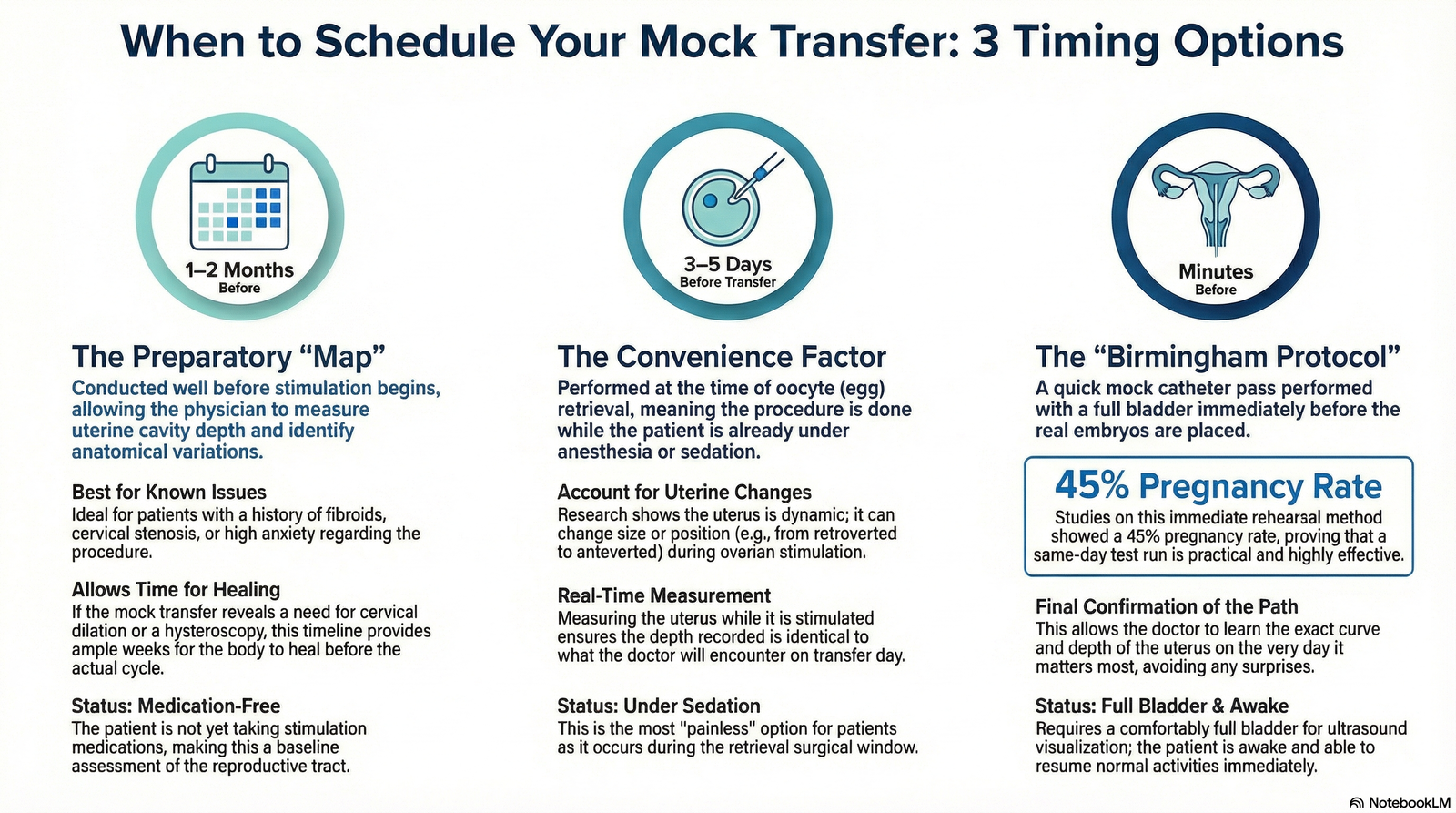
Mock transfer fits into your IVF timeline either before your cycle, around retrieval, or on the day of embryo transfer.
| Timing Option | Main Purpose | Typical Interval Before Transfer |
|---|---|---|
| Pre-cycle mock transfer | Map anatomy and plan corrections, such as cervical dilation | About 1 to 2 months |
| Mock transfer at egg retrieval | Measure the uterine depth while you are already under anesthesia | About 3 to 5 days |
| Same-day mock transfer | Check the exact path and angle on transfer day | Minutes before embryo transfer |
When Should You Have a Mock Transfer?
You and your doctor can fit a mock transfer into your IVF plan in a few different ways. The right choice depends on your anatomy, your history, and how your clinic likes to organize procedures.
Pre-cycle mock transfer
Some clinics schedule a mock transfer as a separate visit about one to two months before your IVF cycle. You are not on stimulation medication yet, and there is no pressure to have your embryos ready that same day. If your doctor finds a very tight cervix or an awkward angle, they can arrange cervical dilation or place laminaria weeks in advance so everything is healed and calm by the time your embryos are ready.
Mock transfer during egg retrieval
Other clinics prefer to do the trial transfer while you are already in the operating room for egg retrieval. The procedure usually happens three to five days before the embryo transfer if you are doing a fresh cycle. Studies show that, when done correctly, such an approach does not reduce implantation rates. Measuring the cavity while your uterus is in a stimulated state can also reflect the conditions at transfer more closely.
Same day “real-time” rehearsal
A third option is to perform a quick mock pass immediately before the real transfer, often with a full bladder. This is the approach used in the Birmingham series that reported a 45% pregnancy rate per transfer and around a 21% implantation rate per embryo. Your doctor can confirm how easily the catheter passes that day and then repeat the same movement with your embryos.
Difficult Embryo Transfers and Why They Matter
A transfer is called difficult when it takes longer than expected, needs a stiffer catheter or a stylet, requires a tenaculum on the cervix, or causes obvious trauma and bleeding. You may feel more cramping, your doctor may have to try more than once, or they may document blood on the catheter tip.
A 2023 systematic review and meta-analysis that summarized 15 studies found that difficult transfers were associated with a 30% lower chance of clinical pregnancy and a similar drop in live birth compared with easy transfers. Another review from the Journal of Human Reproductive Sciences described higher miscarriage rates when the transfer required multiple attempts and noted that observed trauma often leads to stronger uterine contractions.
That same review also showed that when doctors treated problems such as cervical stenosis with dilation or hysteroscopy, they could convert difficult transfers into easy ones in roughly 64% to nearly 80% of patients. Once the transfer became easy, pregnancy rates moved closer to those seen in women who never had difficulty in the first place.
Technique, Difficulty, and Your Comfort
About 1 in 10 transfers – when things get tricky: Across nearly 30,000 IVF cycles, roughly 1 in 10 transfers were classified as difficult, and these difficult transfers consistently showed lower pregnancy and live birth rates than easy ones. If your doctor suggests a mock or trial transfer, the goal is often to move you out of that higher-risk group before your embryos are on board. Source: Scientific Reports (PMID: 38092864).
Up to 80 percent made it easier – fixing the path first: A systematic review on difficult transfers found that treating issues such as a tight cervix or sharply tilted uterus ahead of time turned a previously difficult transfer into an easy one in about two-thirds to four-fifths of patients. Pregnancy rates in those patients then approached the rates seen in people whose transfers were easy from the beginning. Source: Journal of Human Reproductive Sciences (PMCID: PMC6262663).
Full bladder mock transfer – mapping your uterus in real-time: In the Birmingham protocol, doctors used a full bladder and a mock catheter pass right before the real transfer and reported a 45% pregnancy rate and about a 21% implantation rate per embryo. For you, this means your doctor can learn the exact curve and depth of your uterus on the same day your embryos are transferred. Source: Human Reproduction (PMID: 8582967).
Guidelines confirm the role of trial transfer: A 2022 international consensus paper on embryo transfer technique states that trial or mock transfers can reduce the risk of difficult procedures, especially in people with a known tricky cervix or unusual uterine position. The same document reinforces the value of gentle handling and ultrasound guidance to protect implantation. Source: Human Reproduction Open (PMID: 36196080).
Easy transfers and ultrasound – when extra imaging adds little: In one study focusing solely on clearly easy transfers, researchers found similar pregnancy rates whether or not ultrasound guidance was used. This suggests that once your doctor is sure the transfer will be straightforward, extra imaging may not add much benefit. Source: Journal of Assisted Reproduction and Genetics (PMID: 15704516).
Together, these studies support a simple idea. If your team uses mock transfers and corrective procedures to prevent difficulty, your transfer is more likely to fall into the easy group that has better outcomes.
| Technique | Impact on Success | Key Data Point |
|---|---|---|
| Ultrasound-guided transfer | Higher pregnancy and live birth rates than transfers done by feel alone | Around 33% higher pregnancy and live birth rates in pooled trials |
| Soft transfer catheters | Better outcomes than firm catheters | About 1.36 to 1.49 times more likely to result in pregnancy |
| Trial or mock transfer | Reduces risk of difficult transfer | Some series report difficult transfers dropping from about 29.8% to 0% |
Why Speed and Pressure During Transfer Matter
Most people think about where the embryo ends up, not how it gets there. Lab research and simulation work have shown that the speed of injection and the pressure inside your uterus also matter.
The syringe that holds the transfer medium is much wider than the inner catheter. A tiny 1 millimeter move of the plunger can push about 140 times more fluid than the catheter itself can hold. Tests using uterine models have recorded fluid speeds up to 21 meters per second, which is about 75 kilometers per hour. Rapid pushes can raise local pressure inside the cavity up to around 155 mm Hg in less than a tenth of a second.
When scientists compared rapid injections with slower, gentler ones, embryos in the rapid group were more likely to look shrunken or collapsed and showed higher rates of cell death. Fast jets of fluid can also push embryos too far up the uterus or into the tube, which may increase the risk of ectopic pregnancy.
Mock transfers, ultrasound guidance, and modern training tools like embryo transfer simulators all give doctors a chance to practice a slow, steady injection with precise placement. For you, the goal is simple. Your embryo should land in the right spot, around 1.5 to 2 centimeters below the fundus, with as little disturbance as possible.
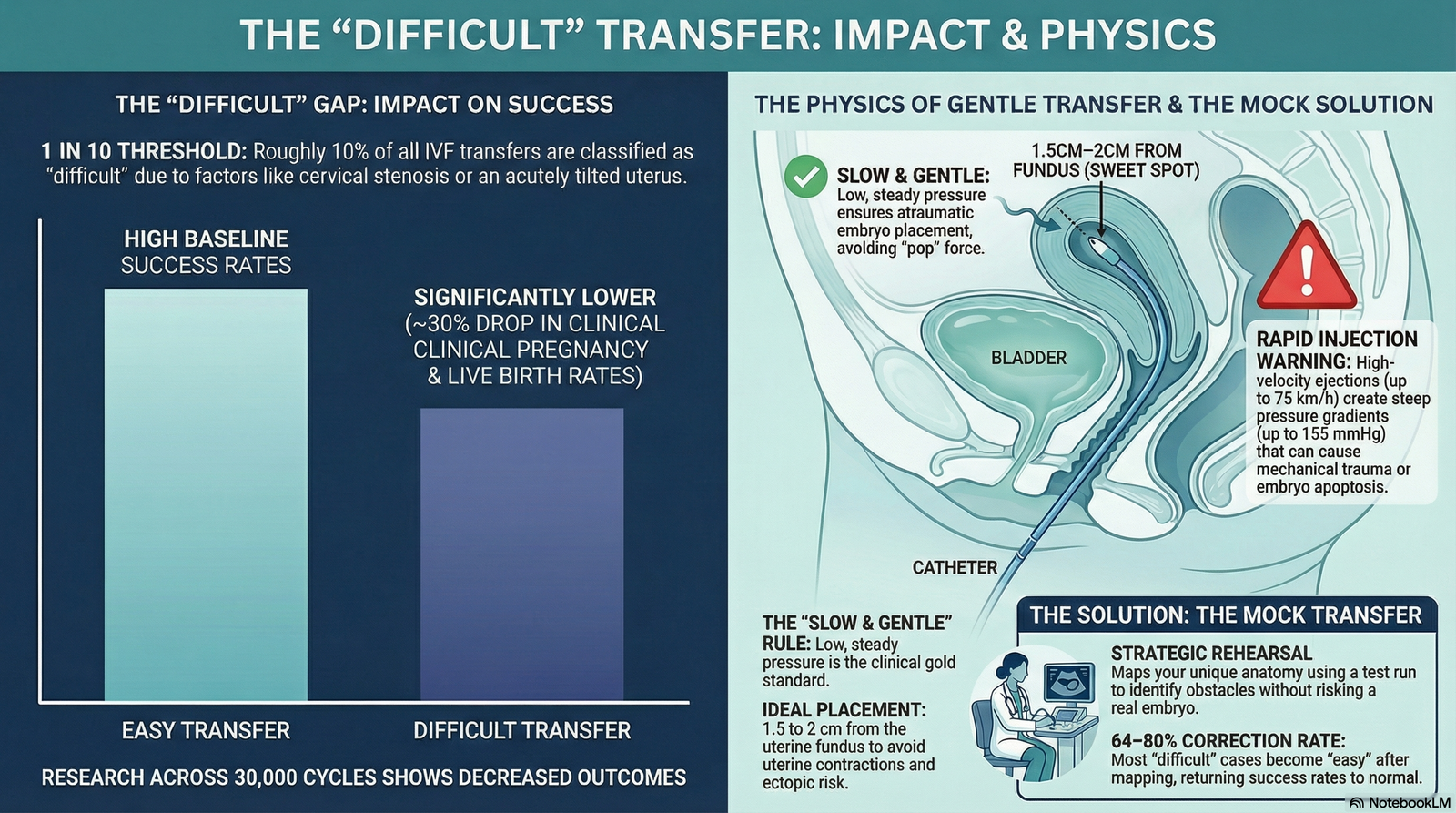
Transfer technique, difficulty level, and exact placement all combine to influence your final chance of success.
Costs, Value, and When a Mock Transfer Is Worth It
Mock transfers add another appointment to an already long process, so it is natural to ask whether the extra time and cost are worth it for you.
Prices vary between countries and clinics. As one example, some Czech clinics list “Pre-PGS or PGD” bundles that include fertilization, extended culture, and transfer tools such as EmbryoGlue starting at about 1,330.00 EUR. Full cycles that include advanced genetic screening and transfer support often start at about 2,000.00 EUR. Mock transfers are sometimes included in these bundles and sometimes billed as a separate visit.
You are more likely to benefit from a mock transfer if:
- You have had a previous transfer that your doctor documented as difficult.
- You have known anatomy challenges such as cervical stenosis, a sharply tilted uterus, or fibroids that distort the cavity.
- You plan to transfer a single euploid embryo or a mosaic embryo that represents a major part of your family building plan.
- You feel anxious about the procedure and would be calmer if you knew exactly how it feels and what your doctor learned from a rehearsal.
| Scenario | Mock Transfer Recommended? | Reason |
|---|---|---|
| First IVF cycle, no known anatomy issues | Discuss with your doctor | Some clinics include a simple trial transfer as part of standard care |
| Previous difficult transfer or failed transfer noted as technically hard | Often yes | Helps your team change tools or correct issues before you transfer again |
| Single euploid or mosaic embryo planned | Strongly consider | Protects a high-value embryo by reducing technical surprises |
Want help planning your transfer and costs?
If comparing protocols, clinics, and add-ons feels like a full-time job, our advisors can collect clear, itemized quotes from verified clinics, explain what is included, and help you plan timelines at no cost to you.

Why trust this guide? The OVU commitment
You are probably juggling hope, timelines, and a lot of tabs open in your browser. And you deserve clear, current, human advice. At OVU, we review clinic protocols, compare real quotes, and talk to people who have done this - intended parents and gestational carriers - so we can give you practical steps, not just theory. If you want help comparing options without sales pressure, we will gather itemized quotes and success data that match your exact situation. You decide, we will bring the info to your table.
Frequently Asked Questions
Is a mock embryo transfer painful?
Most people describe a mock transfer as similar to a Pap smear. You may feel brief pressure when the speculum and catheter go in, but severe pain is not expected. If you are worried about discomfort, tell your doctor so they can move more slowly and talk you through each step.
Can a mock transfer damage my uterine lining?
When done correctly, a mock transfer does not damage the lining. Your doctor usually stops the catheter about 1 to 2 centimeters below the fundus and avoids scraping the top of the uterus. Large studies have not shown lower implantation or pregnancy rates from gentle mock transfers.
What if the mock transfer shows a tight or curved cervix?
Finding a tight cervix during a mock transfer is actually helpful. Your doctor can plan cervical dilation or use laminaria days or weeks before your real transfer. Once the cervix is opened and healed, the transfer itself is more likely to feel smooth and to behave like an easy transfer in terms of success rates.
How much does a mock transfer and an advanced transfer support cost?
Costs vary by country and clinic. In Czechia, for example, some clinics list pre-genetic screening bundles that include fertilization, extended culture, and transfer tools such as EmbryoGlue starting around 1,330.00 EUR, while full genetic screening cycles often start at about 2,000.00 EUR. Ask your clinic for a written breakdown, so you know which services are included.
Why do I need a full bladder for transfer or mock transfer?
A full bladder acts as a window for the ultrasound and helps straighten the angle of your uterus. That makes it easier for your doctor to guide the catheter gently without bumping the cervix or fundus, which in turn can lower the chance of bleeding or uterine contractions during the procedure.
Can I go back to work after a mock transfer?
Yes. You can usually return to normal activity right after the appointment. Some people notice mild cramping or light spotting that settles within a day or two. No evidence resting in bed after a mock transfer or real transfer improves outcomes.
Does the same doctor need to do both the mock transfer and the real transfer?
It is helpful when the same doctor can do both, but many clinics rely on standardized protocols and training, including embryo transfer simulators, so that all team members follow the same steps. What matters most is that your clinic records what they learned from your mock transfer and that whoever performs your transfer reads and follows that plan.
Reference List 7 sources
Journal Article (Research): Sharif K, Afnan M, Lenton W. Mock embryo transfer with a full bladder immediately before the real transfer for in-vitro fertilization treatment: the Birmingham experience of 113 cases. Human Reproduction. 1995;10(7):1715-1718. PMID: 8582967. Available from: https://pubmed.ncbi.nlm.nih.gov/8582967/
Journal Article (Research): Galati G, Reschini M, Mensi L, et al. The impact of difficult embryo transfer on the success of IVF: a systematic review and meta-analysis. Scientific Reports. 2023;13(1):22188. PMID: 38092864. Available from: https://pubmed.ncbi.nlm.nih.gov/38092864/
Journal Article (Systematic Review & Meta-Analysis): Toth TL, Wimmer G, Seeber B, et al. Ultrasound-guided embryo transfer: summary of the evidence and new perspectives. A systematic review and meta-analysis. Reproductive Biomedicine Online. 2018;36(5):542-555. PMID: 29576332. Available from: https://pubmed.ncbi.nlm.nih.gov/29576332/
Committee Opinion (Guidance): Practice Committee of the American Society for Reproductive Medicine. Performing the embryo transfer: a guideline. Fertility and Sterility. 2017;107(4):882-896. PMID: 28366416. Available from: https://pubmed.ncbi.nlm.nih.gov/28366416/
Journal Article (Guidance/Consensus): D'Angelo A, Panayotidis C, Alteri A, Mcheik S, Veleva Z. Evidence and consensus on technical aspects of embryo transfer. Human Reproduction Open. 2022;2022(4):hoac038. PMID: 36196080. Available from: https://pubmed.ncbi.nlm.nih.gov/36196080/
Journal Article (Review): Arora P, Mishra V. Difficult embryo transfer: a systematic review. Journal of Human Reproductive Sciences. 2018;11(3):229-235. PMCID: PMC6262663. Available from: https://pmc.ncbi.nlm.nih.gov/articles/PMC6262663/
Journal Article (Research): de Camargo Martins AM, Baruffi RL, Mauri AL, et al. Ultrasound guidance is not necessary during easy embryo transfers. Journal of Assisted Reproduction and Genetics. 2004;21(12):421-425. PMID: 15704516. Available from: https://pubmed.ncbi.nlm.nih.gov/15704516/
Final Thoughts
The road to pregnancy through IVF is demanding. You invest money, time, and so much emotional energy, all for a procedure that lasts only a few minutes. It is completely normal to want every part of that procedure to be as safe and smooth as possible.
A mock embryo transfer is one of the few tools that focuses almost entirely on reducing technical risk. By mapping your uterus in advance, testing the catheter path, and planning corrections when needed, your team works to turn a potentially difficult transfer into an easy one. You deserve that level of attention, especially when you are transferring embryos you have waited and worked so hard to create.
If your clinic suggests a mock transfer, or if you think you might need one, try asking, “What did you learn from my mock transfer, and how will that change my transfer day?” That simple question can help you feel like an active partner in your care and give you a clearer picture of how your doctor is protecting your chances of success.