


Dr. Sony Sherpa (MBBS)
In addition to her clinical experience, Dr. Sherpa is a published medical researcher and holistic health advocate. Her dual expertise in emergency care and alternative therapies brings a unique lens to medically reviewed content—ensuring it is both accurate and accessible.
If you are choosing between a fresh or frozen embryo transfer, you are not simply deciding between two buttons on a screen. You are choosing the environment where your body and your future baby first meet. This can feel like a heavy burden to carry when you are already overwhelmed by the weight of appointments, lab bills, and hormone shots.
The central question in this choice is whether to transfer immediately after an egg retrieval or to pause and let your body rest. Today, frozen transfers account for almost 80% of IVF cycles in the United States, which is a massive increase from 25% in 2012. Large studies support this shift and show lower risks of preterm birth and low birth weight when a “frozen-thaw” strategy is used. However, the data is nuanced; for some patients with a lower egg count, a fresh transfer may still offer a higher chance of a live birth.
Your fertility team views these statistics through a clinical lens, but you experience them through your daily life. This guide translates that expert data into plain language to help you understand where each strategy shines. By the end, you will be able to match the current research to your unique situation so you can move forward with a plan that feels right for you.
Frozen transfers often result in better birth weights and provide a safer environment for high responders or those diagnosed with polycystic ovarian syndrome (PCOS) and endometriosis. Conversely, fresh transfers may be more effective when you have a few embryos or stable hormone levels. Neither option is universally “best” because each case requires dedicated tailoring of the transfer protocol. While the “why” behind each clinical decision differs, there are several common scenarios. Some patients may need time to stabilize hormone levels, recover from ovarian hyperstimulation or ovarian torsion, or address a non-receptive uterine lining. Others may have an ideal uterine lining and stable hormones; these patients may proceed with a fresh transfer while keeping frozen embryos as a backup in case the first attempt does not lead to pregnancy.
Because of these variables, your doctor will evaluate your egg count, progesterone levels at the time of your trigger shot, and specific health risks before moving forward. This evaluation helps determine which transfer type to prefer and when to schedule the procedure: either at the end of the current cycle or as a delayed frozen transfer. It also informs whether to use a PGT-tested embryo and the critical decision of how many embryos to transfer at once.
Next step: Ask your clinic to show you their success rates for fresh versus frozen transfers by age and diagnosis, and review which specific group you fall into.
What the Latest Research Shows
Recent large studies and guidelines give a clearer picture of fresh versus frozen embryo transfer outcomes. A 2024 meta-analysis of 171,000 births found that singleton babies from frozen transfers were less likely to be born early, underweight, or with very small weight for their age than babies from fresh transfers, although they were more likely to be large for gestational age. A Cochrane review of randomized trials reported that a freeze-all strategy did not change overall live birth rates but cut severe ovarian hyperstimulation from 7 in 100 women to around 1 to 3 in 100.
At the same time, a major trial in women with a low expected egg yield found higher live birth rates with fresh transfer than with freeze-all. For women with endometriosis, a 2025 meta-analysis showed that frozen transfers improved pregnancy and live birth rates by roughly one-quarter to one-third compared with fresh transfers. Together, these findings support a tailored approach rather than a universal rule.
In This Guide
Frozen transfers now account for about 80% of IVF cycles, up from 25% in 2012.
Fresh transfers increase the risk of low birth weight and small for gestational age babies compared with frozen transfers.
A freeze-all strategy can cut severe ovarian hyperstimulation from about 7 in 100 women to around 1 to 3 in 100.
Fresh vs. Frozen: What Actually Changes?
If you want to understand the choice between fresh and frozen transfer, start with what your body is doing in each approach.
In a fresh transfer, your clinic gives you stimulation medications to grow many follicles. Your egg retrieval occurs a few days after your trigger shot. Three to five days later, your doctor transfers an embryo into your uterus during that same cycle. Your hormone levels are still high from stimulation, and your uterine lining is responding to those high levels.
In a frozen embryo transfer (FET), your clinic freezes embryos after the retrieval using vitrification, a rapid freezing method that protects cell structure. You then wait at least one natural or programmed cycle. Later, your team prepares your lining in a calmer hormonal setting and then thaws and transfers one embryo at a carefully chosen time.
Latest Research Insights
25 to 80 Percent Lower Risk – Frozen Birthweight Advantage: Across more than 171,000 singleton births, babies from frozen transfers were less likely to be born early, underweight, or very small for their age than babies from fresh transfers. Babies from frozen cycles were more likely to be bigger than average, but serious problems were similar between groups. This matters if you worry about prematurity or a very small weight for gestational age baby because a frozen transfer often gives your baby a safer growth environment. Source: Medicina (PMID: 39202656).
7 in 100 Down to 1 to 3 in 100 – OHSS Protection: A review of randomized trials found that using a freeze-all strategy did not change the overall chance of having a baby, but it sharply cut dangerous ovarian hyperstimulation. The risk dropped from about 7 in 100 women to around 1 to 3 in 100, and miscarriages were also less common, although some pregnancy complications were a bit more frequent. This matters if you are at high risk for ovarian hyperstimulation because freezing all embryos can protect your health without lowering your long-term chance of success. Source: Cochrane Database of Systematic Reviews (PMID: 33539543).
40 Percent vs. 32 Percent – Fresh Boosts Low Prognosis Success: In women with a low expected response, a fresh transfer led to more babies than freezing all embryos and using them later. About 40 out of 100 women who had a fresh transfer had a live birth, compared with about 32 out of 100 women who used a freeze-all approach, and this gap remained when looking at all transfers over one year. This matters if your doctor describes your prognosis as low because going ahead with a fresh transfer can give you a better chance of having a baby sooner. Source: BMJ (PMID: 39880462).
56 Percent vs. 40 Percent – Endometriosis Frozen Advantage: For women with endometriosis, a meta-analysis found that frozen transfers often led to clearly higher pregnancy and live birth rates than fresh transfers. In one study, live birth was 56 percent with frozen transfer compared with 40 percent with fresh, and across studies, frozen cycles improved success by roughly one quarter to one third without raising miscarriage or ectopic pregnancy. This matters if you have endometriosis because choosing a frozen transfer can meaningfully increase your odds of taking home a baby. Source: Frontiers in Endocrinology (PMID: 40438397).
These findings come from peer-reviewed research. Your results depend on your personal situation. Discuss what this means for you with your fertility specialist.
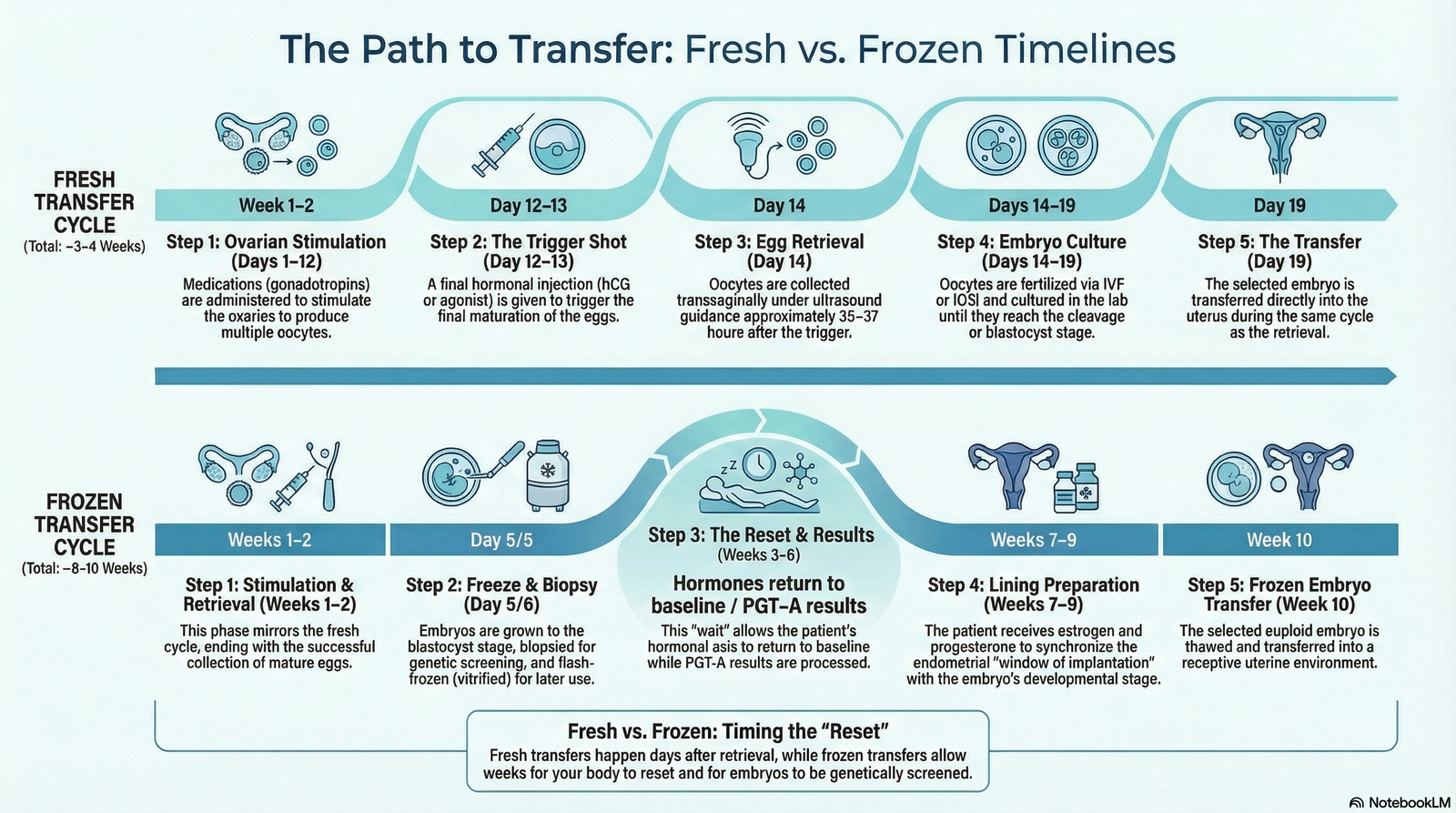
Fresh vs. Frozen Transfer Timelines: fresh cycles move straight from stimulation to transfer, while frozen cycles add a recovery and planning phase.
Who Does Better with Fresh or Frozen?
Once you understand the basic difference in timing, the next step is to match those paths to real patient profiles. Your egg count, hormone levels, and diagnosis all affect whether fresh or frozen gives you the better odds.
When Fresh Transfer Has the Edge
Fresh transfer can be the better choice when you have a lower expected egg yield. Large registry data and randomized trials show that for people who produce only a few eggs, the benefit of freezing everything is smaller, and the risks can feel higher.
In one important analysis, women with a low response of 1 to 5 eggs had a live birth rate of about 25.9 percent with fresh transfer and only 11.5 percent with freeze-all and FET. Even women in the intermediate range of 6 to 14 eggs did slightly better with fresh transfer, about 41.2 percent versus 35.3 percent.
If you have one or two good embryos, each one matters. Even with modern vitrification, a small share of embryos do not survive freezing and thawing. When your embryo count is low, your doctor may lean toward a fresh transfer to give those embryos their chance without extra handling.
When Frozen Transfer Has the Edge
Frozen transfer often helps when your hormone levels are very high or your diagnosis makes your uterus less receptive.
Polycystic Ovary Syndrome (PCOS)
If you have PCOS, stimulation often produces many follicles and a strong hormone response. That raises your risk of OHSS. Studies in PCOS patients show higher live birth rates and safer side effect profiles with frozen transfers. By freezing embryos and transferring in a later, calmer cycle, you lower your OHSS risk and give your uterus a more stable environment.
Endometriosis
If you have endometriosis, your uterus often has ongoing inflammation that can interfere with implantation. A 2025 systematic review in women with endometriosis found that frozen transfers raised clinical pregnancy and live birth rates by roughly 25 to 30 percent compared with fresh transfer. In one study, live birth reached 56 percent with frozen transfer compared with 40 percent with fresh.
Implantation rates followed the same pattern, around 60 to 65 percent with frozen versus about 50 percent with fresh. Researchers think that moving the transfer to a later cycle in a calmer hormonal state gives your lining more time to reset and welcome the embryo.
| Patient Group | Fresh Transfer Live Birth Rate | Frozen Transfer Live Birth Rate | Key Point |
|---|---|---|---|
| High Responders (15+ eggs) | 48.9% | 52.0% | Frozen transfer has a clear advantage |
| PCOS Patients | ~49% | ~55% | Frozen transfer improves outcomes and reduces OHSS risk |
| Endometriosis | 40% | 56% | Frozen transfer offers a strong benefit |
| Low-prognosis (1 to 5 eggs) | 25.9% | 11.5% | Fresh transfer is strongly preferred |
| PGT-A Euploid Embryos | 59% | 77% | Frozen transfer shows higher success rates in key trials |
These numbers are averages from published studies, not promised results. Your clinic’s own rates, your age, and your health history will shift the picture for you.
Timing, Embryo Day, and When to Transfer
Once you know whether you prefer fresh or frozen, timing is the next important question. You might wonder if waiting longer improves your chances or if the day your embryo reached the blastocyst stage matters.
Day 5 vs. Day 6 Blastocysts
Embryos that reach the blastocyst stage by day 5 are often considered the strongest candidates. In fresh cycles, that timing matters. In some data, day 5 blastocysts show success rates around 56 percent, while day 6 blastocysts drop to about 17 percent. By the time a day 6 embryo is ready to transfer in a fresh cycle, the uterus can be past its most receptive window.
Frozen cycles change this. When clinics freeze day 6 embryos and later prepare the uterus to behave like a “day 5” environment at transfer, those day 6 embryos perform much better. In some frozen transfer data sets, day 6 blastocysts reach success rates near 54 percent, close to day 5 results.
How Long Should You Wait Before FET?
After an egg retrieval or a failed fresh transfer, you might be told to wait before your frozen transfer. It is natural to wonder if extra waiting helps or just delays your next chance.
Studies comparing early and delayed FET cycles show very similar pregnancy rates. One analysis found clinical pregnancy rates of about 32.5 percent for immediate FETs and 31.7 percent for delayed FETs. Longer waiting did not improve lining quality or success. It mainly stretched out the time until the next result.
More Evidence to Guide Your Choice
2.5 Times More Low Birth Weight – Fresh Baby Size Trade-Off: In one clinic, almost the same number of women had a baby whether they used fresh or frozen transfers, about 96 percent versus 93 percent. Babies from fresh transfers were about two and a half times more likely to have low birth weight than babies from frozen cycles. This matters because even when success rates look similar, frozen transfer can slightly lower your baby’s risk of being very small. Source: [Journal per PubMed record] (PMID: 37522692).
60 to 65 Percent vs. About 50 Percent – Implantation in Endometriosis: For many women with endometriosis, frozen transfers had implantation rates around 60 to 65 percent, compared with about 50 percent after fresh transfers in several studies within a meta-analysis. Doctors think this phenomenon happens because strong stimulation can make the uterus less welcoming in a fresh cycle, while a later frozen transfer happens in a calmer hormonal setting. This matters if your lining is often described as “not ideal” during stimulation because waiting for a frozen transfer can give embryos a better chance to stick. Source: Frontiers in Endocrinology (PMID: 40438397).
62 Percent vs. 40 Percent – PGT-A Frozen Euploid Edge: In couples using PGT-A, a key randomized trial summarized by ASRM found that frozen transfers of tested chromosomally normal embryos had higher ongoing pregnancy and live birth rates than fresh transfers in the main analysis. Live birth was around 62 percent with frozen transfer of tested embryos versus about 40 percent with fresh in one analysis, although this advantage shrank after adjusting for age and egg number. This matters if you plan PGT-A because your clinic will almost always use frozen transfers of tested embryos, which can modestly raise success and lower ovarian hyperstimulation risk. Source: ASRM Committee Opinion (ASRM PGT-A Guidelines, 2024).
Fewer Tiny Babies, More Blood Pressure Issues – Protocol Choice Matters: A large observational study found that babies from frozen transfers were again less likely to be very small or have low birth weight than babies from fresh transfers. Fully programmed frozen cycles that use higher hormone doses and completely block ovulation were linked with more high blood pressure problems in pregnancy than natural or low hormone frozen cycles. This matters because if you choose a frozen transfer, talking with your doctor about a natural or low-hormone protocol can help protect you from high blood pressure while keeping the baby-size benefits. Source: Human Reproduction Open (hoag002).
These findings come from peer-reviewed research. Your results depend on your personal situation. Discuss what this means for you with your fertility specialist.
Transfer Technique Details That Matter
From your side of the speculum, embryo transfer looks quick and simple. On your doctor’s side, it is a delicate procedure where small details change how gently the embryo reaches your lining.
Ultrasound Guidance vs. Clinical Touch
Many clinics now use real-time ultrasound during transfer. Your doctor and embryologist can see the catheter tip and place the embryo at the right distance from the top of the uterus. This lowers the chance that the catheter touches the fundus and triggers contractions that might push the embryo away.
The Afterload Technique
Some doctors use an “afterload” method. They first place an empty outer catheter to find a smooth path through the cervix. Once that track is ready, they gently slide a second catheter that carries your embryo. In one study, this approach reached a clinical pregnancy rate of about 52.4 percent compared with 44.9 percent for direct transfers.
Does Transfer Speed Matter?
You might have heard that transfers must be completed in under a minute. More recent data, especially in frozen cycles, suggests that careful, unhurried transfers can work just as well. Procedures that take up to two minutes or more show similar success as long as the steps remain gentle.
Mock Transfer
Most clinics plan a “mock” or trial transfer before your real one. This lets your doctor map the angle and depth of your uterus and note any bends or narrow areas. When you come in for your actual embryo transfer, the team already knows the safest path, which often makes the day feel calmer for you.
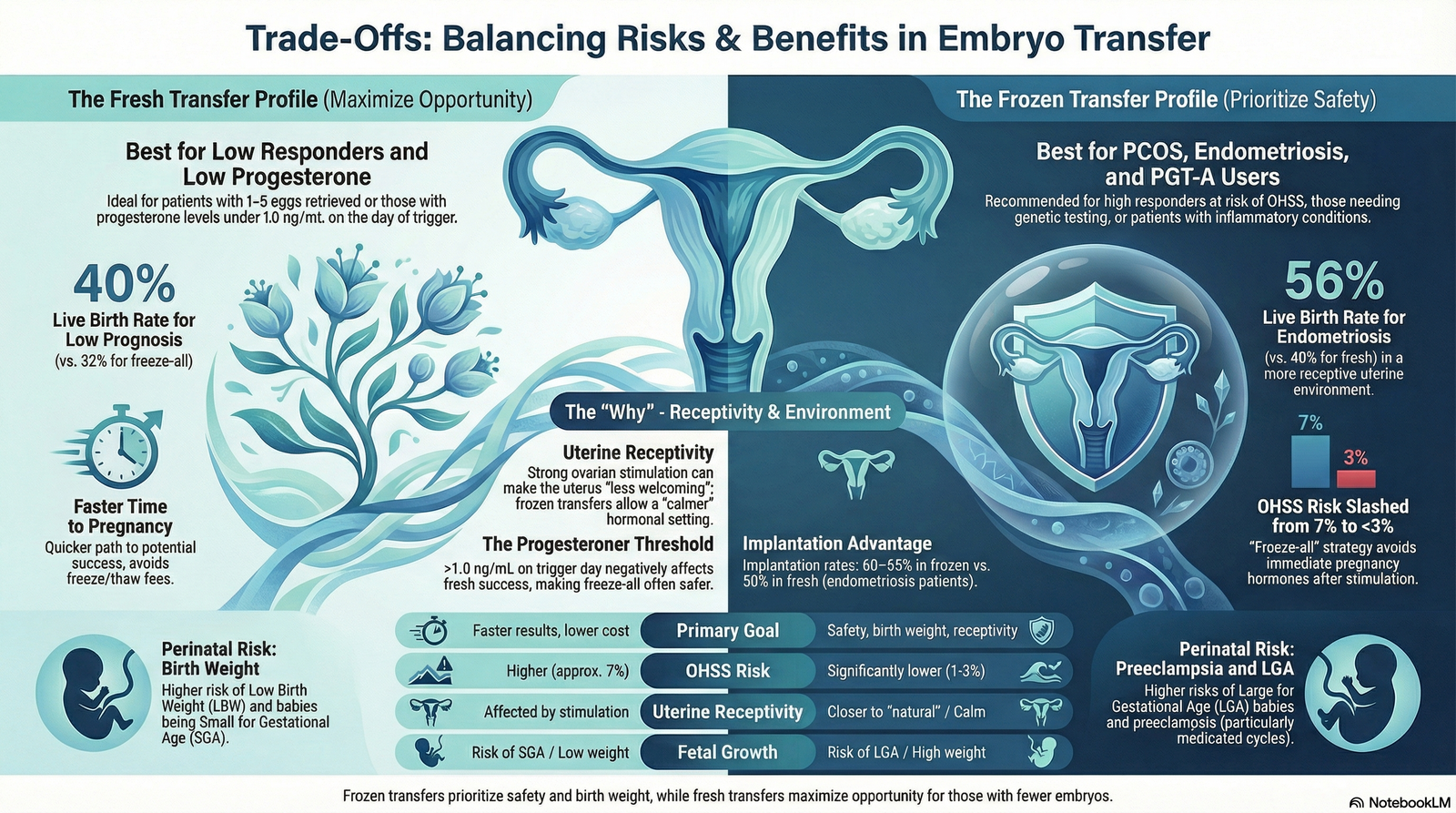
Fresh vs. Frozen Outcomes: frozen transfers often lower the risk of low birth weight and OHSS, while fresh transfers can help when embryo numbers are low.
Safety and Baby Outcomes
You are not just aiming for a positive test. You care about a healthy pregnancy and a healthy baby. Fresh and frozen transfers carry different profiles for birth weight, blood pressure, and other outcomes.
Birth Weight and Size
One of the most consistent findings is that babies from frozen transfers weigh more on average. Several studies link fresh transfers to higher rates of low birth weight and babies who are small for their gestational age. In one clinic analysis, babies from fresh transfers were about 2.5 times more likely to have low birth weight than babies from frozen cycles.
Frozen cycles, on the other hand, have a higher rate of babies who are large for gestational age or have macrosomia. Doctors often define that as a birth weight above 4,000 to 4,500 grams. These larger babies raise the chance of cesarean delivery and complications such as shoulder dystocia. You trade fewer very small babies for more very large weight babies.
Preeclampsia and Frozen Transfer Protocols
Another key safety topic is preeclampsia, a form of high blood pressure in pregnancy. Studies show higher rates of preeclampsia in fully programmed frozen cycles that use estrogen and progesterone without ovulation, compared with natural or modified natural frozen cycles.
The main suspect here is the corpus luteum, the cyst that forms on your ovary after ovulation. It makes progesterone, but it also produces substances like relaxin that help your blood vessels and heart adjust to pregnancy. When you skip ovulation and rely only on hormone pills or patches, you lose those extra signals. If you are planning a frozen transfer and have risk factors for high blood pressure, you can ask your doctor whether a natural or low-hormone protocol is an option.
Ectopic Pregnancy Risk
Frozen transfers do have an important safety advantage. In a study of more than 100,000 cycles, the odds of ectopic pregnancy, where a pregnancy implants outside the uterus, were about 65 percent lower in frozen transfers than in fresh ones. If you have already experienced an ectopic pregnancy or have tubal issues, that difference may guide your choice.
Success Rates and Comparison Table
Here is a side-by-side look at how fresh and frozen transfers compare in different situations. Your clinic’s results and your own medical profile will shift the details, but this table gives you a starting point for questions.
| Category | Fresh Transfer LBR | Frozen (FET) LBR | Notes |
|---|---|---|---|
| High Responders (15+ eggs) | 48.9% | 52.0% | Frozen transfer has a clear advantage |
| PCOS Patients | ~49% | ~55% | Frozen transfer improves outcomes and lowers OHSS risk |
| Endometriosis | 40% | 56% | Frozen transfer offers a strong benefit |
| Low-prognosis (1 to 5 eggs) | 25.9% | 11.5% | Fresh transfer is usually the better choice |
| PGT-A Euploid Embryos | 59% | 77% | Frozen transfer shows higher success in a key trial |
| Single vs. Double (Frozen) Transfer | 38% per embryo | 34% per embryo | Sequential single transfers can give more babies overall with fewer twins |
How to Decide What Is Right for You
There is no universal rule that frozen is always better or that fresh is always faster. The best choice is the one that fits your biology and your values. Here is a simple checklist you can review with your specialist.
- You might lean toward a fresh transfer if: you expect a lower egg yield, your progesterone at trigger is below about 1.0 ng/mL, your lining looks thick and triple line on retrieval day, and you want to avoid extra months of waiting.
- You might lean toward a frozen transfer if: you have PCOS or a high egg count that raises your OHSS risk, your progesterone rose early during stimulation, you plan PGT-A, you have endometriosis with previous fresh failures, or your clinic is concerned about how your lining responds in stimulated cycles.
Ask your clinic for your own numbers. You are allowed to see your follicle counts, hormone levels, embryo grades, and your clinic’s fresh versus frozen outcomes for people your age and with your diagnosis. With that information, you and your doctor can build a plan that feels less mysterious and more intentional.
Want help comparing clinics and costs?
If this feels like a full-time job, and it often does, our advisors can collect clear, itemized quotes from verified clinics and map your likely timeline at no cost to you.

Why trust this guide? The OVU commitment
You are probably juggling hope, timelines, and a lot of tabs open in your browser. And you deserve clear, current, human advice. At OVU, we review clinic protocols, compare real quotes, and talk to people who have done this - intended parents and gestational carriers - so we can give you practical steps, not just theory. If you want help comparing options without sales pressure, we will gather itemized quotes and success data that match your exact situation. You decide, we will bring the info to your table.
Frequently Asked Questions
Does the freeze-thaw process damage embryos?
With modern vitrification, most embryos survive freezing and thawing. Many labs report survival rates above 90 to 95 percent. Older, slow-freeze methods had much lower survival rates. If you want to know what the process is at your clinic, ask for their current thaw survival rate and how it compares with national averages.
Is a frozen transfer more expensive than a fresh transfer?
Frozen transfers usually add lab fees for freezing and thawing, plus the cost of another cycle of medications and monitoring. Some cost studies still find frozen transfer to be more cost-effective in certain groups because better outcomes can mean fewer egg retrievals overall. Your clinic can give you a line-by-line estimate so you can compare real numbers rather than guesses.
What is the window of implantation?
The window of implantation is a short period, often two to three days, when your uterine lining is ready to accept an embryo. In a fresh cycle with very high hormone levels, that window can open and close earlier than usual. Frozen cycles are designed to better match embryo age with that window, so the embryo arrives when your lining is most receptive.
Is the ERA test worth doing?
The Endometrial Receptivity Analysis (ERA) test takes a small biopsy of your lining and tries to measure whether your window of implantation has shifted. It sounds very precise, but large trials show that for most women, ERA-guided timing does not improve live birth rates compared with standard timing. Some clinics still use it for complex or repeated failure cases. For many patients, it adds cost without a clear benefit.
Should I transfer one embryo or two?
Most experts now recommend elective single embryo transfer for many patients. Transferring two embryos at once raises the chance of twins, which brings much higher risks of preterm birth and complications. Transferring one embryo at a time, and using frozen embryos in later cycles if needed, often leads to more total babies and safer pregnancies over time.
Do natural frozen cycles work better than medicated ones?
If your cycles are regular, a natural or letrozole stimulated FET can give equal or better results than a fully medicated cycle in some studies and may lower the risk of preeclampsia. In these plans, your clinic tracks your ovulation or triggers it gently and then times the transfer to match it, so you keep the benefits of the corpus luteum.
Does the catheter type really matter for success?
Catheter choice is one of several small details that matter. Many doctors prefer soft-tipped catheters because they are less likely to injure the lining or pull blood into the catheter, both of which can lower implantation chances. If you have had a difficult transfer before, you can ask what tools and approaches your clinic plans to use next time.
Reference List 8 sources
Journal Article (Systematic Review & Meta-Analysis): Carp-Veliscu A, et al. Fresh versus Frozen Embryo Transfer in In Vitro Fertilization Intracytoplasmic Sperm Injection Cycles: A Systematic Review and Meta-Analysis of Neonatal Outcomes. Medicina (Kaunas). 2024;60(8):1373. PMID: 39202656. Available from: https://pubmed.ncbi.nlm.nih.gov/39202656/
Journal Article (Systematic Review & Meta-Analysis): Wong KM, Mastenbroek S, van Wely M. Fresh versus frozen embryo transfers in assisted reproduction. Cochrane Database of Systematic Reviews. 2021;2(2):CD011184. PMID: 33539543. Available from: https://www.cochranelibrary.com/cdsr/doi/10.1002/14651858.CD011184.pub2/full
Journal Article (Randomized Controlled Trial): Kuang J, et al. Frozen versus fresh embryo transfer in women with low prognosis for in vitro fertilisation treatment: pragmatic, multicentre, randomised controlled trial. BMJ. 2024;[volume(issue)]:[pages]. PMID: 39880462. Available from: https://pubmed.ncbi.nlm.nih.gov/39880462/
Journal Article (Systematic Review & Meta-Analysis): Han Y, Liu X, Liu S, Wu L, Huang R. Pregnancy outcomes in freeze-all versus fresh embryo transfer cycles of women with adenomyosis and endometriosis: a systematic review and meta-analysis. Frontiers in Endocrinology. 2025;16:1507252. PMID: 40438397. Available from: https://pubmed.ncbi.nlm.nih.gov/40438397/
Journal Article (Comparative Study): Frangou D, et al. Fresh vs. frozen embryo transfer in assisted reproductive techniques: a single-center retrospective cohort study and ethical legal implications. [Journal name per PubMed record]. 2023;[volume(issue)]:[pages]. PMID: 37522692. Available from: https://pubmed.ncbi.nlm.nih.gov/37522692/
Journal Article (Observational Study): [Authors]. Frozen versus fresh embryo transfer on perinatal outcomes: do endometrial preparation methods matter? Human Reproduction Open. 2026;2026(1):hoag002. PMID: [see article]. Available from: https://academic.oup.com/hropen/article/2026/1/hoag002/8423497
Committee Opinion (Guidance): Practice Committee of the American Society for Reproductive Medicine. The use of preimplantation genetic testing for aneuploidy: a committee opinion. Fertility and Sterility. 2024;[volume(issue)]:[pages]. Available from: https://www.asrm.org/practice-guidance/practice-committee-documents/the-use-of-preimplantation-genetic-testing-for-aneuploidy-a-committee-opinion-2024/
Journal Article (Supporting Analyses): Han Y, Liu X, Liu S, Wu L, Huang R, and related cited studies on IVF outcomes in endometriosis and adenomyosis. Frontiers in Endocrinology. 2025;16:1507252 and linked articles. PMID: 40438397. Available from: https://pubmed.ncbi.nlm.nih.gov/40438397/
Final Thoughts
The debate about fresh versus frozen transfer is no longer about which method is best. It is about which method is best for you at this moment in your fertility journey. If you are a high responder or have PCOS or endometriosis, frozen transfer often gives you higher success and a safer, more stable hormonal environment. If you have only a few embryos and your hormone levels during stimulation look smooth, a fresh transfer can still be a strong and efficient path.
Success in IVF usually comes from many small choices rather than one big one. That includes how your clinic prepares your lining, how they handle your embryos, how they perform the transfer, and how they support your emotional and financial load. You deserve clear explanations of your options and enough time to ask questions until you feel heard.
If you can, bring this guide to your next appointment. Ask your doctor how many eggs they expect to retrieve, what your progesterone level was at trigger, how your lining responded, and how your clinic’s fresh versus frozen results look for patients like you. With that information, you and your team can choose the timing and approach that give your embryos the best possible place to grow.
Need help turning data into a plan?
If you want another pair of eyes on your quotes and clinic options, our advisors can help you compare clinics, protocols, and pricing so you can move forward with more clarity.