


Dr. Sony Sherpa (MBBS)
In addition to her clinical experience, Dr. Sherpa is a published medical researcher and holistic health advocate. Her dual expertise in emergency care and alternative therapies brings a unique lens to medically reviewed content—ensuring it is both accurate and accessible.
You have probably pictured this moment through every blood draw, hormone injection, and ultrasound scan: finally seeing two clear lines or a screen that says “pregnant.” When you get here after fertility treatment, that joy often lands right next to a new label that can feel heavy: “high-risk pregnancy.”
If you are pregnant after IVF and that label scares you, you are not alone. Doctors use it to trigger closer follow-up for you and your baby, not because something is already going wrong. Still, it can make every twinge feel like a warning, especially after everything you already went through to get here.
Large studies show that assisted reproductive technology (ART) pregnancies, including IVF and ICSI, have higher rates of preterm birth, low birthweight, preeclampsia, and placental problems than pregnancies that start without treatment. At the same time, guidance from ACOG, SMFM, and other expert groups is clear: with the right monitoring, most IVF pregnancies still end in healthy births. This guide walks you through what to expect, week by week, and how to stay grounded while you and your team navigate a higher risk profile together.
Pregnancy after IVF is often labeled “high-risk” because rates of preterm birth, low birthweight, preeclampsia, and placental problems are higher than in spontaneous pregnancies, even with a single baby. That label does not mean something is already wrong; it means your team will use extra scans, blood pressure checks, and lab work to catch issues early. With close follow-up and a clear plan, most high-risk IVF pregnancies result in healthy deliveries.
Next step: Ask your doctor to walk you through your personal risk factors and monitoring plan so you know what to expect in each trimester.
What the latest research shows
Recent large studies help explain why IVF pregnancies get extra monitoring. Meta-analyses show that even single babies conceived with ART have about double the risk of preterm birth and low birthweight compared with naturally conceived singletons. Preeclampsia and placenta previa are also more common, and medicated frozen embryo transfer cycles carry a higher rate of hypertensive disorders than natural-cycle FET.
Good news sits in the same data. When doctors follow high-risk protocols, use single embryo transfer to avoid higher-order multiples, and push for term when it is safe, most IVF pregnancies still end with a healthy baby and parent. This article uses those research findings to explain the “why” behind each scan, test, and extra visit in a way you can actually use.
In This Guide
- Why IVF Pregnancies Get Extra Attention
- First Trimester: Fragile Weeks and Big Jumps
- Multiple Pregnancies: Twins and More
- Maternal Complications: Blood Sugar and Blood Pressure
- Second Trimester: The “Babymoon” Window
- Third Trimester: The Final Stretch
- Placenta and Cord: Your Baby’s Support System
- Pregnancy Loss and Reduction
- Managing Anxiety and Advocating for Yourself
- Your High-Risk IVF Monitoring Roadmap
- Frequently Asked Questions
Singleton IVF pregnancies have about 2x the risk of preterm birth compared with spontaneous singletons.
Hypertensive disorders affect roughly 18% of medicated FET pregnancies vs 10% in natural-cycle FET.
In severe male-factor infertility, miscarriage after the first transfer dropped from 19.1% to 5.8% with PGT-A.
Why IVF Pregnancies Get Extra Attention
An embryo that starts in a lab and then implants in your uterus is a big win, medically and emotionally. At the same time, research shows that pregnancies after ART carry higher rates of a few key complications than pregnancies that start without treatment.
That does not mean you should expect trouble. It means your team knows you sit in a higher-risk group and wants to catch any issues early, when they are usually easier to manage.
- Singleton risk profile: One baby after ART faces about double the risk of preterm birth, low birthweight, and preeclampsia compared with one baby conceived without treatment.
- Placenta checks: IVF roughly doubles the odds of placenta previa and nearly triples the odds of abnormal cord insertion.
- Multiples: Twins and higher-order multiples are much more common after fertility treatment, and about 60 to 70 out of 100 multiple pregnancies deliver before 37 weeks.
Latest Research Insights
18% vs. 10% – Medicated vs. Natural FET Blood Pressure Risk: A large meta-analysis of 152,590 frozen embryo transfers found hypertensive disorders in about 18 out of 100 medicated FET pregnancies, compared with about 10 out of 100 natural-cycle FET pregnancies. For you, this means that if you qualify for a natural-cycle FET, it may reduce your long-term blood pressure risk. Source: Human Fertility (PMID: 40356454).
3x Higher Placenta Problems – Why IVF Needs Detailed Scanning: In a cohort of 13,854 singleton pregnancies, ART conceptions had nearly triple the odds of velamentous cord insertion and over five times the odds of vasa previa compared with spontaneous pregnancies. This explains why your anatomy scan should always include a detailed visualization of the placenta and umbilical cord. Source: Journal of Personalized Medicine (PMID: 40423048).
4x ICU Risk Over 40 – Why Place of Birth Matters: In women aged 40 and older with singletons, overall complication rates were similar between IVF and spontaneous pregnancies after matching. Still, maternal ICU admission was over four times more common after IVF (about 5.5% vs 1.3%). This supports planning delivery in a hospital that can handle rapid escalation if needed. Source: International Journal of General Medicine (PMID: 39554873).
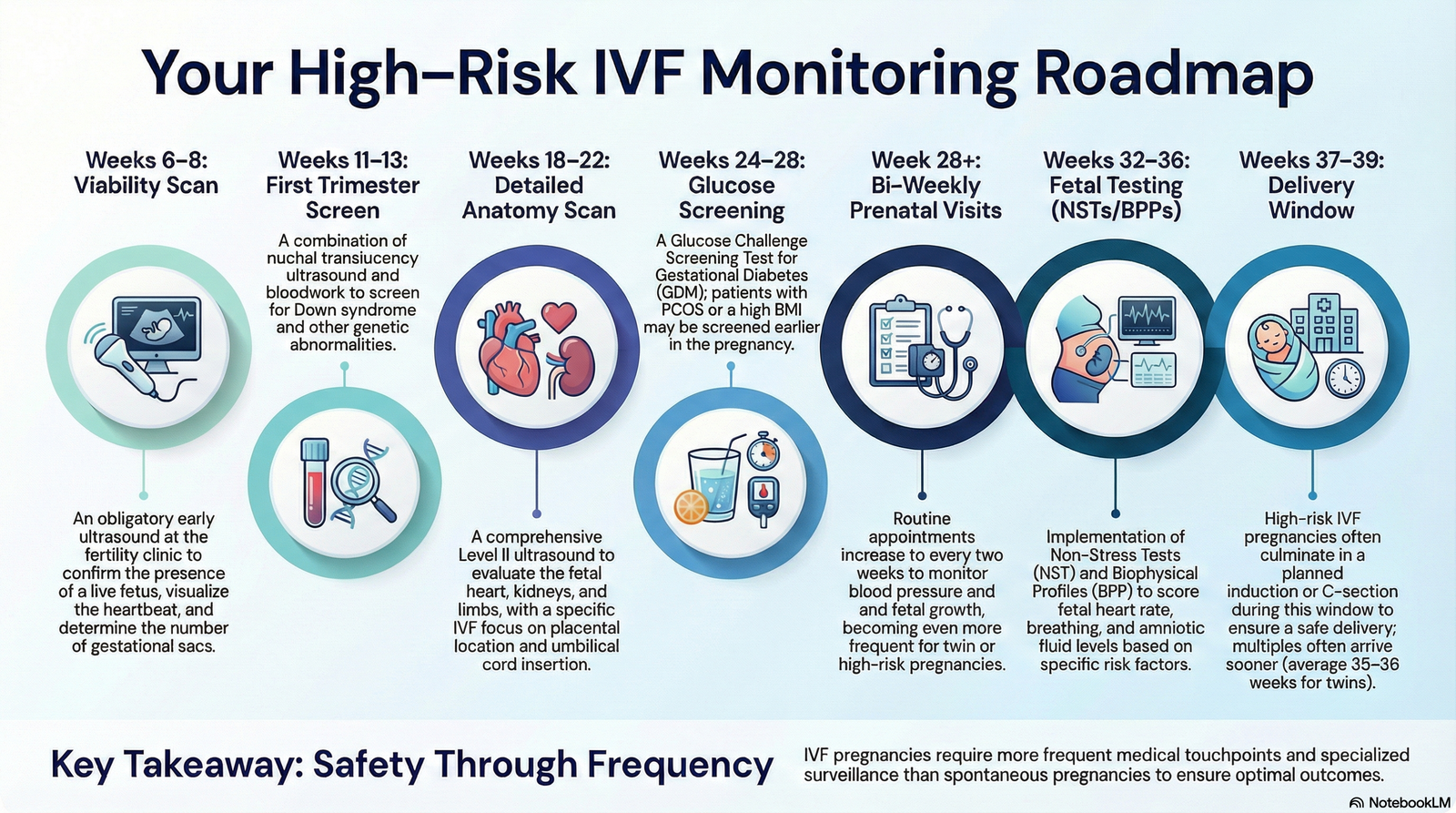
High-risk IVF pregnancy timeline: key milestones, monitoring points, and when extra scans usually happen.
| Scenario | Hypertensive Disorders | Miscarriage After First Transfer |
|---|---|---|
| Medicated FET | 18 out of 100 pregnancies | Not specifically reduced |
| Natural-cycle FET | 10 out of 100 pregnancies | Baseline miscarriage risk |
| No PGT-A (severe male factor) | Depends on FET type | 19.1% |
| With PGT-A (severe male factor) | Depends on FET type | 5.8% |
If you look at that table and feel grateful for the detail but slightly overwhelmed, you are where most IVF patients are. The numbers are there to guide decisions about protocol and monitoring, not to scare you.
First Trimester: Fragile Weeks and Big Jumps
The first 13 weeks are when most miscarriages happen, and they are also when you have the least control. That combination is brutal, especially if you have already experienced loss.
By week 4, your embryo is the size of a poppy seed. The heart and early blood vessels are forming. By the end of week 4 or sometime in week 5, a transvaginal scan often detects a heartbeat. By week 6, that “hearted lentil” might be beating at 100 to 160 beats per minute.
Vanishing Twin Syndrome
If you started with more than one sac, your early scans may show vanishing twin syndrome. This is when one or more embryos stop growing after a heartbeat has been seen.
- It usually happens before the ninth week, most often around weeks 7 or 8.
- Complete early pregnancy loss is lower in twins than in singletons, about 5.1% vs. 21.1% in one large series.
Learning that one heartbeat stopped while another continues is complicated grief. You can feel relief and grief at the same time. Both belong.
Week-by-Week Highlights, Weeks 7 to 13
- Week 7: Wrists and ankles appear. Your embryo is about half an inch long.
- Week 8: The embryo becomes a fetus. Many clinics schedule a “success scan” now to confirm heart activity and location.
- Week 9: The heart is fully formed structurally. Tooth buds start to appear.
- Week 10: Your baby measures over an inch with visible fingers, toes, and tiny nails.
- Week 11: Movement increases, including stretching, turning, and the first hiccups.
- Week 12: Reflexes are strong. Your baby can bend arms and legs and react to touch through the uterus.
- Week 13: Fingerprints form, and the overall risk of miscarriage falls sharply.
Insight: How PGT-A Affects Early Loss
In couples with severe male-factor infertility, a large randomized trial compared IVF with and without PGT-A. Live birth rates over a year were similar, but miscarriage after the first transfer was very different, 19.1% without PGT-A versus 5.8% with PGT-A. That means PGT-A did not magically create more babies; it helped some people reach the same live birth rate with fewer early losses. Source: BMJ 2025;391:e084050.
Multiple Pregnancies: Twins and More
If you are carrying twins or more, you have probably had the “we hit the jackpot” thought and the “this scares me” thought, sometimes in the same minute. Both are valid.
One of the core safety strategies in ART has been the move toward single embryo transfer to avoid higher-order multiples. Still, twins are common after IVF, and they increase risk for everyone.
- Singleton: average around 40 weeks.
- Twins: average around 35 weeks.
- Triplets: about 32 to 33 weeks.
- Quadruplets: around 30 weeks.
Babies born between weeks 24 and 27 usually need prolonged intensive care. After week 32, survival rises a lot, though some complications remain more common.
Twin-to-Twin Transfusion Syndrome (TTTS)
Identical twins that share one placenta can develop TTTS when blood flows unevenly through connecting vessels. One twin (the donor) can stop growing well, while the other (the recipient) gets fluid overloaded.
- In naturally conceived monochorionic twins, TTTS occurs in about 12.7 out of 100 pregnancies.
- In IVF monochorionic twins, reported rates are closer to 2.3 out of 100.
Your team monitors fluid levels, cord Dopplers, and growth patterns in monochorionic twins. If TTTS appears, you may be referred for laser ablation of the connecting vessels at a fetal therapy center.
Maternal Complications: Blood Sugar and Blood Pressure
Gestational Diabetes Mellitus (GDM)
Pregnancy makes your cells more resistant to insulin, so your baby gets a steady supply of glucose. When this progress goes too far, blood sugar rises, and you develop gestational diabetes.
- GDM affects about 6 to 18 out of 100 pregnancies.
- It raises the risk of preeclampsia, large babies, shoulder dystocia, and cesarean delivery.
If you have polycystic ovary syndrome, your risk climbs higher. A large review reported that women with PCOS had up to 2.4 times higher odds of developing GDM. Some studies in PCOS patients show that a high-protein, lower-carbohydrate diet and ongoing Metformin during pregnancy can lower GDM rates from around 30% to about 7%. These are options to discuss with your endocrinologist and obstetrician before and early in pregnancy.
Hypertensive Disorders in IVF Pregnancies
Pregnancy-related high blood pressure problems include gestational hypertension and preeclampsia. IVF interacts with that risk in several clear ways:
- Medicated FET cycles, especially those without a corpus luteum, show hypertensive disorder rates around 18%.
- Natural-cycle FET cycles show rates closer to 10%.
- Across different cohorts, preeclampsia often appears in 6 to 11 out of 100 ART pregnancies versus 3 to 4 out of 100 spontaneous pregnancies.
- Women over 40 who conceive with IVF or ICSI have higher rates of pregnancy-induced hypertension than women of the same age who conceive spontaneously.
If you start pregnancy with older age, a higher BMI, PCOS, a history of high blood pressure, or a strong family history, your team may recommend low-dose aspirin, more frequent blood pressure checks, and earlier or more frequent lab work. These steps do not guarantee a problem-free process, but they give you more chances to catch problems early.
Risk Interpretation
It is easy to see numbers like “2 times the risk” and feel doomed. It helps to remember that doubling a small baseline risk can still leave you in a group where most people do well. For example, if preeclampsia risk goes from 3% to 6%, you are still more likely not to develop it than to develop it, and now your team knows to watch more closely.
If you are also in a group that has faced health disparities, like Black or Hispanic women, you have an extra reason to speak up when something does not feel right. The goal is not to scare you with these numbers, but to give you and your doctors reasons to take your symptoms seriously and plan delivery in the safest setting.
Second Trimester: The “Babymoon” Window
Weeks 14 to 27 often feel like a relative break. Nausea fades for many people, your energy improves, and your bump starts to look like a baby rather than a big lunch. You still have appointments, but they may thin out a bit compared with the intense early weeks.
- Week 14: Your baby is about 3.5 inches long. Kidneys make urine that is swallowed and recycled.
- Week 16: Neck muscles strengthen, and your baby can hold the head more upright. Hearing improves.
- Week 18: Movement becomes more coordinated. Loud sounds may lead to clear kicks.
- Week 20: You reach the halfway mark. Taste buds respond to flavors in the amniotic fluid.
- Week 22: Eyebrows, eyelashes, and nails are in place. Survival rises in a modern NICU, though with high risk.
- Week 24: Brain vessels are fragile. Preventing very early preterm birth here has a big impact.
- Week 27: Last week of the second trimester. Brain activity patterns become more complex.
Third Trimester: The Final Stretch
From week 28 to delivery, you may feel like all you do is eat, pee, and go to appointments. Sleep gets complicated, and the kicks become strong enough to knock things off your belly.
- Week 28: Lungs make surfactant to keep air sacs open after birth.
- Week 29: Hiccups are common as the diaphragm practices rhythmic movement.
- Week 30: Your baby’s movements are strong. Space in the uterus feels tight.
- Week 32: Many babies move into a head-down position.
- Week 34: Bones continue to harden but remain flexible for birth.
- Week 37: Early term. Your baby gains around half an ounce per day.
- Week 40: Due date milestone. Many high-risk or IVF pregnancies have planned delivery before this point, according to your risk profile.
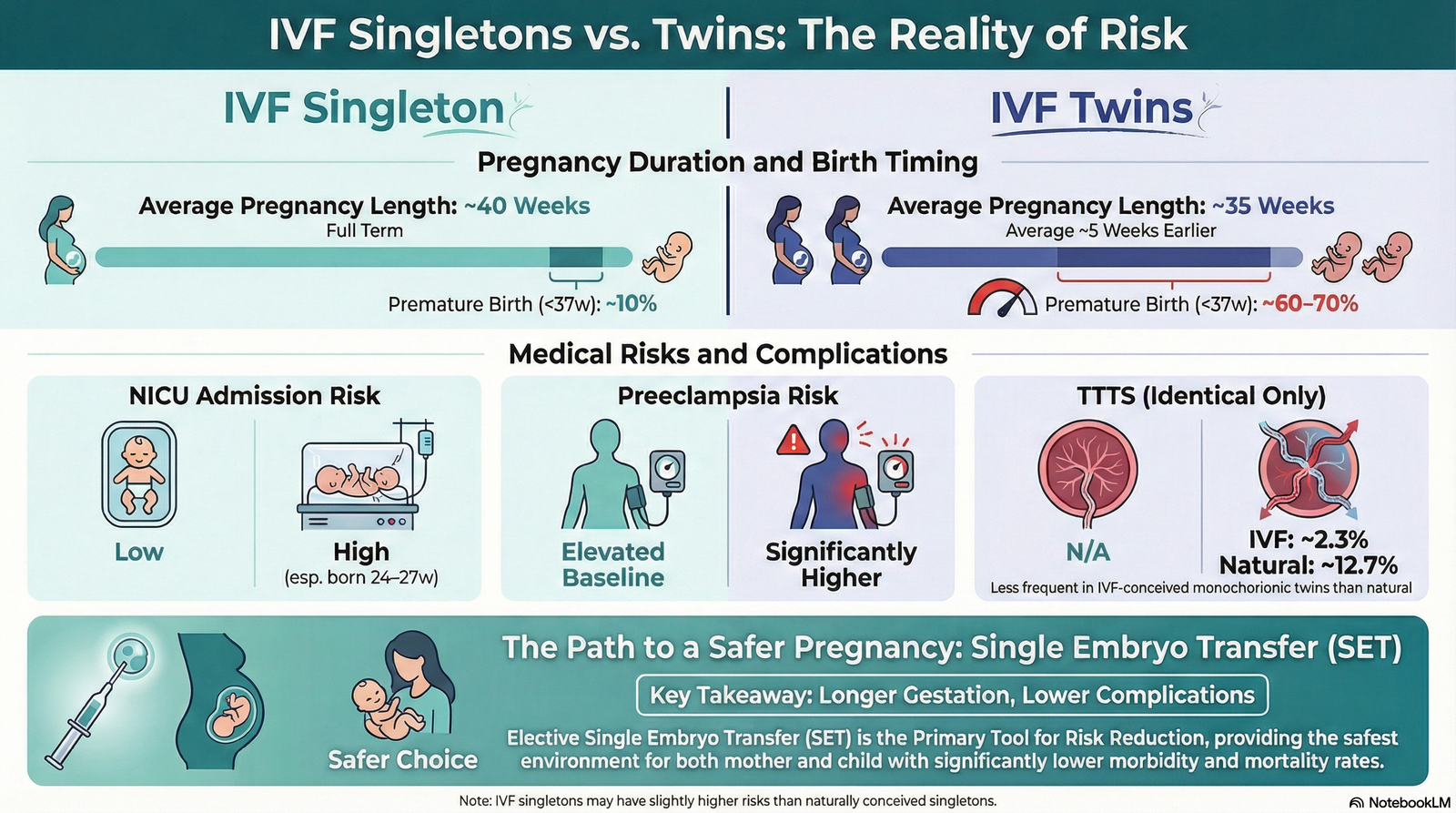
Risk and timing snapshot: how singleton and twin IVF pregnancies differ in average gestational age and complication rates.
Placenta and Cord: Your Baby’s Support System
The placenta acts as the lungs, gut, kidneys, and hormone factory for your baby. The umbilical cord is the lifeline that carries blood back and forth.
After IVF, doctors see more problems with how the placenta and cord attach and function:
- More bilobed placentas and accessory lobes.
- Higher rates of placenta previa are observed, approximately twice as high as those in spontaneous pregnancies.
- Vasa previa is more than five times as frequent in some ART cohorts.
- Marginal and velamentous cord insertions are about three times more common.
- ART pregnancies more often show a single umbilical artery, though it remains rare overal.
These issues can lead to bleeding, growth restriction, preterm birth, and, rarely, stillbirth. That is why your anatomy and follow-up scans should clearly document:
- Exact placental location (front, back, fundal, low, or covering the cervix).
- Placental shape and any extra lobes.
- Cord insertion and whether any vessels run over or near the cervix.
Pregnancy Loss and Reduction
Loss after IVF never feels abstract. You have already invested money, time, and hope. When a pregnancy stops, it rarely feels like “just biology.”
Late Miscarriage and Stillbirth
- Late loss between 12 and 24 weeks happens in about 2 to 3 out of 100 pregnancies.
- Stillbirth after 24 weeks occurs in around 1 out of 100 pregnancies overall, with higher rates in ART pregnancies and in women with hypertension, diabetes, or severe placental problems.
Knowing these numbers will not soften the experience if you have gone through it or if you are living in fear of it. What they can do is justify extra scans, more careful kick counting, and planned delivery in a setting that can respond quickly if something changes.
Multifetal Pregnancy Reduction (MFPR)
When you are carrying triplets or more, your team may talk about reducing the number of fetuses. The goal is to lower the odds of extreme prematurity and the complications that can follow.
- Reducing triplets to twins can add roughly two weeks to pregnancy and increase the share of births at or after 34 weeks.
- In some triplet pregnancies with a monochorionic pair and a singleton, reducing the pair to one baby has been linked to a gain of about 52 days of pregnancy.
Procedure-related loss can still occur, so there is no completely risk-free path. You deserve time, information, and the option of more than one expert opinion.
Recurrent Pregnancy Loss (RPL)
Doctors usually define recurrent pregnancy loss as two or more miscarriages with ultrasound or tissue confirmation. Workup often includes:
- Imaging of your uterus for septums, fibroids, or adhesions.
- Blood tests for clotting disorders, thyroid disease, and certain antibodies.
- Chromosome analysis of you and your partner.
- Genetic testing should be performed on pregnancy tissue whenever possible.
Newer research looks at markers like Inhibin A. Lower levels around six weeks have been linked to pregnancies that later miscarry, sometimes before ultrasound changes appear. These tests are not yet standard everywhere, but they show that care is moving toward earlier warning signs and more tailored interventions.
Managing Anxiety and Advocating for Yourself
By the time you reach a high-risk IVF pregnancy, your nervous system has often been on high alert for months or years. You may check every bit of toilet paper, scan your body for symptoms, and replay past losses in your head when you try to sleep.
Nothing about that makes you weak. It reflects how much you already had to manage.
- Ask for a written plan. Ask your doctor to outline your monitoring schedule and clear reasons to call outside normal hours.
- Bring another set of ears. Let a partner, friend, or family member join visits, take notes, and help you remember what was said.
- Use second opinions wisely. If your instinct says your risk is high and your concerns are brushed off, consider seeing a maternal-fetal medicine specialist.
- Lean on mental health support. Therapists, counselors, and peer groups that focus on infertility and perinatal loss know how to talk about your fears without minimizing them.
Your High-Risk IVF Monitoring Roadmap
Your plan will shift based on your risks, but many high-risk IVF pregnancies follow a pattern like this:
- Weeks 6 to 8: Transvaginal ultrasounds to confirm location, number of sacs, and fetal heartbeats.
- Weeks 11 to 13: First-trimester screening with nuchal translucency and blood tests.
- Weeks 18 to 22: Detailed anatomy scan focusing on the baby’s structures, placenta, and cord. Fetal echocardiogram if indicated.
- Weeks 24 to 28: Glucose tolerance test for gestational diabetes, sometimes earlier if you have strong risk factors.
- From week 28: Visits every two weeks, more often for twins, growth issues, or preeclampsia.
- Weeks 32 to 36: Non-stress tests and biophysical profiles as needed based on your risk profile.
- From week 36: Weekly visits and testing until delivery. Many high-risk and IVF pregnancies have planned induction or cesarean between 37 and 39 weeks.
OVU Expert Perspective
What you want most at this stage is predictability. A clear schedule of scans, lab work, and visits gives structure to weeks that can otherwise feel endless. Ask your team to tell you not just what is happening at the next visit, but also how all these pieces fit into the bigger picture of getting you and your baby safely to delivery.
Want help comparing clinics and monitoring plans?
If this feels like a full-time job and in many ways it is, our advisors can collect clear, itemized quotes from verified clinics, explain how their high-risk monitoring works, and help you map out your next steps at no cost to you.

Why trust this guide? The OVU commitment
You are probably juggling hope, timelines, and a lot of tabs open in your browser. And you deserve clear, current, human advice. At OVU, we review clinic protocols, compare real quotes, and talk to people who have done this - intended parents and gestational carriers - so we can give you practical steps, not just theory. If you want help comparing options without sales pressure, we will gather itemized quotes and success data that match your exact situation. You decide, we will bring the info to your table.
Frequently Asked Questions
Is it my fault if I lose this pregnancy?
No. Most early losses come from chromosomal problems in the embryo or severe placental issues that you cannot change with diet, exercise, or mindset. Self-blame is a common reaction, but it does not match what we see in the data. You did not cause this by something you did or did not do.
Does IVF raise the risk of birth defects?
Some older studies found small increases in certain anomalies after IVF and ICSI, especially when male-factor infertility was involved. More recent work shows that much of that signal is driven by multiples. When you look only at singletons, the rate of major defects is close to the general population rate of about 3 percent. Your age, cause of infertility, and type of treatment all play a role.
Do I need a fetal echocardiogram?
Many specialists recommend a fetal echo for IVF pregnancies, especially when ICSI was used, there is a family history of heart disease, or the standard anatomy scan was not crystal clear. If your detailed 20-week scan shows normal heart structures and flow, the chance of a serious defect is low. Small ventricular septal defects, tiny holes between the heart's lower chambers, often close on their own in the first year of life.
What if I bleed in the first trimester?
Call your doctor, but do not assume the worst. Bleeding is a warning sign that needs a check, not automatic proof of miscarriage. In IVF twin pregnancies, early bleeding is linked to a higher chance of low birthweight, but live birth rates remain high. Your team will likely repeat an ultrasound, check your cervix, and sometimes do blood tests.
Is bed rest required with twins?
No. Strict bed rest has not been shown to prevent preterm birth and can increase the risk of blood clots and muscle loss. Many doctors recommend easing up on heavy lifting, long hours on your feet, and high-impact exercise after 20 to 24 weeks. Your plan may change if your cervix starts shortening or other complications appear.
Will I need a cesarean section?
You might, especially if you are over 40, have a donor egg pregnancy, placenta previa, or a baby that is not head down. In some studies of women over 40, cesarean rates were around 78 percent after IVF compared with about 68 percent in spontaneous pregnancies. When the first twin is head down and there are no other concerns, vaginal birth can still be a safe option in the right setting.
How much weight should I gain with twins?
For people who start pregnancy at a normal BMI, guidelines suggest a gain of about 37 to 54 pounds with twins. The focus is on steady gain, especially in the first half of pregnancy, to support good placental function and birthweights. Your doctor or dietitian can adjust that target if you start underweight, overweight, or with other health conditions.
Reference List 8 sources
Journal Article (Research): Su Y, Niu Y, Zhao B, Su S, Klein C, Hou X, et al. Hypertensive disorders of pregnancy and gestational diabetes mellitus affect fetal growth and perinatal outcomes in women undergoing in vitro fertilization. AJOG Global Reports. 2025;5(4):100571. PMID: 41230473. Available from: https://pubmed.ncbi.nlm.nih.gov/41230473/
Journal Article (Research): Collée J, Noel L, Seidel L, Chantraine F, Nisolle M, Henry L. Impact of assisted reproduction techniques on adverse maternal outcomes and on the rate of hospitalization in maternal intensive care. Medicina (Kaunas). 2023;59(11):2030. PMID: 38004079. Available from: https://pubmed.ncbi.nlm.nih.gov/38004079/
Journal Article (Research): Siargkas A, Tsakiridis I, Giouleka S, Chaveeva P, Mar Gil M, Plasencia W, et al. The association of assisted reproductive technology with placental and umbilical abnormalities. Journal of Personalized Medicine. 2025;15(5):176. PMID: 40423048. Available from: https://pubmed.ncbi.nlm.nih.gov/40423048/
Journal Article (Research): Mao J, Yang G, Su Q, Zeng Z, Lin J, Kong L, et al. Maternal and neonatal perinatal outcomes of singleton pregnancies in advanced-age women undergoing IVF/ICSI-ET compared with spontaneous conception: a retrospective propensity score matched cohort study. International Journal of General Medicine. 2024;17:5249–5259. PMID: 39554873. Available from: https://pubmed.ncbi.nlm.nih.gov/39554873/
Journal Article (Systematic Review & Meta-Analysis): Anonymous. Obstetric and perinatal outcomes in singleton pregnancies following medicated, stimulated, and natural frozen embryo transfer cycles: an updated systematic review and meta-analysis. Human Fertility (Camb). 2024;online ahead of print. PMID: 40356454. Available from: https://pubmed.ncbi.nlm.nih.gov/40356454/
Journal Article (Randomized Controlled Trial): Lin X, Wu D, Zhang C, Wang L, Lu Y, Zhou P, et al. Preimplantation genetic testing for aneuploidy versus no genetic testing in couples undergoing intracytoplasmic sperm injection for severe male infertility: multicentre, open-label, randomised controlled trial. BMJ. 2025;391:e084050. Available from: https://www.bmj.com/content/391/bmj-2025-084050
Committee Opinion (Guidance): American College of Obstetricians and Gynecologists. Perinatal risks associated with assisted reproductive technology. Committee Opinion No. 671. Obstetrics & Gynecology. 2016;128(3):e61–e68. PMID: 27548556. Available from: https://www.acog.org/clinical/clinical-guidance/committee-opinion/articles/2016/09/perinatal-risks-associated-with-assisted-reproductive-technology
Consult Series (Guidance): Society for Maternal-Fetal Medicine. Management of pregnancies resulting from in vitro fertilization. SMFM Consult Series #60. American Journal of Obstetrics & Gynecology. 2022;guidance. Available from: https://publications.smfm.org/publications/435-society-for-maternal-fetal-medicine-consult-series-60/
Final Thoughts
A high-risk IVF pregnancy is not a gentle walk. It is a series of climbs where you keep finding new strength that you did not know you had. You juggle scan reports, lab numbers, and memories of past cycles or losses, all while trying to picture yourself finally leaving the hospital with your baby.
Even on the days when you feel worn down, every stable blood pressure reading, every good growth scan, and every “see you next week” is a real step forward. You are not just a case on a list. You are someone who kept showing up for early morning blood draws, signed consent forms with shaking hands, and still chose to try again.
Your team can bring the science, the monitoring, and the backup plans. You bring the courage to stay in it. Together, you can give this pregnancy the closest watch possible and permit yourself to hope again and again, until that hope becomes a baby in your arms.