


Dr. Sony Sherpa (MBBS)
In addition to her clinical experience, Dr. Sherpa is a published medical researcher and holistic health advocate. Her dual expertise in emergency care and alternative therapies brings a unique lens to medically reviewed content—ensuring it is both accurate and accessible.
If you are staring at IVF prices in your home country and wondering how you will ever afford more than one cycle, you are not the only one doing that math. Many patients consider Turkey as their ideal destination for cross-border fertility care when the combination of age, time pressure, and cost starts to seem impossible to balance.
Turkey has emerged as a major IVF destination, with national data showing live birth rates of about 31 percent per fresh transfer and just over 40 percent per frozen transfer, and up to 51 percent when PGT-tested embryos are used. Those numbers put well-run Turkish clinics in the same league as many Western European centers, often at half to one-third of the price.
This guide gives you a clear, useful picture of what IVF in Turkey is really like. You will see how the bundles work, what you can expect to pay, how success rates compare to those in the UK and Europe, and which decision points are most important when you choose a clinic.
A standard IVF or IVF–ICSI cycle in Turkey with your own eggs and partner’s sperm usually starts around $3,000–$3,800 USD before medication. National data suggest roughly a 30–40 percent live birth rate per transfer, and about 50 percent per transfer when PGT-tested embryos are used. All-in packages that include medication, hotel, and local transfers typically range from $4,000 to about $6,300 USD.
Next step: Decide whether you need a simple IVF cycle, an all-inclusive package, or a PGT-focused plan, then compare two or three clinics against the benchmarks in this guide before contacting them.
What the Latest Research Shows
European registry reports now include more than 11 million ART cycles and over two million births, with typical pregnancy rates per transfer around 33–36 percent and cumulative delivery rates near 32 percent per started cycle. A 2019 Turkish survey of 25 IVF centers found fresh transfer resulted in live birth rates near 31 percent, frozen transfer rates around 40 percent, and PGT cycles at about 51 percent.
UK regulator data from the 2023 report indicate live birth rates of approximately 25 percent per fresh embryo transferred and 33 percent per frozen embryo transferred, with pregnancy rates up to 41 percent in women under 35. These statistics provide a realistic framework for evaluating clinic marketing claims of “80–90 percent success” in one cycle.
In This Guide
Basic IVF or IVF–ICSI: $3,000–$3,800 USD
All-inclusive plans: $4,000–$6,300 USD
Fresh transfer: ~31% per transfer
Frozen transfer: ~40% per transfer
Patients seeking lower costs, more cycles bundled, or access to PGT while staying within a fixed budget.
Why People Choose IVF in Turkey
Many patients explore Turkey as a fertility hub, where a full treatment cycle is often available for under $7,000 or even less than $5,000. This low-cost environment becomes highly appealing when comparing it to domestic care options, where bundled packages, both standard and premium, are often cost-prohibitive. While patients in their home countries may face quotes of $12,000–$20,000 USD per cycle, and clinicians often advise that a single attempt is frequently insufficient to achieve pregnancy, Turkey offers a compelling financial alternative. The cost-effectiveness is particularly notable when considering comprehensive packages such as blastocyst guarantees or guaranteed live birth programs, which often carry high premiums domestically. With a budget of approximately $13,000, Turkey enables patients to plan for two or three consecutive cycles or to include advanced procedures like Preimplantation Genetic Testing (PGT) without incurring substantial financial hardship.
Turkey’s larger hospital networks feature IVF units similar to high-end European centers. They offer modern laboratories, embryologists who work with high cycle volumes, and international patient teams that speak several languages and assist patients in navigating the entire process. For many patients, this combination of quality, cost-effectiveness, and support is the deciding factor.
Latest Research Insights
51% vs. 31% – Turkey’s Top-End Results: A national survey of 25 Turkish IVF centers reported live birth rates of about 31 percent with fresh transfers, 40 percent with frozen transfers, and 51 percent when PGT-tested embryos were used. For you, that means that when you have good embryos and use a modern freeze-and-test strategy, your chance per transfer can be close to one in two.
33–36% Per Transfer – Europe’s Real-World Average: European registry data show pregnancy rates of around 33 percent per transfer for IVF, 33 percent for ICSI, and 36 percent for frozen transfers, with egg donation near 51 percent. This gives you a fair comparison point when you read clinic brochures from Turkey or anywhere else.
1 in 3 to 2 in 5 – Current UK Outcomes: UK data for 2023 report birth rates of about 25 percent per fresh embryo transferred and 33 percent per frozen transfer, with pregnancy rates up to 41 percent in women under 35. A good Turkish center talking to you honestly will usually describe chances per transfer in this range, adjusted for your age.
These figures are not promises for any one person, but they help you spot when a claim sounds too good to be true.
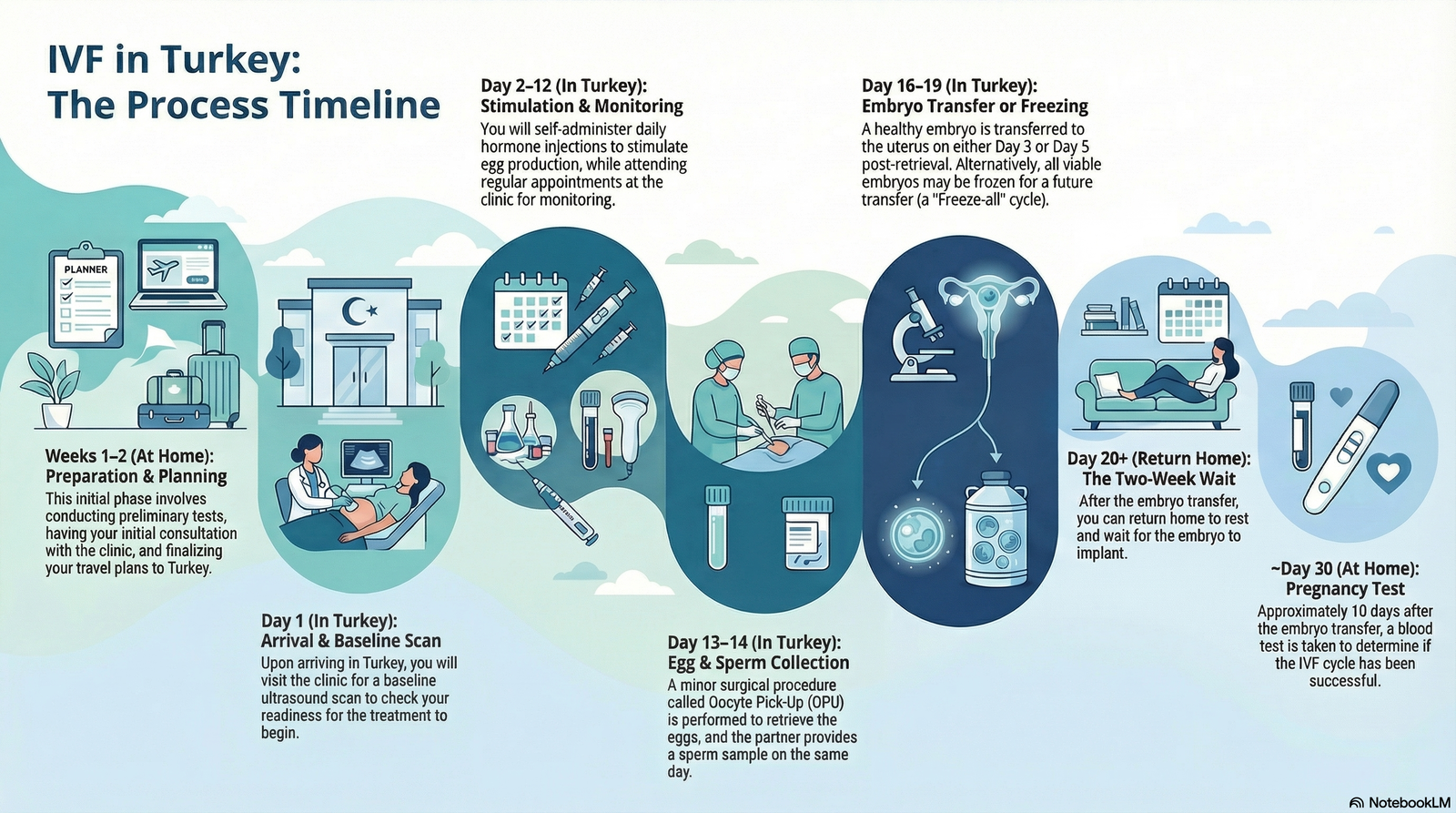
Typical IVF timeline: from stimulation to embryo transfer and pregnancy test.
IVF Costs and Package Types in Turkey
Most Turkish clinics sell IVF as a package, not as separate line items. You pay one fee for the main medical steps, then add medication, genetic testing, and frozen embryo transfers on top. Understanding what is inside each bundle makes a big difference to your real budget.
Core IVF / IVF–ICSI Cycle Prices
A standard IVF or IVF–ICSI cycle with your own eggs and partner’s sperm usually falls in this range:
| Clinic or Network | Starting Price | Locations | Main Notes |
|---|---|---|---|
| Medicana IVF Network | $3,000 USD | Istanbul, Ankara, Samsun, Konya | Mini-IVF or IVF–ICSI; includes cycle medication and one year of embryo storage. |
| Yeditepe University Hospital | $3,300 USD | Istanbul | IVF or IVF–ICSI; medication, PGT, freezing, and storage excluded. |
| Medipol Mega University Hospital | $3,500 USD | Istanbul | IVF drugs, PGT, and freezing excluded, broad international support services. |
| Memorial Hospital Network | $3,500 USD | Ankara, Istanbul, Diyarbakır, Kayseri | IVF drugs, PGT, and storage excluded; full andrology and genetics units. |
| Bahçeci Health Group | $3,800 USD | Multiple centers | Basic IVF; ICSI, IMSI, and Embryoscope already included. |
| Dr. Cengiz Sagiroglu IVF | €2,500 EUR | Istanbul | Basic IVF/ICSI; medication, transport, and hotel excluded. |
All-Inclusive and Premium Packages
If you would rather pay one larger fee and have most things handled for you, some centers offer full packages that include medication, accommodation, and transfers.
- Bahçeci VIP package: about $6,300 USD, includes IVF treatment, full pre‑IVF blood tests for both partners, airport transfers, and 15 nights in a hotel with breakfast.
- Dr. Cengiz Sagiroglu PREMIUM plan: €5,500 EUR, includes consultation, stimulation, monitoring, egg collection, ICSI, culture to day 5, fresh transfer, freezing of extra embryos with first‑year storage, all cycle medication, airport transfers, 20 nights in a partner hotel for two people with breakfast, and all local transfers.
- Dr. Cengiz Sagiroglu ADVANCED plan: €4,000 EUR, includes the full medical cycle and stimulation, trigger, and luteal support medication up to the fresh transfer.
Medication and Typical Drug Costs
Medication is the biggest difference between “cheap” and “realistic” price quotes. If a package excludes drugs, you should add them to your budget to understand the potential final price tag. Turkey’s local prices help:
- Gonal F 450 IU: about $130 USD per pen.
- Meriofert 75 IU: about $10 USD per vial.
- Ovitrelle: about $20 USD per pre‑filled syringe.
If your plan does not include medication, a typical budget for stimulation, trigger, and early luteal support is around €1,700–€2,200 EUR per cycle. If you need extra luteal or pregnancy support around week 11, you can add roughly €500 EUR in medication.
| Cost Component | Low Range | High Range | Notes |
|---|---|---|---|
| Core IVF / IVF–ICSI cycle | $3,000 USD | $3,800 USD | Own eggs and partner’s sperm, main procedures only. |
| Medication per cycle | €1,700 EUR | €2,700 EUR | Stimulation, trigger, and luteal support drugs. |
| PGT-A for several embryos | $620 USD | $5,900 USD | Per embryo screening or full PGT cycle bundles. |
| Frozen embryo transfer | $1,500 USD | €1,150 EUR | Thawing and transfer of frozen embryos. |
| All-inclusive package | €4,000 EUR | $6,300 USD | Includes meds and hotel; details vary by clinic. |
Success Rates: Turkey vs. the UK and Europe
Once you know what you will spend, the next question is what you can realistically expect in return. You want numbers that are clear enough to plan with, without falling for promises that no clinic can keep.
National Turkish Data
A nationwide survey of 25 Turkish IVF centers covering 18,127 embryo transfers in 2019 gives a useful baseline:
- Fresh transfers recorded a live birth rate of about 30.6 percent per transfer.
- Frozen transfers recorded about 40.1 percent live birth per transfer.
- PGT cycles showed about 50.7 percent live birth per transfer.
Single embryo transfers made up about 65.3 percent of all embryo transfers, and singleton births were 86.1 percent of deliveries. These patterns line up well with the European move toward single embryo transfer for safety.
Europe and UK Benchmarks
Zooming out to the European registry (over one million cycles a year) and the UK:
- European data show pregnancy rates per transfer around 33 percent for IVF, 33 percent for ICSI, and 36 percent for frozen transfers, with egg donation around 51 percent.
- Across countries that report fresh and frozen together, the cumulative delivery rate per started cycle sits near 32 percent.
- UK data from a 2023 report about 25 percent of live birth per fresh embryo transferred and about 33 percent per frozen transfer, with pregnancy rates up to 41 percent in women under 35.
When a clinic in Turkey quotes success rates, you can place them beside these baselines. If numbers are far higher than these for broad age groups, ask which patients are included and whether rates are per cycle started, per transfer, or per PGT-tested embryo.
Interpreting the Numbers for Your Situation
40–50% Live Birth Per Transfer – When Strategy Is Right: Turkish data show about 40 percent live birth per frozen transfer and 51 percent with PGT-tested embryos. If your doctor expects good embryo quality and you can afford PGT, a freeze-and-test plan can give you chances near those top-line figures per transfer.
32% Cumulative – Plan for More Than One Transfer: European registry data show cumulative delivery rates around 32 percent per started cycle. The takeaway for you is that most people reach their goal over several transfers from one or more egg collections, not from a single fresh transfer alone.
Protocols and Safety Standards
Beyond success rates, you want to know how safely clinics in Turkey run stimulation and embryo transfer. The aim is a healthy singleton birth with as little risk to you as possible.
Stimulation Protocols and OHSS Risk
Modern guidelines from ESHRE recommend GnRH antagonist protocols for most IVF patients because they deliver similar live birth rates to agonist protocols while reducing the risk of ovarian hyperstimulation syndrome (OHSS). With antagonists, clinics can also use an agonist trigger and freeze-all approach in high responders, which helps keep severe OHSS very rare.
Large European reports place severe OHSS at well under 1 percent of cycles, often below 0.2 percent, when clinics follow prevention strategies. When you look at a Turkish plan, you can ask which protocol the clinic uses, how they may adapt medication doses to your ovarian reserve, and what triggers and freeze strategies they use to keep you safe.
Single vs Double Embryo Transfer
A major safety and outcome decision is how many embryos to transfer. A large meta-analysis of single versus double embryo transfer found that single embryo transfer cut the risk of multiple pregnancy to a small fraction of the risk after double transfer, while still giving strong live birth rates, especially in women under 40 with good-quality embryos.
In the Turkish national survey, about two-thirds of transfers used a single embryo, and twin and higher multiple births made up about 14 percent of deliveries. Many clinics already support single embryo transfer for patients with a good prognosis. You can and should ask about this if you want to lower risk while keeping good odds across several transfers.
Safety, Protocols, and What Top Clinics Do
0.2% or Fewer – Severe Stimulation Complications: Large datasets report serious OHSS in fewer than two out of 1,000 cycles when clinics use antagonist protocols, tailored dosing, and freeze-all strategies in high responders. With this approach, serious complications become unusual events rather than something you should expect.
Single Embryo Transfer – Big Drop in Twin Risk: Reviews of single versus double embryo transfer show that single embryo transfer keeps live birth chances strong while making twins much less likely. That is one of the clearest safety wins you can choose, especially if weight, blood pressure, or age already increase your pregnancy risks.
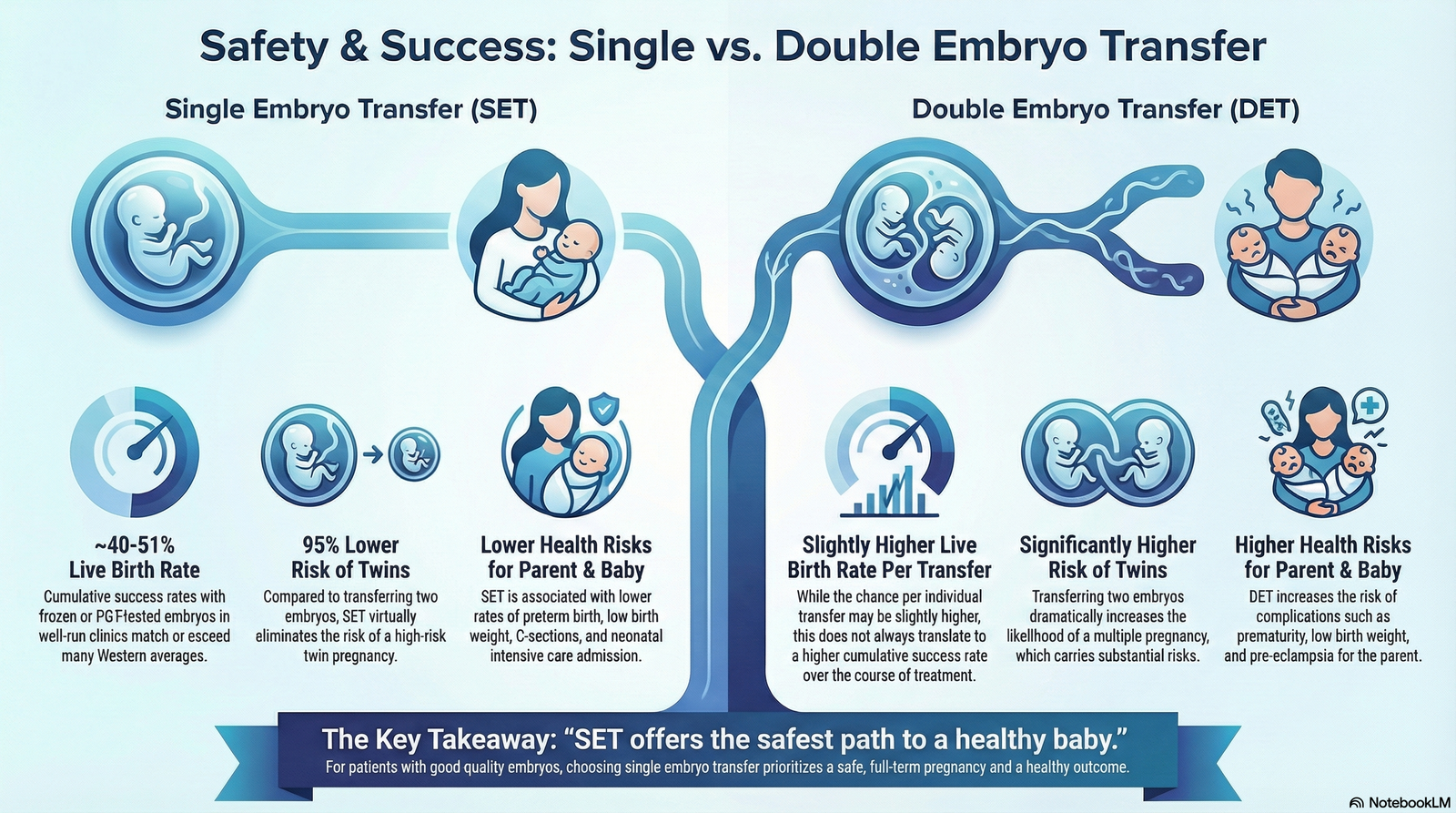
Single embryo transfer lowers twin risk while keeping strong success rates, especially with good-quality blastocysts.
Top Clinic Networks and What They Offer
Turkey’s IVF landscape is built around large hospital networks and focused IVF clinics. Each has its own style and mix of services. Here is how the main players position themselves.
Medipol Mega University Hospital (Istanbul)
Medipol Mega is a large multi‑speciality hospital with a full IVF and genetics center. It has 470 beds, more than 130 intensive care beds, and 25 operating rooms. The international department supports communication in over 20 languages, and offers airport transfers, interpreter services, a dedicated IVF case manager, and translation of key documents into English.
IVF cycles start around $3,500 USD, with PGT cycles for three embryos around $5,900 USD. Medication, freezing, and storage are usually priced separately.
Medicana IVF Network
Medicana’s main advantage is that some bundles already include medication and embryo freezing with storage. Clinics in this network operate in Istanbul, Ankara, Samsun, and Konya. Their mini‑IVF and IVF–ICSI bundles start at about $3,000 USD, and they offer add-ons such as ERA testing and microchip sperm selection.
Memorial Hospital Network
Memorial runs IVF units in several cities. These centers integrate andrology and genetics and offer surgical sperm retrieval methods such as MESA and Micro‑TESE. Standard IVF cycles start around $3,500 USD, before drugs and advanced testing.
Bahçeci Health Group
Bahçeci is known for publishing detailed age‑stratified success rates. Their basic IVF package, around $3,800 USD, includes ICSI, IMSI, and Embryoscope. Their VIP package, about $6,300 USD, folds in pre‑treatment blood work, airport transfers, and a 15‑day hotel stay.
Dr. Cengiz Sagiroglu IVF
This clinic focuses on clear pricing tiers. The basic plan (€2,500) covers the medical cycle without medication or hotel. The advanced plan (€4,000) adds stimulation and trigger medication. The premium plan (€5,500) adds medication, about 20 nights of hotel for two people, and all transfers between the airport, hotel, and clinic.
Travel, Stay, and Practical Logistics
Choosing IVF in Turkey means planning a medical treatment and a short‑term relocation at the same time. If you time it well, that stay can run smoothly instead of adding more stress.
Length of Stay
For one IVF cycle, you usually need to be in Turkey for about two to three weeks. Your doctor may want some baseline tests done at home, but stimulation, monitoring, egg collection, and embryo transfer happen on site.
Clinic Support for Overseas Patients
Larger hospitals and networks often help you with:
- Airport pick‑up and return transfers.
- Daily or scheduled transfers between the hotel and clinic.
- Interpreter services in your language.
- Appointment scheduling and IVF case management.
- Hotel recommendations or a full hotel booking inside a package.
If your plan does not include hotel and transfers, you should budget those yourself. One clinic estimates that 20 nights in a hotel for two adults, with airport and clinic transfers, runs to about €1,700 when managed privately.
Pros and Cons of IVF in Turkey
Advantages
- Lower cycle costs: Basic IVF or IVF–ICSI cycles often cost less than $4,000 USD before medication.
- Access to advanced lab work: ICSI, IMSI, blastocyst culture, and PGT are widely available and priced below many Western centers.
- Cheaper medication: Common IVF drugs cost far less in Turkey than in many patients’ home countries.
- Strong national outcomes: Live birth rates for frozen transfers and PGT cycles compare well with large European registries.
- All-in options: Some clinics offer packages that fold in medication, hotel, and transfers so you can plan with a single number.
Drawbacks
- Extra costs outside the headline price: Drugs, PGT, FET, hysteroscopy, and surgical sperm retrieval often sit outside the basic cycle price.
- Time away from home: You and your partner may need to be away from work and home support for several weeks.
- Legal limits for donors and surrogacy: The clinical sources summarized here focus on own‑egg, partner‑sperm cycles and do not cover detailed legal rules for donor gametes or surrogacy, so you will need separate legal advice if these apply to you.
- PGT adds steps and cost: A PGT‑based plan requires biopsy, freezing, and at least one FET, which extends the timeline and budget.
Want help comparing clinics and costs?
If comparing all these packages feels like a part‑time job, OVU advisors can gather clear, itemized quotes from trusted clinics in Turkey and help you see how many cycles and which add‑ons fit within your budget.

Why trust this guide? The OVU commitment
You are probably juggling hope, timelines, and a lot of tabs open in your browser. And you deserve clear, current, human advice. At OVU, we review clinic protocols, compare real quotes, and talk to people who have done this - intended parents and gestational carriers - so we can give you practical steps, not just theory. If you want help comparing options without sales pressure, we will gather itemized quotes and success data that match your exact situation. You decide, we will bring the info to your table.
Frequently Asked Questions
How many IVF cycles should I plan for in Turkey?
Cumulative birth rates across Europe sit near 32 percent per started cycle. That means many people need more than one transfer from one or more egg collections to have a baby. If your budget allows, planning financially for at least two stimulation cycles or one stimulation with several frozen transfers gives you a more realistic margin.
Is it safe to do a single embryo transfer if I am traveling from abroad?
Yes. Single embryo transfer is often safer, especially if you are traveling. It reduces twin risk and the medical complexity of your pregnancy. With good‑quality blastocysts and possibly PGT if indicated, single embryo transfer can still deliver strong success rates across several transfers.
Can I start testing at home and then move my cycle to Turkey?
Many patients complete basic blood work, infectious disease screening, and sometimes a semen analysis at home, then share those results with the Turkish clinic. The clinic will still repeat some tests on-site, but starting at home can save time once you arrive. Ask the clinic exactly which tests they accept from external labs.
How do I compare two clinics that look very similar?
You can ask each clinic to send a written quote that lists what is included and excluded, including medication, PGT, freezing, and storage. Then ask for their single embryo transfer rate, multiple birth rate, and policies for high responders. When you line up those answers beside price, you usually see a clear frontrunner.
Reference List 8 sources
Journal Article (Research): Benlioğlu C, Aydın Y, Bahçeci M, et al. Demographic distributions and clinical results of assisted reproduction techniques in Turkey in 2019: a descriptive survey. J Turk Ger Gynecol Assoc. 2024;25(1):18–23. PMID: 38444322. Available from: https://pubmed.ncbi.nlm.nih.gov/38444322/
Journal Article (Research): European IVF Monitoring Consortium (EIM) for ESHRE; Wyns C, De Geyter C, Calhaz‑Jorge C, et al. ART in Europe, 2018: results generated from European registries by ESHRE. Hum Reprod Open. 2022;2022(3):hoac022. PMID: 35795850. Available from: https://pubmed.ncbi.nlm.nih.gov/35795850/
Website/Report: European Society of Human Reproduction and Embryology (ESHRE). ART fact sheet +10 (ART in Europe 2020 overview). ESHRE Press Room. 2025; Version 10. Available from: https://www.eshre.eu/-/media/sitecore-files/Press-room/ESHRE_ARTFactSheet_v10_2025.pdf
Website/Report: Human Fertilisation and Embryology Authority (HFEA). Fertility treatment 2023: trends and figures. HFEA Official Statistics Report. Published June 2025. Available from: https://www.hfea.gov.uk/about-us/publications/research-and-data/fertility-treatment-2023-trends-and-figures/
Journal Article (Systematic Review & Meta-Analysis): Zhang Y, Wang X, Zeng C, et al. Comparisons of benefits and risks of single embryo transfer versus double embryo transfer: a systematic review and meta-analysis. Reprod Biol Endocrinol. 2022;20(1):26. PMID: 35086551. Available from: https://pubmed.ncbi.nlm.nih.gov/35086551/
Journal Article (Guideline): ESHRE Guideline Group on Ovarian Stimulation; Broekmans F, Bosch E, Griesinger G, et al. ESHRE guideline: ovarian stimulation for IVF/ICSI. Hum Reprod Open. 2020;2020(2):hoaa009. PMID: 32395637. Available from: https://pubmed.ncbi.nlm.nih.gov/32395637/
Committee Opinion (Guidance): Practice Committee of the American Society for Reproductive Medicine. Prevention and treatment of moderate and severe ovarian hyperstimulation syndrome: a guideline. Fertil Steril. 2016;106(7):1634–1647. PMID: 27678032. Available from: https://pubmed.ncbi.nlm.nih.gov/27678032/
Journal Article (Registry Overview): De Geyter C, Wyns C, Calhaz‑Jorge C, et al. 20 years of the European IVF-monitoring Consortium registry: what have we learned? A comparison with registries from two other regions. Hum Reprod. 2020;35(12):2832–2849. PMID: 33188410. Available from: https://pubmed.ncbi.nlm.nih.gov/33188410/
Final Thoughts
IVF in Turkey gives you a way to stretch your budget without lowering the standard of care you receive. You can plan one or more cycles, consider PGT if it suits your situation, and still stay within a budget that might only cover a single attempt at home.
The right choice for you comes down to three questions. First, can you fund several transfers or cycles rather than pinning all your hope on one try? Second, do you feel comfortable traveling and being away from home support? Third, do you feel you can communicate clearly with your chosen clinic and trust their process? Once you answer those questions, the numbers in this guide will help you choose the clinic and package that match your needs.
Ready to compare real offers from Turkish clinics?
You can share your age, diagnosis, and budget, and OVU can match you with clinics that fit your plan, so you spend less time emailing quotes and more time deciding what feels right for you.