


Dr. Sony Sherpa (MBBS)
In addition to her clinical experience, Dr. Sherpa is a published medical researcher and holistic health advocate. Her dual expertise in emergency care and alternative therapies brings a unique lens to medically reviewed content—ensuring it is both accurate and accessible.
The journey to parenthood through in vitro fertilization (IVF) often feels like a long series of appointments, injections, and two-week waits. Then everything changes in a single hour when your baby is finally placed in your arms. The quiet reality of your home replaces the structured world of the fertility clinic, and you are suddenly responsible for a real, breathing person.
If you look at your small, tense newborn and feel both overwhelming love and sharp anxiety, you are not failing. Your body is sore and bleeding, your hormones are crashing and surging, and your mind is still catching up to the fact that after all those years of trying, you are now someone’s parent. These first 1,000 hours, roughly the first six weeks, are sometimes called the “fourth trimester”. They form a bridge between the high-tech world of IVF and the messy, physical, emotional reality of life with a newborn.
Large studies help put this experience into context. About 25% of babies born after assisted reproduction go to the neonatal intensive care unit (NICU), compared with about 10% of naturally-conceived babies. Around 27% of IVF babies weigh under 2.5 kg at birth, compared with about 8% of naturally conceived babies. Yet when researchers look only at single babies, long-term health, cancer risk, and school progress for IVF children are described as reassuring and very similar to their peers. Understanding this mix of higher early monitoring and strong long-term outcomes can help you move through these first weeks with a bit more confidence.
During the first 1,000 hours after birth, many IVF newborns need closer monitoring, and some spend time in the NICU, especially if they are born early or are smaller at birth. For single IVF babies, early risks are usually modest and short-term, and long-term health and school outcomes are very similar to those of naturally conceived children. Your job in these weeks is to keep your baby safe, notice warning signs, and allow your body and mind to recover from pregnancy and treatment.
Next step: Ask your team before birth how your hospital handles IVF deliveries, NICU decisions, and follow-up so you know what to expect if your baby needs extra care.
What the latest research shows about IVF newborns
Recent large studies from journals such as JAMA Network Open, CMAJ Open, PLOS Medicine, and Human Reproduction Update follow hundreds of thousands of IVF-conceived children. They show higher rates of NICU admission, prematurity, and low birth weight in the early days, especially for twins and triplets. At the same time, they report no overall increase in childhood cancer, reassuring long-term health for single babies, and school performance that matches or slightly exceeds naturally conceived peers.
In simple terms, IVF often makes the first hours and days more medical, but it does not mean your child is destined for poor health. Many of the early differences come from carrying more than one baby and from underlying infertility, not from IVF itself.
In This Guide
IVF / ART babies: 25.3%
Natural conception: 9.7%
IVF / ART babies: about 27%
Natural conception: about 8%
IVF children show similar school readiness and test scores to peers in large population studies.
Quick facts: IVF newborn outcomes at a glance
Seeing the numbers in one place can help you understand what is happening around you in the hospital. It also helps you ask better questions and push back on vague reassurance when you need clearer answers.
| Outcome | IVF / ART Babies | Naturally Conceived Babies |
|---|---|---|
| NICU admission | 25.3% | 9.7% |
| Low birth weight (< 2.5 kg) | 26.9% to 27% | 7.6% to 8% |
| Major birth defects | About 3.7% in one sibling study | About 1.4% in the same study |
Latest Research Insights
1 in 4 vs. 1 in 10, NICU reality check: A Canadian study of more than 518,000 births found that about 1 in 4 assisted reproduction babies went to NICU, compared with about 1 in 10 naturally conceived babies. Most of this difference came from twins and early births, not from IVF itself. This means that if your IVF baby goes to NICU, you are not alone, and it usually reflects closer monitoring rather than a disaster. Source: CMAJ Open (PMID: 37171904).
Low birth weight gap, 27% vs. 8%: The same study reported low birth weight in about 27% of assisted reproduction babies, compared with about 8% of naturally conceived babies. That sounds big, but much of it is driven by twins and triplets and births before full term. Knowing these statistics helps you understand why staff weigh your baby so often and watch feeding so closely in those early days. Source: CMAJ Open (PMID: 37171904).
Singletons catch up, IVF vs. natural: A hospital cohort of 1,770 babies found more prematurity, low birth weight, and longer stays in the IVF group at first glance. Once the team looked only at single babies and adjusted for parent and pregnancy details, IVF was no longer an independent risk factor for poor newborn outcomes. For you, if you are carrying one baby and your pregnancy is well-monitored, your first days together may look very similar to those of families in the regular nursery. Source: Pediatrics & Neonatology (PMID: 38471993).
School readiness equal, not behind: An Australian population study found that IVF children were just as ready for school and had similar or slightly better test scores than their peers. About one more IVF child in every hundred scored above the national minimum in some areas. This tells you that a more medical start to life does not mean your child will always lag behind. Source: PLOS Medicine (PMID: 36693021).
These findings come from peer-reviewed research. Your baby’s outcome still depends on your personal health, your pregnancy, and the care you both receive. Use this information to start clear conversations with your obstetric and newborn team.
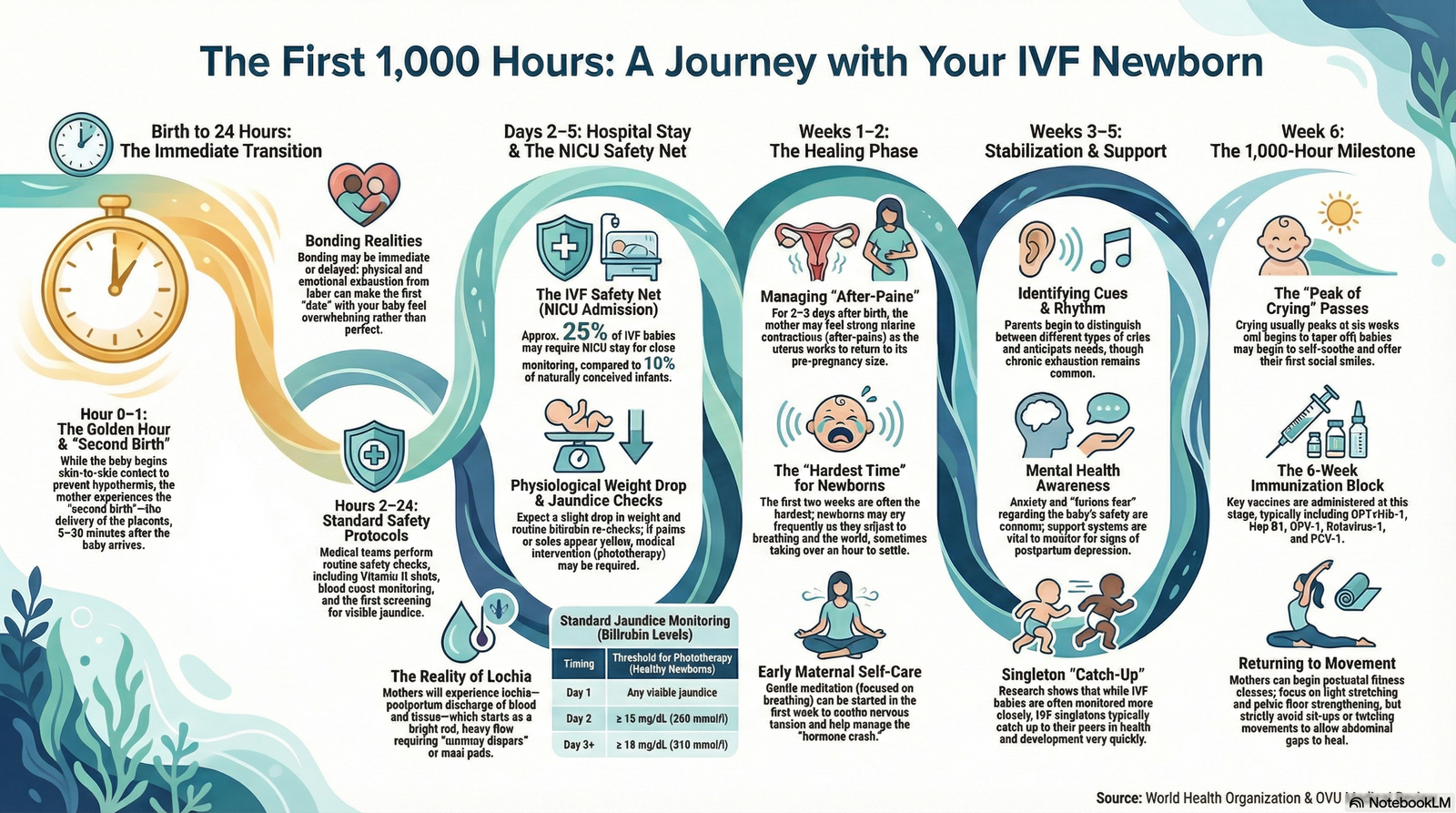
IVF Newborn Timeline: Key checks and milestones in the first 1,000 hours.
The delivery room: your first hours together
If you have spent years in quiet clinic rooms, the birth itself can feel like the opposite. Instead of soft music and dim lights, you may find a crowd. Your team can include labor and delivery nurses, obstetricians, midwives, anesthesiologists, operating room technicians, nursery nurses, neonatologists, and pediatricians. Because IVF pregnancies often carry a higher medical risk on paper, staff are quick to keep extra help nearby. That can mean a warmed incubator or a respiratory therapist in the corner, even if your baby ends up on your chest.
Birth itself is not a single moment. First, you deliver your baby. Then, usually within minutes to half an hour, you deliver the placenta. After that, your uterus keeps contracting to close off the blood vessels where the placenta was attached. That raw surface is like a wide-open wound. Those deep cramps are your body’s way of stopping heavy bleeding.
You may feel strong after pains as your uterus shrinks back toward its pre-pregnancy size. These can last two or three days. The amount of blood can shock you. For a moment, the room can look like a crime scene while nurses mop the floor and gather blood-soaked pads and gowns. None of this means you have done anything wrong. It means your body has just done something enormous.
In the first hour of your baby’s life, the World Health Organization encourages skin-to-skin contact. That simple act helps your baby stay warm and calm, and it supports breastfeeding. But if you had a long labor, a failed epidural, or an emergency cesarean, you may barely remember that hour. You might feel foggy, detached, or numb.
Be kind to your own post-delivery state. If you did not feel an instant, overwhelming bond, you are not broken. Many parents say the real connection took weeks or even a couple of months to grow.
NICU vs. regular nursery, what those first 1,000 hours really look like
1 in 4 vs. 1 in 10, who go to NICU: In a Canadian study, about 1 in 4 assisted reproduction babies were admitted to NICU, compared with about 1 in 10 naturally conceived babies. Most of this difference came from twins and early births, not from IVF itself. Knowing this information helps you brace for the possibility of a NICU stay without assuming the worst about your baby’s future. Source: CMAJ Open (PMID: 37171904).
Singletons level the field, same short-term outcomes: A hospital study found that IVF babies had more early complications overall. When researchers focused only on single babies and adjusted for parent age and pregnancy details, they found that IVF itself was no longer linked to worse newborn outcomes. If you are carrying one baby, there is a good chance your time in the regular nursery looks much like any other family’s stay. Source: Pediatrics & Neonatology (PMID: 38471993).
Extra checks, not just extra problems: Reviews of long-term outcomes show that doctors tend to watch IVF babies more closely and admit them more readily to NICU, especially after high-effort pregnancies. Many NICU stays focus on monitoring, breathing support, and feeding help for babies with a strong long-term outlook. For you, this means the sight of tubes and monitors can be frightening, but it does not always signal a lifetime of health problems. Source: J Assist Reprod Genet (PMID: 38146031).
From NICU to nursery, the long-term outlook is strong: Population studies show that most IVF children, including many who started life in NICU, do as well as their peers in day-to-day health and school performance. One large study even found slightly better school test scores for some IVF children. The intense first 1,000 hours are usually one chapter in a much longer, more ordinary story. Source: PLOS Medicine (PMID: 36693021).
In practice, your team will decide between NICU and the regular nursery based on your baby’s breathing, temperature, blood sugar, and feeding. Ask before birth how your hospital makes those calls so you feel less blindsided if NICU comes into the plan.
Weight, growth, and multiple pregnancies
In these first 1,000 hours, every nurse who walks into your room looks at two numbers for your baby: gestational age and weight. If you had IVF, you have probably worried about both your pregnancy and the health of your baby since your first positive test.
On average, IVF singletons arrive about half a week earlier than naturally conceived siblings and weigh about 70 grams less. Seventy grams is roughly the weight of a bar of soap. It is not much, but it can classify some babies as low birth weight in the chart and trigger more frequent checks.
Fresh vs. frozen embryo transfer
The details of your IVF cycle can nudge those numbers. If you had a frozen embryo transfer, research shows your baby’s outcomes are often as good as, or better than, those from fresh transfers. Frozen embryo transfer singletons can have a slightly higher chance of being large for gestational age or having high birth weight, which brings its own set of conversations with your team.
Timing in the lab matters as well. Babies born after day 5 or day 6 blastocyst transfers tend to have slightly higher, more favorable birth weight scores than those from day 3 transfers. In everyday language, embryos that have spent longer growing in the lab often lead to babies who are a little bigger at birth.
The multiples factor
If your cycle led to twins or triplets, your first 1,000 hours look very different. About 20.8% of IVF cycles still result in twin or higher-order pregnancies. Multiple pregnancies rarely reach 40 weeks. The average lengths of pregnancies are about 35 weeks for twins, 33 weeks for triplets, and 30 weeks for quadruplets.
About 60% of multiples arrive early. That means a higher chance of incubators, breathing support, and longer hospital stays. This is not because you did something wrong. It is simply what happens when one uterus carries more than one baby at once.
| Pregnancy Type | Average Gestational Age | Prematurity Risk |
|---|---|---|
| Singleton | Around 39 to 40 weeks | Lower, but still possible |
| Twins | Around 35 weeks | Higher |
| Triplets | Around 33 weeks | Very high |
Medical monitoring in the first 1,000 hours
These first days can feel like an endless cycle of checks, tests, and forms. Knowing what each one is for doesn’t remove the stress, but it gives you something solid to stand on when you’re overwhelmed.
Vitamin K injection
Shortly after birth, your baby receives a 1 mg injection of vitamin K in the thigh. Newborns do not have enough vitamin K on their own. Without it, they face a risk of dangerous internal bleeding in the brain and gut. The injection is quick and highly protective.
Jaundice checks
Nurses and doctors check your baby’s skin and eyes for yellowing every day. Jaundice is common, but jaundice in the first 24 hours is a red flag. Blood tests measure bilirubin levels. For a healthy baby born at or after 35 weeks, levels above certain cutoffs by day 2 trigger phototherapy, the familiar blue light treatment that helps the body clear bilirubin.
Feeding and weight checks
Staff plot your baby’s weight on growth charts. If your baby’s weight falls more than expected or drops below two standard deviations for age, your team looks closely at feeding. You may get extra help with latch, pumping, or formula plans. In some cases, doctors also look for infection or other medical problems that could explain slow weight gain.
Infection screening
If your baby shows warning signs such as convulsions, very fast breathing of 60 breaths per minute or more, severe chest indrawing, or a fever of 38°C or higher, the team treats that as an emergency. They send you to, or keep you in, the hospital, take blood and sometimes spinal fluid, and start antibiotics such as ampicillin and gentamicin while they wait for results.
Beyond birth, how IVF children are doing
Long-term health mostly reassuring: A 2026 narrative review pulled together many large studies on IVF children and found that, for single babies and when routine freezing is avoided, most long-term health outcomes are similar to those of naturally conceived children. Some small increases appear in allergies, mild blood pressure changes, or asthma, but not on the scale that many parents fear. This supports the idea that a medical start does not doom your child to a lifetime of illness. Source: Long-Term Health Outcomes of Children Born After In Vitro Fertilization (PMID: 41252035).
Risk changes are modest, not massive: A 2024 review of assisted reproduction offspring reported small shifts in risk for conditions such as asthma and minor metabolic changes, often only a few extra cases per 100 children. Many differences shrank when researchers adjusted for parental age, infertility, and twins. For you, this means IVF can nudge risks up in some areas, but usually by a small step, not a leap. Source: J Assist Reprod Genet (PMID: 38146031).
Daily life often looks normal: Another long-term follow-up found that IVF teenagers had similar, and sometimes better, scores for growth, body fat patterns, and quality of life than their peers. Some reported stronger scores in friendships and the home environment. This suggests that in day-to-day life, many IVF children are not just coping, they are thriving. Source: Human Reproduction Update (PMCID: PMC9773093).
These studies cannot predict everything for your child, but they do widen the picture beyond the intense early days in hospital. You can use them as a calm counterweight when your mind races to worst-case scenarios.
Your body’s recovery after birth
While everyone focuses on your baby, your body is going through a brutal reset. Many women say this part shocked them more than labor.
For about the first six weeks, you will likely wear thick pads or adult diapers to manage the flow of blood and tissue called lochia. Some days feel like a heavy period all over again. It can feel messy and far from the glowing images that show up in pregnancy brochures. You are not alone if you feel upset or embarrassed by it.
You may have gained 15 to 60 pounds during pregnancy. Right after birth, you lose 10 to 15 pounds quickly and think the rest will follow. Then the scale freezes. Your belly still looks pregnant. Your hips and thighs feel unfamiliar. The constant message to bounce back turns this normal healing into something you feel you have to fix.
If this is you, it helps to be kind to yourself and still want to feel better. Small, gentle steps can support both your mind and body.
- Meditation: Even five minutes of sitting with your eyes closed, listening to your breath, in the first week, can ease some nervous tension. You do not need apps or music. Just notice your breath going in and out.
- Walking: When your doctor says it is safe, walking is a simple yet excellent first exercise. A simple, purposeful walk around the ward or the block can lift your heart rate and clear some mental fog.
- Yoga: When you feel ready, postpartum yoga can help with aching shoulders, tight hips, and a heavy feeling in your pelvis. It also gives you space to feel grief, relief and joy in the same hour and still leave the room more grounded.
Living with IVF anxiety after delivery
If you had IVF, you know how it feels to watch every number on every test. It is hard to turn off that part of your brain once your baby is here. You might still feel like every cry is a sign of a disaster you have to prevent.
Every time your baby cries, you might hear a small voice that says you are doing this wrong. You may feel a mix of anger, terror, and emptiness that is hard to name. Some mothers describe a feeling like cold panic over their skin, a kind of furious fear that never quite settles.
Data from early parenting services shows that mothers who conceived with ART are more than three times as likely to seek residential help for parenting difficulties than mothers in the general population. That does not mean IVF parents are weaker. It means your pregnancy already demands more from you, emotionally and physically, and you may start parenthood with less in reserve.
Situations that make these first weeks harder include:
- Being a first-time mother.
- Receiving confusing or rushed breastfeeding advice.
- Leaving the hospital without feeling confident about basic baby care.
- Having little or no practical support from family and friends.
You may have spent years believing that if you could just get pregnant, everything after that would be pure joy. Then you find yourself alone with a crying baby, greasy hair, and no adult conversation for hours. You feel guilty for not loving every second. That guilt does not mean you do not love your child. It means your real life is finally catching up to the fantasy that helped you survive treatment.
What an unsettled IVF newborn can look like
During these first 1,000 hours, your baby is adjusting from life in the womb to life in the open air. That job does not seem peaceful from the outside.
Your baby cries, then cries harder. Their face turns red. Their arms flail. They feed, fall asleep for ten minutes, then wake and start again. You walk, rock, bounce, and sing, and some days nothing works. An overstimulated newborn can take an hour or more to settle, even when you do everything right.
Your sleep becomes a series of short naps. You might wake unsure whether you actually fed the baby or just dreamed about feeding. You nod off in a chair and wake with your heart racing, convinced something terrible has happened.
It will not always feel like this.
Slowly, you learn your baby’s patterns. You start to recognize the hungry cry, the tired cry, and the uncomfortable cry. You notice that your baby settles faster if you swaddle more snugly, hold them upright, or walk instead of rocking.
At some point, often when you think you can’t take any more, your baby gives you a longer stretch of sleep. Then it happens again. Over time, those short stretches link together. Your baby learns to drift back to sleep without you every single time. You still feel tired, but you are no longer drowning in it.
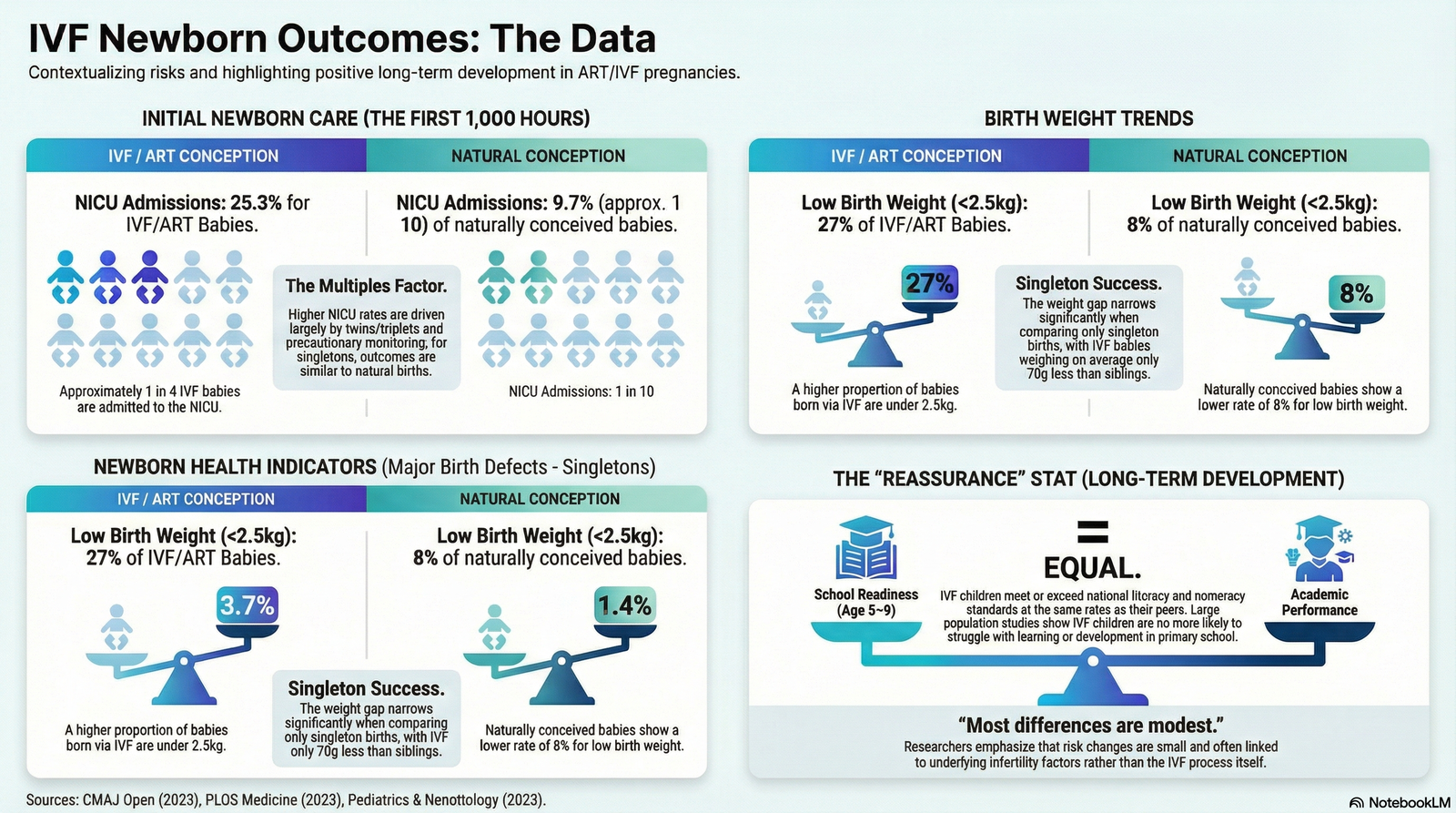
IVF Newborn Outcomes: NICU admissions and low birth weight compared with natural conception.
Choosing support for your first 1,000 hours
You do not have to white knuckle your way through these weeks alone. Support can come from many places: your partner, friends, family, midwives, lactation consultants, online groups, early parenting services, and your fertility clinic.
If you notice that you cannot sleep even when your baby sleeps, that your thoughts are stuck on worst-case scenarios, or that you feel no joy at all, talk to your doctor as soon as you can. You can treat postnatal depression and anxiety, which are common. In some ways, it can make them more likely because you have already been under stress for a long time.
How research can help you feel less alone
Millions of IVF children worldwide: By now, millions of children have been born after IVF and related treatments. Global estimates suggest that assisted reproduction has helped more than 12 million people be born. You and your baby are part of a large, growing group, not an isolated experiment.
Most differences are small and manageable: Across studies, researchers use words like modest and small to describe the risk increases they see. That does not mean they are unimportant, but it does mean most can be managed with good prenatal care, single embryo transfer when possible, and close newborn follow-up.
Daily life often looks very similar: When researchers step back from blood tests and growth curves and instead look at everyday life, they often find IVF families living ordinary, busy, messy lives that look much like everyone else’s. That is the life you are moving into now.
You can use this research as a steady reference point when your thoughts feel wild. It will not remove your anxiety, but it can prevent it from overwhelming you.
OVU expert guidance: turning information into next steps
Know your hospital’s plan before labor: Ask your team how they handle IVF deliveries, who attends the birth, when they call neonatology, and what usually triggers a NICU admission. Being informed before contractions start makes it easier to stay present when the room fills with people.
Plan practical support at home: Map who can hold the baby so you can shower, cook, and listen when you need to cry. IVF parents often carry extra emotional weight into the postpartum period. Lining up help early is not a weakness. It is good planning.
Use your IVF mindset for parenting decisions: You already know how to ask questions, compare options, and weigh risks. The same skills that got you through stimulation protocols and retrievals can help you decide about feeding plans, sleep setups, and follow-up appointments.
Stay in touch with your fertility team: Many clinics welcome your contact after birth. They can answer questions about your pregnancy, talk through fears about your baby’s health, and point you to local resources.
Want help comparing clinics and newborn support options?
If planning IVF, birth and those first 1,000 hours feels like a full-time job, our advisors can collect clear, itemized quotes from verified clinics and help you understand what newborn and postnatal support those clinics offer.

Why trust this guide? The OVU commitment
You are probably juggling hope, timelines, and a lot of tabs open in your browser. And you deserve clear, current, human advice. At OVU, we review clinic protocols, compare real quotes, and talk to people who have done this - intended parents and gestational carriers - so we can give you practical steps, not just theory. If you want help comparing options without sales pressure, we will gather itemized quotes and success data that match your exact situation. You decide, we will bring the info to your table.
Frequently Asked Questions
Is my baby at higher risk of cancer because of IVF?
Large studies that followed more than 8.5 million children found that overall cancer rates are almost the same in IVF and naturally conceived children. Some blood cancers showed a very small increase after certain embryo transfer methods, but that translated into only a few extra cases per million children each year. For your baby, the absolute cancer risk remains low.
Why did my baby go to the NICU when they seemed healthy?
Doctors know IVF pregnancies carry higher rates of prematurity and low birth weight, especially with twins. They also know how emotionally invested you are in this baby. That combination often lowers their threshold for admitting IVF babies to NICU for closer observation. A short NICU stay often means extra monitoring for breathing, blood sugar, or feeding, not that your baby has a serious, long-term problem.
Does IVF cause birth defects?
One sibling study found major birth defects in about 3.7% of IVF babies and 1.4% of their naturally conceived siblings. This is a higher relative risk, but the absolute difference is a bit more than 2 babies in 100. In that study, doctors delivered more than 96 out of 100 IVF babies without major defects. Many experts believe that underlying infertility and parental factors explain at least part of this difference.
Are IVF twins more at risk than natural twins?
The main risks for twins are prematurity and low birth weight, no matter how they were conceived. Studies that compare IVF twins and naturally conceived twins show similar outcomes. Using IVF does not usually change the basic risk picture for twins, but it may change how closely your pregnancy and babies are monitored.
How will my IVF baby do in school?
A large Australian study found no negative causal effect of IVF on school readiness or test scores between ages 4 and 9. IVF children were just as likely, and in some areas slightly more likely, to meet or exceed national standards for reading, writing, and maths. In other words, a more medical start to life does not mean your child will struggle at school.
What if my baby started as a twin and the other twin vanished?
About 10% of IVF singletons begin as a twin pregnancy where one embryo stops developing early, often before you even know it happened. These survivors of a vanishing twin can be at slightly higher risk for preterm birth and lower birth weight than babies who were always singletons. Your team will usually watch growth, placental function, and timing of birth more closely.
Is it safe to transfer a mosaic embryo?
A mosaic embryo contains a mix of normal and abnormal cells. Studies on low-grade mosaic embryos, where 20% to 50% of cells look abnormal, show many of them can still lead to healthy babies. Follow-up research suggests that babies born from these embryos do not have higher rates of chromosomal conditions at birth than babies from fully normal embryos. Your clinic will help you weigh your age, embryo quality, and other options when deciding whether to transfer a mosaic embryo.
Reference List 10 sources
Journal Article (Research): Liao Y-J, et al. Neonatal outcomes in infants conceived using assisted reproductive technologies: A single medical center cohort study. Pediatrics & Neonatology. 2024;65(–):–. PMID: 38471993. Available from: https://pubmed.ncbi.nlm.nih.gov/38471993/
Journal Article (Research): Moore LE, et al. Assisted human reproduction and pregnancy outcomes in Alberta, 2009–2018: a population-based study. CMAJ Open. 2023;11(2):E372–E380. PMID: 37171904. Available from: https://pubmed.ncbi.nlm.nih.gov/37171904/
Journal Article (Research): Kennedy AL, Hiscock RJ, Vollenhoven BJ, et al. School-age developmental and educational outcomes for children conceived by IVF: A causal inference analysis using linked population-wide data. PLOS Medicine. 2023;20(1):e1004148. PMID: 36693021. Available from: https://pubmed.ncbi.nlm.nih.gov/36693021/
Journal Article (Research): Rios P, Herlemont P, Fauque P, et al. Medically assisted reproduction and risk of cancer among offspring. JAMA Network Open. 2024;7(5):e249429. PMID: 38696167. Available from: https://pubmed.ncbi.nlm.nih.gov/38696167/
Journal Article (Review): Zhang S, Luo Q, Meng R, Yan J, Wu Y, Huang H. Long-term health risk of offspring born from assisted reproductive technologies. Journal of Assisted Reproduction and Genetics. 2024;41(3):527–550. PMID: 38146031. Available from: https://pubmed.ncbi.nlm.nih.gov/38146031/
Journal Article (Review): [Authors as listed]. Long-Term Health Outcomes of Children Born After In Vitro Fertilization (IVF): A Narrative Review. [Springer Nature journal]. 2026;–(–):–. PMID: 41252035. Available from: https://pubmed.ncbi.nlm.nih.gov/41252035/
Journal Article (Review): Chambers GM, et al. The longer-term effects of IVF on offspring from childhood to adolescence. Human Reproduction Update. 2023;29(–):–. PMCID: PMC9773093. Available from: https://pmc.ncbi.nlm.nih.gov/articles/PMC9773093/
Journal Article (Research): Fisher JRW, et al. Admissions for early parenting difficulties among women with infants conceived by assisted reproductive technology. Fertility and Sterility. 2012;97(6):1328–1334. PMID: 22520350. Available from: https://pubmed.ncbi.nlm.nih.gov/22520350/
Journal Article (Research): Reig A, et al. Trends in prematurity and low birth weight among IVF-conceived newborns over 25 years. Fertility and Sterility. 2024;–(–):–. Available from: https://www.fertstert.org/
Journal Article (Research): Li M, et al. Obstetric and neonatal outcomes after transfer of vitrified-warmed blastocysts. Fertility and Sterility. 2021;115(2):–. Available from: https://pubmed.ncbi.nlm.nih.gov/
Final thoughts
As you move through these first 1,000 hours, it can help to remember that feeling overwhelmed does not mean you are doing a bad job. You are recovering from pregnancy and treatment while learning to care for a newborn who has never existed before. There is no way to rehearse this. You are learning in real time.
Your IVF journey may have left you feeling powerless. For years, you waited for other people to call with lab results and decisions. Now you are the one making calls, choosing who comes into your home, and deciding what feels right for your baby. You are allowed to claim that role fully.
If your baby cries for hours, that noise is not a judgment on you. It is simply how newborns communicate while they adjust to life outside the womb. Your job is not to stop every cry instantly. Your job is to keep showing up, feed and hold your baby, and ask for help when you need it.
There will be quiet moments when you hold your baby against your chest, breathe in that warm newborn smell, and look into eyes that seem too wise for such a small body. In those seconds, even if no one else sees it, you are becoming a mother or a father in a way that no scan picture could capture.
The map of your old life has changed. Some landmarks are gone. New ones appear, like the chair where you do 3 a.m. feeds or the window you stare out of while rocking your baby. The road is hard. It is also yours. You finished the marathon of IVF. Now you are learning how to live inside the ordinary miracle of each day with your child.