


Dr. Sony Sherpa (MBBS)
In addition to her clinical experience, Dr. Sherpa is a published medical researcher and holistic health advocate. Her dual expertise in emergency care and alternative therapies brings a unique lens to medically reviewed content—ensuring it is both accurate and accessible.
If you are reading this, you already know that the path to parenthood is rarely straightforward. It can feel like a marathon measured in years, a map of bruises from hormone injections, and a mountain of numbers that sometimes feel more like a wall than a guide. Those numbers describe averages, not your future.
When the first IVF baby, Louise Brown, was born in 1978, she arrived after 102 failed embryo transfers with a live birth rate under 1 percent. Today, the reality is very different. In 2017, the cumulative live birth rate for women younger than 35 reached 54.7 percent, and by 2023, in the United States alone, IVF led to more than 95,000 babies, about 3 out of every 100 births.
Whether you are facing unexplained infertility, genetic issues, or building a family in a way your parents never imagined, your story can look very different from the statistics on a chart. You deserve to understand the science, the risks, and the outcomes people have achieved before you so you can make decisions that feel right for you.
Modern IVF gives many people a real chance at parenthood, even after years of trying. Younger women with a good egg count and a healthy weight can achieve cumulative live-birth rates above 90 percent over several cycles, while about 1 in 4 couples take home a baby after their very first IVF cycle. The safest pregnancies are usually single embryo transfers, and extra monitoring in early pregnancy helps catch rare complications early.
If you are thinking about IVF, talk with your clinic about your age, egg reserve, medical history, and budget so they can give you a personal estimate of your chances across one cycle and several cycles.
What the Latest Research Shows
Large studies now track tens of thousands of IVF cycles and births. These data show that cumulative live birth rates can be very high when you have enough eggs, that single embryo transfer keeps twin rates low, and that body weight and uterine age both affect outcomes even when donor eggs are used.
National reports also confirm that IVF has become a common route to parenthood. In the United States, more than 95,000 babies were born from IVF in 2023, and almost all of them were singletons. This shift reflects careful embryo transfer policies that balance safety with success.
Below, these numbers are translated into plain language so you can see where you fit and which factors you can change.
In This Guide
21–30 eggs in women under 35 are associated with about 94 percent cumulative live birth.
About 26 percent of couples take home a baby after their first IVF cycle.
Almost 97 percent of IVF births are now singletons, not twins or triplets.
IVF Success at a Glance
If you are just starting to research IVF, you are probably asking one basic question in many different ways. You want to know what your chances really look like and how many cycles you may need before you hold a baby in your arms.
For women under 35, one large study found that retrieving 21 to 30 eggs in a freeze-all strategy led to a cumulative live birth rate of 93.8 percent after using all the embryos. Women in the same age group with 4 to 10 eggs had a cumulative live birth rate of about 72.5 percent. Another national-level cohort from public clinics showed that about 26 percent of couples had a live birth from their very first IVF cycle.
At a population level, IVF is no longer rare. In the United States, more than 95,000 babies were born from IVF in 2023, about 2.6 percent of all births, and 96.7 percent of these were singletons. This shift toward single embryo transfer has kept success rates high while lowering the risks that come with multiple pregnancies.
Latest Research Insights
93 percent vs. 72 percent, the egg count window: In a freeze-all IVF strategy, women under 35 who produced 21 to 30 eggs reached about a 94 percent chance of having a baby after using all embryos. Those who produced 4 to 10 eggs had about a 72 percent chance. This shows that once you reach the low 20s in egg numbers, your long-term odds are very high, and extra stimulation beyond 30 eggs adds little benefit but more risk. Source: Reproductive Biology and Endocrinology PMID: 32087702.
26 percent first-cycle births, real-world baseline: A five-year study of 5,250 couples found that about 1 in 4 had a baby after their very first IVF cycle at public clinics. Fresh transfers had a 29.5 percent live birth rate per transfer, and frozen transfers added more chances over time. This helps you set realistic expectations. Many people need more than one cycle, but each round adds to your overall chance. Source: JBRA Assisted Reproduction PMID: 41370418.
95,860 babies in 2023, IVF is mainstream: In the United States alone, IVF led to more than 95,000 babies in 2023, about 3 in every 100 births. Nearly 97 percent of these IVF births were single babies, not twins or triplets. This shows that IVF is now widely used and safer than in the past when it comes to avoiding high-risk multiple pregnancies. Source: ASRM and SART national data, ASRM press release.
77 percent vs. 82 percent, PGT-A compared with standard IVF: In a large trial of 1,212 women aged 20 to 37 with several good embryos, about 77 percent in the PGT-A group and 82 percent in the standard IVF group had a baby within one year. Miscarriage was slightly lower with PGT-A, but the overall chance of taking home a baby was very similar. This means PGT-A may reduce some losses but does not guarantee higher overall success for younger, good-prognosis patients. Source: New England Journal of Medicine PMID: 34818479.
These findings come from peer-reviewed research and national reports. Your own chances depend on your age, health, and clinic protocol. Use these numbers as a guide, then talk with your fertility specialist about what they mean for you.
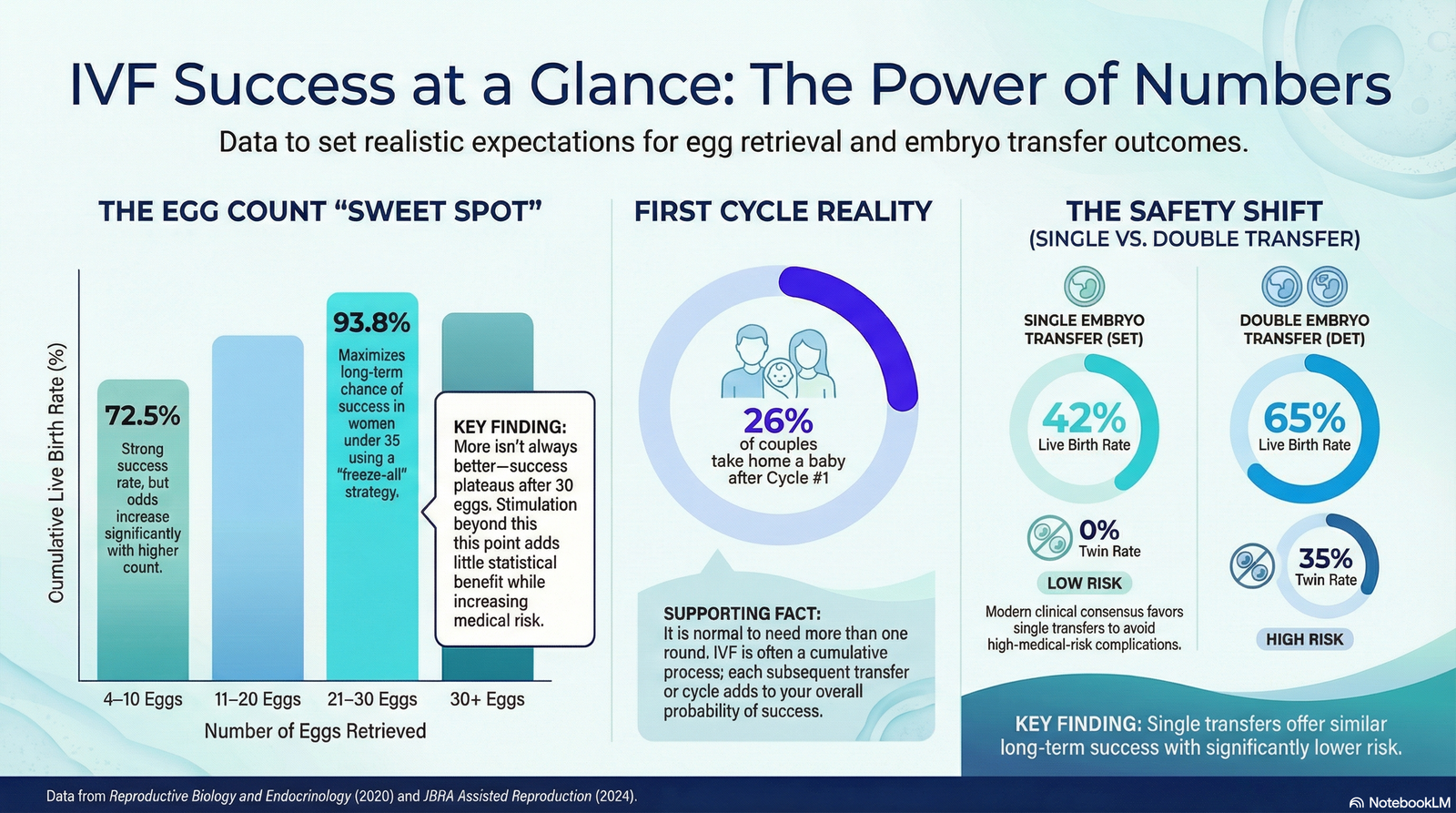
IVF success at a glance, from egg numbers to cumulative live birth and singleton rates.
One of the biggest decisions you and your doctor will make together is how many embryos to transfer at a time. You also need a realistic picture of what your odds look like with different strategies.
| Transfer Strategy | Live Birth Rate per Transfer | Twin or Higher Multiple Rate |
|---|---|---|
| Single embryo transfer (SET) | About 42 percent | 0 percent |
| Double embryo transfer (DET) | About 65 percent | About 35 percent |
| Modern SET policies | Similar cumulative rates over several cycles | About 3 percent or lower overall |
Single embryo transfer gives you a lower chance of twins in a single cycle and keeps your pregnancy safer. Double embryo transfer can raise the chance of a baby per transfer but also raises the chance of twins and the risks that come with them. Many clinics now plan for one embryo at a time and look at your cumulative chance over several transfers instead of trying to reach the finish line in a single step.
Redefining Family Through IVF
One of the most powerful parts of modern fertility care is how many different ways you can build a family. You might be thinking about parenting without a partner, sharing the physical experience as a couple, or designing a path that includes donors and surrogates. All of those are valid and real.
If you are thinking about parenting without a partner, you are not alone. Sia chose solo motherhood on purpose. After years of waiting for a relationship to line up with her wish to have a child, she decided her right time was now and used donor sperm and IVF. The midnight injections and early morning clinic visits faded in her memory the first time she saw a heartbeat on the scan.
For some couples, the process is a shared physical experience. Elena and Sarah used the ROPA method, which stands for Reception of Oocytes from Partner. Elena provided the eggs, and Sarah carried the pregnancy. When they held their twins, they both felt that they were not just co-parents but both physically necessary for these children to exist.
Other stories involve entire teams. In one case of gay surrogacy, triplets were born to two fathers using an egg donor and two surrogates. Another triplet pregnancy involved eleven people in total, including the intended parents, two egg donors, two surrogates, and six clinicians. If you feel like your situation is complex, you can see that IVF can handle very layered arrangements.
The Final Embryo and Unexpected Multiples
If you are staring at one last frozen embryo and feel like everything depends on it, you are not imagining the pressure. One couple reached that point after several failed rounds. They transferred their final embryo, hoping for one baby. That embryo split after transfer and became identical twins.
Doctors aim for single-baby pregnancies because they are usually safer for you and your baby. The numbers around multiples need careful explanation. In a randomized trial, double embryo transfer led to a 65 percent live birth rate but a 35 percent twin rate. Single embryo transfer led to a 42 percent live birth rate with no twins at all. IVF twins show about 40 percent lower complication risks than twins conceived without treatment, probably because IVF pregnancies are identified early and monitored closely.
Higher-order multiples are a separate issue. One embryo can split into three babies and form monochorionic triplets, which happens in only about 0.004 percent of pregnancies. Two adopted embryos can result in three babies. Two blastocysts can both split and produce four babies. These pregnancies often involve prolonged bed rest, cervical stitches, and very close monitoring. If your doctor pushes hard for a single embryo transfer, these numbers are part of the reason.
Genetics, Mosaicism, and “Imperfect” Reports
If your embryo report says mosaic, it can feel like a stop sign. Mosaic embryos have a mix of normal and abnormal cells. For years, clinics often refused to transfer them. Lia’s parents faced that decision and decided to transfer a mosaic embryo after careful counseling. Their child is now a healthy, energetic little person and a reminder that embryos can sometimes correct themselves as they develop.
You may also hear about PGT-A, which stands for preimplantation genetic testing for aneuploidy. It checks embryos for missing or extra chromosomes. In a trial of 1,212 women, those who used PGT-A had a 77 percent live birth rate, compared with 82 percent in the standard IVF group without testing. Miscarriage was lower in the PGT A group, about 9 percent versus 13 percent. For younger women with several good embryos, PGT-A may reduce losses, but it does not always increase the chance of taking home a baby.
Some patients face very specific genetic challenges. A 23-year-old woman with mosaic Turner syndrome and a small uterus delivered triplets after egg donation. Another family dealt with a father who had an AZFc Y chromosome deletion, which causes very low sperm counts. With testicular sperm extraction and ICSI, they conceived triplets. Two sons inherited the same deletion, but they were born healthy. These examples show that genetics can complicate the path but do not always close it.
Pregnancy After Disease and Major Surgery
You might wonder whether a serious illness in your past rules out pregnancy. In some cases, it does not. You and your doctors have to balance your cancer or other disease history against your wish to carry a pregnancy.
One 29-year-old woman had Stage Ia endometrial cancer. Instead of having her uterus removed, she chose high-dose progestin treatment and very close follow-up. Once her biopsies cleared, she moved ahead with IVF and eventually delivered triplets. This path carries real risk and needs careful planning between oncologists and fertility doctors, but it can keep pregnancy on the table.
You can also work around structural problems. One woman had congenital cervical atresia, which means she was born without a cervix. This condition affects about 1 in 80,000 births. Doctors performed a transmyometrial embryo transfer and placed embryos through the wall of the uterus instead of through the cervix. She later delivered twins.
Even after procedures that usually mean no future periods or pregnancies, there are rare success stories. One patient had thermal balloon endometrial ablation, which destroys the lining of the uterus. She also had other medical problems. She conceived through IVF and delivered a healthy baby at 36 weeks, despite serious issues like placenta accreta. These are not easy cases, but they show how far reproductive medicine now stretches.
Unexpected Complications and Ovarian Torsion
If you feel nervous about every cramp and twinge, you are not overreacting. IVF pregnancies get more early checks for real reasons. Some risks are rare but serious enough that your clinic watches you more closely.
Ovarian stimulation can leave your ovaries enlarged in the first trimester, which raises the risk of adnexal torsion. This is when an ovary twists and cuts off its own blood flow. This condition happens in only about 0.08 to 0.13 percent of IVF pregnancies, but when it does, you need emergency care.
In one report, a woman had a torsion of her right ovary at 7 weeks, then torsion of her left ovary at 19 weeks. Surgeons handled both episodes, including untwisting the ovary in one surgery. She still delivered a healthy boy at 38 weeks.
You may also hear about heterotopic pregnancies. This means one embryo implants in the uterus and another implants outside the uterus, such as in a tube or a cesarean scar. These are rare but more common with IVF than with natural conception, reaching up to about 1 percent of assisted conceptions. With early ultrasounds, doctors can treat the ectopic pregnancy and protect the fetus in the uterus in many cases.
What Shapes Your IVF Success
Up to 80 percent lower chance, why weight matters: In almost 1,000 ICSI cycles, overweight women had about a 60 percent lower chance of live birth than women in the healthy weight range, and women with obesity had about an 85 percent lower chance. Male weight did not change the success rates in this study. If your BMI is high, even a modest, safe weight loss before treatment can improve your odds. Source: International Journal of Fertility and Sterility PMID: 30644241.
33,000 transfers, uterine age still counts: A study of 33,141 single donor egg transfers showed that live birth rates started to drop after about age 40 in the woman carrying the pregnancy, even though the eggs came from younger donors. Each year over 40, the risk of the embryo not implanting rose by about 4 percent, and pregnancy loss rose by about 3 percent per year. This means your uterus and overall health, not just egg age, still matter for IVF success. Source: Fertility and Sterility PMID: 40403911.
65 percent vs 42 percent, one or two embryos today: In a randomized trial of women under 38 having their first IVF cycle, double embryo transfer produced a 65 percent live birth rate but a 35 percent twin rate. Single-embryo transfer produced a 42 percent live birth rate and no twins. This data shows why many clinics now plan for single embryo transfer. Your chance per transfer can be lower, but you avoid the higher risks that come with twins. Source: Reproduction, Fertility and Development PMID: 25128910.
Ovarian stimulation protocols, safety first: The main European guideline on ovarian stimulation recommends modern antagonist protocols for most IVF patients, because they give similar pregnancy and live birth rates compared with older agonist protocols but lower the risk of dangerous ovarian hyperstimulation. The guideline also advises against many add-on hormones and supplements that do not improve success. This helps you focus on protocols with solid evidence instead of costly extras. Source: Human Reproduction Open PMID: 32395637.
These studies highlight factors you can influence, such as body weight and protocol choice, and others you cannot, like age. Understanding both helps you and your doctor design a plan that is realistic and as gentle as possible for you.
Managing Anxiety and Emotions
If you feel that the two-week wait lasts longer than the entire stimulation phase, you are not exaggerating. Every trip to the bathroom can feel like a test of courage. Pregnancy after infertility is not the same emotional experience as an unplanned positive test.
The Stress and Sleep Link
About 58 percent of women finishing their first IVF cycle report high stress. High stress often comes with poor sleep and a tendency to stay up late. It does not just live in your head. One study found that women with higher stress levels produced fewer mature eggs and fewer blastocysts. On average, high-stress patients created about 4 embryos, compared with about 6 in women with lower stress scores.
Working on your stress level is not about telling yourself to relax. It can involve therapy, support groups, walks with a friend, breathing exercises, or simply protecting your sleep. All of these are ways to support your biology.
Parenting Stress
If you are carrying twins after IVF and feel anxious about the future, your feelings are valid. Mothers of multiples conceived with IVF are about five times more likely to report severe parenting stress compared with mothers of singletons. They are also less likely to be working one year after birth, often because childcare for multiple infants can be overwhelming in cost and logistics.
There is another side to this. Studies show that women who have singletons after IVF often report lower parenting stress and more confidence than women who conceived spontaneously. After everything you go through to have a baby, you may feel especially prepared and intentional in your parenting.
Postpartum Mental Health
If you have struggled with mood during fertility treatment, you may worry about postpartum depression. Research using the Edinburgh Postnatal Depression Scale found that average scores drop after delivery. Women who conceived with IVF or other assisted methods often have lower postpartum depression scores than women who conceived without treatment.
That does not mean you can ignore your mental health. If you have fibroids or prior trauma, your doctor may watch you more closely because those factors are linked to a slightly higher risk of depression and post-traumatic stress. Staying open about how you feel is as important as any blood test.
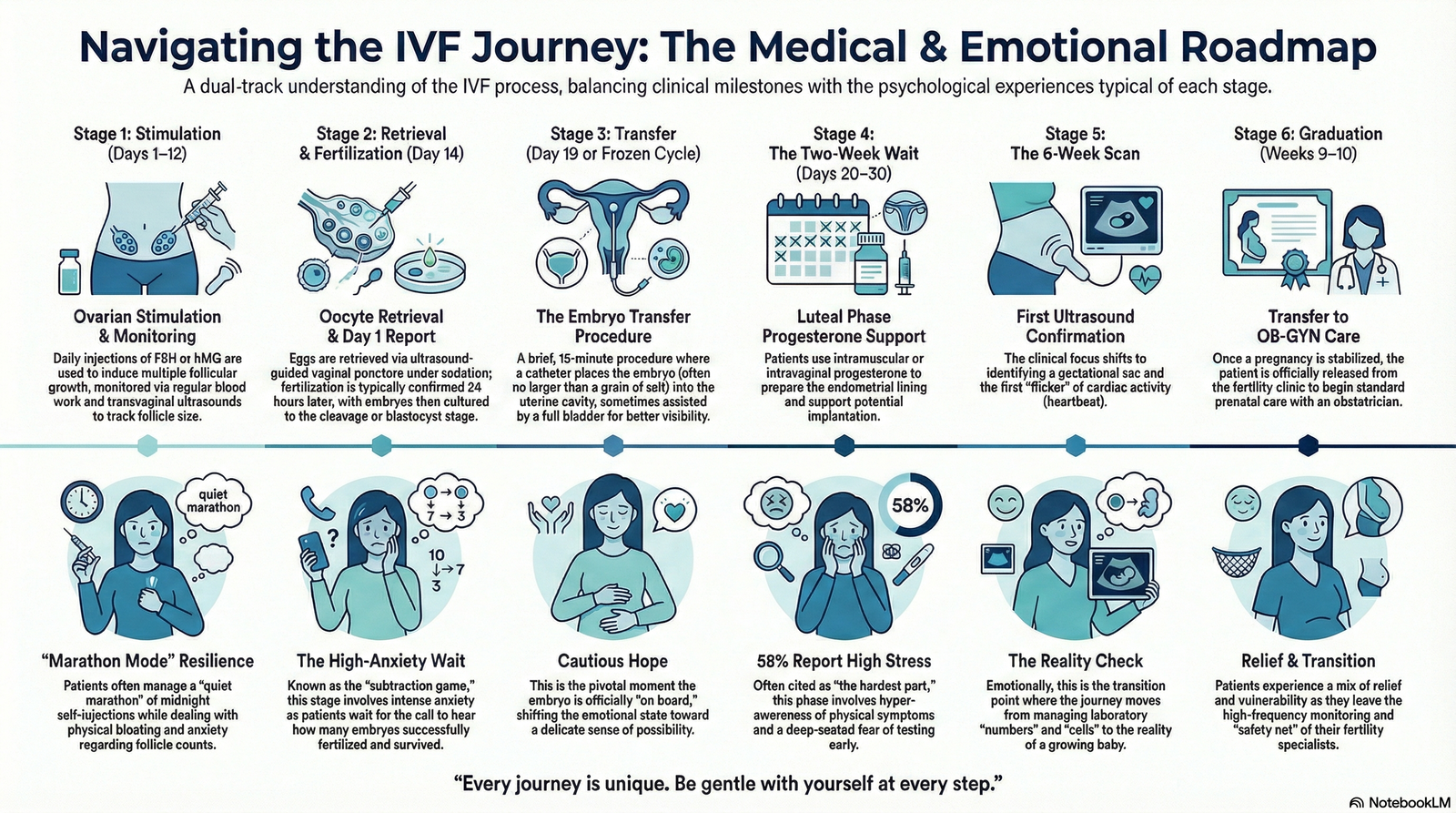
Key emotional and medical touch points from stimulation through postpartum after IVF.
What To Expect in Early IVF Pregnancy
The first trimester after IVF often feels like its own chapter. You are not just pregnant. You are pregnant after appointments, scans, and often losses. Knowing what usually happens can make each new step a little less frightening.
- Extra Monitoring: Because IVF carries a slightly higher risk of heterotopic pregnancy and torsion, your clinic is likely to schedule more early scans. This can feel both reassuring and stressful, but it gives you and your doctor a close look at what is happening.
- Hormonal Support: Many clinics keep you on progesterone, and sometimes estradiol, until around 8 to 12 weeks. This approach is especially common after freeze-all cycles or donor cycles, where your body needs extra support in place of a natural corpus luteum.
- The 6 Week Scan: Around 6 weeks, you often see the first heartbeat flicker. Many patients, like Noor and Nathan, say the 6-week scan is the moment the abstract idea of a frozen embryo turns into a baby in their minds.
- Switching to Regular OB Care: Around 9 to 10 weeks, most fertility clinics discharge you to a general obstetrics practice. That step can feel scary because you lose the constant contact, but it also means your pregnancy is moving into a more routine phase.
- Weight and Nutrition: If your BMI is high, your doctor may talk with you about nutrition and exercise. Women with obesity may need longer stimulation and can respond differently to medications. Healthy food, gentle activity, and small weight changes can support both your cycle and your pregnancy.
- Chronic Conditions: If you live with a condition like irritable bowel syndrome, you and your doctor should plan ahead. IBS can affect how you feel during pregnancy and may slightly affect outcomes, so shared care between specialists helps.
- Genetic Counseling: If you or your partner carries a chromosomal rearrangement or a mutation like SPATA16, you will probably meet a genetic counselor. You may talk through options like noninvasive prenatal testing, chorionic villus sampling, or amniocentesis.
How OVU Can Help You Read These Numbers
If you feel lost in percentages and medical terms, you do not have to figure them out alone. An experienced advisor can look at your age, test results, diagnosis, and budget, then explain how your chances compare with the research and what that means for single versus double embryo transfer, fresh versus frozen cycles, or treatment in different locations.
Instead of trying to match every study to your situation by yourself, you can bring your questions to someone who looks at IVF outcomes all day and can help you turn data into a plan.
Want help comparing clinics and costs?
If this feels like a full-time job, and many people say it does, our advisors can collect clear, itemized quotes from verified clinics, and map your likely timeline at no cost to you.

Why trust this guide? The OVU commitment
You are probably juggling hope, timelines, and a lot of tabs open in your browser. And you deserve clear, current, human advice. At OVU, we review clinic protocols, compare real quotes, and talk to people who have done this - intended parents and gestational carriers - so we can give you practical steps, not just theory. If you want help comparing options without sales pressure, we will gather itemized quotes and success data that match your exact situation. You decide, we will bring the info to your table.
Frequently Asked Questions
Does a previous abortion change my IVF chances?
No. Studies show that a past pregnancy termination does not lower IVF success. In one study, live birth rates and vaginal delivery rates were a bit higher in patients with a prior termination. Your current health, age, and diagnosis matter much more than this part of your history.
My age is under 24. Should I expect the highest success rates?
Not always. In data from more than 2,000 cycles, women under 24 had an intrauterine pregnancy rate of about 32 percent, compared with about 57 percent in women aged 24 to 34. A very young age can be linked to underlying issues like ovulation problems or other conditions. This is why you need personal counseling rather than assumptions based on age alone.
Is it better to transfer one embryo or two?
Single embryo transfer is now the standard recommendation in most cases. It produces about a 96.7 percent singleton rate and avoids many of the risks that come with twins. Double embryo transfer can raise the chance of birth per transfer, about 65 versus 42 percent in one trial, but it also raises the twin rate to about 35 percent. When you and your doctor plan your transfer, they will look at your age, embryo quality, and medical history before recommending one or two embryos.
What if my partner has globozoospermia?
Total globozoospermia is rare and means sperm have round heads without an acrosome. Fertilization rates are usually very low without help. With ICSI and artificial oocyte activation, healthy boys have been born to fathers with homozygous SPATA16 mutations. If this is your situation, your clinic will likely recommend a highly specialized IVF and ICSI plan.
How much does stress really affect my IVF cycle?
Stress does more than just make you feel bad. In one study, every one-point rise on a stress scale linked to about a 3.4 percent drop in mature oocytes and a 3.3 percent drop in blastocysts. You cannot remove all stress, but support, therapy, rest, and small breaks in your day can support your body as well as your mind.
Can IVF work if I had Essure sterilization?
Yes. Essure inserts are designed to block the tubes, not the uterus. Reports of women undergoing IVF without removing the inserts show successful implantations and healthy vaginal births. Your clinic will review your imaging and may coordinate with a surgeon or radiologist, but Essure does not automatically rule out IVF.
What if I keep miscarrying?
If you have recurrent pregnancy loss and doctors suspect an immune cause, you may hear about low-dose IVIG therapy. In some small studies of women with high natural killer cells and other immune markers, IVIG has been associated with term birth rates around 95 percent. This kind of treatment is very specialized, so you will need a team that regularly manages immune-based infertility.
Reference List 8 sources
Journal Article (Research): Polyzos NP, Drakopoulos P, Parra J, et al. Cumulative live birth rates according to the number of oocytes retrieved following the freeze-all strategy. Reproductive Biology and Endocrinology. 2020;18:57. PMID: 32087702. Available from: https://pubmed.ncbi.nlm.nih.gov/32087702/
Journal Article (Research): Sousa Santos R, et al. Characterization of infertile couples and outcomes of their first in vitro fertilization cycle at public fertility centers in Northern and Central Portugal, a five-year cohort study. JBRA Assisted Reproduction. 2024;XX(X):XX–XX. PMID: 41370418. Available from: https://pubmed.ncbi.nlm.nih.gov/41370418/
Journal Article (Research): Yan J, Qin Y, Zhao H, et al. Live birth with or without preimplantation genetic testing for aneuploidy. New England Journal of Medicine. 2021;385(22):2047–2058. PMID: 34818479. Available from: https://pubmed.ncbi.nlm.nih.gov/34818479/
Journal Article (Research): Moragianni VA, et al. Elective single versus double embryo transfer, live birth outcome and patient acceptance in a prospective randomised trial. Reproduction, Fertility and Development. 2015;27(6):849–856. PMID: 25128910. Available from: https://pubmed.ncbi.nlm.nih.gov/25128910/
Journal Article (Research): Hassan MAM, Kilani S, Abu Musa A, et al. The effects of maternal and paternal body mass index on live birth rate after intracytoplasmic sperm injection cycles. International Journal of Fertility and Sterility. 2019;13(1):24–31. PMID: 30644241. Available from: https://pubmed.ncbi.nlm.nih.gov/30644241/
Journal Article (Research): Sebastian Leon P, et al. Advanced maternal age was associated with an annual decline in reproductive success despite use of donor oocytes, a retrospective study. Fertility and Sterility. 2025;XXX(X):XX–XX. PMID: 40403911. Available from: https://pubmed.ncbi.nlm.nih.gov/40403911/
Guideline (Practice Guidance): ESHRE Guideline Group on Ovarian Stimulation. ESHRE guideline, ovarian stimulation for IVF or ICSI. Human Reproduction Open. 2020;2020(2):hoaa009. PMID: 32395637. Available from: https://pubmed.ncbi.nlm.nih.gov/32395637/
Website/Report: American Society for Reproductive Medicine, Society for Assisted Reproductive Technology. US IVF usage increases in 2023, leads to over 95,000 babies born. ASRM Press Release. 2024. Available from: https://www.asrm.org/news-and-events/asrm-news/press-releasesbulletins/us-ivf-usage-increases-in-2023-leads-to-over-95000-babies-born/
Final Thoughts
IVF often feels like a long sequence of needles, appointments, and waiting rooms. Noor and Nathan chose the name Jacob for their son because it means to follow, a quiet nod to every step they took to get to him.
The statistics you read give structure and help you ask the right questions, but they will never capture every twist in your own path. They do not fully describe the extra babies that appear when two embryos split into three or four, or the brothers Giovanni and Joseph who arrived after more than a thousand injections, or the solo parent who holds a scan photo and realizes she is no longer alone.
You are not just a percentage on a clinic report. You are someone building a life in a very deliberate way. Whether you rely on frozen blastocysts, donor eggs or sperm, shared motherhood, a gestational carrier, or a mosaic embryo that surprises everyone, remember this simple fact. Every success story began with someone who refused to let the numbers have the last word. You deserve clear information, honest support, and a team that remembers there is a person, not just a protocol, at the center of all of this.