


Dr. Sony Sherpa (MBBS)
In addition to her clinical experience, Dr. Sherpa is a published medical researcher and holistic health advocate. Her dual expertise in emergency care and alternative therapies brings a unique lens to medically reviewed content—ensuring it is both accurate and accessible.
Your pregnancy test was positive two weeks ago, those two parallel lines silently congratulating you on your new status. But for many who have endured the hurdles of fertility treatment, that joy is swiftly tempered by a new reality: discovering three gestational sacs on your first ultrasound can feel overwhelming and startling all at once. Whether you are already carrying triplets or in the decision-making phase of your IVF journey, you probably feel a mix of anxiety as you navigate the question of how to proceed. Is it normal to feel overwhelmed? Absolutely. The first trimester is the most vulnerable and mysterious time in any pregnancy, and when you are hosting three tiny hearts, that mystery is tripled.
Medical data on triplet pregnancies is significant. While natural triplets occur in about 1 in 10,000 pregnancies, IVF carries unique risks of embryo splitting even with single embryo transfer. Professional societies like ASRM and ACOG now classify multiple gestation as a treatment complication and advocate for the goal of “one healthy baby at a time”. This guide explores why triplet pregnancies happen in IVF, the specific health risks involved, and the choices available to help you bring home a healthy baby without compromising your own well-being.
If you are reading this while staring at that first ultrasound photo, we understand how heavy this can feel. You are trying to balance statistics and medical guidelines against your own hopes to hold all three of your newborn babies. We aim is to provide clear, practical information so you can talk with your team, ask direct questions, and feel more confident about your next steps.
Triplet pregnancies after IVF are now much less common than they used to be, especially when clinics follow single embryo transfer (SET) policies. Natural triplets occur extremely rarely: 1 in 10,000 pregnancies. With single embryo transfer, the triplet risk drops to roughly 0.04 percent, and almost all high-order multiples come from transferring more than one embryo. Triplets tend to deliver early, around 32 to 33 weeks on average, with birth weights around 3.7 pounds. This is why most guidelines now recommend transferring one embryo at a time in good prognosis cases.
Next step: Ask your clinic to explain their embryo transfer policy and your personal risk of multiple pregnancy before you decide how many embryos to transfer.
Research Highlights
Higher Success with Single Transfers: A UK registry analysis of more than 70,000 IVF and ICSI cycles found that performing two back-to-back single-embryo transfers yielded a higher overall live-birth rate than placing two embryos back at once, with far fewer twins and no extra triplets. Source: Human Reproduction (PMID: 39999407).
The Risk of Double Transfers: A German cohort showed that double embryo transfer produced a 25.4 percent multiple pregnancy rate, while single embryo transfer in that group produced none. Source: Reproduction & Fertility (PMID: 40111385).
No Justification for Routine Double Transfer: Large guidelines from ESHRE and ASRM now state that no single factor, such as age or embryo quality alone, justifies routine double embryo transfer, and both groups strongly support single embryo transfer when an embryo is known to be chromosomally normal. Sources: Human Reproduction (PMID: 38364208) and Fertility and Sterility (PMID: 34330423).
The Reality of Triplet Risks: These same guidelines stress that triplet and higher-order multiples carry sharply higher rates of preterm birth, low birth weight, preeclampsia, and cesarean birth. Sources: Human Reproduction (PMID: 38364208) and Fertility and Sterility (PMID: 34330423).
All research citations in this article use PubMed PMIDs for easy verification with your doctor.
In This Guide
Natural triplets: 1 in 10,000 pregnancies
Triplets after single embryo transfer (SET): 0.04%
Singleton: 39 weeks
Triplets: 32–33 weeks
75–83% of triplets need NICU care
Average stay: 17–34 days
Quick Facts About Triplet Pregnancies
- Incidence: Natural triplets appear in about 1 in 10,000 pregnancies. In the early years of IVF, the rate went up almost 100-fold because many clinics transferred several embryos at once.
- The power of one embryo: When you choose single embryo transfer, the triplet risk drops to about 0.04 percent, or 4 in 10,000 cycles. Those rare triplet pregnancies usually involve an embryo that has split more than once.
- Gestational length: Most singleton pregnancies reach around 39 weeks. Triplets, on average, are delivered around 32 to 33 weeks.
- Birth weight: Triplets usually weigh around 3.7 pounds, while a single baby averages about 7.3 pounds.
- Vanishing triplets: Around half of pregnancies that start with three sacs lose at least one embryo in the first trimester, often without any long-term effect on the remaining babies.
- NICU stays: Three-quarters or more of triplets need NICU care, and the stay often runs from about 17 to 34 days.
The Embryo Transfer Decision: Why Practice Changed
If you are looking at your embryo report and thinking, “Should we just transfer more and get this over with?”, you are not alone. In the early days of IVF, implantation rates were lower, and many clinics tried to force the odds by putting back as many embryos as they safely could. That is how a lot of twins and triplets happened.
As outcomes were tracked over time, a clear pattern emerged. Success does not rise forever just because you add more embryos.
What the Success Plateau Looks Like
More Embryos, Just More Multiples: Data from major IVF programs showed that going from one to three embryos raised pregnancy rates. After three embryos, adding more did not improve overall live birth rates. The main increase was in the number of triplets and higher-order multiples. Source: Fertility and Sterility (PMID: 34330423).
The Risk of Double Transfer: In a new German study, double embryo transfer led to a 49.6 percent clinical pregnancy rate, a 39.2 percent live birth rate, and a 25.4 percent multiple pregnancy rate. Single embryo transfer in that group resulted in lower per-transfer pregnancy rates, but no twins or triplets at all. Source: Reproduction & Fertility (PMID: 40111385).
Two Single Transfers Beat One Double: For many clinics, especially those with strong freezing programs, two single-embryo transfers now match or beat one double transfer in total babies born, with far fewer multiples. Source: Human Reproduction (PMID: 39999407).
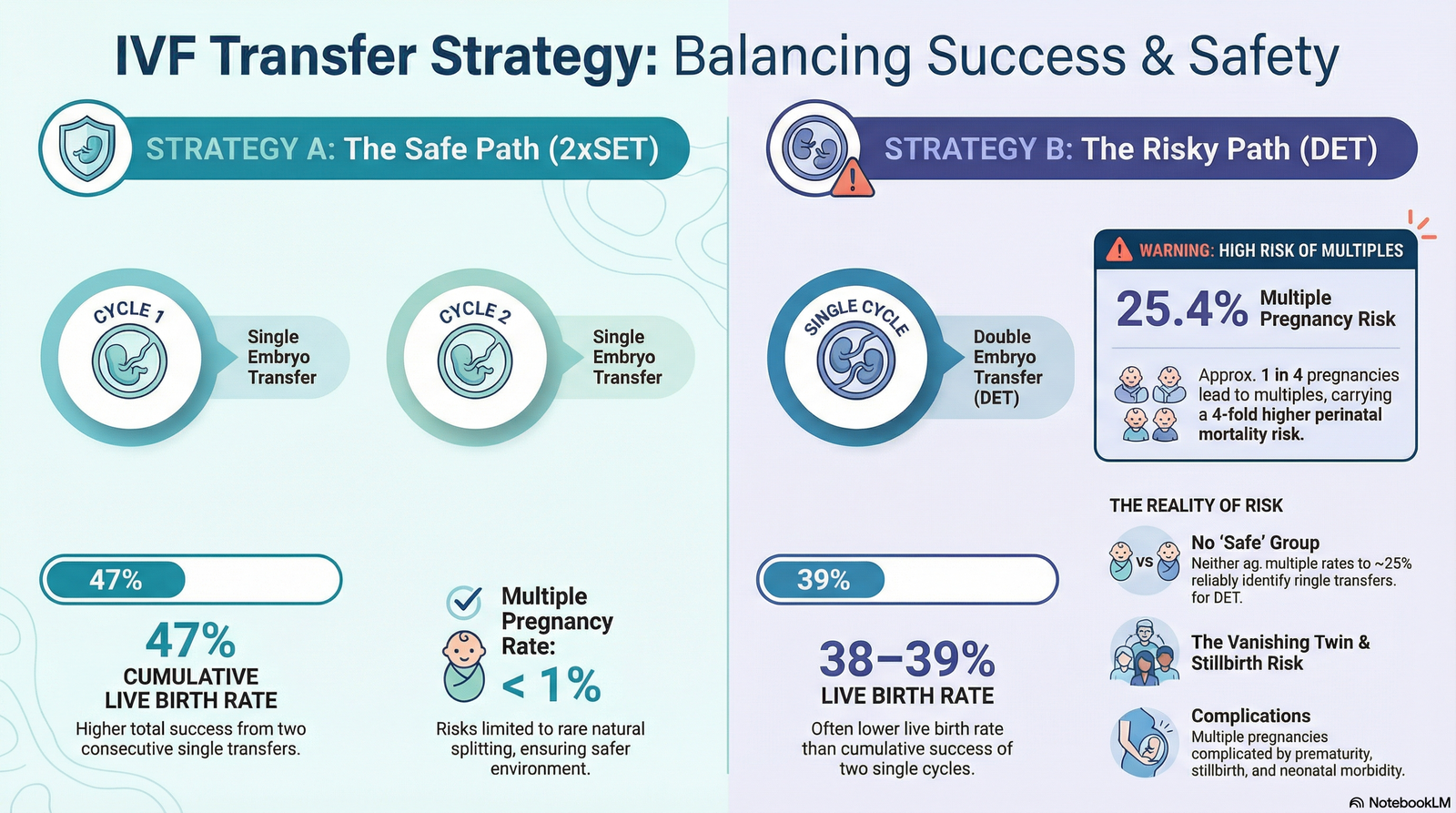
IVF and Multiple Gestation: timeline from transfer to delivery, with triplet risks by transfer strategy.
| Transfer Strategy | Live Birth Rate | Multiple Pregnancy Rate |
|---|---|---|
| Single embryo, two cycles (2xSET) | Up to 47% | Much lower than with double embryo transfer (DET) |
| Double embryo transfer (DET) | Around 38–39% | About 25% of DET |
| Single euploid embryo (any age) | High, clinic-dependent | Near 0%, rare embryo splitting |
These numbers explain why your doctor may strongly advise you to transfer one embryo at a time, especially if you have good-quality embryos to freeze or a euploid embryo after testing.
Guidelines from ASRM and ESHRE say:
- If your embryo is chromosomally normal (euploid), transfer one embryo, whatever your age.
- If you are under 35 a good prognosis, single embryo transfer should be the default.
- If you are 35 to 37, clinics can consider two embryos in some cases, but many still favor single embryo transfer when blastocysts and freezing are available.
- In places where insurance covers several cycles, clinics almost always transfer fewer embryos because you have more chances to try again safely.
Risks in Triplet Pregnancies
If you are already pregnant with triplets, you do not need another list of scary outcomes. You do deserve honest, measured numbers so you understand why your team recommends certain tests or restrictions.
What Happens In Your Body
Your heart, lungs, blood vessels, and musculoskeletal system carry the heaviest load. Your blood volume rises by about half compared with pre-pregnancy. Your uterus pushes against your diaphragm, large veins, and spine. In late pregnancy, your uterus can receive close to a fifth of your total blood flow.
The main maternal risks include:
- Preeclampsia: In singleton pregnancies, about 5 to 8 percent of women develop preeclampsia. In triplet pregnancies, published rates range from about 25 to 60 percent.
- Gestational diabetes: Hormonal changes in pregnancy increase insulin resistance. In triplet pregnancies, gestational diabetes has been reported in 7 to almost 40 percent of cases.
- Preterm labor: Three babies stretch the uterus more and earlier. Between 75 and over 90 percent of triplet pregnancies show signs of labor before term.
| Complication | Singleton Pregnancy | Triplet Pregnancy |
|---|---|---|
| Preeclampsia | 5–8% | 25–60% |
| Gestational Diabetes | 2–10% | 7–38% |
| Delivery before 37 weeks | About 10% | Over 90% |
| Perinatal Death | 4.3 per 1,000 | 21 per 1,000 |
Risks For Your Babies
Most of the extra risk in triplet pregnancies comes from prematurity and low birth weight. That is where the NICU comes in.
- Preterm birth: The average delivery for triplets is around 32 to 33 weeks. Many babies arrive earlier than that.
- Respiratory Distress Syndrome (RDS): About 44 to 50 percent of premature babies in triplet sets have trouble breathing because their lungs are not fully mature.
- Growth discordance: When one baby is much smaller than the others, blood count problems and the need for transfusions become more common.
- Long-term disability: Some studies report that roughly 1 in 5 triplet pregnancies lead to at least one child with a major long-term disability, such as cerebral palsy.
- Perinatal mortality: Death before or shortly after birth is about five times more common in triplets than in singletons.
Putting The Risk In Context
None of these numbers means that your babies will have problems. They show why your doctor treats triplet pregnancy as high risk and why the field has shifted toward single embryo transfer. When you reduce the number of embryos transferred, you keep the live birth rate high while sharply cutting the chance of extreme prematurity and NICU time.
It can feel unfair to be asked to accept a slightly lower per-transfer success rate today in exchange for a safer pregnancy tomorrow. Thinking in terms of your total chance of taking home a baby across one, two, or three transfers can make that trade-off easier to see.
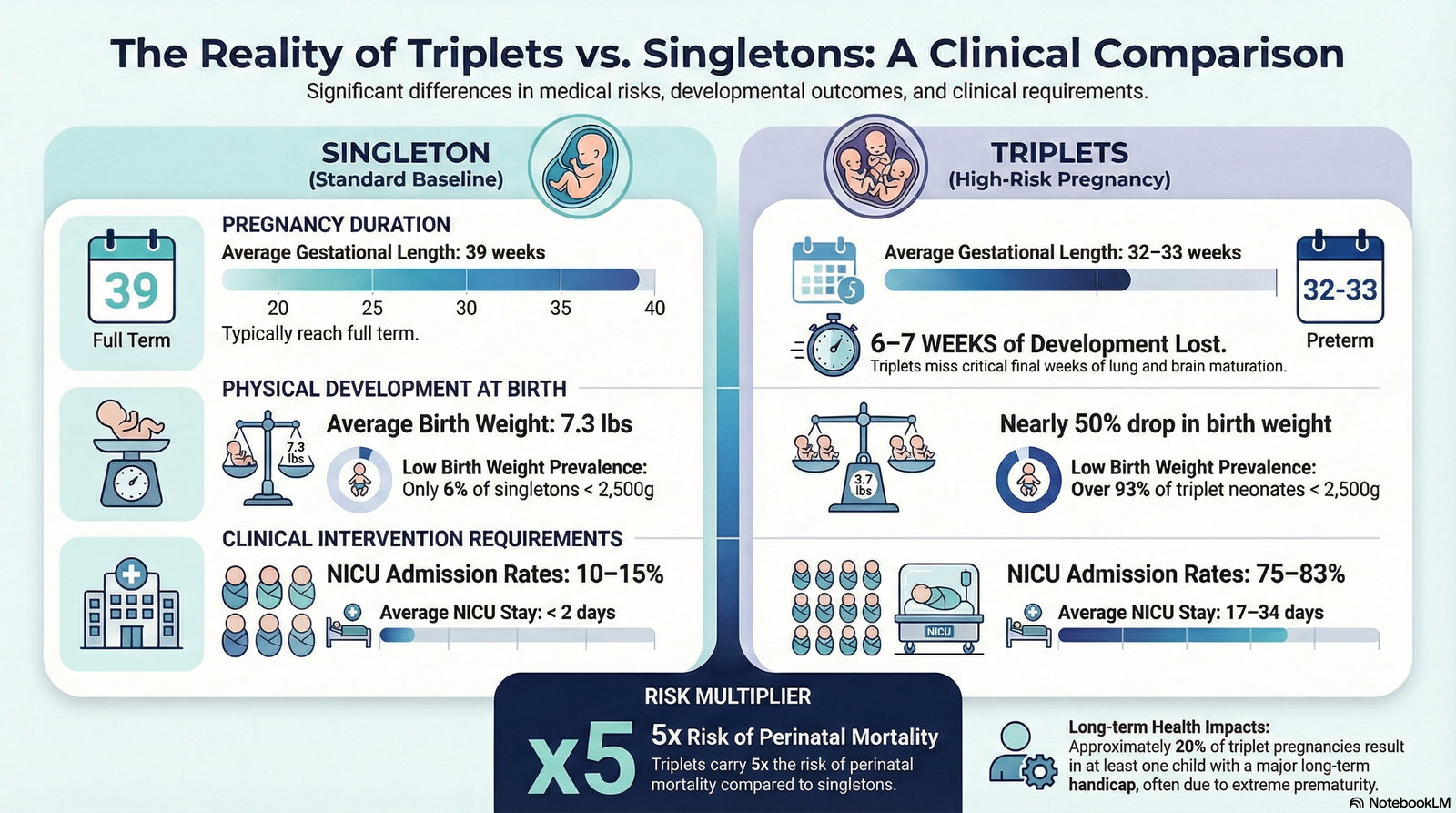
Triplet vs. singleton outcomes: pregnancy length, average birth weight, and NICU stay.
How Triplet Pregnancies Are Managed
If you are carrying triplets now, your care plan will look different from a typical singleton pregnancy. Your team will likely include a maternal fetal medicine specialist as well as your fertility doctor and midwife or obstetrician.
The Vanishing Triplet
When you first see three sacs on a scan at six or seven weeks, the story is not finished yet. Many early triplet pregnancies change shape during the first trimester.
Vanishing embryo syndrome describes the loss of one or more embryos after a heartbeat has been documented. In triplet pregnancies, this happens in up to about 40 percent of cases, usually before 14 weeks. If it happens early, the sac often shrinks and is absorbed. You might notice spotting or cramping, or you might feel nothing different at all.
Early loss usually does not harm the surviving fetuses or your own health, but your doctor will monitor you more closely if it happens later in the first trimester.
Selective Multifetal Pregnancy Reduction (MFPR)
If all three fetuses continue to grow, your doctor might raise the option of reducing the number of fetuses to two or one. This is a deeply personal and often painful choice, but doctors offer it because of the real difference it can make in gestational length and neonatal outcomes.
- Reducing triplets to twins often adds between two and seven weeks to the pregnancy, which can move your babies closer to a safer gestational age.
- The chance of losing the entire pregnancy after MFPR sits roughly between 10 and 26 percent, depending on how and when the procedure is done.
- If two of your triplets share a placenta, their risk of twin-to-twin transfusion and uneven blood oxygen is higher. In that case, reducing the shared pair to a singleton sometimes gives the best odds for one stable pregnancy and one healthy baby.
The procedure usually takes place between 9 and 14 weeks of pregnancy. Under ultrasound guidance, a specialist injects medicine into the fetal heart of the fetus or fetuses chosen for reduction. You are then monitored with follow-up scans and visits.
Monitoring and Milestones
With triplets, your prenatal schedule will often include:
- More frequent prenatal visits with blood pressure and urine checks to catch preeclampsia early.
- Regular ultrasound scans to track growth, amniotic fluid, and placental blood flow.
- Cervical length checks to assess the risk of early opening.
- Non-stress tests or biophysical profiles in the third trimester.
From the late second trimester onward, your doctor may ask you to keep track of fetal movements. Many teams suggest at least ten movements within two hours when the babies are usually active. If your babies seem very quiet for a long stretch, you call. It is always better to go in and be told everything looks fine than to sit at home worrying.
What Your Babies Are Doing Week-by-Week
In the middle of all the monitoring and numbers, your three babies are busy building themselves from scratch. Knowing what they are doing can give you something hopeful to focus on.
- Week 4: Each baby is about the size of a poppy seed. The heart tube and early blood vessels begin to form.
- Week 8: Each baby is about the size of a raspberry. Fingers and toes are distinct, facial features are forming, and internal organs are taking shape.
- Week 12: Each baby is about the size of a lime. They can bend their arms and legs, open and close their hands, and may already bump into one another, especially if they share a sac.
- Third trimester: Your babies are practicing breathing movements, swallowing amniotic fluid, gaining fat, and settling into sleep-wake cycles. On long ultrasounds, they often seem to stretch, kick, curl up together, and sometimes compete for space.
Your joints soften, your spine works harder, and your ligaments stretch far beyond their usual range. You might feel like a whole dance troupe has moved into your belly. That discomfort is real. You deserve practical support and rest, not just comments about how “special” your pregnancy is.
Real Clinical Stories
Every triplet pregnancy has its own story. These examples show the range of what is possible when you and your team work together.
- Triplets after acromegaly: A 33-year-old woman with high growth hormone levels from acromegaly went through IVF and conceived triplets. With close input from her endocrinologist and maternal fetal medicine specialist, she had a planned cesarean in the early thirties of weeks and took home three healthy baby girls.
- Triplets in mosaic Turner syndrome: Another patient with mosaic Turner syndrome and a small uterus on imaging conceived donor egg triplets. With very close monitoring for blood pressure, heart strain, and cervical change, she delivered three babies at 32 weeks. At the three-year follow-up, all three children were meeting developmental milestones.
- One retrieval, three singletons: One couple created six embryos from a single egg retrieval. Instead of putting several back together, they chose one fresh transfer and two frozen transfers spread over five years. They now have three singleton children, all genetic siblings from the same batch of embryos, and they never faced the risks of high-order multiples.
Handling The Emotional Load
If you are pregnant with triplets after IVF, it is easy to feel that every cramp or twinge spells disaster. You might swing between joy and fear several times a day. That does not mean you are weak. It means you understand what is at stake.
The Weight Of Big Decisions
When your doctor brings up selective reduction, you are not just making a medical decision. You are making an emotional and sometimes spiritual one. Many parents describe guilt, sadness, or a feeling that their pregnancy changed in an instant. Those reactions are human. They do not mean that you chose wrongly. They mean the choice mattered deeply to you.
Even if you decide not to reduce, you might still grieve the uncomplicated pregnancy you imagined. You might worry about NICU time, disability, or loss. That worry is a sign of how much you already love these babies, not a sign of weakness.
Practical Coping Tools
- Use a notebook: Keep one place for your appointments, questions for your doctor, weight and blood pressure logs, and your own thoughts. This can clear mental space and help you feel more in control.
- Move gently: Short, approved walks or prenatal yoga can ease back pain and improve sleep and mood. Always clear new activity with your doctor.
- Limit doom scrolling: Online forums can help you feel less alone, but they can also flood you with worst-case stories. If you notice your heart racing or your chest tightening while reading, close the tab and do something grounding instead.
- Ask for real help: This might mean asking friends for childcare for older kids, rides to appointments, or meal support. People often want to help but do not know what you need until you say it.
- Talk to a therapist: Perinatal psychologists and social workers understand loss, high-risk pregnancy, and IVF stress. A few sessions can give you tools that carry into life after birth as well.
Birth, Recovery, and What to Expect
The Delivery Room Reality
If you picture a quiet room with one midwife and soft music, the real scene at a triplet birth may shock you. You might see several doctors, multiple nurses, anesthetists, and separate neonatal teams for each baby. The operating room can feel crowded and bright. It is normal to feel exposed or overwhelmed at first. Try to remember that every person in that room is there to protect you and your babies.
- Most triplet pregnancies end with a planned or urgent cesarean birth.
- Your “pushing stage” will not mirror what friends describe after vaginal births. Much of your work happened in the months leading up to the surgery.
- After your babies are born, your uterus still has to deliver three placentas and clamp down on the raw surface they leave behind. Strong, crampy “afterpains” for a few days are common.
Bleeding and Early Recovery
For about six weeks after birth, you will pass lochia, a mix of blood and tissue. It starts as a bright red, heavy flow, then fades to pink, brown, and finally a pale yellow or white. At first, you will need large maternity pads. Some parents call this the “mommy diaper” phase. It is not glamorous, but it is normal.
You call your doctor or midwife right away if you soak a full pad in an hour, pass clots bigger than a small egg, feel dizzy or faint, or notice a foul smell with your bleeding.
Want help comparing clinics and costs?
If researching all of this feels like a full-time job, you are not imagining it. Our advisors can help you gather clear, itemized quotes from verified clinics, check their embryo transfer policies, and map out your likely IVF costs and timelines, at no cost to you.

Why trust this guide? The OVU commitment
You are probably juggling hope, timelines, and a lot of tabs open in your browser. And you deserve clear, current, human advice. At OVU, we review clinic protocols, compare real quotes, and talk to people who have done this - intended parents and gestational carriers - so we can give you practical steps, not just theory. If you want help comparing options without sales pressure, we will gather itemized quotes and success data that match your exact situation. You decide, we will bring the info to your table.
Frequently Asked Questions
Can I deliver triplets vaginally?
While there are rare exceptions, the answer is almost always no. In modern medical practice, triplets and higher-order multiples (four or more babies) are delivered via cesarean section. This approach significantly reduces the risk of sudden distress for the babies and lowers the chance of serious complications for you, such as heavy bleeding or severe tearing.
How long will my babies stay in the NICU?
While the average NICU stay for triplets ranges from 17 to 34 days, every situation is unique. The time spent in the nursery depends heavily on gestational age; babies born earlier require more support for lung development, feeding, and weight gain. Generally, most babies are ready to go home near their original due date, though some reach these milestones more quickly than others. Your neonatology team will provide regular updates on your babies’ progress as they grow.
Does a vanishing triplet harm the surviving babies?
If a triplet “vanishes” early in the first trimester, often before the 12th week, the gestational sac is typically reabsorbed by the body. In these cases, the surviving babies usually continue to develop normally without being harmed. However, losses that occur later in pregnancy carry more risk and require closer follow-up. If your doctor identifies a vanishing triplet, ask what extra monitoring they recommend for the survivors and what specific symptoms should prompt a call between visits.
Why did my doctor only transfer one embryo if I wanted twins?
Your doctor is aiming for one healthy baby at a time. While transferring two embryos may seem like a way to build your family faster, it raises the chance of a high-risk multiple pregnancy much more than it raises your overall chance of having a baby. Two single embryo transfers, especially with high-quality embryos, usually provide equal or better success rates while significantly reducing the risks of preterm birth and other complications for both you and your baby.
How much weight should I gain with triplets?
For someone who starts pregnancy at a normal weight, many specialists aim for a total gain of about 37 to 54 pounds with triplets. Gaining close to a pound a week in the first half of pregnancy has been linked to better birth weights. Your own target should come from your doctor or dietitian, based on your body type and health conditions.
Reference List 5 sources
Journal Article (Research): Tighe J, Broughton S, Roberts R, et al. Effectiveness and safety of consecutive single embryo transfer compared to double embryo transfer: results from the UK HFEA registry. Human Reproduction. 2025;40(5):885–894. PMID: 39999407. Available from: https://pubmed.ncbi.nlm.nih.gov/39999407/
Journal Article (Research): Dietrich JE, Cáceres Valcárcel I, Capp E, Strowitzki T, Germeyer A. High multiple pregnancy rates after double embryo transfers in human: a retrospective cohort study. Reproduction & Fertility. 2025;6(2):e240078. PMID: 40111385. Available from: https://pubmed.ncbi.nlm.nih.gov/40111385/
Committee Opinion (Guidance): Practice Committee of the American Society for Reproductive Medicine; Practice Committee of the Society for Assisted Reproductive Technology. Guidance on the limits to the number of embryos to transfer: a committee opinion. Fertility and Sterility. 2021;116(3):651–654. PMID: 34330423. Available from: https://pubmed.ncbi.nlm.nih.gov/34330423/
Journal Article (Guideline): ESHRE Guideline Group on the Number of Embryos to Transfer, Alteri A, Arroyo G, Baccino G, et al. Evidence-based guideline: number of embryos to transfer during IVF/ICSI. Human Reproduction. 2024;39(4):647–657. PMID: 38364208. Available from: https://pubmed.ncbi.nlm.nih.gov/38364208/
Committee Opinion (Guidance): American College of Obstetricians and Gynecologists. Perinatal risks associated with assisted reproductive technology. Committee Opinion No. 671. Obstetrics & Gynecology. 2016;128(3):e61–e68. Available from: https://www.acog.org/clinical/clinical-guidance/committee-opinion/articles/2016/09/perinatal-risks-associated-with-assisted-reproductive-technology
Final Thoughts
Your IVF journey has already taken courage, time, and energy. If you are now facing a triplet pregnancy or a big decision about how many embryos to transfer, you are carrying both medical facts and deep feelings at the same time.
When you strip away the medical terms, the key goals stay simple. You want to protect your health, give each baby the best chance, and build the family you dream about. Modern data show that careful embryo transfer policies, especially single embryo transfer (SET) with good-quality embryos, are often a better strategy than transferring “just one more”.
The path will not look exactly like anyone else’s. It may be harder than you expected, and some days will feel heavier than others. The “beautiful chaos” of multiples completely redefines the meaning of love. You do not have to carry it alone. Your care team, your family, your partner or close friend, and dedicated advisors can walk this with you. Every kick you feel, every NICU visit, and every milestone at home will be part of a story you and your children share for life.