


Dr. Sony Sherpa (MBBS)
In addition to her clinical experience, Dr. Sherpa is a published medical researcher and holistic health advocate. Her dual expertise in emergency care and alternative therapies brings a unique lens to medically reviewed content—ensuring it is both accurate and accessible.
If you and your partner are staring at a semen analysis and wondering what it means for your next step, you are in the right place. Imagine this: you have done the blood tests, you have set aside time off work, and now you want a clear plan that saves time and money. That is a normal place to be, and you are not alone.
Here is a helpful anchor as you read: Recent trials show that when semen parameters are not severely impaired, conventional IVF can match ICSI for live birth rates, for example, 36.6 percent vs 33.8 percent in one multicenter RCT. Use this to frame your questions during consults, especially when clinics suggest ICSI by default.
Experts from leading societies recommend reserving ICSI for true male factor indications, surgical sperm retrieval, prior fertilization failure, or when genetic testing is planned. This guide translates that guidance into practical steps you can act on today.
Intracytoplasmic sperm injection (ICSI) is a lab technique where a single sperm is injected into an egg to help fertilization happen. It is most useful for severe male factor infertility, surgical sperm retrieval, using frozen sperm, or after failed fertilization with IVF. A full IVF cycle, involving ICSI, takes about 4 to 6 weeks.
Next step: Confirm whether you meet clear ICSI indications, then align lab strategy with your goals and budget.
Research Highlights
Large studies between 2023 and 2025 report no live birth advantage for routine ICSI when the male factor is not severe, while targeted use of testicular sperm with ICSI can improve outcomes in high sperm DNA fragmentation cases. Guidelines continue to support selective ICSI use tied to specific indications.
In This Guide
Severe male factor, surgical sperm retrieval, using frozen sperm, prior IVF fertilization failure
IVF cycle: 4 to 6 weeks
ICSI add-on: 500 to 2,000 EUR
ICSI at a Glance
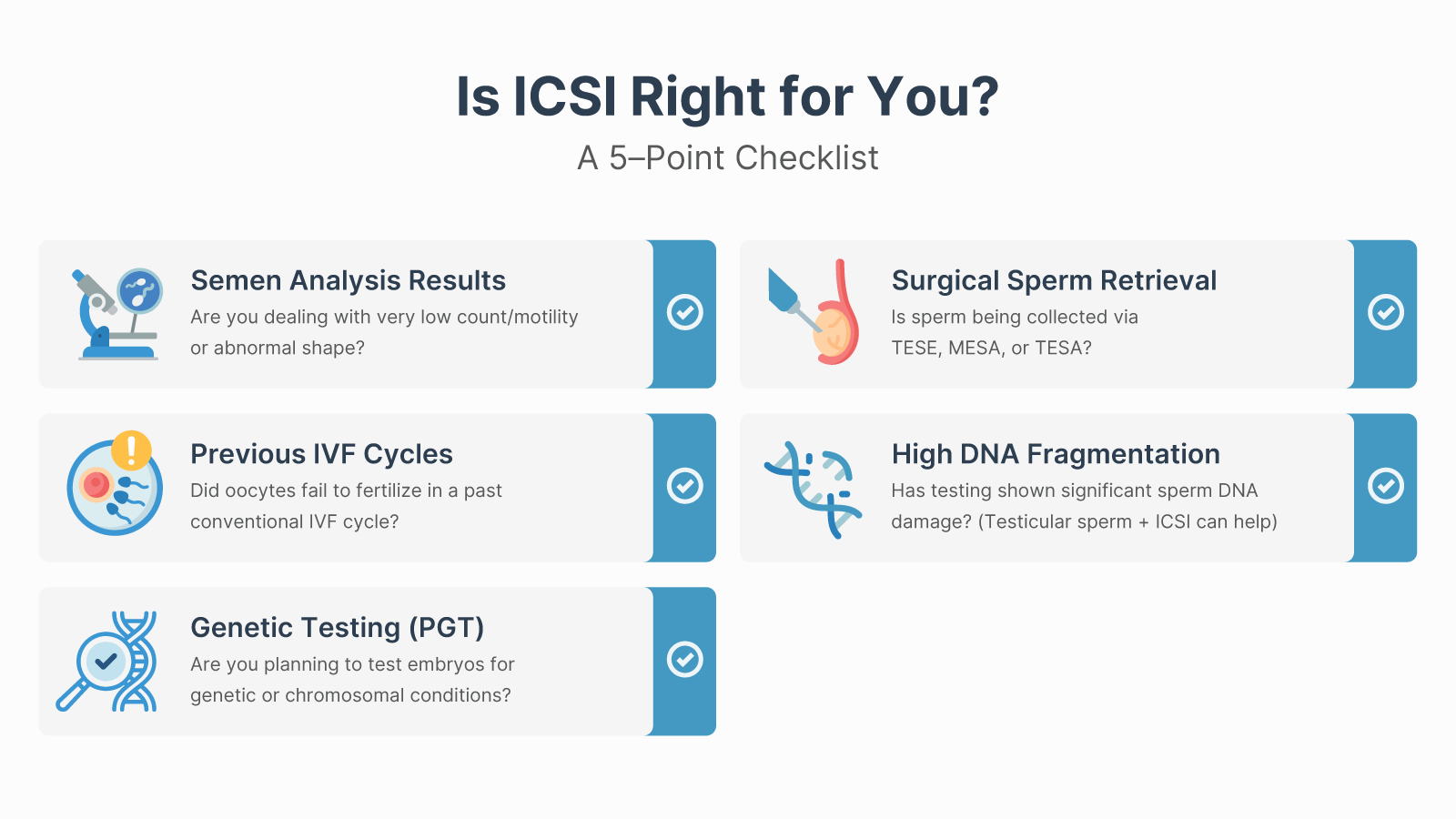
ICSI makes sense when sperm cannot reliably fertilize eggs on their own. Your doctor recommends ICSI for very low count or motility, abnormal morphology, no sperm in the ejaculate with surgical retrieval, high sperm DNA fragmentation, prior failed fertilization with IVF, or when you plan embryo genetic testing.
Latest Research Insights
Finding #1 (2024): In couples with non-severe male factor infertility, ICSI did not improve live birth vs conventional IVF. A 2024 multicenter RCT in The Lancet by Qiao et al. (PMID: 38330980) reported live birth after first transfer was 33.8% with ICSI vs 36.6% with IVF, adjusted RR 0.92, 95% CI 0.83 to 1.03. Why this matters: if semen parameters are acceptable, IVF can perform as well without the extra cost of ICSI.
Finding #2 (2023): For high sperm DNA fragmentation, using testicular sperm for ICSI improved outcomes. A meta-analysis in Translational Andrology and Urology by Yuan et al. (PMID: 38196694) found higher live birth, OR 3.10, 95% CI 2.13 to 4.51, and lower miscarriage, OR 0.28, 95% CI 0.13 to 0.60, with testicular vs ejaculated sperm. Why this matters: switching sperm source can change results when DNA damage is high.
Finding #3 (2023): Testicular sperm showed substantially lower DNA fragmentation than ejaculated sperm in the same men. The same meta-analysis (PMID: 38196694) reported a mean difference of minus 25.81 percentage points, 95% CI minus 34.82 to minus 16.81. Why this matters: lower DNA damage supports better pregnancy outcomes.
Note: These findings summarize peer-reviewed research and clinical guidelines. Individual outcomes vary based on personal health factors. Discuss your case with your fertility specialist.
ICSI overview: when to use it and how it fits into IVF
Costs and Comparison Table
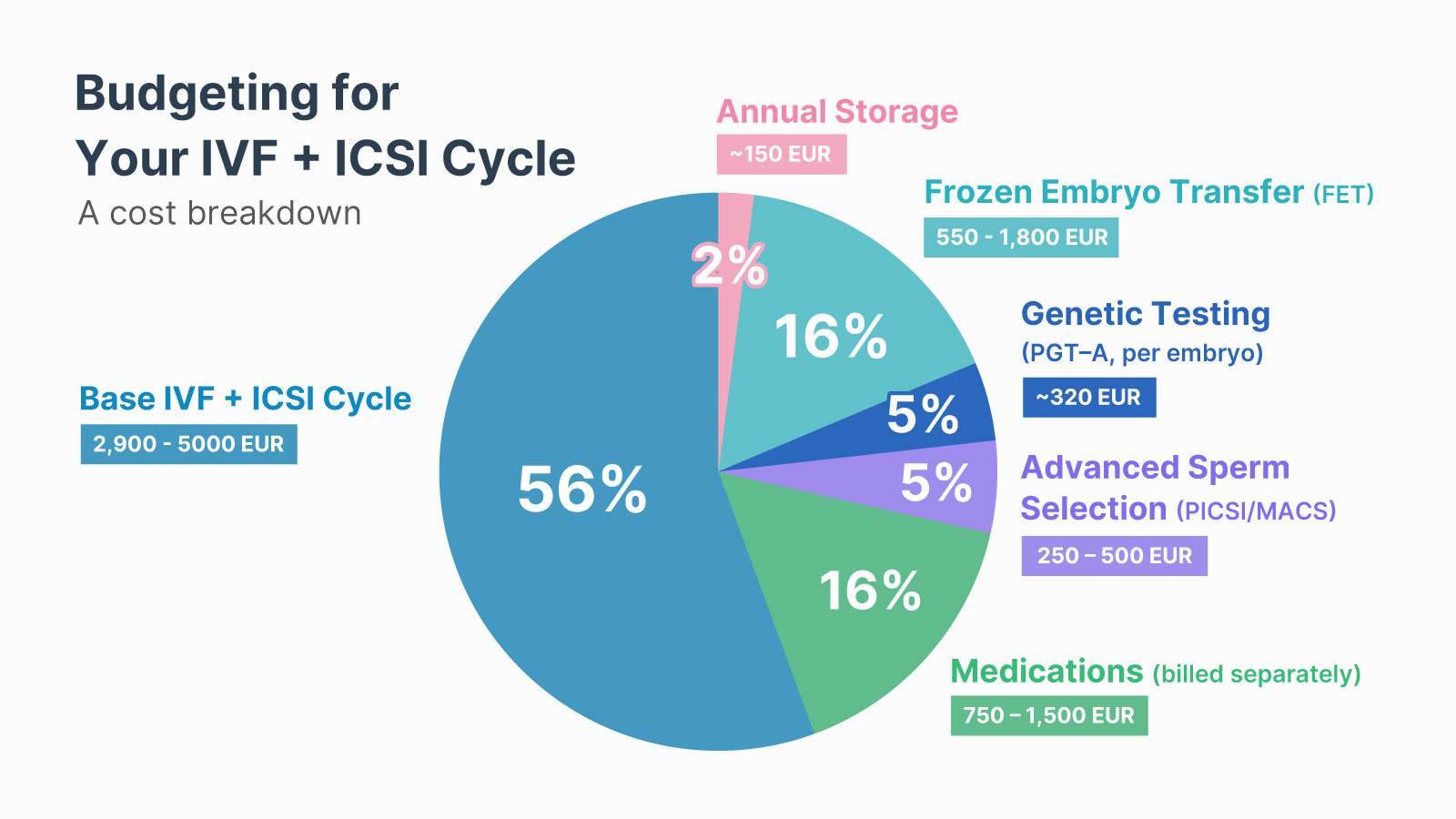
The true cost of an IVF/ICSI cycle is a multi-component expense that extends far beyond the clinic’s advertised “base fee.” While your final invoice depends on your specific protocol, medications dosage, and the number of embryos created and tested, you should budget for the following core services and potential add-ons.
| Service | Common Range | Notes |
|---|---|---|
| IVF with ICSI cycle | 2,900 to 5,000 EUR | Base cycle fee, region–dependent. |
| ICSI add–on | 500 to 2,000 EUR | Per cycle or per set of eggs fee. |
| Medications | 750 to 1,500 EUR | Often billed separately. |
| FET cycle | 550 to 1,800 EUR | Devitrification and transfer; medications always are not included in the core bundle’s cost, therefore, are charged additionally. |
| Storage | ~150 EUR per year | Annual fees for storing vitrified embryos or frozen sperm vary significantly by clinic. These fees must be paid annually to the clinic or storage facility to prolong the storage agreement and prevent the eventual disposal. |
| PICSI (Physiological Intracytoplasmic Sperm Injection) or IMSI (Intracytoplasmic Morphologically Selected Sperm Injection) | 450 to 500 EUR | Non–invasive sperm selection add–on. |
| MACS or microfluidic sorting | 250 to 290 EUR | Using microfluidic sorting in Intracytoplasmic Sperm Injection (ICSI) cycles can lead to higher clinical pregnancy and live birth rates. |
| Time–lapse incubator | 200 to 330 EUR | A technology that provides continuous, real-time monitoring of embryo development, allowing embryologists to make a more informed and objective selection of the best embryo for transfer. |
| PGT–A per embryo | ~320 EUR | Genetic test performed on embryos to screen for aneuploidy, which involves checking for an abnormal number of chromosomes. Most basic IVF bundles do not include this test until it is required. |
| PGT–M package | ~3,400 EUR | PGT–M (Preimplantation Genetic Testing for Monogenic/Single Gene Defects) packages most often cover testing for up to 5 embryos. An extra fee is charged for each additionally screened embryo. |
The IVF + ICSI Process Step-by-Step
IVF cycles involving the ICSI technique follow the routine IVF process, but with a critical difference in the laboratory step. Any cycle starts with a fertility assessment to evaluate overall health and reproductive potential. Once this initial phase is completed, the process unfolds in three main stages:
1. Ovarian Stimulation and Monitoring: You will begin ovarian stimulation, typically for 10 to 14 days, using injectable hormone medications. During this time, the clinic will perform frequent monitoring (ultrasounds and blood tests) to track follicle growth and adjust your medication dosage.
2. Retrieval and ICSI: Once the follicles are mature, you will undergo an egg retrieval, a short procedure performed under light anesthesia. Immediately following retrieval, the lab initiates ICSI. An embryologist injects one selected sperm directly into the cytoplasm of each mature egg.
3. Fertilization Check and Embryo Culture: The next day, the embryology team checks for fertilization success. The resulting embryos are then cultured in the lab, where they typically grow until Day 5 or Day 6 to reach the blastocyst stage. At this point, the blastocysts are either transferred to the uterus (fresh transfer) or frozen (cryopreserved) for future use.
Additional Evidence You Should Know
Finding #1 (2024): Real-world registry data reports no live birth gain with ICSI when the male factor is absent. A HFEA registry study in Journal of Translational Medicine by Paffoni et al. (PMID: 39069615) supports selective ICSI.
Finding #2 (2025): Meta-analysis of congenital anomalies suggests small risk differences between IVF and ICSI. A 113 study review in the Journal of Assisted Reproduction and Genetics by Li et al. (PMID: 40163274) advises careful indication.
Finding #3 (2025): Randomized data show no cumulative live birth benefit with ICSI when the male factor is not severe. See Berntsen et al., Nature Medicine (PMID: 40217077).
Guideline (2024): The AUA and ASRM guideline on male infertility (source) recommends ICSI for severe male factor, surgical sperm retrieval, and after failed fertilization, and cautions against routine ICSI use without indication.
Risks and Special Considerations
While ICSI is a powerful and generally safe laboratory technique, it is essential to understand that it has specific limitations and carries certain low-level risks associated with bypassing natural selection. So, what does that mean for you? Let’s discuss the critical factors, including potential genetic implications, and when ICSI truly provides a significant benefit, such as in cases of high sperm DNA damage.
- ICSI helps overcome sperm-egg binding problems (e.g., in low count/motility cases). It does not correct issues related to egg quality or inherent embryo genetics once fertilization occurs.
- Fertilization Failure: While ICSI is highly effective, it does not guarantee fertilization. Failures can still occur due to issues with the egg or sperm that are unrelated to the injection process.
- High Sperm DNA Fragmentation: When sperm DNA integrity is compromised, studies (including meta-analyses) show that using testicular sperm (surgically retrieved) with ICSI can significantly improve live birth rates and reduce the risk of miscarriage compared to using ejaculated sperm.
- Congenital Anomaly Risk: Some large reviews and meta-analyses note a very small, statistically insignificant difference in the risk of certain congenital anomalies compared to conventional IVF or natural conception. The overall risk is still low, but your doctor will discuss this thoroughly during the consent process.
Deciding on ICSI, a simple flow from indications to outcomes
Clinic and Country Options
When planning your cycle, remember that costs and treatment protocols can vary drastically across clinics and even countries. Choosing the right center is about more than just the lowest price; you need transparency. As you review options, specifically look for clinics offering transparent pricing, clear caps on add-on costs (like the number of eggs injected), and detailed embryology reporting. This reporting is vital because it shows the true success of the lab—look for clear data on your fertilization rates, blastocyst formation, and usable embryo counts. This data will help you compare their actual performance, not just their advertised live birth rates.
OVU Expert Guidance
When consulting with your clinic, make sure you understand precisely how ICSI changes your live birth odds given your specific semen analysis results. A key part of your discussion should cover the clinic’s protocol for switching from conventional IVF to ICSI—for example, what specific fertilization failure rate triggers the change. Finally, don’t be afraid to ask how they decide on sperm selection add-ons like PICSI or MACS, and always request fully itemized quotes. This detailed breakdown is the only way to compare true costs if you are considering multiple clinics.
Want help comparing clinics and costs?
If this feels like a full–time job, and honestly, it can, our advisors can collect clear, itemized quotes from verified clinics and map your timeline at no cost to you.

Why trust this guide? The OVU commitment
You are probably juggling hope, timelines, and a lot of tabs open in your browser. And you deserve clear, current, human advice. At OVU, we review clinic protocols, compare real quotes, and talk to people who have done this - intended parents and gestational carriers - so we can give you practical steps, not just theory. If you want help comparing options without sales pressure, we will gather itemized quotes and success data that match your exact situation. You decide, we will bring the info to your table.
Frequently Asked Questions
Who benefits most from ICSI?
While ICSI is frequently used, current guidelines recommend reserving this technique for those who fall into one of the following categories: severe male factor infertility, surgical sperm retrieval, high sperm DNA fragmentation, prior failed fertilization with conventional IVF, or when embryo genetic testing (PGT) is necessary.
How long does IVF with ICSI take?
Most cycles run 4 to 6 weeks from the first fertility shot to the embryo transfer, including the initial assessments and preparation. The active ovarian stimulation phase usually lasts the most intensive 10 to 14 days.
Is ICSI always better than IVF?
No. Large trials show no live birth advantage for ICSI when the male factor is not severe. Use it when it solves a clear problem.
Do add-ons like PICSI or MACS help?
They can help in specific cases, for example, high sperm DNA fragmentation or poor sperm morphology. Your embryologist will personalize tools to your results.
What does a typical cost breakdown look like?
The Base IVF with ICSI cost ranges from €2,900 to €5,000, while the ICSI add-on price varies between €500 and €2,000. Medications typically cost from €750 to €1,500. Fees for optional lab tools are generally €200 to €500 each, a Frozen Embryo Transfer (FET) costs from €550 to €1,800, and storage expenses are about €150 per year.
Reference List 9 sources
Journal Article (Research): Qiao J, et al. Intracytoplasmic sperm injection versus conventional in vitro fertilisation in couples with non severe male factor infertility: multicentre randomised controlled trial. The Lancet. 2024;403(10430):[pages]. PMID: 38330980. Available from: https://pubmed.ncbi.nlm.nih.gov/38330980/
Journal Article (Comparative Study): Pham TD, Dang VQ, et al. ICSI versus IVF in infertile couples with normal total sperm count and motility: does morphology matter? Human Reproduction. 2025;40(1):23 29. PMID: 39547931. Available from: https://pubmed.ncbi.nlm.nih.gov/39547931/
Journal Article (Research): Berntsen S, et al. IVF versus ICSI in patients without severe male factor infertility: a randomized clinical trial. Nature Medicine. 2025;31(6):1939 1948. PMID: 40217077. Available from: https://pubmed.ncbi.nlm.nih.gov/40217077/
Journal Article (Systematic Review & Meta Analysis): Yuan X, et al. Testicular versus ejaculated sperm for ICSI in men with high sperm DNA fragmentation: systematic review and meta analysis. Translational Andrology and Urology. 2023;12(12):1785 1803. PMID: 38196694. Available from: https://pubmed.ncbi.nlm.nih.gov/38196694/
Journal Article (Research): Paffoni A, et al. ICSI versus conventional in vitro insemination in couples with non male infertility factor in the real world: HFEA registry analysis. Journal of Translational Medicine. 2024;22(1):687. PMID: 39069615. Available from: https://pubmed.ncbi.nlm.nih.gov/39069615/
Journal Article (Systematic Review & Meta Analysis): Li R, et al. Congenital anomalies in ART conceived children versus spontaneous conception: systematic review and meta analysis. Journal of Assisted Reproduction and Genetics. 2025;[vol(issue)]:[pages]. PMID: 40163274. Available from: https://pubmed.ncbi.nlm.nih.gov/40163274/
Journal Article (Systematic Review & Meta Analysis): Cano Extremera M, et al. Testicular vs ejaculated sperm in ICSI cycles with high SDF: live birth and miscarriage outcomes. Biology (Basel). 2025;14(2):130. PMID: 40001898. Available from: https://pubmed.ncbi.nlm.nih.gov/40001898/
Committee Opinion (Guidance): AUA and ASRM. Diagnosis and Treatment of Infertility in Men, amended 2024. Guideline. 2024. Available from: https://www.auanet.org/documents/Guidelines/PDF/2024 Guidelines/Male Infertility Unabridged Final.pdf
Journal Article (Research): Dang VQ, Vuong LN, et al. ICSI vs conventional IVF in couples with normal total sperm count and motility: randomized trial. The Lancet. 2021;397(10284):1554 1563. PMID: 33894833. Available from: https://pubmed.ncbi.nlm.nih.gov/33894833/
Final Thoughts
As you move forward, always remember the guiding principle: Use ICSI when it solves a specific problem, and keep your plan lean and cost-effective when conventional IVF already meets your fertilization goals. Your next steps should be focused: Ask your clinic to clearly show how adding ICSI impacts both your live birth odds and your total costs in your specific case. Having clear information and a stepwise plan is the most powerful way to cut through the complexity and move forward with confidence and clarity.
Compare IVF costs across trusted clinics
Save time and lower the guesswork with itemized quotes and clear timelines from verified clinics. Start your comparison.