


Dr. Sony Sherpa (MBBS)
In addition to her clinical experience, Dr. Sherpa is a published medical researcher and holistic health advocate. Her dual expertise in emergency care and alternative therapies brings a unique lens to medically reviewed content—ensuring it is both accurate and accessible.
Are you feeling overwhelmed by the idea of high-dose hormone injections and daily shots in your stomach? You are not alone. Many people reach a point where they wonder if there is a way to go through IVF that feels more in tune with their cycle and less like a full-time medical job.
From the very beginning of IVF, when Louise Brown, the first “test-tube baby,” was conceived in an unstimulated natural cycle, doctors have tried to balance lab efficiency with respect for how your body already works. For a long time, the trend was “more is better”, with high doses of stimulatory drugs to recruit as many eggs as possible. Now there is a clear shift back toward natural and low-medication approaches, especially for women who respond poorly to stimulation and for those who want a gentler path.
The encouraging news is that natural and modified natural cycles do not just “feel” more gentle. Large trials show that in many situations your live birth chances per transfer stay similar to conventional IVF’s. In some frozen transfer studies, natural cycles reach live birth rates around 54 percent, compared with about 43 percent in fully hormone replacement cycles. That gives you room to choose based on cost, convenience, and risk, not just pressure to follow a standard protocol.
Natural and modified natural IVF uses little or no stimulation and works with your ovulation. They usually cost between $5,000 and $9,000 per cycle, compared with $10,000 to $20,000 for fully stimulated IVF. For frozen embryo transfers, natural-cycle preparation can reach about a 54 percent live birth rate compared with about 43 percent in artificial cycles, and it is linked to lower risks of high blood pressure and heavy bleeding in pregnancy.
If you have regular cycles, react poorly to high-dose drugs, or need a more budget-friendly option, these protocols give you a realistic alternative to standard IVF. Your fertility specialist can help you decide whether to build treatment around your own natural cycle or use stronger stimulation.
What the latest research shows
Recent randomized trials and large cohort studies have compared natural, modified natural, and fully programmed cycles for both IVF stimulation and frozen embryo transfer. The data show that natural and modified natural protocols can match live birth rates per transfer while lowering some pregnancy risks, including preeclampsia and postpartum bleeding, and eliminating the risk of ovarian hyperstimulation syndrome.
Evidence from poor responders suggests that implantation rates around 14.9 percent in natural cycles can outpace rates around 5.5 percent in high-dose cycles, even though fewer eggs are collected. At the same time, cost-effectiveness analyses highlight medication savings of several thousand dollars per attempt when you move away from heavy stimulation.
These findings give you and your doctor room to tailor IVF to your age, ovarian reserve, risk profile, and budget, instead of relying on a one-size-fits-all protocol.
In This Guide
- Natural vs. modified natural IVF: what they really mean
- Why these protocols matter for poor responders
- Getting more eggs from each cycle with IVM
- Your uterus, hormones, and pregnancy health
- ICSI, embryo quality, and PGT-A in natural cycles
- Success rates and costs side by side
- How to know if this approach is right for you
- Frequently asked questions
Natural or modified IVF: $5,000 to $9,000 per cycle.
Conventional IVF: $10,000 to $20,000 per cycle.
Natural-cycle FET: about 54% live birth.
Artificial-cycle FET: about 43% live birth.
OHSS risk: near 0% in natural cycles.
Preeclampsia: about 4% natural vs. 9.2% programmed.
Natural vs. Modified Natural IVF: What They Really Mean
If you are just starting to read about natural IVF, the jargon can feel like a different language. You see terms like “true natural”, “modified natural”, and “mild stimulation”, and it is not obvious what your day-to-day experience would look like. Let’s break it down so you can picture your calendar more clearly.
True Natural Cycle IVF (tNC-IVF) is the most medication-free version of IVF. You do not take stimulatory drugs. Your clinic follows the follicle your body chooses on its own, usually with several ultrasounds and blood tests for estradiol (E2) and luteinizing hormone (LH). Your team times egg retrieval according to your body’s own LH surge.
This approach is gentle on your body and on your budget, but there is a real trade-off. If you ovulate before the team can retrieve your egg, that cycle is lost. In some reported series, up to about a third of cycles cancel for this reason.
Modified Natural Cycle IVF (mNC-IVF) keeps the spirit of a natural cycle and adds a few tools so the clinic can guide the timing more tightly.
- Your team usually adds a GnRH antagonist (such as cetrorelix or ganirelix) when your leading follicle measures around 13 to 15 mm. This drug works like a brake on your LH surge, so you do not ovulate too early.
- Because the antagonist can lower hormone levels a bit, some clinics add a small dose of human menopausal gonadotropin (hMG) or FSH, often 75 to 150 IU, to keep the follicle growing smoothly.
- When the follicle is ready, you take a trigger shot of hCG or a GnRH agonist. This mimics your LH surge and lets the team schedule retrieval about 36 hours after the trigger.
If you worry that the trigger shot will hurt your chances, that concern is common. Large clinical trials have looked at this and found that live birth rates are almost the same, around 49 percent, whether ovulation happens on its own or after an hCG trigger. That gives you room to choose based on your work schedule, travel time to the clinic, and your personal comfort with a bit of medication.
Latest Research Insights
54% vs. 43% – Natural Cycle Edge: In a trial of 902 women, natural-cycle frozen transfers led to live births in 54 out of 100 women, compared with 43 out of 100 using hormone replacement cycles. Miscarriage and bleeding in pregnancy were also less common with natural cycles. This suggests that if you ovulate regularly, working with your own cycle can give you a better chance of a live birth and a calmer pregnancy. Source: PLOS Medicine (PMID: 40561125).
37% vs. 33–34% – Three Protocols, Similar Births: In a large study of 1,428 women, live birth rates after one frozen transfer were 37 percent with a true natural cycle, 33 percent with a modified natural cycle, and 34 percent with a fully artificial cycle. Natural and modified natural cycles had more cancellations before transfer, but once embryos were transferred, birth chances were very similar. This means you and your doctor can choose between natural and modified natural based on convenience and clinic workflow without losing much in terms of success. Source: The Lancet (PMID: 38944045).
42% vs. 41% – Same Births, Fewer Complications: A trial of 4,376 women compared frozen transfers timed to natural ovulation with fully programmed cycles. Healthy live birth rates were almost identical at about 42 out of 100 in both groups, but natural ovulation cycles had lower rates of preeclampsia, heavy bleeding after birth, and caesarean section. If you are able to ovulate on your own, staying closer to your natural hormones can help you reach the same baby outcome with fewer pregnancy problems. Source: BMJ (PMID: 41565309).
These findings come from peer-reviewed research. Your results depend on your age, diagnosis, and egg reserve. Talk with your fertility specialist about what they mean for you.
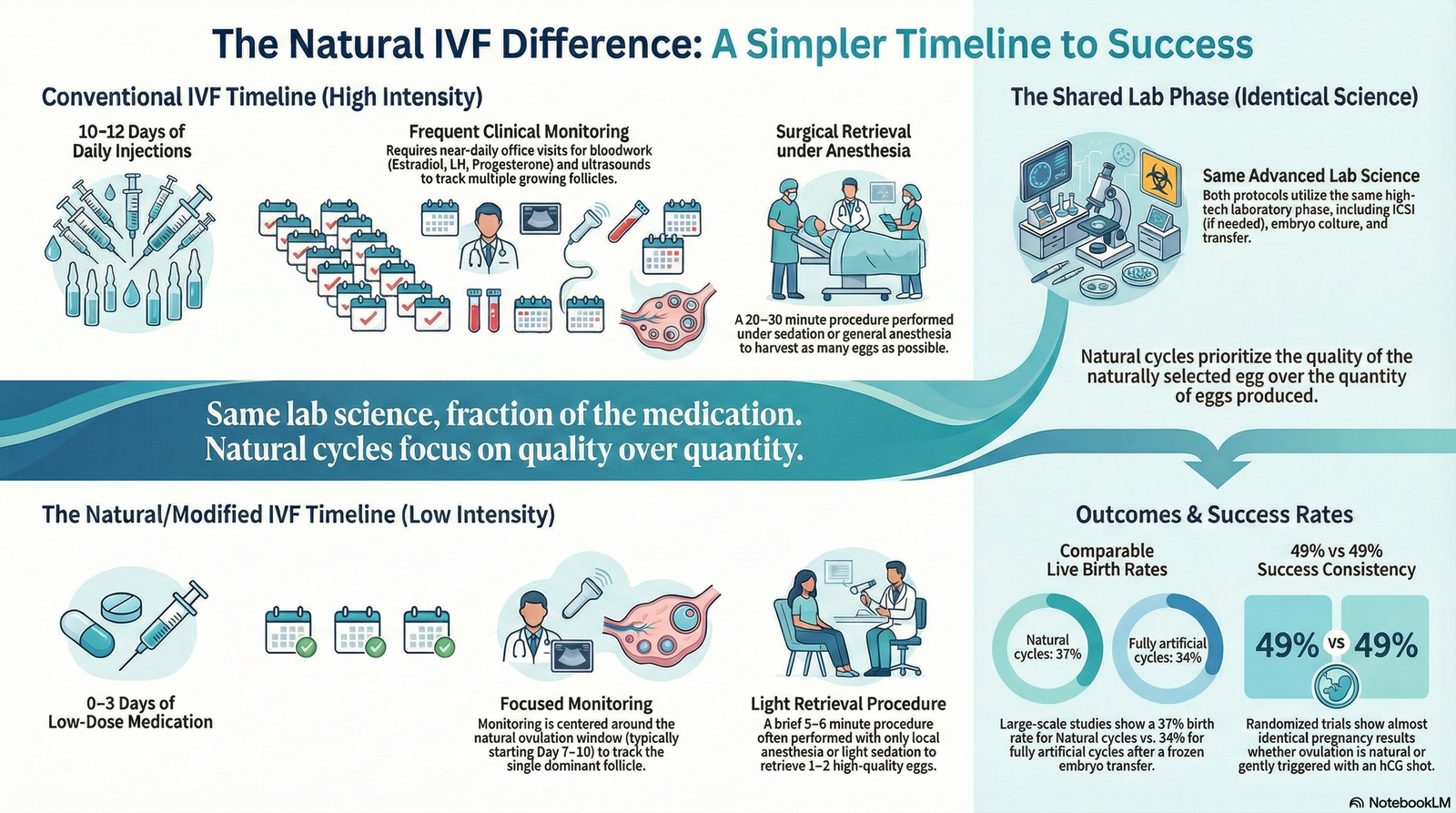
Natural and modified natural IVF follow your own follicle growth, with fewer medications but the same key lab steps.
Why Natural and Modified Natural Cycles Matter for Poor Responders
If you have been told you are a “poor responder” because of low antral follicle counts, high FSH, or low AMH, it is easy to feel boxed in. You may have heard that you need “maximum stimulation” to have any chance. In practice, strong stimulation often brings high costs and side effects without adding many eggs for you.
Standard controlled ovarian hyperstimulation aims to collect many eggs in one cycle. In someone with low ovarian reserve, even very high doses of medication often produce only one or two mature follicles. You carry the cost and discomfort, yet you end up with similar egg numbers to what you would have had in a natural or modified natural cycle.
Several studies in poor responders show a pattern that goes against the “more is better” instinct. In one group, natural cycles reached an implantation rate of about 14.9 percent, while stimulated cycles produced around 5.5 percent. This supports the idea that a calmer, more physiological environment can support a better quality egg and a more receptive lining for some women with low reserve.
For younger poor responders under 35, natural-cycle protocols have shown pregnancy rates of about 18.1 percent per cycle and 29.2 percent per transfer. Even if you have had conventional cycles cancelled because your follicles did not grow as expected, natural-cycle retrieval gives you a realistic and usually more affordable option before you consider egg donation.
You still need clear expectations. In women over 40 with truly low reserve, success per started natural cycle can drop below 1 percent in some subgroups. Your doctor will usually look at your age, hormone profile, and previous cycles before recommending this route.
Getting More Eggs From Each Cycle With IVM
You might look at natural IVF and think, “One egg, one embryo, one shot. That feels risky.” This is where in vitro maturation, or IVM, changes the picture.
Many clinics now use IVM along with natural or modified natural cycles. During egg retrieval, your doctor collects not only the big, dominant follicle. They also aspirate the smaller follicles present at the same time and mature those eggs in the lab.
- In a study of 771 women, aspirating small, nondominant follicles and maturing those eggs produced about 902 extra mature oocytes.
- Those extra eggs led to about 78 additional live births that would not have happened with the dominant follicle alone.
Safety data are reassuring as well. When teams compared blastocysts from small follicles (SF) with those from the main large follicle (LF), miscarriage rates and major birth defects looked similar, about 1.5 percent for SF and 1.3 percent for LF.
With IVM, a natural or modified natural cycle becomes more than a one-egg gamble. Over several cycles, you can build a small group of embryos while keeping each individual cycle simple and low drug. That can help bridge the gap between natural IVF and the egg numbers of a single high-dose cycle.
Your Uterus, Hormones, and Pregnancy Health
You are not just trying to see a positive pregnancy test. You also care about staying healthy through the pregnancy and delivering a healthy baby. The way your clinic prepares your uterine lining influences both.
Very high levels of estrogen and progesterone during strong stimulation do not always help the lining. In some work, extreme hormone levels seem to make the endometrium less receptive. In natural cycles, your ovaries and lining produce a set of signaling molecules, such as G-CSF and interleukin 15, that link to higher implantation rates and better outcomes. These signals often look different, or are missing, in heavily stimulated cycles.
The corpus luteum plays a central role here. After you ovulate, the empty follicle turns into this temporary gland. It does more than make progesterone. It also makes hormones like relaxin that help your heart and blood vessels adapt to pregnancy.
In a fully programmed hormone replacement cycle for FET, you do not ovulate. You take estrogen and progesterone in the form of pills, patches, or injections, and your lining grows, but you do not form a corpus luteum.
- In one large analysis, programmed cycles without a corpus luteum had hypertensive disorders such as preeclampsia in about 9.2 percent of pregnancies. Natural or ovulation-based cycles had rates around 4.0 percent.
- Programmed cycles also showed a higher incidence of very large babies (macrosomia) over 4,500 grams, which can make birth more complicated.
If you ovulate on your own, using a natural or modified natural FET protocol keeps your corpus luteum involved. You may still receive progesterone for extra luteal support, but you also keep your body’s own hormones that help protect you during pregnancy.
More Evidence on Natural vs. Modified Natural IVF
49% vs. 49% – Trigger vs. No Trigger: In a randomized trial of 145 women, live birth rates were almost identical whether ovulation was allowed to happen on its own, about 49 out of 100, or gently triggered with an hCG shot, also about 49 out of 100. Clinical pregnancy rates were similar as well. This means you can choose a true natural or modified natural frozen transfer based on what fits your schedule and clinic timing, without worrying that a trigger shot will lower your chances. Source: Gynecological Endocrinology (PMID: 36220075).
34% vs. 24% – Progesterone Boost in Natural FET: In a trial of 488 natural-cycle frozen transfers, adding vaginal progesterone after transfer raised live birth rates from 24 out of 100 to 34 out of 100 women. The only difference between the groups was the extra progesterone support. If you choose a natural or modified natural cycle, adding progesterone can give your embryo a better chance of implanting and continuing to grow. Source: Human Reproduction (PMID: 35972453).
45% vs. 40% – Flexible Modified Natural Option: A study of 723 single euploid frozen transfers compared a progesterone modified natural cycle with a standard hormone replacement cycle. Live birth happened in about 45 out of 100 women using the progesterone-modified natural protocol and about 40 out of 100 in the hormone replacement group, with similar miscarriage rates. This shows that a carefully timed modified natural cycle can match the results of a fully medicated cycle while giving clinics more control over scheduling. Source: Reproductive BioMedicine Online (PMID: 39244908).
Almost 2x Less Low Birth Weight – Stimulation Trade Off: A meta-analysis of nearly 97,700 births after stimulated IVF and 700 after natural or modified natural IVF found that babies from stimulated cycles were more likely to be born early and underweight. The risk of low birth weight was almost twice as high after stimulated IVF compared with natural or modified natural cycles, even though the absolute risk in both groups stayed modest. This supports natural and modified natural approaches if you qualify and want to lower some baby-related risks. Source: Reproductive BioMedicine Online (PMID: 29111312).
These findings support using natural hormones when you can and show that small protocol changes, such as adding progesterone, can make a real difference for your outcome.
ICSI, Embryo Quality, and PGT-A in Natural IVF
You may hear other patients say that embryos from natural cycles “look better” or “behave better”. There is some logic behind these assertions. In a natural cycle, your body picks one follicle from the group that started to grow that month. Some experts think that this selection favors a healthier egg.
Embryo growth patterns also give clues. In modified natural cycles, embryos that do especially well tend to have four cells on day 2 and eight cells on day 3. That pattern is common in all IVF settings and fits what labs look for in “top-quality” cleavage-stage embryos. In natural and modified natural cycles, embryos that grow a bit slower, with fewer than four cells on day 2, still perform better than you might expect, likely because the lining is well timed and not exposed to extreme hormone levels.
Do you always need ICSI?
Intracytoplasmic sperm injection (ICSI) is essential when sperm counts, movement, or shape are poor. Many clinics also use ICSI by default in natural cycles because each egg feels very precious. But if sperm parameters are normal, ICSI is not always the best choice.
In one study of cycles with normal sperm, conventional IVF, where eggs and sperm simply share a dish, led to higher implantation and clinical pregnancy rates, about 34.5 percent, compared with about 20.0 percent with ICSI. If your partner’s sperm parameters are normal, you can ask your doctor whether standard insemination is reasonable for your cycle.
Where does PGT-A fit?
Preimplantation genetic testing for aneuploidy (PGT-A) checks embryos for missing or extra chromosomes. If you are over 35, you may feel drawn to this option for reassurance. The challenge with natural IVF is the small number of embryos. You often get only one or two embryos per cycle, which makes testing less efficient and pricier per embryo.
The age-related drop in egg quality is real. For women under 35 in natural cycles, about 26 percent of eggs are estimated to be “intrinsically fertile”, meaning that they can produce a live birth if fertilized and transferred. By age 42, that estimate falls to roughly 4 percent. Because of this drop, some clinics suggest banking embryos over several natural or modified natural cycles before sending them for PGT-A. That approach gives you more embryos to test at once and may stretch each testing dollar further.
Success Rates and Costs Side by Side
When you compare protocols, you want clear numbers, not vague promises. The table below summarizes key outcomes from major published studies. This view focuses on per transfer outcomes and does not show cancellation rates, which are higher in natural and modified natural cycles.
| Outcome Measure | Natural Cycle (NC) | Modified Natural (mNC) | Artificial / Programmed |
|---|---|---|---|
| Live birth, FET trial of 902 women | 54% | Not reported | 43% |
| Live birth, Viet Nam trial, first FET | 37% | 33% | 34% |
| Healthy live birth, BMJ trial | About 42% | Not reported | About 41% |
| Implantation, poor responders | 14.9% | Not reported | 5.5% |
| Miscarriage rate | Lower in several studies | Similar | Higher in several studies |
| OHSS risk | 0% | Very low | Present when strong stimulation used |
| Protocol Type | Typical Cycle Cost | Medication Cost Share |
|---|---|---|
| Natural or Modified Natural IVF | $5,000 to $9,000 | Low, often hundreds of dollars |
| Conventional Stimulated IVF | $10,000 to $20,000 | High, often $1,000 to $7,000 |
How to Know if This Approach Is Right for You
You do not have to decide this alone. Your fertility specialist will look at your age, ovarian reserve, diagnosis, previous response to medication, and your values. Still, it helps to walk through the main situations where natural and modified natural cycles tend to shine.
A natural or modified natural cycle can be a good fit if:
- You have regular ovulatory cycles. Your body already selects a dominant follicle each month, so your doctor can work with it instead of pushing your ovaries harder.
- You are a poor responder. If strong stimulation did not produce many follicles in the past, a natural cycle focuses on the single egg your body is ready to give you, without extra cost or side effects.
- You want to lower medication risks. You may feel worried about OHSS, blood clots, or high blood pressure in pregnancy, and you want the gentlest option that still gives you a real chance.
- You want to avoid creating many extra embryos. Personal, ethical, or religious beliefs may guide you to create only as many embryos as you are likely to use.
- You need a more affordable option. Natural and modified natural protocols often cost less and allow you to try more cycles over time.
- You have had repeated implantation failures. A more physiologic hormone pattern and a better timed lining may improve receptivity for some patients.
A conventional stimulated IVF cycle may serve you better if:
- You are over 40. Because egg quality declines steeply with age, you may need several eggs at once to find one healthy embryo, which is easier with stimulation.
- You are anovulatory. If you do not ovulate, your team usually needs to stimulate your ovaries to develop a follicle.
- You have a very low reserve and are older. In some cases, the high cancellation rate with natural cycles makes the process too slow and frustrating compared with other choices.
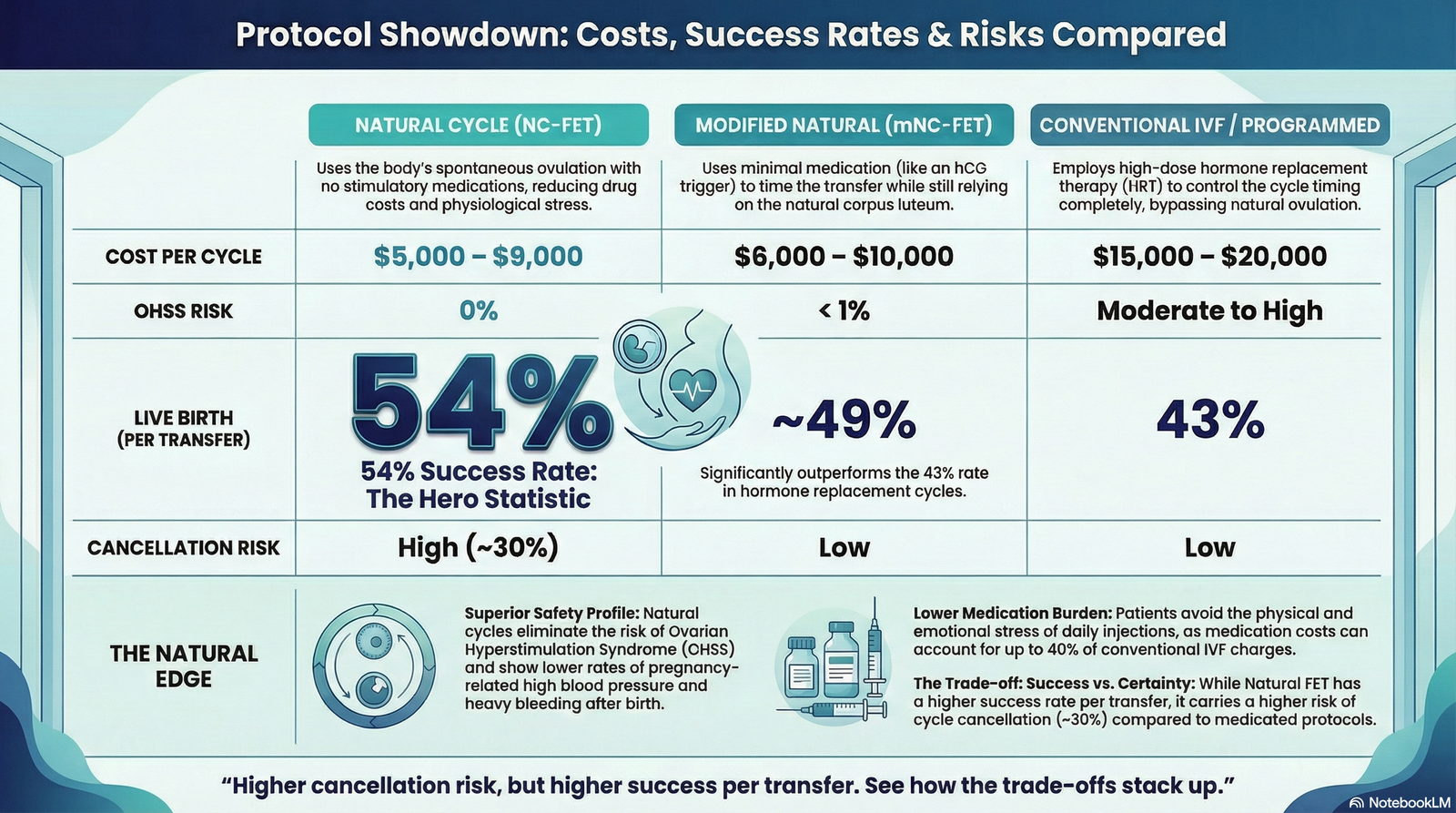
Natural and modified natural IVF balance medication use, cost, and pregnancy risks differently from fully stimulated cycles.
Want help comparing IVF clinics and protocols?
If sorting through natural, modified natural, and conventional IVF options feels like a full-time job, our advisors can collect clear, itemized quotes from verified clinics and map your likely timeline at no cost to you.

Why trust this guide? The OVU commitment
You are probably juggling hope, timelines, and a lot of tabs open in your browser. And you deserve clear, current, human advice. At OVU, we review clinic protocols, compare real quotes, and talk to people who have done this - intended parents and gestational carriers - so we can give you practical steps, not just theory. If you want help comparing options without sales pressure, we will gather itemized quotes and success data that match your exact situation. You decide, we will bring the info to your table.
Frequently Asked Questions
Is the modified version really better than the true natural version?
For success rates alone, neither approach clearly wins. The main difference is convenience and scheduling. A modified natural cycle uses an antagonist and a trigger shot to reduce the chance that you will ovulate before retrieval, so you face fewer cancelled cycles and fewer urgent last-minute monitoring visits. If you have a busy schedule or live far from your clinic, that structure can help a lot. If you live close and prefer to avoid even small doses of medication, your doctor can still consider a true natural protocol.
Why is natural IVF less expensive?
Most of the savings come from drug costs. In a fully stimulated cycle, injectable gonadotropins can cost $1,000 to $7,000 per attempt. In a true natural cycle, you do not use these drugs at all. In a modified natural cycle, the doses are much lower, so your pharmacy bill is also lower. You still pay for monitoring, retrieval, the lab, and transfer, but the medication line on your invoice is usually much smaller.
Does the trigger shot damage egg quality?
No. Studies that compare spontaneous ovulation with hCG-triggered ovulation do not show worse clinical pregnancy or live birth rates with a trigger. The shot copies your body’s natural LH surge so your team can time retrieval more safely. If you qualify for a modified natural cycle, you can feel comfortable that the trigger is there to support timing, not to weaken your egg.
Can I really do cycles back-to-back?
In many cases, yes. Natural and modified natural cycles are easier on your ovaries, so you usually do not need a recovery month in between. That can be a big advantage if you want to bank embryos over several months or keep trying regularly without long breaks. Your doctor will still monitor how you feel and how your hormones look, but most patients do not need the same long rests that are common after intense stimulation.
Is the risk of twins or triplets lower with natural IVF?
Yes. Natural and modified natural cycles almost always involve one leading follicle, and clinics usually transfer a single embryo. The risk of twins and higher-order multiples is therefore much lower than in older approaches, where doctors often transfer two or more embryos after strong stimulation. If you want to lower your risk of twins for health or lifestyle reasons, this option is one more reason to consider natural protocols and single embryo transfer.
Do I still need progesterone after transfer?
Your clinic will individualize this plan, but many teams now lean toward using progesterone. In a true natural FET, some protocols use no progesterone support. In a randomized trial, adding vaginal progesterone after transfer increased live birth rates from about 24 percent to about 34 percent. Because of that, many doctors recommend progesterone even when your corpus luteum is functioning. You can ask your doctor to explain their reasoning so you feel comfortable with the plan.
Can I combine natural IVF with PGT-A?
You can, but it takes patience. Since you usually get only one or two embryos per cycle, you often need several cycles to collect enough embryos to justify testing. Some clinics offer embryo banking plans in this setting, where you do multiple natural or modified natural cycles, freeze embryos, then test and transfer them later. If you are older or have a history of chromosomal issues, that strategy can give you some of the reassurance of PGT-A while keeping each cycle gentle.
Reference List 38 sources
Journal Article (Research): Liu Y, et al. Natural cycle versus hormone replacement therapy as endometrial preparation in ovulatory women undergoing frozen-thawed embryo transfer. PLOS Medicine. 2025;22(6):e1004630. PMID: 40561125. Available from: https://pubmed.ncbi.nlm.nih.gov/40561125/
Journal Article (Research): Ho VNA, et al. Livebirth rate after one frozen embryo transfer in ovulatory women starting with natural, modified natural, or artificial endometrial preparation in Viet Nam: an open-label randomised controlled trial. The Lancet. 2024;Epub ahead of print. PMID: 38944045. Available from: https://pubmed.ncbi.nlm.nih.gov/38944045/
Journal Article (Research): Bao H, et al. Natural ovulation versus programmed regimens before frozen embryo transfer in ovulatory women: multicentre, randomised clinical trial. BMJ. 2026;392:e087045. PMID: 41565309. Available from: https://pubmed.ncbi.nlm.nih.gov/41565309/
Journal Article (Research): Dmitrovic R, et al. Live birth rates in natural compared to artificial frozen blastocyst transfer cycles. Reproduction and Fertility. 2025;6(3):e240104. PMID: 40607655. Available from: https://pmc.ncbi.nlm.nih.gov/articles/PMC12257601/
Journal Article (Comparative Study): Aydin T, et al. Comparing the success rate of natural cycle and modified natural cycle protocols for frozen-thawed embryo transfer. Gynecological Endocrinology. 2022;38(12):1103–1108. PMID: 36220075. Available from: https://pubmed.ncbi.nlm.nih.gov/36220075/
Journal Article (Research): Wånggren K, et al. Progesterone supplementation in natural cycles improves live birth rates after embryo transfer of frozen-thawed embryos, a randomized controlled trial. Human Reproduction. 2022;37(10):2366–2374. PMID: 35972453. Available from: https://pubmed.ncbi.nlm.nih.gov/35972453/
Journal Article (Comparative Study): P, et al. Progesterone-modified natural cycle preparation for frozen embryo transfer. Reproductive BioMedicine Online. 2024;49:104350. PMID: 39244908. Available from: https://pubmed.ncbi.nlm.nih.gov/39244908/
Journal Article (Comparative Study): Imboden S, et al. Low-dose clomiphene citrate does not reduce implantation and live birth rates in otherwise unstimulated modified natural cycle IVF, retrospective cohort study. Archives of Gynecology and Obstetrics. 2023;307(6):1763–1772. PMID: 36525092. Available from: https://pubmed.ncbi.nlm.nih.gov/36525092/
Journal Article (Systematic Review & Meta-Analysis): Kamath MS, et al. Perinatal outcomes after stimulated versus natural cycle IVF, a systematic review and meta-analysis. Reproductive BioMedicine Online. 2018;36(1):94–101. PMID: 29111312. Available from: https://pubmed.ncbi.nlm.nih.gov/29111312/
Committee Opinion (Guidance): ESHRE Guideline Group on Ovarian Stimulation. ESHRE guideline, ovarian stimulation for IVF/ICSI. Human Reproduction Open. 2020;2020(2):hoaa009. Available from: https://pmc.ncbi.nlm.nih.gov/articles/PMC7203749/
Journal Article (Research): Reljič M, et al. Estradiol pattern predicts natural IVF cycle outcome. Fertility and Sterility. 2001;76(5):1019–1024.
Journal Article (Comparative Study): Morgia F, et al. Natural cycle versus microdose GnRH agonist flare for poor responders. Fertility and Sterility. 2004;81(6):1542–1547.
Journal Article (Research): Lédée-Bataille N, et al. Natural IVF in repeated unexplained implantation failure. Fertility and Sterility. 2004;81(3):551–557.
Journal Article (Research): Chian RC, et al. Natural-cycle IVF combined with in vitro maturation of immature oocytes. Fertility and Sterility. 2004;82(3):666–670.
Journal Article (Research): Lim JH, et al. Selection of patients for natural cycle IVF and IVM. Fertility and Sterility. 2009;92(6):e1–e3.
Journal Article (Research): Schimberni M, et al. Natural-cycle IVF in poor responders, 500 completed cycles. Fertility and Sterility. 2009;92(4):1292–1298.
Journal Article (Research): Thomas MR, et al. Predictors of blastocyst formation and pregnancy in natural and modified natural IVF. Fertility and Sterility. 2010;94(3):872–879.
Journal Article (Research): Pelinck MJ, et al. Embryo quality in modified natural cycle IVF. Fertility and Sterility. 2010;94(2):652–658.
Journal Article (Research): Xu Y, et al. Clinical outcomes for various causes of infertility in IVF/M. Fertility and Sterility. 2010;93(3):889–896.
Journal Article (Research): Lédée N, et al. Biomarkers of birth in modified natural IVF and ICSI. Fertility and Sterility. 2011;95(8):2630–2633.
Journal Article (Research): Kadoch IJ, et al. Modified natural-cycle IVF in young poor responders. Fertility and Sterility. 2011;95(2):679–683.
Journal Article (Research): Bodri D, et al. Oocyte retrieval timing in natural cycle IVF. Fertility and Sterility. 2014;101(6):1599–1604.
Journal Article (Research): Lee VCY, et al. Progesterone elevation in natural cycles and IVF outcome. Fertility and Sterility. 2014;102(2):399–405.
Journal Article (Comparative Study): Kedem A, et al. Modified natural cycle IVF in genuine poor responders. Fertility and Sterility. 2014;101(6):1624–1630.
Journal Article (Comparative Study): Mounce G, et al. Natural versus hormone replacement therapy cycles in frozen embryo transfer. Fertility and Sterility. 2015;104(5):1145–1152.
Journal Article (Research): Paulson RJ, et al. Low-dose hCG alone for follicle maturity in natural cycles. Fertility and Sterility. 2016;105(3):640–646.
Journal Article (Research): Teramoto S, et al. Nondominant small follicles in modified natural cycle IVF. Fertility and Sterility. 2016;105(5):1238–1245.
Journal Article (Research): Gonzalez-Foruria I, et al. Age as the main prognostic factor in natural-cycle IVF. Fertility and Sterility. 2016;106(2):e25–e26.
Journal Article (Research): Silber SJ, et al. Intrinsic fertility of human oocytes in natural IVF. Fertility and Sterility. 2017;108(5):e37.
Journal Article (Review): Ho JR, Paulson RJ. Modified natural cycle in IVF. Fertility and Sterility. 2017;108(4):e21–e22.
Journal Article (Review): Nargund G, et al. Mild stimulation for IVF: recommendations from an expert group. Fertility and Sterility. 2017;108(3):e14–e15.
Journal Article (Comparative Study): Groenewoud ER, et al. Natural cycle versus artificial cycle for frozen embryo transfer. Fertility and Sterility. 2018;109(5):978–986.
Committee Opinion (Guidance): ASRM Practice Committee. Comparison of pregnancy rates for poor responders using IVF with mild ovarian stimulation versus conventional IVF. Fertility and Sterility. 2018;109(6):993–999.
Journal Article (Research): Teramoto S, et al. Small follicle-derived blastocyst transfer in modified natural IVF. Fertility and Sterility. 2019;111(4):680–688.
Journal Article (Comparative Study): Asserhøj LL, et al. Reproductive outcomes after different frozen embryo transfer protocols. Fertility and Sterility. 2021;115(2):e13.
Journal Article (Research): Bortoletto P, et al. Timing of frozen embryo transfer in natural cycles. Fertility and Sterility. 2021;116(3):e38–e39.
Journal Article (Comparative Study): Wolfe EL, et al. Modified natural and optimized programmed frozen embryo transfer protocols. Fertility and Sterility. 2023;120(4):e78.
Website/Report: Treatment techniques and cost data from contemporary IVF cost reports and clinic pricing disclosures.
Final Thoughts
Living with infertility often feels like moving from one medical hurdle to the next. It is easy to feel as if your body is working against you. Natural and modified natural-cycle IVF take different stances. They work with the way your ovaries and uterus already behave; they lighten the medication load, and they put more weight on the quality of each egg rather than the number of eggs in one day.
If you are a poor responder, if you feel uneasy about heavy stimulation, or if you want a more measured and body-friendly path, these protocols give you real, evidence-based options. You deserve a plan that fits your health, your values, and your budget. Talk with your fertility specialist about how your age, your test results, and your past cycles fit with this approach. Together, you can decide whether building your treatment around your own cycle is the right next step toward bringing your baby home.
Need a second opinion on your IVF plan?
If you are torn between natural, modified natural, and conventional IVF, you can speak with an OVU advisor who will help you compare success rates, costs, and clinic options so you can move forward with more confidence.