


Dr. Sony Sherpa (MBBS)
In addition to her clinical experience, Dr. Sherpa is a published medical researcher and holistic health advocate. Her dual expertise in emergency care and alternative therapies brings a unique lens to medically reviewed content—ensuring it is both accurate and accessible.
You have likely spent years imagining the moment those two parallel lines would finally appear on a pregnancy test. Now that you’re here, you are living a new reality, hosting a tiny embryo that is already changing everything inside you. However, for some, this long-awaited joy is coupled with a physical challenge that feels anything but miraculous: Ovarian Hyperstimulation Syndrome (OHSS).
It is completely natural to feel a blend of excitement and physical overwhelm as you move through your first trimester after IVF. You might feel like a bundle of nerves, and for good reason, as your body is performing the intense double-duty of recovering from hyperstimulation while beginning the profound work of growing a new life.
If your pregnancy feels different or more difficult than you expected, there is a medical reason for it. OHSS is a side effect of the fertility treatments that helped you conceive, and while the symptoms can feel scary, they are often associated with a strong ovarian response. Understanding exactly what is happening in your body can help you move from a place of anxiety to a position of control.
Ovarian Hyperstimulation Syndrome in early pregnancy happens when high hCG levels make your blood vessels leaky. Fluid moves into your abdomen and chest, and you feel bloated, short of breath, and unwell. Symptoms usually settle by weeks 10 to 12, and about 87% of women with severe late onset OHSS still go on to have a live birth.
Next step: If you notice rapid weight gain, much less urine, or trouble breathing, contact your clinic or emergency services the same day you noticed even one of the above-listed symptoms.
What the Latest Research Shows
Large studies from the United States, Europe, and Asia now give a clearer picture of how OHSS affects pregnancy. Some show higher rates of preterm birth, small babies, and early breathing problems. Others find that when OHSS is treated promptly, and you carry one baby, outcomes look very similar to other IVF pregnancies.
All research citations in this guide include PubMed links so you and your doctor can read the original studies if you wish.
In This Guide
Moderate to severe OHSS occurs in 1 to 5 out of 100 IVF cycles
Risk is 2 to 5 times higher when the cycle leads to pregnancy
About 87% live birth rate in severe late-onset OHSS
The Biology Behind OHSS: Why It Happens
The core problem in OHSS is a sudden jump in how leaky your small blood vessels become. Human chorionic gonadotropin, or hCG, drives this change. That hCG comes either from your trigger shot in an early-onset case or from your own rising pregnancy hormone in a late-onset case.
hCG acts on your ovaries and pushes them to release powerful signaling proteins. One of the most important is Vascular Endothelial Growth Factor, VEGF. When VEGF levels climb, protein-rich fluid starts to move out of your blood vessels and into the spaces around your organs. This is how you end up with fluid in your abdomen, called ascites, around your lungs, called pleural effusion, or around your heart, called pericardial effusion.
As this fluid shifts out of your blood vessels, your blood becomes thicker because it has lost some of its liquid part. Doctors call this hemoconcentration. This change is one reason you feel so drained and unwell during a severe flare of OHSS.
Your embryo is tiny, but it is already running the show hormonally. The early placenta grows into the upper part of your uterus and produces hCG. That same hCG that supports your pregnancy also keeps the "fire" of OHSS going in those early weeks.
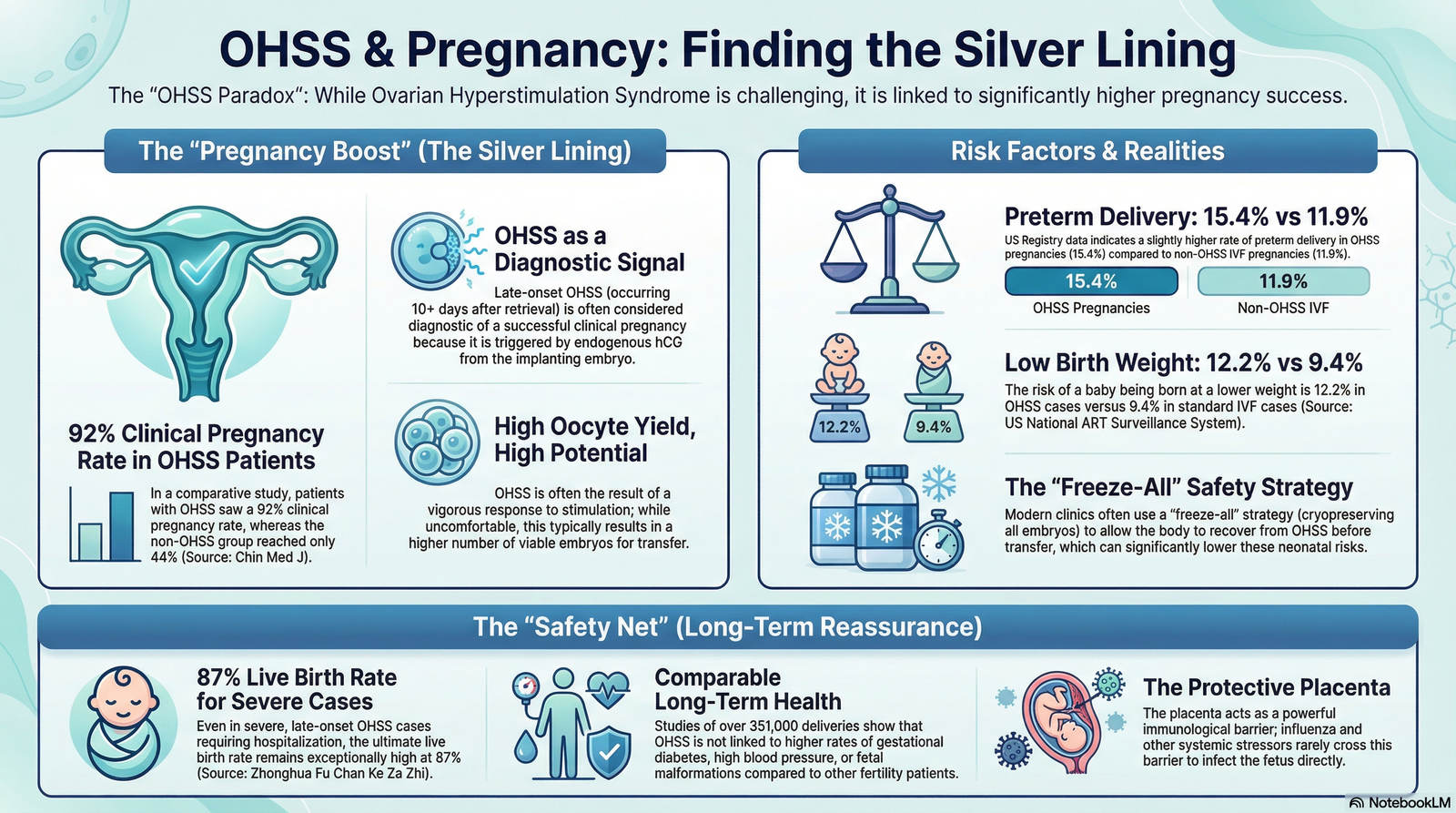
OHSS in Pregnancy: Timeline from symptom peak to recovery, and how outcomes compare.
How Doctors Grade Mild to Critical OHSS
Doctors use standard grading systems, such as the Golan classification, to describe how severe your OHSS is. When you know where you sit on that scale, the situation often feels a little less frightening.
| Stage | Symptoms and Signs | Typical Management |
|---|---|---|
| Mild (Grades 1 to 2) | Bloating, mild abdominal pain, possible nausea, vomiting, or loose stools. Ovaries are usually less than 8 cm in size. | Rest at home, oral fluids, and close outpatient follow-up. |
| Moderate (Grade 3) | Worse discomfort, visible fluid in the abdomen on the ultrasound, ovaries are sized around 8 to 12 cm. | Daily weight checks, urine monitoring, blood tests, and sometimes outpatient intravenous fluids. |
| Severe (Grades 4 to 5) | Large ascites, fluid around the lungs, shortness of breath, rapid weight gain, very little urine, high hematocrit or abnormal liver tests. | Hospital care, intravenous fluids, possible albumin, paracentesis, anticoagulation, and frequent monitoring. |
| Critical | Very tense ascites, massive pleural effusion, kidney failure, or blood clots in major veins or arteries. | Intensive care level support, along with aggressive fluid and clot management, is provided. |
Are you struggling to find a comfortable position to sleep because your abdomen feels tight and heavy? If you reach a point where you cannot keep down food or drinks, or you notice that you are drinking a lot and passing very little urine, you need urgent medical care. In that situation, hospital treatment protects both you and your baby.
Pregnancy Outcomes and Risks
OHSS is serious, and you deserve straight answers. You also deserve to hear the good news that anxiety often drowns out.
- Preterm Birth and Birth Weight: Studies show that pregnancies complicated by OHSS are roughly twice as likely to end in preterm birth before 37 weeks. Babies are also almost five times more likely to be small for their gestational age compared with babies from IVF cycles without OHSS. A large United States registry analysis found a higher rate of low birth weight in the OHSS group, 12.2% compared with 9.4%, and more preterm delivery, 15.4% compared with 11.9%.
- The Multiples Factor: Twins or higher-order multiples add a lot of strain. In twin pregnancies, OHSS is linked to delivery almost a week earlier on average, 34.6 weeks compared with 35.6 weeks.
- Newborn Monitoring: A study including about 29,000 IVF births found that babies born after OHSS were almost twice as likely to have early breathing problems, such as respiratory distress or very fast breathing, soon after birth. Even when birth weight looked good, these babies needed closer observation in the newborn period.
- Long-Term Outlook: A 28-year review of more than 351,000 births found that OHSS did not raise the overall rates of high blood pressure in pregnancy, gestational diabetes, or cesarean birth when you comparing women with OHSS to other fertility patients. The main extra risk was in the IVF subgroup, where OHSS was linked to more very early births before 34 weeks.
Put simply, OHSS raises the odds of some complications, especially early birth and size concerns for your baby. At the same time, most women with well-managed OHSS still deliver healthy babies, especially when they carry one baby and receive careful follow-up.
What Recent Studies Say About OHSS in Pregnancy
94 pregnancies, the preterm signal: In a United States cohort of 94 pregnancies after OHSS, women were about twice as likely to deliver early, and babies were roughly five times more likely to be small for their gestational age compared with women without OHSS. The extra risk was strongest when embryos were transferred fresh rather than frozen. This matters because choosing a freeze-all strategy after OHSS can reduce the chance of very early birth and very small babies. Source: Matern Fetal Med (PMID: 37546365).
Almost 29,000 births, breathing risks: A Korean study of nearly 29,000 IVF births found that babies born after OHSS were less likely to have low birth weight, but were almost twice as likely to be very large and to have breathing problems right after birth. Conditions such as transient fast breathing and respiratory distress were more common in the OHSS group. This information matters because if you conceived after OHSS, your baby may look a healthy size at birth but still need closer breathing checks. Source: J Assist Reprod Genet (PMID: 40528071).
351,000 deliveries, the big picture: In a 28 year study of more than 351,000 births, OHSS itself was not tied to higher rates of high blood pressure in pregnancy, gestational diabetes, or cesarean birth when you look at all fertility patients. In IVF pregnancies only, OHSS was linked to more very early births before 34 weeks. This matters because your main extra risk is very early labor, not every possible complication. Source: Am J Perinatol (PMID: 34327685).
114 vs. 337 births, late severe OHSS reassurance: When researchers compared 114 singleton births after late moderate to severe OHSS with 337 closely matched IVF pregnancies without OHSS, they found no major differences in preterm birth, birth weight, or newborn complications. This matters because if your OHSS was treated and you carry one baby, your overall birth outlook can be just as good as someone who did not have OHSS. Source: Front Endocrinol (Lausanne) (PMID: 36531504).
These studies guide how doctors counsel and monitor you. Your situation depends on your health, how severe your OHSS was, and whether you are carrying one baby or more.
How Doctors Treat OHSS in Pregnancy
If your OHSS is severe, your doctors focus on three main jobs: managing your fluids, preventing blood clots, and removing extra fluid from your abdomen and chest when needed.
Fluids and Electrolytes
Your team usually starts intravenous fluids to keep your blood volume stable and protect your organs. They use normal saline rather than Lactated Ringer's because OHSS tends to lower your blood sodium level. If standard fluids are not enough, they sometimes add concentrated solutions such as 25% human albumin. This kind of fluid helps pull water back from your third spaces into your bloodstream.
Paracentesis, the “Tap”
If your abdomen is very tight or you feel short of breath from pressure on your lungs, your doctor can perform a paracentesis. This is a drainage procedure guided by ultrasound, often using a transvaginal route similar to your egg retrieval. They drain off some of the fluid in your abdomen.
This is not just about comfort. Once the pressure drops, your kidneys usually start working better, and you begin passing more urine. Many patients describe a clear turning point after a tap, even when only a moderate amount of fluid is removed.
Preventing Blood Clots
Thickened blood and prolonged rest increase your risk of clots. That is why your doctors often prescribe low-dose heparin or low molecular weight heparin and ask you to wear compression stockings. There are case reports of clots in major veins such as the internal jugular or subclavian veins, and even in arteries in the brain. Preventing these clots is one of the most important parts of your care plan.
How Clinics Try to Prevent OHSS
If you are still at the planning stage, your team may be able to stop OHSS before it starts. Experienced clinics now keep rates of moderate and severe OHSS well under 5% of stimulated cycles by adjusting medication doses, trigger types, and transfer strategies.
One of the biggest tools is the freeze-all approach. If your clinic sees clear warning signs, such as more than 30 growing follicles or very high estradiol levels on the day of the trigger, they may advise freezing all embryos and delaying transfer. By doing that, they remove the second big wave of hCG that comes from an early pregnancy, and that usually drives the worst form of OHSS.
Why Freeze-All Protects You
Data from national registries show that an embryo banking or freeze-all approach lowers the risk of OHSS by 35%. At the same time, your overall chance of having a baby stays very similar, because you can transfer those frozen embryos later in a calmer, more controlled cycle.
Emotional Health and Coping With OHSS
If you are going through OHSS in early pregnancy, it is no surprise that your nerves feel frayed. Your body is swollen, you may be short of breath, and you are terrified of losing the pregnancy you worked so hard for.
Does every thought, from the moment you wake up until you fall asleep, circle back to “Is my baby okay?” You are not dramatic, you are human. Your hormones are changing quickly, and your nervous system is very alert. Sudden crying spells, feeling out of control, or forgetting small things are all part of this phase.
Here are a few simple tools that many patients find helpful:
- The Diary Method: Choose a notebook that feels special and write down every fear as it comes. When you see your worries on paper, it becomes easier to sort out what belongs in a medical conversation and what comes from past hurt or exhaustion.
- Simple, Honest Conversations: Talk to your partner out loud, not just by text. Tell them what you are scared of and what you need. Feeling heard often calms your body as much as any medication.
- Mindful Breathing: Even a few minutes of noticing your breath can ease the tight feeling in your chest. Once your doctor says it is safe, gentle prenatal yoga or stretching can help you feel a bit more like yourself and rebuild trust in your body.
What to Expect Week-by-Week With OHSS
If you are dealing with OHSS in early pregnancy, the next steps usually follow a rough pattern. Knowing what is ahead can make the road feel less frightening.
- Weeks 4 to 8: This phase is when the endogenous hit from your own hCG shows up. Your embryo implants and hCG levels climb, so OHSS symptoms often peak or flare again. Your clinic may bring you in more often for ultrasounds to check the ovarian size and fluid collections.
- Weeks 9 to 12: For most women, this is when OHSS starts to calm down as the first trimester ends. Severe cases sometimes last longer, in rare situations, until week 21, and may require repeat paracenteses.
- Transitional Care: Once OHSS settles, your pregnancy will be like any other IVF pregnancy. You move into routine visits, including your 12-week scan and later anatomy scans.
- Postpartum Recovery: Your ovaries slowly shrink back to their usual size, which can take weeks or a few months after birth. Your uterus also needs time to contract. Do not feel discouraged if you still look pregnant right after delivery. Your body just did something huge and needs space and time to recover.
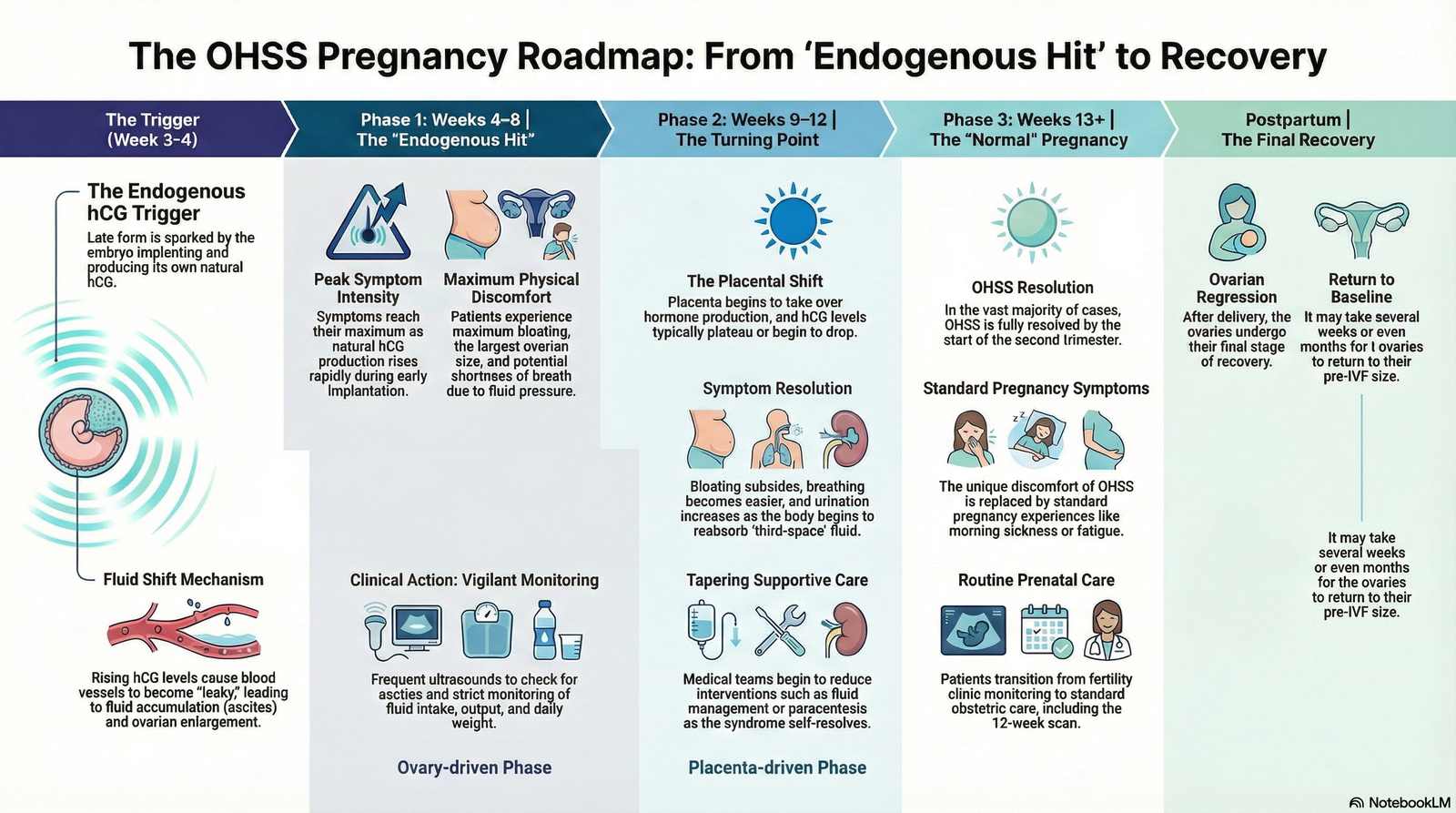
Typical OHSS timeline across early pregnancy, symptom peak, and recovery.
Choosing Your Clinic and Care Team When You Have OHSS Risk
If you know you are at higher risk for OHSS, or you have had it before, the clinic and team you choose matter. You want a center that takes prevention seriously and has clear plans for monitoring and treatment.
OVU Insight: What to Ask Your Clinic
Ask how often the clinic sees moderate or severe OHSS, and what prevention steps they use, such as lower-dose protocols, GnRH agonist triggers, and freeze-all cycles. A clinic that can clearly explain its safety plan gives you more than information; it gives you a sense of partnership and control.
If you feel rushed into decisions or brushed off when you raise concerns, that is important information too. You deserve a team that takes your symptoms and fears seriously and explains every step in plain language.
Want help comparing clinics and costs?
If this feels like a full-time job, and many people say that it does, our advisors can collect clear, itemized quotes from verified clinics and map your timeline at no cost to you.

Why trust this guide? The OVU commitment
You are probably juggling hope, timelines, and a lot of tabs open in your browser. And you deserve clear, current, human advice. At OVU, we review clinic protocols, compare real quotes, and talk to people who have done this - intended parents and gestational carriers - so we can give you practical steps, not just theory. If you want help comparing options without sales pressure, we will gather itemized quotes and success data that match your exact situation. You decide, we will bring the info to your table.
Frequently Asked Questions
Does having OHSS mean my pregnancy is stronger?
Often yes. Several studies show that women who develop OHSS have higher clinical pregnancy rates than those who do not. One multicenter study reported a rate of around 73% in women with OHSS. That does not mean you have to suffer to have a strong pregnancy, but it explains why OHSS and pregnancy often go together.
Is it safe to exercise if I have OHSS?
You need to avoid heavy or impact exercise while your ovaries are enlarged, because they can twist, a condition called torsion, or bleed. Ask your doctor when you can safely start light walking or prenatal yoga again. Many people wait until symptoms and ovary size have settled.
Will my baby be born too small because of the OHSS?
The risk of small for gestational age and low birth weight is higher, especially in severe OHSS. Your doctor will schedule regular growth scans and Doppler studies to track your baby’s size and blood flow, and will adjust your care if they see any concerns.
Can I manage my symptoms at home?
Mild cases are usually handled at home with plenty of fluids, rest, and no strenuous activity. Many clinics suggest at least one liter of fluid a day and sometimes recommend sports drinks to keep your electrolytes balanced. If your weight jumps quickly or you cannot keep fluids down, you need urgent review.
Why am I so much more tired than other pregnant women?
Your body is doing extra work. It is dealing with big fluid shifts and swollen organs on top of growing a baby. That level of strain drains your energy and affects your mood. Feeling exhausted does not mean you are weak; it means your body is working very hard.
Can OHSS happen if I conceived naturally?
This is very rare, but doctors have reported it in people with very high hCG levels or unusual hormone patterns, such as profound hypothyroidism, FSH receptor mutations, or molar pregnancies. If you have these conditions, your team will watch you more closely.
Does OHSS increase my risk of a cesarean section?
Some severe OHSS reports show cesarean rates above 40%. A big part of that comes from the higher rate of twins and triplets in those pregnancies. When you carry one baby, and your OHSS has settled, your delivery plan usually looks similar to other IVF pregnancies, and your mode of birth depends more on obstetric reasons than on your past OHSS.
Reference List 9 sources
Journal Article (Research): Sangtani A, Ismail M, Weaver A, Khan Z. Pregnancy Outcomes Associated with Ovarian Hyperstimulation Syndrome: A Retrospective Cohort Study of Infertile Women. Matern Fetal Med. 2023;5(3):144-154. PMID: 37546365. Available from: https://pubmed.ncbi.nlm.nih.gov/37546365/
Journal Article (Research): Park Y, Jeong H, Shin JH, Cho GJ, Kim YJ. Association between ovarian hyperstimulation syndrome and adverse obstetric and neonatal outcomes in Korea: a nationwide health insurance database study. J Assist Reprod Genet. 2025;42(7):2351-2361. PMID: 40528071. Available from: https://pubmed.ncbi.nlm.nih.gov/40528071/
Journal Article (Research): Vainer-Rotbart S, Sheiner E, Harlev A, Bar G, Levy A. The Association between Ovarian Hyperstimulation Syndrome and Pregnancy Complications following Fertility Treatments. Am J Perinatol. 2023;40(10):1088-1095. PMID: 34327685. Available from: https://pubmed.ncbi.nlm.nih.gov/34327685/
Journal Article (Research): Ran S, Zu R, Wu H, Zheng W, Yang C, Yang S, et al. Perinatal outcomes of singleton live births after late moderate-to-severe ovarian hyperstimulation syndrome: A propensity score-matched study. Front Endocrinol (Lausanne). 2022;13:1063066. PMID: 36531504. Available from: https://pubmed.ncbi.nlm.nih.gov/36531504/
Journal Article (Research): Jiang X, Deng CY, Sun ZY, Chen WL, Wang HB, Zhou YZ, et al. Pregnancy Outcomes of In Vitro Fertilization with or without Ovarian Hyperstimulation Syndrome: A Retrospective Cohort Study in Chinese Patients. Chin Med J (Engl). 2015;128(23):3167-3172. PMID: 26612291. Available from: https://pubmed.ncbi.nlm.nih.gov/26612291/
Journal Article (Research): Hu L, Xie R, Wang M, Sun Y. Patients with IVF complicated by moderate-to-critical OHSS experience increased thrombosis, GDM and neonatal NICU admission but slightly shorter gestation compared with matched IVF counterparts: A retrospective Chinese cohort study. Reprod Biol Endocrinol. 2021;19(1):8. PMID: 33441149. Available from: https://pubmed.ncbi.nlm.nih.gov/33441149/
Journal Article (Research): Serdyńska-Szuster M, Jędrzejczak P, Ożegowska K, Korman M, Pawelczyk L. Perinatal outcome among women undergoing in vitro fertilization procedures complicated by ovarian hyperstimulation syndrome. Ginekol Pol. 2012;83(2):104-110. PMID: 22568354. Available from: https://pubmed.ncbi.nlm.nih.gov/22568354/
Journal Article (Research): Schirmer DA 3rd, Kulkarni AD, Zhang Y, Kawwass JF, Boulet SL, Kissin DM. Ovarian hyperstimulation syndrome after assisted reproductive technologies: trends, predictors, and pregnancy outcomes. Fertil Steril. 2020;114(3):567-578. PMID: 32680613. Available from: https://pubmed.ncbi.nlm.nih.gov/32680613/
Committee Opinion (Guidance): Practice Committee of the American Society for Reproductive Medicine. Prevention and treatment of moderate and severe ovarian hyperstimulation syndrome: a guideline. Fertil Steril. 2016;106(7):1634-1647. PMID: 27678032. Available from: https://pubmed.ncbi.nlm.nih.gov/27678032/
Final Thoughts
The path through IVF and pregnancy is rarely straight. OHSS feels like a sharp curve you did not sign up for. At the same time, it is part of a larger story in which you are doing something hard for a deeply important goal.
Your medical team, your partner, and your own resilience form the net that holds you through this phase. There will be days when you feel strong and days when you do not. Both are normal.
When you finally hold your baby, feel their warm weight in your arms, and see their eyes open, the swollen belly, hospital stays, and long nights of worry will no longer be the whole story. They will become one intense chapter in a much longer book about your family.
You do not have to enjoy every minute of this to be a good parent. You only have to keep going, one day and one appointment at a time.