


Dr. Sony Sherpa (MBBS)
In addition to her clinical experience, Dr. Sherpa is a published medical researcher and holistic health advocate. Her dual expertise in emergency care and alternative therapies brings a unique lens to medically reviewed content—ensuring it is both accurate and accessible.
PGT-A Testing During IVF: Your Complete Guide to Genetic Screening Success Rates and Costs
Hey there! If you are on the IVF journey, chances are PGT–A testing has come up in conversations with your doc. It is that extra step in the IVF process that could boost your odds. You are probably wondering if it is worth the extra dough or what those test results really mean for you and your future mini–me.
PGT–A (Preimplantation Genetic Testing for Aneuploidy) is genetic screening performed on IVF embryos before transfer. It can increase success rates from 35% to 60% or higher, especially for women over 35. Testing costs $3,000–$6,000 and involves a 5–10 cell biopsy performed on day 5–6 embryos.
Next step: Discuss with your fertility team if PGT–A aligns with your specific situation and budget.
In This Guide
Key Facts at a Glance
Under 35 65–70%
35–37 60–65%
38–40 55–60%
Over 42 50–55%
Biopsy day: Day 5–6
Results wait: 7–14 days
Expedited option: 3 days
Transfer delay: 1+ month
Biopsy procedure: $1,500–$2,000
Per embryo testing: $150–$350
Total typical cost: $3,000–$6,000
Insurance coverage: Varies
What Is PGT-A and How Does It Work?
So, let’s break it down together, shall we? PGT–A (Preimplantation Genetic Testing for Aneuploidy) is like a VIP pass for your embryos, potentially bumping your success rate per transfer from about 35% to a whopping 60% or more, particularly if you’re in the 30–something age category and up.
Here is the deal with PGT–A testing: It is like a quality check for your embryos, making sure each one has the right number of chromosomes (46, to be exact, neatly paired up into 23 sets). If an embryo is packing extra chromosomes or missing some, it might not stick around after transfer, might lead to a miscarriage, or could result in conditions like Down syndrome.
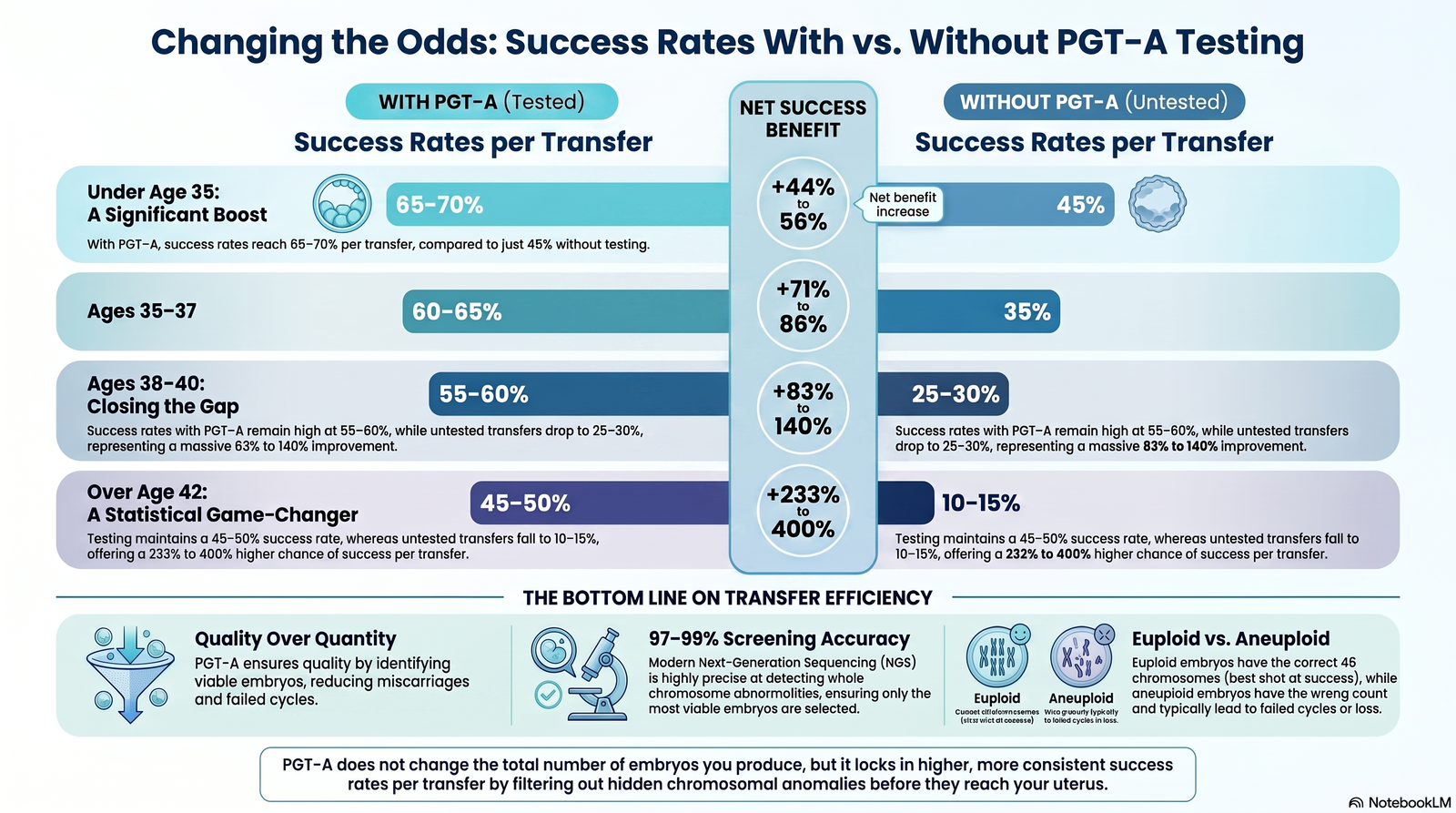
PGT–A Success Rates vs. Untested Transfers
How the Testing Works
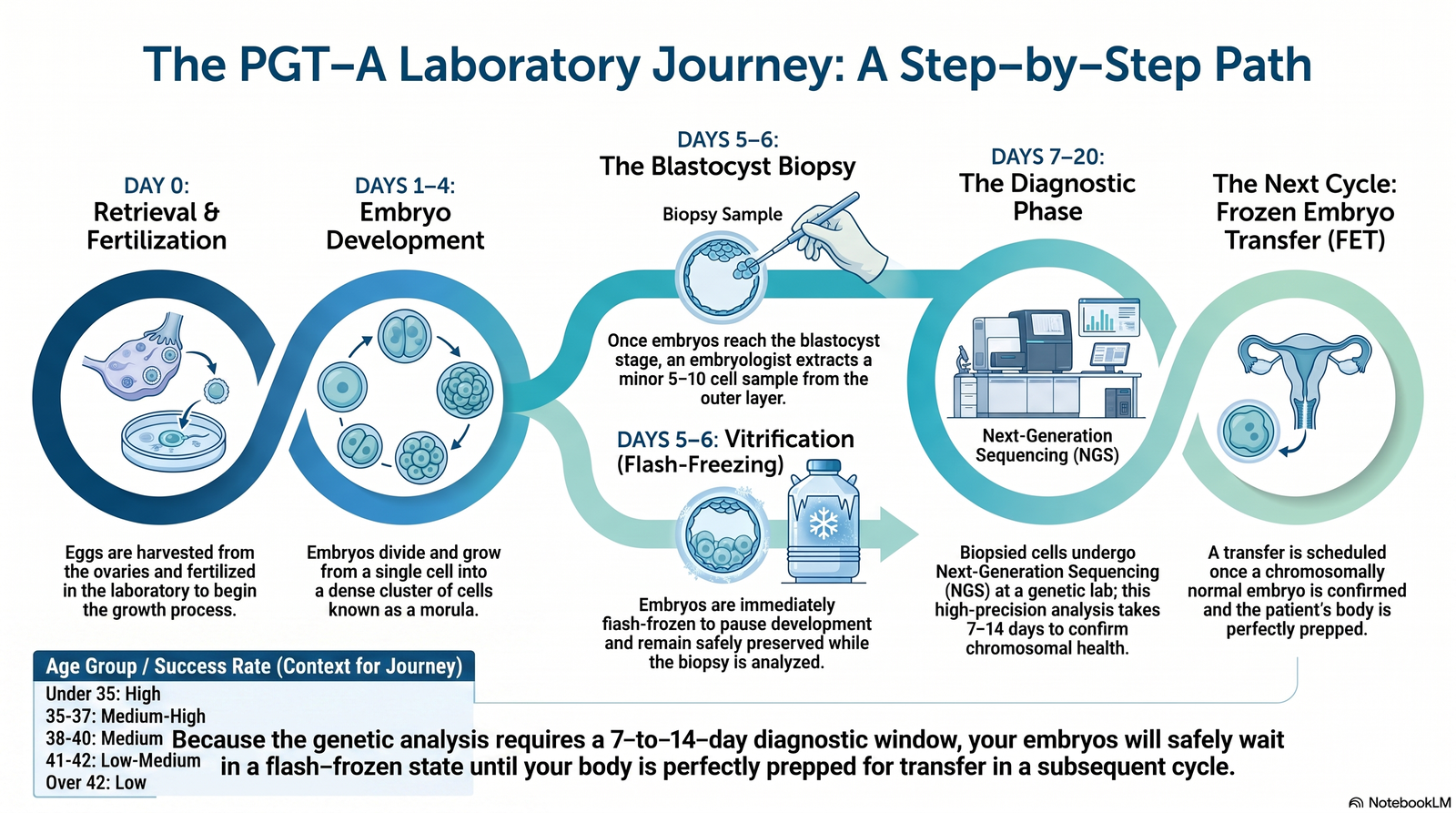
This magic happens around day 5 or 6 when your embryos are in the blastocyst–stage. An embryologist takes a tiny sample (about 5–10 cells) from each embryo and sends it off for a genetic deep dive while your embryos chill in the freezer. You will get your results in about 7–14 days.
The cool part? Today’s PGT–A tech, specifically Next–Generation Sequencing (NGS), is so precise it can even spot “mosaic” embryos — these are the ones with a mix of normal and abnormal cells.
According to a 2020 study (PMID: 32485954), PGT–A has 97–99% accuracy for detecting whole chromosome abnormalities.
Who Should Consider PGT-A Testing?
Okay, but who should really think about going for PGT–A? If you are 35 or older, it is almost a no–brainer. The truth is, by age 38, around 60% of embryos have chromosomal abnormalities. PGT–A can sort out which ones are without any abnormalities, and, thus, are suitable for transfer.
| Indication | Recommendation | Evidence Level |
|---|---|---|
| Age 35 or older | Strongly recommended | High |
| Recurrent pregnancy loss (2+ miscarriages) | Recommended | High |
| Multiple failed IVF cycles | Recommended | Moderate |
| Severe male factor infertility | Consider | Moderate |
| Under 35, no risk factors | Optional | Low benefit |
However, if you are under 35 with no history of pregnancy woes, have only a few embryos, or if cost is a big concern, PGT–A might not be necessary for you.
Real Success Rates: What the Data Shows
Now, let’s talk talk about success rates and what those numbers actually look like. For women under 35 using a PGT–A tested embryo, the live birth rate per transfer hits somewhere between 65% and 70%. That is against the lower success rate of about 45% without PGT–A testing.
The older we get, the starker the contrast. For the 38–40 age group, PGT–A tested embryos boast about a 60% success rate per transfer, while the success rate of untested embryos drops to about 25–30%. After 42, you are looking at 50–55% success with testing, versus a slim 10–15% without PGT–A.
| Age Group | With PGT–A | Without PGT–A | Improvement |
|---|---|---|---|
| Under 35 | 65–70% | 45% | +44–56% |
| 35–37 | 60–65% | 35% | +71–86% |
| 38–40 | 55–60% | 25–30% | +83–140% |
| 41–42 | 50–55% | 15–20% | +175–267% |
| Over 42 | 45–50% | 10–15% | +233–400% |
Keep in mind, PGT–A doesn’t increase the number of normal embryos at your disposal — it just makes sure you are putting your best ones forward.
Understanding Your PGT-A Results
Understanding your PGT–A results can feel a tad overwhelming. You will see terms like “euploid,” meaning all chromosomal counts are correct (aka, your best shot), “aneuploid” (those with issues), and the wild card — ”mosaic.”
Result Categories Explained
- Euploid (Normal): 46 chromosomes, best chance of success (65–70% live birth rate)
- Aneuploid (Abnormal): Wrong chromosome count, typically not transferred
- Mosaic (Mixed): 20–80% abnormal cells, may still result in a healthy pregnancy
- No Result: Insufficient DNA or technical failure (2–5% of cases)
Proceeding with a transfer procedure of mosaic embryos is challenging, as they contain a mix of normal and abnormal cells, but it could still lead to a healthy pregnancy, especially the low–level ones (20–40% abnormal cells). Recent data shows low–level mosaics have about 40–50% success rates.
The Financial Reality: Cost Breakdown
The cost for PGT–A typically ranges from from $3,000 to $6,000 on top of your IVF expenses. This includes the biopsy (around $1,500–$2,000) and the genetic analysis ($150–$350 per embryo). But costs can vary, and some insurance might cover it under certain conditions.
Embryo biopsy $1,500–$2,000
Per embryo testing $150–$350
Batch pricing (8 embryos) $2,500–$4,000
Expedited results +$500–$1,000
May cover if: Recurrent loss
May cover if: Age 35+
Usually excluded: Elective testing
Check your plan: Varies widely
The Testing Process: Step by Step
When starting on your PGT–A journey, expect an open conversation about testing during your initial IVF consultations. Post–egg retrieval, your embryos will be monitored until they hit that blastocyst status for biopsy. Not all embryos make it to this stage, actually, only about 30–50% do.
Accuracy and Limitations
As for accuracy, modern PGT–A testing with NGS technique is super reliable, hitting the mark about 97–99% of the time for spotting whole chromosome issues. But no test is bulletproof. There is a tiny chance of false positives (1–2%) and even rarer false–negatives.
What PGT–A Can and Cannot Do
- Missing/extra chromosomes
- Large deletions/duplications
- Mosaicism (mixed cell lines)
- Gender (if desired)
- Single gene disorders
- Autism risk
- All birth defects
- Implantation potential
Making Your Decision: Key Considerations
Deciding on PGT–A is personal. It is about weighing your specific situation — your age, your emotional readiness, and, yes, your wallet. It can add a bit of wait time for a frozen transfer cycle, but it might also streamline your journey to parenthood, especially if you have got a sizeable squad of embryos.
- Can I emotionally handle potentially having fewer “normal” embryos then expected?
- Would failed transfers be harder than upfront testing news?
- Does the cost prevent another IVF cycle if needed?
- Do I have enough embryos to make testing worthwhile?
- Am I comfortable with the small risk of damaging embryos?
Future Advances in Genetic Testing
The world of genetic testing is constantly evolving. We are seeing cool developments like non–invasive PGT–A, which could sidestep biopsy risks, high resolution PGT–A which detects microdeletions and microduplications, and AI stepping in to refine accuracy.
Coming Soon: Next–Generation Testing
Non–invasive PGT–A: Testing the culture media instead of the embryo itself — currently in clinical trials with promising results showing 85–90% concordance with traditional biopsy.
AI-Enhanced Analysis: Machine learning algorithms are improving mosaic embryo outcome predictions, potentially identifying which mosaics are most likely to self–correct.
Expanded Screening: Future tests may assess mitochondrial DNA and epigenetic factors affecting implantation potential.
Questions to Ask Your Clinic
Got questions? Interview your fertility clinic on their biopsy know–how, their insights and take on mosaic embryos, and the nitty–gritty on costs. Here is your cheat sheet:
Essential Questions for Your Team
- What is your clinic’s specific success rate with PGT–A tested embryos?
- How many embryologists perform biopsies, and what is their experience?
- Which genetic testing lab do you use and why?
- What is your policy on transferring mosaic embryos?
- What are the exact costs, including any hidden fees?
- What is your embryo survival rate after biopsy and thaw?
- Do you offer genetic counseling to discuss results?
- Can I get expedited results if needed?
The Bottom Line
PGT–A is a powerful tool, offering a clearer path through IVF for many. It is not the sole answer, but teamed up with top–notch embryo quality, a welcoming uterus, and skilled transfer technique, it is a game–changer for many.
Remember, going through IVF, with or without PGT–A, is a journey uniquely your own. Trust your gut, pepper your team with questions, and know we are here rooting for you every step of the way.

Why trust this guide? A message from Alex Carter, Head of Patient Education
After working with over 10,000 fertility patients and collaborating with leading reproductive endocrinologists, I understand how overwhelming genetic testing decisions can be. This guide represents the collective wisdom of our medical advisory board, peer–reviewed research, and most importantly — real patient experiences.
Our content is created by a human–led team of fertility experts and healthcare writers, supplemented by advanced AI tools for thorough research and accuracy. Every statistic is verified against current medical literature, and our recommendations align with ASRM and ESHRE guidelines. We update this content quarterly to reflect the latest advances in genetic testing technology.
Ready to Find Your Fertility Clinic?
Connect with OVUTrust® verified clinics offering PGT–A testing and personalized treatment plans.
Find Your ClinicFrequently Asked Questions
What is PGT-A testing and why is it done during IVF?
PGT-A (Preimplantation Genetic Testing for Aneuploidies) screens embryos for chromosomal abnormalities before transfer during IVF. It identifies embryos with the correct number of chromosomes (euploid), which are more likely to implant successfully and result in a healthy pregnancy. It is particularly recommended for women over 35, those with recurrent miscarriages, or couples with previous failed IVF cycles.
How much does PGT-A cost in 2026?
PGT-A testing typically costs $2,000–$6,000 per IVF cycle, depending on the clinic and the number of embryos biopsied. This is in addition to standard IVF costs. In Eastern Europe and countries like Greece, Spain, and Czech Republic, PGT-A is often available at significantly lower prices ($1,500–$3,500) compared to the US or UK.
Does PGT-A improve IVF success rates?
Yes, PGT-A significantly improves the chance of a successful transfer per embryo. Euploid (chromosomally normal) embryos have a 60–70% implantation rate, compared to 30–40% for untested embryos. However, PGT-A reduces the total number of transferable embryos, as typically 40–60% of tested embryos are found to be aneuploid (abnormal).
Is PGT-A recommended for everyone doing IVF?
PGT-A is most beneficial for women over 37, those with recurrent implantation failure, recurrent pregnancy loss, or a known chromosomal translocation. For younger women under 35 with good ovarian reserve and no history of miscarriage, the evidence for universal PGT-A benefit is less clear. Your fertility specialist will advise based on your specific profile.
What is the difference between PGT-A, PGT-M, and PGT-SR?
PGT-A screens for chromosomal count abnormalities (aneuploidies). PGT-M (Monogenic) screens for single-gene disorders like cystic fibrosis or BRCA mutations. PGT-SR (Structural Rearrangements) is used when one parent carries a chromosomal rearrangement. Most couples doing routine IVF screening will use PGT-A; PGT-M and PGT-SR are for specific genetic conditions.
How long does PGT-A testing take?
After embryo biopsy (performed at the blastocyst stage, day 5–6), results typically take 1–2 weeks. This means the embryo transfer is usually done in a subsequent frozen embryo transfer (FET) cycle, not in the same stimulation cycle. The wait adds time but allows the uterus to recover and be better prepared for implantation.
Can PGT-A give false results?
PGT-A has an accuracy rate of 98–99% for detecting chromosomal abnormalities. False positives (an embryo incorrectly classified as abnormal) are rare but possible, particularly due to mosaicism — where an embryo contains a mix of normal and abnormal cells. Mosaic embryos are increasingly being considered for transfer at specialist clinics with careful counseling.