


Dr. Sony Sherpa (MBBS)
In addition to her clinical experience, Dr. Sherpa is a published medical researcher and holistic health advocate. Her dual expertise in emergency care and alternative therapies brings a unique lens to medically reviewed content—ensuring it is both accurate and accessible.
If you are wondering whether more medication always means a better IVF outcome, opening up a unique opportunity to create more embryos with high implantation potency or a cohort suitable for vitrification, you are asking a smart question. For years, standard IVF protocols have used high doses of hormones to stimulate the ovaries to grow multiple follicles, aiming to collect as many eggs as possible during a single egg retrieval. While many clinics still follow this established pattern, the new alternative has been a shift toward “Mini-Stim” or Mild Stimulation IVF. This approach prioritizes egg quality over quantity and focuses on a more gentle physiological response, reducing the physical toll on your body while still aiming for the same ultimate goal: a healthy pregnancy.
Today, more patients are asking whether a gentler approach could work better for their body, schedule, and budget. Studies show that mini (minimal) and mild stimulation IVF can keep success rates close to conventional IVF while significantly cutting down on side effects and medication load. Several large trials and guidelines from professional groups, such as the American Society for Reproductive Medicine (ASRM) and the International Society for Mild Approaches in Assisted Reproduction (ISMAAR), now support using these lower-dose options to optimize the chances of a healthy, singleton birth while reducing the physical, emotional, and financial burden of the process.
In this guide, you will see how Mini Stim and Mild Stim IVF work, what the numbers show for success and safety, and how to talk with your doctor about which protocol fits your situation. Our goal is to help you feel informed rather than overwhelmed when you sit down to plan your next cycle.
“Mini-Stim” and Mild Stim IVF use lower doses of fertility medication to grow a smaller group of good-quality eggs instead of a very large batch. Research shows that for many patients, especially those with lower ovarian reserve or a high risk of OHSS, these gentler protocols give similar chances of a baby compared with conventional IVF, while using less medication, lowering twin risk, and often reducing cost.
Next step: Ask your fertility specialist to explain how mini-stim, mild stim, and conventional IVF would look for you, including expected egg numbers, costs, and safety in your age group.
What the latest research shows
Randomized trials and large reviews now compare mini and mild stimulation directly with standard high-dose IVF. A key trial in first-time IVF patients found a 49% cumulative live birth rate with Mini Stim over six months and 63% with conventional IVF, with far lower OHSS and multiple pregnancy rates in the mini group. Meta-analyses across poor, normal, and high responders show similar live birth rates with mild stimulation and clearly lower the risk of ovarian hyperstimulation syndrome (OHSS).
Guidelines from the American Society for Reproductive Medicine and recommendations from the International Society for Mild Approaches in Assisted Reproduction support using mild stimulation as a valid first-line option in many clinical settings, not just as a last resort.
In This Guide
- Why stimulation intensity matters
- How Mini-Stim and Mild Stim IVF work
- Mini, Mild, and Conventional IVF compared
- Options for low reserve and poor responders
- Safety, OHSS, and twin risk
- DuoStim for very low ovarian reserve
- Success rates and what they mean for you
- How to decide which protocol fits you
- Frequently Asked Questions
Mini Stim: 1–5 eggs
Mild Stim: up to 8–10 eggs
Mini Stim: 49% cumulative
Conventional IVF: 63% (trial)
Mini Stim OHSS: 0%
Conventional OHSS: ~6%
Why stimulation intensity matters
Standard IVF was built around one main idea: collect as many eggs as possible in a single cycle. When you see a retrieval with 20 eggs, it feels like a big win. The catch is that not all those eggs are equal, and your body bears more side effects from strong stimulation.
High-dose protocols drive your ovaries to grow many follicles at once. That can push your estradiol levels very high, which may affect how your eggs mature and how well your uterine lining is ready for a fresh transfer. Many of you also feel the impact in daily life, with more injections, more monitoring visits, and a higher pharmacy bill.
Mini and mild stimulation shift the focus from quantity to quality. They aim to grow a smaller number of good-quality eggs, lower your risk of OHSS, and reduce the stress and cost of each cycle, while keeping your long-term chance of a baby similar to that of standard IVF.
How Mini-Stim and Mild Stim IVF work
When you start IVF, the injection schedule can feel like a full-time job. Understanding how the different protocols work helps you feel more in control and lets you match the plan to your reality.
Mild Stimulation protocol uses lower daily doses of injectable gonadotropins than a conventional cycle. Your doctor usually prescribes around 100 to 150 IU of FSH per day. The goal is to grow a focused group of 3 to 8 eggs rather than a very large group. You start injections early in the cycle, often on day 2 to 5, and then add a GnRH antagonist later in the follicular phase to prevent early ovulation. This pattern aligns more closely with your natural hormonal rhythm.
Mini Stimulation protocol leans even more on your body’s hormones. You often start with oral Clomiphene Citrate, about 100 mg per day from cycle days 3 to 7. This prompts your pituitary to release more of your FSH. Your doctor then adds very small doses of injectable gonadotropins, around 150 IU per day, starting on cycle day 8. Because Mini Stim uses more oral medication and lower gonadotropin doses, you usually have fewer injections and fewer monitoring visits before your egg retrieval.
In both protocols, the steps of egg retrieval, fertilization in the lab, embryo culture, and transfer are the same as in conventional IVF. What changes is how strongly you stimulate your ovaries in the lead-up to retrieval.
Latest research insights
49% vs. 63%, success and safety trade-off: In a randomized trial of 564 first-time IVF patients, the mini-stim protocol reached a 49% cumulative live birth rate over six months, compared with 63% after conventional high-dose IVF. While the cumulative birth rate was lower, the mini-stim protocol used far less medication and focused on single embryo transfers. This approach is a significant option if you want a strong chance of success while reducing the medication load and side-effect risks associated with standard IVF. Source: American Journal of Obstetrics & Gynecology (PMID: 26259908).
0% vs. 6%, OHSS protection: In the same trial, none of the women in the mini-stim group developed moderate or severe OHSS, while about 6 in 100 women on conventional IVF did. This finding matters if you have PCOS, have had a strong response before, or simply want to keep your risk of serious complications as low as possible. Source: American Journal of Obstetrics & Gynecology (PMID: 26259908).
6% vs. 32%, twin pregnancy risk: With mini-stim and planned single embryo transfer, about 6 in 100 pregnancies were twins. With conventional IVF and two embryos transferred, nearly 1 in 3 pregnancies were twins. This information matters if you want to lower the chance of a twin pregnancy and the extra risks that come with it. Source: American Journal of Obstetrics & Gynecology (PMID: 26259908).
Same baby chance with gentler dose: In a 2023 study of women with a low prognosis, mild stimulation and conventional stimulation had almost identical cumulative live birth rates, approximately 21% and 22%. Women in the mild group used significantly less medication and produced fewer eggs, but their overall chance of conceiving was the same. This is important if you have a low ovarian reserve and want to avoid overstimulating your ovaries with hormones. Source: Human Reproduction (PMID: 38033995).
These findings come from peer-reviewed research. Your own results will depend on your age, ovarian reserve, and medical history. Bring these numbers to your doctor and ask how they apply to you.
Mini, Mild, and Conventional IVF compared
Once you know the basic protocol steps, the next question is often simple. What do these approaches mean for your results, your safety, and your budget when you line them up side by side?
The table below summarizes key differences between Mini Stim and conventional IVF from a well-known randomized trial, plus common features of mild stimulation based on large reviews and cost-effectiveness studies. This gives you a clear view of the trade-offs you can discuss with your clinic.
| Protocol | Goal Egg Count | Cumulative Live Birth (example data) | Moderate or Severe OHSS | Multiple Pregnancy Rate |
|---|---|---|---|---|
| Mini-Stim IVF | 1–5 | 49% over 6 months | 0% | 6% |
| Mild Stim IVF | 3–8 | Similar to standard in many studies | Lower than standard | Low with single embryo transfer |
| Conventional IVF | 10–20+ | About 63% over 6 months in one trial | Around 6% in the same trial | About 32% with two embryos transferred |
Cost matters for most families. In a 2024 study in women over 35, a mild protocol that combined clomiphene citrate with lower-dose gonadotropins reached a cumulative live birth rate of 41%. The standard agonist protocol reached about 45%. The mild protocol, however, lowered average treatment cost per patient by roughly 21%, without a major drop in overall success.
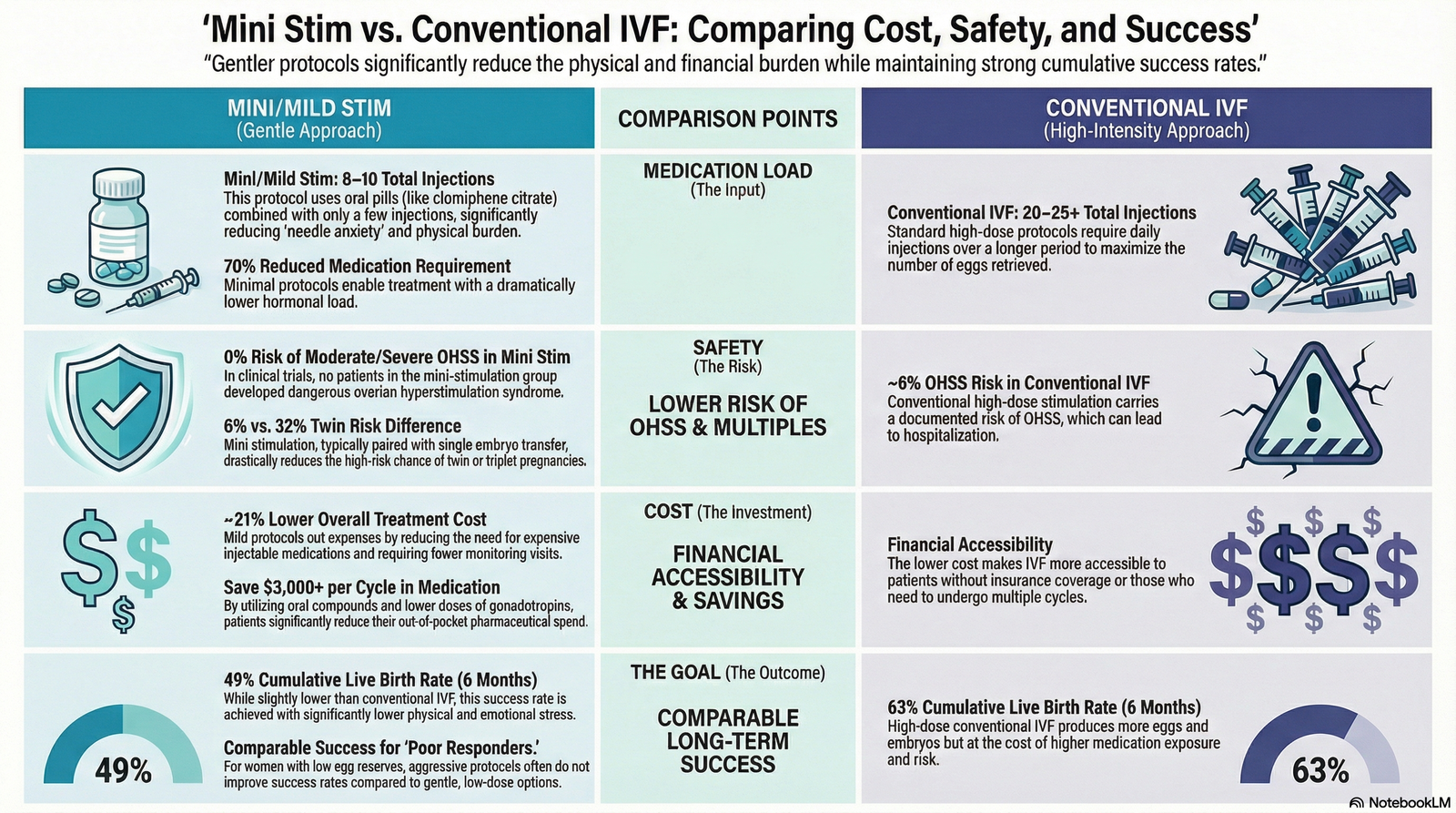
Mini and Mild-Stim IVF focus on fewer injections, lower costs, and similar long-term chances of success compared with conventional IVF.
Options for low reserve and poor responders
If you have been told you have diminished ovarian reserve, a low AMH level, or you are a “poor responder,” it is easy to feel that you must choose the strongest possible stimulation to have any chance. The research gives you a more balanced story.
For women whose ovaries do not produce many eggs, turning up the medication dose often brings more side effects and higher bills without a clear gain in live birth rates. A 2023 study in women with low prognosis found cumulative live birth rates of about 21% with mild stimulation and 22% with conventional stimulation. ASRM guidelines for poor responders reach the same conclusion. Pregnancy and live birth rates look similar between mild and conventional approaches in this group, while mild stimulation lowers drug exposure and cost.
Real-world clinic data back this up. In one group of poor responders, Mini Stim cycles reached a clinical pregnancy rate of about 38% per cycle, very close to the 36% rate seen with full-dose stimulation. The big difference was that the full protocol used about five times as many vials of gonadotropins. If you already have a low egg reserve, a gentler approach can protect your body and your budget while keeping your goal in reach.
Safety, OHSS, and twin pregnancy risk
When you decide how hard to push your ovaries, safety is a central part of that decision. You want to reach a live birth while keeping the process as safe and predictable as possible.
The most talked about risk of strong stimulation is Ovarian Hyperstimulation Syndrome (OHSS). In moderate or severe OHSS, your ovaries swell and leak fluid. You can have abdominal pain, shortness of breath, and in rare cases, need time in the hospital. In the mini-stimulation trial mentioned earlier, zero participants in the mini-stim group developed moderate or severe OHSS, while around 6 in 100 women in the conventional group did.
A large meta-analysis that pooled data across poor, normal, and high responders found that mild stimulation cut the risk of OHSS sharply, especially in women who usually respond strongly to medication. In some subgroups, the risk dropped to around one-quarter of the risk seen with standard high-dose stimulation.
Gentler protocols also help reduce the risk of a twin or triplet pregnancy. Because you are not trying to “use up” many embryos in a single fresh transfer, your care team can safely focus on single embryo transfer in most cycles. This protects you and your baby from the extra risks that come with carrying more than one baby at once, such as preterm birth and low birth weight.
What long-term data say about mild stimulation
Similar live birth rates across responder types: A large meta-analysis across poor, normal, and high responders found that mild stimulation had live birth rates similar to conventional high-dose IVF, both per cycle and across multiple cycles. This means that for many women, you can choose a lower dose protocol without giving up your overall chance of a baby. Source: Human Reproduction Update (PMID: 33146690).
Up to four times lower ovarian hyperstimulation syndrome (OHSS) risk: In the same review, mild stimulation lowered the risk of OHSS by more than half in normal and high responders. In some groups, the risk was roughly four times lower than with standard protocols. This is especially important if you have PCOS or a history of strong responses, because it keeps treatment safer while you try to conceive. Source: Human Reproduction Update (PMID: 33146690).
Similar outcomes in poor responders: A separate meta-analysis focused on poor responders found similar fresh and cumulative live birth rates between mild and conventional stimulation. This suggests that the extra effort of conventional stimulation may not be necessary; although the mild group produced fewer eggs and experienced more cycle cancellations, they achieved the same ultimate success. This supports the idea that pushing for more eggs is not always the same as pushing for more babies. Source: Human Reproduction Open (PMID: 33614987).
These studies suggest that many of the safety gains of mild and mini stimulation do not come at the cost of long-term success. Your doctor can help you weigh this against your own risk factors.
DuoStim for very low ovarian reserve
If you have very few follicles on ultrasound or you have already had a cycle with only one or two eggs collected, even mild protocols can feel slow. In this setting, some clinics offer DuoStim, also called dual stimulation.
Your ovaries grow follicles in waves across the menstrual cycle. DuoStim takes advantage of this process by stimulating twice in the same cycle. You start with stimulation and egg retrieval in the follicular phase, the first half of the cycle. About five days after that retrieval, you begin a second stimulation and then have a second retrieval in the luteal phase, the second half.
In patients who meet the “Bologna criteria” for poor response, DuoStim has doubled cumulative live birth rates in some reports, from 7% after the first stimulation to 15% after completing both. Studies also show that eggs from the second, luteal phase retrieval have similar fertilization rates and chromosomal health to eggs from the first retrieval.
If time feels tight because of age or treatment history, DuoStim can help you build a small group of embryos more quickly, often followed by frozen embryo transfer once you and your doctor agree you have enough embryos stored.
Success rates and what they mean for you
When you see success rates in clinic brochures, it is easy to focus on one number and feel that you must choose the protocol with the single highest value. It helps to break these numbers into two ideas: success per cycle and your cumulative chance over several months.
Standard IVF often has slightly higher pregnancy rates per retrieval because you start with more eggs. Over several cycles, the gap is much smaller or disappears. In the randomized trial of first-time IVF patients mentioned earlier, conventional IVF had a 63% cumulative live birth rate over six months. Mini Stim reached 49% in the same time frame, with less medication and no moderate or severe OHSS.
Another randomized trial compared mild stimulation with single embryo transfer to standard stimulation with double embryo transfer. The cumulative term live birth rates were almost identical, 43.4% for mild stimulation and 44.7% for standard cycling, although the standard arm used more embryos per transfer.
In women aged 40 and older with slightly raised FSH levels, Mini Stim produced a pregnancy rate of about 10% per transfer. A long protocol with standard doses produced a rate of about 10.7%. These numbers tell you that in older age groups, paying for high-dose medication does not always buy you a clear boost in success.
How to decide which protocol fits you
Choosing between Mini Stim, Mild Stim, and conventional IVF is not only a medical decision. It also affects how you feel day-to-day, how many visits and injections you manage, and how your budget holds up over time. You and your doctor can match the protocol to your situation by looking at a few key factors.
Mini or Mild Stim often fits well if:
- You have low ovarian reserve: If your AMH is under about 1 ng/mL, even strong stimulation may only yield 1 to 4 eggs. A lower-dose protocol can give you a similar outcome with lower cost and fewer side effects.
- You have a high OHSS risk: If you have PCOS, a history of strong responses, or other risk factors, mild or mini stimulation keeps you much safer than running a standard high-dose protocol by reducing the risk of OHSS.
- Cost is a major concern: If you pay out of pocket, Mini Stim can save more than 3,000 US dollars in medication per cycle. Mild stimulation protocols in women over 35 may lower overall costs by 21%.
- You prefer fewer injections and visits: A Mini Stim cycle may involve around three monitoring visits and fewer than ten injections, compared with more than six visits and over twenty injections in a typical long protocol.
- You do not want many spare embryos: If you have ethical or emotional concerns about freezing or discarding leftover embryos, lower stimulation helps produce fewer high-quality embryos rather than a large surplus.
Conventional IVF may be a better fit if:
- You need many embryos for genetic testing: If you or your partner carries a genetic condition and needs to test many embryos, you may benefit from the higher egg yield of a standard protocol.
- You are donating eggs: Egg donors usually follow high-dose protocols to produce enough eggs for one or more recipients and to streamline the donation process.
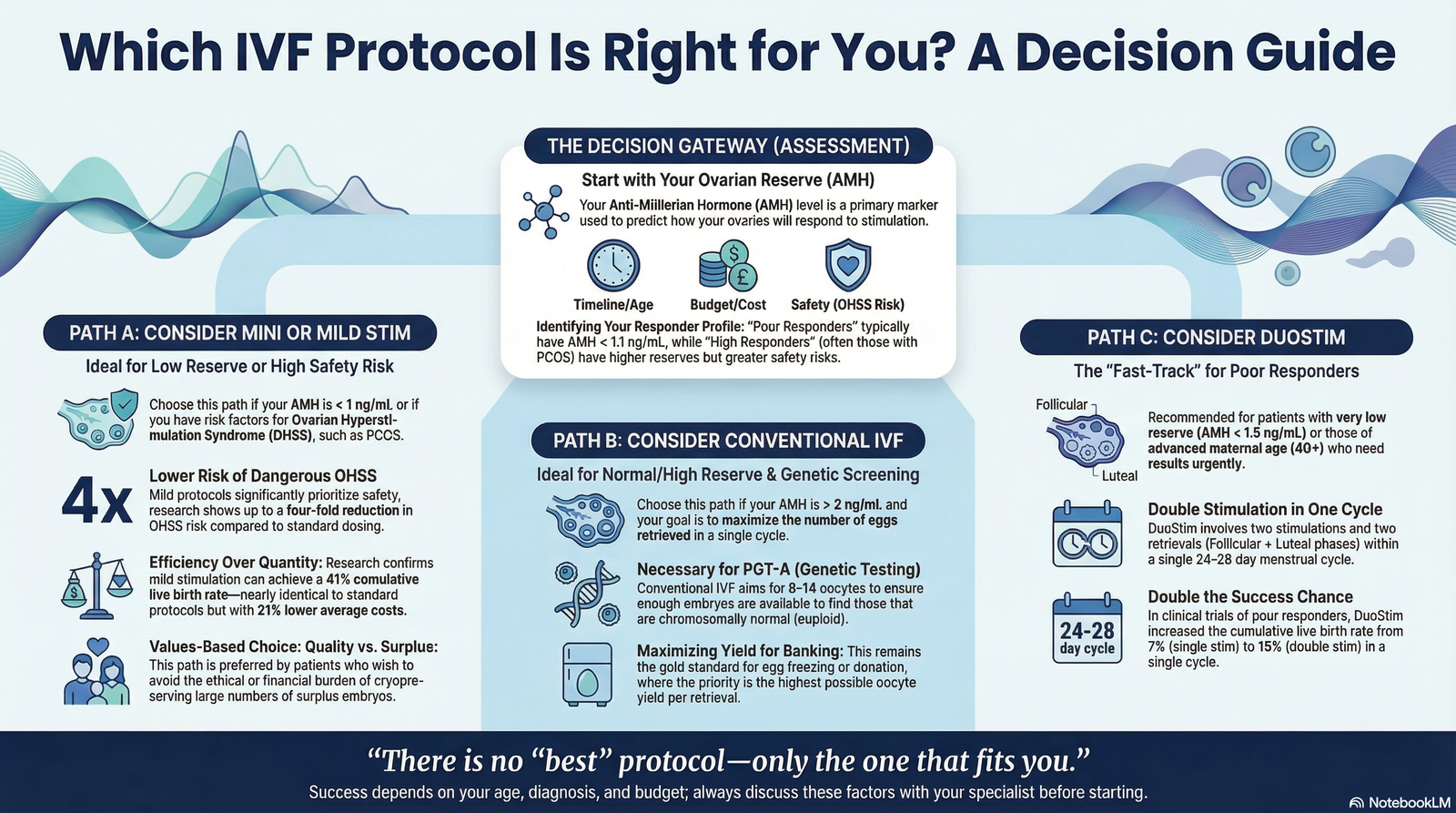
Your age, AMH level, OHSS risk, budget, and feelings about extra embryos all guide whether Mini Stim, Mild Stim, DuoStim, or conventional IVF makes the most sense.
OVU expert guidance
When you sit down with your fertility team, bring concrete questions. Ask how many eggs your doctor would expect from Mini Stim, Mild Stim, and a standard protocol at your age and AMH level. Ask how those numbers translate into embryos and how many embryos your clinic likes to have before moving to transfer or PGT-A. Finally, ask for a side-by-side cost estimate, including medication, for each option.
This approach turns an abstract choice into a clear comparison tailored to you. It also makes it easier to balance your physical comfort, your safety, and your long-term chance of bringing home a baby.
Want help comparing clinics and costs?
If all of this feels like a full-time job, you are not imagining it. Our advisors can collect clear, itemized quotes from verified clinics, explain how Mini and Mild Stim protocols change your budget, and help you plan a timeline that fits your life.

Why trust this guide? The OVU commitment
You are probably juggling hope, timelines, and a lot of tabs open in your browser. And you deserve clear, current, human advice. At OVU, we review clinic protocols, compare real quotes, and talk to people who have done this - intended parents and gestational carriers - so we can give you practical steps, not just theory. If you want help comparing options without sales pressure, we will gather itemized quotes and success data that match your exact situation. You decide, we will bring the info to your table.
Frequently Asked Questions
Will I get fewer eggs with the mini-stim protocol?
Yes. Mini-Stim usually aims for 1 to 5 eggs, while Mild Stim targets fewer than 8 to 10. The goal of the Mini-Stim protocol is to cultivate a smaller group of high-quality eggs rather than a large batch. Studies, especially those involving poor responders, show that having more eggs does not always lead to a higher birth rate; therefore, focusing on quality can be a strategic and effective trade-off.
Is mini-stim much cheaper than conventional IVF?
Often, yes. Mild stimulation has cut overall costs by about 21% in some studies of women over 35. Mini Stim can save more than 3,000 USD per cycle on medication alone, depending on your country and pharmacy prices. Some clinics bundle several mini-stim cycles into “Lite IVF” programs that cost far less than the same number of conventional cycles.
Are embryos from gentle stimulation healthier?
Some research suggests that mild stimulation can increase the share of genetically normal embryos. In one trial, about half of the embryos in the mild stimulation group were chromosomally normal, compared with 38% in the high-dose group. This does not mean every gentle cycle gives better embryos, but it supports the idea that more medication is not always better for egg quality.
What is the biggest risk of mini-stim IVF?
The main risk is cycle cancellation. Because you aim for fewer follicles, there is less margin if your body does not respond or if you ovulate sooner than expected. In some reports, Mini-Stim cancellation rates reach around 18%, compared with about 1% in standard long protocols. Your doctor can help you weigh the stress of possible cancellation against the lower medication load and cost.
Can I use ICSI with mini-stim?
Yes. Many clinics choose ICSI for Mini-Stim cycles. When you expect only a few eggs, ICSI helps make sure each egg has the best possible chance to fertilize. Your clinic will discuss whether ICSI is right for your specific diagnosis and sperm parameters.
Is Mini-Stim a good option for older women?
Mini-Stim can be a strong option if you are in your forties, especially if your FSH is slightly elevated. Studies in women aged 40 and older show similar pregnancy rates per transfer between Mini-Stim and standard protocols, with Mini-Stim offering lower costs and fewer side effects. This lets you try more than one cycle without stretching your body or budget as much.
How does AMH help guide stimulation dose?
Your AMH level gives your doctor a rough idea of how many eggs you may get with different protocols. At higher AMH levels, standard stimulation can produce many more eggs than a natural or Mini approach. At very low AMH, even high doses often only yield a few eggs, so a lower dose protocol can make more sense. Your specialist will use AMH alongside your age, antral follicle count, and past cycles to suggest Mini, Mild, or conventional stimulation.
Reference List 13 sources
Journal Article (Research): Zhang JJ, Merhi Z, Yang M, et al. Minimal stimulation IVF vs conventional IVF: a randomized controlled trial. American Journal of Obstetrics & Gynecology. 2016;214(1):96.e1–96.e8. PMID: 26259908. Available from: https://pubmed.ncbi.nlm.nih.gov/26259908/
Journal Article (Research): Li Y, Li X, Zhang X, et al. Cumulative live birth rate in mild versus conventional stimulation in progestin-primed ovarian stimulation protocols for individuals with low prognosis. Human Reproduction. 2023;[online ahead of print]. PMID: 38033995. Available from: https://pubmed.ncbi.nlm.nih.gov/38033995/
Journal Article (Cost-Effectiveness Study): Xiong Y, Li J, Liu H, et al. The cumulative live birth rate and cost effectiveness of the clomiphene and gonadotropin cotreatment protocol versus the mid-luteal GnRH agonist protocol in women over 35 years old. Scientific Reports. 2024;14:[article number]. Available from: https://www.nature.com/articles/s41598-024-63842-x
Journal Article (Systematic Review & Meta-Analysis): Nargund G, Datta AK, Fauser BCJM, et al. Mild versus conventional ovarian stimulation for IVF in poor, normal, and hyper responders: a systematic review and meta-analysis. Human Reproduction Update. 2021;27(2):229–253. PMID: 33146690. Available from: https://pubmed.ncbi.nlm.nih.gov/33146690/
Journal Article (Systematic Review & Meta-Analysis): Polyzos NP, Drakopoulos P, Parra J, et al. Fresh and cumulative live birth rates in mild versus conventional stimulation for IVF cycles in poor ovarian responders: a systematic review and meta-analysis. Human Reproduction Open. 2021;2021(1):hoaa066. PMID: 33614987. Available from: https://pubmed.ncbi.nlm.nih.gov/33614987/
Journal Article (Research): Magaton I, Arni A, von Arnim L, et al. Ovarian response in natural cycle, minimal stimulation, and conventional IVF protocols in relation to anti-Mullerian hormone level, a multi-center study. European Journal of Obstetrics & Gynecology and Reproductive Biology. 2025;314:114668. Available from: https://www.sciencedirect.com/science/article/pii/S0301211525009443
Journal Article (Review): Nargund G, Datta AK, Campbell S, et al. The case for mild stimulation for IVF: recommendations from The International Society for Mild Approaches in Assisted Reproduction. Reproductive BioMedicine Online. 2022;45(6):1133–1144. PMID: 36220713. Available from: https://pubmed.ncbi.nlm.nih.gov/36220713/
Committee Opinion (Guidance): Practice Committee of the American Society for Reproductive Medicine. Comparison of pregnancy rates for poor responders using IVF with mild ovarian stimulation versus conventional IVF: a guideline. Fertility and Sterility. 2018;109(6):993–999. PMID: 29935660. Available from: https://pubmed.ncbi.nlm.nih.gov/29935660/
Journal Article (Review): Zarek SM, Muasher SJ. Mild or minimal stimulation for in vitro fertilization: an old idea that needs to be revisited. Fertility and Sterility. 2011;95(8):2449–2455. PMID: 21507372. Available from: https://pubmed.ncbi.nlm.nih.gov/21507372/
Journal Article (Research): Weghofer A, Margreiter M, Bassim S, et al. Minimal stimulation using recombinant follicle-stimulating hormone and a gonadotropin-releasing hormone antagonist in women of advanced age. Fertility and Sterility. 2004;81(4):1002–1006. PMID: 15066446. Available from: https://pubmed.ncbi.nlm.nih.gov/15066446/
Journal Article (Review): Muasher SJ, Garcia JE. Fewer medications for in vitro fertilization can be better: thinking outside the box. Fertility and Sterility. 2009;92(4):1187–1189. PMID: 19814778. Available from: https://pubmed.ncbi.nlm.nih.gov/19814778/
Journal Article (Research): Ubaldi FM, Capalbo A, Vaiarelli A, et al. Follicular versus luteal phase ovarian stimulation during the same menstrual cycle (DuoStim) in a reduced ovarian reserve population results in a similar euploid blastocyst formation rate. Fertility and Sterility. 2016;105(6):1488–1495. PMID: 26996909. Available from: https://pubmed.ncbi.nlm.nih.gov/26996909/
Journal Article (Case Series): Vaiarelli A, Cimadomo D, Conforti A, et al. Luteal phase after conventional stimulation in the same ovarian cycle might improve the management of poor responder patients fulfilling the Bologna criteria: a case series. Fertility and Sterility. 2020;113(1):121–130. PMID: 31837743. Available from: https://pubmed.ncbi.nlm.nih.gov/31837743/
Final thoughts
If you feel overwhelmed by protocol names or confused about which path is right for you, you are not alone. It is difficult to balance your emotions while simultaneously trying to understand which treatment options best suit your unique case. You may be weighing whether to add services like preimplantation genetic testing (PGT) or assisted hatching, or perhaps you are considering a mock transfer to prepare for the real thing.
Whatever your situation, your care team should assist you in choosing the most suitable bundle of medical services and tailor a stimulation protocol to your situation and preferences, even if that means avoiding the most intensive protocol available to concentrate efforts on a smaller cohort of oocytes.
Mini-Stim, Mild Stim, and conventional IVF each have their place. Gentle protocols, often called “low-stim IVF,” can protect your health, reduce the risk of side effects, and lower costs while still offering a strong chance of success, especially when planning for more than one cycle. Conversely, conventional IVF may be the right choice when you need a higher number of embryos for testing, donation, or future siblings.
Whether you choose Mini-Stim for its cost savings, Mild Stim for its balance of safety and success, or a DuoStim protocol to maximize your chances despite a low ovarian reserve, remember that the true goal of IVF is a healthy baby, not the number of oocytes collected or embryos vitrified. The right choice is the one that fits your body, your values, and your long-term plan, not someone else’s average.
Bring this article, your lab results, and your questions to your next consultation. Ask your doctor to map out what each protocol would look like for you over the next six to twelve months. When you can see the path clearly, it becomes much easier to choose a plan that feels both realistic and hopeful. Together, you can blueprint a protocol and a support system tailored specifically to your needs and preferences.
Need a second opinion on your protocol?
If you feel unsure about your current plan, you do not have to figure this out alone. Talk to an OVU advisor about Mini, Mild, and conventional IVF options, and get help turning medical data into a clear next step.