


Dr. Sony Sherpa (MBBS)
In addition to her clinical experience, Dr. Sherpa is a published medical researcher and holistic health advocate. Her dual expertise in emergency care and alternative therapies brings a unique lens to medically reviewed content—ensuring it is both accurate and accessible.
If you and your partner are talking about having a baby together, you are carrying a lot at once. You might be excited to imagine a child who knows you both as “Mom”, and at the same time, worried about the process, desirable and undesirable scenarios that might happen, costs, hidden fees, success rates, and whether you will hit legal roadblocks because you are a same-sex couple.
You are not alone in this. In large clinic studies, lesbian women using donor sperm reached live birth from IUI in about 37 percent of cases over several cycles, compared with 23 percent of heterosexual patients in infertility treatment. At the same time, professional groups such as the American Society for Reproductive Medicine (ASRM) clearly state that fertility care should be available regardless of marital status or sexual orientation, so you have guidelines on your side as well.
This guide walks you through how sperm donation works for lesbian couples, what the main treatment paths look like, how much they cost in different regions, what the success rates are, and how to protect your family legally. The goal is simple: to provide you clear information so the decisions you make together feel grounded, not rushed or guessed.
If you are a lesbian couple using donor sperm, your primary options are home insemination, clinic-based IUI, reciprocal IVF (ROPA), and, in some situations, surrogacy. IUI with donor sperm usually costs $2,000 to $4,000 per cycle in North America and gives many couples a live birth within three cycles. Reciprocal IVF is more expensive, often ranging from $10,000 to $30,000 per cycle in the USA, but gives higher per-cycle pregnancy rates, around 45 percent when you use good quality embryos. Regardless of which path you choose, early legal planning ensures that both of you are recognized as full legal parents from the moment your child is born.
Next step: Decide together who will carry the pregnancy, how much you can invest per year, and whether you want both of you physically involved through reciprocal IVF.
What the latest research and guidelines say
Recent studies of almost 12,000 IUI cycles show that lesbian women using donor sperm have at least equal, and often better, chances of pregnancy and live birth than heterosexual couples in infertility treatment. Research on children born through sperm donation, egg donation, and surrogacy, followed to age 14, finds no higher rates of emotional or behavioral problems compared with naturally conceived children.
At the same time, professional bodies such as ASRM and ESHRE have published clear guidance on donor screening, information sharing, and equal access to care for LGBTQ families. This guide uses those standards to help you understand what safe, modern care should look like.
In This Guide
- Your main paths to parenthood with donor sperm
- Choosing your sperm donor
- IUI with donor sperm
- Reciprocal IVF (ROPA) for shared motherhood
- Advanced shared options, concurrent IVF and INVOcell
- When surrogacy enters the picture
- Clinical timeline, what to expect step by step
- Costs by country and treatment type
- Legal protection for both mothers
- Frequently Asked Questions
IUI live birth, about 37 percent for lesbian couples over several cycles.
Reciprocal IVF has a 45 percent chance of pregnancy per cycle in many cohorts.
IUI costs $2,000–$4,000 per cycle in North America.
ROPA in Europe costs €5,000–€8,500 per cycle.
Long-term data show donor-conceived children do as well emotionally as other children.
Good parenting and early, honest conversations matter most.
Your main paths to parenthood with donor sperm
If you are just starting to look at your options, it helps to see the big picture first. With donor sperm, lesbian couples usually follow one of four medical paths.
- Home insemination: Using syringes and donor sperm at home, often with a known donor. This can be simple and private, but you miss formal health screening and legal protection.
- Clinic-based IUI with donor sperm: Sperm is washed and placed into the uterus around ovulation. This is often the first clinical step, low in invasiveness and cost compared with IVF.
- Reciprocal IVF (ROPA): One partner provides the eggs and the other carries the pregnancy. This is more complex and costly but deeply shared.
- Gestational surrogacy: A surrogate carries the pregnancy when neither of you can safely do so or when you choose not to be pregnant.
You can move between these paths over time. Many couples try a few rounds of IUI, then move to IVF or ROPA if needed. Others go straight to IVF if they have known medical issues or are older and want higher per-cycle success.
Latest clinical insights for lesbian couples using donor sperm
37 percent vs. 23 percent – IUI success advantage: In a large IUI study, lesbian women using donor sperm were more likely to ever reach a live birth than heterosexual patients in infertility care, roughly 37 percent versus 23 percent over several cycles. This reflects the fact that many lesbian patients do not have underlying infertility; they simply need sperm access. Source: F&S Reports (PMID: 34553151).
About 45 percent – reciprocal IVF per-cycle pregnancy rate: In shared motherhood IVF, many clinics report pregnancy rates around 45 percent per transfer when they use good-quality blastocysts and single embryo transfer. That is about double the pregnancy rate seen in some donor insemination cohorts. Source: Human Reproduction (PMID: 37009817).
Child outcomes – reassuring long-term data: Longitudinal research that followed donor-conceived children and children born to two mothers into adolescence found similar levels of mental health and family functioning as in naturally conceived families. Warm parenting and openness about conception are the key drivers of well-being. Source: Child Development Perspectives (PMID: 41158435).
These insights help you see that donor sperm and shared motherhood are established, evidence-based routes to parenthood, not experimental options.
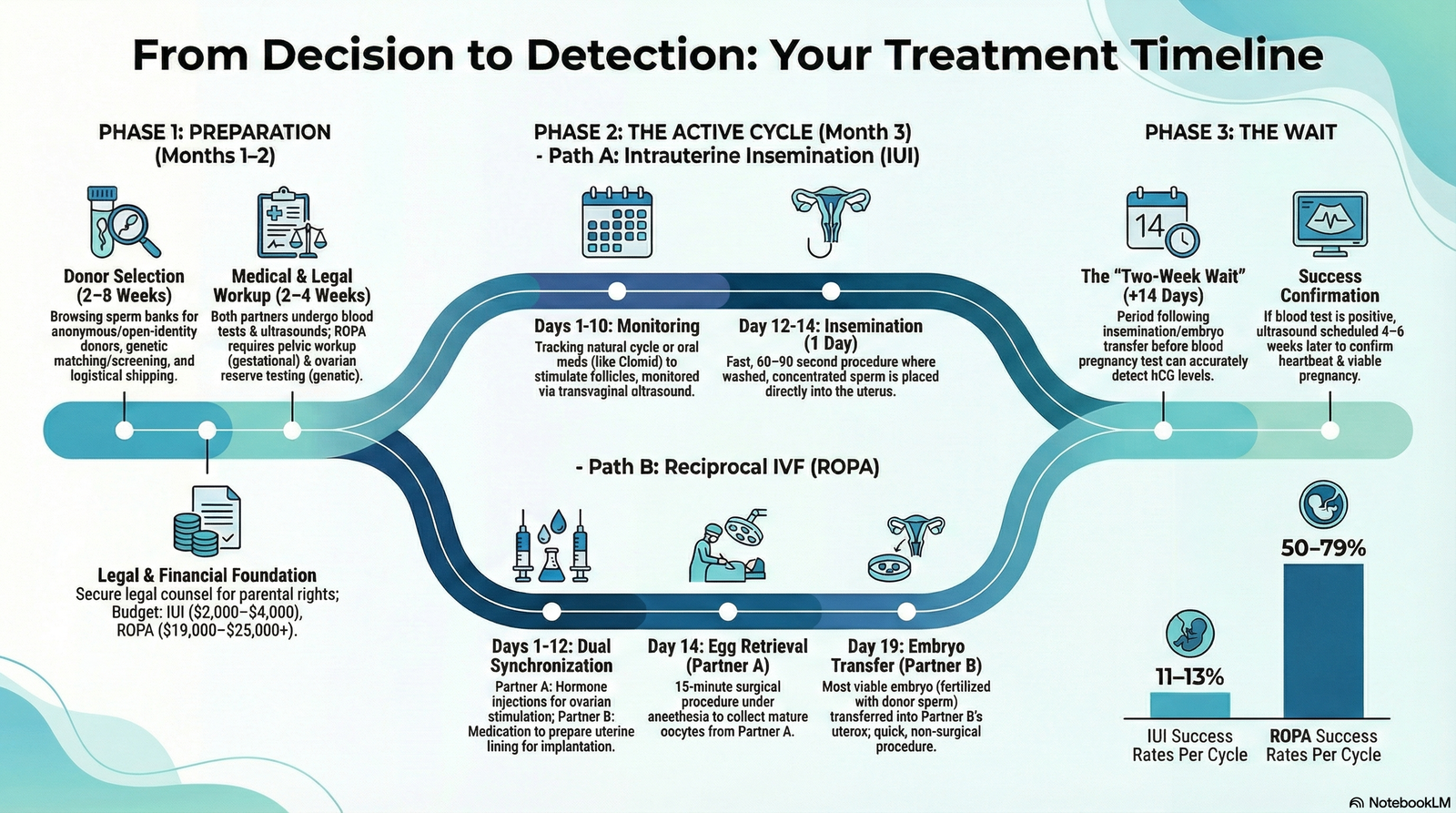
Typical timeline, from choosing a donor to your first pregnancy test with IUI or reciprocal IVF.
Choosing your sperm donor
The donor you choose shapes part of your child’s story, so it is natural if this decision feels heavy or deeply personal. To simplify the process, you can categorize your options into three main paths: anonymous (no contact), open-identity (contact allowed once the child turns 18), or known donors (a friend or acquaintance). Understanding the boundaries of each will help you decide which level of connection feels right for your family.
Anonymous donor sperm means neither you nor your child will have any direct way to contact the donor later. You still receive profiles with non-identifying details, such as medical history, education, physical traits, and sometimes audio or written notes.
Open-identity donors agree that your child can request their identifying details once they reach adulthood. Studies of donor-conceived adults show many appreciate this option, even if they never go beyond a few messages.
Known donors are people already in your life, such as friends or relatives. This can create a visible resemblance and a sense of continuity in your extended family. Still, it requires careful legal planning and emotional boundaries so that everyone understands and accepts their role.
Whatever route you choose, clinic-recruited donors go through medical screening for infections and many genetic conditions, plus a psychological assessment. Clinics follow national and international guidelines to test for HIV, hepatitis, and key recessive diseases. This level of screening is one of the main reasons many couples choose clinic-based sperm, even when they know someone willing to donate.
Intrauterine insemination (IUI) with donor sperm
If you want a medical option that feels lighter on your body and your budget, IUI is usually the first step. It works best when your tubes are open and your uterus is structurally normal.
In an IUI cycle, the laboratory team washes and concentrates the donor sperm. Your doctor passes a very thin catheter through the cervix and places the sample directly into your uterus around ovulation. The procedure feels similar to a Pap smear for many people and usually takes less than two minutes.
You can do this in a natural cycle, where the clinic monitors your own ovulation, or in a medicated cycle with tablets or low-dose hormone injections to recruit one or a few eggs. A trigger injection then times ovulation and insemination.
- Advantages for you: No surgery, no egg retrieval, lower medication doses, and simpler monitoring compared with IVF.
- Typical success: Many donor IUI series report per-cycle clinical pregnancy rates in the low teens, but when you add up several cycles, around one-third of lesbian patients reach a live birth.
- Limits: IUI does not bypass blocked tubes or severe pelvic disease and is less efficient when age or egg quality are major concerns.
Reciprocal IVF (ROPA) for shared motherhood
If you and your partner want both of your bodies involved in creating and carrying the pregnancy, reciprocal IVF gives you that option. One of you acts as the egg provider and the other as the gestational mother.
If you provide the eggs, you take daily hormone injections for about 10 to 12 days. The clinic tracks follicle growth with scans and blood tests. When the follicles reach the right size, you have an egg retrieval under light sedation. The lab fertilizes the eggs with donor sperm and grows the embryos until day five.
If you carry the pregnancy, you prepare your uterus with hormones to thicken the lining. In five days after fertilization, your doctor transfers one embryo into your uterus with a soft catheter. If the embryo implants, you carry the pregnancy and give birth. The baby shares genes with your partner and a full gestational bond with you.
| Option | Who Provides Eggs | Who Carries Pregnancy | Typical Pregnancy Rate Per Cycle |
|---|---|---|---|
| IUI with donor sperm | Partner who ovulates in that cycle | Same partner | About 10–15 percent per cycle |
| Reciprocal IVF (ROPA) | Partner A (egg provider) | Partner B (gestational mother) | Around 40–50 percent per transfer |
| Standard IVF with donor sperm | Same partner who carries | Egg provider | Similar to ROPA when age and embryo quality match |
Many couples experience ROPA as very bonding, since both of you have a clear medical role in the cycle. At the same time, it is more demanding on your time, your body, and your finances than IUI, so it helps to go in with a clear plan for how many cycles you can realistically attempt.
Advanced shared options, concurrent IVF, and INVOcell
If you would like both of you to carry pregnancies close together or even at the same time, some clinics offer concurrent IVF for lesbian couples.
In a concurrent cycle, both of you go through stimulation and egg retrieval together. The clinic can then create two sets of embryos using the same donor sperm and transfer them in a way that each of you carries an embryo created from the other partner’s eggs. This way, each of you experiences pregnancy while supporting the other through it.
Intravaginal culture (IVC) with INVOcell is another shared option when you want IVF outcomes with lower lab costs. With INVOcell, the clinic places eggs and sperm into a small culture device and then places that device in one partner’s vagina for several days. The vagina acts as a natural incubator. After that, the doctor removes the device and transfers one or more embryos into the uterus of the chosen gestational partner. Early research shows pregnancy rates comparable to standard IVF in selected patients, but availability is still limited, and it is important to ask your clinic about their own results.
When surrogacy becomes part of the plan
If neither of you can safely carry a pregnancy because of heart disease, severe uterine problems, repeated pregnancy loss, or other medical reasons, surrogacy can be a path to a genetically related child.
With gestational surrogacy, your clinic creates embryos using your eggs or donor eggs and donor sperm, then transfers them into the uterus of a screened gestational carrier. She has no genetic link to the baby. You work with a surrogacy agency or clinic team to match with a carrier who has had at least one healthy pregnancy, is medically and psychologically cleared, and has her own independent legal support.
Surrogacy is often expensive, especially in the USA, where full programs can range from $100,000 to $175,000, including medical, legal, and agency fees. Some couples consider countries such as Mexico or Cyprus, where laws and costs differ, but cross-border surrogacy always requires very careful legal planning.
Clinical timeline, from first consult to pregnancy test
When you are ready to speak with a fertility specialist, you can expect the process to unfold in a few clear stages.
- Initial assessment: Medical history, blood work for hormones such as AMH and FSH, infectious disease screening, and a transvaginal ultrasound to check ovaries and uterus. If you plan an IUI, a test of your fallopian tubes may be included.
- Choosing your treatment path: Based on your age, egg reserve, known conditions, and budget, your doctor helps you decide between IUI, IVF, or ROPA. This is a good time to ask every question you have.
- Mock embryo transfer for IVF cycles: Many clinics do a trial catheter pass into the uterus to learn the best path and depth before the real embryo transfer.
- Active treatment cycle: Stimulation and retrieval for IVF and ROPA, or ovulation tracking and insemination visits for IUI.
- The two-week wait: After IUI or embryo transfer, you wait about 12 to 14 days, then have a blood pregnancy test.
Clinical risks and how to reduce them
One embryo, safer pregnancy: Data from shared motherhood IVF show that twin pregnancies have a far higher risk of high blood pressure and early birth than single pregnancies. Asking for a single embryo transfer gives you excellent success rates and safer outcomes.
Screening protects you and your child: Fertility guidelines recommend infectious disease screening of all gamete donors, plus genetic testing where appropriate. Choosing a clinic or bank that follows these standards reduces the risk of transmitting serious infection or inherited disease.
Emotional support is part of medical care: Studies of infertility patients show that ongoing stress can harm both well-being and relationships. It is worth planning support from a counselor or support group at the same time you plan your cycle.
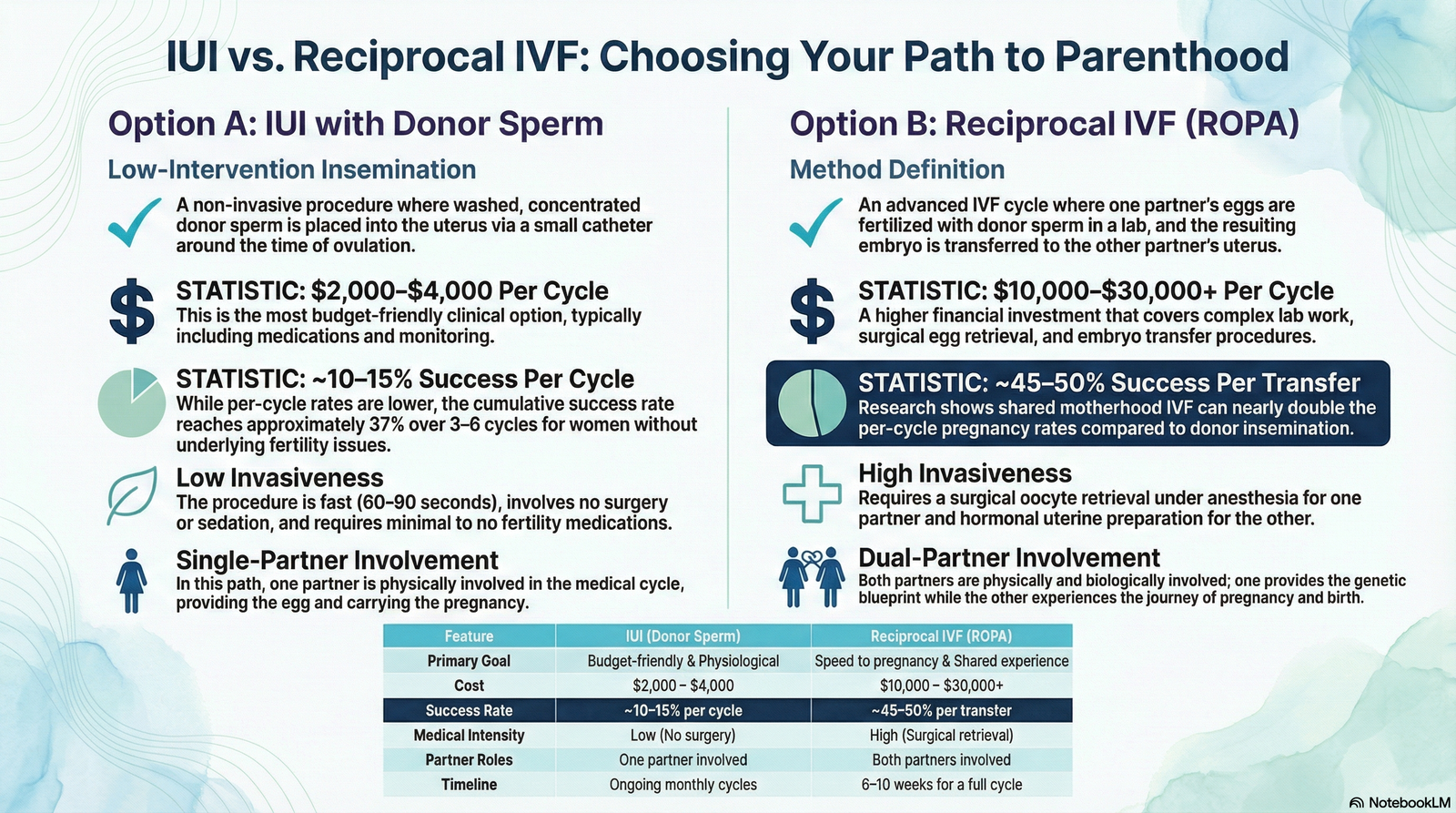
Comparing costs and success rates helps you decide how far to go with IUI before considering reciprocal IVF.
Costs by country and treatment type
Money is one of the biggest practical questions you face, especially if you live in a country with limited fertility coverage. Knowing the ballpark numbers helps you plan without guessing.
| Treatment Type | Region | Estimated Cost |
|---|---|---|
| IUI with donor sperm (per cycle) | North America | $2,000–$4,000, including basic medications |
| Reciprocal IVF (ROPA) | USA and Canada | $10,000–$30,000 or more per cycle |
| Reciprocal IVF (ROPA) | Spain and Portugal | About €5,000–€8,500 per cycle |
| Reciprocal IVF (ROPA) | Mexico | $7,000–$11,900 per cycle |
| Guaranteed surrogacy programs | Cyprus | From about €55,000 for multi-embryo programs |
| Gestational surrogacy | USA | $100,000–$175,000, including medical and agency fees |
On top of base program prices, you need to factor in sperm vials, medications, add-on procedures, and travel.
- Sperm vials: Around $1,000 per vial in many banks. Clinics often suggest buying enough for at least two full cycles and possibly extra for future siblings.
- Medications: Tablet-based IUI cycles are less expensive, while IVF and ROPA medication costs often fall between $3,000 and $8,000 per cycle.
- Laboratory add-ons: PGT-A genetic testing typically adds several thousand dollars for a group of embryos. Embryo freezing and storage also carry yearly fees.
- Travel costs: If you seek treatment abroad, you need to budget for flights, local transport, accommodation, and lost workdays.
Making sense of costs and value
Think cost per baby, not cost per cycle: A cheaper treatment with a low chance of success may become more pricier if you need many cycles. A more costly option with a higher pregnancy rate can sometimes be a better value over time.
Ask for detailed written quotes: Always request an itemized price list that includes monitoring, lab fees, medications if possible, embryo freezing, and storage. This helps you compare clinics fairly.
Look for financing and package options: Many centres now offer multi-cycle packages or refund programs. You can use these to control risk and avoid surprises, especially if you are travelling for treatment.
Legal protection for both mothers
The legal side may feel less urgent than the medical side, but it matters just as much for your child’s safety and your peace of mind. Laws differ widely between countries and even between regions of the same country.
Birth parent rules: In many places, the person who gives birth is automatically a legal parent. When you are a lesbian couple, that means one of you is fully recognized from birth, and the other is not, unless you take extra steps.
Parental orders and second-parent adoption: In several US states and other countries, you can get a pre-birth or post-birth court order that recognizes both of you as legal parents. Even when your name goes on the birth certificate from day one, many lawyers still advise a second-parent adoption to protect your rights if you travel or move.
ROPA recognition: Some countries, including Spain and Portugal, explicitly support ROPA and allow both mothers to be listed as parents when one provides eggs and the other carries. In other countries, the law still assumes a genetic mother and a father, so you may need bespoke legal advice.
Partnership or marriage status: Certain health systems restrict access or automatic joint parentage for couples who are married or in a registered partnership. If you reside in or intend to receive treatment in one of these countries, you may need to formalize your relationship first.
Talking with a lawyer who understands LGBTQ family law before you start treatment helps you avoid gaps. That conversation can feel dry compared with embryo photos or pregnancy tests, but it quietly protects the family you are working so hard to build.
Want help comparing clinics, countries, and real costs?
If this research is starting to feel like a second job, our advisors can help you gather clear, itemised quotes from verified clinics, explain what is really included and map out a realistic timeline with you.

Why trust this guide? The OVU commitment
You are probably juggling hope, timelines, and a lot of tabs open in your browser. And you deserve clear, current, human advice. At OVU, we review clinic protocols, compare real quotes, and talk to people who have done this - intended parents and gestational carriers - so we can give you practical steps, not just theory. If you want help comparing options without sales pressure, we will gather itemized quotes and success data that match your exact situation. You decide, we will bring the info to your table.
Frequently Asked Questions
Is success more likely if we are a lesbian couple using donor sperm?
Often yes, especially if neither of you has other fertility problems. Many heterosexual couples in infertility care have underlying issues like blocked tubes, low sperm count, or ovulation disorders. You and your partner usually arrive at the clinic because you lack sperm access, not because of hidden infertility. In IUI studies, that difference shows up; lesbian patients using donor sperm reach live birth from treatment more often than heterosexual patients overall.
Should we transfer more than one embryo if we want to have twins?
Most fertility experts now advise against transferring more than one embryo just to try for twins. Twin pregnancies carry higher risks of high blood pressure, early birth, and complications for both you and your babies. With modern IVF and ROPA, single embryo transfer gives high success rates with a much safer risk profile. You can talk honestly with your doctor about your wishes, but one embryo at a time is usually the safest plan.
Can we do home insemination instead of going to a clinic?
Home insemination is possible, and some couples do conceive this way, especially with a known donor. But you need to understand the trade-offs. At home, you don't get donor screening for infections and genetics, a formal donation record, or legal certainty about parentage. If you are thinking about home insemination, talk with a fertility doctor and a lawyer first so you can reduce the risks and understand your rights.
Will our child be healthy if we use donor sperm?
Studies that follow donor-conceived children into adolescence show very reassuring results. When parents are loving and open about conception, children born from sperm or egg donation do just as well emotionally and socially as those conceived without treatment. Using a well-screened donor, and getting good prenatal care gives your baby the same health chances as any other planned child.
How and when should we tell our child about their donor?
Research suggests that it is easier for children when they always know, rather than learning suddenly later. Many families start with a simple story with their toddlers, such as saying that a kind donor helped give a tiny seed so they could become a family. As your child grows, you add more detail. Teens who have grown up with this story often show better well-being and more open communication with their parents than those who find out late.
Are there age limits for lesbian couples who want treatment with donor sperm?
Clinics and countries set their own limits. Most require you to be at least 18. Upper age limits are often tied to whether you use your own eggs or donor eggs. Many programs stop using your own eggs in the early to mid-40s and may offer donor egg IVF up to the late 40s or early 50s. Ask each clinic for its exact policy so you can plan timing realistically.
Will treatment put extra strain on our relationship?
Any fertility treatment can test a relationship, regardless of orientation. Long-term research shows that relationship satisfaction before treatment is a strong predictor of whether couples stay together afterward. If you already feel stretched, it is worth investing in couples counselling or regular check-ins before and during treatment. Talking about money, roles, expectations, and fears clearly can protect your bond while you focus on becoming parents.
Reference List 5 sources
Journal Article (Research): Johal JK, Gardner RM, Vaughn SJ, Jaswa EG, Hedlin H, Aghajanova L. Pregnancy success rates for lesbian women undergoing intrauterine insemination. F&S Reports. 2021;2(3):275–281. PMID: 34553151. Available from: https://pubmed.ncbi.nlm.nih.gov/34553151/
Journal Article (Research): Tordoff DM, Moseson H, Ragosta S, et al. Family building and pregnancy experiences of cisgender sexual minority women. AJOG Global Reports. 2023;4(1):100298. PMID: 38269079. Available from: https://pubmed.ncbi.nlm.nih.gov/38269079/
Journal Article (Review): Golombok S. Love and truth, what really matters for children born through third-party assisted reproduction. Child Development Perspectives. 2021;15(2):103–109. PMID: 41158435. Available from: https://pubmed.ncbi.nlm.nih.gov/41158435/
Committee Opinion (Guidance): Ethics Committee of the American Society for Reproductive Medicine. Access to fertility treatment irrespective of marital status, sexual orientation, or gender identity, an Ethics Committee opinion. Fertility and Sterility. 2021;116(2):326–330. PMID: 33906744. Available from: https://pubmed.ncbi.nlm.nih.gov/33906744/
Practice Guideline (Guidance): Practice Committee of the American Society for Reproductive Medicine; Practice Committee of the Society for Assisted Reproductive Technology. Guidance regarding gamete and embryo donation. Fertility and Sterility. 2021;115(6):1395–1410. PMID: 33838871. Available from: https://pubmed.ncbi.nlm.nih.gov/33838871/
Final thoughts
If you are still reading, you are already doing hard and loving work for a child you have not met yet. You are taking a dream that might have felt vague or out of reach, and you are turning it into real options, real numbers, and real next steps.
Your sexual orientation does not limit your ability to be a parent or to have a healthy pregnancy. With donor sperm, modern fertility care, and clear legal planning, you and your partner can build the family that fits you. The most important pieces are often the quiet ones, looking after your relationship, asking questions until you truly understand your choices, and permitting yourselves to pause if you feel overwhelmed.
You do not have to navigate clinics, banks, laws, and costs on your own. Support exists, both from medical teams who understand LGBTQ family building and from communities of parents who have already walked this path. You and your future child deserve that support.
Ready to turn research into a clear action plan?
If you want personalized help choosing between IUI, reciprocal IVF, or cross-border treatment, you can speak with an OVU advisor. Together you can review your age, health, budget and timeline, then build a step-by-step plan that feels realistic for both of you.