


Dr. Sony Sherpa (MBBS)
In addition to her clinical experience, Dr. Sherpa is a published medical researcher and holistic health advocate. Her dual expertise in emergency care and alternative therapies brings a unique lens to medically reviewed content—ensuring it is both accurate and accessible.
If you are pregnant with triplets, quadruplets, or even quintuplets after IVF, it is normal to feel both amazed and frightened. You are living something most people never experience. For many moments, hours, weeks, and months, you have been accurately carrying your precious babies curled beneath your heart. You have watched tiny heartbeats on the screen and seen your babies curled up together. Those images stay with you.
At the same time, every new twinge can send your mind spinning. You are told from the start that IVF pregnancies, and especially higher-order multiples, need closer monitoring is especially important when you are hosting more than one small baby. The first trimester is the most fragile part of any pregnancy, especially with more than one fetus.
While you have already celebrated your positive pregnancy test, you should receive honest information about the risks. Multiple embryo implantation cannot guarantee that absolutely all embryos will turn into fetuses. Between 10% and 40% of multifetal pregnancies go through what doctors call the “vanishing embryo” phenomenon, when one or more embryos stop developing after a heartbeat has been seen. In triplet pregnancies, women often lose one embryo in the first seven weeks. Your pregnancy is precious and worth every effort, and your care team has to balance hope with real numbers and clear guidance.
Vanishing twin syndrome means that one or more fetuses in a multiple pregnancy stop developing after a heartbeat has been seen. This most often happens in the first trimester. Early loss usually does not harm the surviving babies. Loss after the first trimester carries a higher risk and always needs close care from a high-risk obstetric team.
Next step: Ask your maternal-fetal medicine specialist what this diagnosis means for your own babies, your monitoring plan, and your delivery options.
Latest Research Highlights
70% fewer very early births with reduction: When triplet pregnancies are reduced to twins, births before 28 weeks drop from about 10 in 100 to about 3 in 100. Pregnancies also last longer on average, which lowers the risk of serious breathing and brain problems in the babies. This is why your doctor may bring up reduction if you are carrying three or more fetuses. Source: Fertility and Sterility, ASRM multiple gestation guidance.
30% vs. 7% late preterm birth after a late loss: In a large IVF study, about 30 in 100 babies whose co-twin died after 13 weeks were born early, before 37 weeks. In pregnancies that started and stayed as singletons, that number was about 7 in 100. Your doctor should treat your pregnancy as a higher risk if your baby is a survivor after a late loss. Source: Frontiers in Endocrinology (PMID: 35370987).
12% vs. 7% low birthweight after a vanished twin: In more than 4,000 IVF singleton births, about 12 in 100 babies with a vanished twin weighed under 2.5 kg, compared with about 7 in 100 singletons that started as singletons. Most survivors were still healthy but needed closer growth checks. Source: Women’s Health (London) (PMID: 27638897).
Up to half of high-order multiples lose a fetus: Reviews of IVF and multiple pregnancies suggest that 15–36% of twin pregnancies and up to 30–50% of higher order pregnancies lose a fetus early in the first trimester. Early loss in this window usually does not harm the surviving fetus when each has its own placenta. Source: StatPearls, Vanishing Twin Syndrome (NCBI Bookshelf).
One baby at a time is the goal: ASRM now recommends single embryo transfer in most good-prognosis IVF cycles to reduce the risk of twins and triplets. When very high-order multiples do occur, they acknowledge that multifetal reduction can lower the chance of extreme prematurity and serious complications. Source: Fertility and Sterility, ASRM Committee Opinion 2022.
In This Guide
Twins: 10–20% lose a fetus
High order multiples: up to 30–50%
Twins: ~35 weeks
Triplets: ~33 weeks
Quadruplets: ~30 weeks
Twins: ~50% preterm
Triplets: ~90% preterm
Why Vanishing Fetuses Happen in IVF Multiple Pregnancies
Doctors use the term “vanishing twin syndrome” when one or more fetuses in a multiple pregnancy stop developing after a heartbeat has already been seen on ultrasound. The same idea applies when a fetus is lost from a triplet or quadruplet pregnancy.
At your first scan, you might see two, three, or four sacs with pulsing dots inside them. At a later scan, one of those dots has gone quiet. Over time, that sac shrinks, flattens, or is no longer visible. In triplet and quadruplet pregnancies, more than one sac can disappear.
Your body often reabsorbs the lost fetus and its placenta. This is fetal resorption. It usually happens in the first 7 to 14 weeks of pregnancy. When this happens early, and each fetus has its own placenta, the remaining babies usually keep growing without extra harm.
The usual reasons for these early losses include:
- Serious chromosomal problems in that fetus
- Poor or shallow implantation of that fetus’s placenta
- Severe structural problems in vital organs
These are not things you caused. They are built into human reproduction, even though the experience feels brutal and unfair when it happens to you. If a fetus is lost in the first trimester, you might notice some spotting or cramping, or you might notice nothing. Many people only find out about a vanished fetus at a scan.
What early loss usually mean for you
When a fetus is lost in the first trimester of a multiple pregnancy, and the placentas are separate, the surviving fetuses and your own health usually stay stable. Your care team keeps watching for bleeding, infection, or signs of preterm labor, but most people carry on with the pregnancy.
Who Is at Higher Risk for High-Order Multiples?
If you used IVF, your clinic probably talked about the chance of twins or triplets before embryo transfer. That chance depends on how your ovaries responded to stimulation, how many embryos were transferred, and your age.
Older stimulation studies give a sense of how multiple follicles can translate into high-order multiples:
| Maternal Age | Follicles > 10 mm | Risk of Triplets or More |
|---|---|---|
| < 32 years | 3–6 | About 6% |
| < 32 years | 7+ | About 20% |
| > 38 years | Any number | Lower overall risk |
This is why clinics are far more cautious today about how many embryos they transfer, especially in younger patients with many follicles and good-quality embryos. Single embryo transfer is now standard for many people because it lowers the odds of triplets and the chain of risks that follow.
Your Monitoring Schedule With Triplets or More
If you are carrying three or more fetuses, your pregnancy care plan will not look like a standard singleton plan. You can expect:
- Week 6–8: Early ultrasound to confirm the number of sacs and heartbeats.
- First trimester: Repeat scans to track growth and look for any vanishing fetuses.
- Weeks 18–22: Detailed anatomy scans, sometimes over several visits, to check organs and placentas.
- Third trimester: Visits at least every 2 weeks until 36 weeks, then weekly until delivery.
- Extra tests in high-risk cases: Doppler ultrasound to check blood flow through each placenta and umbilical cord, and non-stress tests to track heart rate responses to movement.
These visits and scans can feel endless, but they are how your team stays one step ahead of complications and decides when your babies are safer outside than inside.
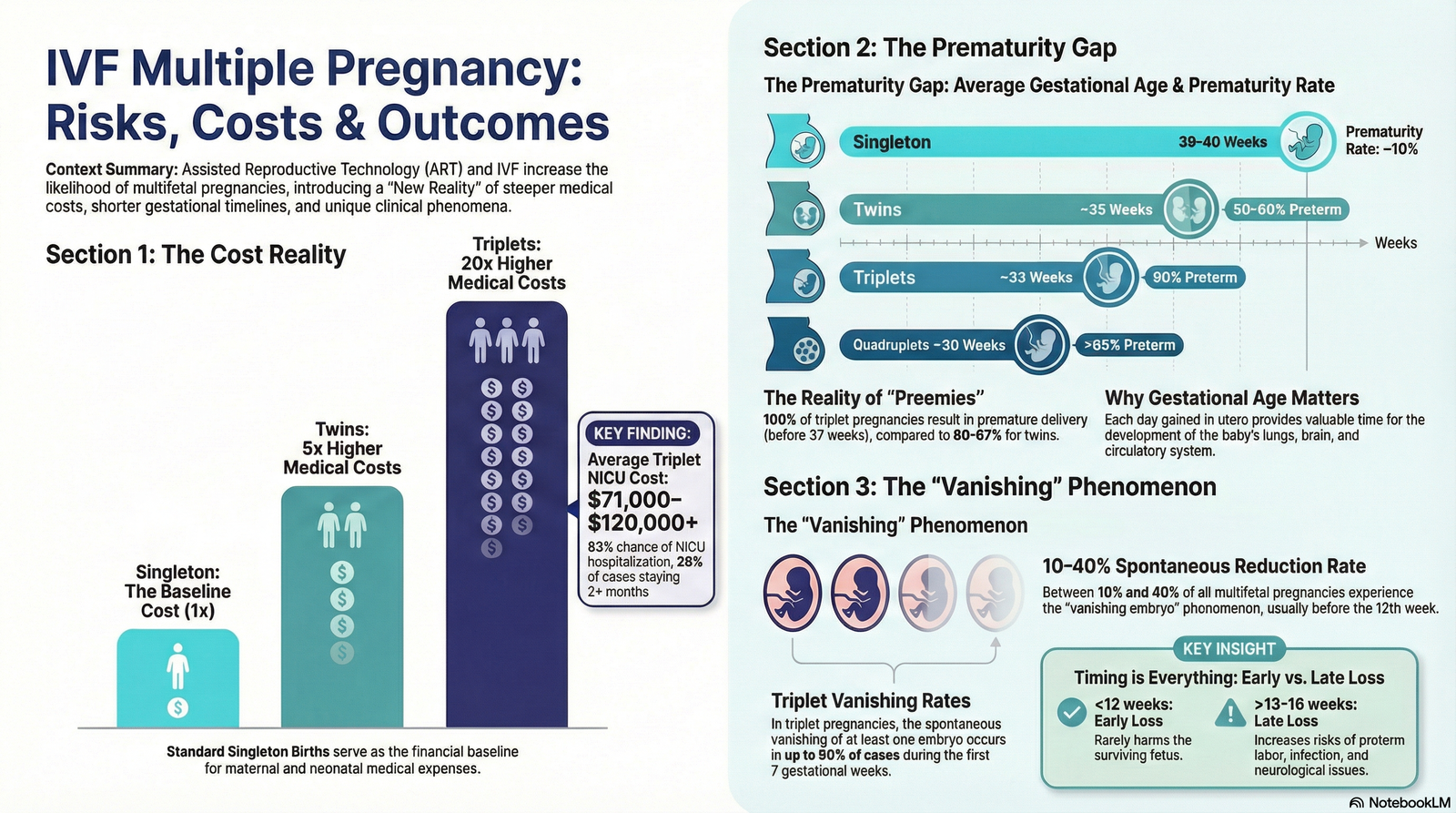
IVF multiple pregnancy at a glance, from early detection to delivery, with cost and risk highlights.
The Physical and Economic Toll of High-Order Multiples
Carrying even one baby is demanding. Carrying three or four pushes your body to its limits. You might feel:
- Severe back and pelvic pain as your uterus stretches
- Leg cramps and swelling from the extra weight and fluid
- Shortness of breath when your lungs have less room
- Overheating, because several babies produce a lot of body heat
The financial pressure is real too. In the United States, estimates show:
| Pregnancy Type | Relative Pregnancy Cost | NICU Admission Rate | Typical NICU Cost Range |
|---|---|---|---|
| Singleton | Baseline | Lower | Variable |
| Twins | About 5x singleton | Around 25% | Varies by hospital |
| Triplets | About 20x singleton | Around 75% | $71,000–$120,000+ per baby |
These numbers do not even include the long-term costs of caring for a child born very early. This is why so many professional societies now push for single embryo transfer in IVF cycles with a good prognosis. It is not about denying you a baby. It is about giving each baby the best chance for a healthy start.
Placental Health and Late Pregnancy Loss
Most losses in multiple pregnancies happen in the first trimester. Loss after 12 weeks is less common but can be much more serious, especially when fetuses share a placenta.
Some late losses relate to underlying conditions such as autoimmune disease, clotting disorders, or severe placental problems. The placenta sits at the center of all of this. It is the shared life support that delivers oxygen and nutrients and removes waste.
In dichorionic pregnancies, each fetus has its own placenta. In monochorionic pregnancies, fetuses share one placenta with blood vessels that connect them. If one fetus dies in a monochorionic pregnancy, sudden shifts in blood flow through those shared vessels can harm the survivor. This can lead to brain injury, organ damage, or even death.
If one fetus dies later in pregnancy, your doctor will usually:
- Increase ultrasound and Doppler monitoring to watch growth and blood flow.
- Watch closely for preterm labor, infection, or heavy bleeding.
- Plan the timing and method of delivery with a high-risk team.
If the dead fetus lies low and blocks the cervix, your doctor will recommend a Cesarean section for the surviving fetus, because a vaginal birth would not be safe in that situation.
What Happens to the Surviving Babies?
If you lose one fetus in a triplet or quadruplet pregnancy, your next question is almost always about the baby or babies who are still alive. Research on IVF pregnancies gives us some patterns to work with.
Across several large studies, survivors of a vanished co-twin or co-triplet are more likely to be born early and small. Key findings include the following:
- About 12% of survivors weighed under 2.5 kg at birth, compared with about 7% of singletons that started as singletons.
- When the loss happened after 13 weeks, about 30% of survivors were born before 37 weeks. In pregnancies that began and stayed singleton, that number was about 7%.
- Survivors after a late loss had higher rates of NICU admission than babies in singleton IVF pregnancies.
How doctors use this data to protect you
Three times higher very early birth after a vanished triplet: IVF twin pregnancies that started as triplets and lost one fetus had roughly three times the risk of birth before 32 weeks compared with other IVF twins. Babies also weighed about 200 grams less on average. Source: Human Reproduction (PMID: 21784732).
Five in one hundred IVF singletons started as twins: In one IVF cohort, about 5% of singleton births started as twins. Survivors had more prematurity, low birthweight, and NICU admissions, especially when the loss happened later. Source: Frontiers in Endocrinology (PMID: 35370987).
Higher risk across many studies, not just one: A meta-analysis found that vanishing twin pregnancies had about 50–70% higher rates of preterm birth and low birthweight than ART pregnancies that started as singletons. Most babies were still healthy, but needed closer follow-up. Source: Journal of Assisted Reproduction and Genetics (PMID: 32840763).
More pregnancy complications with vanishing twins: Reviews show higher rates of gestational diabetes, early rupture of membranes, cervical problems, and birth defects in vanishing twin pregnancies compared with singletons. Source: Archives of Gynecology and Obstetrics (PMID: 28097444).
Double embryo transfer means more losses and more risk: A 2023 study found that pregnancies from double embryo transfer that ended in a vanishing twin or reduction had more growth-restricted babies and more complications than single embryo transfer pregnancies. Spontaneous vanishing twin cases had the worst outcomes. Source: European Journal of Obstetrics & Gynecology and Reproductive Biology (PMID: 37639814).
This does not mean your surviving baby is destined for a negative outcome. It means your pregnancy belongs in the hands of a high-risk team, and your baby deserves closer watching. Your doctor may recommend:
- More frequent growth scans
- Delivery planning in a hospital with NICU care on site
- Earlier delivery if growth slows or the placenta starts to fail
How to Cope With Anxiety and Grief
You are allowed to feel scared, confused, and angry about what is happening in your body. You can feel love for the baby you lost and deep hope for the baby you still carry, all at once.
Research links high stress in late pregnancy with earlier labor, but that does not mean you can think yourself into preterm birth. It does mean that caring for your mental health is part of your medical care, not separate from it.
You might notice thoughts like:
- “I must have done something wrong.”
- “My body cannot handle so many babies.”
- “I should never have transferred more than one embryo.”
These thoughts are common and heavy. They pull you away from the simple fact that most early losses in multiple pregnancies come from chromosomal and placental issues you cannot control.
Some ways to protect your emotional health include:
- Ask your doctor to explain clearly, in plain language, why they think the loss happened.
- Telling a partner or trusted friend exactly how you feel instead of always saying, “I am fine”.
- Seeing a therapist who understands fertility, loss, and high-risk pregnancy.
- Using your baby’s movements as small daily anchors, paying attention to those moments instead of only to your fears.
Week-by-Week in a High-Risk Multiple Pregnancy
Here is a rough guide to how things change as your pregnancy advances with twins, triplets, or more, even if one fetus has been lost along the way.
- Weeks 4–5: Embryos are the size of poppy or sesame seeds. The basic circulatory system forms, and tiny heartbeats begin.
- Week 6: Each baby is about the size of a lentil. Heart rates usually range from 100 to 160 beats per minute. Fetal heart rate is usually detectable by 6 weeks of gestation by ultrasound.
- Week 8: The embryo stage gives way to the fetal stage. Babies curl, stretch, and twist, even if you cannot yet feel it. Many vanishing fetuses are discovered on scans around this time.
- Week 12: Babies reach about the size of a lime. In shared placentas, they may already be touching or moving against each other.
- Week 16: Baby size is similar to an avocado. They start to hear muffled sounds, including your heartbeat and voice. Toenails appear.
- Week 20: You reach the halfway point. Babies swallow amniotic fluid and settle into sleep-wake cycles. In many multiple pregnancies, you can feel clear kicks by now.
- Week 24: Babies look more like small newborns but still need a lot more weight and lung development. Extreme prematurity now carries a high risk because blood vessels in the brain are fragile.
- Week 28: Lungs make more surfactant, which helps them breathe air later. You should feel at least 10 movements within two hours during your babies’ usual active period.
- Week 32: Many twin and higher-order pregnancies deliver around this time. Decisions about timing depend on growth, placental function, and your health.
- Weeks 36–37: If you reach this stage with a multiple pregnancy, many clinicians call this “term” or “near term”. Babies born now usually do very well.
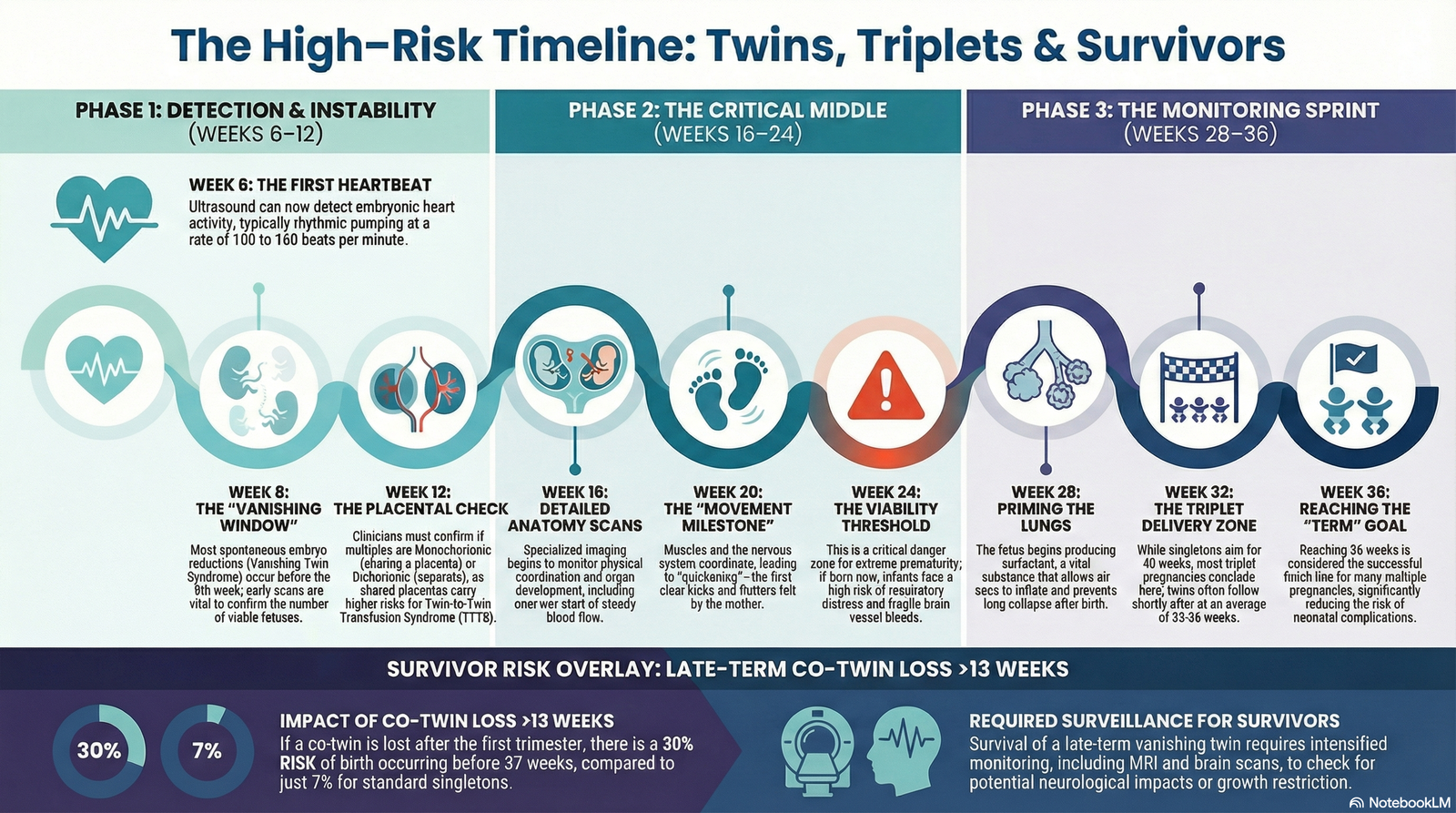
Key milestones and rising risks in twin and triplet pregnancies from early weeks to delivery.
Want help planning high-risk pregnancy care across clinics?
If comparing hospitals, NICU capacity, and specialist teams feels like a full-time job, our advisors can help you understand your options, compare costs, and connect with vetted high risk centers at no cost to you.

Why trust this guide? The OVU commitment
You are probably juggling hope, timelines, and a lot of tabs open in your browser. And you deserve clear, current, human advice. At OVU, we review clinic protocols, compare real quotes, and talk to people who have done this - intended parents and gestational carriers - so we can give you practical steps, not just theory. If you want help comparing options without sales pressure, we will gather itemized quotes and success data that match your exact situation. You decide, we will bring the info to your table.
Frequently Asked Questions
Does the loss of one fetus always harm the survivors?
Not always. When the loss happens early in the first trimester and each fetus has its own placenta, the surviving fetuses and your own health often stay stable. Loss after mid-pregnancy, especially in shared placentas, carries more risk and always needs close specialist care.
What warning signs should I watch for at home?
Call your doctor or go to the hospital if you have strong cramping, heavy bleeding, leaking fluid, a sudden decrease in movements once you know your babies’ usual patterns, a severe headache, vision changes, or pain in your ribs.
Why did one fetus stop growing while the others continued?
The most common reasons are chromosomal problems in that fetus, a weak or abnormal placenta, or a problem with that fetus’s umbilical cord. These are not things you cause through food, exercise, or sex.
Is cerebral palsy more common after a twin or triplet loss?
The risk is slightly higher when a co-twin dies in the second or third trimester, especially in shared placentas. This is one reason your team will increase monitoring if a fetus dies later in pregnancy and may arrange an MRI or ultrasound of the baby’s brain after birth if needed.
Should I consider selective reduction if I am carrying quadruplets?
For very high-order multiples, studies show that reducing to twins lowers the risk of extreme prematurity and some serious complications. This decision is personal and complex. Ask your specialist to walk you through specific numbers for your age, health, embryo quality, and support system.
Can I still plan for a vaginal birth?
For twins, vaginal birth can be safe if the second baby is head down and you and your babies are stable. Triplets and higher order multiples are usually delivered by planned Cesarean section because it is safer for both you and the babies in most situations.
How do doctors confirm that a fetus has “vanished”?
Your early scans show one or more heartbeats. At a later scan, a heartbeat is gone, and the sac has shrunk or is no longer clearly visible. Your doctor compares images over time and uses those changes to make the diagnosis and plan the next steps.
Reference List 9 sources
Journal Article (Research): Petrini AC, Pereira N, Lekovich JP, Elias RT, Spandorfer SD. Early spontaneous multiple fetal pregnancy reduction is associated with adverse perinatal outcomes in in vitro fertilization cycles. Women's Health (London). 2016;12(4):420–426. PMID: 27638897. Available from: https://pubmed.ncbi.nlm.nih.gov/27638897/
Journal Article (Research): Zhou L, Gao X, Wu Y, Zhang Z. Analysis of pregnancy outcomes for survivors of the vanishing twin syndrome after in vitro fertilization and embryo transfer. European Journal of Obstetrics & Gynecology and Reproductive Biology. 2016;203:35–39. PMID: 27236603. Available from: https://pubmed.ncbi.nlm.nih.gov/27236603/
Journal Article (Research): Li J, Li J, Zhang Y, et al. The influence of the vanishing twin on the perinatal outcome of surviving singleton in IVF pregnancy. Frontiers in Endocrinology. 2022;13:832665. PMID: 35370579. Available from: https://pubmed.ncbi.nlm.nih.gov/35370579/
Journal Article (Systematic Review & Meta-Analysis): Li YX, Sun TZ, Lv MQ, et al. Is vanishing twin syndrome associated with adverse obstetric outcomes of ART singletons? A systematic review and meta-analysis. Journal of Assisted Reproduction and Genetics. 2020;37(11):2783–2796. PMID: 32840763. Available from: https://pubmed.ncbi.nlm.nih.gov/32840763/
Journal Article (Systematic Review & Meta-Analysis): Sun L, Jiang LX, Chen HZ. Obstetric outcome of vanishing twins syndrome: a systematic review and meta-analysis. Archives of Gynecology and Obstetrics. 2017;295(3):559–567. PMID: 28097444. Available from: https://pubmed.ncbi.nlm.nih.gov/28097444/
Journal Article (Research): Luke B, Brown MB, Grainger DA, et al. Twin pregnancies with a “vanished” embryo: a higher risk for the surviving twin. Human Reproduction. 2011;26(9):2535–2543. PMID: 21784732. Available from: https://pubmed.ncbi.nlm.nih.gov/21784732/
Journal Article (Research): Anonymous. Clinical outcomes of vanishing twin syndrome and selective fetal reduction on surviving singleton births in IVF pregnancy. European Journal of Obstetrics & Gynecology and Reproductive Biology. 2023;284:58–65. PMID: 37639814. Available from: https://pubmed.ncbi.nlm.nih.gov/37639814/
Committee Opinion (Guidance): Practice Committee of the American Society for Reproductive Medicine. Multiple gestation associated with infertility therapy: a committee opinion. Fertility and Sterility. 2022;117(3):498–511. Available from: https://www.asrm.org/practice-guidance/practice-committee-documents/multiple-gestation-associated-with-infertility-therapy-a-committee-opinion-2022/
Clinical Review (Guidance): Carlson K, Mikes BA. Vanishing Twin Syndrome. StatPearls. Treasure Island (FL): StatPearls Publishing; updated 2025. Available from: https://www.ncbi.nlm.nih.gov/books/NBK563220/
Final Thoughts
Your pregnancy is not just another case on a clinic schedule. It is your family, your body, and your next chapter. A high-order multiple pregnancy with a lost fetus is hard to carry, both physically and emotionally. It is also full of small victories every time a scan looks good or you feel a strong kick.
The love you feel for the baby you lost does not vanish when the sac disappears on the screen. It will always be part of how you became a parent. At the same time, the baby or babies who keep growing deserve every chance you can give them.
Stay close to your medical team. Ask questions until the answers make sense in your own words. Let the people around you help with meals, rides, and appointments. You do not have to be perfect. You only have to keep showing up for yourself and your baby.