


Dr. Sony Sherpa (MBBS)
In addition to her clinical experience, Dr. Sherpa is a published medical researcher and holistic health advocate. Her dual expertise in emergency care and alternative therapies brings a unique lens to medically reviewed content—ensuring it is both accurate and accessible.
If you are exploring surrogacy in the United States, you are probably caught between hope, fear, and urgency. You might already have a long history with infertility treatment, previous failed attempts, or even a pregnancy loss, or years of trying without answers. It can feel like you are stepping into a new world of laws, fees, and medical steps just when you are emotionally exhausted.
At the same time, you are not starting from scratch. The United States has become one of the most structured and successful surrogacy destinations in the world, with many programs reporting overall pregnancy chances of 95% to 99% after two or three embryo transfers in a well-designed journey. Professional bodies such as the American Society for Reproductive Medicine (ASRM) have published detailed guidance on how clinics and agencies should screen surrogates, limit embryo transfers, and protect everyone involved, which gives you a much clearer and safer path than families had even a decade ago.
This guide speaks directly to you. You will see how state laws shape your options, what a realistic total budget looks like, how long the process tends to take, and how agencies and clinics actually work behind the scenes. The goal is not to sell you on surrogacy, but to help you decide whether this route fits your life, your health, and your finances so that you can move forward with real confidence instead of guesswork.
Surrogacy in the United States usually costs between $150,000 and $250,000, and a complete journey often takes about 11 to 15 months from matching with a surrogate to bringing your baby home. Laws vary by state, but many surrogacy-friendly states allow compensated gestational surrogacy for singles, heterosexual couples, and LGBTQIA+ couples, with clear court orders that recognize you as the legal parent or parents.
If you already have good-quality frozen embryos and you work with a reputable agency in a surrogacy-friendly state, you can plan a realistic timeline and budget before you start signing contracts.
What Current Research Shows About Gestational Surrogacy
Recent large studies and guidelines paint a reassuring picture for well-run US surrogacy programs. National registry data and systematic reviews show that gestational carrier pregnancies often have obstetric and newborn outcomes that are as good as, or in some cases better than, other IVF pregnancies, mainly because surrogates are carefully screened and tend to be healthier at baseline.
At the same time, research also highlights avoidable risks. Multiple-embryo transfer increases prematurity and neonatal intensive care unit (NICU) admissions, and outcomes are better when clinics follow ASRM rules on embryo number and medical screening. You can use these findings as a checklist when you evaluate agencies and clinics.
All research citations in this article include PubMed IDs (PMIDs) so that you or your doctor can easily view the original studies.
In This Guide
- Quick Facts: Costs, Timelines, Access
- State Laws and Surrogacy-Friendly States
- Financial Planning and Cost Breakdown
- How to Find and Match With a Surrogate
- Surrogacy Process Timeline
- Insurance and Financial Safety Nets
- Common Concerns and Emotional Realities
- Practical Considerations and Choosing a Team
- Frequently Asked Questions
Most US surrogacy journeys: $150,000–$250,000
Premium guaranteed programs can exceed $300,000
Match, screening, and contracts: 1–2 months
Pregnancy and legal finalization: 10–13 months
Per transfer: about 60–99%
Over 2–3 transfers: often 95–99%
Quick Facts: Why Many Parents Choose the USA for Surrogacy
The United States is one of the most popular surrogacy destinations worldwide. You get access to experienced IVF clinics, strong legal protections in many states, and inclusive programs that welcome single parents and LGBTQIA+ families. The trade-off is cost, which is usually higher than in many other countries but comes with clearer legal and medical structures.
| Feature | Key Data and Explanation |
|---|---|
| Average Total Cost | Most US surrogacy journeys fall between $170,000 and $250,000. Some basic packages that use frozen embryo transfer can start around $90,000, while guaranteed programs that include multiple attempts and donor services can exceed $300,000. |
| Program Type | Gestational surrogacy is the standard in agency-led US programs. The surrogate carries an embryo created with your eggs, donor eggs, your partner’s sperm, donor sperm, or a combination, but she is not genetically related to the baby. |
| Surrogate Compensation | Base pay for US surrogates typically ranges from $30,000 to $90,000. First-time carriers often receive about $45,000–$55,000, while experienced carriers may receive $60,000–$75,000 or more. |
| Timeline | From match to birth and legal finalization, a complete journey usually lasts about 11–15 months, assuming no major medical or legal delays. |
| Access and Inclusivity | Many US programs accept single parents, heterosexual couples, LGBTQIA+ couples, and in some cases HIV-positive parents, depending on state law and clinic policy. |
Latest Research Insights
Finding #1 (2024): A large JAMA Network Open systematic review and meta-analysis of gestational carrier pregnancies found that, compared with non–gestational carrier IVF pregnancies, gestational carrier pregnancies often had equal or better live birth and perinatal outcomes, even though intended parents were often older. The review by Matsuzaki et al. (PMID: 39042408) reported that careful surrogate screening and single-embryo transfer policies contributed to these results. This supports the idea that a well-structured surrogacy program can be both effective and reasonably safe for you and your future child.
Finding #2 (2024): A national-level assessment of gestational carrier pregnancies in the United States showed that gestational carrier cycles now account for a growing share of all ART births and that surrogates tend to have healthier baseline profiles, such as lower body mass index and fewer chronic conditions. Masjedi et al. (PMID: 39565425) linked these factors with strong live birth rates. For you, this means that strict medical selection of surrogates clearly matters for outcomes.
Finding #3 (2024): An analysis of international gestational surrogacy in the United States from 2014 to 2020 found that more than one–third of gestational carrier transfers were for international intended parents and that clinical pregnancy and live birth rates remained high across the study period. Herweck et al. (PMID: 38176517) highlighted that US programs can deliver strong outcomes for both domestic and international families when medical and legal frameworks are aligned. This reassures many parents who are considering flying in for US-based surrogacy.
Finding #4 (2024): A study in the American Journal of Obstetrics and Gynecology looked at gestational carrier cycles between 2014 and 2020 and showed that when clinics followed national guidelines on issues such as embryo number and surrogate screening, perinatal outcomes improved and complications linked to multiple births decreased. Traub et al. (PMID: 38772812) tied guideline compliance to better safety outcomes. This gives you a straightforward question for agencies and clinics: how closely they follow ASRM and related guidance.
Note: These findings come from peer-reviewed research and professional guidelines. Outcomes always depend on your specific medical situation, the surrogate’s health, and clinic practices, so you should review them with your fertility specialist.
State Laws and Surrogacy-Friendly States
Because there is no federal surrogacy law in the United States, everything depends on where your surrogate lives and gives birth. Some states actively support compensated gestational surrogacy with clear statutes. Others rely on case law and long-standing practice. A few still restrict or discourage surrogacy, especially when money changes hands.
If you live in a restrictive state, you can still pursue surrogacy by matching with a surrogate in a more supportive state and working with lawyers who know how to handle cross-border details. What matters most is that the state where your baby will be born has a predictable process for recognizing you as the legal parent or parents.
| State | Gestational Surrogacy Status | Traditional Surrogacy Status | Key Details for Intended Parents |
|---|---|---|---|
| California | Legal; compensated gestational surrogacy allowed. | Legal; not explicitly prohibited. | One of the most established surrogacy states, with statutes and case law (for example, Family Code section 7960) that support clear contracts and pre-birth orders for a wide range of family types. |
| New York | Legal; compensated gestational surrogacy allowed under the Child-Parent Security Act. | Restricted. | The law sets a modern framework for gestational surrogacy, with a Surrogate’s Bill of Rights and clear parentage paths, especially for state residents. |
| Nevada | Legal; compensated gestational surrogacy allowed. | Prohibited. | Nevada law supports gestational surrogacy but does not allow the surrogate to use her own eggs, which keeps arrangements focused on gestational carriers only. |
| Delaware | Legal; compensated gestational surrogacy allowed. | Legal; not specifically restricted. | The Gestational Carrier Agreement Act (2013) gives a step-by-step statutory process for agreements and court recognition. |
| District of Columbia | Legal; compensated gestational surrogacy allowed. | Legal; not expressly prohibited. | A former ban has been replaced with supportive legislation for gestational surrogacy, with protections for both carriers and intended parents. |
| Maine | Legal; compensated gestational surrogacy allowed. | Legal with limits; often confined to certain family relationships. | The Maine Parentage Act sets clear rules for gestational carriers and a narrower path for traditional surrogacy. |
| Rhode Island | Legal; compensated gestational surrogacy allowed. | Typically only allowed on an altruistic basis. | The updated Uniform Parentage Act supports compensated gestational surrogacy while keeping tighter limits on traditional arrangements. |
| Washington | Legal; compensated gestational surrogacy allowed. | Legal. | The revised Uniform Parentage Act (RCW 26.26A) includes detailed requirements for contracts, consent, and court recognition. |
In contrast, states such as Louisiana, Michigan, and Nebraska either restrict or refuse to enforce surrogacy contracts, especially when they involve payment. If you live in those states, you typically work with a surrogate who lives and delivers in a more supportive state while you coordinate legal steps from home.
Financial Planning and Cost Breakdown
It is completely understandable if the price tag is the part that makes your stomach drop. You are not just paying for one procedure. You are paying for the surrogate’s time and health, your agency’s work, multiple medical teams, and legal protection in at least one state. When you see all of the moving parts, the cost starts to make sense, even though it is still a major commitment.
Core Cost Components
Most US surrogacy budgets break down into four main buckets: surrogate compensation and expenses, agency fees, medical and IVF costs, and legal fees.
| Cost Category | Typical Range (USD) | What This Covers |
|---|---|---|
| Surrogate Compensation | $30,000–$79,000 base pay | The surrogate’s base fee for carrying the pregnancy, with additional payments for twins or higher-order multiples and procedures such as Cesarean section. |
| Surrogate Expenses | $10,000–$20,000+ | Monthly allowances, maternity clothing, travel to the clinic, childcare during appointments, and other pregnancy-related costs. |
| Agency Fees | $15,000–$50,000+ | Recruitment, screening, matching, case management, coordination with clinics and lawyers, and rematching if needed, depending on the program. |
| Medical and IVF | $19,000–$30,000 per IVF cycle | Monitoring, medications, egg retrieval, embryo creation, frozen embryo transfer, and laboratory fees. |
| Egg Donation (if needed) | $16,900–$39,000 | Donor matching, donor compensation, donor cycle medications, and donor agency fees. |
| Legal Fees | $4,900–$19,000+ | Gestational carrier agreement drafting and review, background legal work, and pre-birth or post-birth orders to establish parentage. |
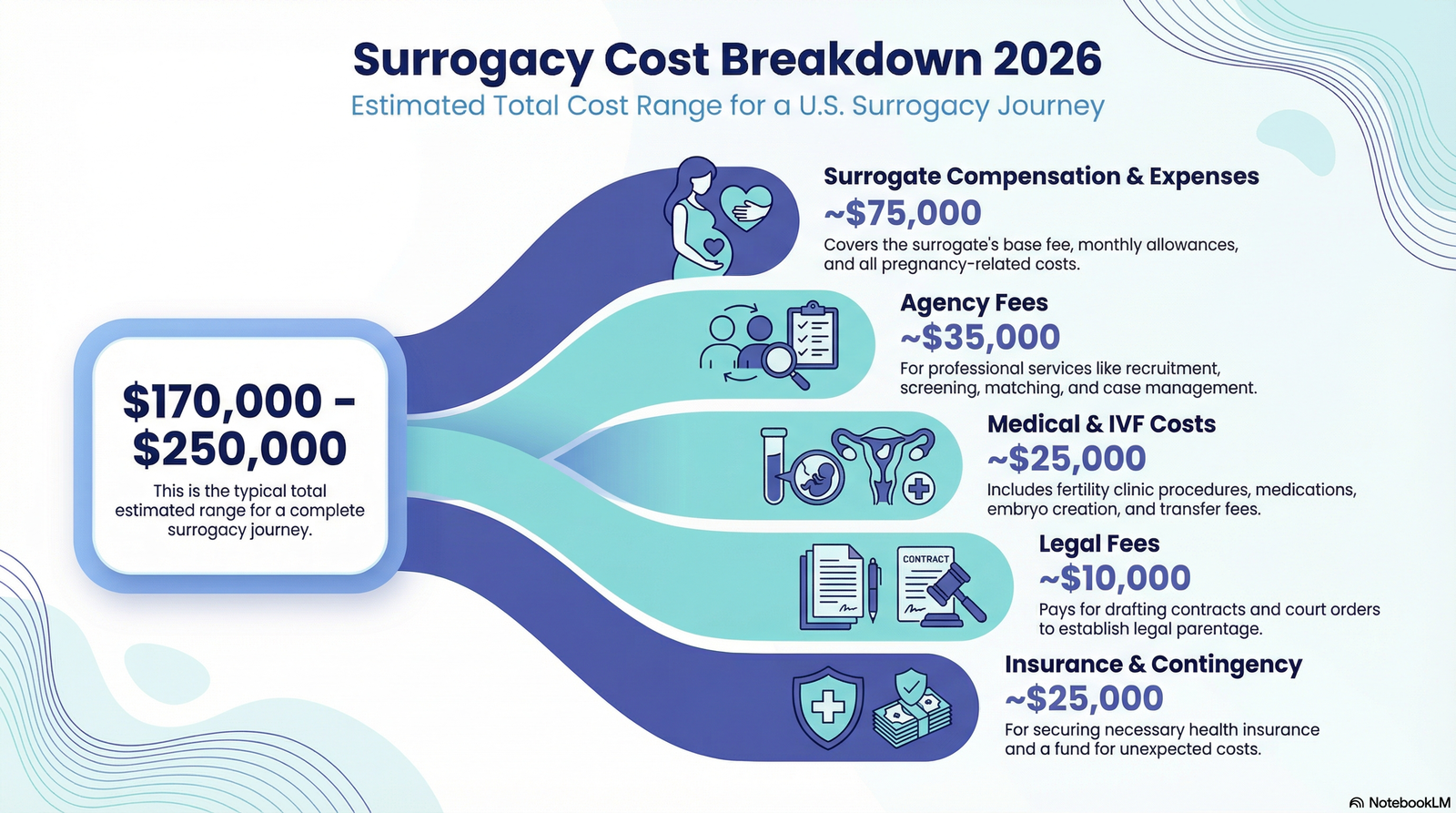
Understanding Where the Money Goes: A typical surrogacy budget breakdown
When you compare basic and premium programs, it helps to look beyond the headline number. A basic package in the $100,000 to $199,000 range might cover just one fresh IVF cycle and one or two transfers. If that first cycle fails, you could spend another $25,000 to $50,000 on a second fresh cycle, which pushes your total cost close to or above the price of a guaranteed package that looked expensive at first glance.
How to Find and Match With a Surrogate
Finding the right surrogate is not just about ticking boxes for age and BMI. You are choosing someone who will carry your baby, attend appointments on your behalf, and share frequent updates about how the pregnancy is going. It is natural to feel nervous before your first meeting.
Surrogate Qualifications and Screening
Good programs follow ASRM-style criteria when they choose surrogates. That usually means:
- Age generally between 21 and the late 30s, sometimes early 40s.
- At least one previous full-term pregnancy with no major complications.
- Limited number of past births and Cesarean deliveries.
- Healthy BMI and no uncontrolled chronic medical conditions.
- Comprehensive medical, infectious disease, and mental health screening.
- Clear legal counseling and independent legal representation.
Background checks and home environment assessments add another layer of safety. You want your surrogate to have a stable support system, a partner or family who understands what she is doing, and solid reasons for becoming a surrogate beyond financial need alone.
The Matching Process, Step by Step
Once you choose an agency, the matching sequence usually looks like this:
- Profile and intake call. You share your story, budget, medical history, and preferences for communication and contact after birth.
- Candidate search. The agency reviews its pool of pre-screened surrogates and identifies candidates who fit your medical, legal, and personal criteria.
- First meeting. You meet your potential surrogate, usually by video call. You talk about expectations, values, and how often you want to communicate.
- Match confirmation and contracts. If both sides agree, lawyers draft contracts, and the clinic completes the final screening before embryo transfer preparation starts.
Some agencies emphasize fast matching and often connect you with a surrogate in 6 to 8 weeks when your criteria are flexible. Others quote 4 to 12 months, with an average of around half a year. The narrower your preferences are, the longer the matching time is.
Surrogacy Process Timeline
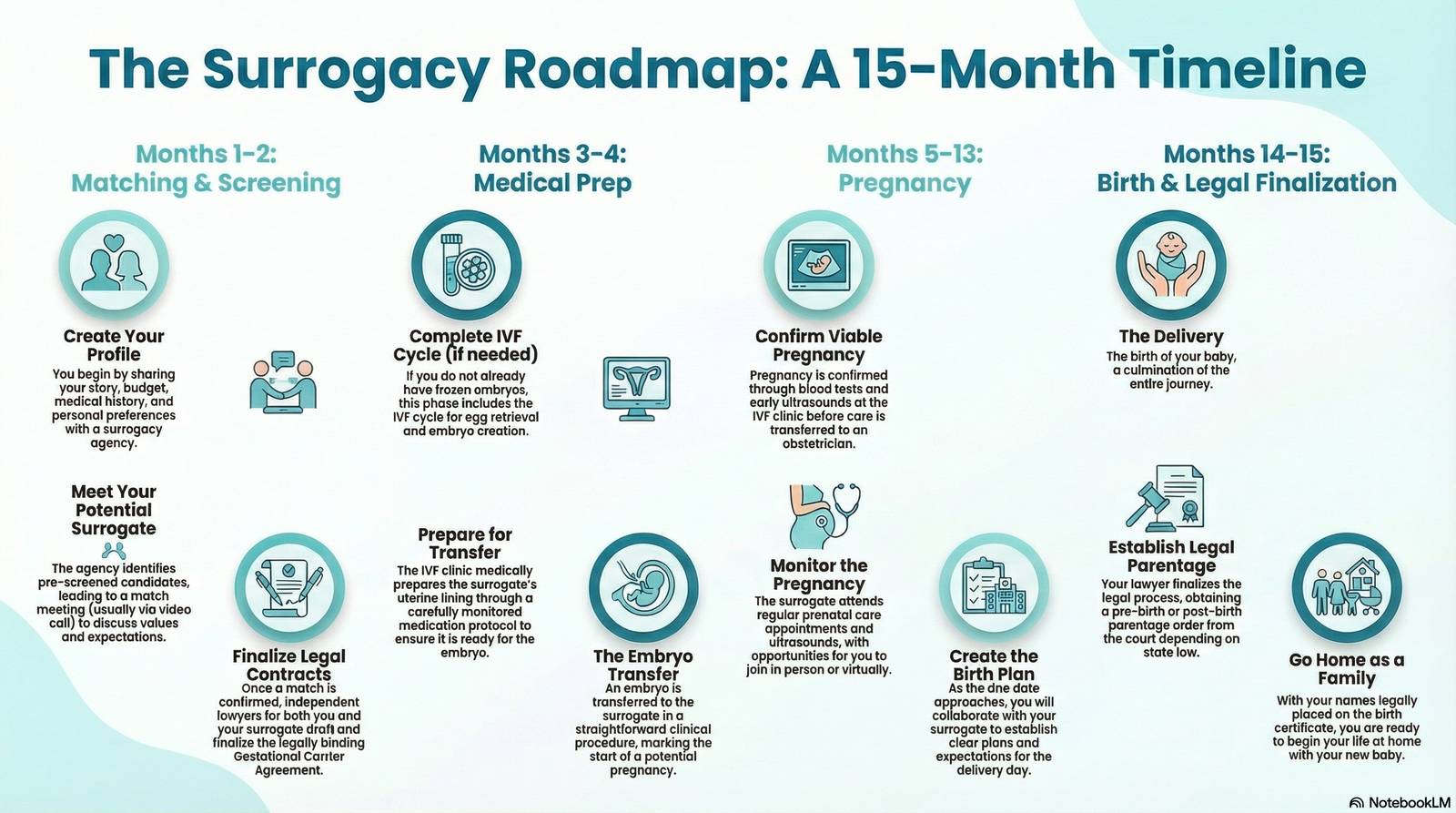
From the moment you sign with an agency until you hold your baby, surrogacy in the USA usually takes about 11 to 15 months, assuming a straightforward pregnancy. You can think of it in three main phases.
Phase 1: Preparation, Matching, and Legal (About 1–2 Months After Match)
- You complete agency intake and clinic consultations.
- Your surrogate finishes medical and psychological screening.
- Lawyers draft and finalize the gestational carrier agreement.
- If you do not have embryos yet, you can complete an IVF cycle or arrange egg donation.
Phase 2: Medical Procedures and Pregnancy (Around 9–10 Months)
- The clinic prepares your surrogate’s uterine lining and schedules the embryo transfer.
- Pregnancy tests and early ultrasounds confirm a viable pregnancy.
- Your surrogate continues prenatal care through an obstetrician, with you joining appointments in person or online when possible.
Phase 3: After Birth and Legal Finalization (About 1–2 Months)
- Your lawyer obtains a pre-birth or post-birth parentage order, depending on state law.
- Your names are placed on the birth certificate.
- If you live abroad, you complete additional paperwork for citizenship and travel.
Insurance and Financial Safety Nets
Insurance is one of the least intuitive parts of surrogacy. Policies use language that can be hard to interpret, and many explicitly exclude surrogacy pregnancies. Sorting this out early protects both you and your surrogate from unpleasant surprises later.
How Surrogacy Interacts With Health Insurance
Most US plans treat IVF and surrogacy as separate issues. Even if your employer covers part of IVF, it might not cover your surrogate’s pregnancy. Many surrogate-owned plans now include clear surrogacy exclusions, which means you need a different policy to cover prenatal care and delivery.
As the intended parent, you usually pay for:
- Insurance premiums and out-of-pocket maximums for a surrogate-friendly plan.
- Deductibles, copays, and coinsurance for pregnancy and delivery.
- Any extra costs for complications such as preterm birth or NICU stays.
Realistic planning often sets aside $10,000 to $36,000 just for insurance-related costs. You may also want a separate cushion of $3,000 to $30,000 or more to handle unplanned events such as extra hospital days or a baby who needs intensive care.
Ways to Reduce Financial Stress
- Employer benefits. Some large companies offer reimbursements for IVF and surrogacy, sometimes up to tens of thousands of dollars in lifetime benefits.
- Tax-advantaged accounts. Flexible Spending Accounts (FSA) and Health Savings Accounts (HSA) can cover certain medical costs with pre-tax funds.
- Local matching. Choosing a surrogate who lives close to your clinic reduces travel and accommodation costs.
- Shared-risk IVF programs. Multi-cycle packages with partial refunds if there is no live birth, spread your risk across several attempts.
Supporting Evidence and Professional Guidance
Finding #1 (2016): A large US registry analysis in Fertility and Sterility compared gestational carrier cycles with non-carrier IVF cycles and reported higher live birth rates per transfer in gestational carrier cycles, but also higher risks of multiple pregnancy-related complications when more than one embryo was transferred. Kissin et al. (PMID: 27087401) emphasized that many risks came from twins and higher-order multiples. This is one reason so many clinics now encourage single-embryo transfer for surrogacy.
Guideline (2022): The ASRM Practice Committee’s recommendations for practices using gestational carriers (source) outline how clinics should screen surrogates, limit embryo numbers, and structure contracts. Programs that follow these guidelines tend to have safer pregnancies and more predictable legal outcomes.
Guideline (2023): The ASRM Ethics Committee opinion on considering the gestational carrier (source) focuses on fully informed consent, independent legal advice, and fair financial arrangements. It is a useful reference when you review agency and clinic policies.
Together, these studies and guidelines suggest that your choice of agency and clinic has a direct impact on safety and outcomes for both your surrogate and your baby.
Common Concerns and Emotional Realities
Gestational vs Traditional Surrogacy
Most agency-led cases in the United States now use gestational surrogacy. Traditional surrogacy, in which the surrogate uses her own eggs, is less common because it is legally and emotionally more complex. If you are considering traditional surrogacy, you should speak with an attorney who has deep experience in that area, because parentage and adoption steps are very different.
Your Relationship With Your Surrogate
Many intended parents worry that they will feel distant from the pregnancy or that their surrogate will feel too attached to the baby. In practice, ongoing contact, regular updates, and clear expectations in the contract help everyone feel grounded. Some families stay close with their surrogate for years; others keep the connection more limited but still friendly and respectful.
If you have lived through pregnancy loss, failed IVF cycles, or a painful infertility diagnosis, it is completely normal to feel both grateful and vulnerable when someone else carries your baby. Many intended parents work with a therapist or support group during the surrogacy process to have a safe place to process these mixed emotions.
Practical Considerations and Choosing a Team
Building Your Team: Key steps in selecting an agency and clinic
Selecting an Agency
Your agency is often your main guide. When you compare agencies, look beyond polished websites and focus on:
- How long they have been operating and how many surrogacy journeys they manage each year.
- How they screen surrogates and how closely they follow ASRM guidelines.
- How transparent their fee structure is, and what is included in each package.
- What happens if a match fails or a pregnancy does not continue.
- How they support you emotionally and logistically throughout the journey.
OVU Insight: How to Use Research When You Compare Programs
You can use the research and guidance discussed earlier as a simple checklist when you interview agencies and clinics. Ask directly how they limit embryo numbers, which screening tests they require for surrogates, and how often they work with your target birth state. Programs that can clearly explain how they align with published ASRM opinions and major studies usually have more robust systems in place and are better prepared to guide you through complex situations.
| Agency Example | Location | Approximate Total Fees | Notable Features |
|---|---|---|---|
| Hatch | California | $160,000–$225,000+ | One of the longest-running surrogacy agencies, with baby guarantee-style programs that cover multiple IVF attempts and donor services until live birth, depending on the specific contract. |
| Circle Surrogacy | Multiple US locations | $157,750–$190,450 | Fixed-fee Journey Protection programs that bundle legal, medical, and agency costs into one package. |
| ConceiveAbilities | Multiple states including CA and IL | $164,900 and up | Personalized matching approach and “All-In” programs with predictable pricing. |
| SurrogateFirst | California | $90,000–$120,000+ | Focus on fast matching and pre-qualified surrogates, with fees that are closely tied to match milestones. |
| Golden Surrogacy | Illinois | $150,000–$225,000+ | Offers guarantee-style programs and reports high clinic approval rates for its surrogates. |
Choosing a Clinic
Your IVF clinic handles embryo creation, genetic testing if needed, and embryo transfer. When you compare clinics, ask about:
- Success rates for patients of your age and diagnosis.
- Experience working with gestational carriers and international intended parents.
- Laboratory capabilities, including PGT and vitrification.
- How they coordinate care with agencies and lawyers.
Many intended parents choose a clinic that has a long-standing relationship with their agency, because that partnership often means smoother communication and fewer surprises around scheduling and billing.
Want help comparing surrogacy clinics and programs?
If this process feels like a second full-time job, our advisors can gather clear, itemized quotes from vetted surrogacy programs in the USA and help you map realistic timelines and budgets based on your situation.

Why trust this guide? The OVU commitment
You are probably juggling hope, timelines, and a lot of tabs open in your browser. And you deserve clear, current, human advice. At OVU, we review clinic protocols, compare real quotes, and talk to people who have done this - intended parents and gestational carriers - so we can give you practical steps, not just theory. If you want help comparing options without sales pressure, we will gather itemized quotes and success data that match your exact situation. You decide, we will bring the info to your table.
Frequently Asked Questions
Who usually considers surrogacy in the United States?
Surrogacy is an option for couples with infertility, single men and women who want to become parents without a partner, and LGBTQIA+ couples who cannot carry a pregnancy themselves. Common reasons include repeated miscarriages, multiple failed IVF transfers, uterine conditions that make pregnancy risky or impossible, and medical problems that make pregnancy unsafe for the intended mother.
What are typical success rates for surrogacy?
When you use a well-screened surrogate, high-quality embryos, and an experienced clinic, each embryo transfer can have a 60% to 99% chance of leading to pregnancy, depending on your age, embryo quality, and other factors. Many structured programs aim for an overall pregnancy likelihood of 95% to 99% after two or three transfers, although results vary by clinic and individual case.
Does traditional surrogacy still happen, and what are the main risks?
Traditional surrogacy still exists, but is much less common than gestational surrogacy in the United States. In traditional surrogacy, the surrogate is the genetic mother, which adds legal and emotional complexity. Parental rights often have to be transferred from her to you, sometimes through adoption, and there is a higher risk of disputes. Many agencies and clinics now work only with gestational surrogacy to reduce these risks.
How much does a first-time surrogate usually receive?
First-time surrogates in the United States typically receive base compensation in the range of $45,000 to $55,000. On top of this, you cover pregnancy-related expenses and additional fees for twins, triplets, or certain procedures such as Cesarean section, as outlined in your contract.
What does IVF surrogacy using my own eggs usually cost?
For a basic one-cycle IVF surrogacy program using your own eggs and your partner’s sperm, many intended parents see total costs in the $100,000 to $199,000 range once you include agency fees, surrogate compensation, legal work, and medical procedures. The IVF portion itself often runs between $19,000 and $30,000 per cycle in US clinics.
Does health insurance cover surrogacy costs?
Most health insurance plans in the United States do not cover the core costs of surrogacy. Your own plan may cover some parts of IVF, but it will usually not pay the surrogate’s compensation or agency fees. Many surrogate-owned policies exclude surrogacy pregnancies entirely. You should plan to pay for a surrogate-friendly insurance policy and out-of-pocket expenses, which may total $10,000 to $36,000 or more.
How much extra should I budget if we have twins or triplets?
Carrying more than one baby increases both medical risks and costs. Many surrogates receive an additional $5,000 to $10,000 for twins and up to $20,000 for triplets on top of their base compensation. Hospital and NICU costs also rise sharply when babies are born early or need intensive care, so you should plan additional funds for those possibilities and discuss embryo transfer strategy carefully with your clinic.
Reference List 7 sources
Journal Article (Systematic Review & Meta-Analysis): Matsuzaki S, Masjedi AD, Mandelbaum RS, et al. Obstetric Characteristics and Outcomes of Gestational Carrier Pregnancies: A Systematic Review and Meta-Analysis. JAMA Network Open. 2024;7(7):e2422634. PMID: 39042408. Available from: https://pubmed.ncbi.nlm.nih.gov/39042408/
Journal Article (Research): Masjedi AD, Mandelbaum RS, Erickson KV, et al. National-level assessment of gestational carrier pregnancies in the United States. Journal of Assisted Reproduction and Genetics. 2025;42(1):201-211. PMID: 39565425. Available from: https://pubmed.ncbi.nlm.nih.gov/39565425/
Journal Article (Research): Herweck A, DeSantis C, Shandley LM, et al. International gestational surrogacy in the United States, 2014–2020. Fertility and Sterility. 2024;121(4):622-630. PMID: 38176517. Available from: https://pubmed.ncbi.nlm.nih.gov/38176517/
Journal Article (Research): Traub AM, Kawwass JF, Kissin DM, et al. Gestational carrier cycles: embryology trends, national guideline compliance, and resultant perinatal outcomes in the United States, 2014–2020. American Journal of Obstetrics and Gynecology. 2024;231(4). PMID: 38772812. Available from: https://pubmed.ncbi.nlm.nih.gov/38772812/
Journal Article (Research): Kissin DM, Kulkarni AD, Mneimneh AS, et al. Trends and outcomes of gestational surrogacy in the United States. Fertility and Sterility. 2016;106(2). PMID: 27087401. Available from: https://pubmed.ncbi.nlm.nih.gov/27087401/
Committee Opinion (Guidance): Practice Committee of the American Society for Reproductive Medicine and the Practice Committee of the Society for Assisted Reproductive Technology. Recommendations for practices using gestational carriers: a committee opinion. Fertility and Sterility. 2022;118(1):65-74. PMID: 35725121. Available from: https://pubmed.ncbi.nlm.nih.gov/35725121/
Ethics Committee Opinion: Ethics Committee of the American Society for Reproductive Medicine. Consideration of the gestational carrier: an Ethics Committee opinion. Fertility and Sterility. 2023;119(5). PMID: 36863967. Available from: https://pubmed.ncbi.nlm.nih.gov/36863967/
Final Thoughts
Surrogacy in the United States asks a lot from you. You invest time, money, trust, and emotional energy long before you see a positive pregnancy test. At the same time, you are not walking into the unknown. When you choose a surrogacy-friendly state, a reputable agency, and an experienced clinic, you are stepping into a system that thousands of families have already used to bring home healthy babies with clear legal parentage.
If you are reading this while feeling scared about costs, worried about new legal words, or grieving earlier losses, that reaction is completely human. You are allowed to feel all of that and still move forward. Take your time to ask hard questions, compare programs, and make sure the people on your team listen to you and respect your limits. Those choices today can make your eventual birth and homecoming feel calmer and more joyful.
Ready to explore your own surrogacy options?
You can start by asking an OVU advisor to map out clinics, agencies, and likely total costs for your situation. A short conversation can turn an overwhelming list of questions into a clear set of next steps.