


Dr. Sony Sherpa (MBBS)
In addition to her clinical experience, Dr. Sherpa is a published medical researcher and holistic health advocate. Her dual expertise in emergency care and alternative therapies brings a unique lens to medically reviewed content—ensuring it is both accurate and accessible.
If you are a gay couple or LGBTQ+ person thinking about having a baby, you are not alone. More male couples, trans people, and queer families are using surrogacy and egg donation every year, and clinics are now creating programs with your family in mind.
You may already imagine the first time you will hold your baby or wonder whose eyes the baby will have. At the same time, you might feel nervous about costs, success rates, legal steps, and the safety of the woman who will carry your child. That mix of hope and worry is a normal feeling.
Recent data indicate that gestational carrier births in the United States have increased by approximately 55% over the past four years. Additionally, live birth rates of around 57% with gestational carriers, compared to 46% with intended parents, have been reported in large donor egg studies. Professional groups such as ASRM now publish detailed guidance on how to choose and care for gestational carriers, and many countries and states have built clear legal routes for gay and LGBTQ+ parents.
Surrogacy for gay couples usually involves donor eggs, IVF with one or both partners’ sperm, and a gestational carrier who has no genetic link to the baby she carries. Total costs often range from $50,000 in lower-cost countries to $175,000 in the United States, with live birth rates in many programs around 50% to 60% per transfer when using healthy donor eggs and a well-screened carrier.
If you want a biological child and live in a place that restricts LGBTQ+ parenthood, surrogacy programs in the USA, Canada, Colombia, Mexico, Cyprus, and Albania offer structured paths that combine medical care, legal protection, and emotional support.
What the Latest Research Shows
Large studies of gestational carrier pregnancies give reassuring news. A review of more than 28,000 surrogate pregnancies found that serious complications were uncommon, and outcomes were similar to or better than other IVF pregnancies. Other research from national IVF databases shows higher live birth rates and lower low birthweight rates when donor-egg embryos are transferred to gestational carriers instead of intended parents.
Guidelines from the American Society for Reproductive Medicine (ASRM) recommend careful medical and psychological screening of carriers, a history of at least one uncomplicated term birth, and strong support for single embryo transfer to reduce the risks of twins. These measures help keep the pregnancy safer for the carrier and your baby.
In This Guide
Around 50–60% per transfer with donor eggs and a gestational carrier in many programs.
12–24 months from the first consultation to the baby’s birth, depending on the country’s legal framework, including the exit process and the clinic.
Costs range from roughly $50,000 in lower-cost destinations to $175,000 in the United States.
How Surrogacy Works for Gay Couples
If you are new to surrogacy, it helps to start with the basics. There are two main models, traditional surrogacy and gestational surrogacy.
In traditional surrogacy, the surrogate uses her own eggs. Her eggs are fertilized with sperm, often through intrauterine insemination (IUI), and she is the genetic mother of the baby. This model can raise difficult legal and emotional questions, so many countries and clinics avoid it.
In gestational surrogacy, which is now the standard in most programs, the surrogate does not use her own eggs. Your clinic creates embryos in the lab using donor eggs and sperm from one or both partners. The embryo is then transferred to a gestational carrier, who carries the pregnancy but has no genetic link to the child.
As a gay male couple, you will also need to choose an egg donor. Some couples look for a donor who resembles the non-genetic father, so the child feels like a visual blend of both of you. Others focus on health history, education, or matching certain traits that matter to them. You can also ask your clinic if it offers a shared or tandem cycle, where some eggs are fertilized with one partner’s sperm and some with the other’s.
Latest Research Insights
57% vs. 46% – Live Birth Advantage: In a large US analysis of donor egg cycles, donor egg embryos transferred to gestational carriers led to live births in about 57% of transfers, compared with about 46% when the same kind of embryos were transferred to intended parents. Babies in surrogate pregnancies were also less likely to be born early or have low birthweight. This suggests that a healthy, well-screened carrier can give your baby a strong start in life. Source: Fertility and Sterility (PMID: 30316434).
2 in 100 vs. 6 in 100 – Serious Complication Rates: A state-wide US study found that about 2 in 100 gestational carrier pregnancies had serious maternal complications, compared with about 6 in 100 other IVF pregnancies. Rates were similar to or better than those of pregnancies in the general population. This reassures you that with proper screening and care, a gestational carrier is not exposed to extreme or unusual risk. Source: Journal of Assisted Reproduction and Genetics (PMID: 33145724).
28,300 Pregnancies – Overall Verdict: A meta-analysis that pooled more than 28,000 surrogate pregnancies concluded that outcomes for gestational carrier pregnancies were slightly better than for other IVF pregnancies and that serious maternal events and deaths were rare. The main drivers of risk were factors linked to IVF and twins, not surrogacy itself. This supports the common advice to use single embryo transfer when possible. Source: JAMA Network Open (PMID: 39042408).
These findings come from peer-reviewed research. Your own risks depend on your health, your surrogate’s health and the clinic, and legal team you choose.
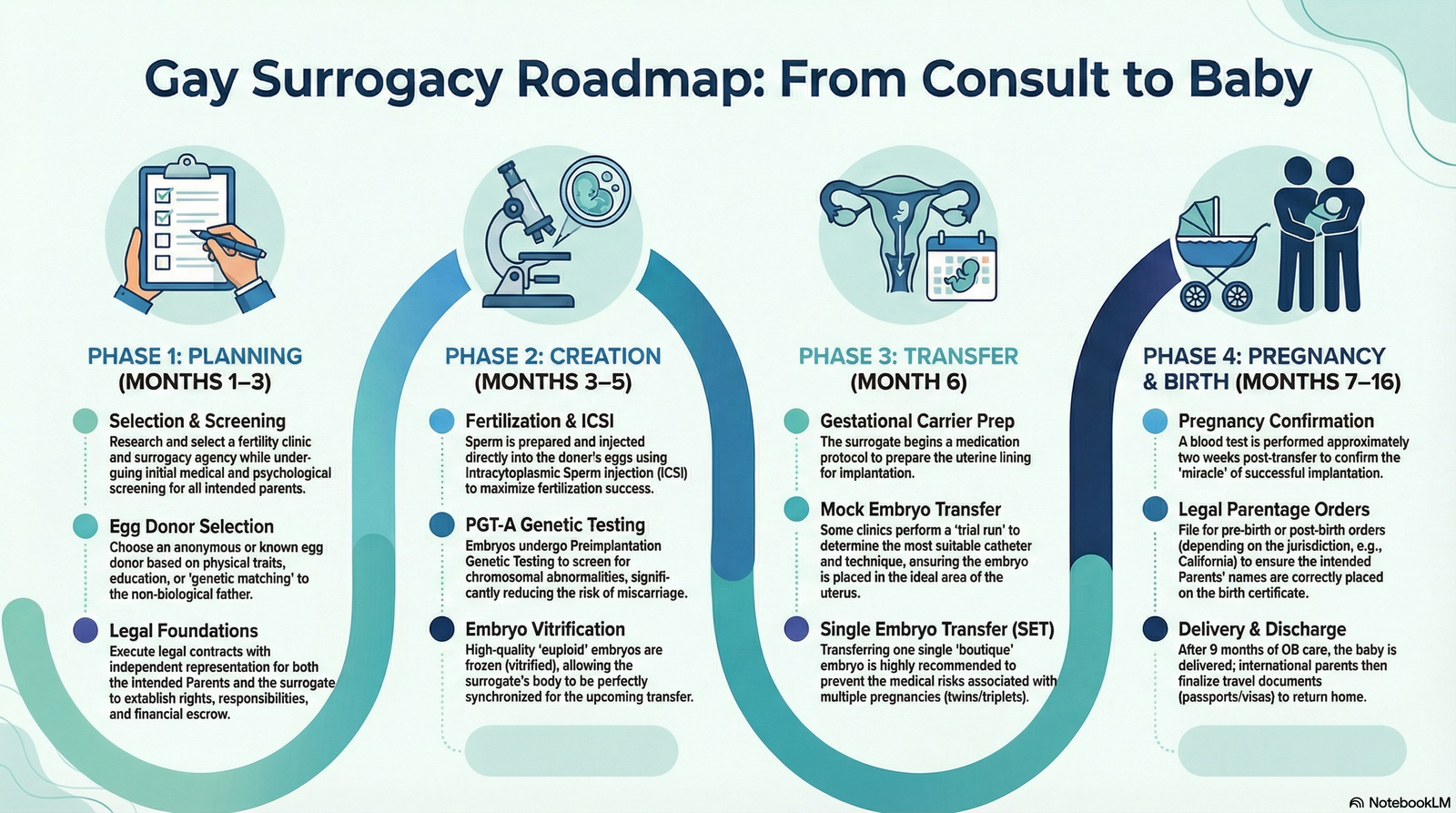
Typical surrogacy timeline for gay couples, from the first consult to your baby’s birth.
Step-by-Step Surrogacy and IVF Process
When you are ready to move from thinking to doing, it helps to see the steps in order. Timelines vary, but most surrogacy plans follow a similar outline.
Step 1: Consults, Screening, and Legal Planning (1–3 months)
You start with calls or video visits with agencies, lawyers, and clinics. During this stage, you choose a clinic, discuss your goals, review costs, and complete your own medical and infectious disease screening. You also meet with a mental health professional to talk through expectations and boundaries.
Your lawyer or agency then drafts contracts for the egg donor and gestational carrier. These contracts set out compensation, medical decisions, contact during and after pregnancy, and what will happen if problems arise.
Step 2: Egg Donor Cycle and Fertilization (1–2 months)
Once your donor is cleared and contracts are signed, she starts IVF medications. Your clinic monitors her egg growth with ultrasounds and blood tests. When the eggs are ready, your doctor retrieves them in a short procedure under sedation.
Your sperm samples are prepared in the lab. An embryologist injects a single sperm into each mature egg using intracytoplasmic sperm injection (ICSI). The lab then grows embryos for several days, checking their cell division and quality.
You can add preimplantation genetic testing (PGT) if you want more information about chromosomes or sex of each embryo, especially if you want to eliminate transferring chromosomally abnormal embryos, or wish to have a child of a specific gender. Your clinic then freezes the embryos while you finalize plans with your gestational carrier.
Step 3: Endometrial Preparation and Embryo Transfer (1 month)
Your gestational carrier starts medications to prepare the lining of her uterus. Nurses track her hormone levels and uterine lining thickness. When her uterus looks ready, the clinic schedules the frozen embryo transfer.
On transfer day, the clinic thaws one or more embryos, loads the chosen embryo into a thin catheter, and your doctor places it gently into the carrier’s uterus. The transfer is usually quick and does not require anesthesia.
Step 4: Pregnancy, Delivery, and Parentage (9–12 months)
About ten to fourteen days after transfer, your carrier takes a blood pregnancy test. If the test is positive, the clinic monitors early development with repeat blood work and ultrasounds. Her regular pregnancy care is taken over by an obstetrician once the pregnancy is stable.
Your legal team files the needed documents for parentage, which may include a pre-birth order, post-birth adoption, or parental order, depending on the country and state. You, your partner, and your surrogate make a plan for delivery and for those first hours with your baby.
Cost Breakdown by Country and Program Type
Cost is often the single biggest source of stress when you think about surrogacy. You deserve clear, realistic numbers so you can plan your budget and avoid surprises.
| Destination | Estimated Cost Range (USD/EUR) | Key Inclusions |
|---|---|---|
| Albania | $50,000 – $70,000 | Basic IVF, surrogate compensation, and standard pregnancy care. |
| Canada | $55,000 – $90,000 | IVF, reimbursed surrogate mother expenses, medical care, and legal fees involved in the altruistic model. |
| Colombia | $60,000 – $119,000 | IVF cycles, surrogate costs, pregnancy care, and post-birth support. |
| Mexico | $60,000 – $75,000 | IVF and embryo transfer, surrogate mother expenses, routine pregnancy care, basic post-partum care; some programs exclude NICU fees or high-risk pregnancy costs. |
| Cyprus (Guaranteed) | €55,000 – €125,000 | Multiple IVF and transfer attempts, donor eggs, options for one or two surrogates. |
| United States | $100,000 – $175,000 | Full agency support, IVF, surrogate compensation, legal work, insurance or medical coverage. |
On top of these package costs, you may see extra line items. Sex selection and extended PGT come with added fees in many clinics. Twin pregnancies with a single surrogate can add a surcharge, and programs that use two surrogates at the same time are usually at the top of the price range.
Safety, Success Rates, and Child Health
You invest a lot of money and trust in this process. It is natural to ask, how safe is this for our surrogate, and what does it mean for our child’s health and future?
The reassuring answer from current data is that gestational surrogacy, when done in line with professional guidelines, looks at least as safe as many other IVF pregnancies. In national and international studies, gestational carriers tend to have lower rates of serious complications than other patients who conceive with IVF, in part because carriers are selected for good health and proven prior pregnancies.
One study of gestational carriers in the United States found that pregnancies that did not follow ASRM guidelines, such as carriers with certain health conditions or more prior caesareans than recommended, had higher rates of caesarean birth, preterm birth, and neonatal complications. This is a strong reason to work only with clinics and agencies that respect these guidelines.
More Evidence on Safety and Risks
4x Higher Risk – Why Guidelines Matter: In one analysis, babies born to carriers who did not meet guideline criteria were nearly four times more likely to need special care after birth, and preterm birth was more common. This underlines why you should insist that your agency and clinic follow ASRM rules on age, medical history, and prior births. Source: Obstetrics and Gynecology (PMID: 32649497).
55% Increase – Surrogacy Is Becoming More Common: A national inpatient study showed that the rate of gestational carrier births rose by 55% over four years in the United States. Gestational carrier births remain rare overall, but this growth means more hospitals and doctors now have hands-on experience with this type of pregnancy. Source: Journal of Assisted Reproduction and Genetics (PMID: 39565425).
10-Year Follow-Up – Children Doing Well: A long-term review of families created through surrogacy found that children had physical health and emotional development similar to children conceived naturally or through other fertility treatments up to ten years of age. Researchers did not see evidence of harm linked to surrogacy as a conception method. Source: Human Reproduction Update (PMID: 26454266).
These studies cannot predict your exact outcome, but they support what many parents and doctors see every day, that well-planned surrogacy can be safe for carriers and healthy for children.
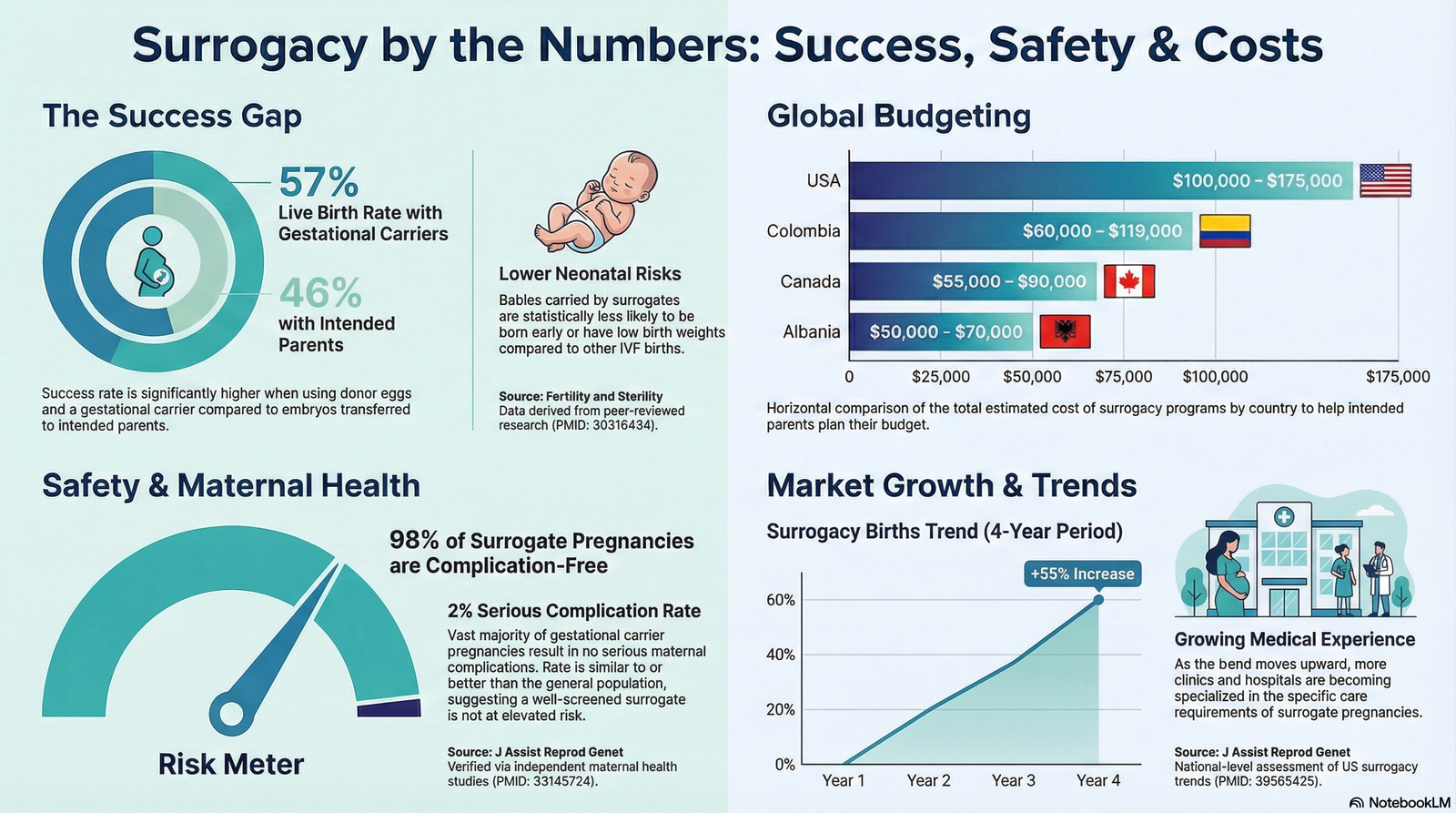
Key numbers for surrogacy for gay couples, including costs, live birth rates and safety data.
Legal Protection and Parentage
The medical plan only works if the law recognizes you as your child’s parents. This is where an experienced surrogacy lawyer is essential.
A legal parent is the person who has the right to live with the child and make decisions about healthcare, school, and day-to-day life. In many surrogacy-friendly US states, courts can name you as legal parents before birth through a pre-birth order. In others, you obtain a parentage order after birth.
If one of you is the genetic father, that person usually becomes a legal parent through a court order or through recognition of genetic parentage. The non-genetic father often completes a second-parent adoption or similar legal step, even if his name already appears on the birth certificate. This can feel repetitive, but it protects your child if you separate or if something happens to one of you.
In countries like the United Kingdom, the surrogate is the legal mother at birth, even when she has no genetic link to the child. Intended parents then apply for a parental order, which transfers legal parentage. In countries without clear surrogacy laws, such as Albania, you will rely on contracts, parentage recognition in another country, and sometimes DNA testing to confirm the link between the child and the genetic father.
Best Countries for Gay Surrogacy
Because laws and attitudes vary, the country you choose shapes your entire experience. Here is a practical overview of popular destinations for gay and LGBTQ+ surrogacy.
United States
The United States remains the main destination for many gay couples. States like California, Connecticut, Nevada, and Oregon have long experience with gestational surrogacy and clear laws that can recognize you as legal parents. You pay more, but you gain strong legal protection, access to high-resource hospitals, and a wide choice of agencies and donors.
Canada
Canada allows only altruistic surrogacy. You do not pay your surrogate a fee, but you can reimburse her for reasonable expenses. Canada is attractive if you want a system that openly supports LGBTQ+ rights and universal health care, and you accept that finding a surrogate can take time because payment is limited to expenses.
Colombia and Mexico
Latin American destinations such as Colombia and some states in Mexico have become important hubs for international gay surrogacy. Colombian law bans discrimination based on sexual orientation, and Mexican law in certain states recognizes gestational surrogacy. Costs are usually lower than in the United States, but laws can change and may differ by region, so local legal advice is vital.
Cyprus and Albania
In Cyprus, some clinics offer guaranteed surrogacy packages that include multiple IVF attempts, donor eggs, and options for one or two surrogates. This appeals if you want a more predictable package price. Albania has no explicit surrogacy law, which allows clinics to work with LGBTQ+ intended parents. Still, your legal team will likely rely on recognition in your home country and contracts drafted under local civil law.
OVU Expert Guidance
One Country or Two – How to Decide: Many gay couples choose to do IVF, egg donation, and surrogacy in the same country to keep things simple. Others create embryos in one country, then ship them to where the surrogate lives. If you value legal clarity above all, a fully in-country program in the United States or Canada may feel safer. If the budget is tight, a carefully structured program in Colombia, Mexico, Cyprus, or Albania can save tens of thousands of dollars, but you will rely heavily on your legal team.
Clinic and Agency Fit: When you compare programs, ask direct questions. How many gay couples have you helped in the last year, and from which countries? Who will be our point person? How do you match carriers and donors? What happens if the first cycles do not work? A good team will answer clearly and will not push you into rushed decisions.
Want help comparing clinics and costs?
If this feels like a full-time job, and it often does, our advisors can collect clear, itemized quotes from verified surrogacy clinics, explain legal options in plain language, and help you map a realistic timeline at no cost to you.

Why trust this guide? The OVU commitment
You are probably juggling hope, timelines, and a lot of tabs open in your browser. And you deserve clear, current, human advice. At OVU, we review clinic protocols, compare real quotes, and talk to people who have done this - intended parents and gestational carriers - so we can give you practical steps, not just theory. If you want help comparing options without sales pressure, we will gather itemized quotes and success data that match your exact situation. You decide, we will bring the info to your table.
Frequently Asked Questions
Can both of us be biologically related to the child?
For one baby, only one of you can be the genetic father. One sperm fertilizes one egg. If you want a genetic connection for both of you, ask your clinic about a shared or tandem cycle. In that approach, half of the donor eggs are fertilized with one partner’s sperm and half with the other’s. If embryos from both partners implant, you could have twins who are half-siblings and share the same birth year.
Is surrogacy safe for the woman carrying our child?
When programs follow professional guidelines and choose carriers with healthy medical histories and at least one prior uncomplicated term birth, risk is similar to or lower than that of many other IVF pregnancies. Studies show that serious complications in gestational carriers are uncommon. To reduce risk further, most clinics recommend single embryo transfer because twin pregnancies carry a higher chance of high blood pressure, early delivery, and bleeding.
What if the surrogate changes her mind and wants to keep the baby?
This fear is common, but in gestational surrogacy, it is rare. The carrier is not the genetic mother, and she has been through counselling and legal contracts before starting medications. In surrogacy-friendly US states and in well-structured international programs, courts usually recognize you as the legal parents as long as the process follows local law and the contract. A good lawyer will explain how this works in your chosen country or state and build in as much protection as possible.
How do we choose between an anonymous or an open egg donor?
An anonymous donor shares medical and personal information with you, but you do not learn her full identity. An open identity donor agrees to the possibility of contact once your child reaches a certain age, often eighteen. Because modern DNA testing can reveal family links even when you do not plan it, many experts suggest that you think about what level of openness will feel honest and manageable for your family in the long term.
What is a “vanishing twin”, and should we worry if it happens?
A vanishing twin happens when early ultrasound shows two sacs or heartbeats, but later scans show only one growing baby. The second sac stops developing and is reabsorbed. This occurs in roughly 10% to 20% of early twin pregnancies. It can be emotionally hard if you were excited about twins, but most of the time, the remaining baby grows normally. Your doctor will explain what they see on each scan and what it means.
Will our child be healthy if we use frozen embryos?
Frozen embryo transfer is now common and has led to many healthy children. Some studies show that certain pregnancy complications, such as high blood pressure in pregnancy, may be slightly more frequent with frozen transfers than with fresh ones, but overall success rates and child health remain good. Your fertility doctor and obstetrician can talk through the pros and cons of a frozen cycle in your situation.
How and when should we tell our child about their birth story?
Most specialists and experienced parents recommend that you talk about surrogacy and egg donation from a young age, using simple, honest language. For a toddler, you might say, “Two dads needed help from a kind woman to carry you, and she helped us so you could be born.” As your child matures, you can provide more information about the egg donor, the surrogate, and the sperm used. Many families use storybooks about donor conception and surrogacy to support these conversations.
Reference List 9 sources
Journal Article (Research): Kroon B, Kawwass JF, et al. Donor oocyte embryo transfer to gestational carriers versus intended parents: reproductive and neonatal outcomes in US cycles. Fertility and Sterility. 2018;110(6). PMID: 30316434. Available from: https://pubmed.ncbi.nlm.nih.gov/30316434/
Journal Article (Systematic Review & Meta-Analysis): Matsuzaki S, Masjedi AD, Anderson ZS, et al. Obstetric characteristics and outcomes of gestational carrier pregnancies: a systematic review and meta-analysis. JAMA Network Open. 2024;7(7):e2422634. PMID: 39042408. Available from: https://pubmed.ncbi.nlm.nih.gov/39042408/
Journal Article (Research): Swanson K, Einerson BD, et al. Severe obstetric morbidity among women who are gestational carriers. Journal of Assisted Reproduction and Genetics. 2021;38(3):661-667. PMID: 33145724. Available from: https://pubmed.ncbi.nlm.nih.gov/33145724/
Journal Article (Comparative Study): Swanson K, Letourneau JM, Kuppermann M, Einerson BD. Association of obstetric and neonatal outcomes with deviation from guidelines for gestational carriers. Obstetrics and Gynecology. 2020;136(2):387-393. PMID: 32649497. Available from: https://pubmed.ncbi.nlm.nih.gov/32649497/
Journal Article (Research): Masjedi AD, Mandelbaum RS, Erickson KV, et al. National-level assessment of gestational carrier pregnancies in the United States. Journal of Assisted Reproduction and Genetics. 2025;42(1):201-211. PMID: 39565425. Available from: https://pubmed.ncbi.nlm.nih.gov/39565425/
Journal Article (Comparative Study): Pavlovic Z, Hammer KC, Raff M, et al. Comparison of perinatal outcomes between spontaneous vs commissioned cycles in gestational carriers for single and same-sex male intended parents. Journal of Assisted Reproduction and Genetics. 2020;37(4):953-962. PMID: 32130614. Available from: https://pubmed.ncbi.nlm.nih.gov/32130614/
Committee Opinion (Guidance): Practice Committee of the American Society for Reproductive Medicine; Practice Committee of the Society for Assisted Reproductive Technology. Recommendations for practices using gestational carriers: a committee opinion. Fertility and Sterility. 2022;118(1):65-74. PMID: 35725121. Available from: https://pubmed.ncbi.nlm.nih.gov/35725121/
Journal Article (Review): Amorado P, Magann EF, Phillips AM, et al. Is a surrogate pregnancy a high-risk pregnancy. Obstetrical and Gynecological Survey. 2021;76(5):302-309. PMID: 34032862. Available from: https://pubmed.ncbi.nlm.nih.gov/34032862/
Journal Article (Systematic Review): Söderström-Anttila V, Wennerholm UB, Loft A, et al. Surrogacy: outcomes for surrogate mothers, children and the resulting families, a systematic review. Human Reproduction Update. 2016;22(2):260-276. PMID: 26454266. Available from: https://pubmed.ncbi.nlm.nih.gov/26454266/
Final Thoughts
Choosing surrogacy as a gay couple or LGBTQ+ person is a big step. It asks you to face money, medical details, law, and emotion all at once. It is also a clear statement that you believe your family is worth this effort and that your future child deserves a safe, planned arrival.
You do not need to have every answer before you start. Your first job is to choose the right partners: a clinic that respects you, an agency and legal team that understand both LGBTQ+ law and surrogacy, and a carrier who feels like a good fit for your values. From there, each phase, the paperwork, genetic testing, embryo creation, and pregnancy care, is another step toward meeting your child.
If you feel overwhelmed, remember that many parents have stood where you stand now. They also worried about costs, visas, hospital rules, and reading every small line in a contract. Today, they are packing school lunches, singing bedtime songs, and explaining to curious little faces that they were so wanted that it took a whole team to bring them into the world. You deserve that chance too.
Ready to explore your options with a real person?
If you want someone to walk through country choices, budgets and clinic options with you, you can schedule a free call with an OVU advisor. Together you can turn a confusing set of choices into a clear, step-by-step plan toward your baby.