


Dr. Sony Sherpa (MBBS)
In addition to her clinical experience, Dr. Sherpa is a published medical researcher and holistic health advocate. Her dual expertise in emergency care and alternative therapies brings a unique lens to medically reviewed content—ensuring it is both accurate and accessible.
Choosing surrogacy is usually the result of a long, emotionally challenging path to parenthood. Infertility, recurrent miscarriages, or health conditions that make pregnancy impossible or unsafe can leave you exhausted and heartbroken in the end. If this is where you find yourself, surrogacy can offer a very real path to the child you have been hoping for.
At the same time, you face a maze of rules. Some countries ban surrogacy, some allow only altruistic arrangements, and others run tightly regulated commercial programs. In a recent national US analysis, only about 1.9 percent of assisted reproductive technology cycles used a gestational carrier, yet those cycles showed higher live birth rates per transfer than non–carrier cycles and a higher risk of preterm birth and multiple gestation. That combination of promise and risk is exactly why the legal framework matters so much.
Professional bodies such as the American Society for Reproductive Medicine (ASRM) and the ESHRE Ethics Committee now publish detailed guidance on who can be a gestational carrier, how clinics should screen candidates, and how to protect surrogates and children. This guide pulls those legal and ethical threads together so you understand where surrogacy is legal, who qualifies, what it costs, and how parentage and citizenship are handled across borders.
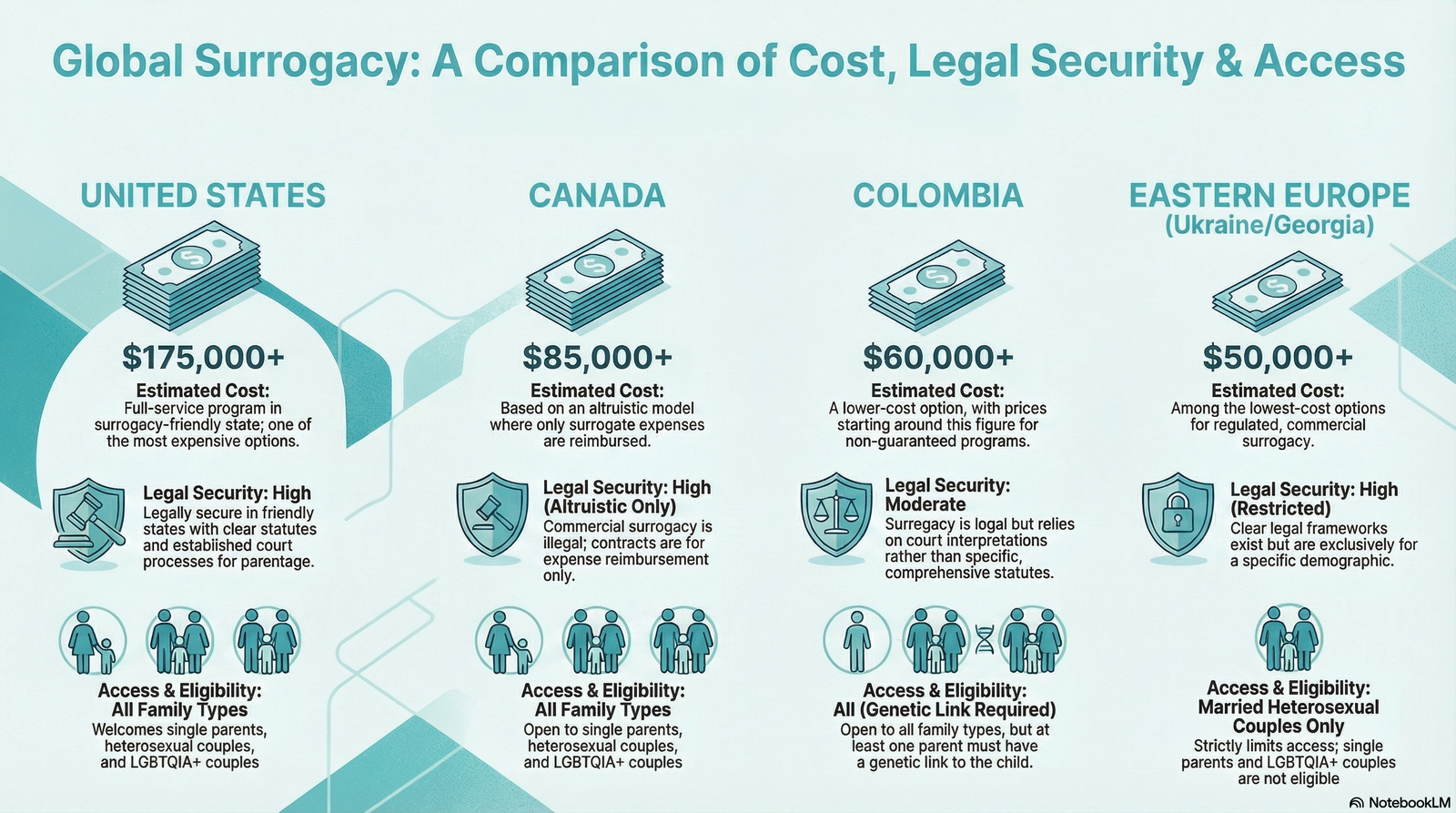
Surrogacy is fully legal and regulated in only a limited set of countries and US states. Some, like parts of the United States, permit commercial gestational surrogacy for singles, heterosexual couples, and LGBTQIA+ couples. Others, such as Canada and Greece, allow only altruistic gestational surrogacy with strict medical criteria. Many countries ban surrogacy entirely or leave it unregulated, which shifts the burden to adoption law. Typical total costs range from about $50,000 in lower cost destinations to $175,000 to $250,000 or more in top US programs.
Your safest route is to combine a legally supportive jurisdiction with an experienced clinic and legal team who understand cross-border parentage and citizenship rules.
What the latest research shows
Large US and international datasets now treat gestational carrier pregnancies as a distinct category within assisted reproduction. National level analyses have found that gestational carrier cycles have higher implantation and live birth rates than non-carrier cycles, but they also show higher odds of multiple gestation, placental complications, late preterm birth, and postpartum hemorrhage in singleton pregnancies.
Recent population-based work from Canada has also shown that gestational carriers have a higher incidence of new-onset mental illness during pregnancy and in the years after birth than women with unassisted or standard IVF pregnancies. Professional guidelines respond to these findings by insisting on careful medical and psychological screening and limiting the number of embryo transfers.
These legal frameworks, clinical guidelines, and outcome data are already reflected in this guide. Your responsibility is to decide which jurisdictions and program types align with your family, budget, and risk tolerance.
In This Guide
Three main models: full ban, altruistic only, and regulated commercial gestational surrogacy.
Lower-cost programs start at $50,000. Full-service US programs often reach $175,000 to $250,000 or more, depending on many factors.
Some destinations accept singles and LGBTQIA+ couples. Others restrict access to married heterosexual couples only.
Global Surrogacy Overview: Legal, Illegal, and Grey Zones
Your options depend on two questions. First, is surrogacy legal at all in the country you are looking at? Second, if it is legal, does the law allow commercial compensation, or only reimbursement of reasonable costs?
| Country / Region | Status | Type Allowed | Who Qualifies |
|---|---|---|---|
| United States (friendly states) | Legal, regulated by state | Gestational, commercial in many states | Singles, heterosexual couples, and LGBTQIA+ couples |
| Colombia | Legal | Altruistic gestational only | Singles, heterosexual couples, and LGBTQIA+ couples with genetic link |
| Canada | Legal | Altruistic gestational only | Singles, heterosexual couples, and LGBTQIA+ couples |
| Greece | Legal | Altruistic gestational only | Single women, married or unmarried heterosexual couples |
| Cyprus | Legal for residents | Non-commercial gestational only | Primarily citizens and residents |
| Armenia / Georgia / Ukraine | Legal | Commercial gestational | Married heterosexual couples only |
| Andorra / Bosnia & Herzegovina / Albania | Unregulated | Practical access varies by clinic | Depends on clinic; Albania often accepts singles and LGBTQIA+ couples |
| Austria / Croatia / Finland | Illegal or prohibited | None | None |
Some countries state very clearly that surrogacy is illegal. Others never mention it, which leaves you and your lawyer trying to use adoption law and general contract law to piece together a solution. Here is how the main groups break down.
Countries that ban surrogacy
Austria, Croatia, and Finland treat surrogacy as prohibited. In Austria, the Law on Reproductive Medicine bans both gestational and traditional surrogacy. In Croatia, surrogacy is forbidden under the law on medically assisted reproduction and everyone involved, including donors, can face criminal penalties. In Finland, the assisted fertility law blocks treatment if the child is intended to be handed over to someone else, and agencies that arrange surrogacy risk fines or prison.
Unregulated “grey zone” destinations
In Andorra, Bosnia and Herzegovina, and Albania, you will not find a clear surrogacy statute. That does not mean clinics never offer surrogacy. It means parentage and citizenship depend heavily on how judges and government offices interpret general family law.
Albania is a good example. The Family Code does not refer to surrogacy, bans same-sex marriage, and yet some private programs accept heterosexual couples, single parents, and same-sex couples. In those cases, only one partner in a same-sex couple can adopt the child, and you rely on a patchwork of local court decisions.
Altruistic–only systems
Canada, Colombia, Greece, Cyprus, and Portugal allow surrogacy but only in an altruistic form. In these countries, you reimburse your surrogate for expenses, rather than paying a fee.
In Canada, you reimburse documented pregnancy-related costs, which often come to $16,000 to $36,000 Canadian dollars. Paying a fee or paying an agency to recruit surrogates can be a crime. In Greece, the law allows reimbursement for IVF, pregnancy, delivery expenses, lost income, and damages, but sets a hard cap of €10,000. Cyprus and Portugal apply similar logic, though eligibility rules in Portugal are among the narrowest in Europe.
Latest Research Insights
Finding #1 (2025, USA – National Inpatient Data): A national cross-sectional study of 14.3 million deliveries identified 1,965 gestational carrier (GC) pregnancies (13.7 per 100,000 births), with a 55% increase in GC prevalence from 2017–2020. Compared with non-GC pregnancies, GC pregnancies had substantially higher odds of multiple gestation (14.7% vs 1.8%; adjusted odds ratio [aOR] 7.83, 95% CI 6.54–9.38), placental abruption (3.5% vs 1.1%; aOR 2.98, 95% CI 2.12–4.19), low-lying placenta (1.6% vs 0.2%; aOR 5.14, 95% CI 3.10–8.52), and postpartum hemorrhage (12.4% vs 4.2%; aOR 2.72, 95% CI 2.25–3.29), but similar severe maternal morbidity overall (PMID: 39565425). This shows that while GC pregnancies are generally well-selected and closely monitored, they carry distinct obstetric risks that need to be built into counselling, contracts, and legal protections.
Finding #2 (2024, Global – Systematic Review of GC Pregnancies): A JAMA Network Open systematic review and meta-analysis synthesized data on obstetric outcomes in gestational carriers versus non-GC pregnancies. GC pregnancies showed higher rates of multifetal gestation and some placental complications, but severe maternal morbidity remained low and comparable to non-GC IVF pregnancies when care followed established screening and embryo transfer limits (PMID: 39042408). For patients and lawmakers, this reinforces that risks are real but manageable when medical and legal standards are enforced.
Finding #3 (2016, USA – ART Surveillance 1999–2013): An analysis of 2,071,984 ART cycles found 30,927 cycles (1.9%) used a gestational carrier, increasing from 1.0% of cycles in 1999 to 2.5% in 2013. GC cycles using non-donor oocytes had higher implantation (aRR 1.22, 95% CI 1.17–1.26), clinical pregnancy (aRR 1.14, 95% CI 1.10–1.19), and live birth (aRR 1.17, 95% CI 1.12–1.21) than non-GC cycles, but also higher preterm birth and multiple birth when more than one embryo was transferred (PMID: 27087401). This is a core “numbers” paper showing why intended parents are drawn to surrogacy (higher success per transfer) and why embryo transfer limits are crucial in any regulatory framework.
Finding #4 (2025, Canada – New-Onset Mental Illness in GCs): A population-based cohort of 767,406 pregnancies (758 GC, 17,916 IVF, 748,732 unassisted) without prior mental illness found new-onset mental illness rates of 6.9 per 100 person‑years in GCs versus 5.2 (unassisted) and 5.0 (IVF). Adjusted incidence rate ratios showed a 43% higher risk vs unassisted conception (adjusted IRR 1.43, 95% CI 1.26–1.63) and 29% higher risk vs IVF (adjusted IRR 1.29, 95% CI 1.13–1.47) (PMID: 40711788). For patient-facing content and legal guidance, this underlines that psychological support and long-term mental health follow-up for surrogates are not “nice to have” – they are evidence-based safety requirements.
Note: These findings represent recent peer-reviewed research and guidance. Actual outcomes depend on individual medical, legal, and psychosocial factors. Always discuss these data with your fertility specialist and, where relevant, a reproductive law attorney in your jurisdiction.

Gestational surrogacy timeline, from legal preparation and matching to IVF, pregnancy, and parentage orders.
United States Surrogacy Laws by State
The United States is not one legal system when it comes to surrogacy. Each state sets its own rules. Some states actively welcome gestational surrogacy, others make it difficult, and a few ban it outright.
In supportive states, courts issue parentage orders that list you as the legal parents on the birth certificate. In restrictive states, contracts can be void and paid surrogacy can be a crime. If you live in a restrictive state, you often work with a clinic and a surrogate in a different state and then manage recognition when you return home.
Surrogacy–friendly states
California, Connecticut, Delaware, the District of Columbia, Maine, New Hampshire, Nevada, Oregon, Rhode Island, and Washington are commonly considered surrogacy–friendly states. They accept gestational surrogacy contracts and, in many cases, welcome single parents and LGBTQIA+ parents as well as heterosexual couples.
States that restrict or ban surrogacy
Michigan and Nebraska treat surrogacy contracts as unenforceable and attach criminal penalties to commercial agreements. Louisiana applies narrow criteria that rule out many common gestational carrier arrangements. If you live in one of these states, you should not try to run a surrogacy journey there. Instead, you work with a surrogacy–friendly state and then consult an attorney on recognition and adoption steps at home.
Surrogacy Costs and Contract Essentials
Once you know where surrogacy is allowed for you, the next hard question is the cost. Surrogacy is one of the most expensive family-building options. The total bill depends on the country, program type, whether you need donor eggs, how many embryo transfers you attempt, and whether any medical complications occur.
Agency–assisted vs independent surrogacy
You can either work with a full-service agency that matches you with a pre-screened surrogate and coordinates the whole process, or you can work independently with your own lawyers and clinic. The agency route offers convenience and reduced complexity but generally comes at a higher cost. The independent route, while requiring more direct management of logistics, may allow for greater control and potential budget savings.
| Feature | Independent Surrogacy | Agency Assisted Surrogacy |
|---|---|---|
| Typical cost | Around $15,000 to $79,000 USD in straightforward cases when you already have embryos and work locally | Often $90,000 to $300,000+ USD including agency fees, IVF, medications, legal, insurance, and travel |
| Agency fee | No agency fee, you handle recruitment and screening | Agency fees commonly start around $30,000 USD |
| Risk and workload | Higher personal risk and time commitment, you coordinate screening, legal, and logistics | Agency manages screening, matching, and coordination, but you pay for the support |
Destination by destination cost ranges
Cost estimates vary between clinics and change over time, but you can use these ranges for planning.
- United States: A realistic total for a full-service gestational carrier program with one successful pregnancy often falls between $175,000 and $250,000 USD. Some simple cases can start around $75,000 USD, but you should budget for higher figures once you include repeated IVF cycles, legal fees, any medical complications, and neonatal care if needed.
- Colombia: Non-guaranteed surrogacy programs start at $60,000 USD. Guaranteed programs with a local egg donor average around $71,000 USD. Sibling programs with two surrogates can reach $125,900 to $139,000 USD.
- Mexico: Non-guaranteed programs usually cost between $56,000 and $60,000 USD. Guaranteed live birth packages range from about $70,900 to $79,900 USD.
- Canada: You might see total budgets between roughly $58,769 and $120,369+ Canadian dollars once you include IVF, reimbursement of expenses, legal work, and travel.
- Greece: Many journeys run between $50,000 and $100,000 USD. A single-attempt IVF surrogacy program commonly starts around $50,000 USD.
- Albania: Programs advertised between €50,000 and €100,000 are common, with lower prices possible in semi-altruistic arrangements where surrogates receive minimal compensation.
- UAE: Initial estimates put complete journeys in the $39,000 to $69,000 USD range, with final totals depending on cycles, medications, and any complications.
What your contract should include
Wherever you go, your contract needs to spell out who does what, how decisions are made, and how parentage will be finalized. Each party should have separate legal representation who knows surrogacy law in that jurisdiction.
- Roles and responsibilities: The agreement should clarify expectations for the surrogate and intended parents, including communication, lifestyle expectations that are lawful, and what happens if someone breaches the contract.
- Medical decisions: You should agree on how to handle prenatal testing, mode of delivery, and who is present at the birth. Emergency scenarios, such as early induction or C-section, need to be covered.
- Reduction and termination: Discuss multiple pregnancy, selective reduction, and termination for medical reasons before embryo transfer. In some countries, such as Colombia, only medically indicated procedures are allowed, and the surrogate cannot choose elective reduction on her own.
- Surrogate autonomy: Laws in countries such as Portugal and Mexico protect the surrogate mother from clauses that strip her of basic rights or expose her to unreasonable health risks. Your contract should align with those rules, not try to override them.
If you feel weighed down already by all these moving pieces, that feeling is normal. The legal and financial side of surrogacy often feels like a second full-time job on top of your existing life.
Indicative cost ranges for surrogacy programs in the United States, Canada, Mexico, Colombia, Greece, Albania, and the UAE.
How Parentage and Birth Certificates Work
The most important legal question in surrogacy is simple to ask, but not always simple to answer: who is the legal mother and father of your child once they are born. The answer depends on the kind of surrogacy you use and the country where your baby is delivered.
Gestational surrogacy and parentage
In gestational surrogacy, your surrogate carries an embryo that was created with your gametes or donor gametes. She has no genetic link to the child. That biological fact makes it easier for many legal systems to treat you as the legal parents from birth.
- Cyprus: The intended mother and intended father are recorded as the legal parents. The surrogate has no parental standing on the birth certificate.
- Greece: A court order is issued before the IVF cycle. That order sets your legal parentage from the start, so the civil registry lists your names at birth.
- Georgia and similar systems: Only the intended parents appear on the birth certificate. Surrogates do not have the option to keep the child.
Traditional surrogacy and adoption
In traditional surrogacy, the surrogate uses her own egg and is the genetic mother. Many countries automatically treat the woman who gives birth as the legal mother. That is why adoption or parentage transfer procedures are common after traditional surrogacy, even if a foreign birth certificate lists you as the parents.
- Austria: The woman who gives birth is the mother-in-law. Adoption is the route to transfer parentage in rare, allowed situations.
- Belgium: The birth mother remains the legal mother until the intended mother adopts the child, even if the surrogate is not the genetic mother.
- Finland: The surrogate is recognized as the legal mother. Intended parents use the Finnish Adoption Act to adopt the child.
- Denmark: The surrogate is the legal mother, and intended parents must follow regulated adoption or parentage recognition routes that comply with international conventions.
Dealing with foreign birth certificates
If your baby is born abroad, you must bring your child home with both a valid passport and a legal link to you. That process can be smooth or very painful, depending on whether your home country accepts the foreign birth certificate and surrogacy judgment.
- Countries such as Austria, Croatia, Denmark, and Bosnia and Herzegovina often refuse to recognize foreign birth certificates from surrogacy that list intended parents in place of the birth mother.
- In Belgium, courts sometimes recognize foreign surrogacy parentage in the child’s best interests, especially when there is no realistic route to undo the arrangement.
- In Canada, most provinces have clear routes for registering children born abroad through surrogacy once you supply court orders and DNA evidence, where required.
Health and Mental Health Risks for Gestational Carriers
When you picture your baby in someone else’s body, you naturally worry about her health too. You are right to treat that concern as central, not secondary. Research now offers a clearer picture of the risks your surrogate takes on.
Obstetric risks identified in large datasets
The National and systematic review data highlight a consistent pattern. Compared with general obstetric populations, gestational carrier pregnancies show:
- Much higher rates of multiple gestation are strongly linked to the number of embryos transferred.
- Higher odds of placental abruption, low-lying placenta, and other placental abnormalities.
- More late preterm births in singleton pregnancies.
- Higher rates of postpartum hemorrhage in singleton gestational carrier births.
At the same time, severe maternal morbidity rates overall remain similar when carriers are chosen carefully and managed in high-quality obstetric units. The goal is not to frighten you but to help you understand why modern guidelines insist on single embryo transfer and strict medical criteria for surrogates.
Guidelines, Cross-Border Trends & Risk Controls
Guideline (2022, ASRM – Clinical Framework for GC Programs): The American Society for Reproductive Medicine’s 2022 committee opinion on practices using gestational carriers (PMID: 35725121) recommends stringent medical screening of carriers, documented informed consent about obstetric risks (including preterm birth and hemorrhage), psychological evaluation, and a strong preference for single-embryo transfer. Clinically, this codifies many of the safeguards that high‑performing programs and better-regulated jurisdictions are already used to reduce complications and multiple gestations.
Guideline (2023, ASRM – Ethical Use of Gestational Carriers): A companion Ethics Committee opinion from ASRM (2023) focuses on ethical governance for GC arrangements, including ensuring the carrier’s autonomous decision-making, fair compensation, and protection from exploitation, as well as clear independent legal counsel for all parties (PMID: 36863967). For legislators and patients comparing jurisdictions, this document effectively outlines a minimum ethical “floor” that good surrogacy laws should reflect.
Guideline (2025, ESHRE – European Ethical Position): The ESHRE Ethics Committee’s 2025 position paper “Ethical considerations on surrogacy” (PMID: 39865605) reviews European legal diversity (from complete bans to regulated altruistic or compensated models) and emphasizes avoiding reproductive exploitation, ensuring long‑term child and surrogate welfare, and requiring robust oversight of cross‑border arrangements. This is particularly relevant in 2026 when many intended parents travel to more permissive countries and must navigate conflicting legal regimes.
Finding (2023, USA – ART Cycles 2014–2020): An analysis of national ART data (SART CORS) showed that cycles using a gestational carrier increased steadily between 2014 and 2020 and that GC cycles generally had higher live-birth rates per embryo transfer compared with non‑GC cycles within age-matched groups. (PMID: 37851614). This supports the view—important in both counselling and policy—that medically well-run GC programs can deliver excellent effectiveness, but their rapid growth also heightens the need for clear legal safeguards and data transparency.
Finding (2024, USA – International Surrogacy Flows): A Fertility and Sterility study of international gestational surrogacy in the United States (2014–2020) reported that a growing proportion of GC cycles involved non‑US intended parents and highlighted marked geographic clustering in “destination” states (PMID: 38176517).
Note: These guidelines and observational studies focus on medical and ethical quality, not on specific contract law. However, they are widely used benchmarks when policymakers craft surrogacy statutes or courts interpret best practices in disputed cases.
Choosing Countries, Clinics, and Agencies
Once you know the legal framework, approximate costs, and risk profile, you face two linked choices. Where should your surrogate be, and who should manage the process?
Agency versus independent journeys
If you value structure and want someone to coordinate the whole process, an agency can be a good fit. Agencies usually pre-screen surrogates for age, BMI, pregnancy history, criminal background, and lifestyle factors. They then work with your clinic and lawyers to keep everything moving.
If you are cost-sensitive and comfortable managing complexity, you can recruit a surrogate yourself, often through personal networks or moderated online communities, and then work directly with a clinic and separate lawyers. This route can be significantly cheaper, but it raises your personal risk and workload.
Eligibility rules that can change your plan
Before you fix your heart on a specific country, check the fine print.
- Some countries, such as Colombia and the UAE, require at least one intended parent to contribute gametes so the child has a genetic link to the family.
- Others, such as Greece and Portugal, require proof that the intended mother cannot safely carry a pregnancy, for example, due to the absence of a uterus or major medical illness.
- Armenia, Georgia, and Ukraine accept only married heterosexual couples, while the United States, Canada, Colombia, Mexico, and some Albanian clinics are open to single intended parents and LGBTQIA+ couples.
OVU expert guidance on choosing a destination
For many families, the best surrogacy destinations are those that combine four features: clear statutes or case law on surrogacy, openness to your family structure, published clinical outcomes, and experienced local legal teams who understand cross-border parentage and citizenship. When you look at options, ask yourself not only “How much does this cost” but also “If something goes wrong, how well does this legal and medical system protect my child, my surrogate, and my parental rights?”
In practice, that often means considering a handful of core destinations, then shortlisting specific clinics and agencies based on transparency, outcome data, and how clearly they explain associated risks, not just success stories.

Key decision points when choosing between US, Canada, Latin America, and European surrogacy programs.
Want help comparing clinics and costs?
If this feels like a full-time job, and it often does, our advisors can collect clear, itemized quotes from verified clinics and map out your likely costs and timelines at no cost to you.

Why trust this guide? The OVU commitment
You are probably juggling hope, timelines, and a lot of tabs open in your browser. And you deserve clear, current, human advice. At OVU, we review clinic protocols, compare real quotes, and talk to people who have done this - intended parents and gestational carriers - so we can give you practical steps, not just theory. If you want help comparing options without sales pressure, we will gather itemized quotes and success data that match your exact situation. You decide, we will bring the info to your table.
Frequently Asked Questions
What is the difference between gestational and traditional surrogacy
In gestational surrogacy, your surrogate carries an embryo created through IVF using your gametes or donor gametes. She is not genetically related to the baby. In traditional surrogacy, the surrogate’s own egg is used, often through insemination, so she is the genetic mother. Gestational surrogacy is more common because it makes legal parentage clearer and lowers the risk of custody disputes.
Is traditional surrogacy riskier from a legal standpoint
Yes. Because the traditional surrogate is the biological mother, she usually has parental rights under local law. If she changes her mind about giving up the baby, you might face a complex custody case or need to complete an adoption. Many clinics and lawyers avoid traditional surrogacy for this reason and focus instead on gestational arrangements.
Are surrogacy agreements always enforceable
No. In some jurisdictions, surrogacy contracts are invalid or unenforceable. For example, Quebec treats surrogacy agreements as having no legal effect, and states such as Michigan and Nebraska make paid surrogacy contracts unenforceable and attach criminal penalties. In supportive states and countries, well-drafted contracts and court orders can give you strong protection, but you always need advice from local specialists.
What does altruistic surrogacy mean in practice
Altruistic surrogacy means your surrogate does not receive a fee for carrying the pregnancy. You reimburse her only for reasonable and documented expenses such as medical care, travel, maternity clothes, and lost wages. Canada and Greece are clear examples. They allow reimbursement within defined limits but prohibit any profit or recruitment fees for agencies.
Why do some European countries refuse to recognize foreign surrogacy birth certificates
In many European systems, the law defines the mother as the woman who gives birth. If you return home with a foreign birth certificate that lists you and your partner instead of the birth mother, officials may refuse to register it. In those cases, you often need to pursue adoption or parentage recognition through the courts. This is common in Austria, Croatia, Denmark, and Bosnia and Herzegovina, among others.
Can I ship my frozen embryos or gametes to another country for surrogacy
Yes. Specialized medical couriers routinely ship vitrified embryos, eggs, and sperm between countries in liquid nitrogen containers. Clinics handle import permits and customs paperwork. Some jurisdictions have stricter rules for donor gametes than for embryos created from your own eggs and sperm, so your clinic and lawyer should confirm what is allowed before you ship anything.
What is the lowest realistic cost for surrogacy
The lowest figures usually occur in independent and semi-altruistic arrangements where a friend or a family member acts as a surrogate in a legally supportive country. In those situations, some families complete a journey for between $15,000 and $40,000 USD, mainly covering medical and legal fees. The trade-off is higher legal and emotional risk, especially if the surrogate is also the genetic mother.
Reference List 9 sources
Journal Article (Research): Masjedi AD, Mandelbaum RS, Erickson KV, et al. National level assessment of gestational carrier pregnancies in the United States. J Assist Reprod Genet. 2025;42(1):201–211. PMID: 39565425. Available from: https://pubmed.ncbi.nlm.nih.gov/39565425/
Journal Article (Systematic Review & Meta Analysis): Matsuzaki S, Masjedi AD, Matsuzaki S, et al. Obstetric characteristics and outcomes of gestational carrier pregnancies: a systematic review and meta analysis. JAMA Netw Open. 2024;7(7):e2422634. PMID: 39042408. Available from: https://pubmed.ncbi.nlm.nih.gov/39042408/
Journal Article (Research): Perkins KM, Boulet SL, Jamieson DJ, Kissin DM. Trends and outcomes of gestational surrogacy in the United States. Fertil Steril. 2016;106(2):435–442.e2. PMID: 27087401. Available from: https://pubmed.ncbi.nlm.nih.gov/27087401/
Journal Article (Research): Shandley LM, DeSantis CE, Lee JC, Kawwass JF, Hipp HS. Trends and outcomes of assisted reproductive technology cycles using a gestational carrier between 2014 and 2020. JAMA. 2023;330(17):1691–1694. PMID: 37851614. Available from: https://pubmed.ncbi.nlm.nih.gov/37851614/
Journal Article (Research): Herweck A, DeSantis C, Shandley LM, Kawwass JF, Hipp HS. International gestational surrogacy in the United States, 2014–2020. Fertil Steril. 2024;121(4):622–630. PMID: 38176517. Available from: https://pubmed.ncbi.nlm.nih.gov/38176517/
Journal Article (Research): Velez MP, Dayan N, Vigod S, et al. New onset mental illness among gestational carriers. JAMA Netw Open. 2025;8(7):e2523428. PMID: 40711788. Available from: https://pubmed.ncbi.nlm.nih.gov/40711788/
Committee Opinion (Guidance): Practice Committee of the American Society for Reproductive Medicine; Practice Committee of the Society for Assisted Reproductive Technology. Recommendations for practices using gestational carriers: a committee opinion. Fertil Steril. 2022;118(1):65–74. PMID: 35725121. Available from: https://pubmed.ncbi.nlm.nih.gov/35725121/
Ethics Committee Opinion: Ethics Committee of the American Society for Reproductive Medicine. Consideration of the gestational carrier: an Ethics Committee opinion. Fertil Steril. 2023;119(4):583–588. PMID: 36863967. Available from: https://pubmed.ncbi.nlm.nih.gov/36863967/
Ethics Committee Opinion: Writing Group on behalf of the ESHRE Ethics Committee. Ethical considerations on surrogacy. Hum Reprod. 2025;40(3):420–425. PMID: 39865605. Available from: https://pubmed.ncbi.nlm.nih.gov/39865605/
Final Thoughts
Surrogacy sits at the intersection of medicine, law, and deep personal emotions. You are not only weighing statistics and price tags. You are deciding how to build your family in a way that feels safe and respectful for you, your future child, and the woman who might carry that child.
The laws you choose to work under shape almost every part of your experience. A clear, tested legal framework helps protect your parental rights, your surrogate’s health and autonomy, and your child’s documentation in both countries. That is why your first concrete step is not just to pick a clinic but to map which jurisdictions actually fit your family structure, your budget, and your home country’s recognition rules.
This process is demanding. You will sign unfamiliar documents, wait on court orders, and replay tough financial decisions in your head at night. Those feelings are normal. They are not a sign that you are doing anything wrong. They are a sign that you care deeply about doing this safely.
For many parents, surrogacy becomes the most direct and realistic way to bring a long-awaited child into their lives. With the right information, a solid legal plan, and a team you trust, you can move from anxious research on a screen to a real baby whose birth certificate, citizenship, and family ties are secure.
Ready to explore your surrogacy options
You do not have to compare countries, clinics, and legal pathways on your own. Talk with an OVU advisor about your budget, timeline, and preferences, and get a short list of vetted programs that match your situation.