


Dr. Sony Sherpa (MBBS)
In addition to her clinical experience, Dr. Sherpa is a published medical researcher and holistic health advocate. Her dual expertise in emergency care and alternative therapies brings a unique lens to medically reviewed content—ensuring it is both accurate and accessible.
You are not alone in this journey. In the United States, an estimated 1.4 to 1.6 million adults identify as transgender, and many of them want children just as much as their cisgender peers. Yet only a small fraction receive clear counseling about fertility before starting gender-affirming care, and even fewer complete fertility preservation. That gap is real, and it is one reason this guide exists.
You are far from alone. In the United States, an estimated 1.4 to 1.6 million adults identify as transgender, and many of them want children just as much as their cisgender peers. Yet only a small fraction receive clear counseling about fertility before starting gender-affirming care, and even fewer complete fertility preservation. That gap is real, and it is one reason this guide exists.
Major medical organizations now agree that your gender identity should not limit your access to assisted reproductive technology (ART). Guidelines from groups like ACOG and ASRM support your right to informed counseling about fertility preservation and family building. In this guide, you will see how hormones affect fertility, which options to consider, what the costs look like, and how to find clinics that respect who you are.
If you are transgender or nonbinary and want children, you still have real options, even if you are already on hormones. Testosterone usually stops periods but does not work as birth control, and many transgender men maintain usable egg reserves after years of use. Estrogen often lowers sperm counts in transgender women, so sperm banking before hormones is the most reliable way to keep a genetic option open. From IUI and IVF to reciprocal IVF, embryo donation, and surrogacy, you can build a family in a way that fits your body, your budget, and your values.
Next step: write down your priorities, then book a consultation with an LGBTQ+ affirming fertility clinic to review hormone history, testing, and preservation options before you commit to a plan.
What recent research shows
Studies of transgender men who used testosterone for several years show that many still have normal or near-normal egg counts and respond well to IVF stimulation. Small IUI studies have reported live birth in every completed cycle among transgender men who paused testosterone and went ahead with treatment. For transgender women, about 60% have semen in the normal range before hormones, which makes early sperm banking highly effective.
Professional groups, including the American College of Obstetricians and Gynecologists (ACOG) and the American Society for Reproductive Medicine (ASRM), recommend fertility counselling before puberty blockers, hormones, and gender-affirming surgeries. Counselling should cover both preservation and future family-building paths so you can make informed decisions that fit your life.
In This Guide
Transgender and nonbinary people at any stage of transition who are thinking about future children or are ready to start treatment now.
Up to 80% live birth rates are in some IVF studies with transgender men, and about 60% of transgender women have normal semen parameters before hormones.
Only about 5–10% of TGNB adolescents complete fertility preservation before treatment, even though many say they want children later.
How Gender-Affirming Care Affects Your Fertility
When considering hormones, you may be concerned that a single decision will permanently eliminate all options for genetic parenthood. Carrying such a heavy burden can be overwhelming. Understanding what testosterone and estrogen actually do to your ovaries or testes can make choices feel more grounded and less scary.
For many transgender men, gender-affirming hormone therapy uses testosterone. Periods usually stop within a few months, and you may notice clear changes in muscle, hair, and voice. Even with these changes, studies show that ovarian reserve, meaning the number of eggs in your ovaries, often stays within a range that still allows egg retrieval and IVF. Long-term testosterone use can make the ovaries look and behave more as they do in polycystic ovary syndrome, but those changes tend to ease when testosterone is paused.
For transgender women, estrogen therapy and tight tucking lower sperm count and reduce sperm movement. Approximately 60% of transgender women have semen that satisfies standard laboratory definitions of normal prior to hormones. After estrogen starts, semen quality often drops a lot, and in some cases, sperm disappear entirely from ejaculated samples. That is why banking sperm before hormones gives you the most predictable option later, even if you never end up using it.
Why does it help to plan fertility preservation before starting hormones?
Once you start hormones, it can take months for your body to recover enough for egg or sperm production if you decide to pause. Planning preservation before hormones does not mean you are less committed to transition. It simply gives your future self more choices, especially if your feelings about parenthood become clearer over time.
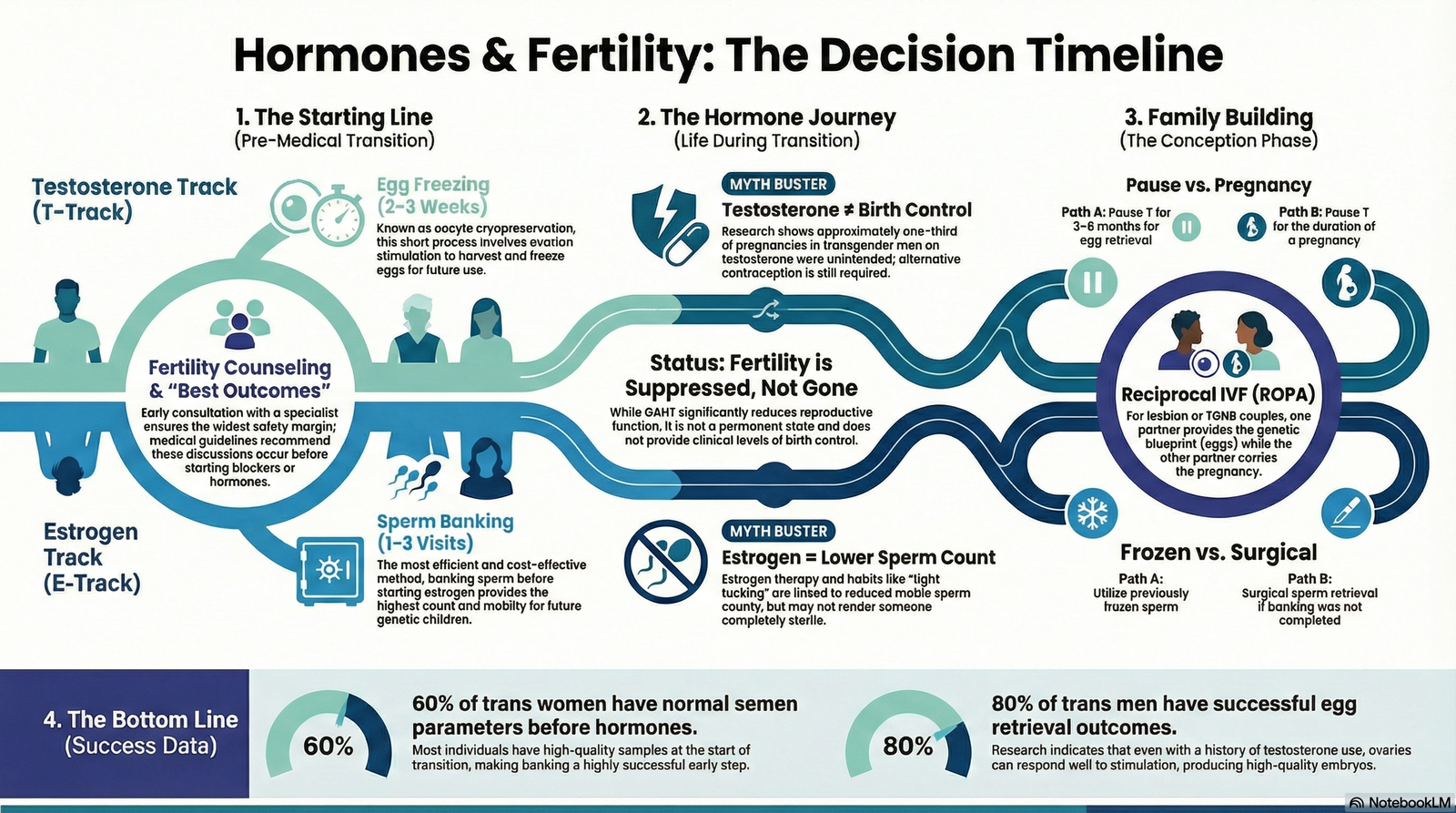
Hormones and fertility: key decision points before and after starting testosterone or estrogen.
Do you have to stop hormones for fertility treatment?
For years, many clinics told transgender men to stop testosterone for three to six months before egg retrieval. That advice often increased dysphoria and delayed both transition and family building. Newer reports show that some patients can complete stimulation and retrieval after much shorter breaks, and a few case reports describe successful retrieval while staying on testosterone throughout a cycle.
Some clinics now use a “random-start” IVF protocol. Instead of waiting for a period, you start stimulation when you come in. This approach shortens the timeline and reduces the number of internal exams. Not every clinic offers this yet, and you will still need a personalized plan, but it is worth asking about during your consult.
Fertility Preservation Options
Fertility preservation means saving eggs, sperm, or reproductive tissue now so you can try for pregnancy later. You might be planning top surgery, starting hormones soon, or already in the middle of long-term treatment. At any of these stages, it is still useful to understand what preservation could look like for you.
Emotional side of preservation
Feeling torn between two directions is a common experience. Part of you may want to move ahead with the transition as quickly as possible. Another part may worry that you will regret not freezing eggs or sperm. Studies show that people feel less regret when they make a clear decision, whether that is to preserve fertility or to decline it, than when they feel rushed and unsure. You deserve enough information and time to make a decision that aligns with your case, preferences, and goals.
Options if you have ovaries
If you have ovaries, you can usually choose between freezing eggs, freezing embryos, or, in specific cases, freezing ovarian tissue. Your medical history, age, and timeline for transition all shape what makes sense.
| Option | What happens | Best suited for |
|---|---|---|
| Egg freezing | You take hormone injections for 10–12 days, then have a short procedure under sedation to collect eggs that are frozen unfertilized. | People who want flexibility about sperm source or partner later. |
| Embryo freezing | Your eggs are collected and fertilized right away with partner or donor sperm, and resulting embryos are frozen. | People who already have a chosen sperm source and feel comfortable deciding now. |
| Ovarian tissue freezing | A surgeon removes small pieces of ovarian tissue that are frozen for possible reimplantation or lab use in the future. | Children and teens who cannot go through stimulation or people who need to start medical treatment very quickly. |
During egg or embryo freezing, your clinic can often use medications like letrozole to keep estrogen levels lower. That step can make the process more tolerable if breast tenderness, bloating, or a sense of “feminization” worsens your dysphoria.
Options if you have testes
If you have testes, sperm banking is usually the first-line preservation option. You can give a sample through masturbation in a private room at the clinic. If that does not work for you physically or emotionally, there are surgical options where a urologist retrieves sperm directly from the testicle.
Testicular tissue freezing is still newer and is mainly offered in research settings for children and adolescents who cannot produce a semen sample yet. This tissue may be used to mature sperm in the lab in the future, but it is currently limited and experimental.
IUI, IVF, Reciprocal IVF, and Surrogacy
Once you are ready to try for a baby, you can use your preserved eggs or sperm, or you can work with what you have at that moment. Your choices depend on whether you want to carry a pregnancy, whether you have a partner, and what your bodies and finances allow right now.
Thinking through who does what
You may be asking yourself big questions: whose gametes to use, who carries, whether to involve a surrogate, and how to talk about this with partners and family. There is no single “more real” way to be a parent. You are still a parent whether you share DNA, carry the pregnancy, do both, or neither. The right path is the one that protects your health and supports how you want to show up in your child’s life.
Intrauterine insemination (IUI)
IUI is often the simplest medical option. The clinic processes sperm from a known or anonymous donor and places it directly into your uterus at the time of ovulation. The procedure takes less than two minutes and does not require surgery or deep anesthesia.
In small studies of transgender men who previously took testosterone, every person who went ahead with IUI had a live birth. These numbers come from small groups, but they do show that your body can respond well even after hormone use.
In vitro fertilization (IVF)
IVF involves stimulating your ovaries to produce multiple eggs, collecting them, fertilizing them in the lab, and transferring one or more embryos into a uterus. This uterus can be yours, your partner’s, or a surrogate’s. Variations include:
- IVF with donor sperm: You use your eggs and donor sperm to create embryos.
- IVF with ICSI: An embryologist injects a single sperm directly into each egg. This is useful if sperm counts are low or movement is poor.
- Embryo donation: You adopt embryos that another family donated, which can cost less than a full IVF cycle with your own eggs.
Reciprocal IVF and co-IVF (shared motherhood)
If you and a partner both have a uterus and ovaries, you can use reciprocal IVF. One partner provides eggs, and the other carries the pregnancy. Some couples also choose to do concurrent IVF, where each partner carries an embryo, sometimes created with the other partner’s eggs.
Success rates for reciprocal IVF are often similar to or slightly better than standard IVF in the same age group, with some clinics reporting pregnancy rates between 50% and 79% per cycle. That range depends on age, egg quality, and clinic protocols.
Surrogacy
Surrogacy can be a great option if pregnancy is unsafe for you or doesn't match your gender and body. In gestational surrogacy, the surrogate carries an embryo created from your eggs, your sperm, or donated gametes. The surrogate does not share DNA with the baby.
Traditional surrogacy uses the surrogate’s own eggs, so they have a genetic connection to the child. Legal and emotional risks are higher in this model, and it is less common in many countries.
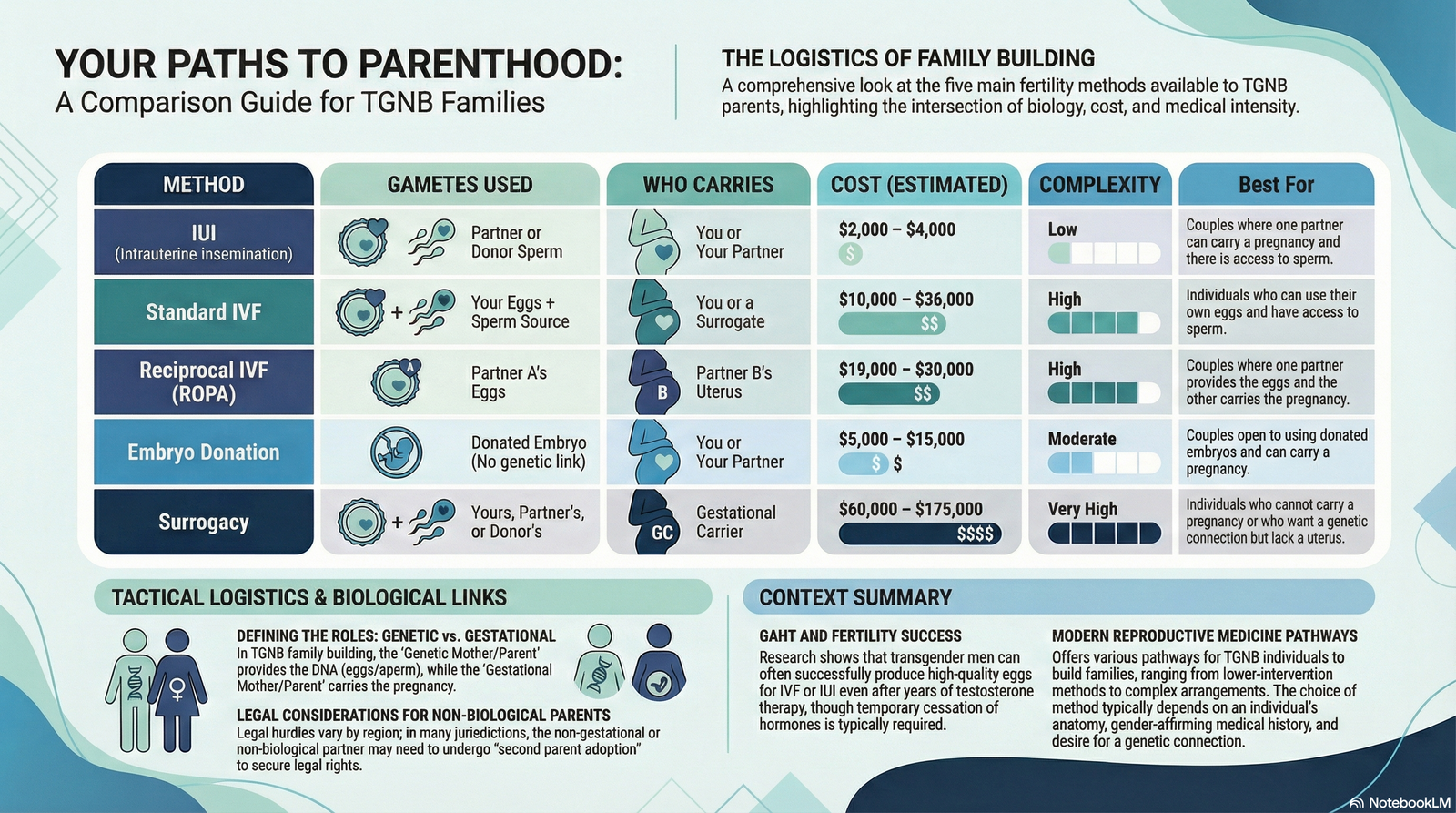
Different paths to parenthood: IUI, IVF, reciprocal IVF, embryo donation, and surrogacy for TGNB families.
| Path | Who provides gametes | Who carries pregnancy |
|---|---|---|
| IUI | Donor sperm or partner sperm | You or your partner |
| IVF | Your eggs and partner or donor sperm, or donor eggs and your sperm | You, your partner, or a surrogate |
| Reciprocal IVF | One partner’s eggs and donor sperm | The other partner |
| Surrogacy | You and/or your partner or donors | Gestational surrogate |
Costs, Insurance, and Budget Planning
The financial side of family building can feel overwhelming. You might be balancing rent, hormones, surgery, and now thousands of dollars in clinic fees. Breaking costs into clear pieces helps you see where you can adjust your plan or look for support.
Cost is not a verdict on your worthiness
High price tags can make it feel like parenthood is only for people with savings or family help. That feeling is real, and it is painful. Remember that cost ranges are averages, not rules. Some people conceive with IUI and a few vials of sperm. Others use shared-risk programs, low-interest medical loans, or employer benefits. Your ability to pay for the most expensive package does not define what kind of parent you will be.
Typical treatment costs
| Treatment | Estimated cost per cycle (USD) | Notes |
|---|---|---|
| IUI | $2,000–$4,000 | Lower intervention can require multiple cycles. |
| IVF | $10,000–$36,000 | Wide range based on meds, lab fees, and add-ons. |
| Reciprocal IVF (North America) | $19,000–$30,000+ | Often includes medications and procedures for both partners. |
| Reciprocal IVF (Europe) | Under $11,000 | Costs depend on the country and legal framework. |
| Sperm vials | $1,000–$2,000 | Price depends on donor type and bank. |
Surrogacy costs by country
| Country | Estimated surrogacy program cost (USD) | Program type |
|---|---|---|
| United States | $100,000–$175,000 | Commercial surrogacy with agency and legal support. |
| Canada | $55,000–$90,000 | Altruistic surrogacy; intended parents reimburse surrogacy-related expenses. |
| Colombia | $60,000–$119,000 | Programs often marketed to international LGBTQ+ parents. |
| Mexico | $60,000–$75,000 | Availability and laws vary by state. |
| Albania | $50,000–$70,000 | Options for heterosexual and LGBTQ+ intended parents. |
| Cyprus | $60,000–$125,000 | Guaranteed packages with repeated attempts until live birth. |
How insurance and laws can help
Some regions now treat infertility caused by gender-affirming care as a medical condition that deserves coverage. In California, for example, SB 600 requires private insurers to cover fertility preservation for iatrogenic infertility, which includes infertility related to gender-affirming hormones or surgeries. After this change, one large health system saw fertility preservation procedures increase by more than 7,000 percent.
As of early 2025, at least 19 states had passed similar mandates. Each law defines what must be covered in its own way. Some include egg and sperm freezing but not embryo storage. Others focus mainly on patients with cancer. Because the details are complex, you will need your clinic’s financial counselor and your insurer’s benefits team to walk you through what your plan offers.
Legal Protection for TGNB Parents
Legal recognition of TGNB parents has improved, but it still varies widely by state and country. You are building not only a family but also a legal structure that needs to hold up in schools, hospitals, and courts.
Why legal steps matter even when everything feels stable
On good days, it can feel like everyone in your life understands who you are to your child. The law deals with worst-case scenarios. Second-parent adoption, pre-birth orders, and careful contracts protect your role if you move, divorce, or face a medical crisis. These steps are not about doubting your relationship. They are about making sure the law matches your reality, even when life is hard.
Key concepts to know
- Legal parentage: Legal parents have the right to live with the child and make decisions about health, education, and overall care.
- Uniform Parentage Act (UPA): Some U.S. states use the UPA to guide decisions about who counts as a legal parent in assisted reproduction and surrogacy cases.
- Second-parent adoption: This lets a non-biological parent adopt the child without ending the first parent’s rights, which is especially important for same-sex and TGNB couples.
- Pre-birth orders and surrogacy contracts: In surrogacy-friendly states such as California and Nevada, courts may allow orders that name you as legal parents before birth. In other regions, the person who gives birth might be the legal parent by default, regardless of contracts.
- Birth certificates: Some places allow both parents in a same-sex or TGNB couple to be listed from the start. Others require separate legal steps first.
Because these rules differ so much, it is wise to speak with a reproductive or family law attorney before signing surrogacy contracts or cross-border clinic agreements. Many clinics can recommend lawyers who understand both ART law and TGNB-specific concerns.
Choosing Inclusive Clinics and Countries
Your relationship with your clinic will shape this experience from the first phone call. Past experiences with health care might make you protective of your time and energy, especially if you have been misgendered or dismissed in the past. You have every right to look for a team that sees and respects you.
What OVU advisors watch for when vetting clinics
When our team reviews clinics for TGNB patients, we pay close attention to more than success rates. We look at whether staff receive TGNB-specific training, whether the clinic offers flexible protocols to reduce dysphoria, and how clearly they explain costs and legal issues. These details tell you as much about how you will be treated as the numbers do.
Signs a clinic is truly TGNB-affirming
- Intake forms ask for your name, pronouns, and gender identity instead of forcing you into outdated boxes.
- Staff use your name and pronouns correctly in person, on the phone, and in the portal.
- The clinic offers options like transabdominal ultrasound when clinically appropriate to reduce dysphoria.
- Patient education materials include examples and language that reflect TGNB families.
- There is a clear process for raising concerns if something feels disrespectful or unsafe.
Choosing a country for treatment or surrogacy
Some countries, including Canada, the United States, Mexico, Colombia, Albania, and Cyprus, have become known for welcoming international LGBTQ+ parents. Each has its own mix of costs, laws, and travel demands. When you are comparing countries, look beyond the headline price. Ask about legal parentage, citizenship for the baby, wait times for donors or surrogates, and how long you will need to stay after birth.
Want help comparing clinics and costs?
If this feels like a full-time job, and it often does, our advisors can collect clear, itemized quotes from verified clinics and map out timelines, legal steps, and likely costs with you at no extra cost.

Why trust this guide? The OVU commitment
You are probably juggling hope, timelines, and a lot of tabs open in your browser. And you deserve clear, current, human advice. At OVU, we review clinic protocols, compare real quotes, and talk to people who have done this - intended parents and gestational carriers - so we can give you practical steps, not just theory. If you want help comparing options without sales pressure, we will gather itemized quotes and success data that match your exact situation. You decide, we will bring the info to your table.
Frequently Asked Questions
Does testosterone act as birth control?
No. Testosterone often stops your period, but it does not reliably stop ovulation. Pregnancies on testosterone do happen. If you do not want to be pregnant, you still need contraception, such as an IUD or another method that fits your health and your comfort with different hormones.
Can I still have a baby if I have been on hormones for years?
Many transgender men who have used testosterone for years still have enough eggs for IVF or pregnancy after a pause in treatment. Some clinics use protocols that shorten the time off hormones. For transgender women, sperm can sometimes return after stopping estrogen, but the most reliable plan is to bank sperm before starting hormones whenever possible.
Will my child be healthy if I am a transgender or nonbinary parent?
Current research does not show higher rates of physical or mental health problems in children raised by transgender or nonbinary parents. Studies report secure attachments and healthy development. Your child benefits most from being loved, supported, and cared for, which you are already thinking about by reading this guide.
How can I find a clinic that will respect my identity?
Start by checking clinic websites for LGBTQ+ content, inclusive language, and visible non-discrimination policies. When you contact the clinic, notice whether the staff ask for your name and pronouns and actually use them. You can also ask directly how many TGNB patients they see each year and whether they have adapted protocols to reduce dysphoria.
What is the “planning gap” for TGNB fertility?
The planning gap is the difference between how many TGNB people say they want children and how few receive real counseling or complete fertility preservation before starting transition-related care. You close that gap for yourself by asking questions early, even if you are not ready to make a final decision yet.
Can I choose my baby’s sex through IVF?
Some clinics and countries allow sex selection through preimplantation genetic testing, where embryos are screened before transfer. Others limit or ban this practice. Law and clinic policy matter here, so you will need to ask about what is allowed where you plan to treat.
Is surrogacy only for gay couples?
No. Surrogacy can support many different families, including TGNB individuals, heterosexual couples, same-sex couples, and single intended parents. What matters most is your medical situation, local laws, and whether surrogacy aligns with your values and budget.
Reference List 10 sources
Journal Article (Research): Ghofranian A, et al. Fertility preservation in transgender men: ovarian stimulation and outcomes. F&S Reports. 2023;4(4):367–374. PMID: 38204952. Available from: https://pubmed.ncbi.nlm.nih.gov/38204952/
Journal Article (Research): Ghofranian A, et al. Assisted reproduction outcomes in transgender and gender-diverse patients. Transgender Health. 2024;9(1). PMID: 38312448. Available from: https://pubmed.ncbi.nlm.nih.gov/38312448/
Journal Article (Review): Feil K, et al. Fertility preservation in transgender individuals. Dtsch Ärztebl Int. 2023;120(14):243–250. PMID: 36794399. Available from: https://pubmed.ncbi.nlm.nih.gov/36794399/
Journal Article (Review): Nadgauda AS, Butts S. Fertility considerations in transgender and gender diverse individuals. Therapeutic Advances in Reproductive Health. 2024;18. PMID: 38292918. Available from: https://pubmed.ncbi.nlm.nih.gov/38292918/
Journal Article (Research): Stolk THR, et al. Decision-making about fertility preservation in transgender adolescents. International Journal of Transgender Health. 2023;24(4):361–367. PMID: 37901065. Available from: https://pubmed.ncbi.nlm.nih.gov/37901065/
Journal Article (Research): de Nie I, et al. Ovarian histology and reserve in transgender men on long-term testosterone. Human Reproduction. 2020;35(7):1529–1536. PMID: 32613241. Available from: https://pubmed.ncbi.nlm.nih.gov/32613241/
Committee Opinion (Guidance): American College of Obstetricians and Gynecologists. Health care for transgender and gender diverse individuals. Obstetrics & Gynecology. 2021;137(3):e75–e88. PMID: 33595253. Available from: https://pubmed.ncbi.nlm.nih.gov/33595253/
Ethics Committee Opinion: Ethics Committee of the American Society for Reproductive Medicine. Access to fertility services by transgender and nonbinary persons. Fertility and Sterility. 2021;115(4):874–878. PMID: 33632473. Available from: https://pubmed.ncbi.nlm.nih.gov/33632473/
Journal Article (Guidance): Wyns C, et al. Updated recommendations on fertility preservation. Human Reproduction. 2025;40(1). PMID: 40574354. Available from: https://pubmed.ncbi.nlm.nih.gov/40574354/
Journal Article (Research): Rubin E, et al. Reproductive outcomes after gender-affirming hormone therapy. Reproduction. 2025;169(1):e240120. PMID: 39441758. Available from: https://pubmed.ncbi.nlm.nih.gov/39441758/
Final Thoughts
Your path to parenthood does not have to look like anyone else’s. You might be just starting hormones, considering surgery, or many years into living in your affirmed gender. At every one of those points, you still have ways to build a family, whether with your own eggs or sperm, a partner’s, a donor’s, or a surrogate’s support.
You deserve care that treats you as a whole person, not just a set of lab values or diagnoses. Ask questions until you understand your options in plain language. Bring a partner, friend, or support person to appointments if that helps you feel grounded. Take breaks when the emotions and numbers feel like too much. There is no single right timeline, only the one that works for your health, your finances, and your sense of self.
Most of all, remember that wanting a child is not selfish or unrealistic. It is a deeply human wish. With good information, a respectful team, and thoughtful planning, the image you hold of yourself as a parent can move from possibility to reality.
Need a second set of eyes on your options?
If you want help sorting through countries, clinics, and costs, you can speak with an OVU advisor about your situation. Together you can map out practical next steps that respect both your identity and your budget.