


Dr. Sony Sherpa (MBBS)
In addition to her clinical experience, Dr. Sherpa is a published medical researcher and holistic health advocate. Her dual expertise in emergency care and alternative therapies brings a unique lens to medically reviewed content—ensuring it is both accurate and accessible.
If you are pregnant with twins after IVF and feel overwhelmed and anxious, you are not alone. You have already been through stimulation shots, egg retrieval, embryo transfer, and the longest two weeks of your life waiting for that positive test. Now you have two heartbeats instead of one, and your hopes, fears, and questions have doubled, too.
You are also stepping into a different type of pregnancy. Doctors watch twin pregnancies, especially after IVF, more closely because they carry higher risks for you and your babies. In a large study of 16.9 million pregnancies, 32.1% of IVF conceptions were twins, compared with 1.5% of natural conceptions, and those IVF twin pregnancies had higher rates of preterm birth, Caesarean delivery, and complications that needed NICU care.
Guidelines from groups like ACOG and ESHRE now frame IVF twin pregnancy as a high‑risk situation that deserves specialist monitoring, clear information, and honest conversations. This guide walks you through what actually happens in an IVF twin pregnancy, what your doctors are looking for, and how you can stay involved and informed without feeling lost.
Twin pregnancy after IVF is common and usually ends with two healthy babies, but it carries higher risks of preeclampsia, gestational diabetes, preterm birth, Caesarean delivery, and NICU admission than a singleton IVF pregnancy. You can expect more scans, more monitoring, and a likely delivery around 35–36 weeks. Staying closely connected with your care team and understanding the key milestones helps you protect both your health and your babies.
Next step: Use this guide to note the key weeks, tests, and red‑flag symptoms, and bring your questions to your next appointment so your team can tailor a plan to your specific situation.
What the Latest Research Shows
Large studies now give a clear picture of IVF twin pregnancies. In a Chinese cohort of 16.9 million births, 32.1% of IVF pregnancies were twins versus 1.5% of natural conceptions. IVF twins had higher rates of preterm birth, low birth weight, gestational diabetes, and hypertensive disorders.
Registry data from Korea and Europe confirm that twins conceived with IVF have more placenta problems, more emergency Cesareans, and more NICU admissions than naturally conceived twins, although most IVF twins still do well with modern care. Frozen embryo transfer appears to reduce the risk of very preterm birth and low birth weight in twins compared with fresh transfer.
These findings support why your team classifies your pregnancy as higher risk and why they often recommend single‑embryo transfer for future cycles.
In This Guide
IVF twins: 32.1%
Natural twins: 1.5%
Twins deliver at 35–36 weeks
Singletons at 39–40 weeks
Higher rates of preeclampsia
More NICU admissions
IVF Twins: What Makes This Pregnancy Different?
When your provider tells you there are two sacs or two heartbeats, you are seeing the direct effect of modern fertility care. Most IVF twins are dizygotic, which means two different eggs and two different sperm. They share a womb and, often, a birthday, but they are just like regular siblings in terms of genetics.
IVF also has a higher rate of identical twins than natural conception. Identical twins come from a single embryo that splits into two. The tools that help IVF work so well, such as ICSI, assisted hatching, and specific culture conditions, also seem to increase the chance that an embryo will split. If your twins share a placenta, your team will talk about extra monitoring and conditions like twin‑to‑twin transfusion syndrome.
Latest Research Insights
32.1% vs. 1.5% – Twin Rate in IVF vs. Natural: In a huge Chinese study, about one in three IVF pregnancies were twins compared to fewer than two in a hundred natural pregnancies. This shows how strongly embryo‑transfer decisions shape your odds of having twins. Source: JAMA Network Open (PMID: 34505887).
39% Preterm Birth – IVF Twin Reality: In that same cohort, nearly 40% of IVF twin pregnancies were delivered before 37 weeks, and about 44% of babies had low birth weight. This is why your doctors lean toward earlier delivery and closer fetal growth checks. Source: JAMA Network Open (PMID: 34505887).
40% Higher Risk – ART Twins vs. Natural Twins: A Korean national study of 36,013 twin pregnancies found higher risks of placenta previa, preeclampsia, gestational diabetes, and emergency C‑section in twins conceived with ART than in naturally conceived twins. This is why IVF twins often see maternal‑fetal medicine specialists. Source: Obstet Gynecol Sci (PMID: 41194682).
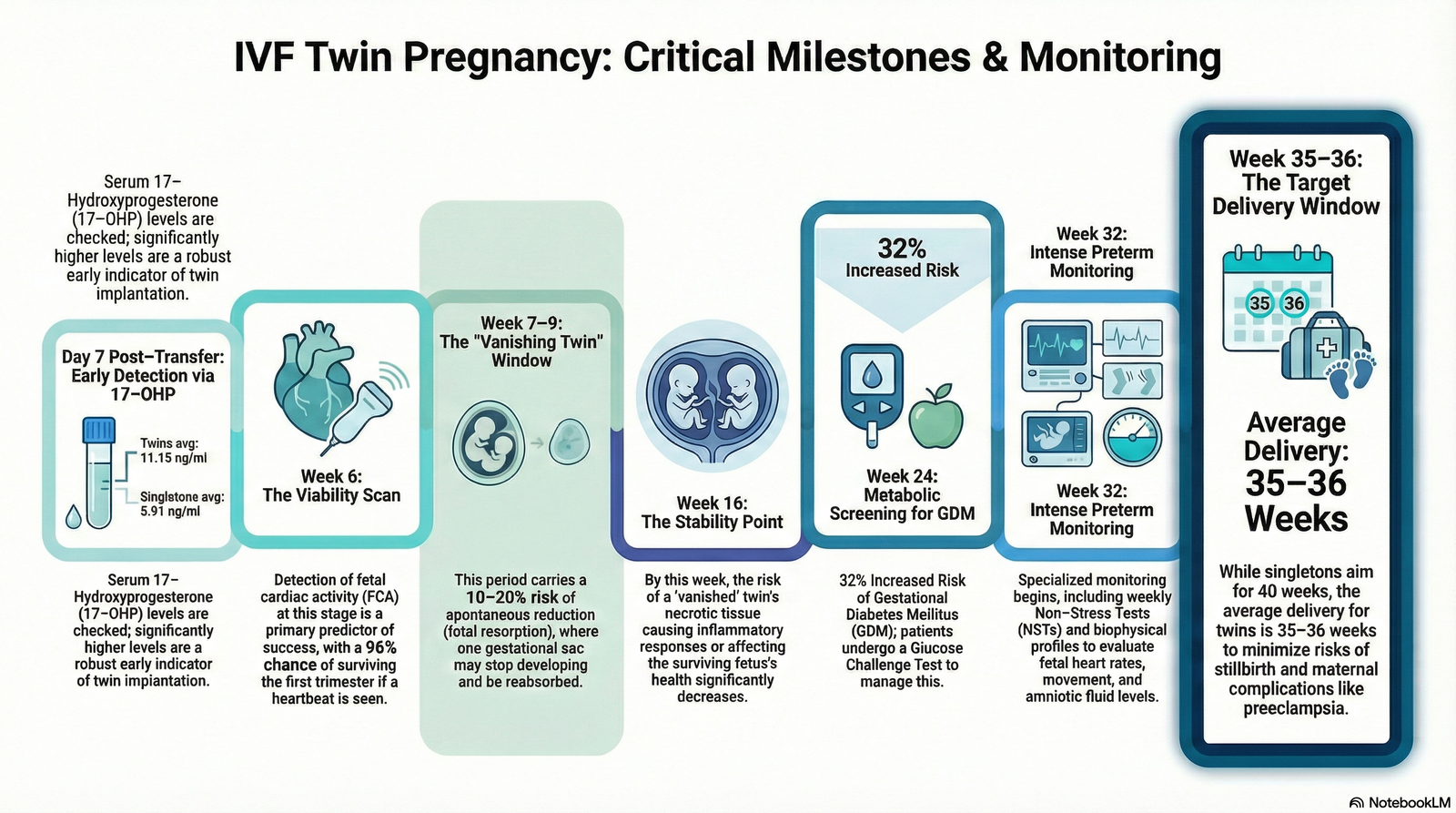
IVF Twin Pregnancy Timeline: From day–7 hormone checks to delivery around 35–36 weeks.
Your body also works harder with twins. Blood volume rises by about half, your uterus takes a big share of your blood flow, and your heart and lungs work against more pressure from your growing uterus. This is why doctors label twin pregnancies as high risk, even when you feel fine.
First Trimester: Early Scans, Vanishing Twin, and Hormone Checks
The first trimester with twins can be a strange mix of joy and fear. One day, you are crying from relief over two heartbeats, the next day, you are worrying about every cramp.
After embryo transfer, some clinics check hormones like 17‑hydroxyprogesterone (17‑OHP) about a week later. Higher levels can hint that more than one embryo has implanted, although blood work alone never replaces an ultrasound.
Your first scan is usually around week 6. At this point, you should see sacs, yolk sacs, and often heartbeats. Once both embryos show heart activity, the odds of both reaching the end of the first trimester are high, although not guaranteed.
Understanding the Vanishing Twin
In about 10–20% of twin pregnancies identified very early, one twin stops growing and disappears on later scans. This is the so‑called vanishing twin. It often reflects a chromosomal problem or poor implantation of the second fetus. If this happens early, before around 16 weeks, the remaining baby usually continues without extra structural risk, though you might have spotting or bleeding.
Interestingly, babies who started as one of two and then lost a co‑twin still have high live‑birth rates. Some data suggest survival rates around 92%, compared with about 76% in pregnancies that started as singletons. These surviving babies do have somewhat higher chances of being small for gestational age, so your team will watch growth more closely.
Second and Third Trimester: Monitoring You and Your Babies
If the first trimester is about “Will this pregnancy stick?”, the second and third trimesters are about “How do we keep everyone safe until delivery?” This is when regular monitoring really ramps up.
Key Risks Your Team Watches For
Preeclampsia: Twin pregnancies develop preeclampsia about two to five times as often as singleton pregnancies. That is why every visit includes blood pressure, urine checks, and questions about headaches or vision changes.
Gestational diabetes: With two babies asking for sugar, your insulin resistance goes up. Around week 24, you do your glucose screening. If you have gestational diabetes, your care team works with you on food, activity, and sometimes medication.
Preterm labor: Because your uterus stretches more, it is more likely to contract early. Most twins deliver around 35–36 weeks. About 69% of multiple pregnancies are delivered before 37 weeks. Your doctor may check your cervix by exam or ultrasound scan if you have symptoms.
Maternal Risk Profile in IVF Twin Pregnancy
+30% – Higher Preeclampsia Risk: IVF twin pregnancies carry about a 30% higher risk of preeclampsia compared with natural twin pregnancies. That means more frequent blood pressure checks and lab tests for you. Source: Obstet Gynecol Sci (PMID: 41194682).
+32% – Higher Gestational Diabetes Risk: The risk of gestational diabetes is roughly one‑third higher in IVF twins versus natural twins, so your sugar screening and follow‑up matter. Source: Obstet Gynecol Sci (PMID: 41194682).
89% – C–Section Rate: In large cohorts, about 9 in 10 IVF twin pregnancies end in Cesarean delivery, often because of baby positions or maternal complications. Source: JAMA Network Open (PMID: 34505887).
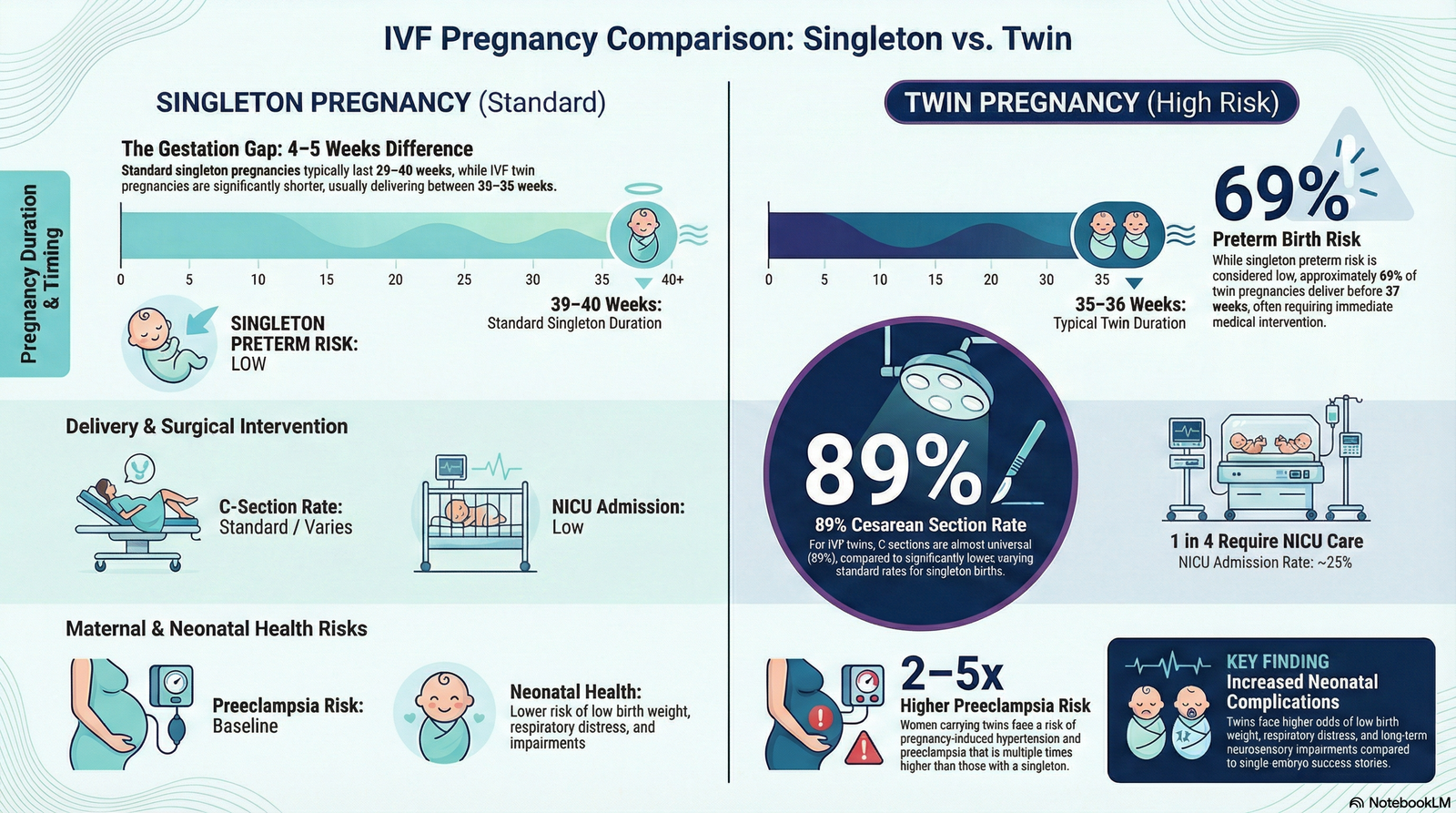
Key differences between singleton and twin IVF pregnancies: timing, delivery mode, and NICU use.
| Aspect | Singleton IVF Pregnancy | IVF Twin Pregnancy |
|---|---|---|
| Typical length | 39–40 weeks | 35–36 weeks |
| Preterm birth (<37 weeks) | Lower risk | Around 69% of multiple pregnancies |
| Cesarean delivery | Common, but varies by clinic | About 89% of pregnancies |
| NICU admission | Lower rate | Around 25% of twin newborns |
For many parents, this is also when you start to feel the strain in daily life. You might struggle to sleep, fight heartburn, and notice swelling in your legs and hands. Ordinary tasks, such as shopping or climbing stairs, feel like workouts. Listening to your body and pacing yourself becomes just as important as taking your vitamins.
Planning Birth and Recovery With Twins
As you move toward the last weeks, the big questions become “How will I deliver?” and “What will recovery look like?” Your doctor looks at three main things: your health, your babies’ growth and wellbeing, and their positions in the uterus.
If the first twin is head‑down and there are no major complications, vaginal birth can be an option. Your team may still recommend a planned Cesarean if the second twin is breech, if there is a shared placenta with twin‑to‑twin transfusion, or if you have severe preeclampsia, placenta previa, or other reasons. In practice, most IVF twins arrive by planned or urgent C‑section.
After birth, many twin parents spend time in the postpartum ward while one or both babies stay in NICU or special care. This does not mean you did anything wrong. Small babies and babies born early simply need help with breathing, feeding, and regulating temperature. It is common to juggle pumping, NICU visits, and your own recovery all at once. Lining up support before delivery, if you can, makes this phase easier.
Why Frozen Embryo Transfer Matters for Twins
15–30% Lower Risk – Frozen vs. Fresh Twins: A UK analysis found that twins from frozen embryo transfers had a noticeably lower risk of very preterm birth and low birth weight than twins from fresh transfers. Source: Fertility and Sterility (PMID: 35717287).
Better Placental Environment: With frozen transfers, your body is not recovering from high‑dose stimulation medications at the same time as early placental development. This may give the placenta more stable support in early pregnancy. Source: Fertility and Sterility (PMID: 35717287).
What this means for you: If you conceive twins from a frozen transfer, you still need close monitoring, but some of the most severe prematurity risks seem lower than with fresh transfer twins.
Want help comparing clinics and twin‑pregnancy experience?
If this feels like a full‑time job, and it often does, our advisors can help you compare IVF clinics, success rates, and costs for single‑ and twin‑pregnancy care, and map out your likely timeline at no cost to you.

Why trust this guide? The OVU commitment
You are probably juggling hope, timelines, and a lot of tabs open in your browser. And you deserve clear, current, human advice. At OVU, we review clinic protocols, compare real quotes, and talk to people who have done this - intended parents and gestational carriers - so we can give you practical steps, not just theory. If you want help comparing options without sales pressure, we will gather itemized quotes and success data that match your exact situation. You decide, we will bring the info to your table.
Frequently Asked Questions
Is the risk of birth defects higher in IVF twins?
Large registry studies show a small increase in congenital anomalies in IVF twins compared with IVF singletons. The odds ratio is about 1.1, which means a slightly higher risk, not a dramatic jump. With good prenatal screening and modern neonatal care, most IVF twins are born healthy.
Why has my doctor put so much emphasis on Vitamin D?
Your babies depend completely on your Vitamin D levels for their bone, immune, and lung development. Research links low Vitamin D to higher rates of preeclampsia, gestational diabetes, and poor placental function. Your doctor may test your level and recommend up to 4,000 IU per day if you are deficient, but your exact dose should always be individual.
Can I still plan for a vaginal birth with twins after IVF?
Sometimes, yes. If the first twin is head‑down, both babies are doing well, and you have no major complications, a vaginal delivery can be safe. In practice, however, about 89% of IVF twin pregnancies end in Cesarean delivery because of baby position, shared placentas, or maternal complications. Your team will review your specific situation in the third trimester.
How much weight should I expect to gain with IVF twins?
For someone who starts pregnancy at a normal BMI, typical recommendations for twins are 37 to 54 pounds of total gain. A simple target is roughly one pound per week during the first half of pregnancy and a bit more later. Your provider adjusts this advice based on your starting weight and how your babies are growing on ultrasound.
Does first‑trimester bleeding mean I will miscarry one or both twins?
Bleeding in early pregnancy is more common in IVF pregnancies than in natural ones and does not always mean you will miscarry. In IVF twin pregnancies, many women who bleed early still deliver healthy babies, although bleeding may be linked with lower birth weight. You should always report bleeding so your doctor can check your cervix, hormone levels, and ultrasound.
Reference List 9 sources
Journal Article (Research): Wang Y, Shi H, Chen L, et al. Absolute risk of adverse obstetric outcomes among twin pregnancies after in vitro fertilization by maternal age. JAMA Network Open. 2021;4(9):e2123634. PMID: 34505887. Available from: https://pubmed.ncbi.nlm.nih.gov/34505887/
Journal Article (Research): Yu E, Lee HJ, Lee S, et al. Obstetric and perinatal outcomes in twin pregnancies conceived via assisted reproductive technology vs spontaneous conception: a population-based cohort study. Obstet Gynecol Sci. 2025;68(6):491–502. PMID: 41194682. Available from: https://pubmed.ncbi.nlm.nih.gov/41194682/
Journal Article (Research): Raja EA, et al. Comparison of perinatal outcomes after frozen or fresh embryo transfer: separate analyses of singleton, twin, and sibling live births from a linked national in vitro fertilization cohort. Fertil Steril. 2022;118(2):323–333. PMID: 35717287. Available from: https://pubmed.ncbi.nlm.nih.gov/35717287/
Journal Article (Research): Tighe J, Broughton S, Roberts R, et al. Effectiveness and safety of consecutive single embryo transfer compared to double embryo transfer: results from the UK HFEA registry. Hum Reprod. 2025;40(5):885–894. PMID: 39999407. Available from: https://pubmed.ncbi.nlm.nih.gov/39999407/
Journal Article (Research): Guo C, Li S, Wang J, Wu Y. The clinical characteristics differences between IVF twins and naturally conceived twins with preterm infants. Medicine (Baltimore). 2025;104(12):e41884. PMID: 40128014. Available from: https://pubmed.ncbi.nlm.nih.gov/40128014/
Journal Article (Systematic Review & Meta-Analysis): Marleen S, Kodithuwakku W, Nandasena R, et al. Maternal and perinatal outcomes in twin pregnancies following assisted reproduction: a systematic review and meta-analysis involving 802,462 pregnancies. Hum Reprod Update. 2024;30(3):309–322. PMID: 38345641. Available from: https://pubmed.ncbi.nlm.nih.gov/38345641/
Journal Article (Review): Eapen A, Ryan GL, Ten Eyck P, Van Voorhis BJ. Current evidence supporting a goal of singletons: a review of maternal and perinatal outcomes associated with twin versus singleton pregnancies after in vitro fertilization. Fertil Steril. 2020;114(4):690–714. PMID: 33040979. Available from: https://pubmed.ncbi.nlm.nih.gov/33040979/
Committee Opinion (Guidance): American College of Obstetricians and Gynecologists. Multifetal gestations: twin, triplet, and higher-order multifetal pregnancies: ACOG Practice Bulletin, Number 231. Obstet Gynecol. 2021;137(6):e145–e162. PMID: 34011891. Available from: https://pubmed.ncbi.nlm.nih.gov/34011891/
Guideline (Practice Guideline): ESHRE Guideline Group on Embryo Transfer. Evidence-based guideline: number of embryos to transfer during IVF/ICSI. Hum Reprod Open. 2024;2024(1):hoad037. PMID: 38364208. Available from: https://pubmed.ncbi.nlm.nih.gov/38364208/
Final Thoughts
A twin pregnancy after IVF is intense. You will probably see your doctor more often than you expected, have more scans than your friends with singleton pregnancies, and spend more time thinking about blood pressure, blood sugar, and fetal growth than you ever imagined. That does not mean you are broken or that your body is failing. It means your care team is trying to stay one step ahead.
You are also doing something extraordinary. You are carrying two babies after a long road to conceive. Every time you show up for a blood draw, every time you call about a symptom instead of ignoring it, and every time you rest when you need to, you are parenting already. Give yourself credit for that.
If you feel scared or tired or unsure, tell your team. Ask the same question more than once if you need to. Lean on friends, family, or support groups where people understand IVF and twin pregnancy. You do not have to carry all the information or all the worry alone. You already did something incredibly hard by getting here. You can do this part too, one appointment, one day, and one kick at a time.