


Dr. Sony Sherpa (MBBS)
In addition to her clinical experience, Dr. Sherpa is a published medical researcher and holistic health advocate. Her dual expertise in emergency care and alternative therapies brings a unique lens to medically reviewed content—ensuring it is both accurate and accessible.
If you are pregnant with twins after IVF, it probably feels like your life has just changed. You may have spent weeks envisioning two precious bundles cuddling beneath your heart, already dreaming of that 12-week scan where you might catch them holding hands. You’ve likely pictured the two bassinets, imagined the twin stroller, and replayed the moment you first saw those two flickering heartbeats on the ultrasound screen. Then, suddenly, a follow-up scan shows one heartbeat instead of two. You hear the phrase “vanishing twin,” and it feels like the ground drops under your feet as you have already lost one tiny bundle and his/her heart has stopped beating, leaving a quiet, aching space where a lifetime of magic was supposed to be.
Vanishing Twin Syndrome (VTS) describes what happens when one fetus in a multiple pregnancy dies in the uterus, and your body partially or completely reabsorbs the tissue. Studies suggest the phenomenon happens in about 10% to 40% of multifetal pregnancies, and around 1 in 10 IVF singleton births started as a twin pregnancy. Professional societies like ASRM and ACOG recognize VTS as a known pattern in early pregnancy, especially when more than one embryo implants after fertility treatment.
In this guide, you will see what actually happens in your body, how common vanishing twins are in IVF and ICSI pregnancies, how doctors monitor and manage these pregnancies, and what all of these factors mean for you and your surviving baby. You will also find practical ideas for coping with the mix of grief, fear, and hope you may be feeling right now.
Vanishing Twin Syndrome happens when one twin in an early multiple pregnancy stops developing and is reabsorbed by your body. In IVF and ICSI pregnancies, this phenomenon often occurs between weeks 7 and 9. Usually, the surviving twin continues to grow normally, although there is a higher risk of preterm birth and low birth weight compared to pregnancies that started with one baby.
If your doctor tells you that one twin has vanished but the other is growing well, your chance of taking home a healthy baby is still excellent.
What the latest research shows
Research in IVF and ICSI pregnancies has shown that 10% to 40% of multifetal pregnancies experience vanishing twin syndrome, usually in the first trimester. About 1 in 10 IVF singleton births began as a twin pregnancy on the first scan. When one sac is empty and one fetus is viable, more than 93% of these pregnancies end in a live birth.
Surviving babies have a higher chance of preterm birth, low birth weight, and being small for gestational age compared with babies who were singletons from the start, but careful monitoring helps manage these risks. Professional guidelines recommend single embryo transfer for many patients to reduce both twin risk and vanishing twin events.
In This Guide
10%–40% of multifetal pregnancies have a vanishing twin, especially with early scans.
About 1 in 10 IVF singleton births began as a twin pregnancy confirmed by an early ultrasound scan.
When one gestational sac is empty and one fetus is viable, more than 93% end in a live birth.
What Vanishing Twin Syndrome Is in IVF
When your doctor says “vanishing twin,” they are describing a real event with a strange name. One embryo implants, begins to grow, then stops developing and eventually disappears. The gestational sac and fetal tissue are reabsorbed by your body or compressed into the placenta of the surviving twin.
This usually happens very early in pregnancy. Many losses occur before you would have had a first scan in a natural conception, so couples never know there was a twin. In IVF and ICSI, you often have a scan at 5 or 6 weeks that already shows two sacs, and then another scan at 7 to 9 weeks that reveals only one growing fetus.
Why this does not mean your body failed
It is very easy to blame your body for a vanishing twin or to replay every step of your IVF protocol in your head. In most cases, the lost twin had a serious problem with its chromosomes and could not continue to grow. Your uterus, your medications, your activity level, and your stress are not to blame.
Your surviving baby is still getting support from your body every single day, even if the story did not unfold the way you first imagined.
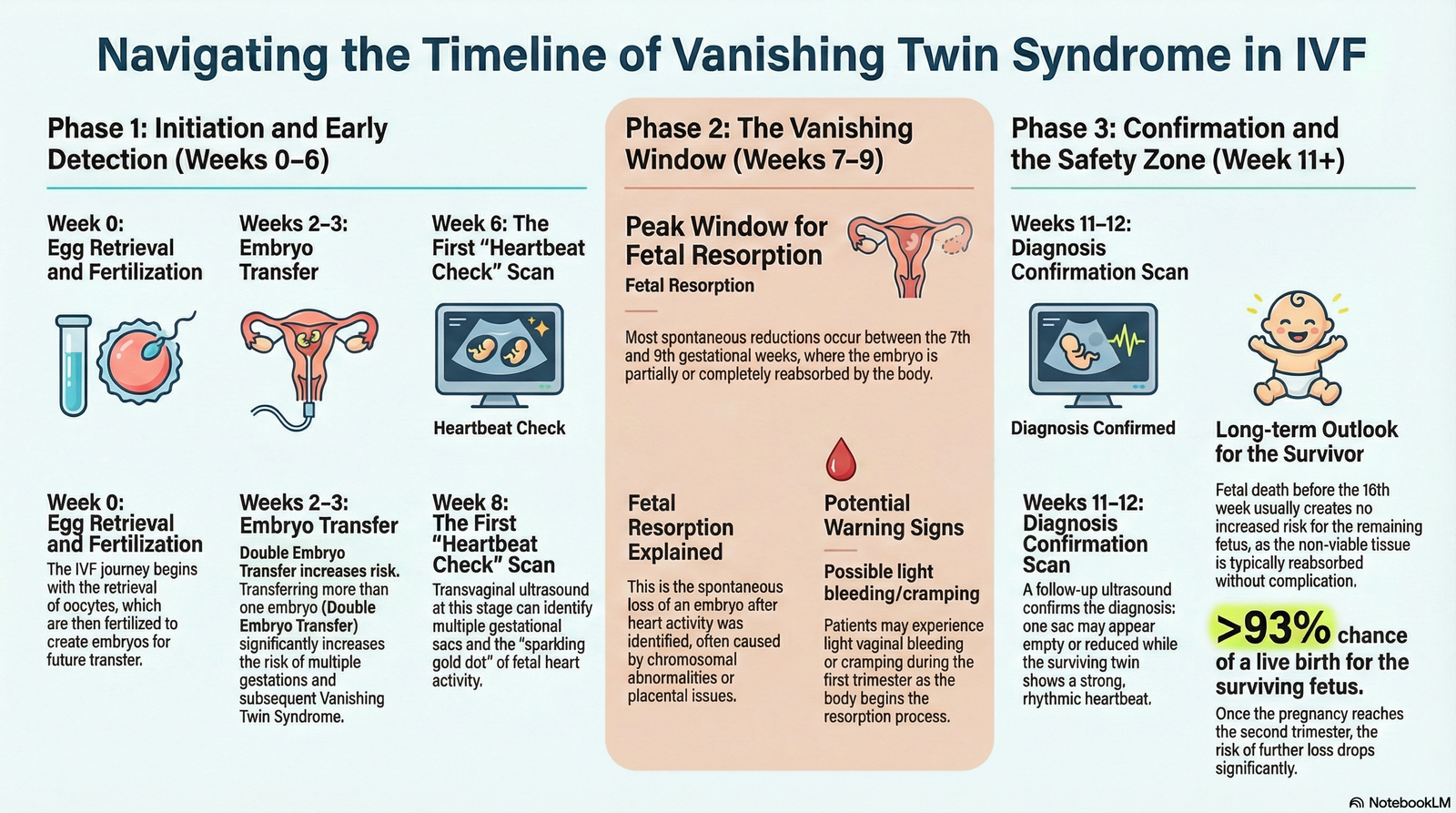
Vanishing Twin Syndrome in IVF: timeline, risk window, and impact on the surviving twin.
How Common Vanishing Twin Syndrome Is After IVF
If you feel like you hear about vanishing twins a lot in IVF groups, you are not imagining it. Vanishing Twin Syndrome shows up more often in fertility treatment because more than one embryo often implants at the start.
Key numbers to remember:
- VTS occurs in about 10% to 40% of multifetal pregnancies, depending on how early and how often you scan.
- About 1 in 10 IVF singleton births began as a twin pregnancy on the first ultrasound.
- In triplet pregnancies, loss of one embryo during the first 7 weeks is seen in about 90% of cases.
Multiple pregnancy after fertility treatment is often an unintended side effect of trying to improve your chances. When clinics transfer two embryos instead of one, pregnancy rates go up, but so do twin rates and vanishing twin events.
| Pregnancy Type | How Often It Starts as Twins | Early Loss Pattern |
|---|---|---|
| Natural conception | Lower, many twins are never seen on scan | Many early losses before the first ultrasound |
| IVF single embryo transfer | Lower, mostly singletons from the start | Standard early miscarriage risk by age |
| IVF double embryo transfer | Higher twin and triplet rates | 10%–40% experience vanishing twin syndrome |
Why Vanishing Twin Syndrome Happens
You may find yourself lying awake and replaying every day of your cycle. You wonder if you walked too far, lifted something too heavy, or argued too much at work. The science behind vanishing twins points somewhere else. In most cases, the reason for the embryo’s failure to survive lies within the embryo itself.
The most common explanations include the following:
- Chromosomal abnormalities
At least half of first-trimester miscarriages involve embryos with extra or missing chromosomes. These errors usually happen at or around fertilization. The embryo may implant and grow for a short time, then stop when its cells can no longer function normally. - Placental problems
Some pregnancies show problems in the placenta, such as poor implantation or abnormal development. Studies see placental issues in about two-thirds of miscarriages. If one twin’s placenta does not develop properly, that twin cannot keep up, while the other twin’s placenta may be healthy. - Umbilical cord issues
The cord is your baby’s lifeline. If the cord inserts poorly into the placenta or has structural problems, blood flow can be interrupted. Such interruptions can be especially harmful to the smaller twin. - Biological competition between cell lines
Researchers describe a kind of quiet competition at the cell level. Chromosomally normal cells tend to grow better and function more smoothly than abnormal cells. Over time, the healthier embryo or cell line can dominate, and the weaker one stops growing.
Beyond the embryo: other factors that play a role
Conditions like chronic endometritis, an ongoing low-grade inflammation of the uterine lining, have been linked with higher miscarriage rates. Smoking increases the risk of pregnancy loss and late fetal death. These factors do not cause every vanishing twin, but they can add extra pressure to an already fragile situation.
If your doctor finds issues like these, treating them before a future embryo transfer can improve your overall odds of a healthy pregnancy.
How Doctors Monitor and Manage These Pregnancies
One of the hardest parts of an IVF pregnancy is how much you know. You often know your exact day of ovulation, the date of embryo transfer, and the embryo grade. That precision continues into early pregnancy monitoring.
Many clinics plan the first pregnancy ultrasound about 28 days after egg retrieval, which is around 6 weeks of gestation. At this point, your doctor looks for:
- The number of gestational sacs
- Presence or absence of yolk sacs
- Crown rump length (CRL) of each embryo
- Visible heartbeats and heart rate
Seeing a heartbeat at 6 weeks gives a 93% to 96% chance of reaching the end of the first trimester. When two heartbeats are visible, your doctor also pays close attention to differences between the twins.
Some warning signs they look for include:
- Large size difference between twins: Doctors may calculate the CRL difference. A ratio of 0.6 or more between the twins strongly predicts that the smaller twin may not survive.
- Gestational sac and embryo mismatch: When the mean gestational sac diameter (mGSD) is only a little larger than the CRL, especially if the difference is less than 5 mm, the first-trimester loss rate can reach about 43.7% in that group.
- Slower beta-hCG rise: In a typical healthy pregnancy, beta-hCG rises by about 128.8% over two days in early weeks. In vanishing twin pregnancies, the average two-day rise is around 114.3%.
When your doctor suspects a vanishing twin, the most important tools are repeat ultrasounds and time. They will often bring you back in one to two weeks to check whether the smaller sac or embryo has grown, or whether the pregnancy has clearly shifted to a singleton.
What It Means for the Surviving Twin
If you have gone through a vanishing twin, you may look at every scan asking one question: “Is my baby still safe?” The positive news is that when the loss happens in the first trimester, and the babies do not share a placenta, the remaining twin usually continues without serious physical harm from the loss itself.
At the same time, research shows some clear patterns compared with pregnancies that started with one baby:
- Preterm birth: Babies from vanishing twin pregnancies are about 50% more likely to be born early in frozen transfer cycles and about 2.5 times more likely to be premature after double embryo transfer than babies from single embryo transfers.
- Low birth weight: Surviving twins are around two to three times more likely to have low birth weight. On average, they weigh about 110 to 162 grams less than IVF or ICSI singletons who started alone.
- Small for gestational age (SGA): The chance of being SGA is about two times higher in survivors of vanishing twins.
| Outcome | Pregnancy Started as Singleton | Vanishing Twin Pregnancy |
|---|---|---|
| Preterm birth | Baseline risk by age and health | About 1.5 to 2.5 times higher |
| Low birth weight | Standard ART risk | 2 to 3 times more likely |
| Small for gestational age | Lower background risk | About twice as common |
How your care team responds
Because survivors of a vanishing twin face higher risks for preterm birth and growth problems, your obstetric team will adjust your care plan. Extra growth scans, earlier screening for gestational diabetes, and closer blood pressure monitoring all help catch potential issues sooner.
If your loss or your starting twin pregnancy was later in gestation, your doctor may also plan delivery at a hospital with a neonatal intensive care unit so your baby has immediate access to support if needed.
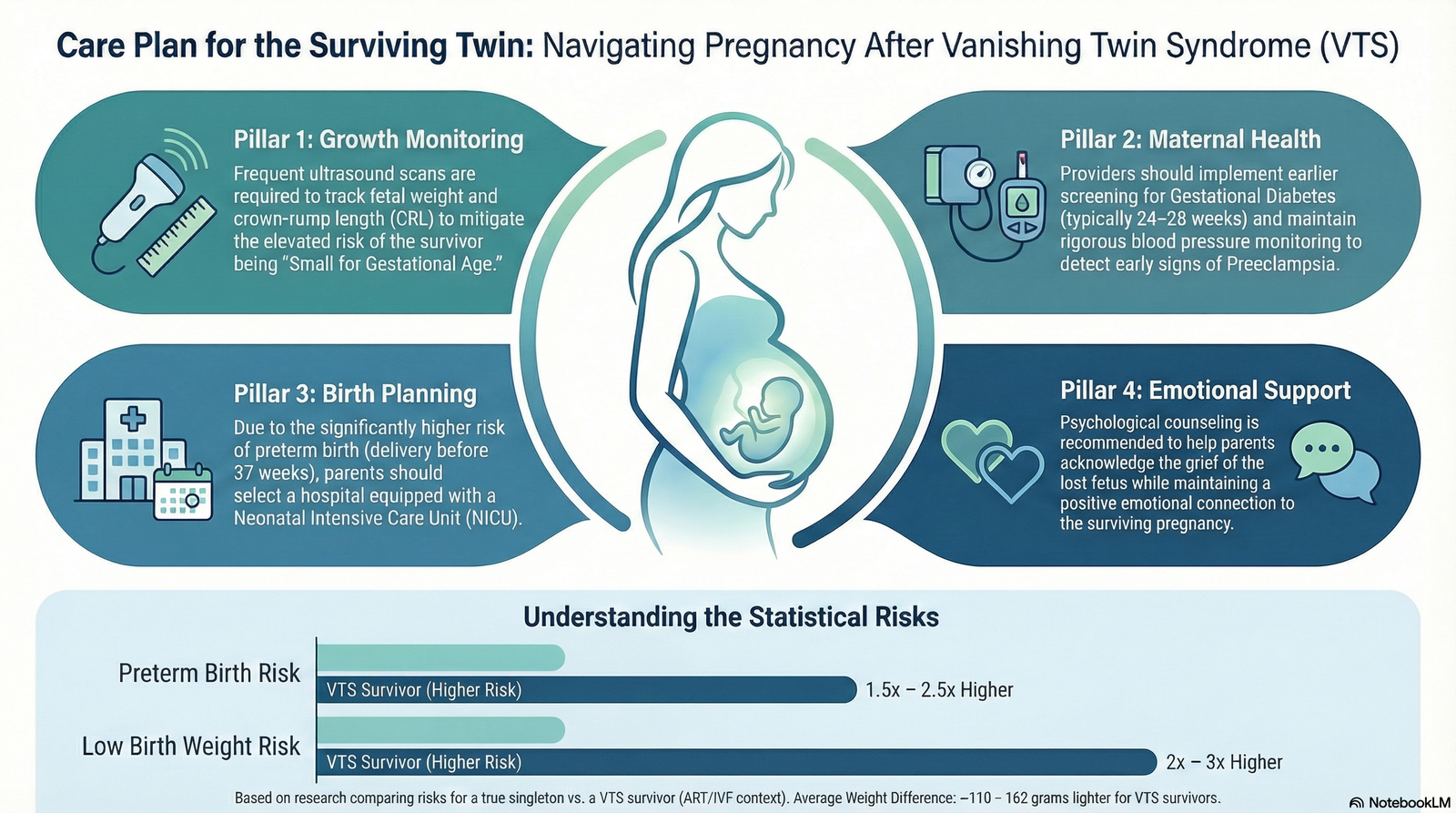
Surviving twin care focuses on growth, timing of birth, and monitoring your health along the way.
Coping Emotionally After a Vanishing Twin
A vanishing twin puts you in a strange emotional place. You are pregnant and grieving at the same time. You lost a baby, even if no one outside your scan room ever saw that baby. You are also still carrying a child who needs you to keep showing up for appointments, taking medications, and eating when you would rather cry.
You might notice some of these thoughts or feelings:
- Guilt about feeling sad when you “still have one baby”.
- Fear that the surviving twin will disappear too.
- Anger that no one warned you this could happen.
- Shame about how often you search for stories like yours.
None of these reactions means you are ungrateful or weak. They mean you are human and attached to both of the babies you saw on that first screen. Grief after a vanishing twin deserves the same respect as grief after any other pregnancy loss.
Some ways you can support yourself while you continue your pregnancy:
- Talk honestly with your partner or a trusted friend about both babies, not just the survivor.
- Ask your clinic if they can refer you to a counsellor who understands fertility trauma and pregnancy loss.
- Join an online or local support group where other parents have experienced twins that became singletons.
- Create a small private ritual to acknowledge the twin you lost, such as writing a letter, lighting a candle, or saving an ultrasound scan image of two gestational sacs.
At the same time, keep paying attention to your own body. Rest when you can, accept help, and tell your doctor if anxiety makes it hard to sleep, eat, or go to appointments. You deserve support for your mental health just as much as for your physical pregnancy.
Want help making sense of your IVF and pregnancy options?
If comparing clinics, protocols, and risks on your own feels overwhelming, our advisors can help you review real-world outcomes, clarify costs, and map out your next steps at no cost to you.

Why trust this guide? The OVU commitment
You are probably juggling hope, timelines, and a lot of tabs open in your browser. And you deserve clear, current, human advice. At OVU, we review clinic protocols, compare real quotes, and talk to people who have done this - intended parents and gestational carriers - so we can give you practical steps, not just theory. If you want help comparing options without sales pressure, we will gather itemized quotes and success data that match your exact situation. You decide, we will bring the info to your table.
Frequently Asked Questions
Does a vanishing twin harm the surviving baby?
When the loss happens in the first trimester, and the twins do not share a placenta, the surviving baby usually does not suffer direct harm from the resorbed tissue. The main concerns involve higher chances of preterm birth, low birth weight, and growth restriction, which your team can monitor with extra scans.
If the loss happens later in pregnancy or the twins share a single placenta, there can be more serious risks, so your doctors will plan close monitoring and may recommend delivery at a hospital with a neonatal intensive care unit.
Did my IVF medications cause the vanishing twin?
There is no evidence that standard IVF medications directly cause vanishing twin syndrome. The higher rate of VTS in fertility treatments mostly comes from higher rates of multiple implantation when more than one embryo is transferred. The most common underlying reason for the loss is a chromosomal issue in the embryo itself, not the stimulation drugs.
Will I notice any symptoms associated with loss, such as bleeding or pain?
Some people notice light vaginal bleeding or mild cramping around the time the twin stops growing. Others have no symptoms at all, and the only sign is a change on ultrasound. If you have heavy bleeding, soaking pads, severe pain, dizziness, or shoulder pain, contact emergency care immediately, because those can signal more serious problems.
Why did my beta-hCG levels rise more slowly?
In a typical early singleton pregnancy, beta-hCG rises by about 128% over 48 hours. In pregnancies involving vanishing twins, the average rise over 2 days is approximately 114%. This happens because the sac that is failing stops adding hormone, while the surviving embryo continues to grow and produce hCG. That mixed signal shows up as a slower rise on your blood tests.
Does my age increase my risk of a vanishing twin?
Age affects both the chance of twins and the chance of chromosomal problems. Women over 35 have more multiple pregnancies after IVF and more embryo losses. The risk of embryo reduction is about 1.3 to 2.6 times higher than in younger women and climbs further with age. By 40, the baseline risk of miscarriage and chromosomal abnormalities rises sharply, so vanishing twins also become more likely.
How is vanishing twin syndrome diagnosed?
Doctors diagnose VTS by comparing at least two ultrasounds. The first scan, usually at 6 or 7 weeks, shows more than one sac and sometimes more than one heartbeat. A follow up scan at 8 to 12 weeks shows that one sac has stopped growing or has been reabsorbed, while the other fetus continues to grow with a normal heart rate and size for dates.
Can I prevent this from happening in a future cycle?
The only reliable way to avoid a vanishing twin in a future pregnancy is to start with a singleton pregnancy. That usually means choosing a single embryo transfer instead of transferring two embryos. Professional societies, including ASRM and ESHRE, recommend single embryo transfer for many good prognosis patients to reduce twin-related risks and vanishing twin events while maintaining high live birth rates over a full course of treatment.
Reference List 7 sources
Journal Article (Research): Bu Z, Hu L, Su Y, Guo Y, Zhai J, Sun YP. Factors related to early spontaneous miscarriage during IVF/ICSI treatment: an analysis of 21,485 clinical pregnancies. Reproductive BioMedicine Online. 2020;40(2):201–206. PMID: 31883882. Available from: https://pubmed.ncbi.nlm.nih.gov/31883882/
Journal Article (Systematic Review & Meta-Analysis): Kasaven LS, Marcus D, Theodorou E, Jones BP, Saso S, Naja R, et al. Systematic review and meta-analysis: does pre-implantation genetic testing for aneuploidy at the blastocyst stage improve live birth rate? Journal of Assisted Reproduction and Genetics. 2023;40(10):2297–2316. PMID: 37479946. Available from: https://pubmed.ncbi.nlm.nih.gov/37479946/
Journal Article (Research): Dong X, Shi J, Liu X, Liu D, Li W, Zhao X, Xue X. Risk factors associated with pregnancy loss after single euploid blastocyst transfer. Frontiers in Endocrinology. 2025;15:1461088. Available from: https://www.frontiersin.org/articles/10.3389/fendo.2024.1461088/full
Journal Article (Research): Makhadiyeva D, Ibragimov A, Baikoshkarova S, Terzic MM, Issanov A. Association of working status with clinical pregnancy and miscarriage among women undergoing in vitro fertilization: single-centre cross-sectional study. International Journal of Fertility & Sterility. 2024;18(3):215–221. PMID: 38973273. Available from: https://pubmed.ncbi.nlm.nih.gov/38973273/
Committee Opinion (Guidance): Practice Committee of the American Society for Reproductive Medicine. Evaluation and treatment of recurrent pregnancy loss: a committee opinion. Fertility and Sterility. 2012;98(5):1103–1111. PMID: 22835448. Available from: https://pubmed.ncbi.nlm.nih.gov/22835448/
Journal Article (Research): Bender Atik R, Christiansen OB, Elson J, Kolte AM, Lewis S, Middeldorp S, et al. ESHRE guideline: recurrent pregnancy loss. Human Reproduction Open. 2018;2018(2):hoy004. PMID: 31486805. Available from: https://pubmed.ncbi.nlm.nih.gov/31486805/
Practice Bulletin (Guidance): American College of Obstetricians and Gynecologists. Early pregnancy loss. Practice Bulletin No. 200. Obstetrics & Gynecology. 2018;132(5):e197–e207. PMID: 30157093. Available from: https://www.acog.org/clinical/clinical-guidance/practice-bulletin/articles/2018/11/early-pregnancy-loss
Final Thoughts
Your pregnancy after IVF was already a big emotional and physical lift before anyone mentioned a vanishing twin. Learning that one baby has stopped growing is a real loss. At the same time, you still have a child who is working hard to stay with you, one heartbeat at a time.
You are allowed to grieve and to hope in the same moment. You can miss the baby you lost and love the one you are still carrying with all your heart. Stay close to your care team, keep asking questions until you understand the plan, and lean on people who can sit with you in the uncertainty.