

IVF & Fertility Treatments

Dr. Sony Sherpa (MBBS)
In addition to her clinical experience, Dr. Sherpa is a published medical researcher and holistic health advocate. Her dual expertise in emergency care and alternative therapies brings a unique lens to medically reviewed content—ensuring it is both accurate and accessible.
If you are finally pregnant after IVF and still feel like a bundle of nerves, you are part of an invisible community that knows exactly why you aren’t exhaling yet; a community that has learned how to hold its breath. That first positive test often comes after months or years of consultations, fertility shots, scans, and heartbreak. While friends who conceived easily may celebrate without a second thought, you are likely sitting with a heavy blend of deep love for this tiny embryo and the constant fear that something will go wrong and you might lose this tiny, nearly invisible, pulsing heart.
Most IVF pregnancies result in healthy births, but your brain does not always listen to statistics. You have already lived through a clinical chapter where life was measured in “grades” and viewed under a microscope; now, your body is taking over a process that is as biological as it is emotional. Whether your baby carries your DNA, a partner’s, or a donor’s, your body is performing a quiet miracle of adaptation. Instead of seeing the pregnancy as “foreign,” your immune system shifts into a sophisticated state of immunological truce, dialling back its reactivity to protect and nurture the life growing within you. Medicine controlled the journey to this point, but your body is now diligently performing its intended functions. Large studies of IVF pregnancies show clear patterns in risks and outcomes, and your doctors use that data to shape a care plan tailored specifically to you.
This guide walks you, step-by-step, through what actually happens in an IVF pregnancy. You will see how your care team dates your pregnancy, what to expect in each trimester, how twin and high-risk pregnancies are managed, and what your real risks look like in numbers rather than vague worry.
Most IVF pregnancies follow the same basic course as unassisted pregnancies, though with a few important twists. You will likely be monitored more closely, especially if you are over 35, have used frozen or donor embryos, or are carrying multiples. While singleton IVF pregnancies carry a slightly higher chance of preterm birth or blood pressure complications, proactive care and the routine timing of delivery around 39 weeks help manage these risks effectively. Once a strong heartbeat is confirmed, your chance of taking home a baby is high, particularly if you transferred a chromosomally screened (PGT-A) embryo.
If you have just received your positive result, your next step is to coordinate the transition from your fertility clinic to an obstetrician who understands the nuances of your IVF history.
What the latest research shows about IVF pregnancy
Recent large studies and meta-analyses give a clearer picture of IVF pregnancy outcomes. Frozen embryo transfers are associated with 25 to 30 percent lower risks of preterm birth and low birth weight than fresh transfers. For term singleton pregnancies conceived with infertility treatment, delivery at 39 weeks offers the lowest combined risk of stillbirth, serious newborn problems, and infant death. Preimplantation genetic testing for aneuploidy (PGT-A) can raise live birth rates from about 32 percent to 55 percent per transfer in patients with recurrent pregnancy loss.
At the same time, data show that IVF, older age, frozen cycles, and donor eggs are associated with higher rates of blood pressure (hypertensive) disorders and placental shifts. These risks are most notable for those over age 40 or 50. Your care team uses this research not to cause alarm but to build a precise “roadmap”, deciding how often to see you, which scans to prioritize, and the optimal timing for your baby’s arrival.
In This Guide
- Quick Facts: IVF Pregnancy Statistics
- Is Pregnancy After IVF Different?
- First Trimester After IVF
- Second Trimester Milestones
- Higher–Risk Monitoring in IVF Pregnancies
- Twin and Multiple Pregnancies
- Managing a High–Risk IVF Pregnancy
- Common IVF Pregnancy Complications
- Prenatal Testing After Fertility Treatment
- Emotional Journey After IVF
- Third Trimester and Delivery Planning
- Preterm Birth and NICU
- Postpartum After IVF
- Secondary Infertility and Next Babies
- Frequently Asked Questions
- Final Thoughts
Frozen transfers reduce the risk of preterm birth and low birth weight by approximately 25 to 30 percent compared to fresh transfers.
For term singletons after infertility treatment, 39 weeks gives the lowest combined risk for mother and baby.
In recurrent pregnancy loss, PGT-A can raise live birth rates from about 32 percent to 55 percent per transfer.
Quick Facts: IVF Pregnancy Statistics
- Frozen advantage: Babies born from frozen embryo transfers (FET) are about 25–30 percent less likely to be born early or very small than babies from fresh transfers.
- 39-week goal: Delivering a singleton at 39 weeks after infertility treatment gives the lowest combined risk of stillbirth, serious newborn health complications, and infant death, about 479 per 10,000 births.
- Vanishing twin rate: About 10–20 percent of twin pregnancies lose one fetus, usually before week 9.
- Preeclampsia rates by age: In women over 40, preeclampsia affects roughly 5–10 percent. In women over 50 after IVF, it can reach about 23–35 percent, depending on the study.
- Early success marker: Once a clear fetal heartbeat is seen, miscarriage risk in IVF pregnancies drops sharply. By week 13, the rate is approximately 2.2 percent.
- PGT-A and recurrent loss: In patients with recurrent pregnancy loss, PGT-A can increase live birth rates from about 32 percent to about 55 percent per transfer.
Is Pregnancy After IVF Different?
If you are used to reading about “normal” pregnancy, IVF can feel like a different world. The first big difference is how your pregnancy is dated. Natural pregnancies are counted from the first day of your last menstrual period. IVF pregnancies are dated from the day of embryo transfer, then converted into a standard gestational age. Your clinic knows the exact day fertilization happened, so your due date is very precise.
Many IVF patients also stay on hormone support, such as progesterone tablets, vaginal capsules, or injections, until around week 10 to 12. These drugs keep your uterine lining stable while the placenta matures and takes over hormone production. Transitioning off these medications can be an emotional milestone; it’s common to feel a sense of “hormone anxiety” or panic at every small cramp once you stop. To ease this transition, ask your fertility care team for a written, step-by-step schedule before you graduate to your OB-GYN’s care.
There are important medical differences to keep in view. Singleton babies conceived via IVF are approximately twice as likely to be born preterm as those conceived without treatment. In one study of first-time mothers aged 35 to 44, oligohydramnios (low amniotic fluid) occurred in about 18 percent of IVF pregnancies compared to 9 percent in spontaneous (natural) conceptions. Surprisingly, the same study found that the rate of low birth weight was actually lower in the IVF group, around 3 percent versus 9 percent. This underscores the fact that IVF pregnancies present a distinct set of risks and outcomes, rather than being universally “higher risk”.
What does this mean for you?
Your IVF history, age, and whether you used fresh, frozen, or donor embryos help your care team tailor your monitoring. For instance, if you used frozen transfers or donor eggs, your doctor may track your blood pressure and placental health more closely. If you are carrying a single euploid (chromosomally normal) embryo and are under age 38, your risk of early pregnancy loss is significantly lower. In these cases, the clinical focus often shifts toward preventative care, such as blood pressure monitoring, gestational diabetes screening, and preterm birth prevention.
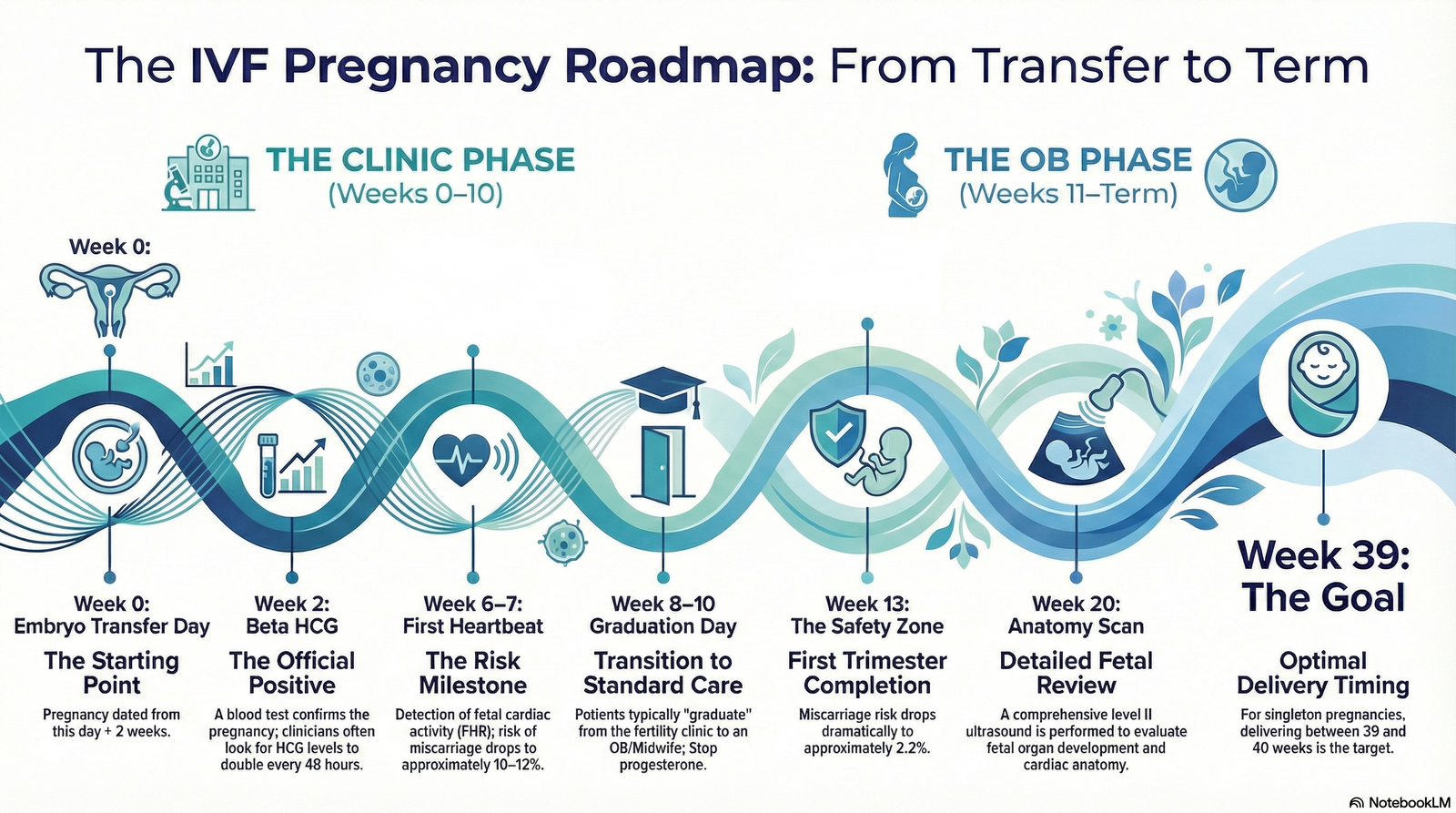
IVF pregnancy roadmap from embryo transfer to optimal delivery at 39 weeks
| Outcome | Singleton IVF | IVF Twins |
|---|---|---|
| Preterm birth | About 13 percent | About 61 percent |
| Stillbirth risk vs. singletons | Baseline | About 4 times higher |
| Typical delivery timing | Around 39 weeks | Around 36 weeks |
First Trimester After IVF: What to Expect
If you feel like you cannot breathe until you clear the first trimester, that is a very common IVF response. Weeks 4 to 13 carry the highest risk of miscarriage, so every twinge can feel like a warning sign.
- Week 4 (Poppy Seed): The embryo starts building its heart and blood vessels. By the end of this week, that tiny heart can begin to beat.
- Week 5 (Sesame Seed): The circulatory system and neural tube, the future brain and spinal cord, start forming.
- Week 6 (Hearted Lentil): Basic facial features appear. The heartbeat usually runs between 100 and 160 beats per minute. Seeing this on ultrasound is a major turning point.
- Week 7 (Hand-Footed Blueberry): Wrists and ankles form. You may already feel your waistband tighten because of bloating and water retention, even though the baby is still tiny.
- Week 8 (Noisy Raspberry): Your embryo officially becomes a fetus. The nervous system branches out, and the baby begins to move, although you cannot feel it yet.
- Weeks 9–10 (Teethed Grape to Nailed Kumquat): Tooth buds form inside the gums, and thin, clear nails grow on the fingers and toes.
- Weeks 11–13 (Moving Fig to Fingerprinted Lemon): Your baby practices stretches and twists, and unique fingerprints form on tiny fingertips.
During this time, you might see spotting or heavier bleeding and feel your stomach drop. One common cause in IVF pregnancies is a subchorionic hematoma (SCH), a blood collection between the uterine wall and the gestational sac. SCH appears in about 7.79 percent of euploid frozen embryo transfer cycles. It can cause dramatic bleeding and frightening clots, yet many pregnancies continue without long-term problems. If you see blood, call your clinic or obstetric provider right away so they can scan you and check what is going on.
Graduating from a fertility clinic to OB care
Most IVF clinics discharge pregnant patients to a regular obstetric provider between about week 8 and week 10. You go from frequent blood tests and scans to standard prenatal visits, and that shift can feel like losing your safety net. Bring printed or digital notes from your clinic, make sure your OB knows your full IVF and medication history, and ask what your monitoring plan will look like through each trimester.
Second Trimester Milestones
If the first trimester feels like holding your breath, the second trimester, roughly weeks 14 to 27, often feels more livable. Nausea usually settles down, and your energy improves, although twins and higher-order pregnancies can stay more tiring throughout.
- Weeks 14–16: Your baby grows fine, soft hair called lanugo, which helps with temperature regulation. Many parents describe this stretch as the first time the pregnancy feels a little more “real” and less like a medical project.
- Weeks 16–24: This is when most people feel the quickening, those first flutters that tell you your baby is moving. At first, it feels like bubbles or gentle tapping, especially when you sit or lie quietly.
- Week 20: You reach the detailed anatomy scan. The sonographer measures your baby’s head, brain structures, heart chambers, kidneys, spine, limbs, and more. This scan can feel tense after infertility, but for many parents, it is the first time they relax a little.
- Week 24: You usually have a glucose screening test for gestational diabetes. Gestational diabetes affects roughly 6 to 18 percent of pregnancies. IVF, age, PCOS, and higher body weight can all push that risk up, so your team may pay special attention to this test.
Higher–Risk Monitoring in IVF Pregnancies
Not every IVF pregnancy is classified as high risk, but many receive closer monitoring due to age, underlying conditions, or twin or triplet gestations. Your team can utilize the following primary tools to monitor you and your baby.
- Non-stress tests (NSTs): Around week 30, especially in high-risk pregnancies, your doctor can place two belts on your abdomen. One tracks your baby’s heart rate, and the other tracks uterine tightening. They look to see that the heart rate rises with movement, a sign of a well-oxygenated baby.
- Biophysical profile (BPP): This test combines an ultrasound with an NST and scores breathing movements, general movement, muscle tone, and amniotic fluid. A full score is reassuring and can help avoid unnecessary early delivery.
- Doppler scans: These look at blood flow in the umbilical cord and, in some cases, the uterine arteries or the baby’s brain. They help your team see how well the placenta is working and whether the baby is under stress.
These tests are not punishments for having IVF. They enable the fertility care team to detect issues early so you can adjust your plan before a small problem becomes an emergency.
Key monitoring differences for IVF pregnancies
You are more likely to have extra blood pressure checks, growth scans, and possibly NSTs in the third trimester if you conceived with IVF, especially with frozen or donor eggs, or if you are over 35. Your doctor will explain which tests you actually need and when. If you do not understand why a test is being ordered, you can always ask how it will change your care.
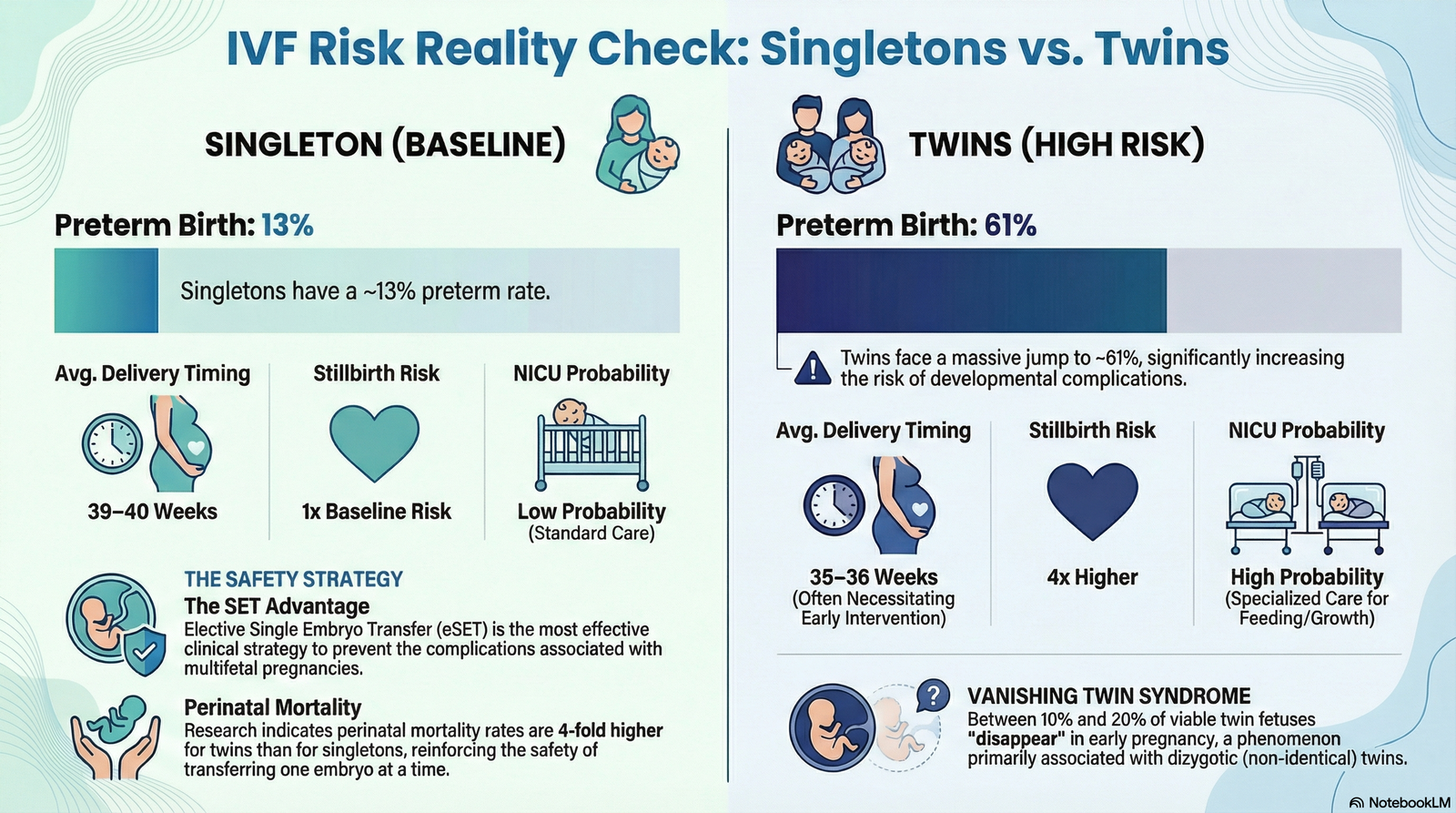
How IVF singleton and twin pregnancies differ in preterm birth and complication risks
Twin and Multiple Pregnancies After IVF
If more than one embryo was transferred, or if a single embryo split, you may be carrying twins or higher order multiples. IVF twins and triplets bring extra joy and extra risk at the same time. Understanding the numbers helps you make sense of the extra monitoring.
- Vanishing twin: If you see two sacs or two embryos on an early scan, there is still a real chance one will stop developing. The vanishing twin phenomenon affects roughly 10 to 40 percent of multifetal pregnancies, often before week 9. This can cause spotting or bleeding and intense mixed feelings, grief and relief together.
- Chorionicity: Your team looks at whether the babies share a placenta, which is monochorionic, or have separate placentas, which is dichorionic. Monochorionic twins have higher risks of complications such as twin-to-twin transfusion and have a higher risk of fetal death than dichorionic twins.
- Stillbirth risk: In twins, stillbirth is about four times more common than in singletons, even with good care. This is why growth and fluid are often checked more often late in pregnancy.
- Selective reduction: In some pregnancies with three or more fetuses, doctors discuss reducing the number of fetuses to lower the chance of extreme prematurity and serious complications. This is a deeply personal decision, and you deserve non-judgmental counselling if it comes up for you.
Managing a High-Risk IVF Pregnancy
If your pregnancy is tagged as high risk, your care plan will focus on preventing preterm birth and controlling conditions such as high blood pressure and diabetes. This sounds scary, but most of the steps are practical and clear.
- Weight, PCOS, and metabolism: For patients with PCOS and high BMI, earlier bariatric surgery has been linked with lower rates of gestational diabetes and pregnancy-related high blood pressure later on. If you are already pregnant, the focus shifts to diet, gentle exercise, and blood sugar monitoring rather than surgery.
- Blood pressure: IVF, especially with frozen transfers and donor eggs, is linked with a higher risk of early-onset preeclampsia. Some studies suggest a double the risk compared with spontaneous conception. This is why your blood pressure, urine protein, and swelling are checked so often.
- Daily movement count: In the third trimester, many providers ask you to track baby movements. A common guide is at least 10 movements in two hours during your baby’s usual active period. If you feel fewer movements, you call your provider or go in for monitoring.
When to call your doctor
In any pregnancy, but especially after IVF, you should call or seek urgent care if you have severe or one-sided abdominal pain, heavy bleeding with clots, sudden swelling of your face or hands, a severe headache, vision changes, chest pain, or if you notice a clear drop in baby movements. Trust your instincts. It is always acceptable to get checked and be told everything is fine.
Common IVF Pregnancy Complications
You have probably read long lists of possible complications, which can make you feel like everything is destined to go wrong. It helps to know what is truly more common in IVF pregnancies and what your team is watching for.
- Ovarian hyperstimulation syndrome (OHSS): OHSS usually shows up around egg retrieval and the days after. In some cases, pregnancy hormones worsen it, leading to severe bloating, pain, and shortness of breath. Modern protocols, such as using a GnRH agonist trigger instead of hCG for ovulation in high-risk patients, have cut down severe OHSS, but your team still watches you closely if you have had many follicles.
- Bleeding: In any pregnancy, bright red bleeding is treated as a warning sign. In IVF, bleeding is common from implantation, SCH, or cervical irritation from progesterone inserts. You still treat it as urgent and call in so they can scan you and check your cervix.
- Ectopic pregnancy: Even though embryos are placed directly into the uterus, ectopic pregnancies still occur in about 2 to 5 percent of ART pregnancies. Warning signs include sharp one-sided pain, shoulder pain, and dizziness with bleeding.
- Late miscarriage: Loss between weeks 12 and 20 is less common than first-trimester loss, affecting about 2 to 3 percent of pregnancies. Cervical weakness, infection, severe bleeding, and major fetal anomalies are some of the causes doctors look for if this happens.
Prenatal Testing After Fertility Treatment
Once you have lived through IVF and possible PGT, it can feel unfair to face more decisions about testing. Understanding what each test does can make those choices a little less heavy.
- Maternal serum markers: Blood tests in the second trimester measure hormones and proteins, such as AFP and hCG, to screen for conditions such as neural tube defects and certain chromosomal issues. If you used a donor egg, your levels often run higher, roughly 26 percent higher for AFP and 29 percent higher for hCG compared with spontaneous pregnancies, which can raise the chance of a false positive screen. Make sure the lab and your doctor know you had IVF and whether you used donor eggs.
- Fetal echocardiogram: Some guidelines recommend a special heart ultrasound for all IVF pregnancies. Newer data suggest that for low-risk IVF pregnancies, the rate of major heart defects is close to that of the general population. Many clinics now reserve fetal echo for pregnancies with extra risk factors, such as diabetes or suspicious views on the regular anatomy scan.
- NIPT and CCS: Non-invasive prenatal testing screens your blood for fetal DNA to look for conditions such as Down syndrome. Comprehensive chromosomal screening on embryos before transfer greatly reduces the chance of first-trimester loss due to aneuploidy, because only chromosomally normal embryos are transferred. If you have had CCS or PGT-A, you can still do NIPT, but remember that your baseline risk is already lower.
Emotional Journey: From Infertility to Pregnancy
Switching from infertility mode to pregnancy mode is rarely smooth. Your body is pregnant, but your brain is still braced for bad news. You might cry over small things, wake up at night to check if symptoms are still there, and feel guilty that you are not “enjoying every moment”.
- Feeling raw: Pregnancy after IVF often strips away your usual coping skills. You can feel like your emotions sit just under the surface, and anything can set them off.
- Anxiety spikes: One thought about labor, a NICU, or losing the pregnancy can set off a full-body panic reaction. That does not mean you are ungrateful. It means your nervous system has spent years in a high alert state.
- Relationship shifts: Your partner or support person might not feel pregnancy in their body the way you do. It can help to say directly, “I am exhausted because my body is working hard, not because I am lazy. I need help with these specific things this week.”
- Pregnant brain: In the third trimester, your baby draws a lot of your blood flow and nutrients. Studies estimate that about 20 percent of your blood volume is dedicated to the uterus and placenta. It is common to misplace keys, forget words, or feel mentally slower. You are not “losing it”. Your brain is sharing resources.
Third Trimester and Delivery Planning
By weeks 28 to 40, you can feel done in every possible way. Your lungs feel crowded, sleep is broken, and every appointment seems to come with another “just to be safe” test. For IVF pregnancies, your team will talk more about when and how you will deliver.
- Best timing for singletons: Large studies of pregnancies conceived after infertility treatment show that delivering a singleton at 39 weeks gives the best balance between stillbirth, NICU stays, and infant death. Waiting longer than 39 weeks slightly increases the combined risk, and delivering earlier without a clear medical reason increases breathing problems and NICU stays.
- Braxton Hicks contractions: Many people have irregular tightening throughout pregnancy. You tend to notice them most in the third trimester. They often ease when you rest or hydrate and do not become longer, stronger, and closer together over time. If they do change like that, you call and get checked.
- Sleep gymnastics: At this stage, many find that lying on one side with a fortress of pillows is the only position that works. A pillow between your knees and one under your belly can take strain off your hips and back.
Preterm Birth and NICU: What IVF Parents Need to Know
Because multiples are more common in IVF, and because age and other conditions are common too, preterm birth is a real possibility. Understanding the numbers can ease some fear of the unknown, even if they don’t change the plan.
- Twin timing: Most twins are born around 36 weeks. Many need a short NICU or special care nursery stay for feeding and temperature support, then go home stable.
- Triplet timing: Triplets often arrive between 32 and 34 weeks. Babies born then usually breathe on their own or with short-term help and often stay in the NICU for a few weeks.
- Milestone at 32 weeks: After about week 32, survival rates are high, and the focus shifts more toward short-term feeding and breathing support and less toward life-threatening complications.
- 24 to 27 weeks: Babies born in this window are extremely premature and need full intensive care, including breathing machines, feeding tubes, and careful monitoring. Outcomes vary widely and depend heavily on birth weight, sex, and any infections or other complications.
Postpartum After IVF
Many IVF parents say they prepared for pregnancy in detail and then felt stunned by what the first weeks after birth actually felt like. Your body, brain, and relationships all go through another set of changes, and the relief of finally holding a baby can be felt as a deep exhaustion.
- Still pregnant look: After delivery, your uterus shrinks but does not disappear right away. It takes weeks to go back down. It is normal to look about seven months pregnant for a while.
- After pains: As your uterus tightens back to its pre-pregnancy size, especially with breastfeeding, you can feel cramps for two to three days. These are often stronger in second or later pregnancies.
- Placental birth: Birth is a two-stage event. First your baby, then the placenta. The placenta usually delivers within about 30 minutes through contractions and gentle traction from your provider.
- Lochia: Postpartum bleeding, called lochia, can last for weeks. It starts bright red, then turns brown, then yellow, and white as the womb lining heals. Sudden heavy bleeding or large clots need urgent review.
Secondary Infertility and Trying for Another Baby
Once you have a baby, it is natural to start thinking about siblings, especially if you still have frozen embryos. That next chapter brings its own mix of hope and anxiety. You know the road this time, which can make it both easier and harder.
- C-section impact: Studies suggest that a previous caesarean birth can lower implantation and ongoing pregnancy rates for a later single euploid frozen embryo transfer compared with a previous vaginal birth from the same embryo cohort. Scarring and changes in uterine blood flow are possible reasons. Your doctor might suggest extra imaging of the uterine scar before another transfer.
- Embryo age: Your frozen embryos stay the age you were at retrieval, not at transfer. If you did your first cycle at 34 and transferred an embryo (embryos) at 39, those embryos still have the chromosomal risk of a 34-year-old, which is reassuring for many patients.
Want help comparing clinics and follow up IVF costs?
If this feels like a full-time job, and it often does, our advisors can collect clear, itemized quotes from verified clinics, explain monitoring plans, and help you map out your next steps at no cost to you.

Why trust this guide? The OVU commitment
You are probably juggling hope, timelines, and a lot of tabs open in your browser. And you deserve clear, current, human advice. At OVU, we review clinic protocols, compare real quotes, and talk to people who have done this - intended parents and gestational carriers - so we can give you practical steps, not just theory. If you want help comparing options without sales pressure, we will gather itemized quotes and success data that match your exact situation. You decide, we will bring the info to your table.
Frequently Asked Questions
What are the miscarriage rates after IVF?
In very early pregnancy, before a heartbeat is seen, loss rates look similar to natural conception because many conceptions end before or just after a positive test. Once a clear fetal heartbeat is confirmed, the risk drops sharply. By around week 13, the miscarriage risk is roughly 2.2 percent in IVF pregnancies.
How dangerous are IVF twins compared with a single baby?
Twin pregnancies in general, and IVF twins in particular, carry higher risks than singletons. Maternal illness and perinatal death are about four times higher than with one baby. Twins are also more likely to be born preterm, about 61 percent of twin births versus about 13 percent of singleton births. Many twins do very well, but your doctors will monitor you much more closely.
What complications should I watch for most during my IVF pregnancy?
The big three to watch for are high blood pressure, gestational diabetes, and significant bleeding, especially with pain. Subchorionic hematoma is common in IVF and often harmless in the long run, but any new bleeding, strong cramps, severe headache, vision changes, or reduced baby movements deserve urgent assessment by your care team.
How often will I be monitored during pregnancy after IVF?
Once you transition from your fertility clinic to an obstetrician, most obstetricians see you about every four weeks until week 28 in a straightforward pregnancy. This schedule increases to every two weeks until week 36 and then weekly until birth. High-risk pregnancies or multiple pregnancies often require additional monitoring, such as weekly non-stress tests and biophysical profiles during the third trimester. Your provider should map out a specific schedule so you know exactly what to expect.
What is the ideal delivery timing for IVF babies?
For term singleton pregnancies conceived after infertility treatment, available evidence points to 39 weeks as the safest target for planned delivery when there is no other medical reason to deliver earlier or later. Twins and higher-order multiples often need earlier delivery for safety, and your team will individualize that plan.
Can I breastfeed after IVF and fertility medications?
Yes. IVF does not block your ability to make milk. Your body usually starts making colostrum, the thick, antibody-rich first milk, in the mid-third trimester. Some IVF-related medications can influence milk supply, so mention every drug and supplement you are taking to your provider and to any lactation consultant you see.
When can I try for another baby after a successful IVF birth?
Most doctors recommend spacing pregnancies by at least 12 to 18 months, so your body can recover. If your birth was by caesarean, you may be advised to wait on the longer side and to discuss uterine healing before your next transfer. It is helpful to have your fertility specialist and obstetrician talk to each other, so you have one shared plan for the next cycle.
Reference List 9 sources
Journal Article (Systematic Review & Meta-Analysis): Tocariu R, Niculae LE, Niculae AȘ, et al. Fresh versus Frozen Embryo Transfer in In Vitro Fertilization/Intracytoplasmic Sperm Injection Cycles: A Systematic Review and Meta-Analysis of Neonatal Outcomes. Medicina (Kaunas). 2024;60(8):1373. PMID: 39202656. Available from: https://pubmed.ncbi.nlm.nih.gov/39202656/
Journal Article (Comparative Study): Yuan CL, He MR, He SM, et al. Differences in Pregnancy Outcomes Between in vitro Fertilization and Natural Conception in Nulliparous Singleton Pregnancies of Advanced Maternal Age: A Propensity Score–Matched Cohort Study. International Journal of Women’s Health. 2025;17:947–954. PMID: 40206690. Available from: https://pubmed.ncbi.nlm.nih.gov/40206690/
Journal Article (Research): Dai F, Lan Y, Pan S, et al. Pregnancy Outcomes and Disease Phenotype of Hypertensive Disorders of Pregnancy in Singleton Pregnancies After In Vitro Fertilization: A Retrospective Analysis of 1130 Cases. BMC Pregnancy and Childbirth. 2023;23:523. Available from: https://doi.org/10.1186/s12884-023-05838-5
Journal Article (Research): Loukopoulos T, Zikopoulos A, Kolibianakis E, et al. High-Risk Outcomes in In Vitro Fertilization Pregnancies for Women of a Very Advanced Maternal Age: Insights from a Multi-Hospital Study in Greece. Journal of Clinical Medicine. 2025;14(4):1323. Available from: https://www.mdpi.com/2077-0383/14/4/1323
Journal Article (Research): Li J, Li Z, Lin X, et al. Effectiveness of Preimplantation Genetic Testing for Aneuploidy in Improving Clinical and Neonatal Outcomes for Patients With Recurrent Pregnancy Loss. Frontiers in Endocrinology. 2025;16:1690361. Available from: https://doi.org/10.3389/fendo.2025.1690361
Journal Article (Research): Hamilton I, DeFranco E, Rossi R. Gestational Age and Birth Outcomes in Term Singleton Pregnancies Conceived With Infertility Treatment. JAMA Network Open. 2023;6(8):e2328335. Available from: https://jamanetwork.com/journals/jamanetworkopen/fullarticle/2808213
Journal Article (Systematic Review & Meta-Analysis): Pandey S, Shetty A, Hamilton M, et al. Obstetric and Perinatal Outcomes in Singleton Pregnancies Resulting From IVF/ICSI: A Systematic Review and Meta-analysis. Human Reproduction Update. 2012;18(5):485–503. PMID: 22611174. Available from: https://pubmed.ncbi.nlm.nih.gov/22611174/
Journal Article (Systematic Review & Meta-Analysis): Elias FTS, Weber-Adrian D, Pudwell J, et al. Neonatal Outcomes in Singleton Pregnancies Conceived by Fresh or Frozen Embryo Transfer Compared to Spontaneous Conceptions: A Systematic Review and Meta-analysis. Archives of Gynecology and Obstetrics. 2020;302(1):31–45. PMID: 32445067. Available from: https://pubmed.ncbi.nlm.nih.gov/32445067/
Journal Article (Review): Ahmadi H, Aghebati-Maleki L, Rashidiani S, et al. Long-Term Effects of ART on the Health of the Offspring. International Journal of Molecular Sciences. 2023;24(17):13564. PMID: 37686370. Available from: https://pubmed.ncbi.nlm.nih.gov/37686370/
Final Thoughts: Celebrating Your Journey to Parenthood
If you are reading this, you have already done something hard. You agreed to hormone shots, early morning scans, retrievals, transfers, and the emotional rollercoaster of two-week waits. You committed to this baby long before conception. That matters.
Your anxiety might not disappear, even in the delivery room. At the same time, you will notice small shifts. The first time you hear a steady heartbeat. The anatomy scan that ends with “everything looks normal”. The day you feel a kick against your hand and realize your body is not only a place of failure, but it is also the place your child lives.
Some days, you might feel that famous pregnancy glow with thicker hair and stronger nails. Other days, you might feel puffy, tired, and overwhelmed. Both realities are valid. Every coo and every late-night feed is built on the work you did through IVF and pregnancy. You do not need to be perfectly calm or endlessly grateful to deserve this. You already did the hard part by showing up, cycle after cycle. Now you get to meet the person you were doing it for.