


Dr. Sony Sherpa (MBBS)
In addition to her clinical experience, Dr. Sherpa is a published medical researcher and holistic health advocate. Her dual expertise in emergency care and alternative therapies brings a unique lens to medically reviewed content—ensuring it is both accurate and accessible.
Complete Surrogacy Guide 2025
You are here because you want real answers, not just sterile definitions. Maybe you have been weighing this for months, or maybe years, clicking through articles at 3 AM when the worries feel loudest. And you’re probably the kind of person who wants to understand things thoroughly before moving forward, while still leaving room for your gut feeling to matter. You’ve probably spent hours researching this online, trying to make sense of conflicting information, all while trying to keep your hopes in check. But you’re allowed to feel both excited about what could be possible and cautious about what comes next, both can be true at once. You value expert opinions and real stories, you want the facts, and you want them to mean something for you, right now.
Gestational surrogacy involves a carefully selected and legally protected surrogate who carries a pregnancy created from embryos made using the oocytes and sperm of the intended parents or donors.
As of 2025, the total cost for surrogacy programs in the U.S. typically ranges from $120,000 to $220,000, although it can be lower in countries with different legal frameworks. The success rates for live births per embryo transfer are generally between 50% and 65% when using embryos from tested donor eggs.
To begin your journey, assess your personal situation, including your budget, the status of your embryos (or your egg/sperm plan), your location, and your timeline. This will help you find clinics and agencies that meet your specific needs.
Next step: Use OVU’s free advisory to compare itemized quotes and success data from verified clinics and agencies that match your criteria.
What the Latest Research Shows
Recent studies from leading journals, including Human Reproduction, Fertility and Sterility, and The Lancet, have provided new insights into surrogacy success rates and gestational carrier outcomes. This guide incorporates findings from thousands of surrogacy cycles analyzed between 2020 and 2024.
In This Guide
- What surrogacy is (and isn’t)
- Is surrogacy right for you?
- Surrogacy costs in 2025 (U.S. and global)
- Success rates: what’s realistic in 2025
- Timeline: step-by-step with real-world pacing
- How to match with a gestational carrier
- Medical steps from embryo to birth
- Legal protections by location
- Insurance, leave, and budgeting
- Ethics, boundaries, and emotional care
- International programs: what to know
- Risks, safety, and how to reduce them
- Checklists, scripts, and next steps
- FAQs: short, honest answers
Total Program: $120,000–$220,000+
Clinic + IVF + Meds: $25,000–$45,000 per cycle
Per Transfer Live Birth (tested donor–egg embryos): ~55–65%
Cumulative within 1–2 transfers: ~65–75%
What surrogacy is (and isn’t)
Let’s keep it simple first. Surrogacy, as most people use it today, means gestational surrogacy: the carrier has no genetic tie to the baby, because the embryo is created from the intended parent(s)’ egg and/or sperm or from donors. And this is different from traditional surrogacy, where the carrier’s own egg is used. You might be picturing the careful line between medical steps and legal protection, and you’re right to, the medical part is only half the story.
You’re probably also wondering who uses surrogacy. People do this for different reasons: uterine factors (absence of a uterus, congenital differences, fibroids or scarring), medical risks that make pregnancy unsafe, repeated IVF failure or repeated losses, or being a single parent or LGBTQ+ family that needs help to carry. And yes, many who choose surrogacy are both optimistic about the outcome and realistic about the path.
Here’s what actually happens. First you confirm embryos or a plan to create them, then you match with a gestational carrier (through an agency or independently). You will go through several main stages — legal contracts, medical screening, embryo transfer, preganacy care, and finally, delivery and parentage. You might find yourself calculating dates and timelines in your head constantly, like you’re trying to see the future on your calendar.

Complete surrogacy timeline: 6 sequential phases from initial matching through delivery, typically 12–18 months total with a recommended 30% time buffer.
Okay, real talk. This part can feel like a second job, the emails, the forms, the insurance, the legal reviews, and the hard conversations. And you can be patient when needed, but this waiting is tough, because your heart is involved even when you’re just collecting lab results. Those targeted ads that keep following you around, yeah, we know that’s annoying.
Is surrogacy right for you?
Whether you are just starting to research or you are deep into planning, you probably want a gut–check. You’re someone who doesn’t just accept things at face value, you want to understand the why, and that’s a strength here. And you’ve likely already imagined what it might feel like to be in a delivery room as a parent, while also feeling unsure about the steps it takes to get there. That mix is normal, and it’s allowed.
Surrogacy may make sense if carrying a pregnancy is unsafe or not possible; you’ve had multiple IVF attempts without success tied to uterine issues; you’re a male same–sex couple or a single dad using donor eggs; or you’ve had recurrent pregnancy loss unrelated to embryo quality. And if you’re considering IVF now to create embryos, your timing can make sense for your situation, especially if you’re ready to compare clinics and egg or sperm options. Waiting a bit longer to gather more info, also valid.
Look, I get it. Part of you wants to start yesterday, and another part wants three more quotes and one more consult. And while you appreciate detailed information, sometimes you just want simple answers like “What will this cost and how long will it take?” Both needs can be met, we’ll cover both.
Overwhelmed Comparing Fertility Clinics & Costs?
It feels like a full-time job (and it is). Let our advisors do the hard work. We'll listen to your unique needs and personally match you with top-verified providers suited for your journey. At no cost to you.
Get My Free ConsultationNo payment. No pressure. Just clarity.
Surrogacy costs in 2025 (U.S. and global)
Those numbers you’ve been adding up, probably late at night when you can’t sleep, they’re heavy. You’ve likely already had that conversation with your partner or someone you trust about budget, what you can afford, and where to draw lines. And if you’ve got a spreadsheet going, color–coded tabs and all, you’re not alone; a lot of people do precisely that to feel in control. The financial spreadsheet you’ve been updating is a good time to plan.
U.S. 2025 headline range: most full programs with an agency land between $120,000 and $220,000+, with some cases below or above, depending on insurance, multiple coverage, number of transfers, location, and whether you need donor eggs. And independent matches can be lower, though you’ll take on more of the logistics yourself. So the best way to think about cost is in buckets you can compare line by line.
| Cost Component | Typical 2025 U.S. Range | Notes you’ll care about |
|---|---|---|
| Agency fee | $18,000–$35,000 | Covers matching, coordination, some screening; tiered “match guarantees” vary |
| Carrier base compensation | $45,000–$75,000+ | Higher for experienced carriers, multiples, C–section, or certain states |
| Carrier benefits/allowances | $8,000–$20,000 | Monthly allowance, maternity clothing, travel, lost wages, life insurance |
| Legal (both sides) | $7,000–$15,000 | Contract + parentage orders; state law and complexity matter |
| Escrow management | $1,200–$2,000 | Independent third–party escrow is strongly recommended |
| Medical screening (carrier) | $2,500–$6,000 | Labs, HSG or saline ultrasound, psychological evaluation; some agencies include parts |
| IVF cycle (intended parent) | $18,000–$30,000 | If creating new embryos, not needed if you already have embryos |
| Medications | $4,000–$8,000 | Stimulation meds (if cycling) + carrier meds for lining prep |
| Embryo transfer procedure | $3,500–$6,500 | Clinic fees, monitoring, and ultrasound–guided transfer |
| Carrier health insurance | $8,000–$30,000 | Varies by state and plan; ACA plans often used; riders for surrogacy vary |
| Delivery & OB care (out-of-pocket) | $5,000–$20,000+ | Deductibles, co–pays, and out–of–network surprises, plan carefully |
| PGT-A testing (optional) | $3,000–$6,000 | May improve per–transfer success; not a guarantee |
| Donor eggs (if needed) | $18,000–$45,000+ | Varies with fresh vs. frozen, donor type, agency fees |
| Travel & lodging | $2,000–$10,000+ | For screening, transfer, delivery; try to plan near major hubs |
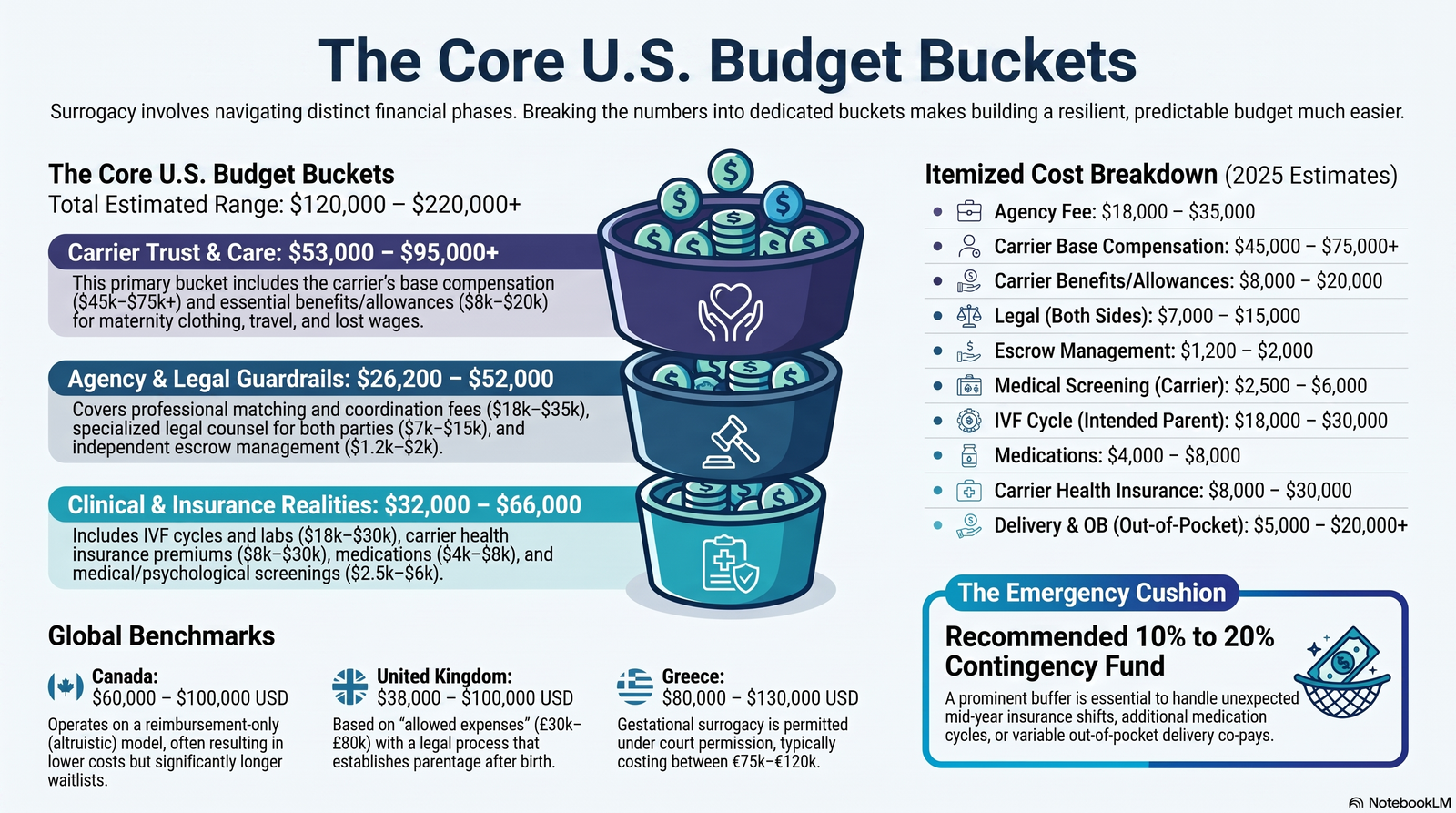
Surrogacy Cost Breakdown
Outside the U.S., ranges depend on law and model. Canada often totals CAD $80,000–$140,000 (roughly USD $60,000–$100,000) with reimbursements rather than compensation as only altruistic surrogacy is considered legal; waitlists can be long. And the U.K. typically totals £30,000–£80,000 with allowed expenses to the carrier (as the only type of surrogacy recognized by the law is altruistic) and a later parental order process. Some European countries allow gestational surrogacy under court permission (for example, certain arrangements in Greece), costs can run €75,000–€120,000 depending on legal and clinic fees. However, many countries restrict or prohibit commercial surrogacy or allow it only for citizens. Laws can change, therefore it is essential to verify current rules before planning travel. So if you’ve seen tempting price tags abroad, add the legal safety check, the travel load, and the time risk into your math.
Here’s what actually happens with budget planning. Most families build a base budget for one transfer and one pregnancy with a ~10–20% buffer for unknowns, then they plan how they’ll cover a second transfer if needed. And some set up a “go/no-go” decision point tied to medical updates, which can lower stress because you know when you’ll pause and review. You can be flexible and still protect your limits, both can fit in the plan.
Success rates: what’s realistic in 2025
You want numbers that actually help with decisions, not just optimistic headlines. You value both expert data and lived experience, and you’re right to cross–check both. And yes, your specific embryo quality and the carrier’s uterine screening matter more than any single national average. The headline is helpful, but the details drive your odds.
Typical 2025 expectations, as quoted by many clinics, are that per–transfer live birth rates are around 50–65% when transferring one euploid (PGT–A tested) embryo from donor eggs to a screened gestational carrier. For embryos from intended parent eggs, success per transfer commonly ranges from 40% to 60% depending on female age at retrieval, embryo quality, and testing. So cumulative live birth within 1–2 transfers often lands ~65–75% when there are multiple euploid embryos available and the carrier is well–screened.
Important context: clinics vary, and reporting methods differ (per transfer vs. per cycle vs. per embryo). And gestational carriers are screened for prior uncomplicated births and uterine health, which tends to raise success chances compared to average IVF. But even great odds don’t erase randomness—implantation is still biology, not a vending machine. You know yourself better than any statistics could predict, so use the data to plan, not to judge yourself.
The two–week wait after transfer can mess with your head, no matter how rational you are. And you might find yourself analyzing every twinge or symptom, while reminding yourself that progesterone can mimic pregnancy signs. Both thoughts will probably visit you at 3 AM, it’s normal.
Timeline: step-by-step with real-world pacing
You might be at the beginning, middle, or nearing the end of your process, and you still want to know how long each piece might take. You tend to plan ahead, but you’re also learning to adapt when a lab date slips or a court filing takes an extra week. And the truth is, most families underestimate timelines by about 30%, because so many steps are sequential.
Here’s a simplified timeline that many people go through: It typically takes about 2 to 4 months to find a match and complete the legal paperwork (agencies with pre–screened carriers can be quicker, while independent matches can take longer). After matching, expect 3 to 8 weeks for medical and psychological evaluations, depending on clinic schedules and carrier availability. Following that, you will need 1 to 2 months to prepare the gestational surrogate mother’s uterine lining and coordinate the transfer process, with a pregnancy test usually done 10 to 14 days after the transfer. After that, standard prenatal care lasts around 9 months, with steps to establish parentage occurring close to delivery or shortly thereafter, depending on your location.
Small delays may interfere with ideally envisaged timeframe: a clinic calendar conflict, an insurance review, a last-minute lab that expires, and a snowstorm on transfer week. And yes, sometimes you have to redo a test because the lab lost a sample, it’s maddening. Build slack time into your mental plan, you’ll thank yourself later.
How to match with a gestational carrier
You’re someone who cares deeply, perhaps more than you show to others, and the idea of trusting another person with something this precious can feel both hopeful and scary. Part of you wants to share everything with loved ones, part of you wants to keep this close until there’s news to share. And you might be wondering what matters most in a match: values alignment, medical history, location, or insurance. All of it matters in different ways.
Two main paths to explore before making a final decision:
- An agency match: you pay a fee for recruiting, screening coordination, matching, and support through transfer and pregnancy.
- Independent match: you find a carrier yourself (community groups, referrals), then you assemble your own team (attorneys, mental health providers, escrow, clinic) to screen and support. So agencies can feel smoother for time–strapped families or first-timers; independent can fit those who want a more hands–on role and lower fees.
When reviewing a carrier profile, consider the following:
- Look for a history of uncomplicated term births with available records.
- Ensure there is a clean obstetric history, meaning no severe preeclampsia, no more C–sections than the clinic allows, and no preterm births that fall below the clinic’s cutoffs.
It is important that the carrier has a stable life situation, a supportive partner if needed, is a non–smoker, has a BMI within the clinic’s acceptable range, does not use substances, and can reliably attend appointments. Additionally, make sure there is alignment on important values such as preferences for single embryo transfer versus twins, options on medical terminations, communication styles, and delivery plans.
Here’s what actually happens in a good match call. You talk about normal life stuff first—kids, pets, favorite coffee orders—because connection matters. And then you cover the hard but important topics: how you each handle stress, what you’d want to know day–to–day, and how you make decisions if something unexpected comes up. You’re looking for that feeling of “we can talk about anything,” and if you sense it, trust that, your intuition is usually more accurate than you think.
Medical steps from embryo to birth
Even if you’ve done IVF before, the IVF process with a gestational carrier involved is a little bit different. You’ve probably already created a mental timeline of how this could work, counting luteal phases and clinic windows. And while you appreciate details, sometimes you want the quick version you can screenshot for your notes to understand each step and each scenario that may happen.
Essential steps: begin with an embryo plan by confirming whether you have frozen embryos or by planning a new IVF cycle using either your own eggs or donor eggs. Next, complete comprehensive carrier screening, which includes reviewing medical records, obtaining OB clearance, performing necessary lab tests (for infectious diseases and hormone levels), and conducting an ultrasound of the uterus. Additionally, a psychological evaluation should be completed for both the carrier and the intended parents.
Before starting any medications, it is essential to establish a legal contract that outlines the boundaries, responsibilities, and financial arrangements involved.
For lining preparation and transfer, the carrier will take estrogen and progesterone to prepare the uterine lining. The clinic will then schedule the transfer, followed by a beta hCG test approximately 10 to 14 days later to check for pregnancy.
During the pregnancy, standard OB visits will be conducted, and a high–risk consultation may be necessary if complications arise. An anatomy scan and glucose screening will also be performed, and a delivery plan will be coordinated with the hospital.
Optional add–ons: And PGT–A testing of embryos to select euploid embryos for transfer and exclude mosaic ones. ERA/endometrial receptivity testing is less commonly used now and is clinic–specific. So single embryo transfer is the default to lower risks for the carrier and baby; twins increase medical risk and costs, and most contracts avoid it unless all agree.
You may have a small panic the night before meds start, wondering if you missed a consent form or an email. And you might check your phone every hour for an update after the transfer; it’s normal to care this much. You have a strength that others might not always see, it shows up in these quiet, steady steps.
Legal protections by location
Legal guardrails make this safe for everyone — the carrier, her family, and you. You don’t have to become a legal expert, but knowing the basics helps you make the right calls. And yes, your state or country can change the order of steps (for example, pre–birth orders vs. post–birth parentage). The right attorney will translate this without jargon.
In the U.S., many states permit compensated gestational surrogacy with clear parentage pathways, including CA, CO, CT, DC, DE, IL, ME, NH, NJ, NV, NY, VT, WA, and more. And a few states still have restrictions or unique steps; for example, some states limit compensation or require post-birth parentage. So always retain separate, specialized attorneys for both you and the carrier; this isn’t a place to DIY.
Outside the U.S., models vary. Canada and the U.K. allow altruistic surrogacy with expenses; parental orders typically happen after birth. And some European countries allow it under court oversight, while others prohibit it. So international programs add layers: immigration, citizenship, and birth registration; work with a legal team experienced in cross–border cases before you transfer an embryo.
Legal can feel like a pile of PDFs you don’t want to read, but this is where you protect relationships and reduce stress. And if you’re torn about a clause, ask your attorney to explain it in one plain sentence; you’re allowed to push for clarity. You want to understand the why, and that’s fair.
Insurance, leave, and budgeting
You’ve probably already called an insurance rep and gotten three different answers to the same question. You value simple answers, and insurance rarely gives those. And still, some patterns help you make decisions quickly.
Carrier medical insurance: And ACA marketplace plans are often used when employer plans exclude surrogacy, but policies vary by state and year. Maternity is covered, but surrogacy exclusions can shift costs back to you; review with an experienced broker. So you’ll also see line items for life insurance for the carrier, short–term disability or lost wages, and bedrest support if medically needed.
Leave and planning: Many intended parents use PTO or unpaid leave around delivery; some employers offer leave for non–gestational parents. Health Savings Accounts (HSA) and Flexible Spending Accounts (FSA) can help with certain medical expenses. So create a delivery–week plan: flights, a hotel near the hospital, NICU what–ifs, and a list of documents for hospital admitting and parentage steps.
Budget tips that actually help: Ask for itemized quotes with caps for add–ons (multiples, C–section fees, invasive procedures). Build a 10–20% contingency fund. So set reminders to re–check insurance terms 60–90 days before transfer and again before the third trimester; plans can change mid–year.
Ethics, boundaries, and emotional care
You care about doing this right, not just getting it done. You sense things others might miss, especially when it comes to how people are treated. And you want a match where everyone feels respected, safe, and heard. That shows who you are.
Ethical anchors: Separate attorneys for the carrier and for you, informed consent for all medical steps, fair compensation (or expense reimbursement where required), and transparency about risks. Respect the carrier’s autonomy—she’s the patient in medical settings. So align in writing on decisions about selective reduction/termination for medical reasons, prenatal testing, and communication habits.
Emotional care: Therapy helps—independent support for both you and the carrier normalizes the swirl of feelings. Community matters too: a small circle who respects your privacy can be a lifeline. So some days you’ll feel ready to start immediately; other days you’ll want more time. Both are okay, and both can lead to wise choices.
Look, I get it. The cashier asks an innocent question about the due dates, and you feel a lump in your throat, or you feel weirdly guilty for not carrying. And then later you feel proud, excited, and deeply grateful that this is even possible. Both are true, the feeling doesn’t cancel the love you already have for this baby.
International programs: what to know
Maybe you’re comparing programs across borders because of cost, wait times, or laws. You’re weighing logic against intuition: numbers on one side, comfort and safety on the other. And your instincts about risk are worth listening to.
Checklist for cross–border decisions: Legal parentage and citizenship — who is the legal parent at birth, and what steps are needed for passports or travel documents? Hospital practices and NICU access: can both intended parents be present, what consent is needed. So what if the baby arrives early: where will you stay, how long might you need to remain in–country, and what are the out–of–pocket medical costs?
You might see lower costs in certain countries, but add the line items for multiple trips, visas, translation and notary fees, and longer time away from work. And verify current rules; some countries limit surrogacy to citizens or married heterosexual couples, and these rules can shift year to year. If you’ve suspected the cheapest option might not be the best fit, you’re probably right.
Risks, safety, and how to reduce them
Every pregnancy carries risk, and surrogacy adds layers to manage thoughtfully. You don’t shy away from facts; you want a plan that reduces risk for the carrier and baby. And that’s exactly what good screening and protocols are for.
Medical risks for carriers include typical pregnancy risks (gestational diabetes, preeclampsia), plus procedure–related risks if invasive steps are needed. And transfer with multiple embryos raises risks for preterm birth and NICU stays; that’s why single embryo transfer is common. So choose clinics with clear criteria for carrier eligibility, and align with the carrier on care plans if complications arise.
How to reduce risk: Select a single–embryo transfer whenever possible. Use euploid embryos when available. So choose a carrier with prior term births and no major complications, and ensure the clinic actually reviews records. Keep communication open and kind; stress isn’t the only factor, but a connected team handles bumps better.
It is essential to note that no plan removes all risk, and that’s hard to sit with. And yet, each careful step—screening, single embryo transfer, up–to–date prenatal care—moves the odds in the right direction. You’re more resilient than you sometimes give yourself credit for.
Checklists, scripts, and next steps
You want clear steps, not just routine conversations. You’re the type of person who likes to understand things fully before making big decisions, and you also want a short list you can actually use this week. And that’s exactly what follows.
Quick checklist to start now and clarify your embryo status: how many embryos do you have, what’s their testing status, do you need a new IVF or a donor plan. Budget rough–in: set a base budget and a 10–20% buffer; decide how you’d fund a second transfer if needed. So pick your approach: agency vs. independent; ask 2–3 agencies for itemized quotes and timelines; if independent, line up an attorney and a therapist experienced in third-party reproduction.
Carrier match conversation starters: “What kind of updates feel good for you day–to–day?” “How do you like to handle uncertainty in medical decisions?” “What does support look like for you in the third trimester?” So “How do you feel about single embryo transfer?” “What are your thoughts on prenatal testing and what we’d do with the information?”
Delivery week packing list for intended parents: A hospital letter from your attorney, copies of IDs, contract summary pages for the hospital and car seat, a simple gift for the carrier, and a plan for meals and sleep. Extra phone chargers, comfy clothes, and patience for paperwork.
Scripts for hard conversations: To a well–meaning friend who asks a lot: “We’re so grateful for your support; we’ll share updates when we have them, thanks for understanding our need for some privacy.” To a carrier when you’re anxious: “I’m feeling nervous today and wanted to check in, kindly tell me if I’m over–texting, I want to be respectful.” So to your employer: “I’ll be becoming a parent through surrogacy; I’d like to review leave options for non–gestational parents and flexible scheduling around the due date.”
If you’re anything like others who’ve walked this path (and something tells me you are), you’ll feel calmer when you know your next two tiny steps, not the next twenty. And today, your two steps can be simple: gather your embryo info and book a consult. That’s it, you don’t have to do it all this week.
Want help comparing surrogacy agencies and costs?
If this feels like a full–time job (and honestly, it can), our advisors can collect clear, itemized quotes from verified providers and map your timeline—at no cost to you.
FAQs: short, honest answers
How many embryos should I have before matching? Many clinics prefer at least 1–3 good–quality embryos available before finalizing a match, especially if you’re using PGT–A tested embryos. And if you’re still creating embryos, some agencies will start pre–matching while you’re cycling. So your exact plan depends on your age, embryo quality, and whether donor eggs are part of your plan.
Do I need PGT–A? Not always. PGT–A can help select euploid embryos and may raise per–transfer success and lower miscarriage risk, especially with advanced maternal age or donor eggs. And it’s not a guarantee; talk to your clinic about your embryo count and history. So if you only have one embryo, testing might not change your choices.
Can we have twins? Most programs strongly recommend single embryo transfer because twins raise risks for the carrier and the babies. And many contracts and clinics require SET (single embryo transfer) unless all parties and medical staff agree otherwise. So if twins feel important, discuss risks in detail with your medical team and carrier.
How private is this? You control who you tell. Some keep it close until viability scans, others tell a few trusted people right away. And you can ask the carrier how she prefers to share or keep things private too. So set a shared plan early to avoid awkward moments later.
What about failed transfers? It happens, even with great embryos and perfect lining. And the plan is usually to review meds, labs, and the transfer report, then try again if everyone’s comfortable. So give yourself a few days if you need them; you’re allowed to feel it and still choose to continue.
Research Findings
U.S. national ART reports and registry analyses consistently show higher per–transfer success when transferring euploid embryos to screened gestational carriers, with outcomes shaped by embryo source and age. See CDC ART reporting: CDC ART Reports and clinic–level data at SART Clinic Finder.

Why trust this guide? The OVU commitment
You are probably juggling hope, timelines, and a lot of tabs open in your browser. And you deserve clear, current, human advice. At OVU, we review clinic protocols, compare real quotes, and talk to people who have done this - intended parents and gestational carriers - so we can give you practical steps, not just theory. If you want help comparing options without sales pressure, we will gather itemized quotes and success data that match your exact situation. You decide, we will bring the info to your table.
Putting it all together: a sample plan
Maybe you’ve been thinking about this for months, or maybe years, and you want to picture what happens next week, not just the big picture. You value structure with flexibility, a plan that breathes. And here’s one you can adjust.
Month 0–1: Schedule two consults—one at a clinic and one at an agency. Gather embryo reports or book an IVF plan if needed. So ask for itemized costs, expected timelines, and single–embryo transfer policies.
Months 2–3: Choose your agency or independent path and initiate legal counsel retention on both sides. Pre–match with 1–2 carriers if agency–based; confirm your priorities (SET, views on prenatal decisions, location). So set your escrow and insurance review in motion.
Months 4–5: Medical and psychological screening for the carrier, records review, and clinic clearance. Finalize the legal contract once medical clearance is in hand. So start lining prep and schedule transfer.
Transfer + 2 weeks: And beta test window—keep your days simple, and plan gentle distractions. If the result is positive, book an early ultrasound. If the outcome is negative, plan a structured review call with the clinic and agency, then decide next steps with a clear mind.
Pregnancy: Regular OB care, sharing updates in a rhythm that works for both of you. Begin your delivery planning with hospital paperwork as early as possible. So, finalize parentage orders according to your location and pack your documents a month before the due date.
Delivery: And be present, patient, and kind with yourselves and with the carrier team. Bring the letter from your attorney and your IDs. So take photos with everyone who wants to, then rest—you’ve probably not slept much the week before.
Real scenarios that might be yours
Scenario A: You have 3 euploid embryos from donor eggs. You’re both optimistic and realistic, and you want to move efficiently. And you choose an agency with short match times and a clinic that does single embryo transfer as standard. So your per–transfer odds are strong, you plan to try up to two transfers before any big review.
Scenario B: You have one embryo from your eggs at age 39, untested, and you’re not sure about a new retrieval. You want simple answers, but you also want to understand nuance. And your clinic suggests trying this embryo first while lining up a donor option if needed. So you set a calendar reminder for a decision call after this transfer to keep your choices clear.
Scenario C: You’re a same–sex male couple starting from scratch. You value both numbers and feeling comfortable with the team, and you need clarity on egg donor choices. And you pick a clinic with strong donor egg program data, ask for their single embryo transfer live birth rates with euploid embryos, and choose an agency that pre-screens carriers for insurance. So you budget on the higher end due to donor costs and plan a realistic 12–18 month window.
Well, you might be reading this while strolling down the street and suddenly feel overwhelmed, then feel oddly calm by the time you reach the parking lot. And that’s the pattern for many people here: your mind is doing its best to protect you. Your intuition about this is probably more accurate than you think.
What to do if something goes off-script
Plans change, even good ones. You can be patient, but uncertainty today hits different. The best way to handle it is to identify your trigger points and determine your next step.
If the match falls through, ask for a structured debrief: what happened, what would we do differently, and how soon can we be re–matched? Update your must–haves vs. nice–to–haves list. So give yourself 48 hours of quiet if you need it, then restart with fresh eyes.
If the transfer fails, request the transfer report, hormone levels, and embryo grading, and then schedule a review with the REI. Consider lab tweaks like progesterone timing or transfer technique adjustments. So decide on a timeline for the next try, even if it’s “Takes 2 weeks—actually, more like 3” to reset.
If there’s a medical curveball, lean on your OB team and your attorneys; write down questions the moment they pop up so you don’t forget. Keep values–based decisions front and center. So communicate early and often with the carrier; kindness and clarity make hard days easier.
Frequently Asked Questions
How many embryos should I have before starting surrogacy?
Most clinics recommend having at least 2–3 good–quality embryos before matching with a carrier. If using PGT–A tested embryos, 1–2 may be sufficient given higher success rates. Some agencies will start pre–matching while you're still creating embryos.
What's the difference between gestational and traditional surrogacy?
Gestational surrogacy (99% of cases) uses IVF with embryos from intended parents or donors — the carrier has no genetic connection. Traditional surrogacy uses the carrier’s own eggs and is rarely done due to legal and emotional complexity.
Can I use insurance to cover surrogacy costs?
Some employer plans cover IVF for creating embryos. Most don’t cover carrier compensation or agency fees. The carrier needs maternity coverage — often through ACA marketplace plans. Review all policies carefully for surrogacy exclusions.
How do I choose between an agency and independent matching?
Agencies offer pre–screened carriers, coordination, and support but cost $18,000–35,000. Independent matching saves money but requires you to manage screening, legal, and logistics. Consider your budget, time, and comfort with complexity.
What happens if the first transfer doesn't work?
About 35–50% of first transfers don’t result in pregnancy. Most contracts include 2–3 transfer attempts. You'll typically wait 1–2 months between attempts. Success rates are cumulative — 65–75% achieve pregnancy within two transfers using quality embryos.
Can international intended parents use U.S. surrogacy?
Yes, many U.S. programs work with international families. You will need to plan for extended stays (2–4 weeks minimum after birth), immigration documents, and embassy/consulate appointments for your baby’s passport and citizenship.
You are someone who does their research—that’s why you’re here. You’ve balanced spreadsheets and feelings in the same hour, and you’ve probably noticed your best decisions come from a mix of data and that quiet sense of “this is right.” And wherever you are—just starting, in the middle, or closer than you expected—you are exactly where you need to be for today. The questions you are asking show you are approaching this thoughtfully. So trust that mix of research and intuition that brought you here; you have more strength than you might realize right now.
Related articles

Surrogacy in Ukraine 2026: Complete Legal Guide, Costs & Process
Surrogacy & Cross-Border Fertility Your guide to surrogacy in Ukraine Last Updated: 15 October 2026 Medically Reviewed 20 min read Evidence-based When you are staring at a mountain of fertility research and wondering if your dream of parenthood is still possible, Ukraine often stands out as one of the clearest options. You want more than a clinic: you want a path that feels legally secure, medically sound, and financially transparent. You might have tried multiple IVF cycles, faced painful setbacks, or been told that pregnancy is too risky for your health. At the same time, you see that surrogacy programs
19 min read
Gestational vs Traditional Surrogacy 2026: Complete Comparison Guide
Surrogacy & Family Building Your guide to gestational and traditional surrogacy Last Updated: 10 December 2025 Medically Reviewed 18 min read Evidence-based If you are thinking about surrogacy, you have probably already ridden the rollercoaster of fertility treatments, second opinions, and late‑night searches. It is completely normal if you feel hopeful and scared at the same time. You are trying to protect your heart, your future child, and your finances, all in one decision. Right now, your main choice is between gestational surrogacy and traditional surrogacy . Most modern surrogacy journeys, around 80% to 90%, use gestational carriers, and only
23 min read
How to Choose a Surrogate: 2026 Complete Matching & Screening Guide
Surrogacy & Fertility Your guide to surrogate matching Last Updated: 08 December 2025 Medically Reviewed 14 min read Evidence-based If you are thinking about using a surrogate to build your family, you are carrying a lot on your shoulders. You are hopeful, but you are also about to entrust someone else with a pregnancy you have long dreamed of. That blend of excitement and fear is completely normal. We understand how heavy this choice feels. Therefore, it is essential to take the time to prepare yourself emotionally and logistically for the path ahead. Remember that every moment of careful consideration
13 min read