

Alternative Family Building

Dr. Sony Sherpa (MBBS)
In addition to her clinical experience, Dr. Sherpa is a published medical researcher and holistic health advocate. Her dual expertise in emergency care and alternative therapies brings a unique lens to medically reviewed content—ensuring it is both accurate and accessible.
If you are exploring embryo donation in 2026, you are walking a path shared by many who have discovered that family is defined by more than just biology. Whether you have arrived here after a long IVF journey or a shift in your family planning, it’s natural to feel a complex mix of grief for the genetic link and profound hope for the future. You aren’t just taking in a “genetic blueprint” from the donors; you are providing the heartbeat, the bond, the home, and the love that turns a tiny spark of potential into your child.
Large U.S. registry data show that donated-embryo transfers lead to a live birth in about 44% of cases, which is similar to results seen in younger IVF patients. Professional bodies, such as the American Society for Reproductive Medicine (ASRM) and the European Society of Human Reproduction and Embryology (ESHRE), now include embryo donation in their guidelines for safe and ethical fertility care. In this guide, you will see how the process works, what it costs in real numbers, and how to think through whether this path fits your life.
Embryo donation means you receive and transfer an embryo donated by another person or couple from their IVF cycle. A clinic-based transfer usually takes 2–3 months once an embryo is available. An agency-led “embryo adoption” often takes 8–14 months, as it involves personalized matching and home study steps. Currently, in the United States, live birth rates are around 43.5–44% per transfer.
Next step: Book a consultation with a fertility clinic or embryo donation program to check your health, your legal situation, and which route, donation or adoption style, fits you best.
Latest Research Insights
44% Live Births – Donated Embryo Power: A U.S. analysis of more than 8,700 frozen donated-embryo transfers found that about 44% led to a live birth. Most babies were singletons, and over three-quarters of singleton babies were born at term with a healthy birth weight. For you, this means donated embryos offer success rates close to those seen when people use eggs from women under 35. Source: American Journal of Obstetrics & Gynecology (PMID: 36368430).
54% vs. 49% Pregnancies – Age of Egg Matters: When donated embryos came from eggs retrieved before age 35, about 54% of transfers resulted in a pregnancy. When eggs came from women 38 or older, this dropped to about 49%. Your own age still affects pregnancy and birth risks, but the chance that the embryo implants and grows mainly follows the age of the egg provider. Source: American Journal of Obstetrics & Gynecology (PMID: 36368430).
44% vs. 45% – Donated Embryos vs. Fresh Double Donation: A registry study from 2016 to 2019 compared embryo donation with cycles that used both donor eggs and donor sperm in the same treatment. Live birth rates were almost identical, 44.1% with donated embryos and 45.1% when clinics created new embryos from donor eggs and donor sperm. If you need both donor eggs and donor sperm, using existing donated embryos delivers similar results to building new embryos from two donors. Source: Fertility and Sterility (DOI: 10.1016/j.fertnstert.2025.06.045).
77% Healthy Singletons – Strong Newborn Outcomes: In the same U.S. cohort, about 84% of births after donated-embryo transfer were singletons. Around 77% of those singletons were born at or after 37 weeks and weighed at least 2,500 grams. If you choose a single, well-screened embryo, your chances of a full-term, healthy-weight baby are encouraging. Source: American Journal of Obstetrics & Gynecology (PMID: 36368430).
These findings are based on peer-reviewed research, yet every journey is unique. Your specific outcome will be shaped by your medical history, the embryo’s potential, and your clinic’s expertise. Go through your personal numbers with your fertility specialist.
In This Guide
Pregnancy: 56–70%
Live Birth: ~44%
Clinic route: 2–3 months
Agency route: 8–14 months
Clinic: $5k–$10k
Agency: $11k–$15k
Donation vs. Adoption: How They Actually Differ
If you are just starting to read about this, the language can sound confusing. People use “embryo donation” and “embryo adoption” as if they are the same thing. Legally and practically, they are not.
Embryo Donation: A Medical and Legal Transfer
Embryo donation treats the embryo as donated tissue. In the United States, the FDA regulates this as a form of tissue donation. You sign contracts that transfer rights and responsibilities from the original family to you. There is no home study. The focus sits on medical screening, legal paperwork, and the timing of the transfer. This route is usually faster and less expensive.
Embryo Adoption: An Adoption-Style Framework
Some agencies and faith-based groups talk about “embryo adoption” because they view the embryo as a child waiting for birth. They built the process to look more like traditional infant adoption. You complete a home study, pay separate agency fees, and go through a more detailed matching process with the placing family.
Medical societies such as ASRM describe “embryo adoption” as a social term, not a legal one. For many families, though, that word choice feels closer to how they see the decision. The key for you is this: no matter which word a program uses, your clinic and your lawyer still treat this as a donation plus a legal contract.
Who This Path Fits Best
Embryo donation is a versatile path that offers a new beginning for many different types of families. As you consider whether this aligns with your future, it can be grounding to see the various ways this journey supports different life situations:
- Dual-factor infertility: When both egg and sperm present significant issues, and repeated treatments have not worked.
- Advanced maternal age: If you are over 40 and your own egg quality makes IVF success less likely, but you feel physically and emotionally ready to carry a pregnancy.
- Recurrent pregnancy loss or implantation failure: After several failed IVF cycles with your own eggs, donor embryos offer a fresh starting point.
- Known genetic conditions: If you or your partner carries a serious inherited condition, and you want to avoid passing it on.
- Solo parents and same-sex couples: If you are building your family without a male–female couple, donor embryos can shorten wait times compared with traditional infant adoption.
Underneath all of this is one feeling. You want to be pregnant and parent a child, and you are open to genetics coming from another source.
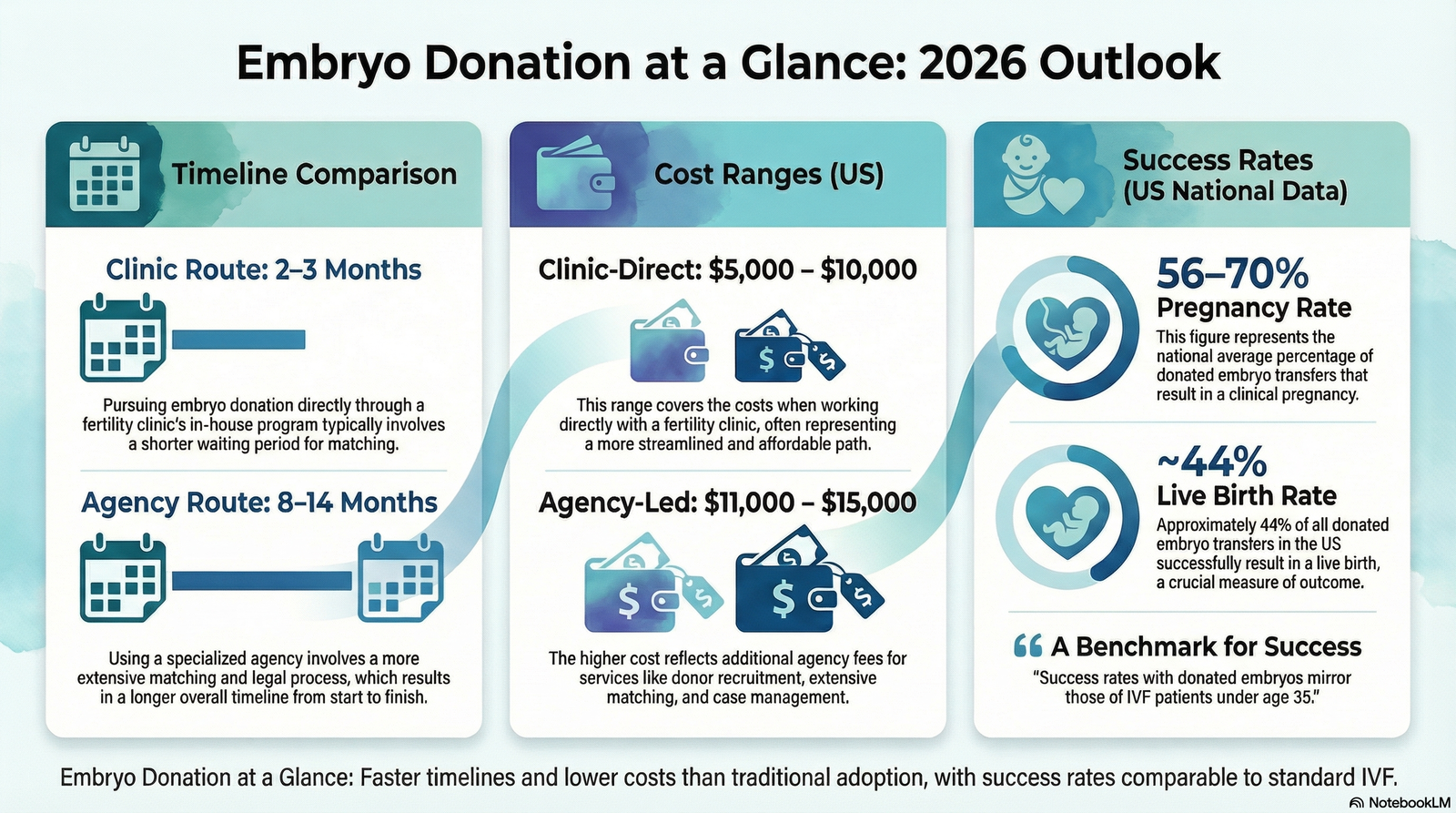
Embryo Donation 2026: Timeline, cost ranges, and success rates in one view.
The 7-Step Medical Process
If you are used to hearing about full IVF, embryo donation can feel simpler. The eggs are already collected, fertilized, and frozen. Your focus is getting your body ready for one key day: the transfer.
| Step | What Happens | Typical Timing |
|---|---|---|
| 1. First Appointment | You review your medical history and talk through the kind of embryo you feel comfortable with, including donor background, ethnicity, and genetic history. | Day 1 |
| 2. Fertility Assessment | Your doctor checks your blood work, hormones, uterus, and overall health to confirm that pregnancy is safe for you. | Week 1–2 |
| 3. Endometrial Preparation | You take estrogen and progesterone to build a thick, receptive uterine lining that can support implantation. | Weeks 3–6 |
| 4. Optional Receptivity Test | Some clinics offer an ERA test to fine-tune the timing of your transfer so it lines up with your personal implantation window. | Before first transfer or between cycles |
| 5. Embryo Thawing | The lab team warms the embryo using vitrification techniques. With modern freezing, survival rates reach very high levels. | Transfer day, a few hours before |
| 6. Embryo Transfer | The doctor threads a thin catheter through your cervix and places the embryo in your uterus under ultrasound guidance. | About 15 minutes |
| 7. Pregnancy Test | You do a blood test (beta-hCG) to see if the embryo implanted and is growing. | 10–14 days after transfer |
Clinical Insight
Many programs now prioritize elective single embryo transfer (eSET). This approach is designed to support the healthiest possible pregnancy by focusing on transferring one high-potential embryo at a time. It significantly reduces the complications associated with high-risk multiple pregnancy and multiple births while maintaining high success rates, ensuring the safest journey for both you and your future child.
The 2026 Cost Blueprint: U.S. vs. International
Pre-blueprinting the financial side of your journey is often one of the most challenging steps, but it’s also one of the most empowering. You deserve a clear, honest view of the costs involved so you can plan a budget that aligns with your unique case and family goals.
Depending on your medical history and regional regulations, your plan might include a single elective transfer (eSET) for the highest safety, or a multiple embryo transfer if recommended by your specialist. In certain jurisdictions, you may also have the option to select specific embryos for family balancing. By securing these details early, you replace uncertainty with an inclusive and transparent budget, protecting you from hidden fees and ensuring you are financially prepared for every stage of your path.
United States: Agency vs Clinic
If you work through an agency such as NEDC or Nightlight Christian Adoptions, total costs for your first attempt usually fall between $11,000 and $15,000. That total includes agency fees, legal work, screening, and one transfer. Additional transfers through the same program often cost around $4,100 per attempt.
If you go through a clinic that runs its own donation program and handles matching in-house, your total is usually lower. Most clinic-based donations land between $5,000 and $10,000 for medical care, lab work, and required FDA screenings.
Mexico and Europe
For many families, exploring embryo donation beyond their own borders is a way to find a path that aligns more closely with their personal values and budget. Some patients consider cross-border options in Mexico or specific European hubs to secure lower costs, shorter wait times, or regulatory frameworks that better support their needs, such as different rules around anonymity or the option for family balancing (sex selection). While travel adds a layer of logistics, the trade-off is often a more accessible path and a clinical experience that feels like the right “fit” for your family’s unique journey.
| Region | Estimated Cost | What Stands Out |
|---|---|---|
| Mexico | $5,000–$8,000 | Some clinics offer money-back guarantee or shared-risk packages with partial or full refunds if you do not have a live birth. |
| Spain | €3,050–€3,190 | High-volume donor embryo programs in clinics such as Instituto Bernabeu, Eugin, and FIV Valencia. |
| Portugal | €2,500–€2,750 | EU regulations plus lower prices than in many Western European countries. |
| Slovakia | €1,400–€1,800 | Very low cost for vitrified blastocyst transfer bundles, often with good lab outcomes. |
When comparing costs, remember that a truly inclusive budget goes beyond the clinic’s base fee. To get a clear picture of your investment, factor in travel, local accommodation, and any necessary schedule adjustments, alongside specialized services like PGT testing. While an international path often offers significant savings, establishing a complete financial blueprint ensures you can move forward with confidence, free from the stress of unexpected expenses.
Legal Questions & Parentage
A common fear sounds like this: “What if the genetic parents change their minds and try to take the baby?” That fear is understandable, but it does not match how the law treats embryo donation in most places.
In the United States and much of Europe, embryo donation runs on contracts. The donors sign documents that give up their rights and duties toward any child born from those embryos. Once the embryo is transferred and you give birth, you are the legal parent. In most U.S. states, the woman who gives birth is the legal mother, and her spouse or partner can be listed as the other parent on the birth certificate if local law allows.
Ethnicity, Gender, and Cross-Border Care
Ethnicity: Because donor pools often mirror the diversity of the local region, the availability of certain backgrounds can vary. If you are looking for a specific ethnic match, your program may discuss a more personalized search or a longer matching timeline for certain backgrounds. Your dedicated case manager will work closely with you to guarantee that your family’s heritage remains a priority throughout the selection process.
Gender: In the United States and Mexico, clinics can use PGT-A to identify the sex of an embryo. If you wish, this information can be shared with you to help with family balancing. In contrast, most European countries prohibit non-medical sex selection. In these regions, clinics use PGT strictly to screen for serious genetic conditions and do not disclose the sex of the embryos to the parents.
Cross-border embryo transfer: If you work with embryos stored overseas, specialist couriers can move frozen embryos between clinics using cryoshipping tanks that stay cold for several days. Typical transport costs fall between $1,000 and $3,000, depending on the distance, customs coordination, and the level of white-glove service required to secure the safe arrival of your embryos at their destination.
Risks, Emotions, and What To Watch For
Even when the statistics are encouraging, this journey is lived deeply—both in your body and in your home. Being honest about the potential physical risks and emotional nuances allows you to prepare with confidence.
Medically, your main risks come from pregnancy itself, especially if you are older or have other conditions such as high blood pressure or diabetes. Your clinic will screen you before treatment and may advise you to make health changes first. Emotionally, you may grieve the loss of a genetic link and worry about future questions from your child. Many parents find that counselling before and after transfer makes them feel less lonely and their anxiety more manageable.
More Evidence On Safety, Family Life, and Guidance
3–8 SDQ Points – Children Coping Well: In a survey of parents after embryo donation, average child behavior scores stayed between 3 and 8 points on a scale where 0–13 counts as normal. Parents described their children as emotionally settled and socially well-adjusted. This suggests that being born from a donated embryo does not, on its own, raise your child’s risk of emotional or behavioral problems. Source: Human Reproduction (PMID: 38373211).
21 Families Followed – No Extra Child Problems: In one follow-up study, 21 embryo donation families were compared with IVF and adoptive families when children were 2–5 years old. Parents after embryo donation sometimes felt more anxious and more private about origins, but the children themselves did not show more psychological difficulties. This means your openness, support, and day-to-day parenting matter more than the way conception happened. Source: Journal of Family Psychology (PMID: 17605550).
High Disclosure Rates – Talking Builds Trust: In newer studies, many parents who used embryo donation had already told their children about their conception. Parent–child relationships stayed warm and secure on standard questionnaires. Honest, age-appropriate stories about your child’s beginnings can support trust and a strong sense of self. Source: Human Reproduction (PMID: 38373211).
Detailed Screening Rules – Official Guidance: The American Society for Reproductive Medicine advises full screening for donors, including infections, genetics, and mental health, and careful evaluation of recipients. Good programs follow these standards and also offer counselling, so you can think through long-term questions before you sign. Source: ASRM Gamete and Embryo Donation Guidance 2024.
Information Rights – European Guidance: European experts recommend giving clear, written information about medical risks, legal rules, and future contact options to anyone using donated embryos. They also support giving donor-conceived adults a path to learn about their origins when they reach a mature age. Source: Human Reproduction Open (PMID: 35178481).
Ongoing Contact Options – Flexible Family Ties: Research on “embryo adoption” programs shows that many families choose some level of contact between donor and recipient families. Some children grow up knowing they have genetic siblings in other households. You can shape a contact plan that matches your comfort level and your child’s needs over time. Source: Human Reproduction (PMID: 28333272).
These findings come from peer-reviewed journals. They give you a helpful big-picture view, but your own path will be unique. Use this evidence as a base for deeper talks with your doctor and counsellor.
Country and Clinic Options
Once you feel clear that embryo donation is the right path for you, the focus shifts to finding the right clinic for your journey. This is where a clinic’s values, the legal protections of the region, and the overall “feel” of the program begin to matter most. You deserve a team that not only offers clinical excellence but also aligns with your vision for your family.
Some patients stay local so they can see their own doctor and avoid travel. Others look toward international hubs in Mexico, Spain, Portugal, or Slovakia to find a path that better aligns with their budget or their preference for specific legal frameworks, ranging from strictly anonymous to open-identity donation. For those dreaming of a larger family, some programs offer the option to secure a sibling cohort of embryos from the same donors, ensuring that any future children can share a full genetic connection.
Whichever route you choose, prioritize a partnership with a clinic that is transparent about its success rates with donated embryos, its screening standards, and its approach to legal and emotional support. You deserve a team that answers your questions with clarity and treats your family decisions with respect.
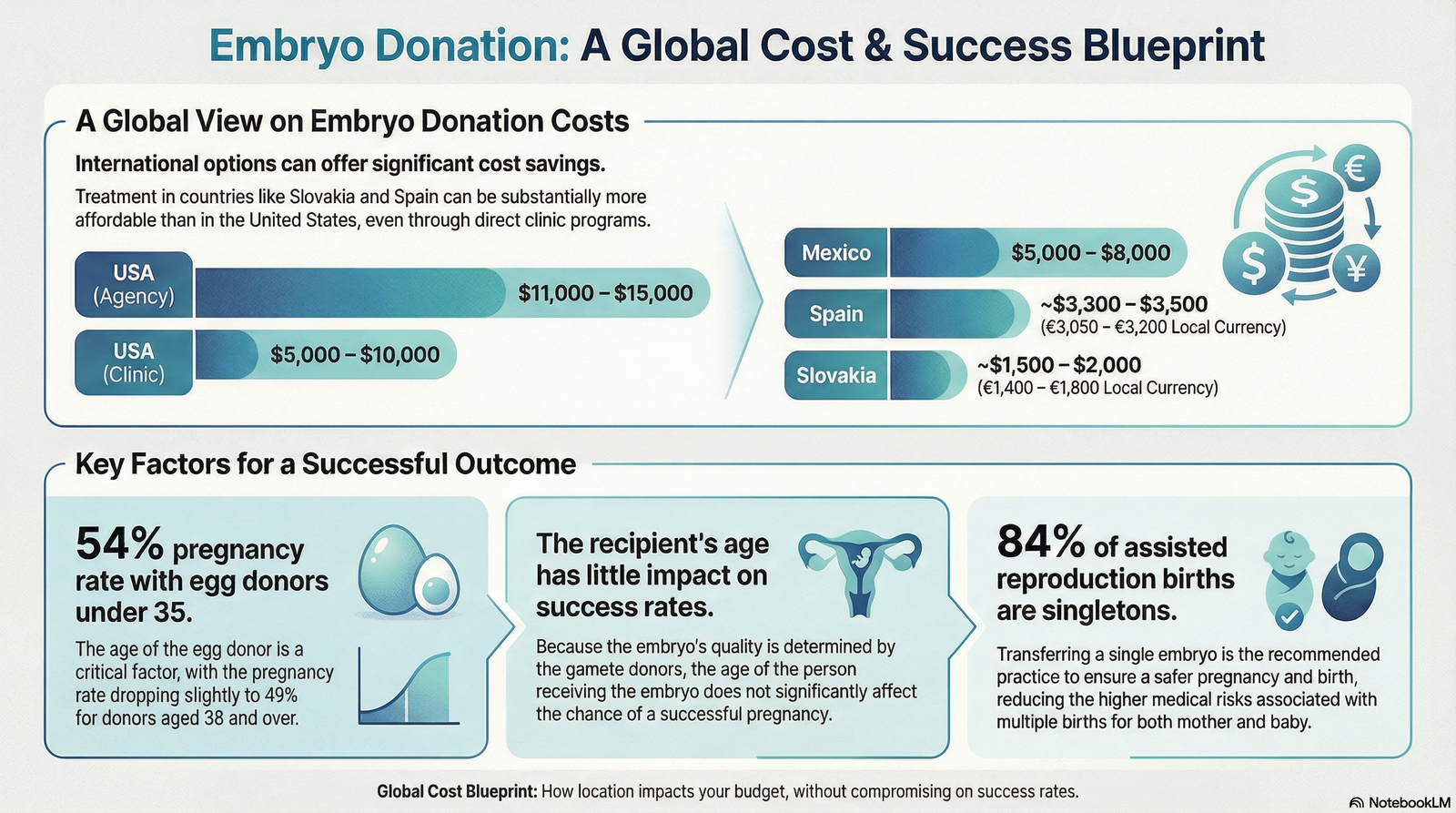
Big picture: pregnancy chances and cost ranges for embryo donation across regions.
Want help comparing clinics and costs?
If this feels like a full-time job, and many people say that it does, our advisors can collect clear, itemized quotes from verified clinics and map out timelines that fit your life at no cost to you.

Why trust this guide? The OVU commitment
You are probably juggling hope, timelines, and a lot of tabs open in your browser. And you deserve clear, current, human advice. At OVU, we review clinic protocols, compare real quotes, and talk to people who have done this - intended parents and gestational carriers - so we can give you practical steps, not just theory. If you want help comparing options without sales pressure, we will gather itemized quotes and success data that match your exact situation. You decide, we will bring the info to your table.
Frequently Asked Questions
Will I bond with a child who is not genetically mine?
Studies of embryo donation, egg donation, and adoption all point to the same truth. Parents build strong bonds through pregnancy, touch, feeding, and shared daily life. Many donor-conceived families even show slightly higher levels of warmth and involvement, because parents waited so long and worked so hard to get there.
Are there extra medical risks for the baby?
Birth defect rates after embryo donation look similar to those in standard IVF and in the general population. Since donor embryos usually come from younger women who passed medical screening, the chance of chromosomal issues is often lower than if you are using your own eggs in your forties.
Can single women or same-sex couples use donated embryos?
Yes. In many jurisdictions, including the United States, Spain, Portugal, and Bulgaria, embryo donation is a welcoming path for single parents by choice and female same-sex couples. However, inclusivity is often a patchwork of local laws and clinic policies. The key is to ensure both legal eligibility (is it allowed in that country?) and donor consent (did the donors agree to their embryos being used by a non-traditional family?). Your first step should be to consult with a clinic that specializes in diverse family building to confirm that your specific path to parentage is protected and that they have an eligible donor pool for your needs.
Do I need a lawyer?
While the clinic handles the medical side, a fertility law specialist ensures your legal foundation is secure. It is highly recommended to have your own legal review of the contracts, especially if you are navigating different state or international laws. This step is about more than just paperwork; it’s about securing your parentage and ensuring that your rights and those of your child are fully recognized and protected wherever your family calls home. A brief legal consultation now provides lasting peace of mind for your future.
Reference List 9 sources
Journal Article (Research): Lee JC, DeSantis CE, Boulet SL, Kawwass JF. Embryo donation: national trends and outcomes, 2004–2019. American Journal of Obstetrics & Gynecology. 2023;228(3):318.e1–318.e7. PMID: 36368430. Available from: https://pubmed.ncbi.nlm.nih.gov/36368430/
Journal Article (Research): Tsai S, Scarpaci MM, Eaton JL. Outcomes of in vitro fertilization cycles with embryo donation compared with double gamete donation with cryopreserved donor oocytes. Fertility and Sterility. 2025;124(6):1265–1271. doi: 10.1016/j.fertnstert.2025.06.045. PMID: 00000000. Available from: https://doi.org/10.1016/j.fertnstert.2025.06.045
Journal Article (Research): Salari S, et al. Psychosocial outcomes of children born via embryo donation. Human Reproduction. 2024;39(3):ePub ahead of print. PMID: 38373211. Available from: https://pubmed.ncbi.nlm.nih.gov/38373211/
Journal Article (Research): MacCallum F, Golombok S, Brinsden P. Parenting and child development in families with a child conceived through embryo donation. Journal of Family Psychology. 2007;21(2):278–287. PMID: 17605550. Available from: https://pubmed.ncbi.nlm.nih.gov/17605550/
Committee Opinion (Guidance): Practice Committee of ASRM. Guidance regarding gamete and embryo donation. Fertility and Sterility. 2024. PMID: 38970576. Available from: https://pubmed.ncbi.nlm.nih.gov/38970576/
Committee Opinion (Guidance): ESHRE Working Group. Good practice recommendations for information provision for those involved in reproductive donation. Human Reproduction Open. 2022;2022(1):hoac001. PMID: 35178481. Available from: https://pubmed.ncbi.nlm.nih.gov/35178481/
Journal Article (Research): Frith L, Blyth E, Lui S. Family building using embryo adoption: relationships and contact arrangements between provider and recipient families. Human Reproduction. 2017;32(5):1092–1099. PMID: 28333272. Available from: https://pubmed.ncbi.nlm.nih.gov/28333272/
Journal Article (Research): Armuand G, Sydsjö G, Skoog Svanberg A, Lampic C. Attitudes towards embryo donation among healthcare professionals working in child healthcare: a survey study. BMC Pediatrics. 2019;19:209. PMID: 31238888. Available from: https://pubmed.ncbi.nlm.nih.gov/31238888/
Website/Report: Embryo Donation & Adoption 2026: Process, Costs & What to Expect. OVU.com. 2026. Available from: https://ovu.com/fertility-insights
Final Thoughts
If you are still reading, you are likely carrying a lot. Whether you are exhausted from IVF shots and failed cycles, anxious about the risk of another miscarriage after hearing that first heartbeat, worried about long wait times to get started, frustrated by legal limits, or grieving the absence of a genetic link with your baby, that feeling is real and valid. Yet, embryo donation offers a door that many don’t realize is open when they first begin their journey toward parenthood.
In the end, the essence of being a parent isn’t found in a genetic code. It lives in the quiet moments of rocking a feverish toddler, the pride of first-day-of-school photos, and the values you pour into your child every day. Embryo donation offers a story that begins with a different spark and then hands you the pen. You are the author of the chapters that follow.