


Dr. Sony Sherpa (MBBS)
In addition to her clinical experience, Dr. Sherpa is a published medical researcher and holistic health advocate. Her dual expertise in emergency care and alternative therapies brings a unique lens to medically reviewed content—ensuring it is both accurate and accessible.
If you are trying to build your family and running into roadblocks, it probably feels like you are living in two worlds. In one, friends seem to get pregnant without thinking about it. In the other, you are juggling clinic visits, lab results, and bills that look more like a mortgage down payment than a medical copay. It is an exhausting place to live.
The numbers behind what you are feeling are stark. The World Health Organization estimates that one in six people worldwide experience infertility, and a single IVF cycle in the United States often costs $15,000 to $25,000 before you even add medications or travel. At the same time, professional groups like ASRM now frame infertility as a disease that deserves real medical coverage, not a lifestyle choice you should fund alone.
That is where your employer comes in. In 2024, about 42% of U.S. employers offered some form of fertility benefit, up from 30% just four years earlier. More companies are starting to treat fertility care as part of basic health coverage, but the details still vary wildly from job to job and state to state. This guide helps you understand what your plan really offers, where the gaps sit, and how you can use those benefits to protect both your future family and your finances.
Employer fertility benefits can turn a single IVF cycle that costs $15,000 to $25,000 into something you can actually manage, especially when they cover medications, egg or sperm freezing, and even surrogacy or adoption support. The catch is that coverage depends on your state, whether your plan is fully insured or self-funded, and how your employer designs the benefit, so you need to read the fine print and ask direct questions about caps, eligibility rules, and what counts as infertility.
Next step: Log in to your benefits portal, download your Summary Plan Description, and highlight everything related to infertility, IVF, egg freezing, surrogacy, and adoption before your next HR or clinic visit.
What the Latest Research Shows About Employer Fertility Coverage
Large employers that add IVF coverage see big jumps in treatment use, especially among lower-income staff who could not afford care before. States with strong infertility mandates show almost three times as many IVF transfers as states with no coverage, and employers report that adding fertility benefits rarely causes a major spike in health care costs.
These patterns come from peer-reviewed studies of U.S. insurance plans, employer benefits, and fertility preservation mandates. They show that the way your plan is designed can make the difference between never starting treatment and having a real shot at pregnancy.
In This Guide
- Why Employer Fertility Benefits Matter
- How Plan Types and State Mandates Shape Your Coverage
- LGBTQ+ Paths, Surrogacy, and Adoption Support
- Fertility Preservation and Egg Freezing at Work
- What IVF Really Costs and How to Budget
- Money-Saving Strategies and Grants
- Top Employers for Fertility Benefits in 2026
- Frequently Asked Questions
About one in six people worldwide live with infertility at some point.
A single IVF cycle in the U.S. often costs $15,000 to $25,000 before add-ons.
By 2024, 42% of U.S. employers offered some kind of fertility benefit.
Why Employer Fertility Benefits Matter
If you are comparing jobs or trying to make your current plan work harder for you, employer fertility benefits can be the difference between doing one desperate cycle and being able to follow a full treatment plan. They also tell you a lot about how much your company values your life outside work.
On the employee side, surveys show that 65% of workers would change jobs for better fertility benefits, and 72% would stay longer at a company that supports their family-building goals. Among people who already have these benefits, 81% say they feel more engaged and productive, and 96% feel more loyal to their employer.
On the employer side, offering fertility coverage is not just about being kind. High-risk twin and triplet pregnancies from self-funded IVF attempts can cost employers many times more than a single, well-managed IVF cycle with single embryo transfer. Research on mandates and employer coverage shows that companies can expand benefits without blowing up their health budgets while also moving Diversity, Equity, and Inclusion goals forward.
Latest Research Insights
3x More IVF Cycles – The Coverage Effect: When a large U.S. university added IVF coverage, IVF use almost tripled, rising from about 34 to 93 cycles per 10,000 women. The biggest jump was in lower-salaried employees, whose IVF use increased nearly tenfold, showing that coverage especially helps people who could not afford treatment before. Source: JAMA (PMID: 31721982).
10x Jump for Lower Income Staff – Closing the Gap: At that same employer, IVF use in the lowest salary group increased from about 8 to 79 cycles per 10,000 women after coverage was added. This was a nearly tenfold increase, much larger than in higher salary groups, which suggests that employer fertility benefits can sharply narrow income-based access gaps. Source: JAMA (PMID: 31721982).
79% More Egg Freezing Patients – When Employers Pay: At one hospital-based fertility center, adding employer coverage for planned egg freezing led to a 79% increase in insured patients freezing eggs. The share of all egg freezing patients who had hospital-based insurance rose from about 5% to 42%, so more people could act earlier instead of waiting until fertility has dropped. Source: Journal of Clinical Medicine (J Clin Med. 2024;13(4):1072).
3x More IVF Transfers – Strong Mandates vs. No Coverage: Clinics in states with strong infertility insurance mandates performed about 3.35 IVF transfers per 1,000 women of reproductive age, compared with 1.21 in states with no coverage. That is almost three times as many treatment attempts, which gives more people a real chance at pregnancy instead of stopping after a single self-funded cycle. Source: Journal of Clinical Medicine (J Clin Med. 2024;13(4):1072).
97% of Employers – Costs Stayed Stable: In a survey of U.S. companies, 97% of private employers that added infertility coverage reported no meaningful rise in their overall medical insurance costs. At the same time, IVF coverage among very large employers rose from 30% to 42% in a single year, which suggests that more companies can offer these benefits without breaking their health budget. Source: F&S Reports (PMID: 34484553).
These findings come from peer-reviewed research. Your experience will depend on your health, age, and personal situation. Talk with your fertility specialist and your HR or benefits team about what these numbers mean for you.
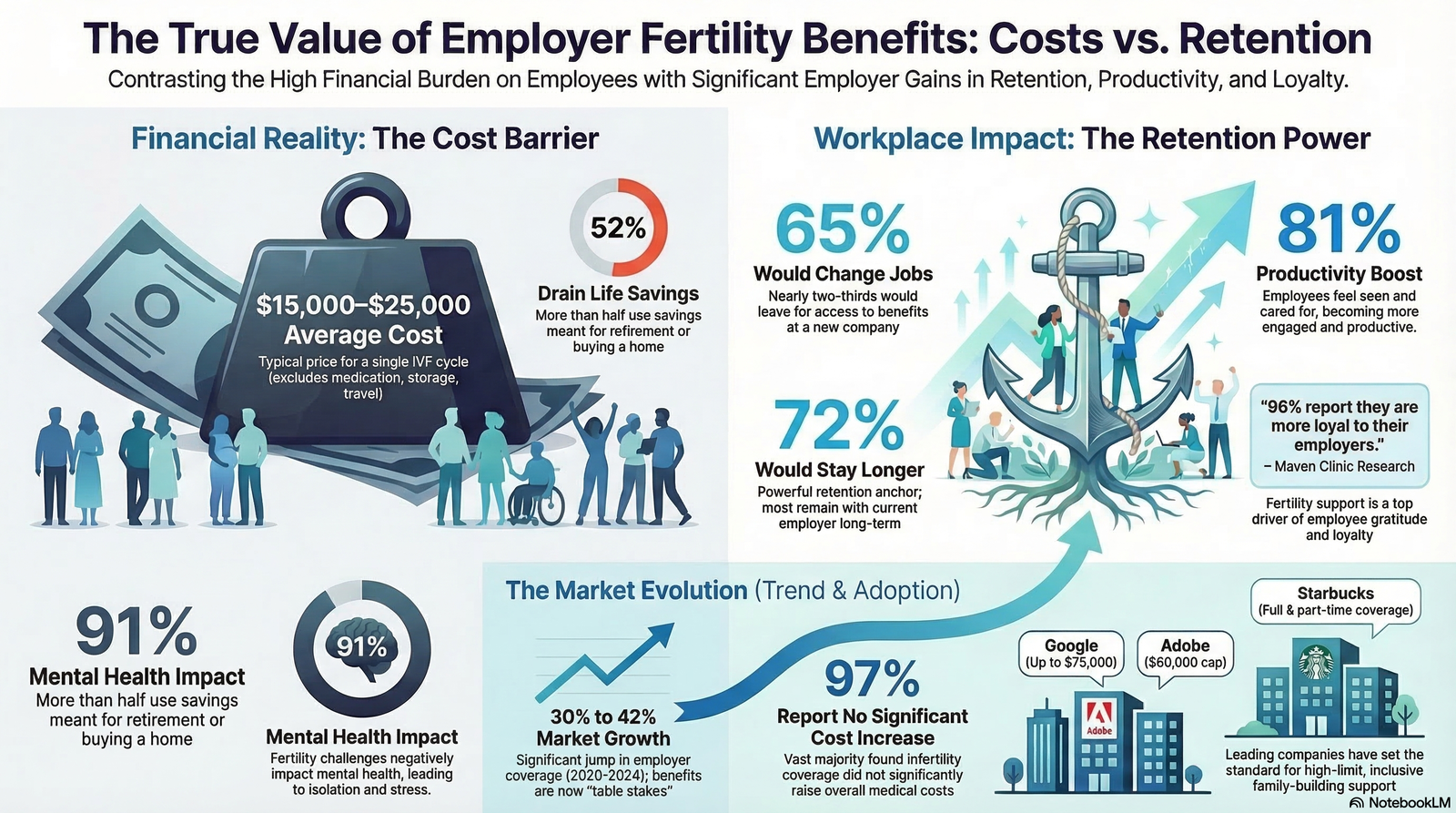
Employer fertility benefits can soften IVF costs and increase employee retention when they are designed well.
| Benefit Impact | Key Number | What This Means for You |
|---|---|---|
| Average IVF Cycle Cost | $15,000–$25,000 | You often need insurance or employer help to afford more than one cycle. |
| Employees Who Would Switch Jobs | 65% | You are not alone if you are considering changing jobs for better fertility coverage. |
| Employers Offering Fertility Benefits | 30% → 42% | Your odds of finding good coverage are higher than a few years ago. |
How Plan Types and State Mandates Shape Your Coverage
If you and a friend both live in Colorado but have totally different IVF coverage, the reason usually lies in the type of plan your employers chose. Before you can push for better benefits, you need to know whether your plan is fully insured or self-funded and which state laws apply to it.
Fully insured plans are plans your employer buys from an insurance carrier. These plans must follow state rules on infertility coverage in states that have mandates. Self-funded plans are paid directly by your employer and are usually exempt from state fertility mandates because they fall under federal ERISA rules. Around 63% of covered workers are in self-funded plans, and at large companies, that number is closer to 79%, so many people never feel the full effect of state laws.
State Mandate Snapshots You Should Know About
Here is a quick look at how some states handle fertility benefits right now. Your exact coverage will still depend on how your employer designs its plan.
- California: Requires certain plans to cover infertility services and is expanding IVF coverage. Self-funded employer plans can still opt out.
- Colorado: Requires coverage for infertility diagnosis and treatment, including IVF, for most fully insured large group plans.
- Texas: Requires insurers to offer infertility coverage, but your employer decides whether to buy that option.
- Washington, D.C.: Starting January 1, 2025, requires coverage for IVF with at least three full egg retrievals and unlimited transfers for many plans.
- Arkansas: Requires IVF coverage, often after trying less invasive treatments first, and with lifetime maximums on what the plan will pay.
- Hawaii: Requires coverage for at least one IVF cycle for couples who meet specific criteria.
If you live in a state like Alabama, Florida, or Michigan that has no fertility mandate, your coverage depends entirely on your employer. That is where vendor names like Progyny, Kindbody, Carrot, and Maven become important signals that your company is at least thinking about fertility support.
How Employer Benefits Shape Real Options
Only 41% Cover IVF – The Reality Check: Among 45 large self-funded employers in states with IVF mandates, only 41% actually covered IVF for their workers. Even when IVF was listed as covered, about half of those plans had lifetime limits that often only paid for one cycle, which leaves many families still facing large bills. Source: Journal of Assisted Reproduction and Genetics (PMID: 41389272).
$16,000 Lifetime Caps – One Cycle at Best: In a review of 58 U.S. insurance companies, most employers that offered infertility benefits put strict lifetime caps on them. A national survey cited in that study found that 88% of employer plans used a lifetime dollar limit, with an average cap of about $16,000, which often only covers one IVF cycle in many markets. Source: Journal of Assisted Reproduction and Genetics (PMID: 36928330).
69% Offer Some IVF Coverage – But With Strings: In that same analysis, 69% of insurers had at least one policy that covered IVF, but most attached strict criteria. Many require a formal infertility diagnosis, failed attempts with lower-cost treatments, or certain disease stages before paying anything, which delays when you qualify for help. Source: Journal of Assisted Reproduction and Genetics (PMID: 36928330).
50% Coverage for Two Cycles – Making Choices Easier: A large public university added a benefit that pays 50% of the cost for up to two IVF cycles on every employee health plan. A trial is testing whether a simple written guide helps employees compare plans, understand real IVF costs, and actually use the benefit so you can pick insurance based on clear numbers instead of guesswork. Source: Contemporary Clinical Trials (PMID: 39566629).
These studies show how important the fine print is. It is not enough to know that your plan covers IVF. You need to know how many cycles, what the dollar caps are, and what you must do before coverage starts.
Surrogacy, Adoption, and the Path for LGBTQ+ Families
If you are in a same-sex relationship, single by choice, or cannot carry a pregnancy safely, standard infertility definitions can lock you out of the very benefits your employer advertises. It is painful to hear that you must prove a year of heterosexual intercourse to qualify for something that is clearly not going to be your path.
Right now, 68% of LGBTQ+ individuals with employer coverage report that plan rules block them from using fertility benefits. Many policies require a medical diagnosis of infertility based on trying to conceive through intercourse for 6 to 12 months. That definition does not match social infertility, where your barrier is who you are partnered with or whether you can safely carry, not whether your fallopian tubes are open.
What Inclusive Family-Building Benefits Look Like
Some employers are starting to fix this by moving away from narrow infertility definitions and towards broader family-building benefits. Instead of only counting IVF cycles, they offer a lifetime family-building allowance that you can use for adoption, surrogacy, donor gametes, or IVF.
Here are a few examples of surrogacy and adoption support that might show up in your benefits booklet:
- Starbucks: Reimburses $10,000 for surrogacy and $10,000 for adoption-related expenses.
- American Express: Offers $35,000 for surrogacy and $35,000 for adoption.
- Tesla: Provides $25,000 for surrogacy and $25,000 for adoption.
- Walmart: Offers $20,000 that you can use toward surrogacy or adoption.
- Rivian: Reimburses up to $10,000 lifetime for adoption or surrogacy costs.
How Taxes Treat Adoption and Surrogacy Benefits
Adoption and surrogacy benefits are taxed differently, so include that in your budget.
- Adoption: Qualified adoption expenses can be reimbursed tax-free up to a limit that adjusts each year. For example, in 2023, the limit was $15,950, with the credit starting to phase out for adjusted gross income over a set threshold.
- Surrogacy: Surrogacy benefits through an employer program usually count as taxable income, and your employer reports them on your W 2.
Fertility Preservation: Egg and Sperm Freezing as a Workplace Benefit
If you are early in your career, carrying a heavy workload, or facing medical treatment that can harm fertility, preservation coverage can give you more breathing room. Egg and sperm freezing used to sit almost entirely outside of insurance, which meant you either paid out of pocket or did not do it.
Surveys show that 59% of women cite cost as their main concern about egg freezing. When employers start to cover this, behavior shifts quickly. At one hospital-based center, the share of patients freezing eggs using a hospital employment insurance plan rose from 5.3% to 41.5% after coverage began, and the number of medical fertility preservation consults climbed from 9 to 60 per year.
Here are a few employer examples that include preservation:
- Google: Includes egg freezing in a $75,000 fertility benefit that can also cover IVF and other services.
- Adobe: Covers freezing and storage for eggs, sperm, and embryos under its fertility benefit.
- Disney: Includes egg and sperm freezing in its Progyny-based package.
- Spotify: Covers preservation along with unlimited IVF and PGT testing.
Importantly, research suggests that 79% of women would not delay having children just because they have access to egg freezing through work. Most see it as a way to survive intense training or early career pressure without feeling they have given up on having a biological child.
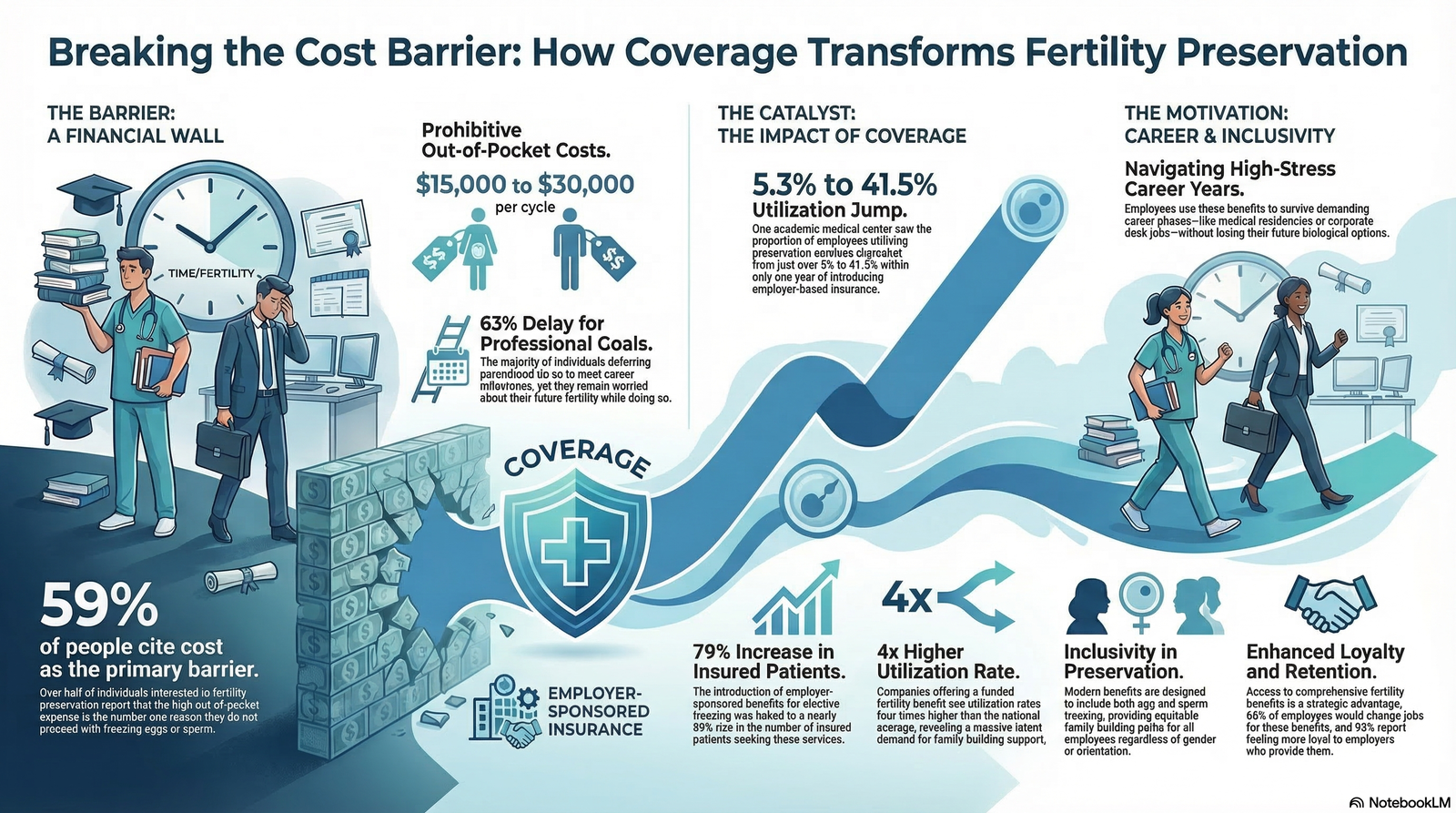
When employers cover preservation, far more people feel able to freeze eggs or sperm before fertility drops.
What IVF Really Costs and How to Budget
If you are staring at a clinic quote, it probably lists the base IVF cycle and not much else. That can be misleading when planning multiple attempts or juggling care with rent, loans, or childcare for an older child. Let us unpack the main buckets so you can build a realistic plan.
- Base IVF Cycle: Often listed as $15,000 to $25,000 for a standard cycle, not including genetic testing or donor costs.
- Medications: Can add around $10,000 per round, which is why some employers anchor their pharmacy caps at this number.
- Genetic Testing (PGT-A): Frequently billed as a separate add-on and can run into the thousands, especially if you test multiple embryos.
- Storage Fees: Yearly charges to keep embryos, eggs, or sperm frozen at the clinic or a storage facility.
- Surrogacy Agency and Legal Fees: Often very high, which is why many employers create separate lifetime surrogacy limits in the $10,000 to $35,000 range.
- Travel and Lodging: Extra costs if your preferred or in-network clinic is far from home.
- Deductibles and Co-insurance: Even with a strong plan, you might still owe a 20% co-insurance share or need to meet a deductible of $1,600 to $3,300 or more each year.
Money-Saving Strategies and Grants
When you add all those numbers up, it is easy to feel like having a child is only possible for people with six-figure savings. That is not true, and you deserve to know about every lever you can pull.
- Use Clinically Managed Benefits: Programs like Maven or Progyny connect you with patient care advocates and clinical teams who help you follow clear treatment paths. In some programs, 55% of members get pregnant without IVF or IUI because they receive better preconception and early fertility care.
- Look at Part-Time Roles: Companies like Starbucks offer fertility benefits to part-time baristas, including up to $25,000 for IVF and a separate medications cap. Some other retailers and warehouse employers also extend benefits to hourly staff, though the details differ.
- Apply for Grants: There are at least 37 private foundations in the United States that help with fertility costs. The average grant size is around $8,191, but many programs, such as Livestrong, reserve most funding for people with a history of cancer, so you need to read the rules closely.
- Excepted Benefit HRAs: Under federal rules that took effect in late 2025, employers can now set up a small separate HRA that reimburses up to $2,200 in out-of-pocket fertility costs in 2026, even if you are not on the main health plan.
- Use Tax Deductions: If your total medical costs for the year are more than 7.5% of your adjusted gross income, you might be able to deduct IVF and related care. In most cases, this rule applies to treatment for you, your spouse, or your dependents, not a surrogate.
The Big 15: Employers Leading on Fertility Benefits in 2026
If you are open to changing jobs to get better coverage, it helps to know which employers are currently leading the way. Even if these specific companies do not fit your field, their benefit designs can give you language to use when you lobby your HR team.
- Google: Offers up to $75,000 for IVF and fertility preservation and provides “Baby Bonding Bucks” for new parents.
- The Walt Disney Company: Provides up to $75,000 through Progyny for IVF, surrogacy, and egg or sperm freezing.
- Adobe: Covers 80 to 90% of approved fertility services with a $60,000 lifetime maximum.
- Tesla: Offers $40,000 for IVF, IUI, and preservation, plus $20,000 for medications, and separate $25,000 caps for surrogacy and adoption.
- Bain & Company: Covers unlimited IVF cycles and offers 21 weeks of paid parental leave.
- Spotify: Offers unlimited IVF coverage, including PGT testing, and 6 months of fully paid parental leave.
- Chanel: Provides broad fertility coverage with minimal cycle limits, depending on the specific plan.
- American Express: Reimburses $35,000 for fertility treatment and another $35,000 for adoption or surrogacy.
- Starbucks: Gives both part-time and full-time employees access to up to $25,000 for IVF, $10,000 for medications, and $10,000 for surrogacy or adoption.
- Walmart: Partners with Kindbody to offer $20,000 toward IVF, surrogacy, or adoption, plus $10,000 for medications.
- Pinterest: Covers up to 4 IVF cycles and provides $20,000 for surrogacy and $5,000 for adoption.
- Bank of America: Reimburses up to $20,000 for family building expenses and offers navigation support.
- Chobani: Includes up to 3 IVF rounds and coverage for egg or sperm freezing.
- Gusto: Offers up to $20,000 in fertility reimbursement, including for LGBTQ+ employees, regardless of a medical infertility diagnosis.
- Lowe’s: Provides fertility care through Progyny and up to $5,000 in adoption assistance for eligible employees.
Want help comparing clinics and costs?
If this feels like a full time job, and many people say it does, our advisors can collect clear, itemized quotes from verified clinics and map your timeline at no cost to you.

Why trust this guide? The OVU commitment
You are probably juggling hope, timelines, and a lot of tabs open in your browser. And you deserve clear, current, human advice. At OVU, we review clinic protocols, compare real quotes, and talk to people who have done this - intended parents and gestational carriers - so we can give you practical steps, not just theory. If you want help comparing options without sales pressure, we will gather itemized quotes and success data that match your exact situation. You decide, we will bring the info to your table.
Frequently Asked Questions
Does my insurance cover IVF if I live in a mandated state?
Not automatically. Most state fertility mandates apply only to fully insured plans and often depend on the size of the employer. If your employer runs a self-funded plan, which is common at large companies, it is governed by federal law (ERISA) and does not have to follow state infertility mandates. You should check your Summary Plan Description (SPD) or contact your HR department to see what your specific plan covers.
Can I use these benefits if I work part-time?
Sometimes. A few employers, such as Starbucks, extend fertility coverage to eligible part-time staff. Other companies, including some big retailers and warehouse employers, may also offer benefits to hourly workers. You should review your eligibility rules and minimum hours, and then confirm details with HR.
What is the difference between a lifetime maximum and a per-cycle benefit?
A lifetime maximum, such as a $60,000 cap, is the total your plan will ever pay for fertility care. A per-cycle benefit covers a set number of attempts, such as four IVF cycles, no matter what those cycles cost. You need both numbers to understand how far your coverage will actually stretch.
Are surrogacy and adoption benefits taxable?
Most employer surrogacy benefits count as taxable income and appear on your W-2. Adoption assistance can often be treated as tax-free for federal income tax purposes up to a yearly limit, provided you meet income requirements; however, this credit phases out at higher income levels. A tax professional can help you run the exact numbers for your specific situation.
Does my employer cover elective egg freezing?
Some employers, such as large tech and media companies, include elective egg freezing in their fertility benefits, often through a lifetime dollar maximum. Many traditional insurance plans only cover freezing when it is medically necessary, such as before chemotherapy, and may exclude it for age-related reasons. You can look for explicit language about “cryopreservation” or “fertility preservation” in your benefits booklet or ask HR directly.
What if my partner’s insurance looks better than mine?
You should compare both plans side by side, including premiums, deductibles, co-insurance, and fertility caps. If you both qualify for the same employer program, you usually cannot double the benefit, but you can choose the plan that gives your family the best coverage for the lowest total cost. If you have different insurance carriers, you should also ask if “Coordination of Benefits” allows one plan to cover what the other excludes.
How can I ask my employer to add or improve fertility benefits?
You do not have to start from scratch. Advocacy groups such as RESOLVE offer toolkits with sample letters and talking points. It often helps to frame your request in terms of retention, DEI goals, and long-term cost savings from safer pregnancies. While your personal story can make the issue feel real for decision-makers, focusing on the business impact is often the most effective way to see results.
Reference List 7 sources
Journal Article (Research): Dupree JM, Levinson Z, Dalton VK, Schultz SE, MacEachern MP, Jungheim ES. Provision of insurance coverage for IVF by a large employer and changes in IVF rates among health plan enrollees. JAMA. 2019;322(19):1920–1921. PMID: 31721982. Available from: https://pubmed.ncbi.nlm.nih.gov/31721982/
Journal Article (Research): Dupree JM, Kitaevich J, Agostino C, Murali S, Borah L, Castle SK, Kirkland A. When states require fully insured employers to cover in vitro fertilization (IVF), what do self insured employers provide? J Assist Reprod Genet. 2026;43(2):615–621. PMID: 41389272. Available from: https://pmc.ncbi.nlm.nih.gov/articles/PMC12765564/
Journal Article (Research): Goldstein DP, Panagiotopoulou N, Goodman LR, et al. In vitro fertilization: a cross sectional analysis of 58 U.S. insurance companies. J Assist Reprod Genet. 2023;40(4):793–803. PMID: 36928330. Available from: https://pmc.ncbi.nlm.nih.gov/articles/PMC10033791/
Journal Article (Research/Commentary): Quinn MM, Wolgemuth T, Eisenberg ML. Infertility and the power of word choice. F&S Reports. 2021;2(3):284–286. PMID: 34484553. Available from: https://pmc.ncbi.nlm.nih.gov/articles/PMC8417189/
Journal Article (Review): Hammer A, Cakmak H, Quinn MM. The status of fertility preservation insurance mandates and their impact on utilization and access to care. J Clin Med. 2024;13(4):1072. PMID: 38394064. Available from: https://www.mdpi.com/2077-0383/13/4/1072
Journal Article (Study Protocol): Quinn MM, Kim SE, Lee CC, et al. Navigating health insurance selection for in vitro fertilization benefits: a study protocol. Contemp Clin Trials. 2025;139:107596. PMID: 39566629. Available from: https://pmc.ncbi.nlm.nih.gov/articles/PMC12916094/
Journal Article (Research): Hammer A, Cakmak H, Quinn MM. IVF utilization by mandate status. In: The status of fertility preservation insurance mandates and their impact on utilization and access to care. J Clin Med. 2024;13(4):1072. PMID: 38394064. Available from: https://www.mdpi.com/2077-0383/13/4/1072
Final Thoughts
If you are reading this, there is a good chance you are trying to hold two hard things at once. On one side is the hope of a child. On the other side is the reality of bills, forms, and benefit rules that were never written with your exact story in mind. That disconnect can feel lonely and unfair.
You deserve support that treats fertility care as real health care, not an optional luxury. You also deserve clear information, not vague promises about “family building benefits” that vanish in the fine print. When you understand how your plan works, you are in a stronger position to decide whether to stay, push for change, or look for a new employer that matches your needs.
As you move forward, try to take one concrete step at a time. Download your plan documents. Highlight every line that mentions infertility, IVF, egg freezing, surrogacy, or adoption. Ask HR to explain anything that feels confusing. Talk with your clinic about how to sequence treatment around coverage caps. Share your story with people you trust so you do not have to carry all of this alone.
You are not asking for anything unreasonable. You are asking for a fair chance to build the family you want without destroying your financial future. More employers are starting to understand that. You have every right to ask the ones in your life to catch up.
Related articles

Fertility Grants & Scholarships: How to Actually Afford IVF
Fertility Costs & Financing Your guide to fertility grants, IVF costs, and real-world budgeting Last Updated: 19 July 2026 Medically Reviewed 16 min read Evidence-based I know the sticker price of fertility treatment is terrifying. When you first get that folder from your clinic, it is easy to feel completely overwhelmed. Very few of us can easily set aside $25,000 for a single IVF cycle, especially when that investment comes with no guarantees. This financial pressure forces a difficult internal dialogue: “How are we going to pay for this?” or even worse, “Are we paying for treatment or paying to
16 min read
Fertility Financing Options: How To Pay For IVF Without Losing Your Mind
Fertility Costs & Financing Your guide to fertility treatment costs and financing options Last Updated: 16 July 2026 Medically Reviewed 20 min read Evidence-based If you have just opened a clinic estimate and seen figures like $20,000 or $30,000, you might feel a wave of embarrassment or anxiety. It is natural to hesitate before rushing into treatment when your mind is overwhelmed by the thought of affording it all without taking on a second job or starting a side business just to cover the costs. You aren’t just thinking about the medications and procedures; you’re wondering how to pay for
16 min read
Fertility Insurance Coverage: What Treatment Really Costs
IVF Costs & Insurance Your guide to fertility insurance coverage and IVF costs Last Updated: 13 July 2026 Medically Reviewed 14 min read Evidence-based If you are thinking about IVF or are already in the middle of testing, you probably feel pulled in two directions. On one side, you are picturing a baby in your arms. On the other side, you are staring at numbers that look bigger than a car loan. Many people in this situation describe it as working a second job, where every spare hour and spare dollar goes into trying to grow their family. Infertility affects
16 min read