


Dr. Sony Sherpa (MBBS)
In addition to her clinical experience, Dr. Sherpa is a published medical researcher and holistic health advocate. Her dual expertise in emergency care and alternative therapies brings a unique lens to medically reviewed content—ensuring it is both accurate and accessible.
I know the sticker price of fertility treatment is terrifying. When you first get that folder from your clinic, it is easy to feel completely overwhelmed. Very few of us can easily set aside $25,000 for a single IVF cycle, especially when that investment comes with no guarantees. This financial pressure forces a difficult internal dialogue: “How are we going to pay for this?” or even worse, “Are we paying for treatment or paying to hope?”
Infertility is a disease, not a lifestyle choice. It affects about 1 in 8 couples in the United States, roughly 12% to 15% of people in their reproductive years. Yet only about 24% of infertile couples have enough access to the care they need to get pregnant. That gap is mostly about money and coverage, not motivation or desire.
If you are staring at numbers that do not match your bank account, you are not alone. State mandates and specialty loans help in some cases, but they still leave many of the most motivated patients stuck. Fertility grants and scholarships are one of the few tools that can flip your situation from “this feels impossible” to “we actually have a path.” These are awards of free money or donated services that you never have to repay, and they can be combined with tax strategies, medication discounts, and clinic programs to bring costs down to earth.
Most families spend around $50,000 on fertility treatment by the time they bring home a baby. To bridge this gap, many turn to fertility grants and scholarships, which provide non-repayable funds or donated services. These awards average around $8,000, though some reach as high as $25,000. When you layer grants with tax-advantaged accounts and medication discounts, you transform a bill that seemed impossible to cover alone into a manageable financial plan.
Next step: Identify 2 to 3 grant programs you qualify for, start your medical form at least two weeks before the deadline, and line up your tax and medication strategies in parallel.
What the Latest Research Shows About Cost and Access
Large studies on infertility coverage show that people are more likely to stay in treatment and reach a live birth when insurance covers several IVF cycles instead of just one. Grant recipients in some programs also see higher cumulative live birth rates. This means that targeted financial help can directly translate into more babies being born than the national average.
At the same time, global data from the World Health Organization (WHO) shows that access to fertility care remains sharply unequal. High costs and limited coverage still push treatment out of reach for many hopeful parents, especially in lower-income regions and communities of color. Grants, scholarships, and structured discount programs are one way to close part of that gap for you.
In This Guide
- Quick Facts: Costs, Grants, and Success Rates
- National Fertility Grants You Can Apply For
- Regional and Specialized Support
- How Grant Committees Choose Winners
- Application Requirements and Timeline
- Why Grants Are a Critical Safety Net
- Money-Saving Strategies Beyond Grants
- What to Budget For: The All-In Cost List
- 7 Common Questions About Fertility Grants and Money
- Final Thoughts
About $50,000 across all cycles before achieving a live birth.
The average grant is $8,191, with some up to $25,000.
One grant cohort reached a 61.9% live birth rate on the first transfer.
Quick Facts: Costs, Grants, and Success Rates
If you are just starting to price things out, you need a fast snapshot before you dig into the details. This is the reality that most families face when they step into an IVF clinic for the first time.
- One IVF cycle: Usually between $12,400 and $30,000 once you factor in medications and lab work.
- Injectable medications: Often $3,000 to $7,000 per cycle on their own.
- Total journey: Many families end up spending around $50,000 by the time they have a baby.
- Grant landscape: At least 37 private foundations offer fertility-related financial help.
- Grant volume: Together, these groups give nearly 10,000 grants per year, with about $9 million in total awards.
- Average award: Around $8,191, with some single awards up to $25,000.
- Success rates: In one group of grant recipients, 61.9% had a live birth after their first transfer, compared with a national average near 29%.
Grant Impact at a Glance
61.9% vs. 29% – Why Funding Matters: In one cohort, grant recipients had a live birth in about 62 out of 100 first transfers, compared with about 29 out of 100 nationally. When you can afford to follow a clear, evidence-based plan instead of cutting corners, your chances of success often rise.
$8,000+ Average Award – Real Relief: An average grant of $8,191 can cover medications, a chunk of your base IVF fee, or almost your entire diagnostic workup. That can be the difference between delaying treatment and starting on time.
37 Foundations – More Than One Shot: With dozens of programs open to different ages, diagnoses, and locations, you are not stuck with a single application. You can build a plan that includes several targeted grants that fit your story.
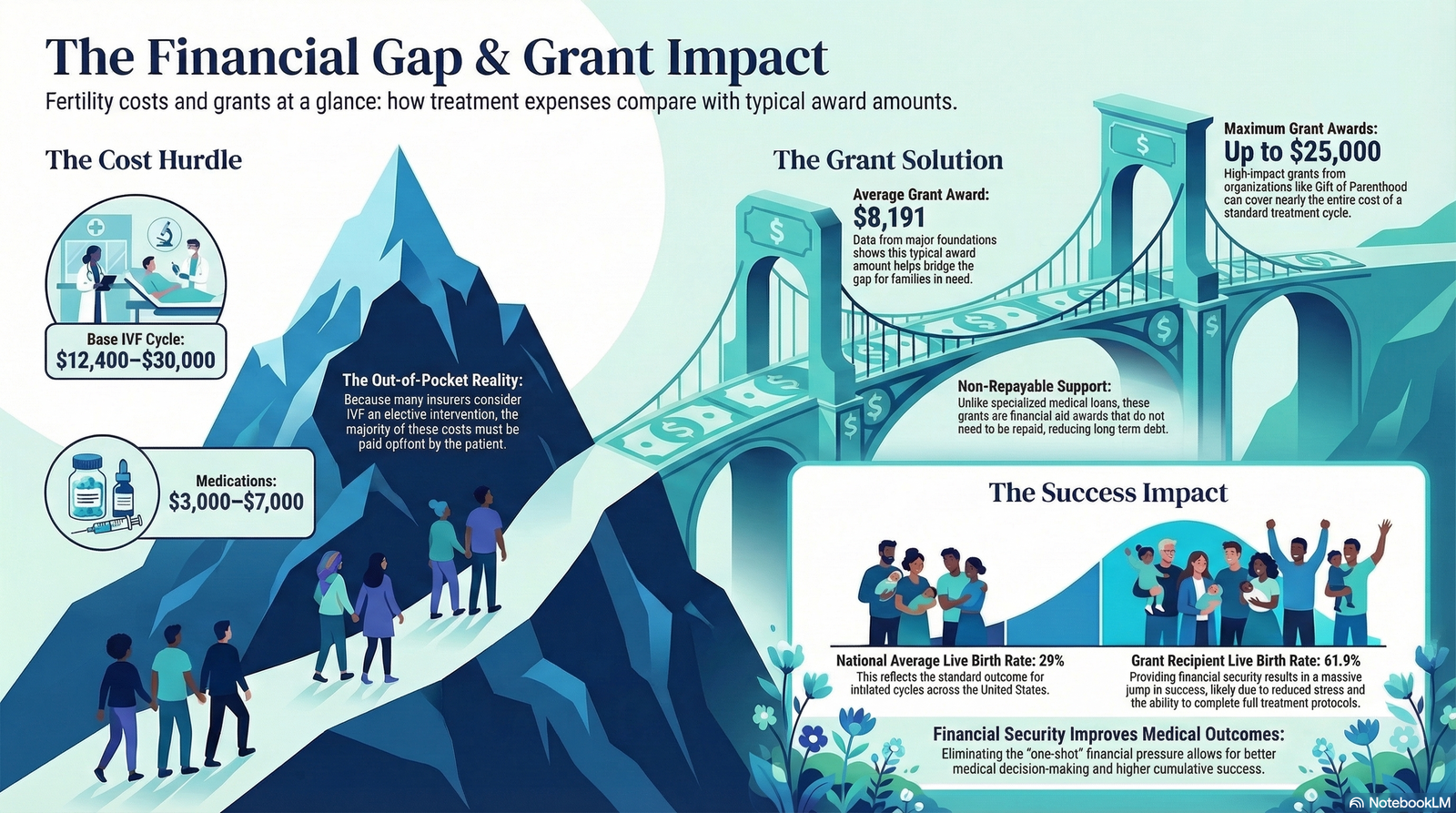
Fertility costs and grants at a glance: how treatment expenses compare with typical award amounts.
| Cost Item | Typical Cost Range | How Grants Help |
|---|---|---|
| IVF Cycle (base) | $12,400 – $30,000 | One large grant can cover a full cycle at many clinics. |
| Medications | $3,000 – $7,000 | Some grants include donated meds, lowering this cost sharply. |
| ICSI Add-on | $1,500 | Smaller grants can cover lab add-ons, such as ICSI. |
| Diagnostics | $659 – $1,639 | Awards can pay for testing, so you enter IVF fully worked up. |
National Fertility Grants You Can Apply For
If you are not sure where to begin, national grants are a natural first step. These programs accept applications from across the country, which means you can often keep working with a clinic close to home instead of flying across the country for care.
Think of these grants as the backbone of your financial plan. You can layer regional and specialty programs on top, but these national options are where many people take their first swing.
Baby Quest Foundation
Baby Quest is one of the most visible fertility grant programs. It has awarded more than $3.9 million across over 290 grants. The foundation welcomes applicants regardless of gender, marital status, or sexual orientation, which makes it a good fit if you are part of the LGBTQ community or are applying as a single parent.
- Award amounts: Grants usually fall between $2,000 and $15,000, often with donated medications.
- Deadlines: One round closes on March 12, 2026 (applications open January 2). A second round closes on September 10.
- Covers: IVF, gestational surrogacy, egg and sperm donation, egg freezing, and embryo donation.
- Key requirement: You need basic health insurance for yourself and the baby.
Tinina Q. Cade Foundation
The Tinina Q. Cade Foundation offers the Family Building Grant, which can award up to $10,000 per family. Since 2005, it has focused on helping families who want children but cannot cover treatment costs alone.
- Deadlines: Two rounds per year, usually February 1 (spring) and July 1 (fall).
- Medication support: Through EMD Serono, the foundation can also provide medication grants for Gonal-f, Cetrotide, and Ovidrel.
- Eligibility: You must be a U.S. citizen or legal permanent resident.
Gift of Parenthood
If you want several chances in one year, Gift of Parenthood might fit your style. The foundation runs multiple giveaways and grant cycles throughout the year.
- Award amounts: Grants range from $5,000 to $25,000.
- Next deadline: The Q1 2026 cycle closes on March 31, 2026.
- Four-Cycle Pass: For $250, you can apply to four consecutive grant cycles in 12 months, which increases your chances over time.
Regional and Specialized Support
Once you have a shortlist of national grants, your next step is to consider your specific situation. Programs that target one region or one group often receive fewer applications, which can raise your odds.
Regional Champions
- Nest Egg Foundation: For residents of Connecticut and New York. Offers grants up to $10,000 for IVF at selected partner clinics.
- Chicago Coalition for Family Building: Provides donated IVF cycles and grants up to $10,000 for people in IL, WI, IA, IN, or MO with family income under $200,000.
- The Kyle and Samantha Busch Bundle of Joy Fund: Supports North or South Carolina residents who receive care at REACH Fertility Clinic in Charlotte.
- New York State IVF Grant: Reserves close to $1 million per year for New York residents who earn under $195,000 and are strong IVF candidates.
- Fertility Foundation of Texas: Awards $12,000 grants twice a year for central Texas residents with an income of $100,000 or less.
Special Focus Programs
- Livestrong Fertility: A major resource for cancer survivors. Offers discounted services and free medications. Livestrong accounts for more than 92% of all identified fertility grants, roughly 9,187 awards.
- The Chick Mission: Focuses on women newly diagnosed with cancer who need to freeze eggs before chemotherapy or other treatments that can damage fertility.
- Jewish Fertility Foundation (JFF): Offers grants up to $10,000 and interest-free loans up to $20,000 for people in its communities (Atlanta, Cincinnati, Denver, and others) who plan to raise their child in the Jewish faith.
- VIVA Program for Veterans: Supported by the Bob Woodruff Foundation. Provides up to $5,000 for veterans who need IVF because of service-related injuries.
Choosing Where to Focus Your Effort
Smaller Pool, Higher Odds: Regional grants and niche programs for cancer survivors, veterans, or specific faith communities often receive fewer applications than national grants. If you qualify, this can quietly raise your chances without extra cost.
Stacking Awards: Many families combine a national grant with a regional grant and a medication discount. If you take that approach, you can sometimes lower your out-of-pocket cost for a full IVF cycle to the level of a typical car loan.
How Grant Committees Choose Winners
You might be asking yourself if this process is just a lottery. The honest answer is that some programs do use random draws, but many follow a structured scoring system. That system helps them use limited funds to support applicants who are likely to reach a live birth.
The 100-Point Framework
The Chicago Coalition for Family Building helped develop a 100-point model that some programs now use or mirror.
1. Medical prognosis (up to 55 points)
- Ovarian reserve (35 points): Based on age, AMH, and FSH. Being under 30 or having AMH above 2 ng/dL often earns full points.
- BMI (5 points): Full points for a BMI between 18.5 and 24.
- Uterine and male factors (5 points each): Points for a healthy uterine cavity and a normal semen analysis.
- Living children (5 points): Full points when you do not have living children, which lets committees prioritize first-time parents.
2. Personal characteristics (up to 45 points)
- This section focuses on your personal statement and story. Committees read about your history, your support system, and what parenthood would mean for you.
Why Prognosis Matters
Programs use these scores to find people with a strong chance of success. In one study, grant recipients reached a 72.9% cumulative live birth rate, while the 2019 SART national average sat around 37.1%. By backing candidates with higher odds, foundations help more families bring home babies with the same pool of money.
Application Requirements and Timeline
The application process is detailed and can feel like a full extra job. Treat it like a major scholarship or college application. You are putting your story in front of real people who want to help, and they need clear information to work with.
Common Eligibility Requirements
- Documented infertility: You must have a formal diagnosis of infertility from a doctor.
- Employment and means: Most programs expect at least one partner to be employed, so they know you can support a child after treatment.
- Financial need: You will submit tax forms, such as a W-2 in the U.S. or T1 in Canada, to show that treatment is out of reach without help.
- Residency: National grants usually require U.S. or Canadian citizenship or legal permanent residency.
The Must-Haves for Your Application
- Application fee: Most programs charge a non-refundable fee of $50 to $75.
- Medical form: Your fertility specialist completes a detailed report about your diagnosis and prognosis. This step often causes the most delay, so start at least two weeks before the deadline.
- Personal story: Expect to write up to 1,000 words. Explain what you have tried, how infertility has affected your life, and what this grant would change for you.
- Media consent: Many foundations ask recipients to share their stories on social media, websites, or events. Think about your comfort level with public visibility before you apply.
Why Grants Are a Critical Safety Net
You may wonder why your insurance does not simply cover this care. For many years, insurers in the United States treated IVF as a luxury rather than essential medical care. That attitude still shapes policy today.
The Mandate Loophole
About 20 states now have some kind of fertility coverage mandate. On paper, this sounds like a major win. In practice, many patients still do not receive the care they need.
- The ERISA exemption: A federal law called ERISA keeps state mandates from applying to many self-insured employer plans, which large companies often use. In Massachusetts, one of the most generous states, only about 26% to 36% of women actually qualify for the state’s fertility coverage.
- The Medicaid gap: Aside from New York, state mandates do not require Medicaid to cover infertility care.
- Cost-sharing and caps: Even when coverage exists, you can still hit tight lifetime caps, such as a $15,000 maximum in Arkansas, as well as deductibles and co-pays.
These gaps land hardest on lower-income families and people of color. Black women are about twice as likely to experience infertility as white women, yet they travel about twice as far for care and appear less often in clinic data. Grants and scholarships are one of the few tools that can help close this financial and access gap for you.
Money-Saving Strategies Beyond Grants
While you wait for grant decisions, you can still work on your budget. Think of this as building a puzzle. Grants are one big piece, but you have several other pieces you can put in place too.
1. The Triple Tax Advantage: Using Your HSA
If you have a Health Savings Account (HSA), you can run most fertility expenses through it using pre-tax dollars.
- How it adds up: For a family in the 24% tax bracket that spends $25,000 on IVF, using an HSA can save around $7,000 to $9,000 in combined federal, state, and payroll taxes.
- Retroactive reimbursement: You can pay your clinic out of pocket now and reimburse yourself later from your HSA, as long as the HSA existed at the time of the expense and you keep the receipts.
- Spouse coverage: You can use your HSA for your spouse’s treatment even if they are on a different insurance plan, as long as you are legally married.
2. Medication Discount Programs
Before you pay full price at the pharmacy, check for income-based or diagnosis-based discounts.
- Compassionate Care (EMD Serono): Offers 25%, 50%, or 75% off selected fertility medications, depending on income. In 2020, this program saved patients more than $11.6 million.
- Compassionate Corps: Provides free medication for eligible, uninsured veterans who were injured in the line of duty.
- ReUnite Rx: Offers discounts up to 75% based on income and insurance status.
3. Professional and Military Discounts
- HRC Fertility: Offers a 40% IVF discount to active-duty military and veterans.
- University of Iowa: Provides 50% discounts for veterans on egg retrievals and embryo transfers.
- CNY Fertility: Gives a 5% military and veteran discount on IUI, IVF, and FET.
What to Budget For: The All-In Cost List
When you build your budget, you need to think well beyond the clinic’s base IVF quote. These extra costs often catch people by surprise and can make a big difference to your final total.
- Diagnostic workup: Semen analysis, hormone panels, and exams often cost $659 to $1,639 before any cycle starts.
- Travel and lodging: If you travel for care, you can usually use HSA funds for mileage at 20.5 cents per mile and for lodging up to $50 per night, following IRS rules.
- Time off work: The average couple spends about 125 hours on appointments, monitoring, and procedures over 18 months, which is close to 16 workdays.
- Ancillary services: Acupuncture sessions often cost $100 to $200 each.
- Annual storage fees: Expect $577 to $1,435 per year for embryo or egg storage.
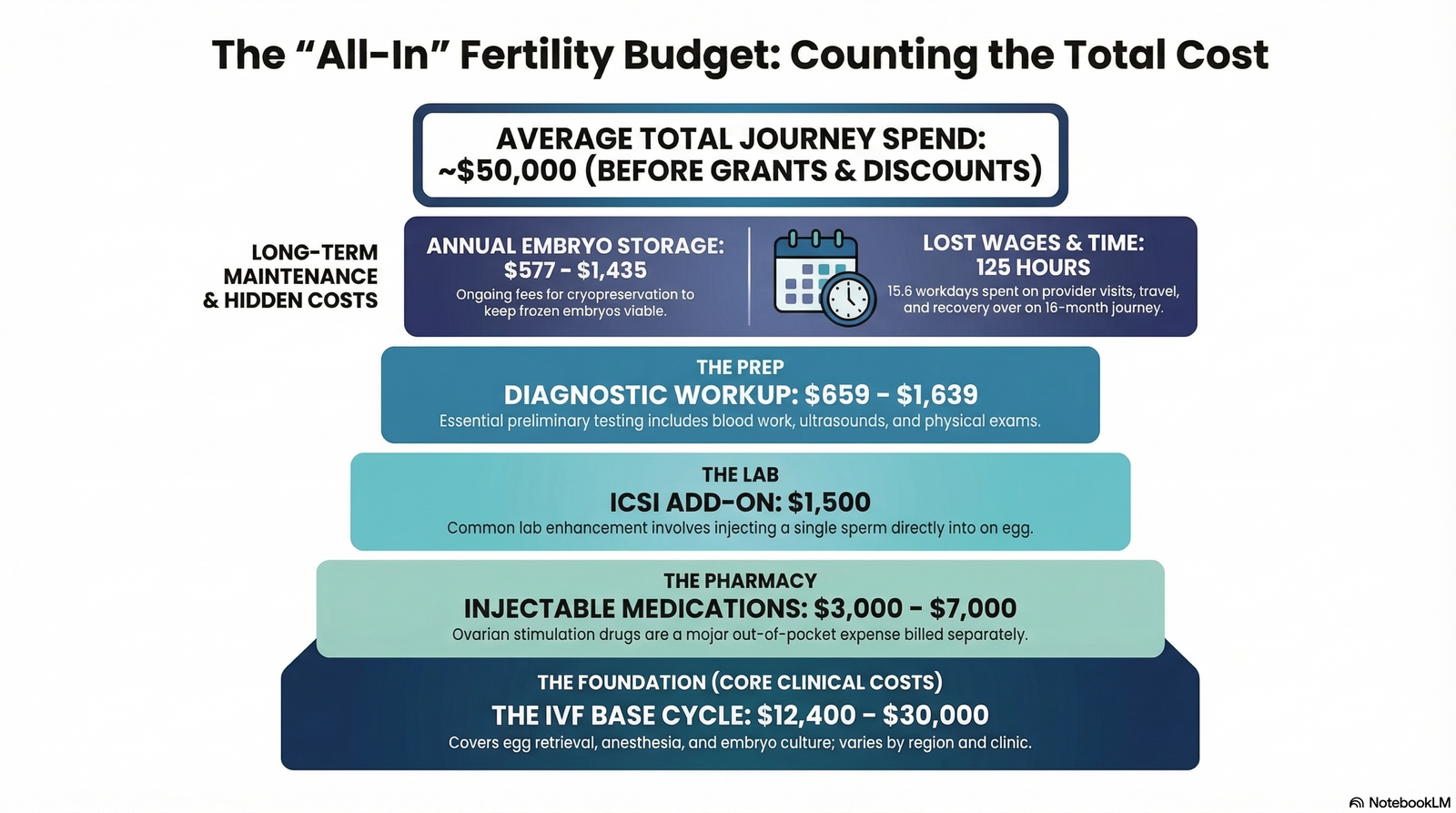
Your all-in fertility budget: how base IVF fees, medications, time off work, and storage costs stack up over time.
Want help comparing clinics and costs?
If this feels like a full-time job, and it often does, our advisors can collect clear, itemized quotes from verified clinics and help you map your timeline at no cost to you.

Why trust this guide? The OVU commitment
You are probably juggling hope, timelines, and a lot of tabs open in your browser. And you deserve clear, current, human advice. At OVU, we review clinic protocols, compare real quotes, and talk to people who have done this - intended parents and gestational carriers - so we can give you practical steps, not just theory. If you want help comparing options without sales pressure, we will gather itemized quotes and success data that match your exact situation. You decide, we will bring the info to your table.
Frequently Asked Questions
Can I use a grant for gestational surrogacy?
Yes, but only a few organizations support it. The Baby Quest Foundation and Gift of Parenthood clearly include surrogacy in their guidelines. Keep in mind that surrogate compensation and legal fees are usually not HSA-eligible under IRS rules, so you still need a separate plan for those costs.
Can I use crowdfunding like GoFundMe for IVF?
Many people try crowdfunding. Between 2013 and 2020, more than 3,300 campaigns asked for $52 million to cover fertility costs. Only about 22.8% reached their full target, and the average amount raised was $6,759. Crowdfunding can help, but it rarely covers your entire budget, so treat it as a supplement.
What happens if I have bad credit?
Most grants do not involve credit checks, which can be a relief if your credit score has taken a hit. If you do need a loan, some clinics, such as CNY Fertility, offer in-house financing with no credit check, although they often require a down payment of about 50% of the total cost.
Does insurance cover the cost of egg or sperm donors?
In most cases, no. Many state mandates, including those in New Jersey and New York, exclude non-medical costs such as donor compensation and donor travel. Some grants, such as Parental Hope, cover the IVF cycle itself but not donor fees or donor medications.
How much does ICSI add to the bill?
ICSI usually adds about $1,500 to a cycle. Its use is lower in states with strong insurance mandates, likely because people are less pressured to pack every possible add-on into a single cycle when coverage allows more than one attempt.
Is natural conception common after stopping treatment?
It happens more often than many couples expect. In one study of women who stopped IVF, 24.1% said they ended treatment because they conceived without assistance. That included nearly 1 in 5 women aged 40 to 42.
Can I apply for more than one grant?
Yes. Many families build a “financial quilt” that includes one or more grants, an HSA strategy, medication discounts, and employer benefits from programs like Progyny or Carrot. As long as you respect each program’s rules, you can apply to several at once and accept more than one award.
Reference List 4 sources
Journal Article (Research): Kawwass JF, Crawford S, Hipp HS, et al. Association of state insurance coverage mandates with assisted reproductive technology care discontinuation. American Journal of Obstetrics and Gynecology. 2023;228(3):315.e1-315.e10. PMID: 36368429. Available from: https://pubmed.ncbi.nlm.nih.gov/36368429/
Journal Article (Research): Ha M, Drees A, Myers M, et al. In vitro fertilization: a cross-sectional analysis of 58 US insurance companies. Journal of Assisted Reproduction and Genetics. 2023;40(3):581-587. PMID: 36542313. Available from: https://pubmed.ncbi.nlm.nih.gov/36542313/
Journal Article (Review): Mburu G, Kiarie J, Allotey P. Infertility services in the context of decreasing total fertility rates. Bulletin of the World Health Organization. 2026;104(2):121-123. PMID: 41602493. Available from: https://pubmed.ncbi.nlm.nih.gov/41602493/
Journal Article (Policy Commentary): What is the status of insurance coverage for fertility services in the United States? Journal of Assisted Reproduction and Genetics. 2023;40(3):589-592. PMID: 10033810. Available from: https://pubmed.ncbi.nlm.nih.gov/10033810/
Final Thoughts
Fertility treatment is hard on your body, your mind, and your bank account. When money is tight, you may feel tempted to take bigger risks, such as transferring more embryos than your doctor recommends, just to try to get everything done in one shot. Those choices raise the chance of preterm birth and low birth weight, which adds new worries on top of the old ones.
When people have better financial support, they can follow safer treatment plans that still give them a strong chance at a baby. In states with stronger coverage, patients often transfer fewer embryos, yet bring home healthy singleton babies more often. Grants, scholarships, tax strategies, and discounts are not just about lowering stress; they also help you say yes to the plan that truly fits your body.
If this all feels overwhelming, pick one or two actions you can take this week. Look up the next deadlines for Baby Quest or the Cade Foundation. Ask your clinic whether they work with any grant programs or discount plans. Open your benefits portal at work and search for “fertility” or “family building.” You are not selfish for fighting this hard. You are trying to bring your child into the world.
Most parents who have been through this path will tell you that, in the end, the child they waited for was worth every bill, every appointment, and every form. You deserve clear information, real support, and a plan that fits your life while you work toward that same goal.
Related articles

Employer Fertility Benefits: How to Read the Fine Print and Protect Your Budget
Fertility Benefits & Financing Your guide to understanding employer fertility benefits, costs, and coverage gaps Last Updated: 22 July 2026 Medically Reviewed 14 min read Evidence-based If you are trying to build your family and running into roadblocks, it probably feels like you are living in two worlds. In one, friends seem to get pregnant without thinking about it. In the other, you are juggling clinic visits, lab results, and bills that look more like a mortgage down payment than a medical copay. It is an exhausting place to live. The numbers behind what you are feeling are stark. The
19 min read
Fertility Financing Options: How To Pay For IVF Without Losing Your Mind
Fertility Costs & Financing Your guide to fertility treatment costs and financing options Last Updated: 16 July 2026 Medically Reviewed 20 min read Evidence-based If you have just opened a clinic estimate and seen figures like $20,000 or $30,000, you might feel a wave of embarrassment or anxiety. It is natural to hesitate before rushing into treatment when your mind is overwhelmed by the thought of affording it all without taking on a second job or starting a side business just to cover the costs. You aren’t just thinking about the medications and procedures; you’re wondering how to pay for
16 min read
Fertility Insurance Coverage: What Treatment Really Costs
IVF Costs & Insurance Your guide to fertility insurance coverage and IVF costs Last Updated: 13 July 2026 Medically Reviewed 14 min read Evidence-based If you are thinking about IVF or are already in the middle of testing, you probably feel pulled in two directions. On one side, you are picturing a baby in your arms. On the other side, you are staring at numbers that look bigger than a car loan. Many people in this situation describe it as working a second job, where every spare hour and spare dollar goes into trying to grow their family. Infertility affects
16 min read