

Fertility Costs & Financing

Dr. Sony Sherpa (MBBS)
In addition to her clinical experience, Dr. Sherpa is a published medical researcher and holistic health advocate. Her dual expertise in emergency care and alternative therapies brings a unique lens to medically reviewed content—ensuring it is both accurate and accessible.
If you have just opened a clinic estimate and seen figures like $20,000 or $30,000, you might feel a wave of embarrassment or anxiety. It is natural to hesitate before rushing into treatment when your mind is overwhelmed by the thought of affording it all without taking on a second job or starting a side business just to cover the costs.
You aren’t just thinking about the medications and procedures; you’re wondering how to pay for them while keeping the rest of your life stable. This often leads to a search for ways to save $30,000 quickly or finding options to pay in interest-free installments.
Additionally, you might find yourself researching discounted bundles or “cross-border” journeys to get more services for less. Some fertility clinics offer discounts during festive seasons or holidays, with a few even offering locked-in pricing for up to two years. Premium care bundles often include a “backup” to ensure at least one more trial if the first attempt isn’t successful, as most of these packages are designed to be multi-cycle.
In the United States, infertility affects about 1 in 8 couples, and only about 24 percent of infertile couples have enough access to care to reach a pregnancy. In countries with strong public coverage, up to 5.9 percent of all births come from IVF. In the United States, that number hovers around 1.5 to 2 percent, indicating how much money influences who actually receives treatment.
We understand how heavy the burden can feel. You are not just comparing clinics, you are weighing savings, credit cards, loans, and maybe even support from friends or family. The goal of this guide is simple. You will see what IVF really costs, how families actually pay for it, and which tools can make this less overwhelming so you can focus on building your family, not just on doing math at 2 a.m.
A single IVF cycle often costs between $12,400 and $30,000 when you include medications and common add-ons. Across all attempts, many families spend around $50,000 before they have a live birth, but you rarely pay this from one source. Most people combine insurance, specialized fertility loans, grants, and tax-advantaged accounts to build a realistic plan.
Next step: Map your likely per-cycle costs, then layer in what your insurance, employer benefits, and financing options actually cover so you know your true out-of-pocket range before you start.
What the Latest Research Shows About Fertility Costs
Economic studies on IVF show that treatment costs are often higher than most families can pay out of pocket in a single year. One cost-benefit analysis from Australia found that publicly funding several IVF cycles for women younger than 42 can still represent good value for taxpayers. A separate review protocol highlights that in some countries, three IVF cycles can cost about 3 percent of an average person’s annual income.
For you, this means that feeling squeezed by fertility costs is not a personal failure. The system is expensive by design, and you are allowed to look for every possible support, from mandates and carve-out benefits to grants and well-structured loans.
In This Guide
$12,400 to $30,000, including medications and common add-ons.
Around $50,000 across all cycles for many families.
Only about 24% of infertile couples have enough access to the needed fertility care.
The True Cost of Care: What IVF Really Costs
If you are trying to plan more than one cycle, it helps to see the pieces that make up the invoice. IVF costs fall into three main buckets: procedures and monitoring, medications, and add-ons that protect your future options.
Medical Procedures and Monitoring
A basic IVF package often includes egg retrieval, anesthesia, embryo culture, and a fresh transfer. At a small number of lower-cost clinics, a self-pay package starts around $6,300. Across the United States, a more typical range for these core services is between $17,000 and $25,000 per cycle.
If you try Intrauterine Insemination (IUI) first, your cost range is wide, from $500 for a basic, low-medication cycle to $15,000 when you stack medications and monitoring. You can use IUI when your doctor feels you do not yet need IVF or when cost is the main barrier and success rates are still acceptable for your age and diagnosis.
Medications: The Hidden Second Invoice
Many people are surprised to see a separate, large bill for medications. Injectable drugs such as Gonal-F, Follistim, and Menopur usually add $3,000 to $7,000 per cycle. About one in five families name drug costs as the biggest source of stress, even when they were prepared for high procedure fees.
Add-ons and Future Security
- Preimplantation Genetic Testing (PGT): Adds about $2,000 to $6,000 per cycle. Clinics may bill around $800 for the biopsy, and genetics labs often charge another $1,800 to $4,500.
- Intracytoplasmic Sperm Injection (ICSI): Often used for male factor infertility and adds roughly $1,500 per cycle.
- Cryopreservation and Storage: Freezing embryos usually costs about $1,000, and yearly storage runs between $577 and $1,435.
- Egg Freezing: If you freeze eggs now for the future, each cycle typically costs between $6,790 and $16,126.
Research Insights On The Cost Burden
5+ Publicly Funded Cycles – Real Value Under 42: A cost-benefit study from Australia found that paying for at least five IVF cycles through public insurance gives good value for women younger than 42. In many scenarios, funding up to seven cycles still made financial sense when taxpayers were willing to support fertility care. Source: Frontiers in Global Women's Health (Does in vitro fertilization (IVF) treatment provide good value for money? A cost-benefit analysis).
3% Of Income – Real Strain Over Three Cycles: A Norwegian study cited in a recent review protocol found that paying for three IVF cycles used about 3 percent of an average annual income. For families with lower incomes, that share was even higher. Source: PLOS One (systematic review protocol) (Financial cost of assisted reproductive technology for patients in high-income countries: A systematic review protocol).
These findings underline why IVF often feels unaffordable without help. They do not tell you what to do, but they give you language and numbers you can use when you talk with your clinic, your employer, or your elected officials about coverage.
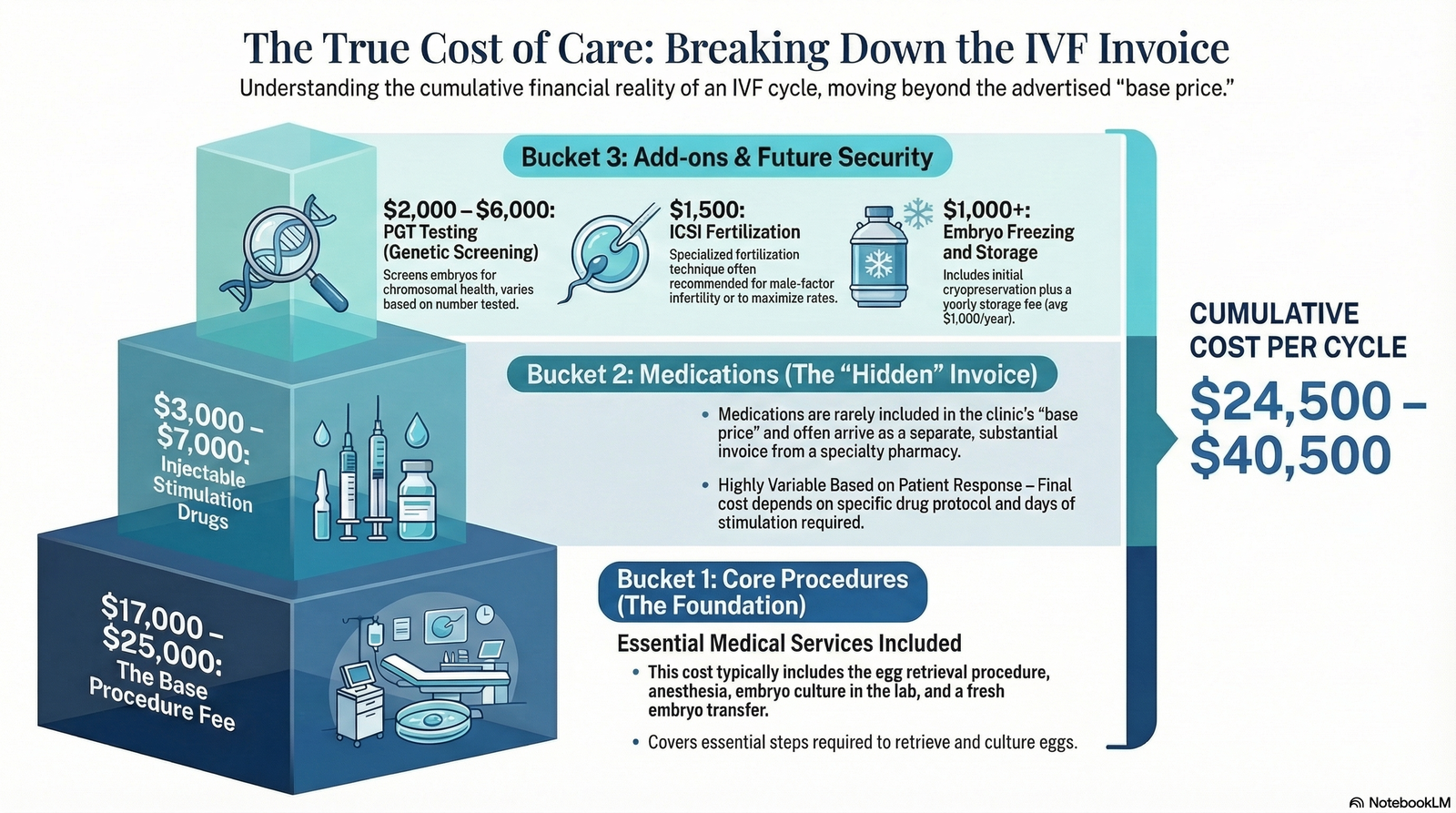
IVF costs cluster into three main areas: procedures, medications, and future-focused add-ons such as PGT and storage.
| Cost Category | Typical Range (per cycle) | When You Pay It |
|---|---|---|
| Core IVF procedures | $17,000 – $25,000 | At retrieval and transfer |
| Medications | $3,000 – $7,000 | During stimulation cycle |
| PGT (genetic testing) | $2,000 – $6,000 | After fertilization, before transfer |
| ICSI | ~$1,500 – $1,900 | On egg retrieval day |
| Cryopreservation & storage | $1,000 + $577 – $1,435 yearly | At freezing, then yearly |
State Mandates And The Insurance Map
Once you know the rough numbers, your next question is usually, “What will my insurance actually pay for?” The answer depends heavily on your state and on whether your employer follows state rules.
The States With Strongest Fertility Mandates
Ten states now have laws that require insurers to cover IVF with relatively few limits. These states are Connecticut, Colorado, Delaware, Illinois, Maine, Massachusetts, Maryland, New Jersey, New York, and Rhode Island. If you have a fully insured plan in one of these states, your out-of-pocket cost can fall from $25,000 to your deductible and co-pays, which might be a few hundred or a few thousand dollars per cycle.
Restrictions That Shape Your Real Coverage
Even with a mandate, coverage is not automatic. You still need to check eligibility rules, dollar caps, and cycle limits in your plan documents.
- Eligibility rules: States such as Hawaii ask you to show five years of infertility. Arkansas and New Jersey often use a two-year standard.
- Dollar caps: Arkansas sets a lifetime maximum of around $15,000. Maryland and Rhode Island set higher caps at around $100,000.
- Cycle limits: Hawaii covers one IVF cycle. Connecticut covers two. New Jersey covers four egg retrievals.
- Spousal rules: Arkansas, Hawaii, and Texas can require that your eggs be fertilized with your spouse’s sperm, which blocks single parents, some LGBTQ+ patients, and people using donor gametes.
The Self-Insured Loophole
The most important fine print is often hidden in your employer’s funding model. State fertility mandates do not apply to self-insured employer plans. Under a federal law called ERISA, many large companies pay claims directly and do not have to follow state coverage rules.
In Massachusetts, which many consider a model for fertility mandates, only about 30 percent of women in their reproductive years are actually eligible for the mandated fertility benefits. The rest work under self-insured plans that choose their own rules. This is why you might live in a “good” state and still feel like the door is closed.
Specialized Fertility Loans: Borrowing For Your Future
If your insurance covers little or nothing, and your savings are not enough, you can still move forward by spreading costs out over time. Specialized fertility loans give you unsecured credit built around IVF, IUI, and related services, without tying your home or car to the debt.
Key Lenders And Their Terms
- CapexMD: Works only in fertility. They coordinate directly with your clinic and let you borrow from $3,000 to $55,000 with repayment terms from 6 to 84 months. APRs often fall between 8.99 percent and 24.99 percent.
- Future Family: Wraps treatment, medications, and lab bills into one monthly payment. Offers loans up to $50,000 and gives you access to nurse coaches who help you follow the plan.
- PatientFi: Focuses on fast approvals using a soft credit pull that does not affect your credit score. Offers higher limits for larger treatment plans.
- LightStream: Fits people with strong credit histories. Limits can reach $100,000 with more favorable interest rates in top credit tiers.
How To Read Loan Fine Print
When you compare loans, do not stop at the headline interest rate. Focus on the APR, or Annual Percentage Rate. APR includes interest plus extra costs, such as origination fees that lenders may take off the top before you see the funds. Ask about prepayment penalties. Many fertility-focused lenders, such as CapexMD and Future Family, let you pay off your loan early without extra fees, which can save you a lot if your finances improve faster than expected.
Making Loans Work For You, Not Against You
You are allowed to treat a fertility loan like any other financial tool. That means comparing offers, saying no to terms that feel unfair, and asking your clinic whether they recommend any lenders because of predictable service rather than because of referral fees. Your goal is not just to “get approved”, it is to choose a monthly payment that fits your real life so treatment does not create a new crisis down the line.
Refund Programs And Multi-Cycle Bundles
One of the hardest parts of IVF is the feeling that you could spend $20,000 on a single cycle and still have nothing to show for it. Refund programs and multi-cycle bundles try to shift some of that risk away from you.
How Refund Programs Work
In a typical shared-risk or refund plan, you pay a larger fee up front for two or three cycles. Should you not have a live birth after using those cycles, a large share of the clinic fees will be sent back to you by the clinic.
- ARC Fertility: Offers One-Cycle, Two-Cycle, and Three-Cycle Plus packages. Their Success Program refunds the cost of unused cycles if you conceive and have a live birth earlier than expected.
- The Fertile Guarantee (CNY): Promises a 75 percent refund if you complete all cycles without a live birth. For women younger than 35, a six-cycle package often costs about $20,000.
- BUNDL: Lets you bundle multiple cycles and bolt on risk-protection plans that refund your costs if treatment does not work.
- Gaia: Uses an insurance-style model where you pay an initial amount to start. If treatment does not lead to a live birth, you do not pay the full cycle cost.
These programs can be helpful, but they also screen carefully. Many exclude patients over a certain age, such as 38 or 40, or people with a very low ovarian reserve or a high BMI. If you think you might want a refund plan, ask about eligibility early so you can factor that into your timing.
Grants And Scholarships: The Search For Free Money
Grants and scholarships do not cover all of your costs, but even a few thousand dollars can provide some financial flexibility. The best part is that you do not repay them.
National Grants
- Baby Quest Foundation: Has awarded more than $3.9 million across more than 290 grants. Runs applications twice a year and is open to singles and same-sex couples.
- Tinina Q. Cade Foundation: Offers Family Building Grants up to $10,000 per family and medication grants through EMD Serono.
- Gift of Parenthood: Runs quarterly awards up to $25,000.
- Hope for Fertility: Offers grants from $250 to $10,000 for U.S. citizens who are legally married.
Specialized And Regional Grants
- Livestrong Fertility: Helps cancer survivors with steep discounts or free medications and services.
- The Chick Mission: Focuses on funding egg freezing for women who have just been diagnosed with cancer.
- Jewish Fertility Foundation (JFF): Offers grants up to $10,000 and interest-free loans up to $20,000 in select communities such as Atlanta, Denver, and Detroit.
- New York State IVF Grant: Reserves nearly $1 million per year for residents earning under $195,000 who meet medical criteria for IVF.
Most grant programs charge a $50 to $100 non-refundable application fee and ask your doctor to fill out a medical form. If you plan to apply, start at least two weeks before the deadline so you have time to gather everything without rushing to your clinic.
Money-Saving Strategies That Add Up
You do not always need a huge lump sum if you can reduce the total from several angles. Here are three levers that can save you thousands without adding more stress.
Use Your HSA’s Triple Tax Advantage
If you have a Health Savings Account, you can pay for nearly every fertility expense with pre-tax dollars. That includes specialist visits, labs, ultrasounds, anesthesia, and medications.
- The math: If your family is in the 24 percent tax bracket and you spend $25,000 on IVF, using an HSA can save you more than $9,000 in combined federal, state, and payroll taxes.
- The strategy: You can pay costs out of pocket now and reimburse yourself from your HSA later once you build up the balance. The rules do not set a time limit on that reimbursement as long as you keep your receipts.
Lean On Medication Discount Programs
- Compassionate Care (EMD Serono): Offers income-based discounts of 25, 50, or 75 percent on certain fertility drugs and has saved patients millions of dollars on medications.
- Compassionate Corps: Provides free medications for some uninsured veterans who were injured in the line of duty.
- ReUnite Rx: Offers income-based discounts that can reach up to 75 percent.
Ask About Military And Professional Discounts
- HRC Fertility: Offers a 40 percent IVF discount to active-duty service members and veterans.
- University of Iowa: Gives veterans 50 percent discounts on retrievals and transfers.
- CNY Fertility: Applies a 5 percent discount to IUI, IVF, and FET for military and veteran patients.
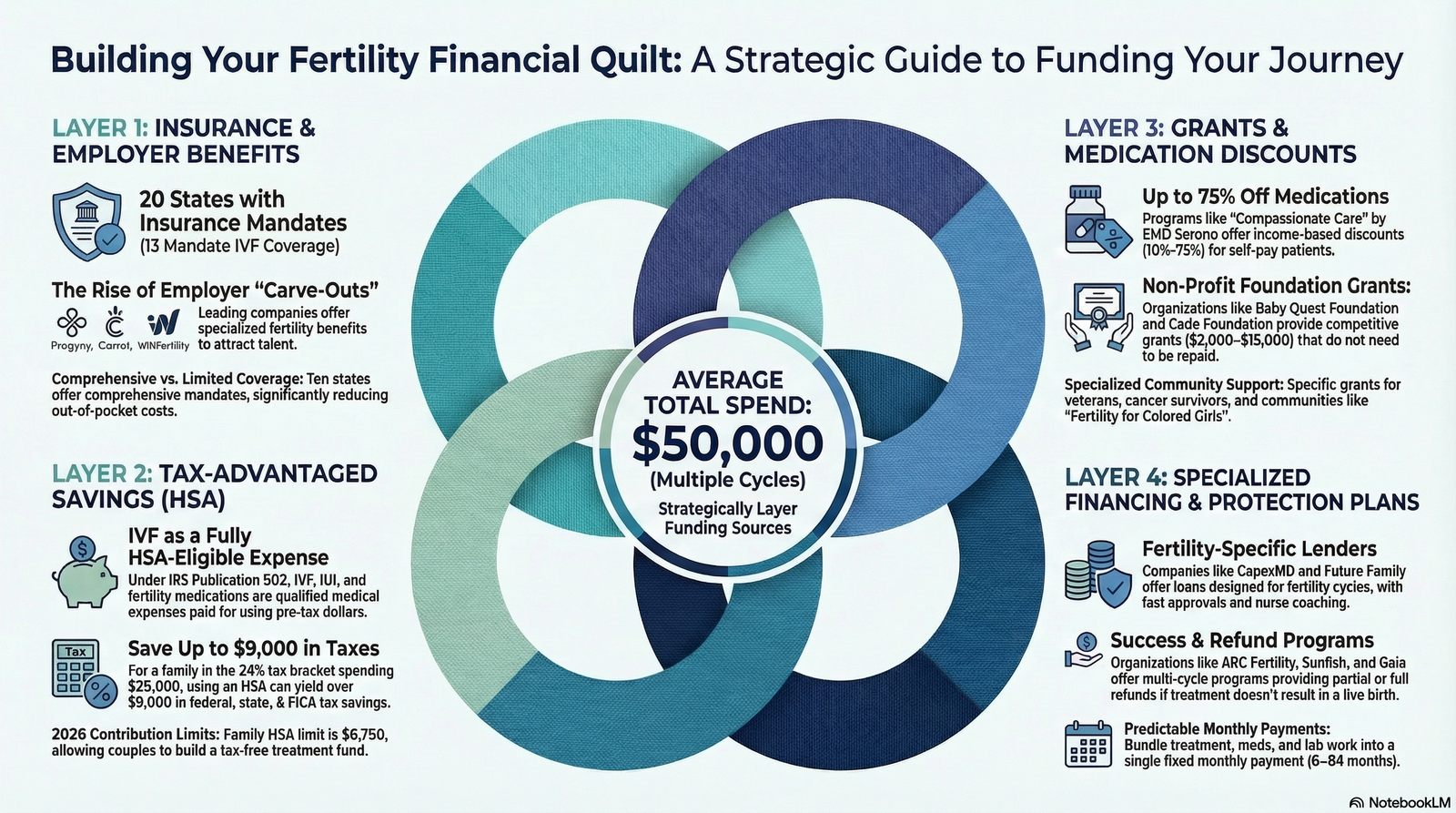
Most successful families build a “financial quilt,” layering insurance, grants, HSAs, and focused loans rather than relying on a single source.
What To Include In Your All-In Budget
When you sketch out your plan, it helps to see more than just the clinic quote. Here are common costs that catch people off guard.
- Monitoring costs: If you travel to a lower-cost clinic, you still need local ultrasounds and bloodwork, which can cost $500 to $5,000.
- Diagnostic workup: Semen analysis, hormone panels, and physical exams can add $659 to $1,639 before you even start treatment.
- Time off work: Couples often spend around 125 hours on treatment over 18 months, almost 16 full workdays, which can lead to lost wages or used-up leave.
- Ancillary services: Acupuncture and other supportive care are usually out-of-pocket and run $100 to $200 per session.
- Travel and lodging: If you travel for care, the IRS lets you use HSA funds for mileage, at 20.5 cents per mile in recent guidance, and for lodging up to $50 per night.
Turning A Scary Number Into A Real Plan
When you look at the full list, it is easy to feel like IVF is only for people with endless savings. In reality, many families get there by breaking the total into smaller pieces, lining those pieces up against real benefits such as mandates, carve-out programs like Progyny or Carrot, and time-limited grant windows. You do not have to solve the whole $50,000 puzzle in one day. You only need to decide your next, concrete step.
Want help comparing clinics and costs?
If managing quotes, benefits, and fine print feels like a full-time job, our advisors can collect clear, itemized quotes from verified clinics and map your likely timeline at no cost to you.

Why trust this guide? The OVU commitment
You are probably juggling hope, timelines, and a lot of tabs open in your browser. And you deserve clear, current, human advice. At OVU, we review clinic protocols, compare real quotes, and talk to people who have done this - intended parents and gestational carriers - so we can give you practical steps, not just theory. If you want help comparing options without sales pressure, we will gather itemized quotes and success data that match your exact situation. You decide, we will bring the info to your table.
Frequently Asked Questions
Does health insurance cover egg or sperm donor costs?
Most plans do not cover donor compensation or agency fees. Many state mandates, including New Jersey and New York, clearly exclude non-medical donor costs. Some plans in strong mandate states, such as Massachusetts, do cover the medical procedures used to retrieve donor eggs or prepare donor sperm, so read your plan booklet carefully.
Can I use my HSA for my spouse’s treatment if they have different insurance?
Yes. As long as you are legally married, you can use your HSA funds to pay for your spouse’s qualified medical expenses, even if they are not on your high-deductible health plan.
What if I have bad credit? Can I still get financing?
You can still find options, but it may take more work. You might need a co-signer with stronger credit. Some clinics also offer in-house financing without a credit check, but these plans often require a large down payment. For instance, some programs ask for 50 percent of the package cost up front.
Are surrogacy costs tax-deductible or HSA-eligible?
Current IRS rules do not treat surrogacy compensation, legal fees, or the surrogate’s medical bills as qualified medical expenses for intended parents. This means you generally cannot pay those costs from an HSA or claim them as medical deductions on your taxes.
How much does ICSI add to an IVF cycle?
ICSI, where an embryologist injects a single sperm directly into each mature egg, usually adds about $1,500 to the cost of a cycle. In states with strong insurance mandates, clinics tend to use ICSI more selectively because patients do not feel as much pressure to “do everything at once” in a single self-funded cycle.
Does a “100 percent refund” program really give all my money back?
Usually not. Most refund programs return the clinic fees only. You still pay for medications, diagnostic testing, and PGT. That means you can still be out thousands of dollars even if you do not bring home a baby, so read the fine print line by line before you sign.
Can I use crowdfunding to pay for fertility treatment?
Some families do use crowdfunding as one layer of their plan. Between 2013 and 2020, more than 3,300 campaigns on GoFundMe asked for a total of $52 million for fertility costs, but only about 22.8 percent of those campaigns reached their goals. You can view crowdfunding as a supplement rather than your only strategy.
Reference List 2 sources
Journal Article (Cost-Effectiveness Study): Keller E, Botha W, Chambers GM. Does in vitro fertilization (IVF) treatment provide good value for money? A cost-benefit analysis. Frontiers in Global Women's Health. 2023;4:971553. Available from: https://www.frontiersin.org/journals/global-womens-health/articles/10.3389/fgwh.2023.971553/full
Journal Article (Systematic Review Protocol): Njagi P, Groot W, Arsenijevic J, Mburu G, Chambers G, Calhaz-Jorge C, et al. Financial cost of assisted reproductive technology for patients in high-income countries: A systematic review protocol. PLOS One. 2025;20(2):e0318780. Available from: https://journals.plos.org/plosone/article?id=10.1371/journal.pone.0318780
Final Thoughts
Fertility treatment is a marathon, not a quick sprint. The emotional weight is already heavy, and the financial side can feel like too much. You might worry that every decision you make about money will come back to haunt you if treatment does not work on the first try.
What the data and real-world stories show is that outcomes improve when money is less of a barrier. In states with strong mandates, patients transfer fewer embryos, have more single-baby pregnancies, and still reach similar or better chances of having a child. When you do not feel backed into a financial corner, you and your doctor can focus on what is medically safest instead of what seems cheapest in the short term.
If this all feels overwhelming, take a small, concrete step. Call your HR department and ask whether your plan offers fertility carve-out benefits through programs such as Progyny, Carrot, or Maven. Look up your state’s laws so you know what your employer could offer, even if they do not offer it yet. Then choose one next move, whether that is a grant application, an HSA strategy, or a realistic loan amount that fits your life.
You are not alone in feeling scared by these numbers. Thousands of families have sat where you are now, stared at the same invoices, and still found a path through. The child you are working toward is not a price tag, and the choices you make today are simply tools to help you reach them.