


Dr. Sony Sherpa (MBBS)
In addition to her clinical experience, Dr. Sherpa is a published medical researcher and holistic health advocate. Her dual expertise in emergency care and alternative therapies brings a unique lens to medically reviewed content—ensuring it is both accurate and accessible.
If you are thinking about IVF or are already in the middle of testing, you probably feel pulled in two directions. On one side, you are picturing a baby in your arms. On the other side, you are staring at numbers that look bigger than a car loan. Many people in this situation describe it as working a second job, where every spare hour and spare dollar goes into trying to grow their family.
Infertility affects about 15% of couples in the United States. Doctors define it as not getting pregnant after 12 months of regular unprotected sex if you are under 35, or after 6 months if you are 35 or older. The World Health Organization recognized infertility as a disease in 2009. Still, many health plans treat fertility care as optional. One IVF cycle in the U.S. averages about $12,400. When you add medications and more than one cycle, total costs can climb to around $85,000.
This guide walks you through how insurance coverage works, what you actually pay for, and how to lower the bill where you can. We will explore state laws, employer benefits, grants, and real numbers so you can plan with clear information instead of guessing from clinic brochures.
Most U.S. health plans cover basic infertility testing but not full IVF. A single IVF cycle can cost around $12,400 before medications and add-ons, and total spending can reach $85,000 if you need several rounds. State laws and employer benefits make a big difference in what you actually pay.
Next step: Check if your plan is self-funded, look up your state mandate, and ask your HR team for your fertility benefits summary in writing.
What the Latest Research Shows About Coverage
Large national studies show that infertility insurance mandates are more than just a theoretical concept. In states with broad mandates, IVF use is more than double what it is in states with no mandates, and multiple birth rates are lower because patients do not feel forced to transfer several embryos at once. Surveys also show that only about 1 in 7 women of reproductive age in the U.S. has ever used fertility services, and use is highest in those with private insurance and higher incomes.
These patterns tell a simple story. The more your insurance helps, the more likely you are to reach a specialist early, choose safer treatment plans, and stay in care long enough to have a real chance at success.
In This Guide
Fewer than 24% of infertile couples in the U.S. have enough access to fertility services.
40% of employers now offer some fertility benefit, up 33% since 2020.
Couples spend around 125 hours on fertility care over 18 months.
Why Fertility Treatment Is So Expensive
When you first see an IVF quote, it often looks like a single price for “one cycle”. In reality, you are paying for many different pieces. You cover the clinic team, the lab, the medications, the operating room, the storage tanks that keep embryos safe, and the extra testing that gets suggested along the way.
In the U.S., a base IVF cycle averages $12,400. That number usually includes monitoring visits, egg retrieval, fertilization, embryo culture, and one fresh transfer. It does not include most medications or many of the popular add-ons you will hear about in consults. In high-cost areas like the California Bay Area, the median cost per person is around $24,373, and the cost to achieve one live birth can exceed $61,377.
On top of this, the U.S. charges a large premium for IVF compared with many other countries. One analysis found that a U.S. IVF cycle costs about 271% more than the average cost across 25 other developed nations. You pay more per cycle, and you often pay for more cycles, especially when insurance coverage is thin.
How Insurance Coverage Shapes Real Outcomes
46 vs. 20 Cycles Per 10,000 Women: In states with strong infertility insurance mandates, about 46 IVF cycles start for every 10,000 women of reproductive age. In states with no mandate, that number is closer to 20. Coverage more than doubles access to treatment for people who might otherwise be priced out. Source: Fertility and Sterility (PMID: 37775023).
88% Have Policies, Far Fewer Cover IVF Fully: A review of 58 major insurers found that 88% had a written IVF policy, but only about a third clearly covered IVF across all plan types. Many plans either denied coverage outright or paid on a case-by-case basis. Source: Journal of Assisted Reproduction and Genetics (PMID: 36542313).
Fewer Embryos, Safer Pregnancies: In more than 90,000 IVF cycles, clinics in states without IVF mandates transferred more embryos per cycle and had higher twin and triplet rates than clinics in mandate states. The live birth rate per cycle was only slightly higher in non-mandate states, but the risk of multiples was clearly higher. Source: Fertility and Sterility (PMID: 20688327).
1 in 7 Women Use Fertility Services: Recent national survey data show that about 14 in 100 women aged 20 to 49 in the U.S. have ever used fertility services. Use is higher among women with private insurance and higher incomes. Source: NCHS Data Brief (PMID: 41678837).
These findings come from peer-reviewed research. Your experience will depend on your age, diagnosis, and treatment plan. Use this data as a starting point for questions to ask your clinic and your insurer.
| Service | Typical Cost Range |
|---|---|
| Base IVF cycle | $12,400 |
| Medications per cycle | $3,000–$6,000 |
| PGT-A testing | $3,000–$5,000 |
| ICSI add on | $1,500 |
| Embryo storage (5 years) | $2,000 |
| Initial evaluation and testing | $1,000–$2,000 |
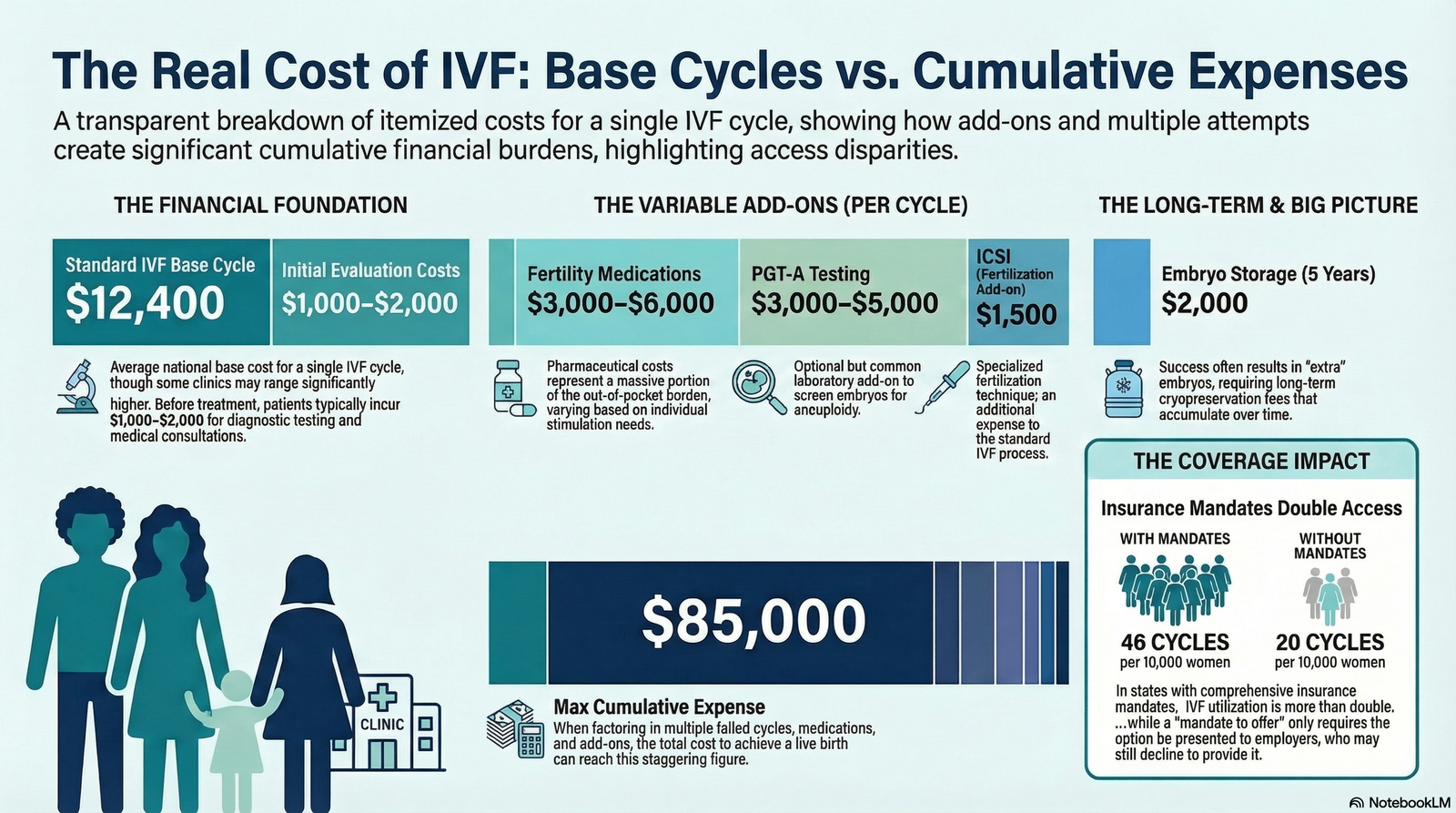
IVF cost and coverage snapshot, from base cycle fees to add-ons and time costs.
When you add everything together, total spending can reach around $85,000 for people who need several cycles. That number is not meant to scare you. It is there so you can plan and protect yourself financially instead of getting surprised one bill at a time.
How State Mandates Change Access and Safety
State laws are one of the biggest reasons why your friend in one state gets coverage for IVF while you pay cash in another. As of 2022, about 20 states had laws that tell insurers to either cover infertility care or at least offer it to employers. Those laws are not all the same, and they do not apply to every type of plan.
The first key difference is between a mandate to cover and a mandate to offer. A mandate to cover means health plans sold in that state must include infertility benefits. A mandate to offer only means insurers must offer an infertility option to employers. Your employer can still say no to adding it.
Only about 10 states have broad IVF mandates that require third-party coverage with fewer limits on who qualifies and how much is covered. These include Connecticut, Colorado, Delaware, Illinois, Maine, Massachusetts, Maryland, New Jersey, New York, and Rhode Island. Even within that group, the rules can be very different.
| State Example | Key Coverage Rules |
|---|---|
| Arkansas | Covers IVF with maternity benefits, a $15,000 lifetime cap, 2-year infertility history. |
| Hawaii | Covers one IVF cycle, 5-year history of specific diagnoses is required. |
| Illinois | Covers up to four egg retrievals, plus two more if you have a live birth. |
| Maryland | $100,000 lifetime max, three IVF attempts per live birth. |
| Rhode Island | Coverage for women aged 25 to 42, $100,000 cap. |
| Texas | Insurers must offer IVF, employers can decline, coverage often requires use of a spouse’s sperm. |
Insurance Mandates and Real World Impact
More Treatment When Coverage Exists: In one large analysis, IVF use in comprehensive mandate states was more than double use in states with no mandate. That means more people actually reach treatment, instead of stopping after testing because of cost.
Safer Pregnancies With Less Pressure: Studies show lower twin and triplet rates in mandate states, because patients are more willing to transfer fewer embryos when they are not gambling all their savings on one cycle.
Gaps Still Remain: Even in states with strong laws, IVF use is higher in White and Asian patients than in Black and Hispanic patients. People with private insurance and higher incomes still benefit the most from these protections.
If you live in a mandated state, you still need to check whether your plan is fully insured or self-funded. Self-funded employers can skip state mandates, so your coverage might not match what the law promises.
The 2026 California Shift (SB 729)
If you live or work in California, a new law will change coverage for many people. Starting on January 1, 2026, Senate Bill 729 will require fully insured large group employers, those with at least 101 employees, to cover infertility diagnosis and treatment, including IVF.
The law will cover up to three completed egg retrievals and unlimited embryo transfers. It also broadens the definition of infertility so that LGBTQ+ couples and single parents by choice can qualify based on their need for medical help to build a family, not just on a narrow definition tied to heterosexual intercourse. SB 729 does not apply to Medi Cal, small group employers, or self-funded plans, so you still have to confirm exactly what type of plan you are on.
Hidden Costs Beyond the Clinic Bill
When you add up IVF costs on paper, you usually start with what the clinic quotes you. The reality is that the process also costs you time, focus, and energy. You sit in waiting rooms, drive to early morning ultrasounds, repeat lab work, and spend lunch breaks on the phone with pharmacies and insurers.
One large study found that over 18 months, couples spent about 125 hours on fertility care. If you go through IVF, that number goes up to around 162 hours. That is about 15.6 workdays of your life dedicated to appointments, travel, and paperwork.
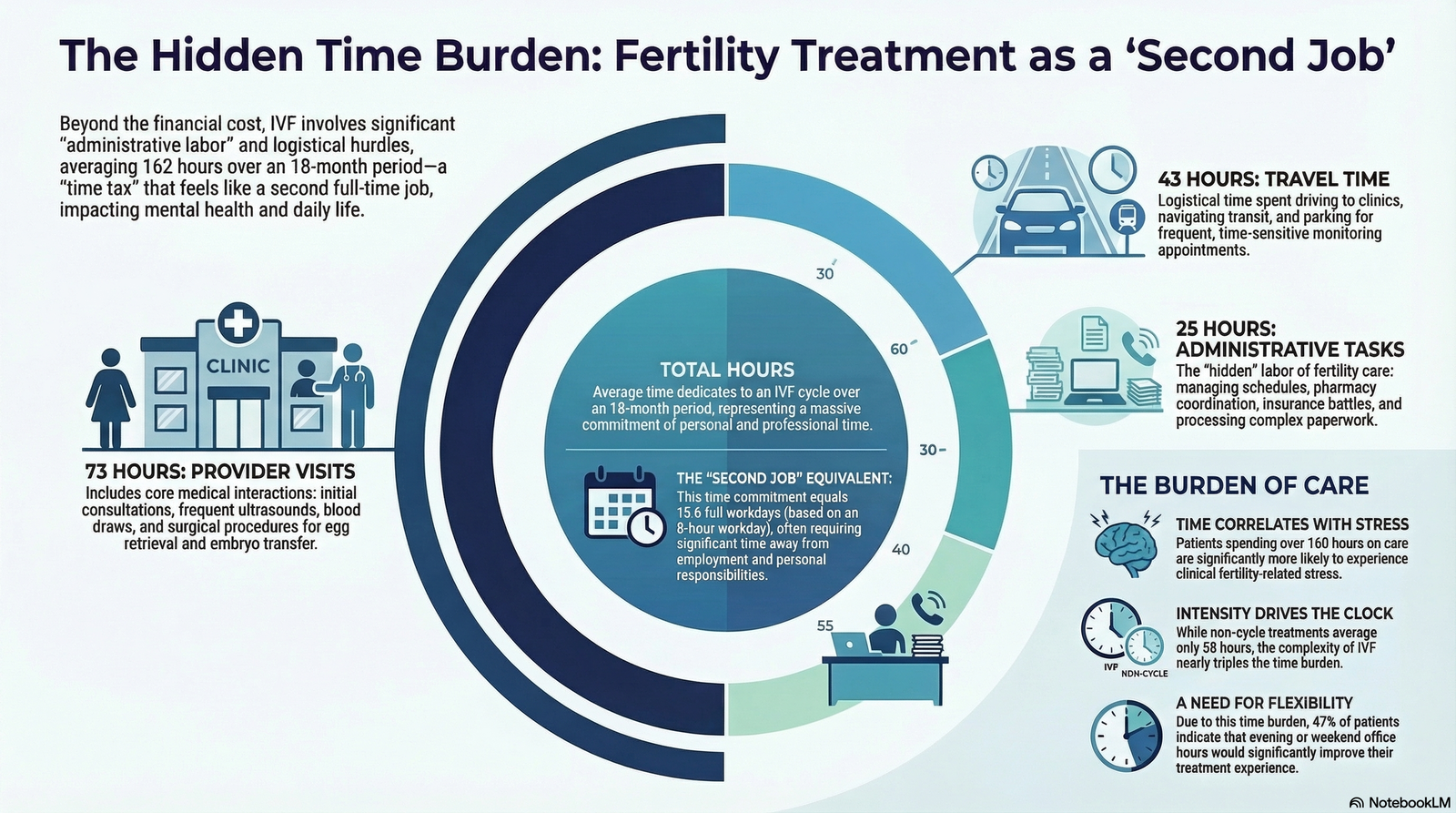
Time cost of fertility care, from provider visits to travel and admin tasks.
Here is how those hours break down:
- Provider visits: About 73 hours for consults, ultrasounds, blood draws, and procedures.
- Travel time: About 43 hours in the car or on public transport.
- Phone calls and admin tasks: About 25 hours spent on scheduling, insurance questions, pharmacy issues, and forms.
If you work full-time, and most fertility patients do, you feel this in your paycheck and in your stress level. You might burn through paid time off, take unpaid leave, or hide appointments from your manager because you worry about how it looks. That strain adds to the emotional burden of not knowing whether each cycle will work.
The Cost of Add-ons
Beyond the base cycle, clinics often offer add-ons that they frame as ways to boost success. Some are helpful in clear situations. Others have less evidence behind them. What they all have in common is extra cost, often paid out of pocket.
- ICSI: Intracytoplasmic sperm injection can add about $1,500 per cycle. It is used in the majority of cycles in the U.S. Use is higher in non-mandate states, where around 73.9% of cycles include ICSI, compared with 63.5% in mandate states.
- PGT: Preimplantation genetic testing is used in about 37.7% of cycles. It can lower miscarriage risk by helping select chromosomally normal embryos, but it also adds about $3,000 to $5,000. It is about 31% less common in mandate states, where patients feel less forced to “do everything” in one round.
- Cryopreservation and storage: Freezing and storing embryos is often billed separately. Many mandates do not cover storage, and a typical fee is around $2,000 for 5 years.
Ways To Make Treatment More Affordable
When you look at numbers like $12,000 per cycle or $85,000 over time, it is easy to feel like IVF is only for people with very high incomes. You do have ways to close the gap. None of them is perfect, and most take effort, but together they can take real pressure off your budget.
Understand Your Employer Plan and Carve-outs
Even if your state has a mandate, your actual coverage depends on whether your employer uses a fully insured plan or a self-funded one. Self-funded employers can ignore state laws under ERISA. Many large companies now try to fill this gap with separate fertility benefit platforms, sometimes called carveouts, such as Progyny, Kindbody, Carrot, or Maven.
These programs often use a “cycle-based” model instead of a flat dollar cap. For example, Progyny’s Smart Cycle bundles an egg retrieval, transfer, lab work, and monitoring. Your employer chooses how many Smart Cycles to give you, often between one and five. These platforms also assign care managers who help you plan the order of tests and treatment so you do not burn through your benefits before you even start IVF.
Look Outside Insurance for Help
Several types of support can sit on top of whatever your health plan offers.
- Grants and foundations: Around 37 private foundations in the U.S. offer grants for fertility care. The average grant is about $8,191. Many focus on cancer patients who need to freeze eggs or sperm before treatment, but some, such as Baby Quest and the Tinina Q. Cade Foundation, help a wider group.
- Crowdfunding: Between 2013 and 2020, people requested over $52 million on GoFundMe to cover fertility costs. The average campaign raised about $6,759, which is roughly 43% of a typical goal.
- Shared risk or package pricing: Some clinics in non-mandate states offer bundle deals or partial refunds if you do not have a baby after a set number of cycles. An IVF Assist type program might charge around $13,000 for a cycle, not including medications, at a lower rate than their standard package.
- Medication discount programs: Drug manufacturers often run income-based assistance programs for IVF medications. Your clinic’s financial counselor can give you a list of options and help you apply.
OVU Expert Guidance on Managing Costs
Start With Your Plan Documents: Before you make any decisions, get your full benefits booklet from HR and read the infertility section line by line. Do not rely on phone summaries alone.
Match Treatment To Your Odds: Ask your doctor for clear, number-based estimates of your chance of success with IUI versus IVF based on your age and diagnosis. This helps you avoid spending money on many low-yield IUIs when IVF would be more efficient.
Protect Your Mental Bandwidth: Assign one night a week for financial tasks, such as grant applications or insurance calls, so that cost planning does not take over every evening of your life.
Is Egg Freezing a Smart Move For You?
Egg freezing has moved from rare to common over the last decade, especially for people in demanding training or careers. For female graduate students, cost is the main reason they say no. In one survey, cost was named as the top concern by about 59% of respondents. Around 81% said they would be more likely to consider egg banking if an employer covered it. Only about 10% would consider egg freezing without coverage, a number that jumped to 48% when coverage was offered.
Even when employers do cover egg freezing, most women say they will not push back their ideal timeline for having children. They tend to see egg freezing as an insurance policy, not an excuse to delay forever. If you are thinking about freezing eggs, it helps to run through both the medical pros and the true cost before you decide.
What To Budget For
To build a realistic fertility budget, it helps to think in categories instead of focusing on one sticker price. Here are the main buckets to expect.
- Base IVF cycle: Around $12,400 for one cycle.
- Medications: Around $3,000 to $6,000 per cycle.
- ICSI: About $1,500 if you add this lab procedure.
- PGT-A testing: Around $3,000 to $5,000.
- Embryo storage: About $400 to $600 per year, or around $2,000 for a 5-year block.
- Initial evaluation and testing: Around $1,000 to $2,000, often covered as diagnostic care.
- Supportive care: Services such as acupuncture for stress relief often cost $100 to $200 per session.
If you are in a relationship, you and your partner can sit down together with these numbers and decide how much you are both comfortable putting at risk. It is also reasonable to set a hard ceiling in advance so you do not have to make emotional money decisions in the middle of a failed cycle.
Want help comparing clinics and costs?
If this feels like a full-time job, and honestly it can, our advisors can collect clear, itemized quotes from verified clinics and map your timeline at no cost to you.

Why trust this guide? The OVU commitment
You are probably juggling hope, timelines, and a lot of tabs open in your browser. And you deserve clear, current, human advice. At OVU, we review clinic protocols, compare real quotes, and talk to people who have done this - intended parents and gestational carriers - so we can give you practical steps, not just theory. If you want help comparing options without sales pressure, we will gather itemized quotes and success data that match your exact situation. You decide, we will bring the info to your table.
Frequently Asked Questions
Does my state have a mandate if I work for a small company?
Often, no. Many mandates only apply to employers above a certain size. For example, New Jersey and Maryland do not apply their laws to employers with fewer than 50 employees. Illinois uses a 25-employee cutoff. If you work for a smaller company, your employer might not have to follow the state mandate, even if it exists.
Can my insurance deny me if I am not in a heterosexual relationship?
Some older laws require the use of a spouse’s sperm, which makes it hard or impossible for LGBTQ+ couples and single parents to qualify. Newer laws in states like California, Illinois, Maine, and Maryland now spell out coverage for same-sex couples and single people. You still need to read your plan’s language carefully.
Is egg freezing covered for cancer patients?
Yes, in several states. Ten states, including California, Colorado, Illinois, New York, New Hampshire, Connecticut, Rhode Island, Delaware, Maryland, and New Jersey, require insurers to cover fertility preservation for medical treatments that can cause infertility, such as chemotherapy. This typically includes freezing eggs or sperm before treatment begins.
Why did my premium go up after a mandate was passed?
Any new covered service adds some cost to premiums, but IVF mandates usually have a modest impact. Actuarial studies show that adding IVF coverage tends to raise premiums by only about 0.5% to 1.1%. That still shows up in your paycheck, but it is much smaller than many people expect.
How many IVF cycles will insurance pay for?
This depends on your state and your specific plan. New York covers three cycles for large group plans. New Jersey and Illinois cover four egg retrievals. Maryland covers three IVF attempts per live birth within a $100,000 limit. Your employer can offer more generous coverage than the minimum, or less, so you need to confirm your plan’s limits.
What counts as a cycle in my plan?
Some insurers count each embryo transfer as one cycle. Others define a cycle as one egg retrieval and all transfers from that retrieval. Platforms like Progyny use their own structure, where an IUI might count as a quarter of a cycle and egg freezing as a half. Ask your benefits department to explain your plan’s exact definition in writing so you can plan how to use it.
Does insurance cover the male partner’s testing?
Only some state laws clearly include male factor testing. In other states, your plan might cover the woman’s treatment but exclude semen analysis or other tests for the male partner. Because male factor infertility is common, it is worth checking this detail before you start, so you are not surprised by separate bills.
Reference List 4 sources
Journal Article (Research): Korkidakis A, DeSantis C, Kissin D, Hacker MR, Koniares K, Yartel A, Adashi EY, Penzias AS; Assisted Reproductive Technology Epidemiologic Research (ART ER) Group. State insurance mandates and racial and ethnic inequities in assisted reproductive technology utilization. Fertility and Sterility. 2024;121(1):54–62. PMID: 37775023. Available from: https://pubmed.ncbi.nlm.nih.gov/37775023/
Journal Article (Research): Ha M, Drees A, Myers M, Finkelstein ER, Dandulakis M, Reindorf M, Roque DM, Beall SA, Slezak S, Rasko YM. In vitro fertilization: a cross sectional analysis of 58 US insurance companies. Journal of Assisted Reproduction and Genetics. 2023;40(3):581–587. PMID: 36542313. Available from: https://pubmed.ncbi.nlm.nih.gov/36542313/
Journal Article (Research): Jain T, Harlow BL, Hornstein MD. Insurance coverage and in vitro fertilization outcomes: a U.S. perspective. Fertility and Sterility. 2011;95(3):964–969. PMID: 20688327. Available from: https://pubmed.ncbi.nlm.nih.gov/20688327/
Government Report: Nugent CN, Chandra A. Use of fertility services in women ages 20–49 in the United States: 2022–2023. NCHS Data Brief. 2025;(542):1–8. PMID: 41678837. Available from: https://pubmed.ncbi.nlm.nih.gov/41678837/
Final Thoughts
If you are reading this, you are probably trying to balance hope for a child with very real fear about money. That mix is heavy. It is normal to feel worn down, angry, or numb when yet another bill arrives or another prior authorization gets denied.
At the same time, it is important to remember that wanting a family is not a luxury. It is a basic human need. The good news is that more employers are waking up to this reality, and more states are treating infertility as a medical condition that deserves coverage. The shift is slow, but it is happening.
Your job right now is not to fix the whole system. Your job is to protect your own health, your relationships, and your finances as best you can while you move toward the family you want. Ask questions. Speak up when something does not make sense. Bring a friend, partner, or advocate to challenging appointments. Reach out to support groups where people understand that you are not “overreacting” about cost, because they have lived it too.
You are not alone in this. With clear information, a realistic plan, and the right support, you can move through this process in a way that feels more in your control, even when the outcomes are not.