


Dr. Sony Sherpa (MBBS)
In addition to her clinical experience, Dr. Sherpa is a published medical researcher and holistic health advocate. Her dual expertise in emergency care and alternative therapies brings a unique lens to medically reviewed content—ensuring it is both accurate and accessible.
If you are thinking about using a surrogate to build your family, you are carrying a lot on your shoulders. You are hopeful, but you are also about to entrust someone else with a pregnancy you have long dreamed of. That blend of excitement and fear is completely normal. We understand how heavy this choice feels. Therefore, it is essential to take the time to prepare yourself emotionally and logistically for the path ahead. Remember that every moment of careful consideration moves you closer to holding your baby.
To help you with that essential preparation, we have compiled the key practical information you need to move forward. This guide walks you through what actually matters when you choose a gestational carrier: the medical criteria, the screening steps, the legal basics, and the numbers on success and safety. The goal is simple: to help you spot a safe, solid match and feel more confident in each decision you take.
Large donor‑egg studies show that when clinics follow strict screening guidelines, gestational carrier pregnancies can reach live birth rates around 57% per transfer, compared with about 46% when similar embryos are transferred back to high‑risk intended parents. Expert groups such as ASRM and ACOG use these data to shape very specific safety rules for who should, and should not, carry as a surrogate.
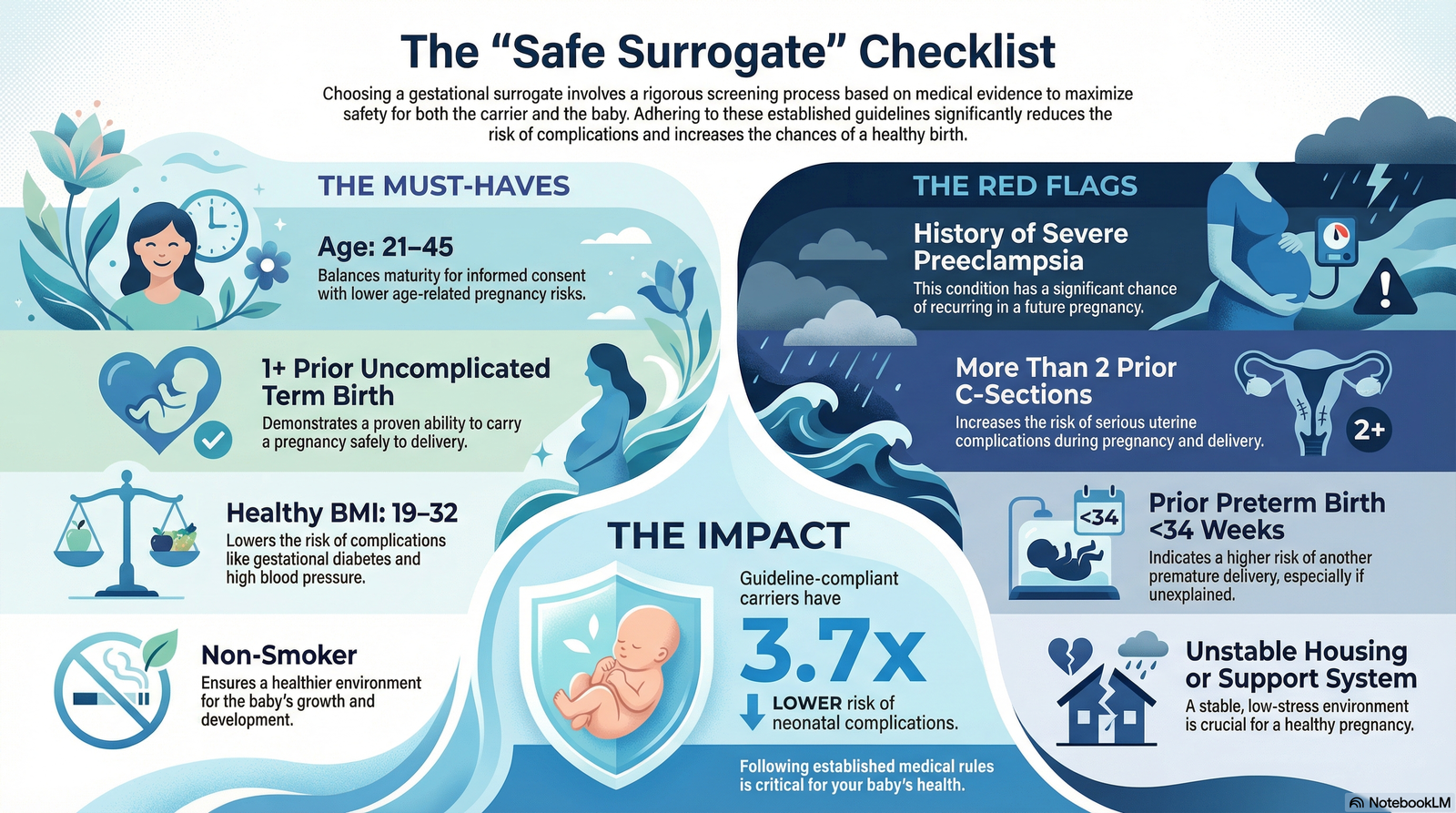
The best surrogate match is a healthy woman between 21 and 45 who has had at least one uncomplicated full‑term birth, has a stable home life, and passes detailed medical and psychological screening. From matching to embryo transfer, you are usually looking at about 3–6 months. Sticking to established medical guidelines lowers the risk of complications and raises your chances of bringing home a healthy baby.
Next step: Talk with your surrogacy agency or clinic and ask to see profiles of pre‑screened carriers who already meet these criteria.
Latest Research Insights
Finding #1 (2024): A major review of over 28,000 surrogate pregnancies found that surrogates have a slightly higher chance of developing high blood pressure during pregnancy compared to natural conceptions. However, their outcomes were just as good - or even better - than other IVF pregnancies. The extra risks come mainly from IVF itself and carrying twins, not from surrogacy alone. Source: JAMA Network Open (PMID: 39042408).
Finding #2 (2018): When embryos were transferred to a surrogate instead of the intended parent, success rates jumped from 46% to 57% - an 11 percentage point improvement. Babies born to surrogates were also nearly half as likely to have low birthweight. For intended parents with health concerns, using a well-screened surrogate may give your baby a healthier start. Source: Fertility and Sterility (PMID: 30316434).
Finding #3 (2021): Serious pregnancy complications were rare in surrogates - only about 2 in 100 experienced them. This was actually much lower than in other IVF pregnancies, where about 6 in 100 had complications. Well-screened surrogates tend to have safer pregnancies than many intended parents would carrying themselves. Source: Journal of Assisted Reproduction and Genetics (PMID: 33145724).
Finding #4 (2020): When surrogates didn't meet recommended screening guidelines - such as being too young, too old, or having certain health issues - problems increased significantly. These pregnancies had more C-sections, more premature births, and babies were nearly 4 times more likely to need special medical care. This shows why choosing a properly screened surrogate matters so much for your baby's health. Source: Obstetrics & Gynecology (PMID: 32649497).
Note: These findings come from recent peer-reviewed research. Your own results depend on your personal health and your clinic's approach. Always discuss what these findings mean for you with your fertility specialist.
In This Guide
21–45 years
Often 25–38 in practice
About 57% per transfer
In large donor‑egg GC cohorts
Matching: 1–4 months
Screening: 1–2 months
Key Medical Criteria for Surrogates
If you scroll through agency sites, you see lots of bullet lists about who “can” and “cannot” be a surrogate. Behind those lists is a clear purpose. Keep the pregnancy as safe as possible for both your surrogate and your baby.
Here are the core medical requirements most clinics and agencies use, with the plain‑language reason for each.
| Requirement | Why It Matters |
|---|---|
| Age 21–45 | You want someone old enough to give informed consent and young enough to keep pregnancy risks manageable. |
| At least one prior term birth | A previous full‑term, low‑risk pregnancy shows that her uterus can carry safely to delivery. |
| Healthy BMI | A weight that is too high or too low raises the risk of gestational diabetes, high blood pressure, and birth complications. |
| No major past obstetric complications | A history of severe preeclampsia, very early preterm birth, or severe hemorrhage increases the chance that it happens again. |
Why Guideline Rules Are Worth Protecting
One population study found that when pregnancies followed ASRM guidelines, severe maternal complications were rare. When teams ignored those rules, babies faced 3.7 times higher odds of serious problems, and carriers faced more C‑sections and preterm births. That is why you will often hear your team say “no” to a candidate who seems lovely but does not tick all the boxes.
How Screening Actually Works
Once you match with a potential surrogate, your clinic and agency shift into a different gear. Their job is to confirm that she is as safe a choice in practice as she looks on paper. This usually takes one to three months, depending on how fast records arrive.
Step 1: Record Collection and Medical Review
Your agency and clinic pull every delivery report they can get, plus prenatal records. Your doctor looks for full‑term births, normal birthweights, and a lack of red‑flag events such as severe preeclampsia, ICU stays, or severe hemorrhage.
Step 2: Psychological Evaluation
A mental health professional meets with the surrogate, and often her partner, to talk through her motivations, support system, and how she handles stress. The goal is to be sure she understands what it means to hand a baby to you at birth and that she has people in her life who will support her.
Step 3: Uterine Evaluation and Lab Testing
At the clinic, your reproductive endocrinologist performs a physical exam, an ultrasound, and often a saline sonogram to evaluate the uterine cavity. The team also orders a full panel of blood tests, including infectious disease screening and hormone levels, plus a drug screen. Only when all of this looks reassuring does the clinic give final medical clearance.

At a glance: screening steps, success rates, and how guideline‑compliant screening changes risk.
How Matching Works in Real Life
You are not just matching on medical charts. You are also matching on personality, values, and expectations. A good match feels like a partnership, not a transaction, but a bond that will support everyone involved throughout the pregnancy and beyond.
What You Talk About in a Match Call
During a match call, you usually cover four big areas.
- Story and motivation. You share your path to surrogacy, and she shares why she wants to carry a child for someone else.
- Communication. How often do you want to get the updates? Are you hoping to attend ultrasounds in person or by video? Do you want a long‑term relationship after birth or a more defined endpoint?
- Hard decisions. You talk directly about views on single‑embryo transfer, twins, selective reduction, and pregnancy termination in the case of serious fetal or maternal problems.
- Practical life details. Work schedule, childcare, partner support, comfort with travel to your clinic, and other day‑to‑day realities.
| Topic | Questions to Cover |
|---|---|
| Communication | How often will you text or call? Who joins the appointments? How do you want to share scan pictures and updates? |
| Medical decisions | Views on twins, selective reduction, and termination for serious anomalies or maternal risk. |
| After birth | Will you keep in touch with photos or messages, or keep things more private? |
Why Legal Support Is Non‑Negotiable
Your lawyer and your surrogate’s lawyer are there to protect both of you. Each of you needs your own attorney. The contract outlines the compensation, medical decision‑making, insurance, bed rest pay, lost wages, contact after birth, and much more. Do not start medications or transfer an embryo until everyone has signed this agreement.
Success Rates, Safety and Outcomes
You deserve clear numbers, not vague promises. Here is what large studies show so far.
In donor‑egg cycles, transferring embryos to a gestational carrier gave live birth rates of about 57% per transfer, compared with about 46% when the same kind of embryos went back to intended parent recipients. For singletons, low birthweight and prematurity both occurred less often in the gestational carrier group.
Large registry data from the United States also show that gestational carrier cycles now rely heavily on frozen embryo transfer and single‑embryo transfer, without hurting success rates. Carriers are usually younger and have proven uncomplicated pregnancies behind them. Severe maternal morbidity is rare in carriers and lower than in other IVF pregnancies.
Guidelines and Matching Criteria That Really Matter
ASRM practice guidance (2022): Recommends that gestational carriers be 21–45 years old, have at least one prior uncomplicated term birth, fewer than five total deliveries, and fewer than three cesarean sections, with no major uncontrolled medical or psychiatric conditions and full infectious‑disease screening. This gives you a concrete checklist when you look at profiles (PMID: 35725121).
ASRM Ethics Committee (2023): Stresses that carriers must have full decision‑making autonomy over their own medical care, access to independent legal counsel, and dedicated psychological support. Good matches are those where everyone agrees in advance, in writing, on embryo number, prenatal testing, reduction, and termination plans (PMID: 36863967).
ACOG (2016): Advises using gestational surrogacy mainly when pregnancy is biologically impossible or medically unsafe for the intended parent and strongly encourages single‑embryo transfer to reduce twin and triplet risks (Family Building Through Gestational Surrogacy).
ESHRE Task Force (2005): Views surrogacy as a last‑resort option for clear medical indications and recommends that surrogates have at least one child, be under 45 years old, undergo strict medical and psychological screening, and usually carry only one embryo (ESHRE Ethics and Law 10: Surrogacy).
Choosing Clinics and Countries
Once you understand the medical and emotional side of surrogacy, your next questions are usually practical. Where should you do this, and which clinic or agency should you trust?
In the United States, surrogacy law sits at the state level. Some states are very friendly to gestational surrogacy and allow pre‑birth orders that put your names directly on the birth certificate. Others have unclear or restrictive laws. If you live abroad, you also have to think about how your home country handles citizenship, passports, and recognition of parentage.
OVU Expert Tip on Picking Location and Team
Focus on three questions. Does the law in the surrogate’s state clearly support gestational surrogacy and pre‑birth orders? Does the clinic publish honest success data for gestational carrier cycles, not just IVF in general? Does the agency insist on ASRM‑level screening and give every carrier her own lawyer and therapist? If you can answer yes to all three, you are starting from a strong base.
Clinic choice, local law, and carrier screening all feed into your chances of a safe birth and smooth handover.
Want help comparing clinics and costs?
If this feels like a full‑time job, and many people say it does, our advisors can collect clear, itemized quotes from verified clinics and map out realistic timelines for you at no cost.

Why trust this guide? The OVU commitment
You are probably juggling hope, timelines, and a lot of tabs open in your browser. And you deserve clear, current, human advice. At OVU, we review clinic protocols, compare real quotes, and talk to people who have done this - intended parents and gestational carriers - so we can give you practical steps, not just theory. If you want help comparing options without sales pressure, we will gather itemized quotes and success data that match your exact situation. You decide, we will bring the info to your table.
Frequently Asked Questions
How long does it usually take to find a surrogate?
Most families match within one to four months once they start working with an agency, but the exact timing depends on your preferences, your budget, and the pool of available carriers. If you have a very specific wish list, your wait may be a bit longer.
Can a friend or family member be my surrogate?
Yes. This is called an “identified” or “known” surrogate. She still needs the same medical, psychological, and legal screening as any other carrier. Many families choose this route but still lean on an agency or lawyer to handle contracts and logistics.
What usually disqualifies someone from being a surrogate?
Common reasons include a very high or very low BMI, serious past pregnancy complications, more than two or three prior C‑sections, uncontrolled medical conditions, active smoking or drug use, and unstable housing or finances. The clinic looks at the whole picture to decide if a pregnancy would be safe enough.
Reference List 11 sources
Journal Article (Systematic Review & Meta-Analysis): Matsuzaki S, Masjedi AD, Matsuzaki S, et al. Obstetric characteristics and outcomes of gestational carrier pregnancies: a systematic review and meta-analysis. JAMA Network Open. 2024;7(7):e2422634. PMID: 39042408. Available from: https://pubmed.ncbi.nlm.nih.gov/39042408/
Journal Article (Research): Swanson K, Letourneau JM, Kuppermann M, Einerson BD. Obstetric morbidity in gestational carrier pregnancies: a population-based study. Journal of Assisted Reproduction and Genetics. 2021;38(1):177–183. PMID: 33145724. Available from: https://pubmed.ncbi.nlm.nih.gov/33145724/
Journal Article (Research): Swanson K, Letourneau JM, Kuppermann M, Einerson BD. Association of obstetric and neonatal outcomes with deviation from guidelines for gestational carriers. Obstetrics & Gynecology. 2020;136(2):387–393. PMID: 32649497. Available from: https://pubmed.ncbi.nlm.nih.gov/32649497/
Journal Article (Comparative Study): Segal TR, Kim K, Mumford SL, Goldfarb JM, Weinerman RS. How much does the uterus matter? Perinatal outcomes are improved when donor oocyte embryos are transferred to gestational carriers compared to intended parent recipients. Fertility and Sterility. 2018;110(5):888–895. PMID: 30316434. Available from: https://pubmed.ncbi.nlm.nih.gov/30316434/
Journal Article (Research): Shandley LM, DeSantis CE, Lee JC, Kawwass JF, Hipp HS. Trends and outcomes of assisted reproductive technology cycles using a gestational carrier between 2014 and 2020. JAMA. 2023;330(17):1691–1694. PMID: 37851614. Available from: https://pubmed.ncbi.nlm.nih.gov/37851614/
Journal Article (Research): Herweck A, DeSantis CE, Shandley LM, Kawwass JF, Hipp HS. International gestational surrogacy in the United States, 2014–2020. Fertility and Sterility. 2024;121(4):622–630. PMID: 38176517. Available from: https://pubmed.ncbi.nlm.nih.gov/38176517/
Journal Article (Review): Kim HH. Selecting the optimal gestational carrier: medical, reproductive, and ethical considerations. Fertility and Sterility. 2020;113(5):892–896. PMID: 32386618. Available from: https://pubmed.ncbi.nlm.nih.gov/32386618/
Committee Opinion (Guidance): Practice Committee of the American Society for Reproductive Medicine; Practice Committee of the Society for Assisted Reproductive Technology. Recommendations for practices using gestational carriers: a committee opinion. Fertility and Sterility. 2022;118(1):65–74. PMID: 35725121. Available from: https://pubmed.ncbi.nlm.nih.gov/35725121/
Ethics Committee Opinion: Ethics Committee of the American Society for Reproductive Medicine. Consideration of the gestational carrier: an Ethics Committee opinion. Fertility and Sterility. 2023;119(5):903–909. PMID: 36863967. Available from: https://pubmed.ncbi.nlm.nih.gov/36863967/
Committee Opinion (Guidance): American College of Obstetricians and Gynecologists’ Committee on Ethics. Family building through gestational surrogacy. Committee Opinion No. 660. Obstetrics & Gynecology. 2016;127(3):e97–e103. Available from: https://www.acog.org/clinical/clinical-guidance/committee-opinion/articles/2016/03/family-building-through-gestational-surrogacy
Ethics & Law Statement: Shenfield F, Pennings G, Cohen J, Devroey P, de Wert G, Tarlatzis B; ESHRE Task Force on Ethics and Law. ESHRE Task Force on Ethics and Law 10: surrogacy. Human Reproduction. 2005;20(10):2705–2707. PMID: 15979996. Available from: https://www.eshre.eu/-/media/sitecore-files/Accreditation/Nurses/reading-list/Papers/Shenfield_dei147.pdf
Final Thoughts
If you are reading this, you have already done a lot of hard work. You have faced medical news you never wanted to hear, and you are still here, looking for a path forward. That takes grit.
Choosing a surrogate is not about finding a perfect person. It is about finding a woman whose health, history, values, and support system line up with what you and your doctors know is safest. When you build that kind of match, the numbers are on your side.
As you move into calls, contracts, and clinic visits, remind yourself that you are allowed to ask direct questions, you are allowed to say no, and you are allowed to pause before the next step. This is still your family and your story, even when someone else carries the pregnancy.
Ready to talk through your options?
You do not have to map all of this out alone. A short call with an OVU advisor can help you narrow down clinics, countries, and agency models that fit your budget and your risk comfort. It is one small, concrete step you can take today.