

IVF & Fertility Treatments

Dr. Sony Sherpa (MBBS)
In addition to her clinical experience, Dr. Sherpa is a published medical researcher and holistic health advocate. Her dual expertise in emergency care and alternative therapies brings a unique lens to medically reviewed content—ensuring it is both accurate and accessible.
If you are trying to choose between standard IVF and ICSI, it can honestly feel like you need a medical degree just to keep up with the conversations. Between the flood of new terminology and the reality of the price tags, it’s a lot to process. It’s easy to feel lost as you try to understand the confusing jargon, blueprint your journey, and make financial decisions on where to start. You’re likely weighing which treatment to prioritize, which bundle best fits your unique case, and which care team will truly advocate for your success. Ultimately, you aren’t just picking a procedure; you’re creating a plan that lets you and your team work together to find the right path that fits your body, your values, and your dream of bringing home a healthy baby.
To make this easier, think of standard IVF as providing a safe space for the sperm and egg to meet and fertilize on their own. In contrast, ICSI involves a lab team member gently placing one carefully chosen sperm directly inside the egg. Because ICSI is a more hands-on approach, many assume it automatically leads to higher success, but the data tells a more nuanced story. Large studies show that when sperm parameters are normal, live birth rates are comparable. For example, one major trial showed success rates of around 47% with IVF and 43% with ICSI, though ICSI provides a clear advantage when sperm quality is poor.
In this guide, you will see what happens step by step in the lab, where ICSI truly helps, how success rates compare, and how costs change when ICSI is added. The goal is simple: to help you feel informed and more in control when you meet with your fertility doctor.
Standard IVF lets many sperm compete to fertilize each egg in a dish. ICSI uses a microscope and a fine needle so the embryologist can inject one sperm directly into each mature egg. For couples with clear male factor infertility, ICSI often turns very low sperm numbers into a real chance at pregnancy. For couples with normal sperm tests, big trials show that ICSI does not raise live birth rates compared with standard IVF, even though it can reduce the risk of total fertilization failure.
Your next step is to ask your clinic which specific factor, sperm, eggs, uterus, age, or genetics, is driving their recommendation for or against ICSI in your case.
What recent research tells you about ICSI vs. IVF
Modern studies from national registries and randomized trials reveal a clear pattern. When sperm quality is normal or only mildly reduced, using ICSI doesn’t increase your chances of taking home a baby; in fact, standard IVF performs slightly better for certain groups. On the other hand, if there is a severe male factor issue or a history of total fertilization failure, ICSI is a vital tool that can prevent a cycle from ending with no embryos.
This article uses findings from large data sets, including more than 275,000 UK cycles, about 1.4 million US cycles, and a recent randomized trial of 824 first IVF cycles, so you can see how real-world outcomes compare.
In This Guide
Clear male factor infertility, frozen eggs, prior total fertilization failure, or planned preimplantation genetic testing.
Large trials show similar live birth rates for IVF and ICSI when sperm parameters are in the normal range.
ICSI usually adds from $1,000 to $3,000 on top of the base IVF cycle fee.
How Standard IVF and ICSI Actually Work in the Lab
If you picture what happens to your eggs after retrieval, the IVF and ICSI paths look different but share the same final goal: a healthy embryo ready for transfer.
Standard IVF, letting the strongest sperm win
In standard IVF, your retrieved eggs go into a fertilization dish filled with special culture fluid. Your partner’s or donor’s sperm is washed and prepared so that the best moving sperm remain. The lab team places many thousands of these moving sperm with each egg and gives them time to reach and enter the egg on their own.
One sperm still has to cross the outer shell of the egg, called the “zona pellucida”, and then the inner membrane, called the “oolemma”. This setup copies what normally happens in your fallopian tube as closely as possible while keeping everything visible in the lab.
ICSI, precision injection under the microscope
ICSI changes that race. It uses a special workstation with an inverted microscope and very fine glass tools, called “micromanipulators”, so the lab team can work at a tiny scale.
- Denudation: The lab removes the cloud of support cells around each egg so they can see if the egg is mature.
- Sperm selection: The embryologist chooses one moving, healthy-looking sperm under the microscope. The tail is gently tapped to trigger the internal changes that help fertilization start.
- Injection: The egg is held steady with a glass pipette. A fine needle passes through the outer shell and deposits the sperm into the center of the egg.
- Confirmation: The embryologist checks that the egg’s membrane has opened properly before releasing the sperm.
If sperm cannot swim well enough or cannot penetrate the egg’s shell, ICSI gives the sperm a way in that they would not have naturally.
Latest Research Insights
47% vs. 43% – No Extra Babies From ICSI: In a large randomized trial of first IVF cycles without severe male factor infertility, standard IVF led to live births in about 47 percent of women, and ICSI in about 43 percent. When sperm quality was acceptable, adding ICSI did not give couples more babies for their time or money. Source: Nature Medicine (PMID: 40217077).
275,000 Cycles – IVF Slightly Ahead: An analysis of more than 275,000 UK cycles in couples without clear male factor infertility found that IVF gave a slightly higher live birth rate than ICSI when infertility was due to female factors only, about 30 percent for IVF and 29 percent for ICSI. For unexplained infertility, success rates were almost identical. Source: The Lancet / HFEA registry study (PMID: 39069615).
18 Trials, Same Baby Rate: A review of 18 randomized trials in women without male factor infertility found that ICSI improved lab fertilization rates and reduced total fertilization failure but did not increase live birth rates compared with standard IVF. Source: Acta Obstetricia et Gynecologica Scandinavica (PMID: 37930100).
1.4 Million Cycles – No Outcome Boost Without Male Factor: A US study of about 1.4 million fresh IVF cycles showed that in couples without male factor infertility, ICSI had slightly lower implantation and live birth rates than standard IVF, about 39 percent with IVF and 36 to 37 percent with ICSI. Source: JAMA (PMID: 25602996).
These findings come from peer-reviewed research. Your own results depend on your diagnosis, age, egg number, and clinic lab quality. Talk through these numbers with your fertility specialist.
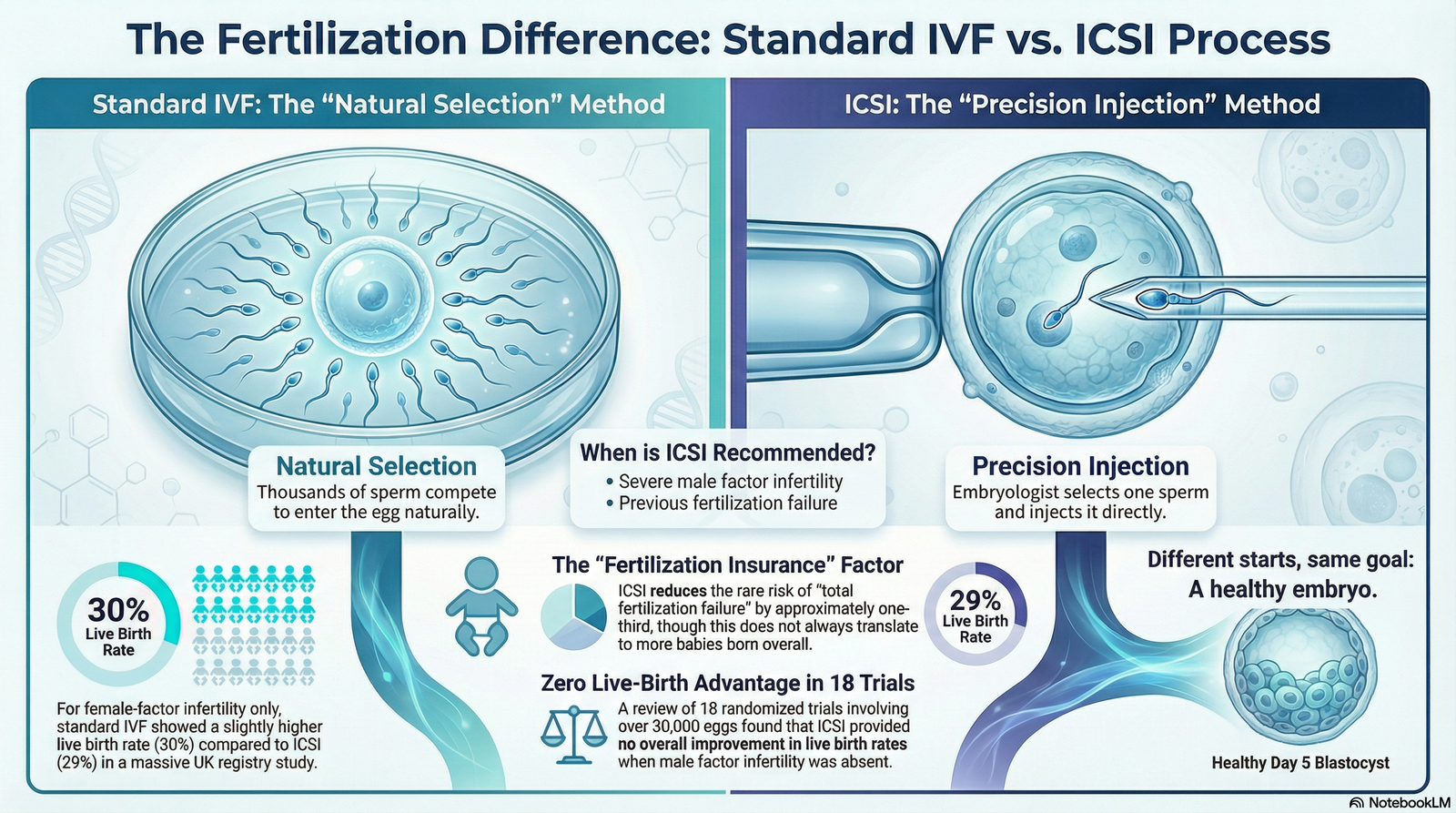
Standard IVF lets many sperm try to fertilize each egg. ICSI uses a fine needle to place one sperm inside each egg.
| Treatment Step | Standard IVF | ICSI |
|---|---|---|
| Fertilization method | Many sperm are placed around each egg in a Petri dish | One sperm is injected directly into each mature egg |
| Main indication | Normal or mild male factor, unexplained infertility | Clear male factor infertility, frozen unfertilized oocytes, prior failed fertilization, and PGT |
| Fertilization failure risk | Higher risk of total fertilization failure | Lower risk of total fertilization failure |
| Live birth in non male factor | About 39 to 47 percent per cycle in large studies | About 36 to 43 percent per cycle in large studies |
| Extra cost | Included in base cycle fee | Adds from $1,000 to $3,000 to the core cost per cycle |
When ICSI Really Helps Your Chances
You may see clinics use ICSI for nearly everyone, but research and professional guidelines point to a shorter list of situations where it clearly adds value for you.
Severe male factor infertility
Severe male factor infertility remains the clearest reason to choose ICSI. Your team usually recommends ICSI when:
- Your partner has azoospermia, and sperm are collected surgically from the testis or epididymis.
- Sperm count is very low, often below 1 million per milliliter, known as ‘severe oligozoospermia’.
- Sperm movement is very poor, called ‘severe asthenozoospermia’.
- Sperm shape is very abnormal; for example, under 4 percent normal forms by strict Kruger criteria, called ‘severe teratozoospermia’.
When you plan preimplantation genetic testing (PGT)
If you plan to use PGT-A to screen for chromosome errors or PGT-M and PGT-SR for specific genetic conditions, your clinic often prefers ICSI. The goal is to keep fertilization clearly monospermic, meaning only one sperm fertilizes each egg. That lowers the risk that extra sperm on the egg surface will confuse the biopsy result.
After a cycle with failed fertilization
If you went through standard IVF before and your lab found no fertilized eggs or very low fertilization, switching to ICSI for the next cycle is common. In that setting, ICSI acts as insurance against repeating the same painful outcome.
Eggs that need extra help
Your doctor may also lean toward ICSI when:
- You are using vitrified (frozen) eggs: When using your own or donor eggs, the freezing and thawing process can cause the egg’s outer layer to harden, making it difficult for sperm to penetrate on their own.
- You are using eggs matured in the lab: For eggs that undergo in vitro maturation (IVM), ICSI is typically required to ensure high fertilization rates.
ICSI vs. IVF: What the safety and lab data mean for you
30% Fewer Cancelled Cycles – Fertilization Insurance: In the large UK HFEA registry study, IVF cycles were about one third more likely to be cancelled because no embryos developed, compared with ICSI cycles. ICSI lowered the chance of a zero fertilization day, which matters most if you have a history of failed fertilization. Source: The Lancet / HFEA registry study (PMID: 39069615).
Same Live Births, More Lab Work: The 2024 meta-analysis confirmed that in non-male factor infertility, ICSI increased fertilization per egg and reduced total fertilization failure, but did not raise live birth rates compared with IVF. For you, this means that high lab numbers with ICSI do not always translate into more babies in the real world. Source: Acta Obstetricia et Gynecologica Scandinavica (PMID: 37930100).
ICSI Without Clear Indication – Fewer Blastocysts: A US registry study of more than 318,000 cycles found that when clinics used ICSI without a clear reason, patients were less likely to reach a blastocyst stage transfer and had lower overall live birth odds in fresh cycles compared with standard IVF. Once embryos were transferred, success rates were similar, but fewer couples reached that stage. Source: F&S Reports (PMID: 38524206).
Guidelines Say Use ICSI Only When Needed: The American Society for Reproductive Medicine recommends ICSI mainly for clear male factor infertility, previous fertilization failure, or specific genetic testing needs. They do not support routine ICSI for all IVF cycles when semen parameters are normal. Source: Fertility and Sterility (PMID: 32654822).
These findings suggest that ICSI is most helpful when it directly solves your main problem, such as very low sperm numbers or repeated fertilization failure, rather than as a blanket add-on for everyone.
Success Rates, Timing, and What to Expect
Success rates matter to you more than any lab picture. It helps to separate three ideas: fertilization rates in the lab, the day of embryo transfer, and the chance of a live birth.
Day 3 vs. Day 5 transfer
- Day 3, cleavage stage: The embryo usually has 6 to 10 cells.
- Day 5 or 6, blastocyst stage: The embryo has around 100 cells and has formed an inner cell mass and an outer trophectoderm layer.
Many clinics now prefer blastocyst transfer when you have enough embryos. Some data show clinical pregnancy rates of about 67.9 percent for blastocyst transfers compared with about 37.7 percent for cleavage stage in good prognosis groups.
Growing embryos to Day 5 allows the lab to see which ones keep dividing and look robust. That is why many doctors recommend single blastocyst transfer for patients with several good embryos, so you can keep high success rates and reduce the chance of twins.
What big studies say about IVF vs. ICSI success
- UK HFEA registry (over 275,000 cycles): In couples with female factor infertility and normal sperm, IVF had a slightly higher live birth rate than ICSI, about 30 percent vs. 29 percent.
- US SART CORS data (about 1.4 million cycles): In couples without male factor infertility, live birth rates were about 39 percent with IVF and around 37 percent with ICSI.
- Nature Medicine randomized trial (824 first cycles): Cumulative live birth rates were about 47 percent with IVF and 43 percent with ICSI in patients without severe male factor infertility.
Taken together, these numbers suggest that if sperm tests are normal and your main challenge lies with age, egg quality, tubes, or uterus, standard IVF is usually at least as effective as ICSI for live birth, and sometimes slightly better.
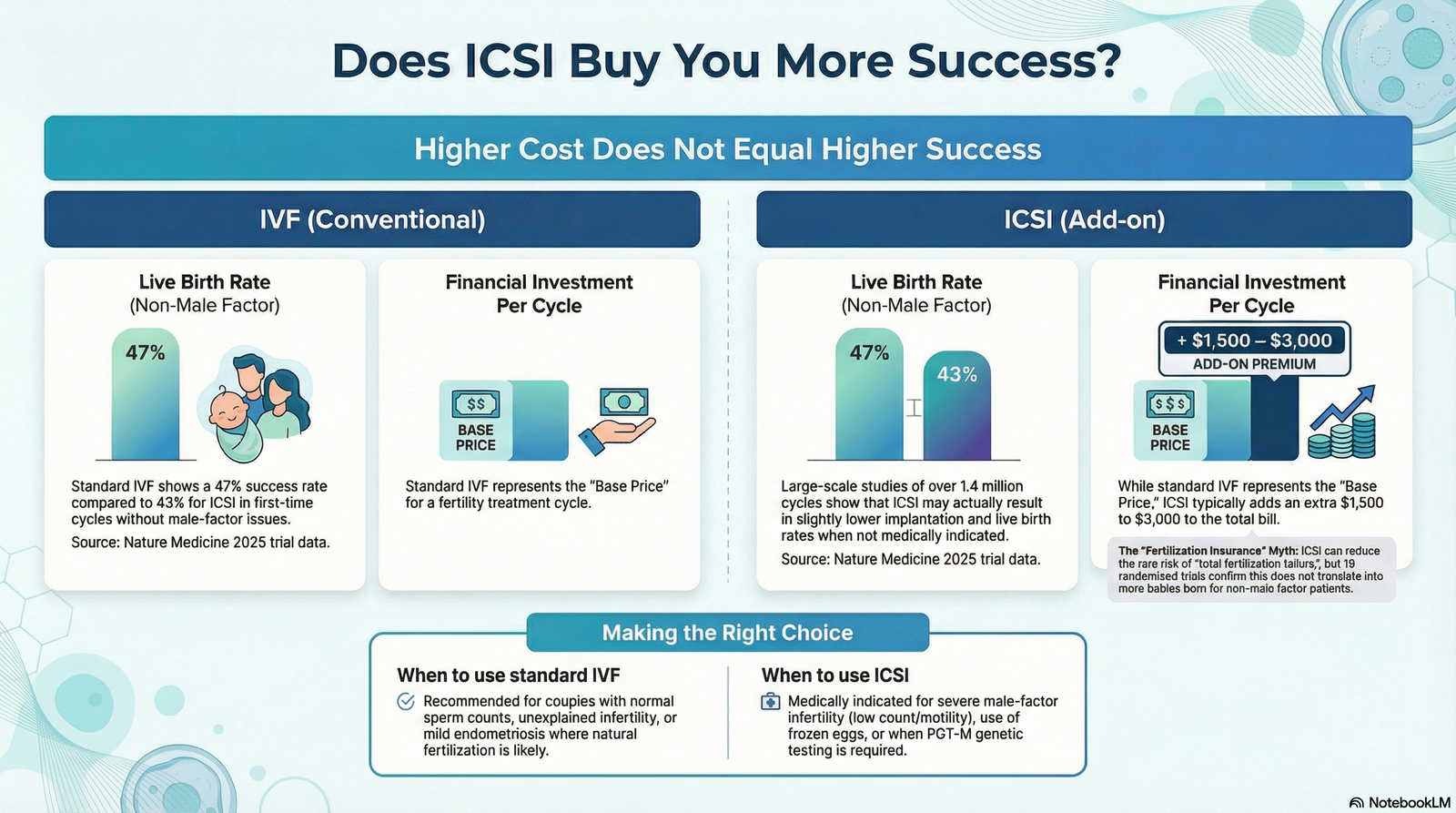
When sperm is normal, ICSI rarely improves live birth rates compared with standard IVF, but it does add cost.
Costs, Country Packs, and Budget Planning
The financial side of IVF and ICSI can feel as stressful as the medical side. Knowing where the money goes helps you decide where ICSI is worth paying for.
What ICSI adds to a typical IVF bill
- Base IVF fee: In North America, often between $10,000 and $20,000 per cycle.
- ICSI fee: Usually adds about $1,000 to $3,000 per cycle.
- Stimulation medications: Often $1,000 to $7,000 per cycle, depending on your dose and response.
- Mock transfer: A trial transfer can add about $250 to $500.
In Europe, many clinics package ICSI into fixed-price bundles:
- Slovakia: A basic ICSI IVF pack may start around €3,335 and include ICSI and genetic screening for two embryos, while more advanced packs with assisted hatching, EmbryoGlue, and microfluidic sperm sorting can reach €5,500. Oocyte activation as an add-on may cost around €150.
- Ukraine: Standard ICSI plus PGD packages may start around €6,000, with TESA surgical sperm retrieval adding ~€1,000. Some “guaranteed pregnancy” programs start near €12,000, and complex packages that switch to surrogacy after failed IVF can begin around €66,500.
| Cost Item | Standard IVF Only | IVF with ICSI |
|---|---|---|
| Base IVF cycle | $10,000 to $20,000 | $10,000 to $20,000 |
| ICSI lab fee | $0 | $1,000 to $3,000 |
| Medications | $1,000 to $7,000 | $1,000 to $7,000 |
| Genetic testing (PGT) | Often extra, varies | Often extra, varies |
| Total estimated range | $11,000 to $27,000 | $12,000 to $30,000 |
ICSI vs. IVF: A Practical Decision Checklist
When you talk through options with your doctor, it can help to work through a simple checklist rather than trying to remember every study detail.
Times when ICSI often makes sense
- Clear male factor infertility: Your partner has a very low count, poor sperm movement, or sperm was collected surgically because none are seen in the ejaculate.
- Very abnormal sperm shape: Normal forms are under about 4 percent on strict criteria.
- Planned PGT: You are screening embryos for chromosome problems or a known family condition.
- Frozen eggs: You are using vitrified eggs that have been thawed.
- Very low egg numbers: You are over 40 and usually get only a few eggs, for example, four or fewer, and your clinic wants every egg to have a direct fertilization attempt.
Times when standard IVF may be enough
- Normal semen analysis: Sperm count, motility, and morphology are all in the normal range on repeated tests.
- No history of fertilization failure: You have not had a past cycle where none of the eggs fertilized.
- Budget is tight: You want to save the ICSI fee for other priorities, such as another cycle, PGT, or freezing embryos.
We know it is hard to balance hope, fear, and money all at once. Use this checklist as a starting point, then let your fertility team walk you through how your own lab numbers fit these patterns.
Want help comparing clinics and costs?
If this feels like a full-time job, and it often does, our advisors can collect clear, itemized quotes from verified clinics and map your likely timeline at no cost to you.

Why trust this guide? The OVU commitment
You are probably juggling hope, timelines, and a lot of tabs open in your browser. And you deserve clear, current, human advice. At OVU, we review clinic protocols, compare real quotes, and talk to people who have done this - intended parents and gestational carriers - so we can give you practical steps, not just theory. If you want help comparing options without sales pressure, we will gather itemized quotes and success data that match your exact situation. You decide, we will bring the info to your table.
Frequently Asked Questions
Does ICSI increase the risk of birth defects?
Some studies have found a small increase in certain chromosome problems in children conceived with ICSI compared with natural conception. Many experts believe that the underlying male infertility explains part of this risk rather than ICSI alone. Your doctor can review these numbers with you, so you can decide what feels acceptable for your family.
Can ICSI damage my eggs?
ICSI is invasive and does stress the egg. On average, about 10 percent of injected eggs may degenerate and become unusable. This rate can be higher if the outer lining of the egg is very tough or the inner membrane is fragile. Your clinic can tell you how your eggs responded after each cycle, so you are not guessing.
Is laser-assisted ICSI better than standard ICSI?
Laser-assisted ICSI uses a tiny laser pulse to open the outer lining of the egg before injection. In some women, especially those whose eggs have broken easily in past cycles, this method has reduced egg damage and improved fertilization rates compared with regular ICSI. It is usually reserved for specific cases rather than used for everyone.
Does it matter if sperm comes from a testicular biopsy instead of ejaculate?
When ICSI uses sperm from the testis or epididymis in men with azoospermia, pregnancy and live birth rates are often similar to cycles using ejaculated sperm from men with severe male factor infertility. You can ask your team how the sperm source might affect lab work, cost, and your schedule.
What is artificial oocyte activation, and who needs it?
Artificial oocyte activation uses chemicals such as calcium ionophores to trigger the egg to start developing after ICSI. Clinics usually consider this only for couples who have already had cycles where eggs did not activate and fertilize properly after ICSI. It is a powerful tool, but not a routine add-on.
Can ICSI change the sex of my baby?
ICSI itself does not choose the sex of your baby. Sex selection only happens when clinics combine IVF or ICSI with genetic testing and then transfer only embryos of a specific sex. Without that extra step, the chance of having a boy or a girl is similar to natural conception.
Is rescue ICSI an option if standard IVF fails overnight?
Some clinics perform rescue ICSI if eggs show no fertilization after standard IVF. Because eggs age quickly, success rates with rescue ICSI are usually lower than with planned ICSI. That is why clinics prefer to plan ICSI in advance when they see clear warning signs, such as very poor sperm movement or a previous fertilization failure.
Reference List 8 sources
Journal Article (Research): Berntsen S, Zedeler A, la Cour Freiesleben N, et al. IVF versus ICSI in patients without severe male factor infertility: a randomized clinical trial. Nature Medicine. 2025;31(6):1939–1948. PMID: 40217077. Available from: https://pubmed.ncbi.nlm.nih.gov/40217077/
Journal Article (Research): Wu H, Gingold JA, Lieman H, et al. Comparing reproductive outcomes between conventional in vitro fertilization and nonindicated intracytoplasmic sperm injection in autologous embryo transfer cycles: a Society for Assisted Reproductive Technology Clinic Outcome Reporting System Study. F&S Reports. 2023;4(4):XXX–XXX. PMID: 38524206. Available from: https://pubmed.ncbi.nlm.nih.gov/38524206/
Journal Article (Systematic Review & Meta-Analysis): Yang L, Liang F, Zhu R, et al. Efficacy of intracytoplasmic sperm injection in women with non-male factor infertility: a systematic review and meta-analysis. Acta Obstetricia et Gynecologica Scandinavica. 2024;103(1):30–41. PMID: 37930100. Available from: https://pubmed.ncbi.nlm.nih.gov/37930100/
Journal Article (Comparative Study): Boulet SL, Mehta A, Kissin DM, et al. Trends in use of and reproductive outcomes associated with intracytoplasmic sperm injection. JAMA. 2015;313(3):255–263. PMID: 25602996. Available from: https://pubmed.ncbi.nlm.nih.gov/25602996/
Journal Article (Comparative Study): Supramaniam PR, Granne I, Ohuma EO, et al. ICSI does not improve reproductive outcomes in autologous ovarian response cycles with non-male factor subfertility. Human Reproduction. 2020;35(3):583–594. PMID: 32161952. Available from: https://pubmed.ncbi.nlm.nih.gov/32161952/
Journal Article (Comparative Study): Gingold JA, Wu H, Lieman H, et al. Intracytoplasmic sperm injection versus conventional in vitro insemination in couples with non-male infertility factor in the real-world setting: analysis of the HFEA registry. The Lancet. 2024;403(XXXX):XXX–XXX. PMID: 39069615. Available from: https://pubmed.ncbi.nlm.nih.gov/39069615/
Journal Article (Research): Ho VN, Dang V, et al. Intracytoplasmic sperm injection versus conventional in vitro fertilization in infertile couples with normal total sperm count and motility: does sperm morphology matter. Human Reproduction. 2024;40(1):23–29. PMID: 39547931. Available from: https://pubmed.ncbi.nlm.nih.gov/39547931/
Committee Opinion (Guidance): Practice Committees of the American Society for Reproductive Medicine and the Society for Assisted Reproductive Technology. Intracytoplasmic sperm injection (ICSI) for non–male factor indications: a committee opinion. Fertility and Sterility. 2020;114(2):239–245. PMID: 32654822. Available from: https://pubmed.ncbi.nlm.nih.gov/32654822/
Final Thoughts
IVF and ICSI are both powerful tools and have already helped many families grow. The real question for you is not which method sounds more advanced, but which one fits your specific diagnosis, values, and budget.
If you are facing clear male factor infertility or using frozen eggs, ICSI often turns a very low chance into a realistic path to pregnancy. If sperm tests are normal and your main challenges are age, egg supply, or uterine factors, standard IVF usually offers the same or slightly better chance of a live birth without the extra ICSI fee.
We know this is emotionally and financially heavy. You do not have to untangle every study alone. Use this article as a starting point, bring your questions to your clinic, and ask your doctor to walk through your lab results side by side with you. When you understand why they recommend or do not recommend ICSI in your case, you can move forward feeling more informed and more confident in the plan.
Need a second set of eyes on your options?
If you are comparing clinics or struggling to decode their quotes, you can speak with an OVU advisor who will help you line up real offers and timelines so you can choose with more clarity.