


Dr. Sony Sherpa (MBBS)
In addition to her clinical experience, Dr. Sherpa is a published medical researcher and holistic health advocate. Her dual expertise in emergency care and alternative therapies brings a unique lens to medically reviewed content—ensuring it is both accurate and accessible.
If you are considering international surrogacy, you are probably weighing one of the biggest decisions of your life. You might feel hopeful, worried about money, and unsure where to start, all at once. That blend of intensive and nuanced emotions is normal, especially when you are trying to build your family through a path that comes with legal and medical complexity, where someone else will be carrying your pregnancy to term.
For many intended parents, especially if you are single or part of the LGBTQIA+ community, the United States can feel out of reach when a single surrogacy cycle often runs from $100,000 to over $300,000. By contrast, several international programs start at $50,000 and go up to the $90,000 range for a singleton birth. With careful planning, you can lower your costs and still keep legal and medical safety as a central priority.
This guide walks you through where to go, who each country accepts, what you are likely to spend, and the medical risks you need to understand. The goal is simple—you should finish this article with a clear sense of which countries fit you, what a realistic budget looks like, and what questions to ask before you sign anything. There is encouraging data that when you pick a country that ideally suits your case and your family structure, and when you work with clinics that follow modern medical guidelines and protocols, you can often save tens of thousands of dollars compared with the US–based surrogacy arrangement and still keep safety as the utmost priority.
International surrogacy means working with a gestational carrier in another country who carries your embryo created through IVF to term and delivers a baby for someone else. In 2026, popular destinations include Mexico and Colombia for inclusive laws and lower costs, and Ukraine or Georgia for married heterosexual couples who want fixed-price guaranteed programs. Most full programs cost $50,000 to $90,000, while US programs often start at nearly $100,000. From the start of the matching process to flying home with your baby, the journey usually lasts 11–12 to 24 months, varying based on matching time and required medical/legal procedures.
Next step: Work out whether you need an inclusive country that accepts singles and LGBTQIA+ parents or a country that requires a married heterosexual couple, then talk with at least two or three agencies or clinics that operate in those places.
Latest Research Insights
28,000 Pregnancies—The Big Picture: The largest review of surrogate pregnancies found that outcomes were similar to, or even slightly better than, other IVF pregnancies. Preterm birth and low birthweight rates were comparable, and serious complications were rare. The takeaway? Well-screened surrogates perform just as well as other IVF patients. Source: JAMA Network Open (PIMD: 39042408).
3x Higher Placenta Risk—Why IVF Needs Extra Monitoring: A study of over 3 million pregnancies found that all IVF pregnancies—not just surrogacy—carry higher risks for certain complications like placenta problems and bleeding. This is not unique to surrogacy; it is part of why any IVF pregnancy benefits from closer monitoring. Source: Archives of Gynecology and Obstetrics (PMID: 28547098).
26% Higher Diabetes Risk—Plan for Closer Monitoring: IVF pregnancies have about a 26% higher chance of gestational diabetes compared to natural conceptions, even after accounting for age and weight. This means your surrogate should have regular blood sugar checks throughout pregnancy, regardless of her health history. Source: Acta Diabetologica (PMID: 36271972).
70% vs 38%—The Hidden Risk of Treatment Abroad: When intended parents had IVF abroad and then delivered at a US hospital, 70% experienced high blood pressure problems during pregnancy—compared to just 38% who had IVF domestically. If you are considering international surrogacy, factor in how pregnancy care will be managed. Source: Journal of Assisted Reproduction and Genetics (PMID: 40119090).
Note: These findings come from peer-reviewed research. Your actual risks depend on your surrogate’s health, your clinic’s protocols, and how carefully screening is done. Always discuss these factors with your fertility specialist before choosing a program.
In This Guide
Most singleton surrogacy journeys abroad cost $50,000–$90,000.
US commercial surrogacy often runs from $100,000 to $300,000+.
Plan for about 11–12 months from contract to flying home with your baby.
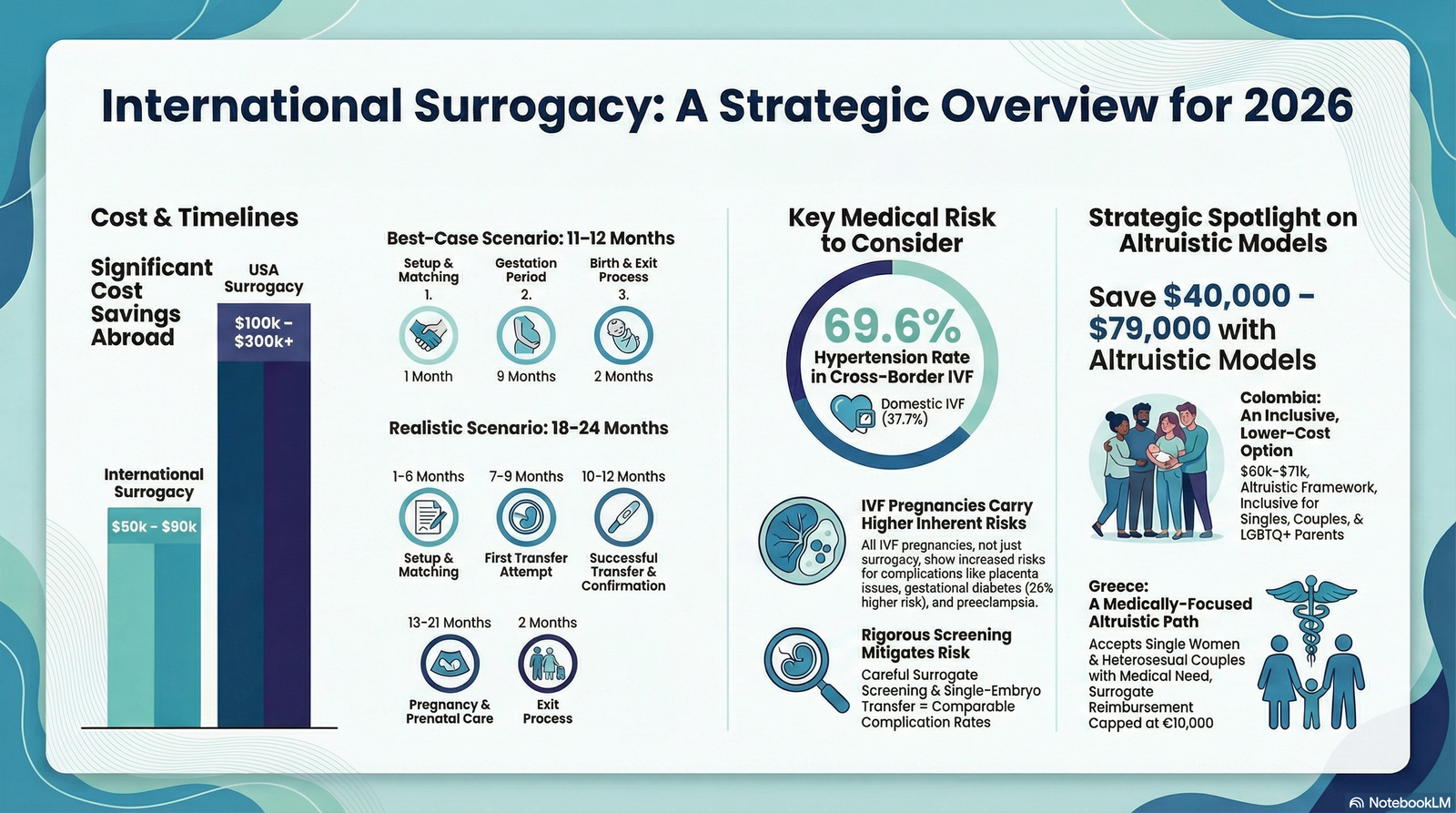
Strategic overview of international surrogacy: timeline, typical cost bands, and headline medical risks.
Global Surrogacy Landscape: Quick Facts
If you are still deciding where to look, understanding the global legal frameworks, legislative nuances, and possible legal hurdles is essential. Laws regulate who can access surrogacy, what type is allowed, and how your parental rights are recognized in the country where the surrogacy arrangement takes place and in your home country. Costs then layer on top of that.
| Country | Surrogacy Type | Typical Cost Range | Eligibility Snapshot |
|---|---|---|---|
| United States | Commercial | $100,000 – $300,000+ | Broad, but state-dependent |
| Colombia | Altruistic | $60,000 – $71,000 | Singles, couples, LGBTQ+, genetic link required |
| Mexico | Commercial or altruistic | $49,000 – $90,000 | Highly inclusive, including HIV-positive parents |
| Cyprus | Unregulated | €50,000 – €76,000 | Inclusive, but legal grey zone |
| Ukraine | Commercial | €74,900+ | Married heterosexual couples only |
| Greece | Altruistic | $50,000 – $100,000 | Single women and heterosexual couples with medical indications only |
| Canada | Altruistic | $58,769 – $120,369+ CAD | Inclusive, but the surrogate receives reimbursement only and no financial compensation for carrying the baby, therefore, it might be hard to find an altruistic gestational carrier |
| Albania | Unregulated | €50,000 – €100,000 | Inclusive, however, legal parentage is often approved via adoption |
Legal Frameworks and Eligibility Criteria, or Who Each Country Accepts?
If you are trying to narrow down countries, start with one question: Who does the law recognize as eligible intended parents in that place? Once you know that, you can look at costs and timelines.
Most Inclusive Destinations: Mexico, Colombia, Cyprus, Albania
Mexico. A 2021 Supreme Court decision recognized surrogacy as a protected medical procedure. That means surrogacy is legal in the country, though individual states still regulate contracts and implementation. Cities and states that already work with international parents, such as Mexico City or Quintana Roo, tend to offer clearer paths. You often seek a court order confirming parentage either before or after birth. If a pre-birth order is not granted, you can still obtain parental recognition through a human rights trial called an Amparo. Mexico accepts singles, couples, LGBTQIA+ parents, and HIV-positive individuals, subject to medical screening.
Colombia. The Colombian Constitution gives foreigners the same civil rights as citizens, including access to assisted reproduction. Gestational surrogacy is allowed under this umbrella. The model is altruistic. Your surrogate receives reimbursement for pregnancy-related costs, not a fixed base fee, and the arrangement must be gestational, not traditional. At least one intended parent must provide sperm or eggs. After birth, you go through a process grounded in constitutional law to have your parentage recognised on the child’s birth certificate.
Cyprus. Cyprus lacks a comprehensive surrogacy law that covers all scenarios, leaving surrogacy arrangements initiated in the country in a legal grey zone. Because there is no explicit ban, clinics can proceed with embryo transfer, making it possible for single parents, heterosexual couples, LGBTQIA+ couples, and HIV-positive parents. You should know that parentage and contract enforceability lean heavily on clinic practice and existing medical law, so you should always have a local lawyer review your case and your arrangement (or legal agreements).
Albania. Albania does not have a specific surrogacy statute that bans or regulates the practice, so clinics run surrogacy as part of IVF services. This brings flexibility for a wide range of family types. In practice, the surrogate is the legal mother at birth, and you later complete a surrogacy adoption after she transfers parental rights, so you need strong legal support from day one.
More Restricted Destinations: Georgia, Ukraine, Greece, UAE
Georgia and Ukraine. Both countries allow commercial gestational surrogacy and give strong legal protection to intended parents. They restrict access to married heterosexual couples. In Ukraine, the surrogate cannot use her own eggs. The child’s birth certificate lists only the intended parents’ names, not the surrogate’s. In Georgia, the civil registry issues a birth certificate naming only the intended parents within about one day of delivery, and the surrogate does not have the legal right to keep the baby.
Greece. Greece legalized altruistic surrogacy in 2002. It accepts single women and married or unmarried heterosexual couples, but not male same-sex couples or single men. The intended mother needs a medical reason she cannot carry a pregnancy, such as the absence of the uterus or a serious medical contraindication. Before any treatment, you must obtain a court decision that authorizes the arrangement and confirms who will be the legal parents. Greek law caps surrogate reimbursement at €10,000 for lost wages and pregnancy-related expenses.
United Arab Emirates. The UAE recently introduced a legal pathway for gestational surrogacy. Only married couples qualify, including some non-Muslim expats. The intended mother must have a documented medical indication and must use her own eggs, because egg donation is banned. The surrogate must be a citizen or resident, and she cannot share genetics with the baby (traditional surrogacy is prohibited).
International Surrogacy Costs: What Drives the Numbers
Once you know where you legally fit, the next question is always the bundle-associated costs and potential fees that might be involved in surrogacy. You need to understand not only the headline program price, but also what happens if the first cycle fails or your situation gets medically complicated and how much the final price tag may impact your overall budget for the entire journey.
Colombia: Altruistic Model and Lower Baseline Cost
Because the law only allows reimbursement, not base compensation, you avoid a large chunk of gestational surrogate compensation, which is standard in the US, resulting in median savings of $40,000 to $79,000.
- Non-guaranteed IVF surrogacy, single attempt: About $55,900, often landing around $60,000 once all standard items are included.
- Guaranteed surrogacy with local egg donor: Programs that promise treatment until live birth usually cost between $66,000 and $77,000, with an average around $71,000.
- Surrogacy only, using your frozen embryos: If you ship embryos to Colombia, packages start around $50,000 and go up to $59,000.
- Sibling guarantee using two surrogates: For intended parents who want two children, programs using two surrogates typically cost from $125,900 to $139,000.
Mexico: Inclusive Laws and Tiered Bundles
Mexico is a renowned cross-border fertility care hub because you can access surrogacy as a single parent or LGBTQIA+ couple and because the bundles’ pricing is more flexible than in the US.
- Basic programs: Frequently marketed at around $49,000 to $60,000. These often cover only one IVF cycle and one or two transfers, with limited or no coverage for complications.
- Premium or guaranteed programs: Generally fall between $70,000 and $90,000. These bundles typically include unlimited IVF cycles and transfers, PGT-A, sometimes sex selection, and defined coverage for medical and legal services until live birth. When setbacks occur, total spending often ends up $40,000 lower than a basic “pay-as-you-go” path that runs into the second or third cycles.
- Sibling or twin guarantees with two surrogates: Larger packages that aim for two children through two surrogates often range from $135,900 to $149,000.
Ukraine: Structured Guaranteed Programs
Ukraine focuses on fully preconfigured and packaged programs for married heterosexual couples. Most agencies and clinics offer core and premium bundles with versatile services and extensive coverage of each new attempt until a live birth is achieved.
- Smart Guaranteed Bundle: Starts at €74,900. The package includes unlimited egg donation cycles, unlimited IVF-ICSI attempts, PGT on 24 chromosomes and sex selection, unlimited embryo transfers, coverage for surrogate hospitalization and complications, birth (vaginal or Cesarean), NICU coverage in defined scenarios, basic pediatric care, and legal support, including DNA testing and exit paperwork.
Cyprus: Flexible Structures for Singletons and Multiples
If you are thinking about twins or siblings and are ready to navigate a looser legal setting, Cyprus offers several clearly priced options.
- Independent surrogacy with egg donation: From about €64,000 for a successful singleton.
- Agency-assisted package with one donor and one transfer: The core bundle costs around €57,000 to €60,000 for a singleton baby.
- Premium guaranteed singleton: Typically ranges from €70,000 to €76,000, covering repeated cycles and transfers.
- Twins with one surrogate: Often between €79,000 and €89,000.
- Twins with two surrogates (Guaranteed Pack #1): Starts at €122,000 for two babies carried separately. For triplets (three babies with three surrogates), a triple program can start around €183,000.
Greece: Medically Indicated, Altruistic Surrogacy
Greece can work well if you are a woman who cannot carry a pregnancy yourself and prefers a European legal system.
- Single-attempt IVF surrogacy: Around €50,000.
- Multiple-cycle packages: Often between €57,000 and €69,000, depending on the number of included transfers.
- Guaranteed surrogacy with local donor: Usually around €79,000 to €84,000.
- Surrogacy only with frozen embryos: Roughly €39,000 to €50,000.
- Surrogate reimbursement cap: Greek law caps reimbursement at €10,000.
Canada: Altruistic with High Living Costs
On paper, Canada recognizes only altruistic surrogacy arrangements, like those in Colombia and Greece. In reality, higher living costs and reimbursement rules push total spending into US-level territory.
- Gestational surrogacy using existing embryos: Plan for about $60,000 CAD for a single-attempt transfer of a devitrified embryo.
- Fresh IVF cycle with surrogate: About $79,000 CAD.
- Egg donation plus surrogacy: Commonly between $100,000 and $139,000 CAD.
- Surrogate reimbursement: Typically $16,000 to $36,000 CAD for expenses, lost wages, childcare, and similar costs.
- Total average: Often reported between $58,769 and $120,369+ CAD.
Why Cheap Basic Programs Often End Up Expensive
If you sign up for a basic $50,000 package without built-in retries or complication cover, every setback sends your costs up. Extra IVF cycles can add $16,000 to $19,000 each, donor cycles can add $25,000 to $69,000 once you include agency and travel fees, and PGT-A can add $6,000 to $10,000. If your baby spends a few days in NICU, that can quickly move into five figures. When you put those pieces together, a guaranteed program that looks expensive at the start can easily end up cheaper overall and much less stressful for you.
Medical Risks: What You Should Ask About?
If you are focused on costs only, it is easy to neglect the health side. The medical risks in surrogacy come from three main elements: IVF itself, donor eggs, and cross-border care, where standards vary.
IVF and Donor Eggs Increase Risk
- Hypertensive disorders: Meta-analyses show that singleton IVF pregnancies have around 70% higher odds of preeclampsia than natural conceptions. When you add frozen embryo transfer, the risk rises further, especially in cycles with artificial endometrial preparation.
- Donor-egg pregnancies: Oocyte donation pregnancies are among the highest risk for preeclampsia. In pooled data, donor-egg pregnancies show about five times higher odds of preeclampsia and more than seven times higher odds of severe preeclampsia than natural conceptions. Many surrogacy cases use donor eggs, so you need a clinic and hospital that can handle high-risk obstetrics.
- Gestational diabetes: National registry data from Finland show IVF pregnancies have 26% higher odds of gestational diabetes than spontaneous pregnancies, even after adjustment for age and BMI.
Cross-Border IVF Adds Another Layer
In the US hospital study on CBRC, almost one quarter of IVF births came from treatment abroad. Among those, the rate of hypertensive disorders was nearly double that of domestic IVF patients, and the multiple gestation rate was higher. That tells you two things. First, many people who travel for IVF are older or have more complex histories. Second, clinics abroad often transfer more embryos at once. Both factors push the risks up for your surrogate.
When Guidelines Are Followed, GCs Often Do Well
It is easy to assume that GCs always face far higher risks, but that is not what every study shows. When researchers compare GCs to other IVF patients, not to the general pregnant population, GCs often have similar or even lower rates of severe complications and cesarean delivery. The difference comes from strict carrier selection, careful screening for previous uncomplicated births, and single-embryo transfer. That is the standard you want to see in your contract, regardless of country.
Timeline, Cryoshipping, and Exit Process
If you are trying to map all of these milestones onto your real life, timeline matters as much as budget. The journey’s length depends heavily on your starting point and matching speed, ranging from the 11-to-12-month best-case, post-setup scenario to a realistic average of 18 to 24 months.
Phase 1: Pre–Cycle Setup (1–4 Months)
This initial phase is essential unless you already have frozen embryos ready to ship and a matched surrogate.
- Embryo Creation: If needed, you complete your IVF cycle to create embryos.
- Cryoshipping: If you have frozen embryos in your home country, this is the time to finalize all paperwork and logistics for shipping your vitrified embryos to the international clinic.
- Matching and Contracts: You match with a surrogate, who completes a full medical/psychological screening, and all contracts are legally finalized in the country of destination. (Note: For pre-screened surrogates and fast-working agencies, matching can occur in as little as 1–2 weeks, significantly speeding up this phase).
Post-Transfer Timeline: The Two Scenarios
The time from the surrogate’s medical preparation to flying home falls into two main scenarios, separated by whether the first attempt is successful and whether Phase 1 is already complete.
Scenario A: Quickest Possible Journey (11–12 Months Total)
This is the best-case scenario that occurs when Phase 1 (Embryo creation/shipping and contract finalization) is complete, and the very first embryo transfer is successful.
- Month 1: Setup and Matching. Match with a surrogate, complete medical screening, and finalize contracts. Surrogate starts medical preparation for transfer.
- Months 2–10: Pregnancy. Your clinic monitors the surrogate locally, and you receive updates from the agency or clinic.
- Months 11–12: Birth and Legal Exit. You handle parentage recognition, local birth certificates, and your baby’s passport.
Scenario B: Realistic Average Journey (18–24 Months Total)
This is the most common timeline, which includes all of Phase 1 plus the time needed for potential setbacks, such as matching delays, medical screening retries, or one or two unsuccessful embryo transfer attempts.
- Months 1–6: Setup and Matching. Research, initial screening, and matching. Time is absorbed by matching with a surrogate, surrogate medical/psychological screening, records review, and legal contract finalization.
- Months 7–9: First Transfer Attempt. Surrogate starts endometrial preparation for the transfer medications (approx. 6–8 weeks). If the transfer fails, there is a necessary recovery window of 1–2 months before the next attempt.
- Months 10–12: Successful Transfer & Confirmation. Second or Third Transfer Attempt: A successful embryo transfer is achieved, and a fetal heartbeat is confirmed (around week 6–8 post-transfer).
- Months 13–21: Pregnancy and Prenatal Care. The nine-month pregnancy proceeds. Your legal team may begin pre-birth parentage proceedings (where available).
- Months 22–24: Birth and Legal Exit. Birth occurs, followed by the post-birth legal process. This includes securing parentage (court/administrative order), obtaining the local birth certificate, and securing the baby’s passport/visa for re-entry to your home country.
Cryoshipping Costs if You Already Have Embryos
If you already completed IVF at home, you may choose a “surrogacy only” package abroad. In that case, you need a cryoshipping company to move your embryos from your country to the destination where the medical part (embryo transfer) of your surrogacy arrangement will take place.
| Route | Estimated Shipping Cost | Typical Transit Time |
|---|---|---|
| US to US | $3,000 – $5,000 | 2 – 6 days |
| Europe to US | $1,900 – $3,000 | 2 – 4 days |
| South America to US | $3,700 – $6,900 | 2 – 6 days |
| Asia to US | $3,000 – $4,900 | 2 – 6 days |
| Australia to US | $3,700 – $5,900 | 4 – 10 days |
Using frozen embryos often saves $20,000 or more because you skip a full own-egg IVF cycle abroad, and up to $40,000 if you avoid a donor-egg cycle. Before you start the cryoshipping process, talk with a lawyer in the country where the embryos were created and in your destination country. This is essential to understand the legal workflow on export and import, especially if you used donor gametes, as the donor’s consent, quarantine rules, and specific import papers are often legally required to proceed.
Exit Process and Paperwork
After birth, your focus shifts from medical updates to documents.
- In places like Georgia, you receive a birth certificate naming you and your husband as legal parents within days.
- In Colombia and Mexico, you may need court procedures or an Amparo trial, then a new birth certificate listing you as legal parents.
- In Albania, you usually complete a surrogacy-related adoption.
Once you have a local birth certificate, you apply for your baby’s passport at your embassy. Families often spend about a month on this stage, although times vary by embassy workload and case complexity.

International surrogacy can give you a clear path from contract to holding your newborn, as long as you plan for costs, laws, and medical risks upfront.
How to Use This Information to Plan Your Path
If you are reading through current (and upcoming) laws, costs, and risks, it is easy to feel overwhelmed. A simple way to move forward is to decide on your non-negotiables. Do you need an inclusive country that recognizes you as a single parent or same-sex couple? Do you want a fixed-fee program that covers all cycles? Or do you feel more comfortable in a place with a very clear state-backed surrogacy law, even if access is narrower? Once you know your must-haves, the country list often shrinks to two or three real options, and your next step becomes much clearer.
Want help comparing clinics and costs?
If this feels like a full-time job, and honestly it can, our advisors can collect clear, itemized quotes from verified clinics and map your likely timeline at no cost to you.

Why trust this guide? The OVU commitment
You are probably juggling hope, timelines, and a lot of tabs open in your browser. And you deserve clear, current, human advice. At OVU, we review clinic protocols, compare real quotes, and talk to people who have done this - intended parents and gestational carriers - so we can give you practical steps, not just theory. If you want help comparing options without sales pressure, we will gather itemized quotes and success data that match your exact situation. You decide, we will bring the info to your table.
Frequently Asked Questions
Can single men or same-sex couples use surrogacy abroad?
Yes. Countries like Mexico and Colombia accept singles and LGBTQIA+ couples based on explicit legal decisions. Others, like Cyprus and Albania, also accept them due to a lack of detailed restrictive laws. In contrast, Ukraine and Georgia do not; they are limited to married heterosexual couples only. If you are single or in a same-sex relationship, focus your research on inclusive countries from the start.
Is surrogacy in Mexico safe?
Safety depends less on the passport you hold and more on the clinic, hospital, and legal team you choose. Mexico’s Supreme Court has confirmed that surrogacy is a protected medical procedure. To protect yourself, you should ask clinics about their embryo transfer policies, hospital partners, NICU access for babies, legal strategy for birth certificates, and what happens if something goes wrong. A reputable program will give you clear, written answers to those questions.
What is the difference between altruistic and commercial surrogacy for my budget?
In commercial surrogacy, your surrogate receives a base compensation fee on top of reimbursed expenses. In altruistic surrogacy, she is only reimbursed for actual pregnancy-related costs. An altruistic arrangement can reduce your overall bill by tens of thousands of dollars. In Colombia, for example, the absence of base pay contributes heavily to the $40,000–$79,000 difference compared with US-style commercial programs. In Greece and Canada, you see a similar pattern, although the other costs, such as clinic fees and legal work, still add to the final price tag.
How long does the international surrogacy process usually take?
You should plan for a total journey of 18 to 24 months from initial research to returning home with your baby. While the swiftest possible scenario (with pre-existing vitrified embryos or a successful IVF cycle, pre-screened gestational carrier, and an immediate successful transfer) can take as little as 11–12 months, the average timeline is longer. Key factors stretching the timeline are: the initial months needed for IVF/embryo creation or cryoshipping, the time required for matching and legal contracts, and the necessary waiting period between unsuccessful embryo transfer attempts. Factor these variables in if you have age-related considerations or work commitments.
What does a traveling egg donor add to the cost?
A traveling donor adds her fee, agency fees, travel and lodging, local medical monitoring, compensation for time lost, insurance, and legal work. In practice, you can expect around $25,000 for the donor’s side alone, and once you include clinic costs, the total can reach from $36,000 to $69,000. If you know you will need a donor, make sure any guaranteed program you are considering spells out whether donor cycles are fully included or billed separately.
Reference List 9 sources
Journal Article (Research): Matsuzaki S, Masjedi AD, Matsuzaki S, et al. Obstetric characteristics and outcomes of gestational carrier pregnancies: a systematic review and meta-analysis. JAMA Network Open. 2024;7(7):e2422634. PMID: 39042408. Available from: https://pubmed.ncbi.nlm.nih.gov/39042408/
Journal Article (Research): Rodriguez S, Marquez K, St Louis G, et al. Incidence of cross-border reproductive care and pregnancy outcomes: a retrospective evaluation of IVF conceptions. J Assist Reprod Genet. 2025;42(5):1671–1677. PMID: 40119090. Available from: https://pubmed.ncbi.nlm.nih.gov/40119090/
Journal Article (Research): Sabban H, Zakhari A, Patenaude V, Tulandi T, Abenhaim HA. Obstetrical and perinatal morbidity and mortality among in-vitro fertilization pregnancies: a population-based study. Arch Gynecol Obstet. 2017;296(1):107–113. PMID: 28547098. Available from: https://pubmed.ncbi.nlm.nih.gov/28547098/
Journal Article (Research): Vaajala M, Liukkonen R, Ponkilainen V, et al. In vitro fertilization increases the odds of gestational diabetes: a nationwide register-based cohort study. Acta Diabetol. 2023;60(2):319–321. PMID: 36271972. Available from: https://pubmed.ncbi.nlm.nih.gov/36271972/
Journal Article (Research): Swanson K, Letourneau JM, Kuppermann M, Einerson BD. Obstetric morbidity in gestational carrier pregnancies: a population-based study. J Assist Reprod Genet. 2021;38(1):177–183. PMID: 33145724. Available from: https://pubmed.ncbi.nlm.nih.gov/33145724/
Journal Article (Systematic Review & Meta-Analysis): Keukens A, van Wely M, van der Meulen C, Mochtar MH. Pre-eclampsia in pregnancies resulting from oocyte donation, natural conception or IVF: a systematic review and meta-analysis. Hum Reprod. 2022;37(3):586–599. PMID: 34931678. Available from: https://pubmed.ncbi.nlm.nih.gov/34931678/
Journal Article (Systematic Review & Meta-Analysis): Chih HJ, Elias FTS, Gaudet L, Velez MP. Assisted reproductive technology and hypertensive disorders of pregnancy: systematic review and meta-analyses. BMC Pregnancy Childbirth. 2021;21(1):449. PMID: 34182957. Available from: https://pubmed.ncbi.nlm.nih.gov/34182957/
Committee Opinion (Guidance): Practice Committee of the American Society for Reproductive Medicine. Recommendations for practices using gestational carriers: a committee opinion. Fertil Steril. 2022;118(1):65–74. Available from: https://www.asrm.org/practice-guidance/practice-committee-documents/recommendations-for-practices-using-gestational-carriers-a-committee-opinion-2022/
Ethics Committee Opinion: Ethics Committee of the American Society for Reproductive Medicine. Cross-border reproductive care: an Ethics Committee opinion. Fertil Steril. 2022;117(5):954–962. PMID: 35216836. Available from: https://pubmed.ncbi.nlm.nih.gov/35216836/
Final Thoughts
If you are considering international surrogacy, you are carrying a lot at once, both emotionally and financially. This guide was designed to simplify that complexity. You deserve clear information, not sales pressure. When you match your family structure to countries that will legally recognize you as an eligible prospective parent, choose clinics that stick to single-embryo transfer and strict surrogate screening, and think through the full cost picture, you give yourself a safer, more predictable path to becoming a parent.
Your situation is unique, but you are not the only one facing these challenging choices. Many single aspiring parents and those in a stable relationship have taken this path before you, and with the right team in place, you can move from research and spreadsheets to holding your child, knowing you made informed, thoughtful decisions at every step. Now, take the next step: reach out to two or three reputable agencies or clinics in your preferred countries to begin discussing your personal scenario.