


Dr. Sony Sherpa (MBBS)
In addition to her clinical experience, Dr. Sherpa is a published medical researcher and holistic health advocate. Her dual expertise in emergency care and alternative therapies brings a unique lens to medically reviewed content—ensuring it is both accurate and accessible.
If you are part of the LGBTQ+ community and you dream about having a child, you are not alone. You might already imagine the first time you walk through your front door and hear the hustle and bustle of little feet and a laugh that sounds exactly like home; the moments of soothing a toddler who is too embarrassed to join the preschool play; the nighttime stories; the first days of school; and the moment you introduce your baby to your family.
Parenthood is found in these tiny yet powerful things: the sparkling joy of hanging festive lights on a noble fir, the scent of mandarin-basilic candles drifting through the room, and a Monday morning that is no longer quiet.
Whether you are dreaming of this as a solo parent or with a partner, that ordinary magic can often feel locked behind a wall of legal hurdles and medical nuances. You may feel forced to become an expert in everything from local frameworks to the “hidden” logistics of cross-border care, managing the surprise expenses of premium egg donors or the complexities of shipping vitrified embryos to countries where your rights are legally protected.
You shouldn’t have to be a travel agent, a lawyer, and a clinical expert just to become a parent. The distance between your current life and that first day of school shouldn’t be measured in acronyms or price tags, but in the heartbeat of a dream finally coming true. Before thinking your journey is anything less than possible, hush your frustration and read on.
Today, there are more real paths to parenthood for our community than ever before. In the United States alone, an estimated 6 to 14 million children are being raised by at least one LGBTQ+ parent. Large-scale clinical studies demonstrate that these children thrive emotionally and socially, and organizations such as ASRM and ESHRE explicitly support your right to care, regardless of your orientation or identity.
This guide walks you through your main options, their costs, timelines, and success rates. You will see where IUI fits, how reciprocal IVF works for two moms, what to expect from surrogacy as a gay couple, and how to protect your fertility as a trans or non‑binary person. The goal is simple: to help you move from anxiety and guesswork to a clear plan that fits your life, your budget, and your values.
LGBTQ+ family building in 2026 is medically safe, legally supported in many regions, and offers several reliable options for each unique case, including those where more sophisticated techniques and more services are needed to resolve a severe infertility issue. IUI starts around $2,000 to $4,000 per cycle, reciprocal IVF for two moms typically ranges from $19,000 to $30,000 in North America, and full surrogacy for gay dads usually falls between $100,000 and $175,000 in the United States. Success rates range from about 13% per IUI cycle to over 80% live birth rates in well-run surrogacy programs, so the right path for you depends on your biology, budget, and timeline.
Next step: identify which path matches your situation, then compare clinics and programs that have proven experience with LGBTQ+ patients.
What the latest research shows
Recent studies give reassuring data for LGBTQ+ parents. Large national registries show that birth outcomes for lesbian couples using ART are similar to, and in some measures slightly better than, outcomes for heterosexual couples, regardless of sperm source. A 2024 review of over 28,000 gestational carrier pregnancies found that severe complications for surrogates were rare and comparable to other IVF pregnancies. Studies of reciprocal IVF report live birth rates above 60% per treatment course, and high-volume surrogacy programs for gay couples report live birth rates above 80% per journey.
These numbers confirm that LGBTQ+ family building is not experimental medicine. It is mainstream care backed by peer-reviewed research and professional guidelines.
In This Guide
- LGBTQ+ Family Building Overview
- Options for Gay Male Couples
- Options for Lesbian Couples
- Reciprocal IVF and ROPA
- Surrogacy for Gay Couples
- Sperm Donation for Lesbian Couples
- Co‑IVF and Shared Motherhood
- Transgender Family Building
- Legal Rights and Parentage
- Costs by Path and Region
- Finding LGBTQ+‑Friendly Clinics
- Donor Selection Priorities
- Success Rates by Treatment
- International Treatment Options
- Insurance and Financing
- Frequently Asked Questions
IUI, IVF, and reciprocal IVF for two moms
Egg donation and surrogacy for two dads
IUI: $2,000–$4,000 per cycle
The US-based surrogacy: $100,000–$175,000
IUI: ~13% success rates per cycle
Surrogacy programs: 80%+ live births
LGBTQ+ Family Building Overview
If you are just starting to research, it helps to see the big picture first. Most medical paths for LGBTQ+ parents fall into a few categories: lower-cost insemination options, IVF-based options such as reciprocal IVF, and combined egg donation plus gestational surrogacy. On top of that, you have timing questions around fertility preservation if you are planning or already using gender affirming hormones.
You also bring more than lab results to this decision. Your values around genetics, your emotional comfort with donors and surrogates, the laws in your home country, and your budget all matter. Once you see how the pieces fit together, it becomes much easier to choose one or two realistic routes and block out the rest of the noise.
Latest Research Insights
57% vs. 46% – Surrogacy Success Advantage: When donor egg embryos were placed in gestational carriers, live birth rates reached about 57%, compared with roughly 46% when intended parents with the same embryos carried the pregnancy themselves. Babies carried by surrogates were also less likely to be born very small or early. This matters if your uterus or medical history adds risk, because a healthy gestational carrier can meaningfully raise the odds of a smooth pregnancy. Source: Fertility and Sterility (PMID: 30316434).
28,000 Pregnancies – Safety of Surrogacy: A review that pooled over 28,000 gestational carrier pregnancies found outcomes similar to or slightly better than other IVF pregnancies. Severe complications and deaths were rare, and most risks were tied to IVF and multiple pregnancies, not to surrogacy itself. This matters because it shows that, with good screening and single embryo transfer, surrogacy is generally as safe as other assisted reproduction. Source: JAMA Network Open (PMID: 39042408).
Better Outcomes for Lesbian ART Pregnancies: Swedish registry data show that babies born after ART to same sex female couples had similar or slightly better birth weights and gestational ages than babies of heterosexual couples, whether those couples conceived naturally or with ART. This matters because when you use donor sperm and IVF without underlying infertility, your baby’s outlook is at least as good as that of heterosexual couples. Source: JAMA (PMID: 37014346).
These findings come from peer-reviewed research. Your own results depend on your age, medical history, and the clinic you choose, so always discuss specifics with your fertility specialist.
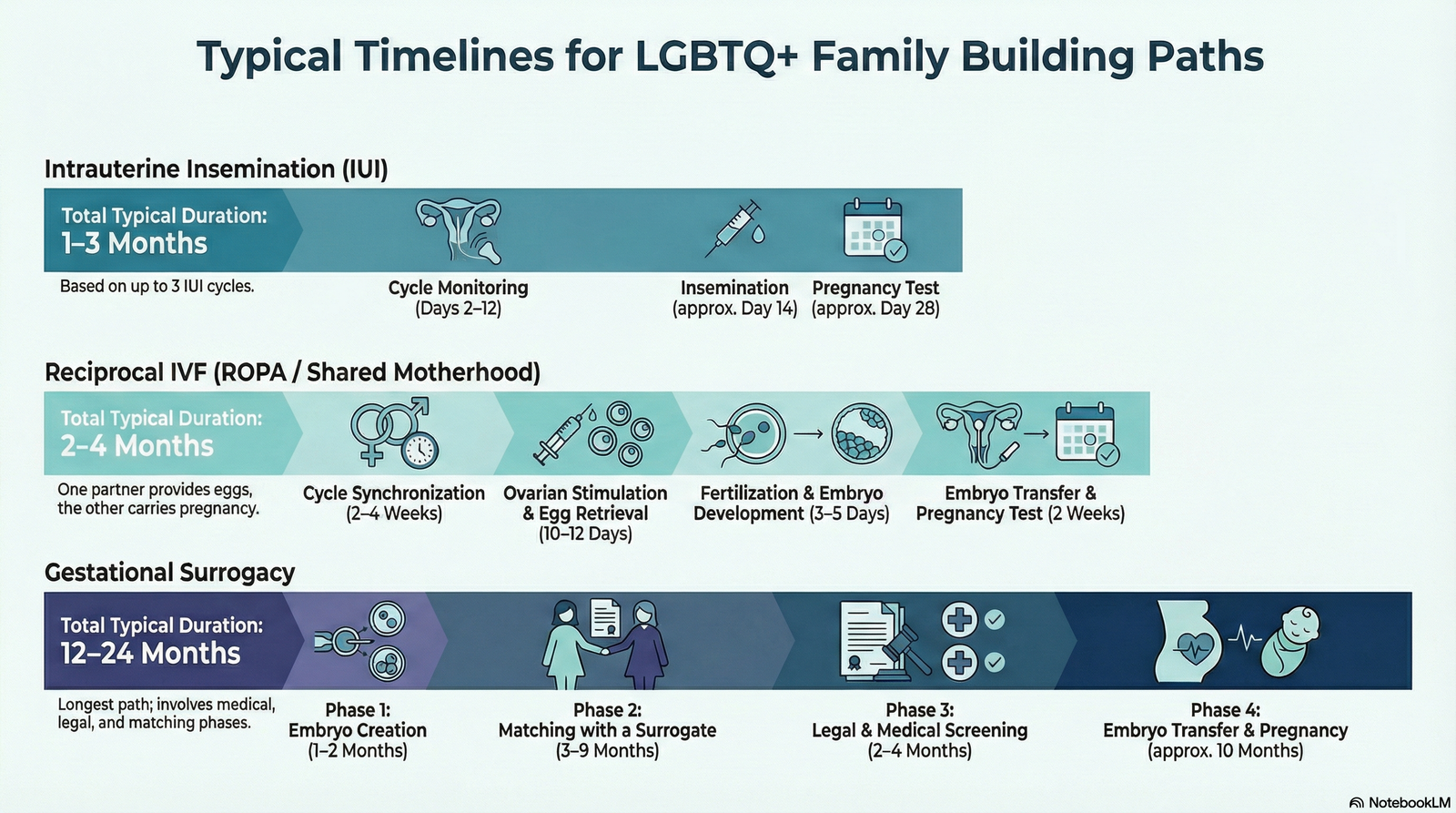
Typical timelines: weeks for IUI and reciprocal IVF, one to two years for full surrogacy journeys.
Options for Gay Male Couples
If you are a gay male couple and you want at least one of you to have a genetic link to your child, you will almost always combine donor eggs with a gestational carrier. You choose whose sperm to use, which egg donor to work with, and which clinic and surrogacy agency to trust.
The Sperm Selection Decision
Deciding whose sperm to use can bring up strong feelings. Some couples pick the older partner, often around 40, because he has less time biologically. Others choose a partner with a stronger wish to have a genetic link. Many couples use a shared approach. They fertilize half of the donor eggs with one partner’s sperm and half with the other’s, then transfer the best embryo or embryos regardless of who provided the sperm.
If you transfer one embryo from each partner and both embryos implant, you can have twins who are biological half-siblings. They share egg donor genetics but have different biological fathers. This shared approach can feel fair and can also spread the genetic risk.
Medical Screening for Sperm Providers
The partner who provides sperm needs routine infectious disease screening. That usually includes HIV, Hepatitis B, Hepatitis C, and Syphilis tests. If you are living with HIV, you can still pursue surrogacy. With effective antiretroviral treatment, many semen samples show no detectable virus. Clinics follow strict sperm washing and testing protocols. In published groups that used these protocols, all babies and surrogates tested negative for HIV.
Options for Lesbian Couples
If you are a two-mom family, you have more than one way to build your family. You can start with low intervention options such as IUI, move to IVF if needed, or go directly to reciprocal IVF if you want to share roles biologically and gestationally.
Intrauterine Insemination (IUI)
IUI is usually the first medical step because it is simple and relatively affordable. Your doctor washes and concentrates donor sperm and then places it directly into the uterus with a thin catheter.
- Procedure time: ~60 to 90 seconds in the exam room.
- Number of cycles: Many lesbian couples who conceive with IUI do so within 3 cycles.
- When to move on: If you complete 6 to 10 well-timed IUIs without success, most specialists advise switching to IVF.
- Success rate: Live birth rate per IUI cycle is around 13.1%.
Standard IVF for Lesbian Couples
If IUI does not fit your medical picture or has not worked, IVF is the next step. One or both of you take medications that help your ovaries produce multiple eggs. The eggs are retrieved, fertilized in the lab with donor sperm, and one or more embryos are transferred into the uterus.
- Success rate: Many programs report a live birth rate of about 42.1% per IVF cycle for lesbian couples using donor sperm.
Reciprocal IVF and the ROPA Method
If you want both of you to be physically involved in the pregnancy, reciprocal IVF, also called the ROPA method (Reception of Oocytes from Partner), is a strong option.
How Reciprocal IVF Works
- One partner (the biological mother) provides her eggs to create an embryo: She takes stimulation medications and goes through egg retrieval.
- The other partner (the gestational mother) carries the pregnancy: She receives the embryo transfer and carries the pregnancy.
- Timeline: A typical ROPA cycle takes from 4 to 6 weeks from the start of stimulation to the pregnancy test.
Why Many Couples Choose ROPA
- Shared experience: Both of you attend consultations and scans, manage medications, and feel equally involved in the process.
- Clear two-mom story: One of you gives birth, and the other shares genetics. Many couples feel this helps friends and relatives see both of you as full mothers.
- Strong outcomes: Studies report clinical pregnancy rates around 50% to 79% per cycle. One co‑IVF study found a 61.5% live birth rate, which is far higher than IUI.
Surrogacy for Gay Couples
For gay male couples who want genetic ties and cannot or choose not to adopt, gestational surrogacy is usually the most direct route. You work with an egg donor, a gestational carrier, and a clinic that coordinates both medical and legal steps.
Selecting Your Surrogate
A good match with your gestational carrier matters for both safety and emotional comfort. Most reputable programs follow similar criteria.
- Typical profile: At least 21 years old, at least one prior uncomplicated pregnancy and delivery, no major chronic illness, no serious genetic conditions, and a stable home environment.
- Relationship: Many gay dads describe ongoing contact with their surrogate mom after the birth. Some families share photos and updates, and some build long-term friendships.
- Safety: A large review of more than 28,300 gestational carrier pregnancies found complication rates similar to or slightly better than those to other IVF pregnancies. Severe events were rare, and most risk was linked to multiple pregnancies rather than surrogacy itself.
Sperm Donation for Lesbian Couples
Choosing a sperm donor is a major decision, both for your treatment and for your future child. You can use fully anonymous donors, identity‑release donors, or known donors.
The Shift Toward Open Identity
- Donor-conceived adults: Many adults conceived with donor sperm say they want access to their donor’s identity for medical and personal reasons. This has pushed banks to offer more identity‑release options.
- Talking with your child: Most experts suggest you tell your child about their donor conception in an age-appropriate way during early childhood. Children who grow up knowing this usually see it as a normal part of their story.
- Genetic privacy today: Direct-to-consumer DNA tests make true anonymity difficult. Because of this, many parents prefer donors who accept that contact might happen once the child is older.
Co‑IVF and Shared Motherhood
Some couples use an expanded version of ROPA called concurrent or co‑IVF. It creates an even more immersive and symmetric experience.
- Swapped roles: Each of you makes embryos from your own eggs and shared donor sperm, and each of you carries an embryo created from the other partner’s eggs.
- Both pregnant: If both transfers are successful and the embryos implant, both of you will be pregnant simultaneously. Each of you carries a baby that is genetically related to your partner.
- Family level success: When both partners in a lesbian couple attempt conception, the chance that the family has at least one live birth can reach about 88.9%, compared with about 68% when only one partner tries.
Supporting Evidence for LGBTQ+ Paths
Similar Birth Outcomes – Donor Sperm Confidence: In a Swedish cohort of single women and women in lesbian relationships using donor sperm, live birth rates and perinatal outcomes were very similar once age was taken into account. This matters because your relationship status does not reduce your chance of a healthy pregnancy when the medical care is the same. Source: Journal of Assisted Reproduction and Genetics (PMID: 35106694).
Equal or Higher Donor Sperm Success: Other donor sperm studies show that cycles using donor sperm, including for lesbian couples and single parents, often have equal or higher pregnancy and birth rates than similar IVF cycles using a partner’s sperm. This matters because using donor sperm is not a second-best route; it is a medically strong option. Source: Journal of Assisted Reproduction and Genetics (PMID: 35106694 and related analyses).
Expert Support for LGBTQ+ Access: Professional bodies such as ASRM and ESHRE have issued guidance stating that fertility services should be offered regardless of sexual orientation, gender identity, or marital status. This matters because you can point to formal guidance when you advocate for coverage and equal care. Sources: ASRM Ethics Committee Opinions 2021, ESHRE Task Force on Ethics and Law 23 (PMID: 25052011).
These findings support what many LGBTQ+ parents already know from experience: your family plans are medically realistic, not wishful thinking.
Transgender Family Building
If you are trans or non‑binary, your fertility decisions are closely tied to timing. Hormones and surgeries can affect your options, but they do not erase them. It is normal to feel pulled between starting transition now and saving fertility for later. You deserve a clear explanation of what is realistic at each stage.
Transgender Men (Assigned Female at Birth)
- Egg freezing: Oocyte cryopreservation is the main option to preserve fertility before or during gender-affirming care. You can freeze eggs before testosterone or after a pause in hormone therapy.
- Testosterone and fertility: Testosterone usually reduces ovulation and can thin the uterine lining, but these changes are often reversible. Many trans men regain ovarian function after a break from testosterone.
- Stimulation while on hormones: Newer data show that some trans men complete egg retrieval cycles without fully stopping testosterone, although many clinics still recommend a break of 3 weeks to 3 months to improve egg numbers.
- IUI after testosterone: We now have documented IUI pregnancies in trans men with past testosterone use. This proves that not every patient needs high-dose IVF medication to conceive after hormone therapy.
Transgender Women (Assigned Male at Birth)
- Sperm banking: Around 76% of trans women who choose fertility preservation bank sperm before or early in hormone treatment.
- Hormone impact: Estrogen and anti‑androgens lower sperm counts and can stop production, but some patients still produce sperm. In one series, some trans women on hormones had about 2.4 million sperm per milliliter in their samples.
Legal Rights and Parentage
Medical care is only part of your family plan. Legal parentage protects your child and your rights if you move, separate, or have medical issues. Laws change often, so you should work with a lawyer who knows LGBTQ+ family law in your country and state.
Parentage in the United States
- Marital presumption: In many states that fully recognize marriage equality, a child born into a same sex marriage is treated like a child born into a different sex marriage. Both spouses can appear on the birth certificate.
- Surrogacy‑friendly states: States such as California and Connecticut have clear surrogacy laws and well-established court processes. Judges there routinely issue pre‑birth orders so that the intended parents are listed on the birth certificate from day one.
- Second-parent adoption: In places without clear parentage rules, the non-genetic or non-gestational parent often completes a second-parent adoption. This step protects your relationship legally across state and country lines.
International Differences
- United Kingdom: Under UK law, the woman who gives birth is the legal mother at birth, including in gestational surrogacy. Intended parents apply for a parental order after birth to transfer legal parentage.
- Countries with limits or bans: France, Spain, China, and several other countries either ban or heavily restrict surrogacy. Many LGBTQ+ parents in those countries travel to the United States, Canada, or parts of Latin America to access surrogacy.
Costs by Path and Region
For many solo parents and couples, the financial hurdle is the heaviest one. These ranges reflect typical costs for 2026, though your final total will depend on your specific clinic, your location, and the availability of insurance or public funding to help light the way.
| Path to Parenthood | Region | Estimated Cost (USD) |
|---|---|---|
| IUI (Lesbian/Trans) | United States | $2,000 – $4,000 (procedure only) |
| TDI (with sperm purchase) | US / Canada | $10,000 – $19,500 |
| Standard IVF | US / Canada | $10,000 – $36,000 |
| Reciprocal IVF (ROPA) | North America | $19,000 – $30,000+ |
| Reciprocal IVF (ROPA) | Europe (for example, Spain) | $6,500 – $11,000 |
| Surrogacy (Gay Male) | United States | $100,000 – $175,000 (average about $120,000) |
| Surrogacy (Gay Male) | Canada | $55,000 – $90,000 |
| Surrogacy (Gay Male) | Colombia / Mexico | $60,000 – $119,000 |
| Surrogacy (Gay Male) | Albania | $50,000 – $70,000 |
| Surrogacy (Gay Male) | Cyprus | $55,000 – $125,000 |
These costs usually include clinic fees, essential legal work, and medications, though the bundled services can vary significantly. Some packages may exclude medications or specific diagnostic tests, while only select programs cover an initial infertility workup or an additional frozen embryo transfer if a fresh cycle is unsuccessful. Unlike basic bundles, premium “success-guaranteed” programs may include more sophisticated services and even offer a refund if a live birth is not achieved. To avoid hidden fees or overlapping costs, we recommend always requesting a written, itemized quote so you can accurately compare bundles offered by clinics both locally and abroad.
Finding LGBTQ+‑Friendly Clinics
You deserve fertility care in a place where your family structure is treated as normal. The clinic you choose can change how supported you feel during what is already an emotional process.
- Language: Look for forms that ask for “Parent 1 / Parent 2” or “Partner 1 / Partner 2” rather than only “mother / father.”
- Signals of welcome: Gender-neutral restrooms, Pride symbols, and staff who ask for and use your pronouns are good signs.
- Experience: Ask how many LGBTQ+ patients your clinic sees each year and whether they have dedicated protocols for reciprocal IVF or surrogacy for gay couples.
- Comparison tools: Platforms such as OVU.com and similar services can help you compare costs, success rates, and patient reviews across clinics and agencies that already have strong LGBTQ+ experience.
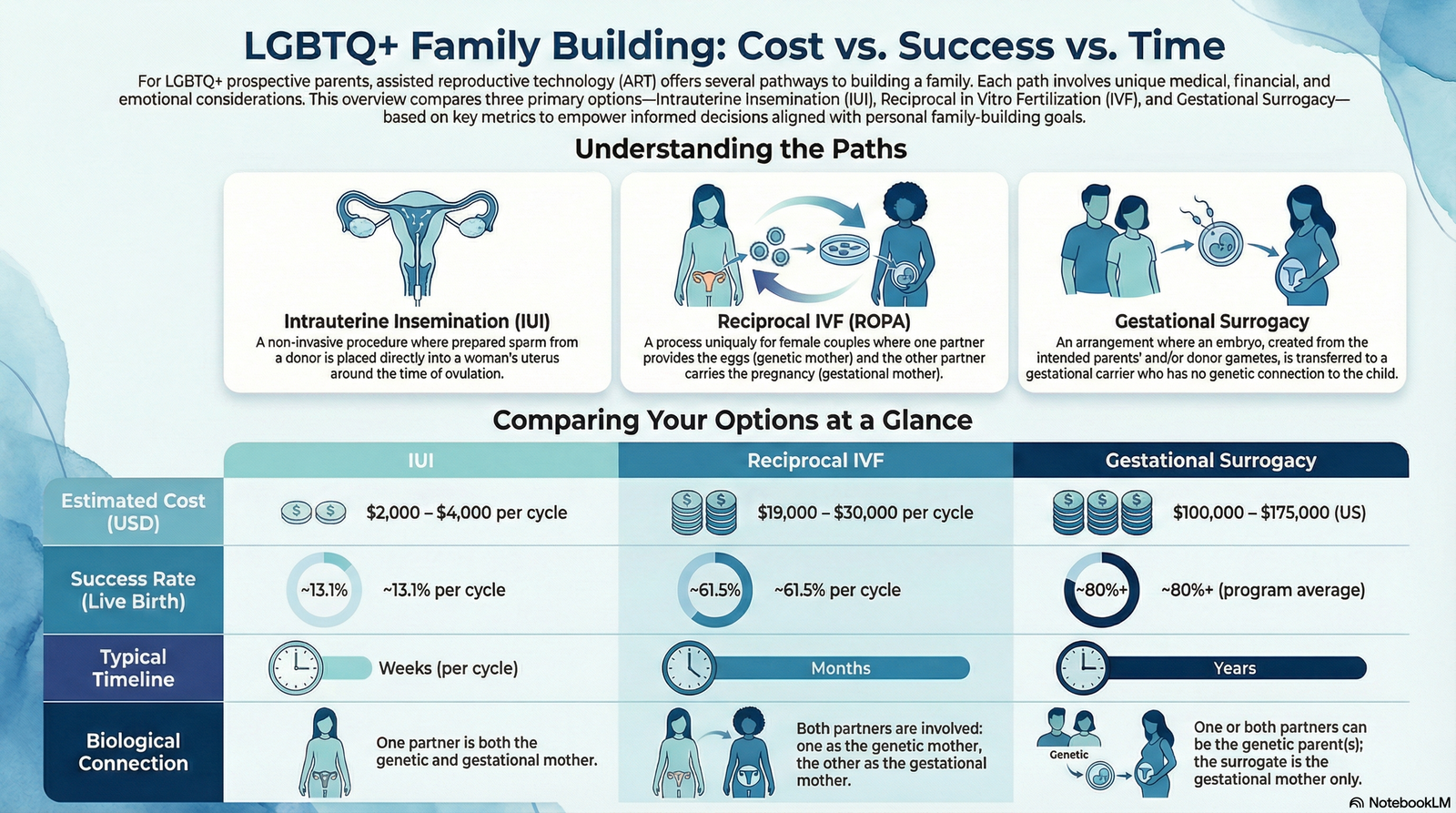
Comparing your main options side-by-side helps you balance cost, timeline, and chance of success.
Donor Selection Priorities
If you are choosing an egg or sperm donor, you are not just picking names on a screen. You are thinking about your future child and what will matter for their health and identity.
- Health first: 83.5% of surveyed gay men list medical history as their top factor when choosing an egg donor.
- Other priorities: The level of education and extended family history each matter to 64.9% of respondents, and race or ethnicity matters to 60.8%.
- Looks and personality: 50% of intended parents say physical attractiveness is important, and many also look at hobbies and personal interests.
- Genetic link: More than half of gay men say having a biological connection to their child feels “extremely important,” which shapes how they think about donors and shared sperm approaches.
Success Rates by Treatment
When you plan your family, you need more than stories. You need real numbers so you can set expectations and budget for more than one try if needed.
- IUI: Live birth rate per cycle is around 13.1%, so most people need several cycles.
- Standard IVF: For many lesbian couples using donor sperm, live birth rates are about 42.1% per cycle.
- ROPA and reciprocal IVF: Cumulative live birth rates for reciprocal IVF can reach about 78% to 89% across a full course, including frozen transfers.
- Surrogacy for gay couples: High-volume US-based programs report live birth rates around 85.2% per surrogacy journey.
- Donor eggs in surrogates vs intended parents: When the same quality donor egg embryos are transferred, gestational carriers reach about 57% live birth rates compared with roughly 46% when intended parents carry the pregnancy themselves.
- Age and IVF: For women under 35 using their own eggs, many programs quote about a 60% chance of a positive pregnancy test per IVF cycle.
How to Use These Numbers
Success rates are averages, not promises. Your own odds change with age, egg and sperm quality, your uterus, and your clinic. If you are under 35 with no major health issues, your realistic plan might include one or two IVF or ROPA cycles. If you are older or if your uterus adds risk, a gestational carrier may give you the safest path to a healthy baby.
International Treatment Options
If care in your home country is too expensive or your laws are restrictive, you may explore the options available abroad. Cross-border fertility care is common in LGBTQ+ family building, but it adds legal and logistical layers you need to understand.
- United States: Many couples travel to the United States for surrogacy because certain states offer clear laws and experienced clinics, especially in California and Connecticut.
- Canada: Known for inclusive parenting laws and strong medical care. Only altruistic surrogacy is legal, meaning carriers receive expense reimbursement but not a base fee.
- Colombia: The constitution bans discrimination based on sexual orientation, and clinics there increasingly work with international LGBTQ+ intended parents.
- Cyprus: Some programs advertise “guaranteed” surrogacy packages with unlimited IVF attempts, with costs starting near €55,000 to €71,000.
Expert Guidance on Choosing a Location
Legal First, Price Second: Saving money matters, but your legal status as parents is more important. Before you choose a low-cost destination, have a specialist review whether your home country will recognize the birth certificate and parentage documents. Sometimes, slightly higher costs in a surrogacy‑friendly region save years of legal stress.
Insurance and Financing
Even with strong success rates, you still have to make the numbers work. You are not alone if you worry more about money than about injections.
- State mandates: Nineteen US states have some form of insurance mandate for fertility preservation or treatment. In California, SB600 requires coverage for infertility caused by medical treatment, which includes gender affirming hormone therapy.
- Out of pocket gaps: Even where mandates exist, donor sperm, donor eggs, and surrogacy fees are usually not covered.
- Saving timelines: Surveys of gay men planning surrogacy report that about 50% of couples save for an average of 3.6 years before starting.
- Clinic programs: Many clinics offer payment plans or “guaranteed live birth” packages for IVF and ROPA in the $19,000 to $25,000 range, which can spread costs over time.
Want help comparing clinics and costs?
If researching all of this feels like a full-time job, you are not imagining it. OVU advisors can collect clear, itemized quotes from verified clinics and help you map out a realistic timeline at no cost to you.

Why trust this guide? The OVU commitment
You are probably juggling hope, timelines, and a lot of tabs open in your browser. And you deserve clear, current, human advice. At OVU, we review clinic protocols, compare real quotes, and talk to people who have done this - intended parents and gestational carriers - so we can give you practical steps, not just theory. If you want help comparing options without sales pressure, we will gather itemized quotes and success data that match your exact situation. You decide, we will bring the info to your table.
Frequently Asked Questions
1. How much does it really cost to get started?
If you are starting your journey with IUI, you can expect to pay between $2,000 and $4,000 per cycle in the United States. Since many families require multiple attempts, three cycles of IUI will result in a final price tag of at least $6,000. If you are planning full surrogacy in the United States, expect to pay a minimum of $120,000 once you include agency fees, legal work, clinic fees, and the surrogate’s compensation and expenses. While $120,000 covers core surrogacy-related bundles, additional expenses may arise, especially if your surrogate conceives twins or triplets, or if an additional embryo transfer is required.
2. What are my legal rights as a non-biological parent?
If you live in a surrogacy friendly state with clear laws, a court can issue a pre-birth order so both of you are listed on the birth certificate from the start. In other places, the non-gestational or non-genetic parent usually completes a second-parent adoption to secure full parental rights. It is smart to do this even if your names are already on the birth certificate.
3. What is often the best medical option for two moms?
Many couples start with IUI because it is less expensive. For those who want both partners physically involved and who can afford IVF, reciprocal IVF (ROPA) is often the most satisfying path. It combines a relatively high live birth rate, around 61.5% in some series, with a clear two mom story where one is genetic and the other is gestational.
4. How does reciprocal IVF work in practice?
One partner does the egg retrieval, the clinic fertilizes those eggs with donor sperm, and the other partner receives the embryo transfer. You can swap roles in future pregnancies if you wish. A complete cycle usually takes 4 to 6 weeks from the start of medications to the pregnancy test.
5. Can we have any kind of relationship with our donor?
Yes. Many banks and agencies now offer identity‑release donors who agree that your child can contact them once they reach a certain age, often 18. Some programs also support known donors, such as a friend or extended family member, under clear legal agreements.
6. Will we face discrimination at clinics?
Experiences differ by region, but a growing number of clinics openly welcome LGBTQ+ patients. Look for clear non-discrimination statements, inclusive language on their website, and staff who use your names and pronouns correctly. If a clinic’s paperwork or staff attitudes feel dismissive, you are allowed to take your care elsewhere.
7. How long does the whole process take?
From your first consultation to embryo transfer, a reciprocal IVF cycle typically takes 6 to 10 weeks. A full surrogacy journey, including matching with a carrier, medical screening, legal work, IVF, pregnancy, and birth, usually takes about one to two years. Adoption and foster routes follow different timelines that depend on your country and agency.
Reference List 9 sources
Journal Article (Systematic Review & Meta-Analysis): Matsuzaki S, Masjedi AD, Matsuzaki S, et al. Obstetric characteristics and outcomes of gestational carrier pregnancies: a systematic review and meta-analysis. JAMA Network Open. 2024;7(7):e2422634. PMID: 39042408. Available from: https://pubmed.ncbi.nlm.nih.gov/39042408/
Journal Article (Comparative Study): Segal TR, Kim K, Mumford SL, Goldfarb JM, Weinerman RS. How much does the uterus matter? Perinatal outcomes are improved when donor oocyte embryos are transferred to gestational carriers compared to intended parent recipients. Fertility and Sterility. 2018;110(5):888-895. PMID: 30316434. Available from: https://pubmed.ncbi.nlm.nih.gov/30316434/
Journal Article (Population-Based Study): Swanson K, Letourneau JM, Kuppermann M, Einerson BD. Obstetric morbidity in gestational carrier pregnancies: a population-based study. Journal of Assisted Reproduction and Genetics. 2021;38(1):177-183. PMID: 33145724. Available from: https://pubmed.ncbi.nlm.nih.gov/33145724/
Journal Article (Research): Goisis A, Cederström A, Martikainen P. Birth outcomes following assisted reproductive technology conception among same-sex lesbian couples vs natural conception and assisted reproductive technology conception among heterosexual couples. JAMA. 2023;329(11):914-923. PMID: 37014346. Available from: https://pubmed.ncbi.nlm.nih.gov/37014346/
Journal Article (Prospective Cohort): Wrande T, Kristjansdottir BH, Tsiartas P, Hadziosmanovic N, Rodriguez-Wallberg KA. Live birth, cumulative live birth and perinatal outcome following assisted reproductive treatments using donor sperm in single women vs. women in lesbian couples: a prospective controlled cohort study. Journal of Assisted Reproduction and Genetics. 2022;39(3):629-637. PMID: 35106694. Available from: https://pubmed.ncbi.nlm.nih.gov/35106694/
Journal Article (Ethics Committee Opinion): De Wert G, Dondorp W, Shenfield F, et al. ESHRE Task Force on Ethics and Law 23: medically assisted reproduction in singles, lesbian and gay couples, and transsexual people. Human Reproduction. 2014;29(9):1859-1865. PMID: 25052011. Available from: https://pubmed.ncbi.nlm.nih.gov/25052011/
Journal Article (Review): Armuand GM, Dhejne C, Olofsson JI, Rodriguez-Wallberg KA. Fertility preservation and fertility treatment in transgender and gender-diverse individuals. Human Reproduction Open. 2022;2022(2):hoac008. PMID: 35309678. Available from: https://pubmed.ncbi.nlm.nih.gov/35309678/
Ethics Committee Opinion: Ethics Committee of the American Society for Reproductive Medicine. Access to fertility treatment irrespective of marital status, sexual orientation, or gender identity: an Ethics Committee opinion. Fertility and Sterility. 2021;116(1):e1-e8. Available from: https://www.asrm.org/practice-guidance/ethics-opinions/access-to-fertility-treatment-irrespective-of-marital-status-sexual-orientation-or-gender-identity-an-ethics-committee-opinion-2021/
Ethics Committee Opinion: Ethics Committee of the American Society for Reproductive Medicine. Access to fertility services by transgender and nonbinary persons: an Ethics Committee opinion. Fertility and Sterility. 2021;115(4):874-878. Available from: https://www.asrm.org/practice-guidance/ethics-opinions/access-to-fertility-services-by-transgender-and-nonbinary-persons-an-ethics-committee-opinion-2021/
Final Thoughts
If you have read this far, you are already doing the hard work of showing up for your future child. You are weighing costs, success rates, laws, and your own feelings so that when you do become a parent, you will know how much thought went into that choice.
It is normal to feel excited and scared at the same time. You might worry about money, medical risks, or how your family will react. You might also feel deep joy when you imagine holding your baby. Both sets of feelings can live side by side, and neither means you are any less ready to be a parent.
Your path might be short and simple, or it might take years and more than one type of treatment. Either way, you and your partner, or you as a solo parent, are allowed to want this and to ask for real support. There are clinics, lawyers, donors, surrogates, and advisors whose full-time job is to help you get there.
Ready to map out your next step?
You do not have to compare every clinic and country on your own. Talk to an OVU advisor about your LGBTQ+ family building options and get a short list of vetted clinics that match your budget and your values.