


Dr. Sony Sherpa (MBBS)
In addition to her clinical experience, Dr. Sherpa is a published medical researcher and holistic health advocate. Her dual expertise in emergency care and alternative therapies brings a unique lens to medically reviewed content—ensuring it is both accurate and accessible.
When you are experiencing extreme hurdles with your health, the daily hustle hushes, the world fades, and the usual hassles disappear, leaving you alone. But as the issues become more serious, the tension becomes hard to control, especially when you hear a diagnosis of pre-cancer or, even harder, cancer. You may feel like a bundle of nerves; you may envision several undesirable scenarios, desperately hoping to avoid the hardest diagnosis. In the end, you may feel numb, frustrated, desperate, and terrified. It is in this very moment of silence and fear that you need a voice to remind you that while the world has slowed down, your story is far from over.
This guide aims to assist you in understanding oncofertility during a time when your life may feel chaotic. Upon hearing the words “you have pre-cancer or cancer”, your mind immediately focuses on survival. That reaction is completely normal, as your priority is your recovery. But it is also fine to think about your life after treatment, including having a child.
If you are reading this, you probably want clear answers, not vague promises. You will see real numbers here, such as embryo survival rates of around 96% to 99% after freezing and thawing or the way egg-freezing success changes sharply after your mid‑30s. You will also see how often young women lose ovarian reserve after chemotherapy and why that makes early planning so important. You will also find that for men, sperm cryopreservation is a highly effective “gold standard” that can be used decades later with success rates of up to 50% for achieving parenthood through assisted technology, demonstrating that for both men and women, preserving your future is a realistic and achievable goal.
The discipline that brings these hopes and medical science together is oncofertility. It sits at the precise point where oncology and reproductive medicine meet, bridging the gap between your urgent medical care and your future dreams. Specialists in this field follow guidance from major international medical organizations such as the American Society of Clinical Oncology (ASCO), the American Society for Reproductive Medicine (ASRM), and the European Society of Human Reproduction and Embryology (ESHRE). They work directly with your oncology team so that fertility preservation fits safely around your cancer treatment, not in place of it. Think of this as a roadmap that helps you ask the right questions and understand the options your doctors describe, ensuring you can make informed decisions with confidence.
Oncofertility is the part of medicine that focuses on protecting your chance to have a child before, during, or after cancer treatment. For women, the main options are egg freezing, embryo freezing, and ovarian tissue freezing. For men, the main option is sperm banking, with testicular tissue freezing for boys who have not reached puberty. Many of these steps can be done urgently, sometimes without delaying chemotherapy.
If you have just received a pre-cancer or cancer diagnosis, ask your oncologist for an urgent referral to a fertility specialist before treatment begins, even if you are not yet sure what you want to do.
What current research and guidelines say
Clinical guidelines from the American Society of Clinical Oncology (ASCO) state that doctors should discuss fertility risks with every patient of reproductive age, offering options like sperm, egg, or embryo freezing whenever a meaningful risk exists. Current research supports the safety of these options, showing that for women with breast cancer and BRCA mutations, pregnancy after treatment is possible without increasing the risk of recurrence. Beyond standard freezing, medical innovation has made it possible to help those who have not yet reached puberty; worldwide programs in ovarian and testicular tissue freezing have already involved thousands of patients, including children and teens.
These recommendations and findings come from peer‑reviewed research and international guideline groups. Your own plan should always be tailored with your oncology and fertility teams.
In This Guide
Modern cryopreservation techniques yield embryo survival rates of approximately 96% to 99% after freezing and thawing.
The chance of a live birth following egg freezing is approximately 74% for those under 35, but it drops significantly to around 2% for those aged 41 to 42.
In some centers, fewer than 15% of young women with gynecologic cancers receive a referral to a fertility specialist.
What oncofertility means for you
If you are newly diagnosed, you might feel extremely exhausted and torn between starting treatment immediately and wanting time to think about the rest of your life. Many people feel guilty for even asking about fertility care when everyone around them seems focused only on survival. Your feelings are valid; wanting a future family does not make you less serious about fighting your cancer.
Oncofertility planning usually starts with three questions. First, how likely is this treatment to affect your fertility or hormone function? Second, how quickly do you need to start treatment? Third, which preservation options make sense for your body, your timeline, and your values? When your team answers these questions clearly, you can make decisions that match both your medical needs and your hopes for the future.
Latest research insights for oncofertility decisions
41% vs. 21% – Embryo and tissue outcomes: In women who preserved fertility before cancer treatment, about 41 in 100 eventually had a baby after using frozen embryos. For women who used ovarian tissue that had been removed and later transplanted, the live birth rate after IVF was about 21 in 100, with around 33 in 100 having spontaneous live births after tissue transplant. This shows that embryo and egg freezing are established paths to a future pregnancy, and ovarian tissue freezing can also lead to natural conception in some cases. Source: Human Reproduction (PMID: 36421038).
1 in 5 – Pregnancy after breast cancer in BRCA carriers: In a global study of more than 4,700 young women with BRCA‑related breast cancer, about 1 in 5 became pregnant within ten years of diagnosis. Their cancer outcomes were as good as those who did not become pregnant, and survival was actually better in the group who did. This tells you that, with proper timing and clearance from your oncologist, pregnancy after breast cancer can be a safe and realistic goal. Source: JAMA (PMID: 38059899).
3,118 boys – Fertility preservation in children: Across international centers, testicular tissue from more than 3,000 boys under 18 has already been frozen to protect future fertility. This shows that pediatric oncofertility is no longer an experimental idea on paper, it is something many families have already chosen. Source: Human Reproduction Open (PMID: 38449521).
29% – Periods stopped after treatment: In one study of girls and young women under 21 who had oncofertility consultations, nearly 3 in 10 had no periods one year after finishing treatment. Higher doses of certain chemotherapy drugs and pelvic radiation raised this risk. Knowing this helps you see why doctors push for fertility referrals early, before those drugs are given. Source: Journal of Adolescent and Young Adult Oncology (PMID: 38064519).
These findings come from peer‑reviewed research. Your own outcome depends on your age, diagnosis, and specific treatment plan, so always review these numbers with your doctors.
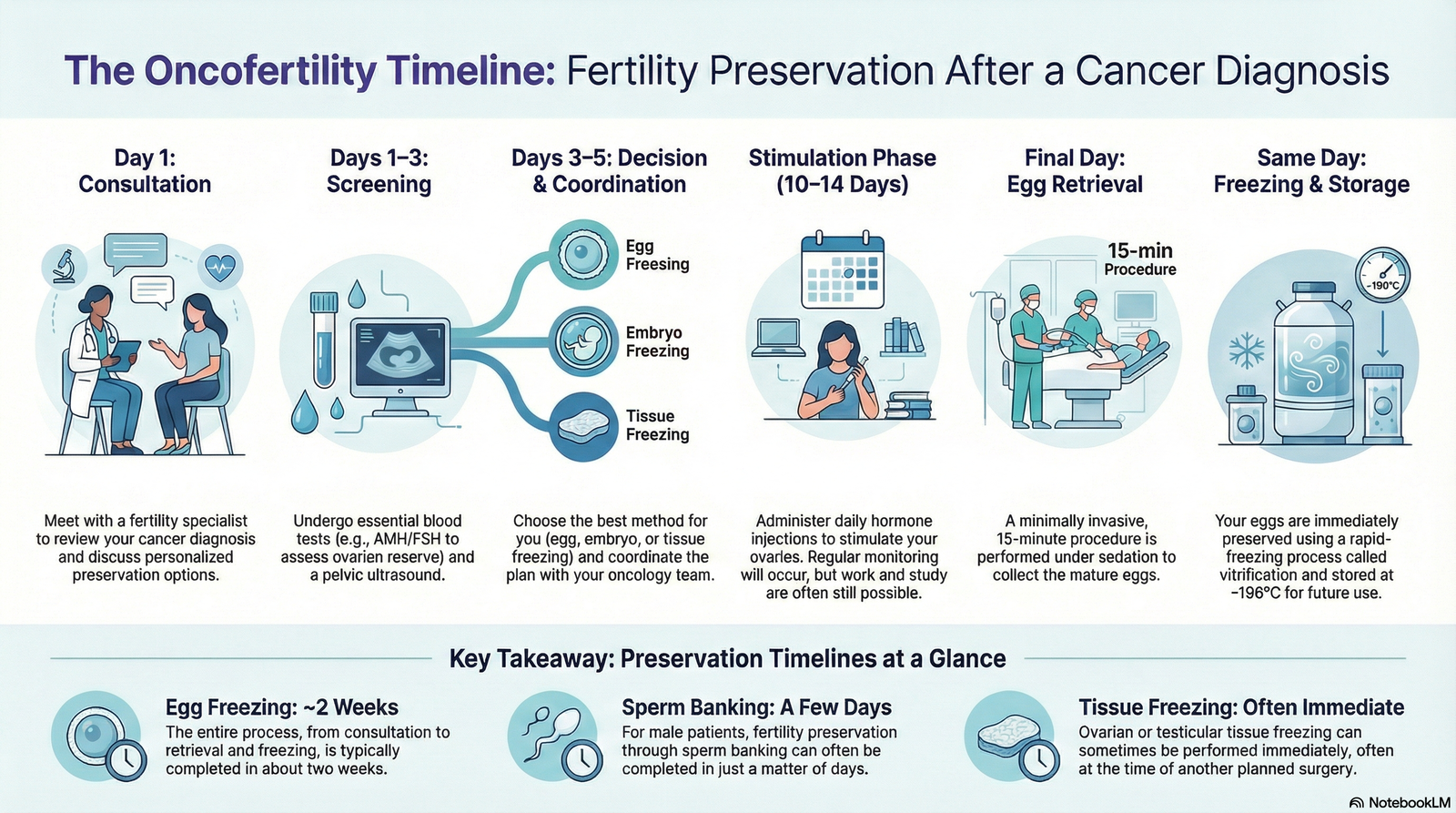
Typical oncofertility timeline from first consultation to freezing eggs, embryos, or sperm.
Female fertility preservation options
If you are a teen, you may feel lost, scared, and isolated after hearing a diagnosis of pre-cancer or cancer. It is deeply overwhelming to see your parents feeling embarrassed, shocked, and numb while they hustle to cope with their own fears. In this whirlwind, it is okay to pause and seek clarity. Booking a consultation for a second opinion or scheduling tests at an additional lab to confirm the diagnosis may provide more medical certainty before moving forward; this is particularly relevant in certain types of “pre-cancerous” screenings or specific blood markers, where results can occasionally return a false-positive. While not a routine recommendation, some clinics may offer to complete elective fertility preservation simultaneously or during this diagnostic window to ensure no time is lost before treatment begins.
If you are thinking about egg freezing in your mid-20s, late 30s, or early 40s, the clock on the wall can feel very loud. This urgency is driven by the fact that certain cancer drugs, especially alkylating agents like cyclophosphamide, are known to damage the ovarian follicles that hold immature oocytes. This damage can bring menopause closer and lower your chances of achieving a viable pregnancy after treatment.
Managing this window of time requires a clear understanding of the options available to you. Most oncofertility plans focus on three primary tools: egg freezing, embryo freezing, and ovarian tissue freezing. Each carries its timing demands, costs, and benefits. The right choice for your specific situation depends on how many days you have before starting treatment, whether you have a partner or sperm source, and your personal preferences regarding surgery versus hormone injections. Once you have selected an option, your oncofertility care team will tailor a bundle of fertility preservation services for your unique case, beginning the work on a specific treatment protocol and the adjustment of medication dosages.
Egg and embryo freezing success rates by age
Egg quality declines with age, and freezing does not alter this. It simply preserves the age your eggs were when you froze them. In studies that track egg freezing journeys through to live birth, the chance that at least one baby results from a full plan of eggs can look roughly like this:
| Age at Freezing | Approximate Chance of Live Birth From Egg Freezing Plan |
|---|---|
| Under 34 | About 74% |
| 35 to 37 | About 55% |
| 38 to 40 | About 18% |
| 41 to 42 | About 2% |
For a solid chance of a baby later, many doctors suggest aiming for about 20 mature eggs if you are under 35, and closer to 40 eggs if you are between 35 and 38. That often means more than one stimulation cycle. It is normal to feel tired just thinking about that. You are not asking for too much when you want your doctors to explain what these numbers really mean for you.
Hormone‑sensitive cancers and safer stimulation
If you have a hormone‑sensitive cancer, such as estrogen receptor-positive breast cancer, it is natural to worry that IVF medicines may raise estrogen too high. To lower that risk, many fertility specialists use medicines like letrozole or tamoxifen during stimulation. These drugs help keep estrogen levels closer to normal while still allowing several eggs to mature at once. Studies in breast cancer patients show that this approach does not increase the risk of recurrence when used carefully alongside oncology care.
Ovarian tissue cryopreservation (OTC)
Ovarian tissue cryopreservation is often considered when you cannot wait even two weeks for egg stimulation or when the patient is a child who cannot undergo egg retrieval. In a short laparoscopic surgery, your surgeon removes strips of the outer ovary, which contain thousands of resting follicles. These strips are then frozen for later use.
When your cancer treatment is complete and you are cleared to try for pregnancy, doctors can transplant some of the tissue back. In many cases, your hormone production returns, your periods restart, and you may even conceive naturally if your uterus and tubes are healthy. More than 200 live births have been reported worldwide after ovarian tissue freezing and later transplantation.
Oncofertility care in practice
14.6% – Low referral rate to fertility specialists: In one large academic center, only about 15 in 100 women aged 18 to 41 with new gynecologic cancers were referred to a fertility clinic. Younger age, not having children yet, and seeing a female oncologist all made referral more likely, and referrals did not delay cancer treatment. This shows that you sometimes need to ask directly for fertility counseling, even when guidelines say it should be offered. Source: Journal of Clinical Medicine (PMID: 39200851).
2,585 patients – Decision tools help with hard choices: A review of more than 2,500 patients with low health literacy found that decision aids and mobile apps made cancer treatment choices clearer and less stressful. While very few tools were built specifically for oncofertility, the pattern was the same: simple, interactive tools improved understanding. This supports asking your team for clear written plans, diagrams, or digital tools if verbal explanations are not sinking in. Source: Patient Education and Counseling (PMID: 38070299).
Standard of care – Guideline support: Expert guidelines state that sperm, egg, and embryo freezing are now standard approaches for fertility preservation in people facing gonadotoxic therapy, and that ovarian tissue freezing is moving quickly from experimental to established practice. Hormone shots alone should not replace proven freezing methods when those are available. Source: ASCO Guideline (PMID: 29620997).
These insights highlight gaps in care, but they also show you where to focus your conversation: on a referral, on written options, and on the time required to think before treatment starts.
Male fertility preservation options
For men, fertility can already be affected at diagnosis. Tumours, weight loss, stress, and inflammation can lower testosterone and disrupt the hormone signals that tell your testicles to make sperm. First, many men learn there is a problem when they see their semen analysis.
If possible, sperm banking should happen before you receive any chemotherapy or pelvic radiation. Even a single dose of some drugs can damage sperm DNA. That does not always mean you become infertile, but it does mean that samples collected before treatment are usually the safest for future use.
Sperm banking and advanced retrieval methods
The simplest way to bank sperm is by masturbation in a private room at the clinic. If your anxiety, pain, or physical condition makes this very difficult, you still have options. Under anesthesia, a doctor can use electroejaculation to trigger ejaculation, or can perform testicular sperm extraction to remove sperm directly from testicular tissue.
Even if semen tests show a very low count or poor movement, sperm banking can still be worth doing. With intracytoplasmic sperm injection, an embryologist needs only a single healthy sperm per egg to try for fertilization. That is why doctors often recommend banking any usable sperm at all before treatment, rather than waiting to see what happens after.
Oncofertility for children and teens
When a child or teenager has cancer, fertility can feel like a distant concern compared with survival. Still, many parents say that knowing they at least explored preservation options brings comfort years later, even if they decide not to go ahead.
Ovarian tissue freezing in girls and young women
Girls who have not started menstruating cannot have their eggs retrieved. In these cases, ovarian tissue freezing is often the only way to preserve eggs using the child’s own tissue. The procedure is usually combined with another planned surgery when possible to avoid multiple anesthetics.
Testicular tissue freezing in boys
Prepubertal boys do not yet produce mature sperm, so standard sperm banking is not an option. In testicular tissue freezing, surgeons remove tiny pieces of testicular tissue that contain spermatogonial stem cells and freeze them for future research or clinical use.
Across worldwide programs, more than 3,000 boys have had testicular tissue frozen. Researchers are working on ways to either transplant the tissue back safely in adulthood or mature the stem cells in the lab to create sperm. Professional groups recommend that families be told about this option, where it is available, even though it is still considered experimental, because parents often value the chance to choose.
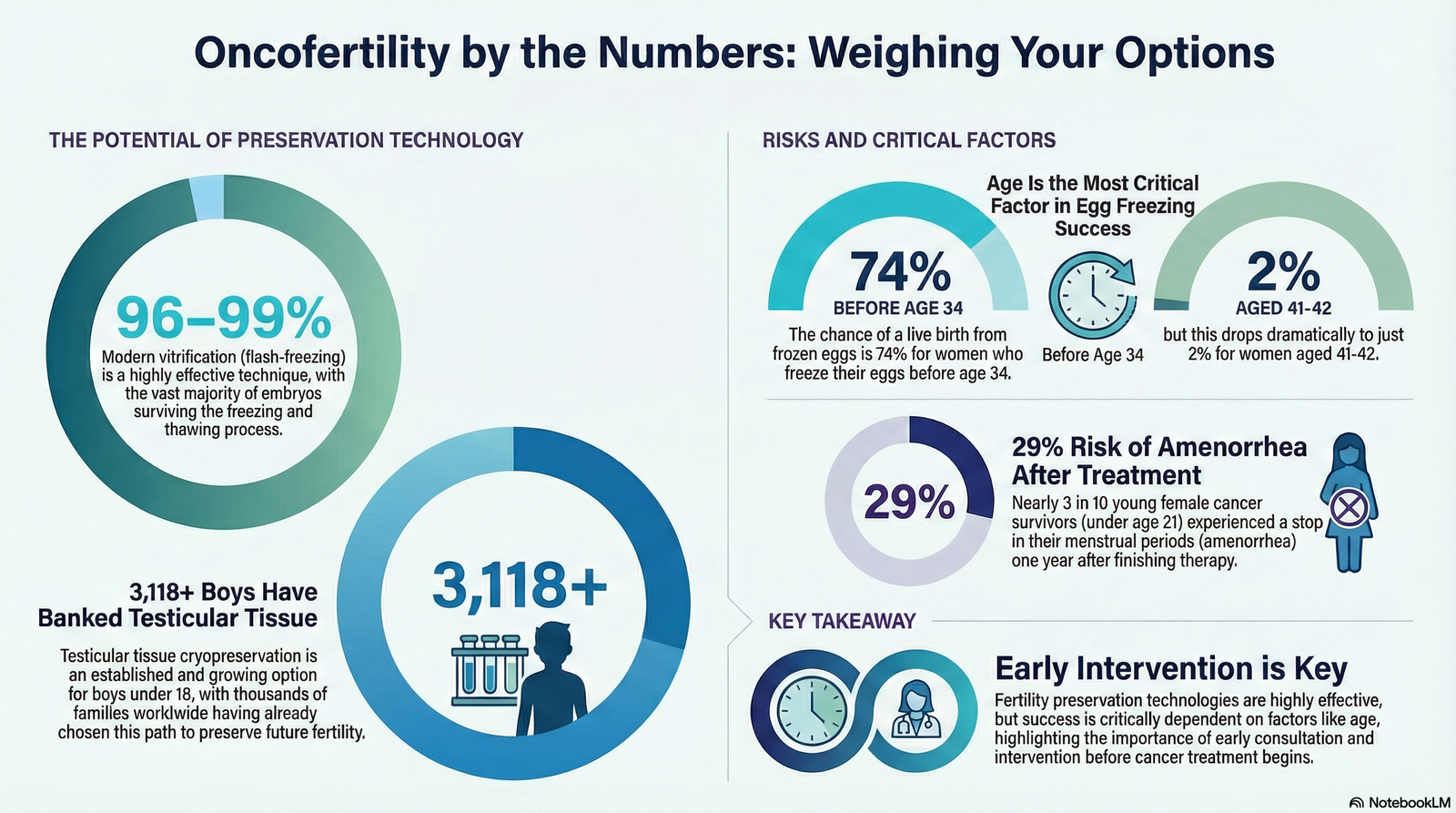
Key oncofertility numbers, including embryo survival, egg freezing success by age, and risk of losing periods after treatment.
Costs and country options for fertility preservation
The high costs of oncology treatment, including bundled services, additional consultations, follow-up care, diagnostic tests, and medications, can be a major barrier to oncofertility care when working within a limited budget. If you don’t have enough money to spend on both cancer treatment and fertility care, it might be hard to buy a fertility preservation package, especially if your country doesn’t help cover the costs of freezing germ cells or reproductive tissue for cancer reasons. This financial burden often comes in tandem with the hidden costs involved in primary targeted cancer treatments and long-term, post-treatment preventive care.
Because money is such a significant barrier, it is not unusual to feel angry or overwhelmed when you see these prices. However, you deserve clear numbers up front and honest guidance regarding your options. This includes exploring available grants, checking for public coverage exceptions, or investigating lower-cost options in other countries if those are realistic paths for you.
Typical cost ranges
The ranges below give you a rough idea of 2024 to 2025 pricing. Your own costs depend on your clinic, medication doses, and any public funding where you live.
| Country or Region | Treatment Type | Typical Cost Range |
|---|---|---|
| United States | Egg freezing (1 cycle, with medications) | $10,000 – $20,000 |
| United States | Embryo freezing (per cycle) | $11,000 – $15,000+ |
| United States | Sperm banking (initial setup) | $1,000 – $4,000 |
| United States | Annual storage (eggs, embryos, or sperm) | $500 – $1,000 per year |
| Czech Republic | IVF with own eggs | €1,970 – €3,680 |
| Czech Republic | Egg freezing bundle | Around €3,100 |
| Czech Republic | Sperm freezing | €230 – €500 |
| Romania | IVF cycle, average cost | Around €3,275 (with vouchers up to about €2,955) |
| Bulgaria | Stimulated IVF cycle | €1,190 – €2,375 (public funding up to about €3,000) |
| Slovenia | Stimulated IVF cycle | €2,000 – €3,969 (up to 6 cycles funded for first child) |
| Croatia | Stimulated IVF cycle | €2,000 – €2,500 (up to 6 cycles covered for citizens) |
| Montenegro | Stimulated IVF cycle | €3,769 – €4,669 |
If these numbers make you feel hopeless, you are not alone. Many people cannot pay these costs from their savings. This is why it is important to ask early about hospital charity funds, national cancer programs, fertility preservation grants, and whether your health insurance or employer benefits include cancer‑related fertility coverage.
What the fertility preservation timeline feels like
Once you decide to explore fertility preservation, the process can progress rapidly. It can feel like starting a second urgent project on top of your cancer care. Knowing the steps in advance can make the process feel a little less chaotic.
Typical egg or embryo freezing timeline
- Consultation (Day 1). You meet a fertility specialist, either in person or by video. You review your diagnosis, treatment plan and family goals, and talk through options such as egg freezing, embryo freezing, or ovarian tissue freezing.
- Testing and screening (Days 1 to 3). You have blood tests, often including AMH and FSH, and a transvaginal ultrasound to count resting follicles on your ovaries. This helps estimate how many eggs you may respond with.
- Planning and decision (Days 3 to 5). Your fertility team and oncology team coordinate dates so that your cancer treatment can start as safely and quickly as possible after preservation. You decide whether to freeze eggs, embryos, or tissue.
- Ovarian stimulation (about 10 to 14 days). You give yourself small hormone injections once or twice a day to grow multiple follicles. You have several short visits for ultrasound and blood work. Many people continue working or studying during this time but feel bloated or tired.
- Egg retrieval (one day). You go to the clinic for a short procedure under light sedation, usually around 15 minutes. The doctor passes a thin needle through the vaginal wall into each follicle and aspirates the fluid so the lab can collect eggs.
- Freezing. Embryologists check your eggs or embryos and then vitrify them. They are moved into storage tanks filled with liquid nitrogen at minus 196 degrees Celsius.
For sperm banking, the process is often much quicker. Many men complete testing and provide one or more samples within a few days of referral. For ovarian or testicular tissue, timing depends on operating room schedules and when your oncologist wants to begin treatment.
Want help comparing oncofertility options and costs?
If it feels like you are trying to plan two treatments at once, your cancer care and your fertility preservation, you are not imagining it. Our advisors can help you collect clear quotes from verified clinics, understand typical success rates for your age, and map out a timeline that fits your oncology plan at no cost to you.

Why trust this guide? The OVU commitment
You are probably juggling hope, timelines, and a lot of tabs open in your browser. And you deserve clear, current, human advice. At OVU, we review clinic protocols, compare real quotes, and talk to people who have done this - intended parents and gestational carriers - so we can give you practical steps, not just theory. If you want help comparing options without sales pressure, we will gather itemized quotes and success data that match your exact situation. You decide, we will bring the info to your table.
Frequently Asked Questions
Does cancer treatment always cause infertility?
No. Many people still conceive after receiving cancer treatment. The risk depends on your age, the type of medication or radiation you receive, the specific dose, and the area of the body being treated. Some regimens carry a high risk of infertility, while others carry a moderate or low risk. Ask your oncologist to explain your personal risk level as clearly as possible and whether fertility preservation is recommended for you.
Is it safe to get pregnant or use frozen eggs or sperm if I have a BRCA mutation?
Large studies of women with breast cancer and BRCA mutations show that pregnancy after treatment does not worsen cancer outcomes when timed safely and cleared by the oncology team. In some analyses, women who became pregnant had better overall survival than those who did not. Use this information as a starting point, then work closely with your oncologist and fertility care specialist to choose the right timing for you.
How long can my eggs, embryos, or sperm stay frozen?
They can stay in storage for many years. There is no strong evidence that quality decreases just because more time has passed in liquid nitrogen. There are reports of healthy children born from sperm that was frozen for more than 20 years. Storage limits are often framed by legal rules or clinic policies, rather than by a known biological time limit.
Will my insurance cover fertility preservation if I have cancer?
Coverage of fertility preservation for medical indications, especially for pre-cancerous conditions and cancer diagnoses, varies widely. Some large employers include these services for patients facing gonadotoxic treatment, and a growing number of U.S. states now mandate at least some coverage for cancer-related care. It is important to review your specific health plan, ask your oncology social worker for guidance, and search for national or local grants that support oncofertility.
Can I still have a family if I have already started chemotherapy?
Once chemotherapy has begun, standard egg retrieval is usually not recommended because of possible genetic damage to the oocytes, as oocyte imprinted genes may already be affected. However, this does not mean your hope for a family is gone. Some people still conceive naturally after completing their cancer treatment, while others build families through donor eggs, donor sperm, gestational surrogacy, adoption, or by using tissue or gametes preserved before oncology-related treatment. A fertility specialist can help you understand which of these specific paths remain open to you.
What happens if I never use my frozen embryos?
In many regions, you can choose to continue storing them, donate them to another patient, donate them to research, or have them thawed and discarded. Because laws and clinic policies differ significantly by country and state, it is essential to review your consent forms carefully and discuss these long-term options with your team before you start the fertility preservation process.
Can a man bank sperm if his count is already very low?
Yes. With ICSI, an embryologist can inject a single healthy sperm into an egg. Even a small number of usable sperm can still give you a chance at pregnancy. That is why doctors often suggest banking whatever sperm can be collected before treatment, instead of waiting to see whether the count will improve later.
Reference List 9 sources
Journal Article (Systematic Review & Meta-Analysis): Fraison E, Huberlant S, Labrune E, Cavalieri M, Montagut M, Brugnon F, Courbiere B. Live birth rate after female fertility preservation for cancer or haematopoietic stem cell transplantation: a systematic review and meta-analysis of the three main techniques; embryo, oocyte and ovarian tissue cryopreservation. Human Reproduction. 2023;38(3):489-502. PMID: 36421038. Available from: https://pubmed.ncbi.nlm.nih.gov/36421038/
Journal Article (Research): Lambertini M, Blondeaux E, Tomasello LM, et al. Pregnancy after breast cancer in young BRCA carriers. JAMA. 2024;331(3):241-254. PMID: 38059899. Available from: https://pubmed.ncbi.nlm.nih.gov/38059899/
Journal Article (Research): Duffin K, Mitchell RT, Wyns C, et al. A 20-year overview of fertility preservation in boys. Human Reproduction Open. 2024;2024(2):hoae010. PMID: 38449521. Available from: https://pubmed.ncbi.nlm.nih.gov/38449521/
Journal Article (Research): Park SJ, Kim J, Kim JY, et al. Risk factors for treatment-related amenorrhea in female pediatric and adolescent cancer survivors after fertility preservation consultation. Journal of Adolescent and Young Adult Oncology. 2024;13(1):67-76. PMID: 38064519. Available from: https://pubmed.ncbi.nlm.nih.gov/38064519/
Journal Article (Qualitative Research): Bayefsky MJ, Anderson D, Rosenberg K, et al. Experiences and intentions of patients undergoing oocyte or embryo cryopreservation for medical reasons. Human Reproduction. 2023;38(12):2440-2450. PMID: 37944107. Available from: https://pubmed.ncbi.nlm.nih.gov/37944107/
Journal Article (Research): Frisch EH, Doering JV, Sangi-Haghpeykar H, et al. Rate of referral to infertility providers among reproductive-aged women with gynecologic cancer. Journal of Clinical Medicine. 2024;13(13):4709. PMID: 39200851. Available from: https://pubmed.ncbi.nlm.nih.gov/39200851/
Journal Article (Systematic Review): Ong C, Chung J, Ko JJ, et al. Interventions to improve oncofertility knowledge and decision-making among patients with low health literacy: a systematic review. Patient Education and Counseling. 2024;117:107828. PMID: 38070299. Available from: https://pubmed.ncbi.nlm.nih.gov/38070299/
Practice Guideline (Guidance): Oktay K, Harvey BE, Partridge AH, et al. Fertility preservation in patients with cancer: ASCO clinical practice guideline update. Journal of Clinical Oncology. 2018;36(19):1994-2001. PMID: 29620997. Available from: https://pubmed.ncbi.nlm.nih.gov/29620997/
Committee Opinion (Guidance): Rodolakis A, Scambia G, Planchamp F, et al. ESGO/ESHRE/ESGE guidelines for the fertility-sparing treatment of patients with endometrial carcinoma. Human Reproduction. 2023;38(7):1174-1193. PMID: 36756380. Available from: https://pubmed.ncbi.nlm.nih.gov/36756380/
Final thoughts
A cancer diagnosis crashes into your life and shatters your sense of a predictable future. It is completely human to feel like you are losing control of your body, your time, and your plans. Wanting to talk about fertility in the middle of all this does not mean you are ignoring the seriousness of your illness. It means you see yourself living beyond it.
Oncofertility will not remove all of the fear and uncertainty, but it gives you something precious. Options. When you explore sperm banking, egg or embryo freezing, or tissue preservation, you are protecting a part of your future that cancer did not ask permission to threaten. You are allowed to do that.
Think of fertility preservation like backing up your most important files before a major repair. Your treatment team does what it needs to do to fight the cancer. At the same time, those eggs, embryos, or sperm sit safely aside, unchanged by the storm your body is going through. The choices you make now are a gift to the future version of you who has finished treatment and is ready to decide what family looks like.