


Dr. Sony Sherpa (MBBS)
In addition to her clinical experience, Dr. Sherpa is a published medical researcher and holistic health advocate. Her dual expertise in emergency care and alternative therapies brings a unique lens to medically reviewed content—ensuring it is both accurate and accessible.
If you feel your life is finally coming together, but your timeline for having children feels completely out of sync, you are not alone. Many people reach their early or mid-30s with a growing career, changing relationships, or a new medical diagnosis, and suddenly realize that their fertility may not wait politely in the background.
We understand how stressful that realization can be. You are making long-term decisions about your body, your money, and your future family, often on a tight timeline. The good news is that in 2026, you have clear, practical ways to protect your fertility, even if pregnancy is still years away.
Large studies now show that if you freeze eggs before 35, your chance of a baby from those eggs is about 52 percent, compared with about 19 percent if you wait until 40. Major medical societies also treat sperm banking, egg freezing, embryo freezing, and ovarian tissue freezing as standard tools, not experimental last resorts. This guide walks you through what those options look like in practice and how to consider timing, costs, and success rates for your situation.
Fertility preservation means freezing eggs, sperm, embryos, or ovarian tissue while they are still healthy, so you can use them later if natural conception is harder. In 2026, egg freezing before 35 can give you around a 50 percent chance of a future baby from those eggs, sperm banking is fast and reliable for men facing cancer treatment or surgery, and embryo freezing offers very high survival rates after thaw. Costs range from about $6,000 to $15,000 per cycle in the United States, with lower prices in parts of Europe.
If you are in your early to mid-30s or facing medical treatment that might harm fertility, now is the right time to speak with a fertility specialist about preservation options.
What the Latest Research Shows
Recent high-quality studies on egg freezing, sperm banking, and fertility preservation in cancer patients give a much clearer picture of real-world outcomes. These findings are based on large meta-analyses, long-term follow-ups, and international guidelines from scientific societies such as ESHRE (European Society of Human Reproduction and Embryology) and ASCO (American Society of Clinical Oncology).
For example, a 2024 analysis of 8,750 women who froze eggs for age-related reasons found an overall live birth rate of about 28 percent when they returned to use those eggs. Women who froze at 35 or younger had about a 52 percent chance of a live birth, compared with about 19 percent for women who froze at 40 or older. Other work shows that freezing 20 or more mature eggs before 38 can give roughly a 70 percent chance of one baby later and that pregnancies using long-stored sperm and embryos are just as safe as those using fresh samples.
These numbers are not promises, but they can help you and your doctor move from vague hope to concrete planning.
In This Guide
- What Fertility Preservation Really Means
- Egg Freezing (Planned OC): Who It Helps and How It Works
- Sperm Banking: Fast Protection for Male Fertility
- Embryo Freezing vs. Egg Freezing
- Oncofertility and Transgender Fertility Preservation
- What Fertility Preservation Costs in 2026
- How Long Eggs and Embryos Last and How You Use Them
- Social vs. Medical Egg Freezing
- How to Choose a Fertility Preservation Clinic
- Insurance, Employer Benefits, and Financing
- Frequently Asked Questions
Egg freezing is most effective before age 35, often in the early 30s.
Egg freezing before 35: ~52 percent live birth chance per patient.
Egg freezing cycle in the United States: about $6,000 to $15,000, plus storage.
What Fertility Preservation Really Means
Fertility preservation is about protecting your ability to have a biological child later, even if your body changes or your situation shifts. You and your doctor focus on saving eggs, sperm, embryos, or ovarian tissue at a time when they are still healthy, then store them in liquid nitrogen until you are ready to try for pregnancy.
For women and people with ovaries, this matters because egg quantity and quality drop with age, especially in the mid-to-late 30s and 40s. For men and people with testes, sperm counts and quality can also fall with age, medications, and illnesses, and some treatments can shut down production completely. Knowing this can feel scary, but it also gives you a clear reason to think ahead.
| Option | What is frozen | Best for |
|---|---|---|
| Egg freezing | Unfertilized eggs | Women who want to protect their own genetic link and do not yet have a partner or chosen sperm donor. |
| Sperm banking | Semen samples | Men facing surgery, cancer treatment, or gender affirming therapy that can damage sperm production. |
| Embryo freezing | Fertilized eggs (embryos) | Couples with a stable partner or those already using a donor. Embryos have very high survival after thawing. |
| Ovarian tissue freezing | Ovarian cortex tissue | Pre pubertal girls and people who cannot wait 2 to 3 weeks for a full stimulation cycle before treatment. |
Latest Research Insights
52 percent vs. 19 percent, age freezing advantage: A large review of egg freezing found that women who froze their eggs at 35 or younger had about a 52 percent chance of having a baby when they later used those eggs. For women who froze eggs at 40 or older, this dropped to about 19 percent. This statistics show how strongly timing shapes your future options. Source: Human Reproduction Update (PMID: 38654466).
70 percent chance, hitting the target egg number: Another major review suggests that freezing 20 or more mature eggs before age 38 can give around a 70 percent chance of one baby later. This helps you and your doctor move from a vague idea of “enough eggs” to a specific target. Source: Reproductive Biomedicine Online (PMID: 37804606).
28 percent overall, realistic big picture: Across 8,750 women who froze eggs for age related reasons, about 28 percent had a baby when they later came back to use them. Success was much higher for those who froze at younger ages. This tells you egg freezing is not a guarantee, but it can clearly improve the odds compared with doing nothing. Source: Human Reproduction Update (PMID: 38654466).
Nearly 80 percent of eggs survive freeze-thaw: In the same analysis, about 79 percent of frozen eggs survived warming in the lab. You do lose some eggs in this process because doctors focus on achieving a solid egg count before freezing. Source: Human Reproduction Update (PMID: 38654466).
These findings come from peer-reviewed research. Your personal results depend on your age, health, and how many eggs you freeze, so it is important to review them with your fertility specialist.
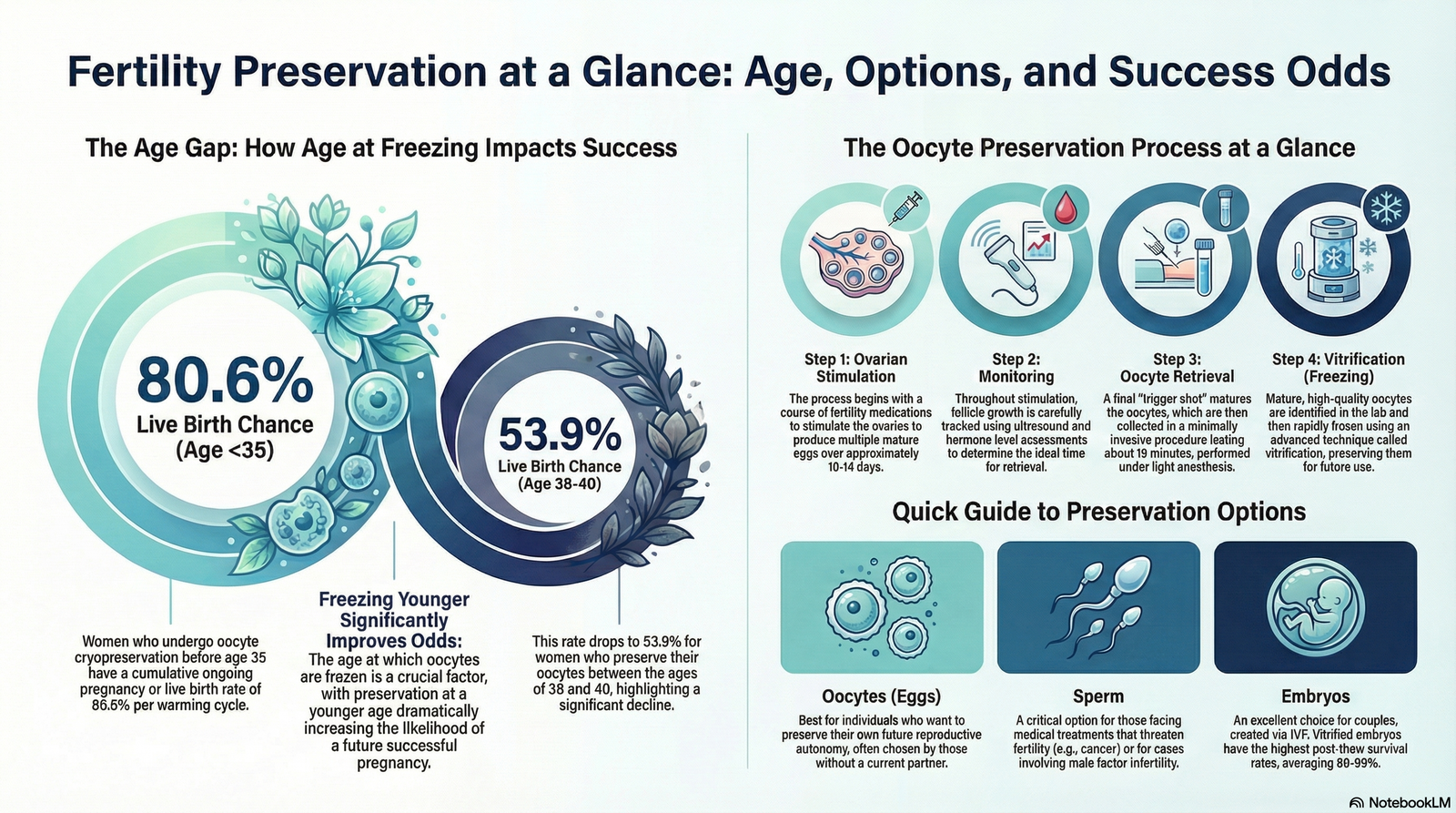
Fertility Preservation at a Glance: Age, Options, and Success Odds
Egg Freezing (Planned OC): Who It Helps and How It Works
Doctors often call elective egg freezing for age-related reasons, Planned Oocyte Cryopreservation (Planned OC). The aim is simple. You store younger eggs now, so you are not fully dependent on older eggs later.
Who Should Think About Egg Freezing?
You may be wondering if 30 is too early to freeze eggs or if 38 is too late. There is no single right answer, but some patterns are clear.
- You are single in your early to mid-30s and don’t want to rush into a relationship.
- You want to focus on work or education for several more years but still care deeply about having a child one day.
- You have medical conditions, such as endometriosis, that can slowly reduce your ovarian reserve.
- You are a transgender man planning hormone therapy or surgery that will stop egg production.
- You want peace of mind and less day-to-day pressure from the feeling that you are running out of time.
It is normal to feel torn between living your life right now and protecting your future. Going through egg freezing will not settle every question, but it can give you more room to breathe.
The Egg Freezing Process Step-by-Step
A typical cycle takes about four to six weeks from the first visit to the day your eggs go into storage.
- Consultation and screening: Your doctor reviews your history and orders blood tests such as AMH and FSH to estimate your ovarian reserve. You also have a transvaginal ultrasound to count antral follicles.
- Ovarian stimulation, 10 to 14 days: You take hormone injections once or twice a day for 10 to 14 days. These medicines encourage many follicles to grow instead of the single one that would mature in a natural cycle.
- Monitoring visits: You come in several times for ultrasounds and blood work. The team tracks how many follicles are growing and adjusts the dose so your eggs mature safely.
- Trigger shot: When follicles reach about 18 to 20 millimeters, you take a final shot, often hCG or a similar medicine, to mature the eggs. Timing is strict, usually down to the hour.
- Egg retrieval: About 34 to 36 hours later, you return for retrieval. Under light anesthesia, your doctor guides a thin needle through the vaginal wall, drains each follicle, and collects the eggs. The procedure usually takes 10 to 20 minutes, and you go home the same day.
- Vitrification: The lab checks which eggs are mature and uses vitrification, a rapid freezing method, to store them in liquid nitrogen. These eggs can stay frozen for many years.
Success Rates by Age and Egg Number
Frozen eggs improve your odds, but they do not erase age. What matters most is your age at the time of freezing and how many mature eggs you store.
- Age 35 or younger: About a 52 percent chance of at least one live birth from your frozen eggs.
- Ages 36 to 39: Success falls gradually. At 37, one analysis showed about a 51.6 percent chance of a live birth with egg freezing compared with about 21.9 percent without fertility preservation.
- Age 40 or older: About a 19 percent chance of a live birth.
- Ages 41 to 42: Around 13.3 percent chance.
Doctors often talk about a “target number” of mature eggs:
- If you are under 38, freezing 20 or more mature eggs can give roughly a 70 percent chance of having one baby later.
- If you are under 35, freezing 8 to 10 mature eggs can already provide a strong chance, but storing more eggs can enhance your safety net.
If all of this data feels like statistics overload, that is normal. A good fertility doctor will run through example scenarios for your age and situation so the numbers feel less abstract.
Sperm Banking: Fast Protection for Male Fertility
Sperm banking is one of the simplest and fastest ways to protect fertility. It is especially important when you have only days or weeks before cancer treatment or surgery.
When Sperm Banking Makes Sense
- Before cancer treatment: Chemotherapy and radiation often damage sperm-producing cells and can cause permanent infertility.
- Before surgery on the testicles or prostate: Some procedures put future fertility at risk, even when they are needed for your health.
- Before vasectomy: Banking sperm first gives you a backup if you later want more children and a reversal does not work.
- Before gender-affirming care: Transgender women are usually advised to bank sperm before starting hormone therapy or having surgery that stops sperm production.
These are often intense periods in your life, and fertility may not feel like the top priority. Thinking about your future self for one afternoon can still can protect options you may be glad to have later.
How Sperm Banking Works and Survival Rates
- You give a semen sample in a private room at the clinic or sperm bank.
- The lab checks sperm count, movement, and shape.
- The sample is mixed with a protective solution and frozen in liquid nitrogen.
Sperm can be frozen with two main approaches:
- Slow freezing, where survival after thawing is around 76 percent to 84 percent.
- Vitrification, where survival often reaches 92 percent to 98 percent.
Even though between 20 percent and 75 percent of individual sperm cells may not survive freezing and thawing, modern IVF procedures need very few sperm. With ICSI, one healthy sperm is enough for each egg.
More Evidence on Safety and Long-Term Outcomes
Ten-year follow-up, real-life results: A long-term study of women who froze eggs and later tried for pregnancy showed that egg freezing can lead to healthy live births many years after storage. This means you are not racing against a short storage clock once your eggs are frozen. Source: Human Reproduction (PMID: 38145619).
All main methods work in cancer patients: A review of fertility preservation for women facing cancer or stem cell transplant found that embryo freezing, egg freezing, and ovarian tissue freezing all resulted in live births. This confirms that you usually have more than one valid option, even in urgent settings. Source: Human Reproduction (PMID: 36421038).
Two-hundred twenty one thousand IVF cycles, age, and egg number together: A large study of more than 221,000 IVF cycles showed that the “ideal” egg number for a strong live birth chance depends heavily on age. Younger women reach high success with fewer eggs, while older women usually need more eggs per cycle. This helps explain why your doctor focuses on egg numbers differently at 30 than at 40. Source: Human Reproduction (PMID: 31398253).
Fifteen years of sperm banking, reassuring safety: A 15-year regional report on sperm banking for cancer patients found that pregnancies from frozen-thawed sperm were safely achieved, with healthy children and good outcomes. This supports sperm banking as a standard, not experimental, step. Source: Fertility and Sterility (PMID: 33401381).
Clear pathways from international guidelines: The ESHRE guideline on female fertility preservation outlines who should be offered egg, embryo, or ovarian tissue freezing and how to organize care and counseling. You should expect your team to follow structured, evidence-based steps, not guesswork. Source: Human Reproduction Open (PMID: 33225079).
Standard of care in oncology: An updated ASCO guideline states that sperm banking, egg and embryo freezing, and sometimes ovarian tissue freezing should be discussed and offered quickly to people whose cancer treatment may harm fertility. Fertility preservation is now part of standard cancer care, not an optional extra. Source: ASCO Fertility Preservation Guideline Update.
Together, these findings and guidelines show that fertility preservation is now a well-established field. Your main task is to choose the approach and timing that match your life and health.
Embryo Freezing vs. Egg Freezing
If you have a partner or a chosen sperm donor, you can decide between freezing eggs or embryos. The stimulation and retrieval steps are the same. The difference is whether the eggs are fertilized before freezing.
When Embryo Freezing Fits Better
- Very high survival after thaw: With modern vitrification, about 96 percent to 99 percent of embryos survive thawing in many labs.
- You see which embryos develop: The lab can grow embryos for several days and freeze only those that reach strong stages, such as a blastocyst.
When Egg Freezing Fits Better
- More control over future decisions: Eggs remain yours alone. If a relationship ends, you still decide how to use them.
- Flexibility about future partner or donor: You do not have to choose that person now.
There is no universal right answer here. If you worry about legal or emotional questions with embryos, egg freezing can feel safer. If you want the slightly higher lab predictability that comes with embryos, embryo freezing may feel steadier.
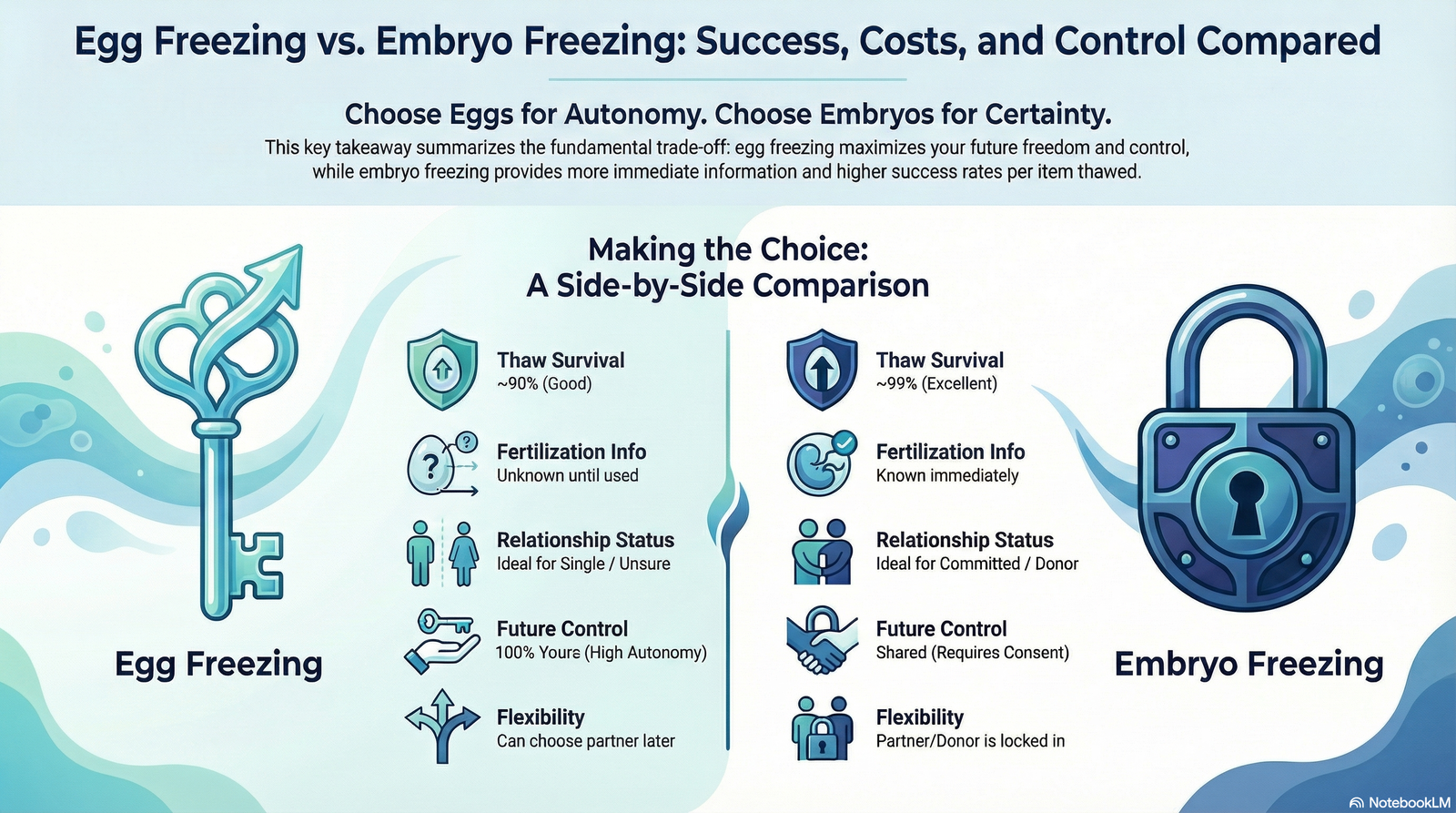
Egg Freezing vs. Embryo Freezing: Success, Costs, and Control Compared
Oncofertility and Transgender Fertility Preservation
When you face cancer or other serious illnesses, the last thing you want is more decisions. Yet fertility treatment often has to start quickly, before chemotherapy, radiation, or surgery. Oncofertility brings oncology and reproductive medicine together to protect your options in this window.
Oncofertility for People With Ovaries
- Random start stimulation. Your doctor does not need to wait for day 1 of your cycle. They can start medicines at almost any point, which saves time when treatment cannot wait.
- Ovarian tissue freezing. In a short surgery, a small piece of ovarian cortex is removed and frozen. After treatment, this tissue can be transplanted back. Studies report that ovarian function comes back in up to 95 percent of cases after transplantation, and many pregnancies have followed.
Both steps can feel like a lot to add to an already heavy moment. Many people say later that they are grateful someone on the team pushed the fertility conversation early, even if it felt tiring at the time.
Transgender Fertility Preservation
- Transgender men can freeze eggs or embryos before taking testosterone or having surgery that removes the ovaries or uterus.
- Transgender women can bank sperm before starting estrogen or puberty blockers and before genital surgery.
These choices can stir up complex feelings. You may feel strongly about moving forward with gender affirming care and, at the same time, feel unsure about whether you want children later. That tension is normal. Talking with a fertility specialist who has real experience with transgender patients can help you make decisions you will feel at peace with years from now.
What Fertility Preservation Costs in 2026
Cost is often the biggest practical barrier to egg freezing, embryo freezing, or sperm banking. Prices vary by country and clinic, but the ranges below give a realistic sense of what you might face.
Typical Costs in the United States
- Egg freezing cycle: around $6,000 to $15,000 per cycle. This often includes monitoring and retrieval, but medication costs can push totals higher.
- Embryo freezing: similar base costs as egg freezing, plus fertilization and embryo culture fees.
- Annual storage: usually $500 to $1,000 per year for eggs or embryos.
- Cost per extra live birth: for planned OC at age 37, one analysis estimated a “cost per additional live birth” of about $28,759 compared with not freezing eggs.
Costs in Parts of Southeastern Europe (2024 to 2026)
Some people travel abroad for fertility preservation to reduce costs while still receiving careful medical care.
- Romania: egg vitrification bundles are available starting at 1,400 to 1,500 EUR per cycle.
- Bulgaria: stimulated egg freezing cycles cost from 1,500 to 1,600 EUR.
- Greece: egg freezing packages, including 12 months of storage, cost around 2,225 to 2,500 EUR.
- Sperm freezing: often 200 to 500 EUR, including an initial 12-month period of storage.
| Region | Service | Typical cost range |
|---|---|---|
| United States | Egg freezing cycle | $6,000 to $15,000 |
| United States | Annual storage | $500 to $1,000 per year |
| Romania | Egg vitrification | 1,400 to 1,500 EUR |
| Bulgaria | Stimulated egg freezing | 1,500 to 1,600 EUR |
| Greece | Egg freezing bundle with 12 months storage | 2,225 to 2,500 EUR |
| Southeastern Europe | Sperm freezing and storage | 200 to 500 EUR |
How Long Eggs and Embryos Last and How You Use Them
Storage Duration
Long-term data show that frozen eggs and embryos can lead to healthy pregnancies even when they have been stored for 10 years or more. Within these time frames, storage itself does not appear to harm quality. Many countries set legal storage limits, but those are policy choices, not strict biological limits.
What Happens When You Use Frozen Eggs?
When you are ready to try for pregnancy, you return to the clinic that stores your eggs or transfer them to another clinic.
- The lab thaws your eggs and notes how many survive.
- An embryologist performs ICSI (Intracytoplasmic Sperm Injection), injecting a single sperm into each mature egg.
- Fertilized eggs develop into embryos over several days.
- One or sometimes two embryos are transferred to your uterus in a short procedure.
Across large studies, typical lab outcomes look like this:
- Egg survival after warming: about 79 percent to 85 percent.
- Fertilization rate: around 75 percent of surviving eggs form embryos in women who froze eggs up to about 38.
Your exact numbers depend on your age at freezing, the number of eggs you stored, the clinic’s lab quality, and your health at the time of transfer.
Social vs. Medical Egg Freezing
Different countries frame egg freezing in very different ways.
- In Israel, national committees often treat age-related fertility decline as a medical issue. In some situations, the state helps pay for egg freezing as a preventive step.
- In the United States and much of Europe, egg freezing for age-related reasons is usually labeled “elective” or “social,” so public insurance rarely covers it.
The result is that two people with similar fertility risks can have very different access and costs based only on where they live. Many families end up paying out of pocket for egg freezing during medical crises such as cancer, even when everyone agrees that fertility matters deeply to them.
How to Choose a Fertility Preservation Clinic
Clinic websites and social media can look polished and persuasive, so it helps to focus on a few concrete checks.
- Ask for real numbers. In the United States, look up SART or CDC reports. When possible, focus on live birth rates from warmed eggs or embryos, not just retrieval counts.
- Check lab experience. Ask how many egg freezing cycles the clinic handles each year and who performs vitrification and warming. These steps are skill-based.
- Look for a track record with frozen eggs. Clinics that show pregnancies and births from frozen eggs are more reassuring than those that only highlight fresh cycles.
- Notice how the staff speak to you. You deserve clear explanations and honest answers. If you feel rushed, dismissed, or pushed toward a single option, take that seriously.
Choosing a clinic is not about finding the flashiest brand. It is about trusting a team with something as personal as your future family.
Insurance, Employer Benefits, and Financing
Paying for fertility preservation can feel like a second full-time job. The more you know about your options, the less alone you feel in that process.
- Employer fertility benefits. Some large employers now offer fertility packages that cover IVF, and sometimes egg freezing, up to around $20,000 or more.
- Growing, but uneven, insurance coverage. In some insurance networks, coverage for planned OC has increased sharply since 2017, though coverage still depends heavily on where you live and which plan you have.
- Clinic payment plans. Many clinics work with financing companies or offer in-house payment plans that spread costs over time, often for overall treatment paths in the $15,000 to $20,000 range.
- Crowdfunding. People increasingly use crowdfunding platforms. For cancer-related fertility preservation, campaigns often raise around $6,390 on average.
We know it can feel unfair to negotiate coverage while also dealing with cancer risk, gender dysphoria, or age pressure. You deserve a financial plan that honors the emotional weight of what you are going through, not just a bill.
Want help comparing clinics and costs?
If researching all of this feels like its own part-time job, our advisors can collect clear, itemized quotes from verified clinics and help you map out a timeline that matches your age, budget, and personal plans.

Why trust this guide? The OVU commitment
You are probably juggling hope, timelines, and a lot of tabs open in your browser. And you deserve clear, current, human advice. At OVU, we review clinic protocols, compare real quotes, and talk to people who have done this - intended parents and gestational carriers - so we can give you practical steps, not just theory. If you want help comparing options without sales pressure, we will gather itemized quotes and success data that match your exact situation. You decide, we will bring the info to your table.
Frequently Asked Questions
What is the best age to freeze my eggs?
You get the strongest benefit if you freeze eggs before 35, and often in your early 30s. Freezing before 35 can give you roughly a 52 percent chance of a future baby from those eggs. Waiting until 40 drops that chance to around 19 percent. That does not mean freezing later is pointless. It means that earlier freezing buys you more security per egg stored.
How much does fertility preservation cost each year?
An egg freezing cycle usually costs about $6,000 to $15,000 in the United States. After that, you pay yearly storage fees, often between $500 and $1,000. If you travel to Europe, cycle costs can be closer to 1,400 to 2,500 EUR, but you still need to factor in travel and time away from home.
Does egg freezing reduce my natural fertility now?
No. Each month, your ovaries recruit a group of follicles, but usually only one egg ovulates and the others fade away. Stimulation medicines rescue eggs your body would have lost that month anyway. You are not taking eggs from future cycles.
How long can eggs and embryos stay frozen?
Study data and clinic experience show that eggs and embryos can remain frozen for at least 10 to 15 years and still lead to healthy pregnancies. There is no sign that quality slowly declines while they are in storage. Legal time limits, if they exist where you live, come from law and policy, not from lab limits.
Does thawing damage egg quality?
Modern vitrification techniques give about a 90 percent survival rate in many labs. Some eggs do not make it through thawing, but those that survive behave much like they did on the day they were frozen. This is why doctors focus on reaching a healthy egg count before freezing.
What if I never use my frozen eggs?
Most people who freeze eggs do not come back to use them, at least in the first years of follow-up. That number often quoted as around 90 percent is likely to change as more people reach the ages when they want to use their eggs. You will eventually decide whether to keep paying for storage, donate eggs to research, discard them, or explore donation to another person if your clinic allows it.
Do people regret freezing their eggs?
In a study of 201 women, about 49 percent reported some level of regret. Many said they wished they had frozen eggs earlier or had stored more eggs. Others felt they did not get enough emotional support or clear counseling. That does not mean egg freezing was the wrong choice. It means good information and emotional support matter just as much as the procedure itself.
Reference List 8 sources
Journal Article (Systematic Review & Meta-Analysis): Hirsch A, Hirsh Raccah B, Rotem R, Hyman JH, Ben-Ami I, Tsafrir A. Planned oocyte cryopreservation: a systematic review and meta-regression analysis. Human Reproduction Update. 2024;30(5):558–568. PMID: 38654466. Available from: https://pubmed.ncbi.nlm.nih.gov/38654466/
Journal Article (Review): Cascante SD, Berkeley AS, Licciardi F, et al. Planned oocyte cryopreservation: the state of the ART. Reproductive Biomedicine Online. 2023;47(6):103367. PMID: 37804606. Available from: https://pubmed.ncbi.nlm.nih.gov/37804606/
Journal Article (Systematic Review & Meta-Analysis): Fraison E, Huberlant S, Labrune E, et al. Live birth rate after female fertility preservation for cancer or haematopoietic stem cell transplantation: a systematic review and meta-analysis of the three main techniques; embryo, oocyte and ovarian tissue cryopreservation. Human Reproduction. 2023;38(3):489–502. PMID: 36421038. Available from: https://pubmed.ncbi.nlm.nih.gov/36421038/
Journal Article (Research): Law YJ, Zhang N, Venetis CA, Chambers GM, Harris K. The number of oocytes associated with maximum cumulative live birth rates per aspiration depends on female age: a population study of 221,221 treatment cycles. Human Reproduction. 2019;34(9):1778–1787. PMID: 31398253. Available from: https://pubmed.ncbi.nlm.nih.gov/31398253/
Journal Article (Research): Loreti S, Darici E, Nekkebroeck J, et al. A 10-year follow-up of reproductive outcomes in women attempting motherhood after elective oocyte cryopreservation. Human Reproduction. 2024;39(2):355–363. PMID: 38145619. Available from: https://pubmed.ncbi.nlm.nih.gov/38145619/
Journal Article (Research): [Authors]. Fifteen year regional center experience in sperm banking for oncology patients. Fertility and Sterility. 2021;[Volume(Issue)]:[Pages]. PMID: 33401381. Available from: https://pubmed.ncbi.nlm.nih.gov/33401381/
Committee Opinion (Guidance): Peccatori FA, et al. ESHRE guideline: female fertility preservation. Human Reproduction Open. 2020;2020(4):hoaa052. PMID: 33225079. Available from: https://pubmed.ncbi.nlm.nih.gov/33225079/
Committee Opinion (Guidance): Oktay K, Loren AW, et al. Fertility Preservation in People With Cancer: ASCO Guideline Update. Journal of Clinical Oncology. 2024;[Volume(Issue)]:[Pages]. Available from: https://ascopubs.org/doi/10.1200/JCO-24-02782
Final Thoughts
Preserving your fertility is not a promise of a baby, but it is a concrete way to protect your options. If you act in your early to mid-30s, you stack the odds in your favor. Even if you are older or facing urgent medical treatment, there are still meaningful steps you can take.
You do not have to rush into a decision. Start by understanding what is realistic for your age, your health, and your budget. Talk with a fertility specialist you trust, ask all your questions, and give yourself permission to care about both your present life and your future family at the same time.
Think of fertility preservation like storing the detailed plans and key materials for a house that matters deeply to you. You hope you will never need to rebuild. If life takes an unexpected turn, you will be glad you took the time to keep those plans and pieces safe.