

IVF & Pregnancy Risks

Dr. Sony Sherpa (MBBS)
In addition to her clinical experience, Dr. Sherpa is a published medical researcher and holistic health advocate. Her dual expertise in emergency care and alternative therapies brings a unique lens to medically reviewed content—ensuring it is both accurate and accessible.
Congratulations. You have pushed through tests, injections, scans, and waiting, and now those two lines on your pregnancy test are real. You are pregnant. This is a huge moment, and it is okay if it feels both joyful and a little unreal. Maybe you are carrying a tiny embryo the size of a poppy seed with a brand new heartbeat, or maybe you are already feeling the strong kicks of a coconut-sized baby in your third trimester. Either way, this pregnancy is hard-won and deeply personal.
If you notice a new wave of pregnancy after infertility anxiety, you are not alone. Many people in your position worry about every twinge and feel unsettled by all the extra appointments on the calendar. You might be asking yourself why your IVF pregnancy is called high-risk and why your team is monitoring your case so closely for early labor.
Most babies conceived with Assisted Reproductive Technology are born healthy and at term. At the same time, IVF pregnancies carry a higher risk of preterm birth, which means delivery before 37 weeks of pregnancy. Understanding why this happens is not about scaring you. It is about giving you clear information so you can work with your doctors and nurses and feel more in control of what comes next.
Compared with natural conception, babies conceived with IVF are about twice as likely to be born early. Most of that extra risk comes from twin and triplet pregnancies, plus several other factors like blood pressure problems, uterine conditions, and how many embryos you transfer.
Some known effective strategies to lower your risks of preterm delivery include choosing single embryo transfer, tracking your cervical length, monitoring your blood pressure, and planning your delivery timing around 39 weeks with your obstetric team.
What the latest research shows
Large studies following millions of pregnancies confirm that IVF singletons have a higher rate of preterm birth than naturally conceived singletons. The risk is highest with twins and higher order pregnancies, fresh embryo transfers, thin uterine lining, and conditions like PCOS, endometriosis, or pregnancy high blood pressure.
The same research also shows that many of these risks are manageable. Single embryo transfer, frozen embryo transfer, careful blood pressure and blood sugar control, cervical length checks, and low-dose aspirin in selected patients all help reduce the risk of your baby arriving too soon.
In This Guide
- The Big Picture: How IVF Affects Preterm Birth Risk
- Why Twins and Triplets Change the Timeline
- How Your Fertility Diagnosis and Health Play a Role
- IVF Lab Choices That Influence When You Deliver
- Placenta and Hormone Factors Behind Early Birth
- How Doctors Monitor and Reduce Your Risk
- Managing Anxiety When You Know the Statistics
- Fetal Development Milestones and When to Worry
- Frequently Asked Questions
IVF singletons: about 2x higher risk of early delivery than natural conception.
About 70 to 75 percent of extra preterm births after ART come from twins and triplets.
For stable IVF singletons, delivery at 39 weeks gives the lowest combined risk for mother and baby.
The Big Picture: How IVF Changes Preterm Birth Risk
When you conceived with IVF, someone on your team probably told you that your pregnancy would be watched more closely. That is not because something is already wrong. It is because big population studies show clear patterns that your doctors want to get ahead of.
Across more than 16 million pregnancies, single babies conceived with IVF or ICSI are roughly twice as likely to be born before 37 weeks as babies conceived without treatment. The risk is even higher for a very early birth before 32 weeks. At the same time, most IVF singletons still reach term, especially when clinics focus on one healthy baby at a time and provide careful pregnancy care.
Latest research insights
About 2x higher risk, the big picture: A review of multiple meta-analyses, covering more than 16 million pregnancies, found that single IVF or ICSI babies have about double the risk of preterm birth compared with naturally conceived babies. Very early births (before 32 weeks) are also more frequent, especially after fresh embryo transfers. This is why your team treats an IVF pregnancy as higher risk and builds in extra monitoring from the start. Source: American Journal of Obstetrics and Gynecology (PMID: 38796038).
28% vs. 11%, the fertility treatment tradeoff: A large study of United States births found that about 11 in 100 babies conceived without treatment were born early, compared with roughly 28 in 100 after IVF or other fertility treatment. When researchers looked only at singletons, the difference narrowed but remained real. This helps you see that treatment itself adds some risk, but a large part comes from twins and triplets, which you and your clinic can actively work to avoid. Source: F&S Reports (PMID: 37719103).
Most extra risk from twins, why one embryo matters: The same work showed that about 70 percent of the extra preterm births after fertility treatment were explained by multiple pregnancies. As more clinics moved to single embryo transfer, preterm birth rates after IVF dropped from roughly one in three cycles to about one in four. Choosing single embryo transfer when it is safe for you is one of the strongest choices you can make to protect a future baby. Source: F&S Reports (PMID: 37719103).
39 weeks, safest delivery window: A study of more than 178,000 term pregnancies conceived with infertility treatment found that delivering at 39 weeks gave the lowest combined risk of stillbirth, serious newborn problems, and infant death. Delivering earlier or waiting longer both raised the overall risk. This gives you and your obstetrician a clear target week to plan around, as long as your pregnancy stays stable. Source: JAMA Network Open (PMID: 37566418).
These findings come from peer-reviewed research. Your own risk depends on your age, health, fertility diagnosis, and how your clinic structures your IVF cycle. Bring these numbers to your doctor and ask how they apply to you.
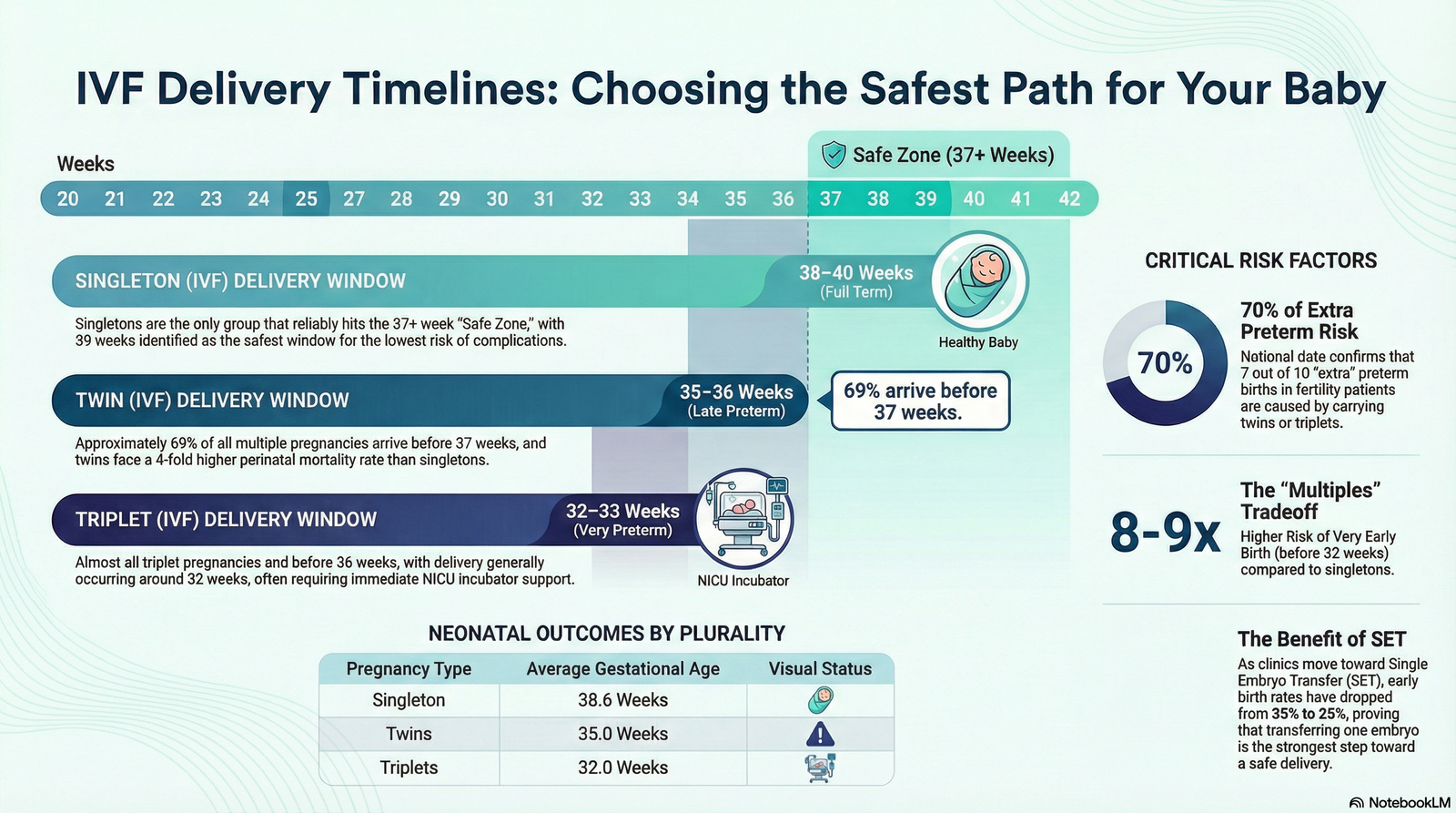
Preterm birth patterns after IVF: singletons, twins, and triplets.
| Pregnancy Type | Typical Delivery Week | Chance of Preterm Birth |
|---|---|---|
| Singleton (IVF) | 38 to 40 weeks | Higher than natural, about double overall |
| Twins (IVF) | 35 to 36 weeks | Around 69 percent deliver before 37 weeks |
| Triplets (IVF) | 32 to 33 weeks | Very high, most arrive well before term |
Why Twins and Triplets Change the Timeline
If you are pregnant with twins after IVF and you feel nervous, that reaction is normal. Twin and higher-order pregnancies are the single biggest reason preterm birth is more common in the fertility world. Many couples once felt pressure to transfer two embryos to boost their chances. Now we know that the real tradeoff is a much higher risk of early delivery.
The explanation is mostly technical. As the number of babies increases, the average length of pregnancy drops. On average, singletons reach about 38.6 to 40 weeks, twins often deliver prematurely at around 35 to 36 weeks, triplets usually deliver around 32 to 33 weeks, and quadruplets often deliver by 30 weeks. The uterus stretches more and earlier with each additional baby. The placenta or placentas also work harder to support extra growth. As a result, the majority of multiple pregnancies end before 37 weeks.
Twinning also raises the risk of complications linked to prematurity. Compared with a single baby, twins have about ten times the risk of cerebral palsy and about three times the risk of newborn death. These differences mostly come back to the higher rates of early birth and low birth weight.
The “Vanishing Twin” Effect
You might have started with two embryos and then learned early in the first trimester that only one kept growing. That is called vanishing twin syndrome. Even if you now carry a single baby, that early twin can still leave a mark. Babies who started as part of a multiple pregnancy but ended as singletons have higher rates of low birth weight and preterm birth than babies who started and stayed as singletons.
Because of this, many fertility clinics and obstetricians watch IVF singletons more closely when they know there was a second embryo early on, even if that embryo stopped growing very early.
How Your Fertility Diagnosis and Health Shape Your Risk
People often ask whether it is the IVF itself that raises preterm birth risk or the reason they needed IVF in the first place. Researchers have spent years trying to untangle this question. The answer is that both matter. The treatment has some effect, and so do your personal health history and fertility diagnosis.
The “Healthy Tubes” Clue
There is an important pattern that shows up when doctors look closely at who needs IVF. In couples whose only issue is blocked fallopian tubes, and who otherwise have a healthy body weight, no PCOS, and no endometriosis, the extra risk of preterm birth is much smaller. In some studies, this group looks very similar to people who conceived without ART.
This tells us that your baseline health and fertility diagnosis play a big role in how your pregnancy unfolds. IVF is not a simple on and off switch for risk. It is one piece of a larger picture.
What drives IVF preterm birth in the real world
Risk disappears in low-risk couples, the healthy tubes clue: In a cohort of nearly 9,500 IVF singletons compared with almost two million naturally conceived babies, early birth and low birth weight were more common after IVF overall. When researchers focused only on couples with normal body weight and no PCOS, endometriosis, uterine problems, or sperm issues, most of the extra risk faded. If your only barrier was blocked tubes and you are otherwise healthy, your baby’s chance of being born on time may be quite close to that of natural conceptions. Source: Scientific Reports (PMID: 35296798).
23 percent preterm, when several risks combine: In a smaller study of ART singletons, about 24 in 100 pregnancies ended preterm. Transferring more than one embryo, pregnancy-related high blood pressure, PCOS, scarring in the uterus, and water breaking early were the key triggers. The authors built a simple risk score to flag higher-risk IVF pregnancies early so doctors can add cervical checks and offer treatments like progesterone or a cervical stitch. Source: BMC Pregnancy and Childbirth (PMID: 41057779).
Your own risk profile depends on your age, diagnosis, body weight, and pregnancy history. Bring your full story to your doctor and ask them to walk you through which parts of this research match your situation.
Key Risk Indicators You Should Know About
- PCOS and endometriosis: Both conditions raise the chance of early labor and other complications. For example, women with ovarian endometriomas have close to double the risk of preterm birth compared with women without them.
- Maternal age and first pregnancy: Being over 35 or 40 and being pregnant for the first time both raise risk. In some data, age has a stronger impact on natural conceptions than in ART pregnancies, likely because IVF patients get more intense early monitoring.
- Body mass index: A body mass index over 25, and especially over 30, increases the risk of very early preterm birth under 32 weeks. The risk is higher if you are carrying twins.
- Time to pregnancy: Couples who take more than 12 cycles to conceive, even without treatment, have higher rates of preterm birth and placenta problems. Long-standing subfertility matters, even when IVF is not used.
IVF Lab Choices That Influence When You Deliver
Every major decision in an IVF cycle can nudge your risk up or down. That includes how many embryos you want to transfer, whether you use fresh or frozen embryos, how long the embryos grow in the lab, and what your hormone levels look like around the time of transfer.
Fresh Versus Frozen Embryo Transfers
One of the biggest shifts in modern IVF is the move toward frozen embryo transfer. Many large studies show that babies from frozen transfers have lower rates of preterm birth and low birth weight than those from fresh transfers.
- Fresh transfers: These transfers happen in the same cycle as ovarian stimulation. Hormone levels are very high. That environment can affect how and where the placenta implants in the uterus and can raise the chance of preeclampsia and growth restriction.
- Frozen transfers: These transfers happen after your body has had time to return to a more natural hormonal state. That pause lets your uterus recover and respond more as it does in a spontaneous cycle. For many patients, this leads to better birth outcomes.
Blastocyst Versus Cleavage Stage Transfers
Transferring embryos at the blastocyst stage, day 5 or 6, often gives higher implantation and live birth rates than transferring earlier-stage embryos on day 2 or 3, called cleavage-stage transfers. This is one reason so many clinics prefer blastocyst transfer.
Some large data sets show a slightly higher rate of preterm birth after blastocyst transfer compared with the cleavage stage. One theory is that longer culture in the lab affects the cells that later form the placenta. That shift might alter how the placenta works and how long the pregnancy lasts.
Why Endometrial Thickness Matters
Your uterine lining is another key part of the story. At the time of the HCG trigger, an endometrial thickness under about 7.5 millimeters is linked to a roughly twofold higher risk that your baby will be small for gestational age and that you will deliver early.
If your lining was on the thin side, your obstetrician may schedule more growth scans to track your baby’s size and blood flow to the placenta. This does not mean that something is already wrong, but it is a reason to watch more closely.
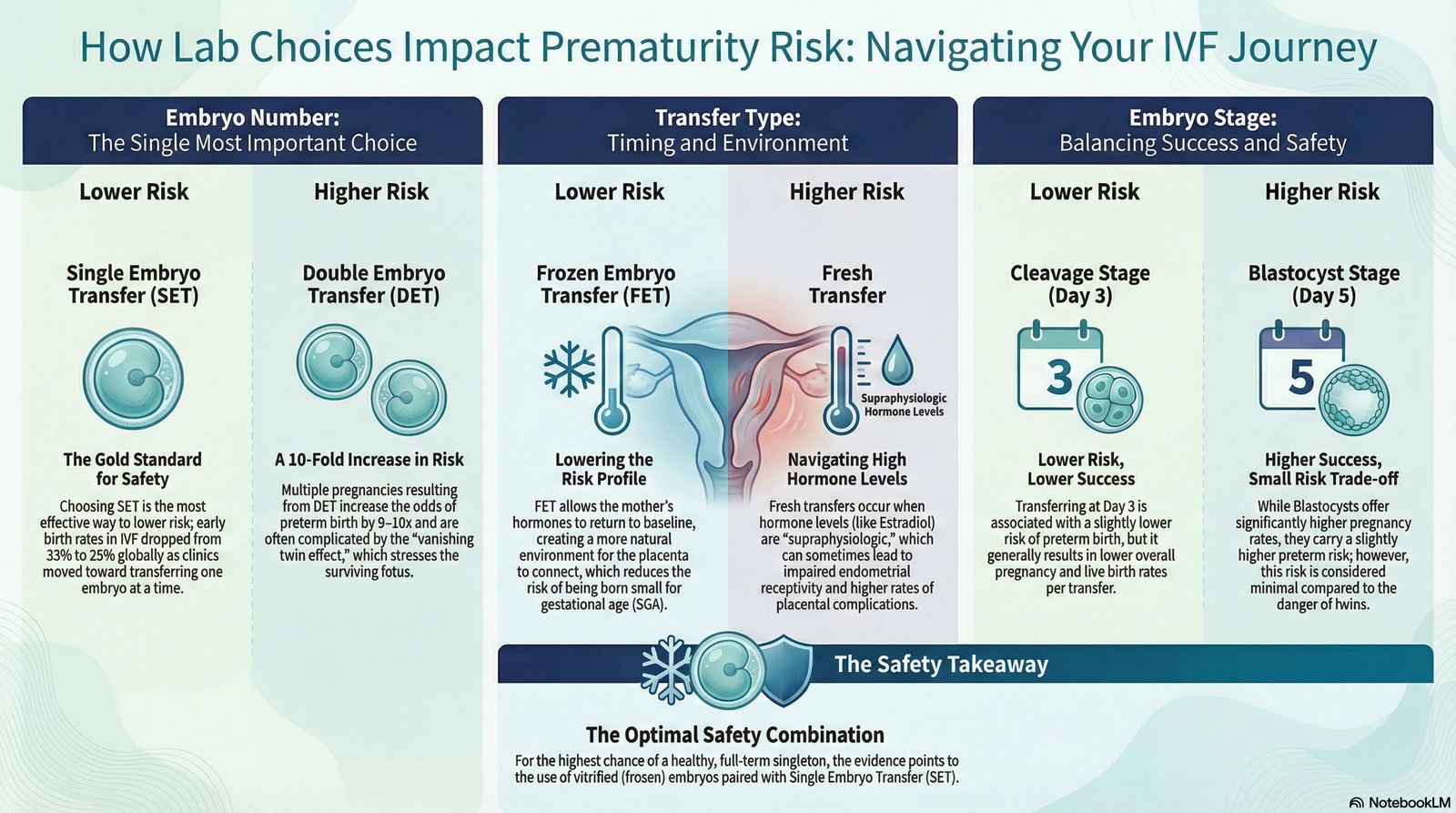
How fresh versus frozen transfers and embryo stage can influence preterm birth risk.
| IVF Decision Point | Option | Impact on Preterm Birth Risk |
|---|---|---|
| Number of embryos | Single embryo transfer | Lowest risk of preemie newborn as transferring one embryo avoids twin-driven prematurity |
| Number of embryos | Transfer of two embryos | Raises risk through possibility of conceiving IVF twins and “vanishing twin” syndrome effects |
| Embryo type | Fresh transfer | Higher risk is shown in many studies due to higher hormonal levels and placental changes |
| Embryo type | Frozen transfer | Often closer to natural conception, birth outcomes |
Placenta and Hormone Patterns Behind Early Birth
Sometimes the reason a baby comes early sits deep in the placenta or uterine environment, far from anything you can see or feel. IVF pregnancies give doctors a close look at several patterns that show up more often after treatment.
Ischemic Placental Disease
Doctors use the phrase ischemic placental disease to capture several conditions, including preeclampsia, placental abruption, and intrauterine growth restriction. All of these share a common thread. The placenta does not get or give enough blood flow.
- Spiral artery remodeling: Early in pregnancy, uterine arteries transform to allow more blood to flow to the placenta. If this remodeling is shallow or incomplete, the placenta can struggle. IVF pregnancies show higher rates of both early and later versions of these placenta problems.
- High estradiol levels: When estradiol peaks above a certain level on the trigger day, studies link this to higher rates of preeclampsia and growth-restricted babies. High estradiol is common in strong ovarian responses.
Silent Infection and Inflammation in the Lining
The inner lining of the uterus, the endometrium, can carry low-grade infection or inflammation without causing obvious symptoms. When endotoxin levels in menstrual fluid rise above a certain threshold, pregnancy is less likely to occur and more likely to miscarry when it does.
Those same inflammatory signals can trigger a chain of events that lead to contractions, cervical change, and early delivery. This is one reason doctors pay attention to any history of pelvic infection, chronic endometritis, or procedures that might have changed the lining.
The Role of Relaxin
During a stimulated IVF cycle, your ovaries may form several corpora lutea, not just one. These structures release relaxin, a hormone that helps soften collagen in the cervix and pelvic ligaments to prepare for labor.
Higher early relaxin levels can soften tissues sooner than ideal. Some studies connect this pattern with a higher chance of preterm birth. This does not mean relaxin is harmful, but it is one more reason to respect how powerful a stimulated cycle can be on your body.
Blood pressure and placenta links you should discuss
One in five extra preterm births, blood pressure link in frozen transfers: A large Nordic registry study showed that babies from frozen embryo transfers were more likely to be born early than naturally conceived babies. About one in five of these extra early births after frozen transfers could be traced back to pregnancy, high blood pressure, and related placenta problems. If you conceived from a frozen transfer, early blood pressure checks and, when appropriate, low-dose aspirin are practical ways to cut your risk. Source: Human Reproduction (PMID: 39656847).
Official guidance, why singletons are the goal: A major opinion from a leading obstetric group confirms that even singletons conceived with IVF have higher chances of preterm birth, low birth weight, and placenta problems than naturally conceived singletons. The same document stresses that the greatest danger comes from twins and higher-order multiples. This is why your clinic pushes for single embryo transfer even when you are eager to stack the odds. Source: Obstetrics and Gynecology, Committee Opinion on perinatal risks with assisted reproductive technology.
How Doctors Monitor and Reduce Your Preterm Birth Risk
Once you know where the risks come from, you can focus on what you can actually control. IVF pregnancies get more monitoring for a reason. The goal is not to label your pregnancy as fragile but to catch small problems early, when they are easier to manage.
The Power of One: Single Embryo Transfer
The strongest step you can take to cut preterm birth risk is to transfer only one embryo whenever it is medically reasonable. As clinics shifted toward single embryo transfer, preterm birth rates in IVF dropped from about one in three pregnancies to about one in four.
One healthy baby at a time is safer for you and your child. Many clinics talk about the BEST outcome, short for best endpoint of single singleton term. That outcome is not just a slogan. It is a measurable safety goal.
Cervical Length Checks
A short cervix is one of the clearest warning signs of preterm birth. Your doctor may offer regular transvaginal ultrasound measurements from around 16 to 28 weeks to track cervical length.
If your cervix measures under about 2.5 centimeters or starts shortening quickly, your team may offer extra support.
- Progesterone support: Extra progesterone, often as a vaginal suppository, can calm the uterus and support the cervix.
- Cerclage: This is a stitch placed around the cervix to help keep it closed. Doctors usually consider this when the cervix is quite short or if you have a history of early loss or birth.
Low-Dose Aspirin
If you conceived with a frozen transfer, have chronic high blood pressure, kidney disease, autoimmune disease, diabetes, or a history of preeclampsia, your team may recommend daily low-dose aspirin, often 81 milligrams, starting in the late first trimester.
This small step can lower the risk of preeclampsia, growth restriction, and some preterm births. It is not a cure-all, but it is a simple tool with a good safety profile for many patients when a doctor supervises it.
Blood Pressure and Blood Sugar Control
Your blood pressure and blood sugar have a direct impact on your placenta and your baby.
- Blood pressure: High readings can damage the blood vessels that feed the placenta. Regular monitoring at home or in the clinic, along with medication when needed, helps prevent dangerous spikes.
- Gestational diabetes: High blood sugar raises the risk of preterm birth and other complications. Diet changes, walking, and medicine or insulin when needed can bring numbers into a safer range.
In both cases, catching changes early gives you and your team more options and more time.
Watching For Leaking Fluid
Your baby develops inside a fluid-filled sac. When that sac breaks too early, doctors call it preterm premature rupture of membranes. This problem plays a role in a large share of late preterm births.
Call your doctor or labor ward if you notice a sudden gush of clear or pale fluid from your vagina or ongoing leaking that feels more like water than urine or discharge. Sometimes labor starts soon after. Other times, doctors can hold things off for days or even a week. That delay lets your team give steroids to mature the baby’s lungs and antibiotics when needed to lower infection risk.
Turning risk information into a care plan
15.5 percent vs. 1.8 percent, who delivers earliest: In a study of over 4,300 IVF pregnancies, about 16 in 100 babies (15.5%) were born before 37 weeks, and about 2 in 100 (1.8%) were born before 33 weeks. The strongest drivers of these early deliveries were twin pregnancies, placenta previa, the necessity of embryo reduction, and high blood pressure. This data highlights why your care team prioritizes confirming the number of implanted embryos, frequent blood pressure checks, and monitoring placenta location. Source: Scientific Reports (PMID: 35562588).
Up to 20 times higher risk, when complications stack: A study of more than 11,000 IVF singleton births found that smoking, pregnancy, high blood pressure, placenta problems, waters breaking early, and vanishing twin syndrome – all greatly increased preterm birth risk. For example, waters breaking early carried about a twentyfold higher chance of delivering before 37 weeks. This is why your team takes every report of fluid loss seriously and why they keep such a close eye on your placenta and blood pressure. Source: Frontiers in Endocrinology (PMID: 37274330).
Ask your doctor which of these risk factors apply to you and which ones do not. A clear, written plan often helps lower anxiety and makes each extra visit feel more purposeful.
Managing Anxiety When You Know the Statistics
If you feel like you are waiting for the other shoe to drop, you are not alone. After infertility or loss, many people scan for danger all the time. You might feel every cramp, every quiet spell, and every extra appointment as a threat.
There is another layer. Higher anxiety in late pregnancy has links to earlier labor in some research. One likely reason involves a hormone called placental corticotropin-releasing hormone. Stress can raise this hormone, and it helps set the timing of birth.
Ways to Cope Day to Day
- Use information as an anchor: When you know what your team is watching and why, surprise phone calls and new tests feel less frightening.
- Balance “what-if” thinking: For every scary “what-if” this goes wrong, practice adding what if this goes right. Picture yourself leaving the hospital with your baby in your arms.
- Ask about Vitamin D: Some small studies link low vitamin D levels to higher prenatal anxiety. Do not start supplements on your own. Ask your doctor if testing and supplementation make sense in your case.
- Find your people: Support groups for IVF or high-risk pregnancy can make a big difference. Talking to others who know what injections, failed cycles, and waiting rooms feel like can ease the sense of isolation.
Fetal Development Milestones and When to Worry
When you know what your baby is doing inside your body, time can feel more meaningful and less like a blur of appointments. It also helps you understand why doctors push hard to keep the pregnancy going even a few days longer if you face an early delivery.
First Trimester, Weeks 1 to 13, the Fragile Start
- Week 4: Your embryo is around the size of a poppy seed. The heart tube and early blood vessels are forming.
- Week 5: At about sesame seed size, the neural tube that becomes the brain and spinal cord is closing.
- Week 13: Your baby is about the size of a lemon and already has unique fingerprints. By this point, the risk of miscarriage drops sharply for most pregnancies.
Second Trimester, Weeks 14 to 27, Often the Easiest Stretch
Many people call this the honeymoon phase of pregnancy. Nausea often eases, energy starts to return, and you begin to feel movement. If you are carrying twins or triplets, those first movements may feel more like tight squeezing or deep cramps than gentle flutters.
Third Trimester, Weeks 28 to Birth, The Final Build
In the last three months, your baby gains most of their weight and finishes organ development.
- Week 27: Average weight is around 2 to 2.25 pounds, and length is about 14.25 to 14.5 inches.
- Week 32: Weight often reaches 4 to 4.5 pounds. Babies born now usually spend time in the neonatal intensive care unit but have strong survival odds.
- Week 36: Many babies weigh around 5.75 to 6.75 pounds and measure 17 to 19 inches.
- Week 40: A full-term baby usually weighs around 6.75 to 8 pounds.
Early Labor Symptoms You Should Not Ignore
- Regular contractions: Call your doctor if you have 12 or more contractions in an hour that do not stop with rest, water, or a change in position.
- Overheating: Feeling warm in pregnancy is normal, but if you feel very hot, flushed, or have a fever, drink fluids and call your provider for advice.
- Shortness of breath: Mild breathlessness is common in late pregnancy. If you feel short of breath for more than 30 minutes or you have chest pain, call emergency care right away.
When to Talk to Your Clinic About Your Risk Profile
It can feel intimidating to bring your worries to your team, especially if you already feel grateful just to be pregnant. You still deserve clear answers and a plan you understand.
Ask for a dedicated visit to talk only about preterm birth risk. Bring a list of your diagnoses, your IVF protocol, whether you had a fresh or frozen transfer, how many embryos were transferred, and any previous pregnancies or losses. Ask your doctor to tell you which risk factors from this article you actually have, and which ones do not apply to you at all.
How OVU advisors can help you navigate clinic conversations
If you feel rushed in appointments or unsure how to raise your worries, it helps to practice. An experienced advisor can help you list the right questions to ask, such as whether you need cervical length scans, how they will monitor your blood pressure, and what their plan is if you show early signs of labor. Going into the visit with a simple, written agenda often turns a ten-minute check-in into a real planning session.
Want help turning this information into a plan?
If comparing advice from different clinics and trying to predict your own risk feels like a full-time job, our advisors can walk through your history, explain what clinics usually do in your situation, and help you prepare questions for your next visit at no cost to you.

Why trust this guide? The OVU commitment
You are probably juggling hope, timelines, and a lot of tabs open in your browser. And you deserve clear, current, human advice. At OVU, we review clinic protocols, compare real quotes, and talk to people who have done this - intended parents and gestational carriers - so we can give you practical steps, not just theory. If you want help comparing options without sales pressure, we will gather itemized quotes and success data that match your exact situation. You decide, we will bring the info to your table.
Frequently Asked Questions
Is my miscarriage risk higher because of IVF?
IVF pregnancies feel more fragile in part because you know about them earlier. Many natural conceptions end before a person even misses a period. Once your doctor sees a heartbeat on an ultrasound, your miscarriage risk drops a lot. By around 13 weeks, that risk falls to a low single-digit percentage in many IVF cohorts. Your own numbers depend on your age and medical history, so ask your doctor for a personalized estimate.
Should I be on bed rest if I am at risk for preterm birth?
Strict bed rest used to be common. Now, most specialists avoid full bed rest because it can cause muscle loss, blood clots, and mood changes. Your doctor is more likely to suggest reducing heavy activity, working shorter hours, and coming in more often for checkups and cervical length scans instead of full bed rest. If you are told to rest, ask exactly what that means in daily life.
Does a frozen embryo transfer always mean a later delivery?
No. On average, frozen transfers are linked with a lower risk of preterm birth and healthier birth weights than fresh transfers. In many studies, pregnancies from frozen transfers look a lot like pregnancies conceived without treatment in terms of gestational age at birth. You can ask your clinic whether your cycle was programmed in a way that affects blood pressure risk, and how they will monitor for that.
If my water breaks early, do I have to deliver right away?
Not always. If your water breaks in a big gush and you are past the mid-thirties in weeks, labor often follows quickly, and delivery is usually the safest plan. If you are earlier and fluid is leaking slowly, doctors sometimes can delay delivery for several days. That time allows steroids to strengthen your baby’s lungs and antibiotics to reduce infection. The exact plan depends on how far along you are and how both you and your baby look on monitoring.
Are IVF babies always smaller?
No. IVF singletons have a higher chance of being small for gestational age, especially when the uterine lining was thin at transfer. At the same time, babies from frozen transfers have a slightly higher chance of being large for gestational age. In real life, IVF babies come in all sizes, just like other babies. Your growth scans during pregnancy give the clearest picture of how your baby is doing.
I am carrying triplets. Will I definitely deliver before 32 weeks?
Triplet pregnancies often deliver between 32 and 34 weeks, but there is no fixed rule. Some triplet pregnancies reach 35 weeks. Your team will monitor your cervix, uterine activity, blood pressure, and baby growth very closely and will aim to keep the pregnancy going as long as it is safe for you and the babies. Ask your doctor what gestational age they are hoping to reach in your particular case.
Can I do anything to lower my risk of preeclampsia?
You cannot erase the risk entirely, but you can lower it. The main tools are keeping your body weight in a healthy range before pregnancy when possible, checking and treating high blood pressure early, and using low-dose aspirin when your doctor recommends it. IVF pregnancies generally get early and frequent screening for preeclampsia, so your team can step in quickly if problems start.
Reference List 9 sources
Journal Article (Systematic Review & Meta-Analysis): Salmeri N, Alteri A, Farina A, et al. Preterm birth in singleton pregnancies conceived by in vitro fertilization or intracytoplasmic sperm injection: an overview of systematic reviews. American Journal of Obstetrics and Gynecology. 2024. PMID: 38796038. Available from: https://pubmed.ncbi.nlm.nih.gov/38796038/
Journal Article (Research): Fineman DC, Ratnasiri AWG, Libsack EJ, et al. Fertility treatment increases the risk of preterm birth independent of multiple gestations. F&S Reports. 2023;4(3):313–320. PMID: 37719103. Available from: https://pubmed.ncbi.nlm.nih.gov/37719103/
Journal Article (Research): Yu H, Wang Y, Chen Q, et al. Association of adverse birth outcomes with in vitro fertilization after controlling infertility factors based on a singleton live birth cohort. Scientific Reports. 2022;12(1):4459. PMID: 35296798. Available from: https://pubmed.ncbi.nlm.nih.gov/35296798/
Journal Article (Research): Li J, Shen J, Zhang X, et al. Risk factors associated with preterm birth after IVF and ICSI. Scientific Reports. 2022;12(1):7944. PMID: 35562588. Available from: https://pubmed.ncbi.nlm.nih.gov/35562588/
Journal Article (Research): Liao Z, Cai L, Liu C, et al. Nomogram for predicting the risk of preterm delivery after IVF and ICSI treatment: an analysis of 11,513 singleton births. Frontiers in Endocrinology. 2023;14:1065291. PMID: 37274330. Available from: https://pubmed.ncbi.nlm.nih.gov/37274330/
Journal Article (Research): Wang Z, Mo H, Zhu L, et al. A prediction model of preterm birth in singleton pregnancy after assisted reproduction therapy. BMC Pregnancy and Childbirth. 2025;25:1037. PMID: 41057779. Available from: https://pmc.ncbi.nlm.nih.gov/articles/PMC12505749/
Journal Article (Research): Petersen SH, Åsvold BO, Lawlor DA, et al. Preterm birth in assisted reproduction: the mediating role of hypertensive disorders in pregnancy. Human Reproduction. 2025;40(1):167–177. PMID: 39656847. Available from: https://pubmed.ncbi.nlm.nih.gov/39656847/
Journal Article (Research): Hamilton I, Martin N, Ehrenthal DB, et al. Gestational age and birth outcomes in term singleton pregnancies conceived with infertility treatment. JAMA Network Open. 2023;6(8):e2328335. PMID: 37566418. Available from: https://pubmed.ncbi.nlm.nih.gov/37566418/
Committee Opinion (Guidance): American College of Obstetricians and Gynecologists. Perinatal risks associated with assisted reproductive technology. Obstetrics and Gynecology. 2016;128(3):e61–e68. Available from: https://www.acog.org/clinical/clinical-guidance/committee-opinion/articles/2016/09/perinatal-risks-associated-with-assisted-reproductive-technology
Final Thoughts
Your pregnancy is not just a set of lab values and scan results. It carries every injection you gave yourself, every negative test you cried over, and every hopeful plan you dared to make again. Each kick, each hiccup, and each new line on your growth chart reflects your persistence and care.
An IVF pregnancy can feel like a high-wire act, with more appointments and more data than you ever wanted. Even so, the goal stays simple and human. You are holding a healthy baby, born as close to term as possible, while you recover safely.
Keep asking questions. Keep speaking up when something feels off. Give yourself permission to rest and to feel what you feel. You have already done something hard and brave to get to this point, and you do not have to carry the rest of it alone. Your body, your baby, and your medical team are all working toward the same finish line.
You are closer than you think.