


Dr. Sony Sherpa (MBBS)
In addition to her clinical experience, Dr. Sherpa is a published medical researcher and holistic health advocate. Her dual expertise in emergency care and alternative therapies brings a unique lens to medically reviewed content—ensuring it is both accurate and accessible.
If you are considering IVF sex selection, you are not alone in weighing this option. This choice often evokes many emotions, from the desire to protect a future child from a sex-linked genetic disease to the simple feeling that your family is unfinished without a son or a daughter. Along with these hopes, you may feel embarrassed and burdened by a variety of concerns. You may worry that sex selection could impact the health of your pregnancy or feel the weight of ethical “nuances” and the fear of judgement. You might even feel a sense of guilt, wondering if choosing one gender inherently means devaluing another.
This uncertainty can leave you feeling lost, leading to deep frustration or a sense of numbness. Instead of finding peace, cocooning in your blankets and resting, you may find yourself tossing and turning through sleepless nights, trapped in “what-if” scenarios. It can feel as though you are constantly holding your breath, trying to hush the emotional hurdles and manage the heavy responsibility of this choice.
To help quiet that noise, this guide offers a clear path forward. It walks you through what preimplantation sex selection actually involves, what the numbers show about success and risks, and how medical and ethical experts around the world think about it. The goal is to provide clear, honest information so you can move from a place of “what-if” to a decision that feels right for you and your family.
IVF sex selection usually relies on preimplantation genetic testing (PGT) of Day 5 embryos. When you compare cycles that transfer healthy, chromosome‑normal embryos, live birth rates are very similar whether you choose the best‑quality embryo regardless of sex, or choose a specific sex. While these outcomes are consistent across various family structures and gender identities, it is important to remember that PGT results depend on the number of viable embryos available after testing. The more significant differences often lie in cost, regional laws, and personal ethics, rather than in the clinical success rates themselves.
If you are considering sex selection for medical reasons or personal family-balancing desire, your next step is to talk with a fertility specialist. They can help you navigate your medical history, local laws, and whether PGT aligns with your unique situation, identity, and values.
What the latest research and guidelines say
Recent research shows that live birth rates stay strong when you choose a tested embryo based on sex, as long as the embryo is chromosome‑normal. Large surveys of U.S. clinics report that nearly three out of four now offer sex selection, mostly for family balancing. At the same time, major professional bodies such as ASRM, ACOG, and ESHRE urge caution about nonmedical sex selection and highlight worries about gender bias and social impact.
Several countries, including the United Kingdom, India, China, and Canada, ban nonmedical sex selection outright. Others, such as the United States and Israel, allow it in some situations but layer on ethical guidance and, in Israel’s case, special committees. This mix of strong demand and careful regulation is the reality you are stepping into.
In This Guide
- Sex Selection in IVF: Key Facts and Overview
- The Genetic Toolkit: PGT-A, PGT-M, and PGT-SR
- Ethics, Religion, and Social Questions
- Global Laws and Reproductive Tourism
- Do Male Embryos Grow Faster?
- Sperm Sorting and New Technologies
- Mosaic Embryos and Health First
- Success Rates and What They Mean for You
- Is Sex Selection Right for You?
- Frequently Asked Questions
Best‑quality embryo: about 58.8% live births.
Sex‑selected euploid embryo: about 56.7% live births.
About 73% of the US-based ART clinics offer sex selection.
Most clinics use it for family balancing requests.
IVF cycle: about $12,000 to $30,000.
PGT‑A add‑on: about $2,500 to $3,000.
Sex Selection in IVF: Key Facts and Overview
If you are just starting to read about IVF sex selection, it helps to ground yourself in a few simple numbers. These do not tell your whole story, but they do give you a map.
- Live birth rates are almost the same when you compare transferring the single best‑looking embryo with unknown sex to transferring a chromosome‑normal embryo of your chosen sex.
- Male embryos often appear more often among the very highest‑grade blastocysts in some labs, which can tilt outcomes toward boys when clinics always pick the “best-looking” embryo.
- Nearly three-quarters of the US-based clinics that answered a national survey said they offer sex selection, and almost all of them offer it for family balancing.
- Many people still feel uneasy about choosing a child’s sex for social reasons. In one U.S. survey, about 68% of respondents opposed using embryo testing only to select sex.
Latest Research Insights
59% vs. 57%, success holds steady with sex choice: In more than 5,100 IVF cycles with chromosome‑normal embryos, live birth rates were almost the same whether couples chose the best‑quality embryo or chose based on sex. This means you can usually focus on family balancing without clearly lowering your overall chance of a baby, as long as you have healthy embryos to choose from. Source: J Assist Reprod Genet (PMID: 38914899).
45% choose by sex, preference is common: In the same study, 45% of patients chose their embryo based on sex when both a male and a female embryo were available. Knowing that many other couples think about sex selection can help you feel less alone when you weigh this option. Source: J Assist Reprod Genet (PMID: 38914899).
73% of clinics, sex selection is widely offered: A survey of 476 U.S. fertility clinics found that almost 73% offer sex selection, and most of those clinics offer it for family balancing and other elective reasons. This means that if you want to discuss sex selection, many clinics already have processes and counselling in place. Source: J Assist Reprod Genet (PMID: 29080968).
164 boys for 100 girls, sex ratios can skew: National IVF data showed that when PGT was used specifically for sex selection, about 164 boys were born for every 100 girls. This is much higher than the natural sex ratio and shows how quickly sex selection can shift the balance when many families favor sons. Source: Fertil Steril (PMID: 38762806).
These findings come from peer‑reviewed research. Your own results depend on your age, your egg and sperm quality, and your overall health. Talk with your fertility specialist about how these numbers fit your situation.
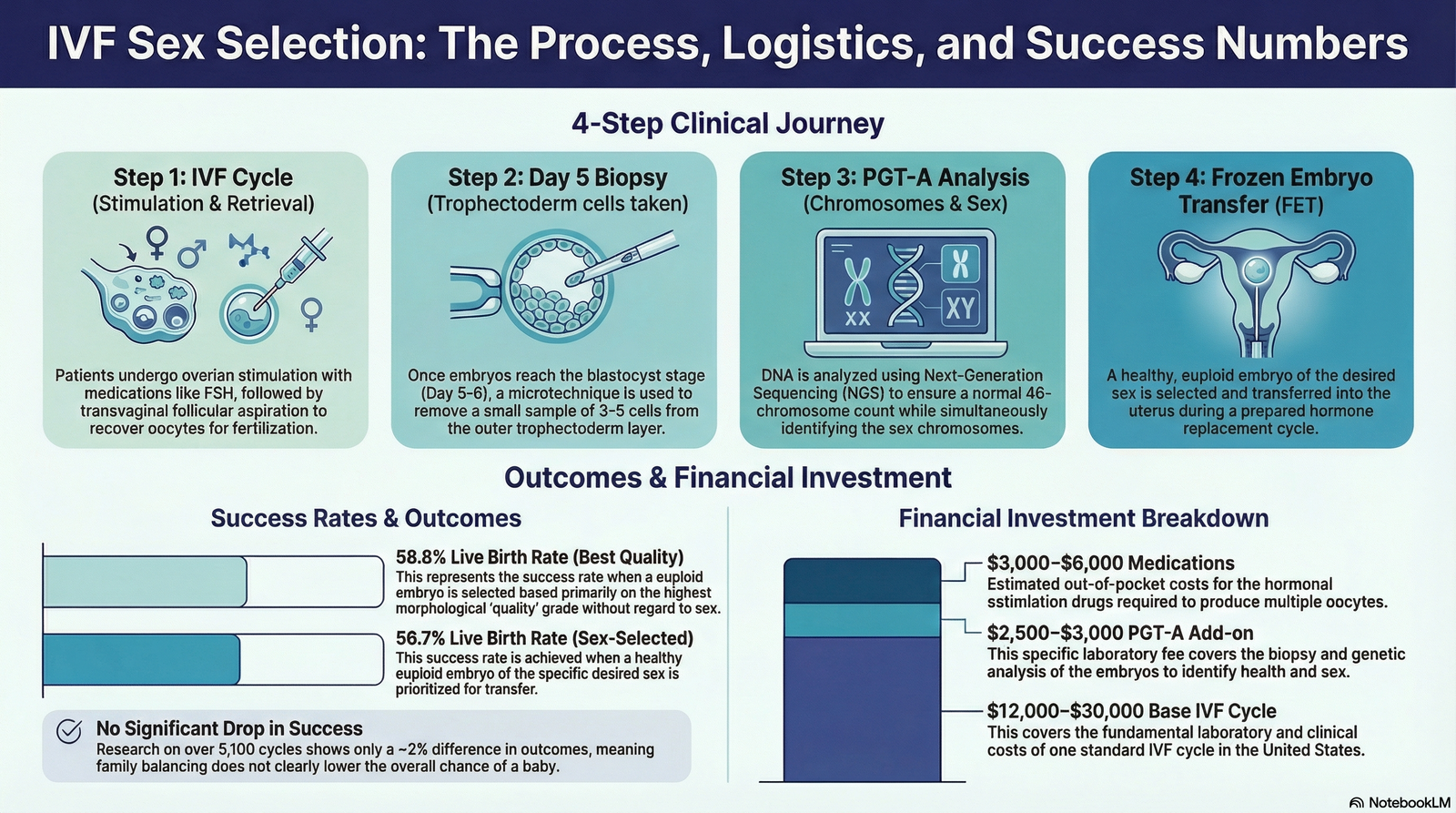
IVF sex selection at a glance, from PGT testing to costs and success rates.
Costs and What They Actually Cover
Sex selection is never an isolated process. It is built on top of a full IVF cycle, with all of the monitoring, procedures, and medications that are already involved. Understanding the basic cost structure can help you decide how important sex selection is compared with other goals, such as more cycles or extra embryos.
| Item | Typical Cost Range |
|---|---|
| Base IVF cycle (U.S.) | $12,000 to $30,000 |
| PGT‑A add‑on (per batch of embryos) | $2,500 to $3,000 |
| Medication costs | $3,000 to $6,000 |
| Extra costs abroad (travel, stay) | Highly variable by country |
Some European programs bundle ICSI and limited PGT into packages that start around a few thousand euros, but travel and time away from home still add up. It is worth asking clinics for itemized quotes so you can compare true totals, not just headline prices.
The Genetic Toolkit: PGT-A, PGT-M, and PGT-SR
If you are trying to decide whether PGT is worth the extra cost and effort, it helps to know what each type actually does. All three approaches involve taking a few cells from a Day 5 or Day 6 embryo and looking at its chromosomes or specific genes before transfer.
PGT-A, checking chromosome number
PGT‑A looks at whether an embryo has the right number of chromosomes. A healthy embryo usually has 46 chromosomes. Extra or missing chromosomes can lead to miscarriage or conditions such as Down syndrome. Many clinics now offer PGT‑A to reduce the risk of transferring embryos with clear chromosome problems.
During this testing, the lab also sees the sex chromosomes. ‘XX’ means female, and ‘XY’ means male. Many couples learn their embryos’ sex during this screening, even if they did not request sex selection as their main goal.
PGT-M, avoiding single‑gene disorders
If you or your partner carries a known genetic disease, PGT‑M is the main tool that protects your future child. The lab designs a test that looks for your specific mutation and checks each embryo for it. This is often called ‘medical sex selection’ when the disease mainly affects boys and is passed on the X chromosome.
Conditions such as Hemophilia, Duchenne Muscular Dystrophy, and some forms of adrenal disorders fall into this category. In those situations, your doctor may suggest transferring only embryos that are tested negative for the mutation or only female embryos, depending on the exact disease and the family’s wishes.
PGT-SR, structural chromosome rearrangements
Some people carry balanced translocations, where two chromosomes have swapped pieces but still contain all of the needed genetic material. They are often healthy themselves, but many of their embryos will have missing or extra pieces and will not lead to a healthy pregnancy.
PGT‑SR searches for these structural changes in embryos. With modern next‑generation sequencing, labs can often tell the difference between:
- Embryos with normal chromosomes
- Embryos that are healthy carriers, like the parent
- Embryos with unbalanced changes
Why Day 5 biopsy became the norm
Earlier, PGT was done on Day 3 embryos with only about eight cells. Removing one cell at that stage is proportionally a bigger loss. Today, most clinics wait until Day 5 or Day 6, when the embryo has become a blastocyst with many more cells and a clear outer layer.
The embryologist removes a small group of cells from the trophectoderm, the layer that will form the placenta. The inner cell mass, which becomes your baby, stays intact. This approach seems gentler on the embryo and gives the lab more DNA to work with.
Ethics, Religion, and Social Questions
If you feel torn about sex selection, you are not being overly sensitive. Doctors, ethicists, and religious leaders argue about these same questions. Most discussions land in one of two places: medical necessity or social and elective reasons.
Autonomy and reproductive choice
Supporters see sex selection as a natural extension of reproductive freedom. They say that if you have the right to accept, continue, or end a pregnancy, you should also have the right to choose which embryo to transfer. For families with a long history of a severe disease, or for parents who have experienced multiple losses, that sense of control can feel vital.
Gender bias and the fear of a slippery slope
Opponents, including the American College of Obstetricians and Gynecologists, draw a clear line between preventing serious disease and choosing a sex just because you prefer boys or girls. They worry that social sex selection reinforces harmful expectations about how sons and daughters should behave and about whose lives are valued more.
There is also constant talk about a slippery slope. If clinics routinely offer sex selection for family balancing, will parents soon expect options for height, eye color, or school performance? Complex traits like these depend on many genes and the environment, but the overall mindset can still shift toward treating children as products to customize.
Global guidance and patient impact
68 percent against – public unease with pure sex choice: One large U.S. survey found that about 68 percent of people disapprove of using embryo testing only to pick a baby’s sex. Recognizing that most people feel uneasy about pure social sex selection can help you reflect on your own values, rather than feeling pressured by technology or family expectations. Source: J Assist Reprod Genet (PMID: 29080968).
Multiple regions, guidelines are cautious: A European ethics task force could not fully agree on allowing nonmedical sex selection and highlighted concerns about gender bias and social pressure. This split view among experts shows that your mixed feelings are valid and that careful counseling should be part of any clinic’s approach. Source: Hum Reprod (PMID: 23578946).
Medical risk only, ACOG’s core position: ACOG supports sex selection to prevent serious sex‑linked diseases but opposes doing it for personal preference or family balancing alone. This means your obstetrician may support sex selection when it clearly protects a child’s health but feel uneasy if the only goal is picking pink or blue. Source: Obstet Gynecol (PMID: 17267863).
Religious ethics, concern about imbalance: Islamic bioethics writers warn that “opportunistic” sex selection during PGT, especially when families strongly prefer sons, may upset the sex balance and deepen discrimination against girls. If your faith matters to you, this guidance can help frame questions for your own religious advisors. Source: Asian Bioeth Rev (PMID: 38586573).
These ethical statements are meant to help you think, not to hand you a single “right” answer. Your values, culture, and lived experience deserve space in this conversation.
Religious and cultural views in more detail
- Islamic perspective: Many scholars accept IVF between married partners but warn that seeking sons through sex selection can disturb the natural balance of society and strengthen son preference, especially where daughters already face discrimination.
- Jewish perspective: Some rabbinic authorities support using fertility treatment to fulfill the commandment to “be fruitful and multiply”, often understood as having both sons and daughters. How far that extends into active sex selection varies by community and rabbinic ruling.
- Catholic perspective: The Catholic Church generally rejects IVF and embryo selection, including sex selection, because it involves creating and possibly discarding embryos, which the Church sees as human lives from conception.
If faith plays a part in your life, it can help to discuss these questions both with your fertility team and with a trusted religious or spiritual advisor. You should not have to carry that tension alone.
Global Laws and Reproductive Tourism
Where you live has a giant impact on what is possible. In some countries, nonmedical sex selection is an everyday clinic offering. In others, it is tightly restricted or outright banned. This legal patchwork is one reason many couples consider travelling for treatment.
United States, wide freedom and mixed messages
In the United States, no federal law bans sex selection. Professional groups such as ASRM discourage starting an IVF cycle only for nonmedical sex selection, but clinics are not legally blocked from doing so. Each practice sets its own policies on whether, when, and how it will offer sex selection.
Most sex selection cycles in the U.S. take place in private clinics and are funded by patients themselves. Recent court decisions, such as the Alabama ruling that treated frozen embryos as children under state law show how quickly the legal climate can change. Those shifts can affect how comfortable clinics feel storing or discarding embryos, including embryos of the “non‑preferred” sex.
United Kingdom, strict control under national law
In the UK, the Human Fertilization and Embryology Authority regulates almost every aspect of IVF. Clinics can use PGT to avoid serious sex‑linked diseases but they cannot use it to pick sex for family balancing or simple preference.
Because of these limits, some UK couples travel to the U.S., Cyprus, or other destinations where clinics openly advertise sex selection. This kind of cross‑border care is often called reproductive tourism and adds travel, time, and cost to an already demanding process.
India and China, pushing back against skewed sex ratios
India and China have both faced decades of son preference and skewed birth ratios. In some regions, birth records have shown roughly 120 boys born for every 100 girls. To protect girls from selective abortion and misuse of technology, both countries passed strict laws that ban sex selection for nonmedical reasons.
In India, the Pre‑Conception and Pre‑Natal Diagnostic Techniques Act makes it a crime to use technology to determine or influence a baby’s sex for nonmedical reasons. Penalties can include fines and prison time for both providers and parents. China has also cracked down on sex determination outside of medical indications in an effort to correct past imbalances.
Israel, a narrow family-balancing path
Israel is known for generous public funding of IVF, often covering multiple cycles until a couple has two children. Even so, sex selection is not freely available for social reasons. Couples who already have four children of the same sex can apply to a national committee for permission to use sex selection for the next pregnancy.
The committee reviews each case and considers medical, emotional, and social reasons before granting or denying approval. For many families, this structure creates a narrow middle ground between a total ban and a free market for sex selection.
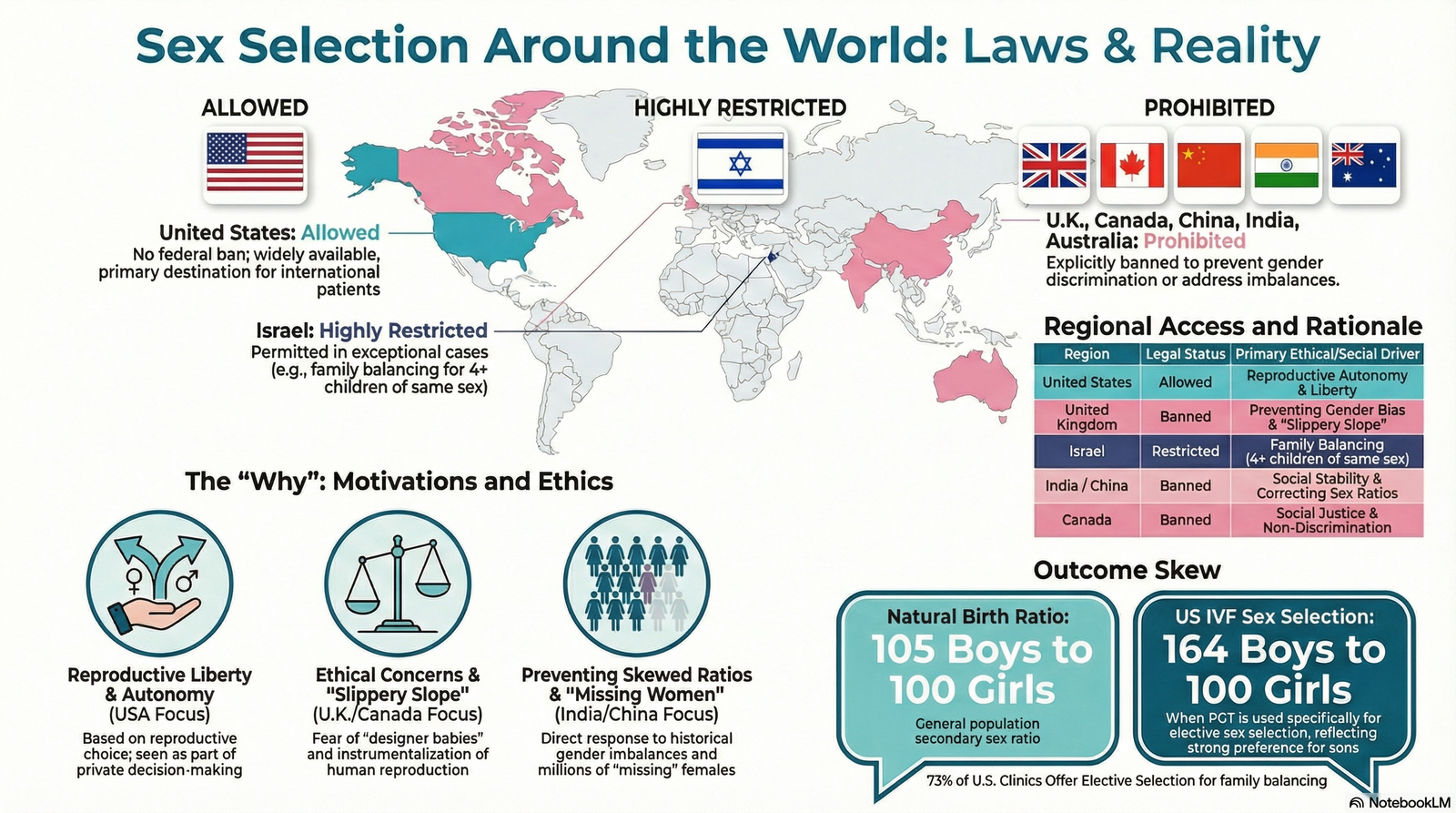
How laws, costs, and success rates vary when you look at IVF sex selection in different countries.
Do Male Embryos Grow Faster?
Many patients ask whether the lab, without meaning to, is already favoring boys. The idea comes from studies that suggest male embryos sometimes grow a little faster in culture.
Studies that show a male tilt
Some research has found that male embryos are more likely to reach the very top blastocyst grades. In one study, about 72 percent of embryos graded 5AA or 6AA were male. Another analysis that looked at cycles where the clinic always chose a single “best” blastocyst reported a birth sex ratio of about 164 boys for every 100 girls.
Studies that see less difference
Other large groups, including Weston and Csokmay, did not see a big speed advantage for male embryos by the time they reached Day 5. They noted that male embryos may be slightly ahead on Day 2, but female embryos appear to catch up later. In their data sets, blastocyst transfer alone did not clearly push the sex ratio away from the natural level.
For you, this means that if you are not doing PGT and your clinic simply picks the best‑looking embryo, there might be a small tilt toward boys in some labs. It is not a guarantee, and not all studies agree, but it is part of the picture.
Sperm Sorting and New Technologies
You might hope for a simpler path than IVF and PGT, such as a pill, a special timing trick, or a less invasive test. At the moment, true control over sex still relies on lab techniques, but there are different layers to consider.
MicroSort sperm sorting
MicroSort is a sperm sorting method that uses a flow cytometer to separate X‑bearing sperm from Y‑bearing sperm. It works by staining the DNA and measuring how much light each sperm cell emits. Because the X chromosome carries slightly more DNA than the Y, the machine can enrich samples for one sex or the other.
- For girls, X‑enriched samples have reported purities of about 80 to 91 percent.
- For boys, Y‑enriched samples are less clean, around 60 to 76 percent.
MicroSort once operated in the United States but lost FDA approval for nonmedical family balancing. Some programs using similar technology still exist in other countries, often combined with IVF and sometimes with PGT‑M when there is a known genetic disease.
Noninvasive embryo testing
Several research groups are working on ways to learn about an embryo’s chromosomes and sex without a cell biopsy. Two promising sources are the blastocoel fluid inside the embryo and the spent culture medium in which the embryo grew. Both contain small fragments of DNA that drift out of the embryo as it develops.
In theory, labs can collect that DNA and read it to check chromosome counts and sex. Early studies look hopeful but are not yet reliable enough to replace current biopsy methods in routine care.
Time‑lapse imaging is another frontier. Special incubators with built‑in cameras record how embryos divide and grow. Subtle timing patterns, such as the interval between three and four cells or the exact moment the morula stage appears, seem to differ slightly between male and female embryos. Some models can guess sex with an accuracy of around 70 percent in research settings. That is not high enough to guide your decisions yet, but it hints at a future with more information and fewer invasive steps.
Mosaic Embryos and Putting Health First
One of the hardest conversations in PGT is what to do with mosaic embryos. A mosaic embryo has a mix of normal cells and cells with chromosome errors. For many years, clinics simply discarded these embryos. Now, data from thousands of transfers show that mosaic embryos can still result in healthy babies.
Because of these findings, many clinics now rank embryos roughly in this order when they counsel you:
- Euploid: all sampled cells show the correct chromosome number
- Segmental mosaic: a smaller part of one chromosome is affected
- Low‑level mosaic: fewer than half of the tested cells were abnormal
- High‑level mosaic: more than half of the tested cells were abnormal
If you have both euploid and mosaic embryos, most clinics will suggest transferring euploid embryos first, regardless of sex. Mosaic embryos tend to have lower implantation rates and higher miscarriage rates than euploid embryos. If a mosaic embryo is your only option, it can still be a real path to parenthood, but you and your doctor should plan careful prenatal follow‑up.
Success Rates and What They Mean for You
Numbers never tell the whole story, but they do help you ask better questions. Here is a simplified look at outcomes for different embryo categories.
| Transfer Type | Live Birth Rate | Miscarriage Rate |
|---|---|---|
| Best‑quality embryo (sex untested) | About 58.8 percent per transfer | About 11 percent |
| Sex‑selected euploid embryo | About 56.7 percent per transfer | About 11 percent |
| Aneuploid embryo | Around 4 percent | Very high |
| Mosaic embryo | About 37 percent | About 20.4 percent |
When PGT was used in the United States specifically for elective sex selection, reporting showed a birth ratio of roughly 164 boys for every 100 girls, compared with a natural ratio closer to 105 boys for every 100 girls. That tells you that sex selection can strongly change population‑level sex ratios, even if your own single outcome still feels like a coin toss.
Is Sex Selection Right for You?
Choosing sex selection is not just about medicine. It touches on finances, culture, religion, and how you imagine your future family. It can also stir up grief or guilt if you have already been through losses, failed cycles, or difficult pregnancies. Your reasons matter just as much as the technology you use.
When sex selection can be a helpful tool
- You carry an X‑linked genetic condition: If a disease would almost certainly affect sons but not daughters, choosing female embryos or embryos that tested negative can spare your child a serious illness.
- You are already in IVF with PGT: If you are already doing IVF with PGT for infertility or miscarriage, learning the sex of your embryos does not add physical risk. You can then decide whether to use that information when choosing which embryo to transfer.
- You know your emotional limits: Some parents say they cannot face another pregnancy unless they feel more control over the outcome, especially after many years of treatment. Sex selection can feel like one way to set a boundary that they can live with.
When it may not fit your situation
- Your main motivation is a stereotype: If you hope a boy will be “stronger” or a girl will be “more gentle”, it is worth pausing. Children often surprise us. Tying your love to a gender role can place heavy expectations on a child and lead to disappointment on both sides.
- Your budget is already stretched thin: IVF and PGT together can easily exceed $20,000 in the United States. If you are choosing between more cycles and sex selection, or between treatment and other major family needs, it is okay to decide that a preferred sex is not worth extra financial stress.
- You live where sex selection is banned: Trying to work around laws in countries such as the UK or India, for example, by lying about your plans or misusing local tests, carries real legal and ethical risks for you and your doctors.
Want help comparing clinics and costs?
If researching IVF sex selection feels like a full‑time job, you are not imagining it. Our advisors can collect clear, itemized quotes from verified clinics and help you map out realistic timelines and options at no cost to you.

Why trust this guide? The OVU commitment
You are probably juggling hope, timelines, and a lot of tabs open in your browser. And you deserve clear, current, human advice. At OVU, we review clinic protocols, compare real quotes, and talk to people who have done this - intended parents and gestational carriers - so we can give you practical steps, not just theory. If you want help comparing options without sales pressure, we will gather itemized quotes and success data that match your exact situation. You decide, we will bring the info to your table.
Frequently Asked Questions
Is PGT‑A testing 100 percent accurate for sex?
No test is flawless, but PGT‑A is considered extremely accurate for identifying XX versus XY embryos. Rare conditions, such as Androgen Insensitivity Syndrome, can mean that an XY embryo later appears female, but this is uncommon. For most families, PGT‑A gives a very reliable answer about biological sex.
Can you use sex selection if you are not infertile?
In the United States, many clinics will offer IVF and PGT‑A to fertile couples who want family balancing. Each clinic sets its own rules, and some refuse nonmedical sex selection. You should ask any clinic you are considering how they handle requests from fertile patients and what counseling they provide.
Does PGT‑A hurt the embryo?
Studies of Day 5 trophectoderm biopsy have not shown a clear drop in implantation rates when the procedure is done in experienced labs. This approach is very different from older Day 3 biopsies, which removed a larger share of the embryo’s total cells. Your clinic should explain its own results and lab practices, so you can weigh risks and benefits.
What happens if all of your embryos are the “wrong” sex?
This does happen. In one study of couples who already had three or more daughters, 83.2 percent still produced more female than male embryos, even when they were hoping for a boy. You cannot force biology to give you embryos of a certain sex. You can only choose among the embryos you have, or decide to stop if the options do not feel right.
How much does IVF sex selection actually cost?
In many U.S. clinics, a single IVF cycle can range from about $12,000 to $30,000, excluding medications. PGT‑A often adds another $2,500 to $3,000. In some European programs, packages that include ICSI and PGT for a limited number of embryos start around a few thousand euros, but you then need to factor in flights, hotels, and time away from work.
Does a “male” or “female” pill exist?
No. Some surveys ask people if they would take a simple pill to choose a baby’s sex, and many say yes. That product does not exist. True sex selection today relies on sperm sorting, embryo testing, or both.
Can a clinic refuse to tell you the sex of your embryos?
Yes. Professional groups encourage clinics to create clear policies about when they will share sex information. Some clinics choose not to disclose embryo sex for nonmedical reasons. In many U.S. states, you still have strong rights to your medical records, but how that plays out in practice can vary. Always ask about a clinic’s policy before you start treatment if this is important to you.
Reference List 8 sources
Journal Article (Research): Gill P, Whitehead C, Werner M, Seli E. Best quality vs. sex selection, an analysis of embryo selection preferences for patients undergoing preimplantation genetic testing for aneuploidy over a 10‑year period. J Assist Reprod Genet. 2024;41(8):2211–2216. PMID: 38914899. Available from: https://pubmed.ncbi.nlm.nih.gov/38914899/
Committee Opinion (Guidance): Practice Committee of the American Society for Reproductive Medicine. The use of preimplantation genetic testing for aneuploidy, a committee opinion. Fertil Steril. 2024;122(3):421–434. PMID: 38762806. Available from: https://pubmed.ncbi.nlm.nih.gov/38762806/
Journal Article (Research): Capelouto SM, Archer SR, Morris JR, Kawwass JF, Hipp HS. Sex selection for non‑medical indications: a survey of current pre‑implantation genetic screening practices among U.S. ART clinics. J Assist Reprod Genet. 2018;35(3):409–416. PMID: 29080968. Available from: https://pubmed.ncbi.nlm.nih.gov/29080968/
Ethics Committee Opinion: Ethics Committee of the American Society for Reproductive Medicine. Use of reproductive technology for sex selection for nonmedical reasons: an Ethics Committee opinion. Fertil Steril. 2022;117(4):720–726. Available from: https://www.asrm.org/practice-guidance/ethics-opinions/use-of-reproductive-technology-for-sex-selection-for-nonmedical-reasons-an-ethics-committee-opinion-2022/
Committee Opinion (Guidance): American College of Obstetricians and Gynecologists Committee on Ethics. ACOG Committee Opinion No. 360, Sex selection. Obstet Gynecol. 2007;109(2 Pt 1):475–478. PMID: 17267863. Available from: https://pubmed.ncbi.nlm.nih.gov/17267863/
Ethics Committee Opinion: Dondorp W, de Wert G, Pennings G, et al.; ESHRE Task Force on Ethics and Law. ESHRE Task Force on Ethics and Law 20, sex selection for non‑medical reasons. Hum Reprod. 2013;28(6):1448–1454. PMID: 23578946. Available from: https://pubmed.ncbi.nlm.nih.gov/23578946/
Journal Article (Research): Sindiani AM, Zayed F, Alshdaifat EH, Rawashdeh HM, Al‑Woshah W, Zayed N. Pre‑Implantation Gender Selection, Family Balancing in Jordan. Risk Manag Healthc Policy. 2021;14:2797–2801. PMID: 34239335. Available from: https://pubmed.ncbi.nlm.nih.gov/34239335/
Journal Article (Ethics/Review): Muhsin SM, Zawawi SZ, others. Islamic Viewpoints on Opportunistic Sex Selection of IVF Embryos upon doing Preimplantation Genetic Testing for Preventing Genetic Diseases. Asian Bioeth Rev. 2023;15(4):[pages not specified]. PMID: 38586573. Available from: https://pubmed.ncbi.nlm.nih.gov/38586573/
Final Thoughts
Sex selection in IVF sits at the meeting point of powerful science and very human hopes. You want a healthy child. You might also dream of a son to play with your daughter, or a daughter to balance a house full of boys. Those feelings are real, and you deserve space to explore them without shame.
The current evidence suggests that when you transfer healthy, chromosome‑normal embryos, choosing based on sex does not dramatically lower your chance of a live birth. The bigger questions are about cost, law, and ethics. They concern how much control you want, how you feel about discarding or freezing embryos of the “non‑preferred” sex, and how this fits with your values and relationships.
Whatever you decide, one truth remains. A child is more than chromosomes. As ethics committees often remind clinicians, parents need to be ready to welcome the real person who arrives, not just the idea they had in mind. Your future son or daughter will bring their own personality, talents, and identity, no matter how modern the lab that helped bring them into the world.
Need help turning information into a plan?
If you are feeling overwhelmed by laws, lab terms, and clinic marketing, you do not have to figure it out alone. Talk with an OVU advisor about your budget, values, and timeline so you can move from reading to making clear, confident decisions.