


Asif Baliyan (MD)

Dr. Sony Sherpa (MBBS)
In addition to her clinical experience, Dr. Sherpa is a published medical researcher and holistic health advocate. Her dual expertise in emergency care and alternative therapies brings a unique lens to medically reviewed content—ensuring it is both accurate and accessible.
If you’re reading this, you’re probably trying to figure out one thing above all else. What are my chances with IVF? I hear that every week, and honestly, it makes sense. Your time, your money, your heart — all in the balance.
Here’s the thing. Age matters a lot with IVF. It is not the only factor, but it is an important one. Not everything, but a lot. National reports from the CDC and SART show clear patterns by age, and knowing those numbers can help you plan with less guesswork and fewer late–night spirals.
IVF success rates drop with age. Under 35, many clinics report about 40 to 50 percent live births per transfer or per cycle, depending on how they track. Between ages 35 and 37, success rates usually fall to around 30 to 35 percent. For women aged 38 to 40, the chance of a live birth is in the 20 to 25 percent range. After age 40, the rates often drop into the single digits when using your own eggs. Donor eggs, however, present a different picture, with success rates holding steady at around 45 to 55 percent per transfer across all recipient ages.
Next step: Use the age–specific tables below and match them to your own testing results
In This Guide
- IVF Success Rates Overview by Age Group
- Success Rates for Women Under 35
- Success Rates for Ages 35-37
- Success Rates for Ages 38-40
- Success Rates for Women Over 40
- Cumulative Success with Multiple Cycles
- Donor Egg Success Rates
- How To Improve Your Chances
- 2025 Costs and Planning by Age
- Practical Decisions by Age Group
- Next Steps
Under 35: ~40-50%
35–37: ~30-35%
38–40: ~20-25%
Over 40: ~5-15%
All recipient ages: ~45-55% per transfer
Age independence: Yes
Often single embryo transfer
IVF Success Rates Overview by Age Group
Success rates for IVF can be tricky to interpret because clinics don’t measure them the same way. Some clinics quote live births per embryo transfer, some per retrieval, and some per cycle started. To make fair comparisons, it’s best to look at national dashboards that use consistent definitions.
For 2025 planning, use the latest CDC ART and SART national summaries. These show clear age–related trends when using your own eggs, and they also make it clear that recipient age matters far less when donor eggs are used. You can browse the public data here: CDC ART Success Rates and the SART national dashboards here: SART National Summary.
The estimates below are taken from those national summaries and from large clinic reports. They are meant to provide a realistic planning range, and not to promise a specific result at your clinic.
| Age Group | Typical Live Birth Rate per Transfer | Typical Live Birth Rate per Cycle Started | Notes |
|---|---|---|---|
| Under 30 | ~45–55% | ~40–50% | High embryo quality, strong response |
| 30–34 | ~40–50% | ~35–45% | Still very favorable |
| 35–37 | ~30–40% | ~25–35% | Time starts to matter more |
| 38–40 | ~20–30% | ~18–25% | Often need multiple retrievals |
| 41–42 | ~10–20% | ~8–15% | Aneuploidy rises sharply |
| 43–44 | ~5–10% | ~3–8% | Low euploid embryo yield |
| 45+ using own eggs | <5% | <3% | Rare success, discuss options |
| Any age using donor eggs | ~45–55% | Varies by clinic | Recipient age less impactful |
If you would like to check the official numbers for your age group, the CDC dashboard makes it easy; you can filter by age and transfer type, and the layout is simple to follow. Here it is again: CDC ART Success Rates.
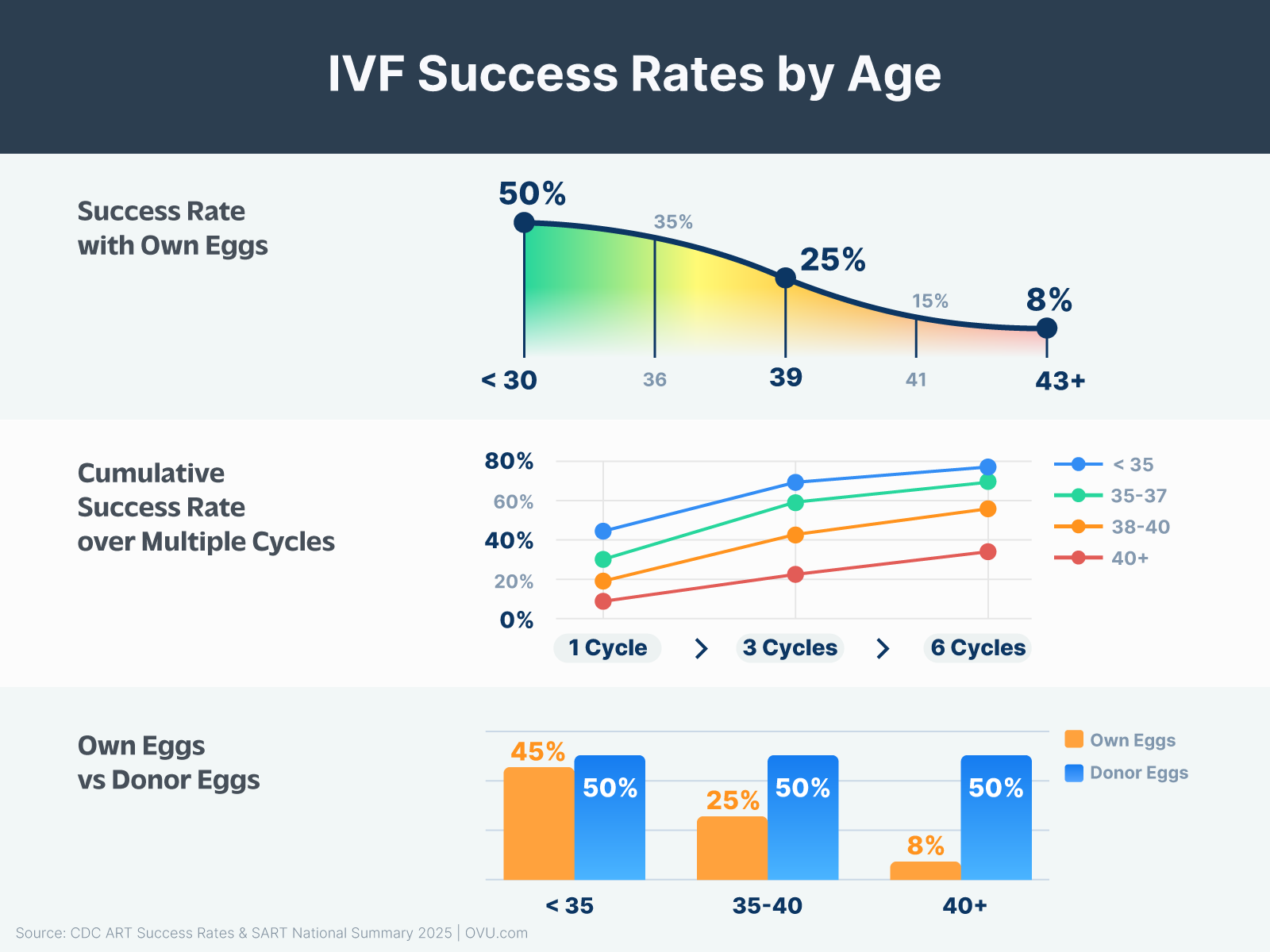
IVF success rates by maternal age, with ranges you can compare to your clinic’s data
Success Rates for Women Under 35
If you are under 35, you are in the age group with the highest IVF success rate using your own eggs. Recent national summaries show that many clinics report about 40 to 50 percent live births per transfer in this range. And with multiple transfers, your overall chances improve over time.
Success rate is higher in women under 35 because of multiple factors:
- Good egg quality: Higher chance of chromosomally normal embryos.
- Response to medications: About 10 to 20 mature eggs can be obtained per retrieval.
- Blastocyst development: A larger share of embryos progress to the blastocyst phase (day 5 or day 6), which improves success of embryo transfer.
- Miscarriage risk: Risk of spontaneous miscarriage is lower than in older age groups.
What the guidelines say
Elective single embryo transfer (eSET) in younger patients reduces the risk of twins without lowering the chances of success. See the ASRM practice guidance here: ASRM eSET.
Even if your first retrieval goes well, some people choose to bank extra embryos while they are younger and strong responders. This can make building a family later easier. But is it the right choice for everyone? Not necessarily — it depends on individual circumstances.
Success Rates for Ages 35-37
Truth is, 35 to 37 is a tipping point. Still good odds, just a bit less wiggle room with time. Many clinics report around 30 to 35 percent live births per transfer in this group. You might notice more talk about PGT–A, single embryo transfer, and setting smart timelines.
Key ideas I cover with patients in this bracket:
- Time matters: This is not the time to panic, but it is a critical time to plan wisely.
- PGT–A testing: This additional step can help reduce transfers with aneuploid embryos and is most helpful as age rises. ASRM overview here: ASRM PGT.
- Egg or embryo banking: This is most useful if you are planning for more than one child.
- Protocol tweaks: Your AMH and AFC help guide medication dosing and the timing of your trigger shot.
Planning the egg count
I’ve seen many clinics aim for roughly 10 to 12 mature eggs as a solid target in this age range, knowing not every egg becomes a blastocyst and not every blastocyst is normal. Your actual number will vary based on AMH, AFC, and prior cycles. The national dashboards help frame expectations: SART National Summary.
Success Rates for Ages 38-40
At 38 to 40, IVF is still very possible, but the plan usually needs more steps. Many clinics report about 20 to 25 percent live births per transfer using their own eggs in this group. The big shift is egg quality — more embryos test aneuploid, so you often need more eggs to get a euploid embryo to transfer.
What tends to change around 38 to 40:
- Egg count per retrieval: Often 5 to 10 mature eggs.
- Aneuploidy rate: Higher, so PGT–A is frequently discussed.
- Miscarriage risk: Higher than in younger groups.
- Cycles required: Many patients need 2 to 3 retrievals to feel confident they have a good shot.
| Treatment Option | Typical Result at 38-40 | What to keep in mind |
|---|---|---|
| Standard IVF | ~20–25% live birth per transfer | Multiple retrievals often needed |
| IVF with PGT–A | Higher per euploid transfer | Fewer transfers, more upfront cost |
| Single embryo transfer | Recommended when embryo quality allows | See ASRM eSET |
| Donor eggs | ~45–55% per transfer | Recipient age plays a smaller role |
Makes sense so far? If your first retrieval yields fewer eggs than hoped, your team can adjust dosing, trigger timing, or add strategies for lab optimization ahead of the next round.
Success Rates for Women Over 40
After 40, the discussion gets very real, very fast. It is not impossible with your own eggs, but it is tougher. The national data show falling live births per transfer in the 40 to 42 and 43 to 44 groups when using own eggs. And yet, I’ve seen patients hang in, adjust the plan, and get there.
Ages 40-42
Typical live birth rates per transfer often land around 10 to 15 percent with own eggs, sometimes a bit higher or lower depending on the clinic and embryo testing. With persistence and good embryo quality, cumulative chances can still add up across multiple tries. The CDC tool lets you slice by age group and transfer type: CDC ART Success Rates.
Ages 43-44
At 43 to 44, success with your own eggs becomes uncommon. Many clinics report single–digit live births per transfer. This is the stage where donor eggs often enter the conversation seriously, not because you must, but because the odds are very different with donor eggs.
Age 45 and beyond
Using your own eggs at 45 plus has extremely low chances of success. Donor egg IVF, however, tends to keep a strong per–transfer rate across recipient ages. CDC and SART both show that recipient age is not the main driver when donor eggs are used. You can scan those donor egg tabs here: CDC ART Success Rates and here: SART National Summary.
When comparing numbers, check whether a clinic is quoting per transfer or per cycle started. Also check how many embryos are transferred. ASRM recommends single embryo transfer in most patients to reduce twin risks and improve safety. See the guidance here: ASRM eSET.
Cumulative Success with Multiple Cycles
One IVF cycle is just a snapshot, it doesn’t tell the whole story. Many patients achieve success on their second or third transfer, and sometimes after a second retrieval. I remember one patient who told me, after round one, “I learned more in two weeks than in two years of Googling.” Round two went better. That happens a lot.
Here’s an easy way to look at it: if your chance of success per transfer is 30 percent, two transfers don’t simply add up to 60 percent. But your overall chance across both transfers is higher than 30 percent — and with a third transfer, it increases even more. The UK’s HFEA has a readable overview on why chances add up across multiple attempts: HFEA success rates.
| Age Group | Typical 1 Transfer | Typical 3 Transfers | Typical 6 Transfers |
|---|---|---|---|
| Under 35 | ~40–50% | ~60–75% | ~70–85% |
| 35–37 | ~30–35% | ~55–65% | ~65–75% |
| 38–40 | ~20–25% | ~40–50% | ~50–60% |
| 41–42 | ~10–15% | ~25–35% | ~30–40% |
| 43–44 | ~5–10% | ~15–25% | ~25–35% |
These are planning ranges, not promises. The same national sources apply here too: CDC ART , SART , and the HFEA overview above. Your individual results depend on diagnosis, ovarian reserve, lab quality, and transfer strategy.
Donor Egg Success Rates: Age Independent Option
Donor eggs level the field in a way that surprises people. Recipient age has a smaller impact because the embryo’s chromosomes reflect the donor’s age. That is why you see similar strong live birth rates per transfer for 30 year old recipients and for 48 year old recipients.
Donor Egg IVF by the numbers
- Live birth per transfer: Often ~45 to 55 percent in U.S. national summaries.
- Miscarriage risk: Lower than that of same–age own eggs because donor eggs are younger.
- Number of embryos transferred: Usually one. See ASRM eSET.
Who tends to consider donor eggs?
- Age 43 plus with limited ovarian reserve.
- Multiple IVF attempts with own eggs without a normal embryo to transfer.
- Certain genetic conditions.
- Primary ovarian insufficiency.
- Same–sex male couples or single men pairing donor eggs with a gestational carrier.
Is it an easy decision? No. It is a deeply personal one. But I’ve seen donor egg IVF bring relief to patients who felt stuck for years, and for many, seeing the strong success rates can be a huge source of hope.
How To Improve Your IVF Success Chances
You might be thinking, okay, these are the averages, but what can I do to improve my odds? Fair question. Some things are in your control, some aren’t. Here’s the practical list I use when coaching patients through their plan.
1) Fine-tune the basics before treatment
- Stop smoking and vaping: Smoking is linked to lower IVF success and higher miscarriage risk. See ASRM’s guideline on smoking and infertility here: ASRM Smoking and Infertility.
- Alcohol: Keep intake minimal during ovulation stimulation and embryo transfers.
- Weight and nutrition: Outcomes are often best in the BMI 19 to 30, but talk with your doctor about a safe plan for you.
- Supplements: Intake of folic acid during prenatal and antenatal period is standard practice. Vitamin D is also often checked, but evidence for boosting IVF outcomes is mixed, so ask your doctor what fits your labs.
- Sleep, movement, stress tools: Light exercise, counselling, acupuncture, or mindfulness — use what genuinely supports your well–being.
2) Choose the protocol that fits your labs
- Stimulation plan: AMH and antral follicle count guide dosing and trigger choices.
- Fresh vs frozen transfer: Many clinics see strong results with frozen transfers because the lining prep can be timed more precisely. CDC national dashboards let you compare fresh and frozen outcomes by age: CDC ART.
- Single embryo transfer: Recommended in most cases to reduce risk of twins and NICU stays due to poor outcome secondary to multifetal pregnancy. See ASRM eSET.
- PGT–A: Especially considered in women over 35 to help identify embryos with abnormal chromosome counts. Overview from ASRM here: ASRM PGT.
3) Use targeted lab techniques when they actually fit
- Intracytoplasmic Sperm Injection (ICSI): This technique is very helpful in cases with male factor infertility or prior fertilization failures. Overview here: ASRM ICSI.
- Assisted hatching: Sometimes used in select groups. More details available here: ASRM Assisted Hatching.
- Embryo banking: Multiple retrievals before transfer can make sense in women over 38, or when you plan for more than one child.
2025 Costs and Planning by Age
Let’s talk about costs, since they are an important part of planning. While prices vary by city and clinic, but 2025 pricing across the U.S., based on typical clinic fee sheets and large patient surveys, looks roughly like this:
| Service | Typical 2025 Price Range | What’s included |
|---|---|---|
| IVF cycle – retrieval and lab | $12,000 – $22,000 | Monitoring, retrieval, fertilization, culture |
| Medications for stimulation | $4,000 – $7,500 | Gonadotropins, trigger, support meds |
| Frozen embryo transfer | $3,500 – $6,000 | Lining prep, monitoring, transfer |
| PGT–A testing | $3,000 – $5,500 | Biopsy and lab testing per batch |
| ICSI add–on | $1,500 – $3,000 | Fertilization technique |
| Donor egg cycle – clinic fees | $20,000 – $35,000 | Retrieval, lab, recipient transfer |
| Donor compensation and agency | $10,000 – $25,000 | Donor fee, screening, legal |
| Embryo storage per year | $500 – $1,200 | Annual storage fee |
These figures align with widely cited patient cost audits. A readable external reference for cost ranges is the FertilityIQ cost guide: FertilityIQ IVF Costs.
How age affects your total cost
Older patients often require more retrievals and transfers to achieve a live birth with their own eggs. This is not anyone’s fault, it is simply biology. Here is an easy way to estimate costs by age using typical cycle counts.
| Age Group | Common number of retrievals | Typical total out of pocket | Ways to reduce cost |
|---|---|---|---|
| Under 35 | 1–2 | $15,000 – $35,000 | Single embryo transfer, multi–cycle package |
| 35–37 | 2–3 | $30,000 – $55,000 | Medication discounts, package pricing |
| 38–40 | 2–4 | $45,000 – $80,000 | Refund programs, right–sized PGT–A |
| 41–42 | 3–5 | $60,000 – $100,000 | Clear stop rules, donor eggs if needed |
| 43+ | 3+ with own eggs | $70,000+ | Donor eggs shorten time and cost |
Insurance and financing options in 2025
- State mandates: More than 20 U.S. states have some infertility coverage laws, and a growing subset include IVF. Check your state here: RESOLVE Coverage by State.
- Employer benefits: Many larger employers offer fertility benefits through dedicated vendors.
- Multi–cycle packages: These can cut per cycle costs by 15 to 30 percent.
- Refund or “shared risk” programs: Often available up to a certain age or AMH threshold
- Financing: Fertility loans are common, but it is important to compare interest rates and fees carefully.
- Travel medicine: Some patients reduce costs by seeking care in lower–cost regions, at the expense of convenience.
Practical Decisions by Age Group
I get asked for a roadmap all the time. The right plan depends on your labs and your goals. But here is a practical starting point by age that I use with many patients.
Under 35
- Consider trying less invasive options first if your diagnosis allows, like timed intercourse or IUI.
- When doing IVF, stick with single embryo transfer in most cases to avoid twins.
- If you want more than one child, embryo banking can be a smart move.
- Egg freezing is highly effective in this age group.
Age 35-37
- Do not spend too long on IUI if you qualify for IVF, usually 3 to 4 IUIs max.
- Discuss PGT–A to cut down on transfers with aneuploid embryos.
- Set a timeline and cycle limit you feel okay with, and review after each round.
- Think ahead to baby number two if that is in your plan.
Age 38-40
- Most people go straight to IVF unless there is a specific reason not to.
- Expect that you might need more than one retrieval.
- Consider PGT–A, especially if miscarriage risk is a big worry for you.
- Have a clear discussion about when you would consider donor eggs if cycles are not yielding a normal embryo.
Age 41+
- Get a clear read on ovarian reserve early and update it if cycles change your response.
- Talk about donor eggs early, even if you plan to try one or two cycles with your own eggs first.
- Understand the difference between your chance of success per individual transfer and your overall chance of having a baby across multiple attempts.
- Be honest about the emotional and financial toll, not just the numbers on a page.
Remember this
National reports are averages. Your odds depend on specific things like AMH, AFC, sperm parameters, embryo grading, PGT–A results, and your clinic’s lab. Use the national dashboards for context, then get your personalized estimate from your clinic’s team.
Frequently Asked Questions
At what age should I start considering donor eggs?
Many clinics start this conversation around 43 if you are using your own eggs, because the chance of finding a normal embryo drops a lot. That said, I’ve seen people try one or two cycles first to see what the response and embryo quality look like. With donor eggs, recipient age is less of an issue, which is why success rates look steadier. You can confirm the trend here: CDC ART Success Rates.
How many IVF cycles should I try?
Under 40, a lot of patients who will be successful get there within 3 transfers, and most by 6, especially when PGT–A is used to focus on normal embryos. Over 40, if you have had several well–run cycles without a normal embryo to transfer, it is reasonable to pause and reconsider the plan. The HFEA explains why chances build across attempts: HFEA success rates.
Does the father’s age matter for IVF?
Yes, but generally it matters less than maternal age. Sperm quality degrades with age, and that can affect fertilization or embryo development. ASRM has a patient–friendly overview about age and fertility here: ASRM Age and Fertility.
Are frozen embryo transfers as good as fresh?
Often equal or a bit better in many groups, especially when PGT–A is used or when a freeze–first approach helps time the lining nicely. You can compare fresh and frozen outcomes by age on the CDC dashboard: CDC ART Success Rates.
How reliable is AMH for predicting IVF success?
AMH tells you about egg quantity, not quality. It predicts how you might respond to stimulation more than it predicts your chance of live birth per embryo transferred. That’s why a 29 year old with low AMH can still do well, while a 42 year old with normal AMH may still face quality limits due to age.
Want help comparing clinics and costs?
Need help comparing clinics and costs? If this feels overwhelming (and it can be), our advisors can gather clear, itemized quotes from verified clinics and help map out your timeline, completely free of charge.

Why trust this guide? The OVU commitment
At OVU, our mission is clarity, compassion, and data-driven guidance. Our patient advocates and editorial team create every guide to help you make confident choices with accurate information.
- Vetted global network: Access to 6,000+ leading clinics across 25 countries.
- Patient-first support: Unbiased guidance from a team that has supported over 10,000 journeys.
- Data you can use: Current success figures and policy updates reviewed for 2025.
Next Steps
Ready to turn these average national and clinic–reported IVF success rats into a personal plan? Here’s a simple checklist you can use this week.
- Pull your labs together: AMH, AFC, recent semen analysis, prior cycle details.
- Check your age group on the national dashboards: CDC ART and SART.
- Decide what matters most: Fastest path to a baby, or trying first with your own eggs even if odds are lower.
- Set a clear limit: Example, 2 retrievals and 4 total transfers before revisiting donor egg or other options.
- Make a financing plan: Verify insurance, compare multi–cycle packages, and review pharmacy discounts.
- Interview 2 to 3 clinics: Ask for age–matched data, single embryo transfer policy, PGT–A approach, and lab reporting.
Source List and Helpful Links
- CDC ART Success Rates - National Dashboards
- SART National Summary and Clinic Reports
- HFEA – What are the success rates for IVF
- ASRM – Elective Single Embryo Transfer
- ASRM – Preimplantation Genetic Testing
- ASRM – Intracytoplasmic Sperm Injection
- ASRM – Assisted Hatching
- ASRM – Smoking and Infertility
- ASRM – Age and Fertility Patient Fact Sheet
- RESOLVE – Insurance Coverage by State
- FertilityIQ – IVF Costs