


Dr. Sony Sherpa (MBBS)
In addition to her clinical experience, Dr. Sherpa is a published medical researcher and holistic health advocate. Her dual expertise in emergency care and alternative therapies brings a unique lens to medically reviewed content—ensuring it is both accurate and accessible.
Embarking on the path to parenthood is a significant milestone for any couple, and for many LGBTQ+ individuals, it signifies years of hope, advocacy, and sometimes painful waiting. You might be dreaming about hearing your baby’s heartbeat for the first time, seeing your partner hold your child, or introducing your family to the people who supported you along the way. At the same time, you are likely trying to make sense of clinic websites, cost estimates, and legal terms that can feel like a second language.
Today’s fertility landscape is very different from what it was even one generation ago. Research on IVF, surrogacy, and fertility preservation has grown quickly, and more clinics now design protocols specifically for LGBTQ+ patients. Studies report live birth rates that often reach or exceed 50% per cycle for many IVF scenarios and success rates above 70% for carefully managed gestational surrogacy programs. These numbers do not tell your personal story, but they do show that your chances of building the family you want are real and measurable.
Professional organizations such as the American Society for Reproductive Medicine (ASRM) and the World Professional Association for Transgender Health (WPATH) now recommend that clinics provide affirming care, clear counseling about fertility options, and early discussion of fertility preservation before medical transition. In practice, this means you can expect your care team to treat your family goals as valid, to explain options in plain language, and to help you navigate the legal and financial aspects that come with third-party reproduction.
If you are an LGBTQ+ individual or couple, you can build your family through options like donor insemination, reciprocal IVF, gestational surrogacy, and fertility preservation. Shared motherhood with reciprocal IVF often costs between $19,000 and $39,000 in North America, while full U.S. surrogacy journeys frequently reach $100,000 to $175,000. With the right legal planning and clinic support, most couples find at least one path that fits their medical needs, budget, and values.
Next step: Decide which path feels closest to your current situation, then speak with a fertility clinic or advisor who has clear experience working with LGBTQ+ families.
What the Latest Research Shows
Recent studies of reciprocal IVF, gestational surrogacy, and transgender fertility preservation show that outcomes for LGBTQ+ patients are comparable to those of heterosexual couples when care is tailored and clinics follow current guidelines. Research on single embryo transfer has confirmed that transferring one embryo at a time reduces risks for carriers and babies without lowering overall live birth rates across multiple transfers.
Guidance from ASRM and other expert groups calls for early fertility counselling in gender-affirming care, careful psychological and medical screening for surrogates and donors, and legal contracts that protect all parties before treatment starts. These recommendations are now considered standard of care in many leading clinics.
In This Guide
- LGBTQ+ Paths to Parenthood: Overview
- Shared Motherhood and Reciprocal IVF
- Surrogacy Pathways for Gay and Bisexual Men
- Transgender and Nonbinary Fertility Preservation
- Global Fertility Destinations for LGBTQ+ Parents
- Cost Breakdown for LGBTQ+ Family Building
- Legal Planning and Protecting Your Parental Rights
- Frequently Asked Questions
Options include donor insemination, reciprocal IVF, gestational surrogacy, and fertility preservation before or during transition.
Many IVF-based paths reach live birth rates of 50% or higher per transfer in younger patients, with strong outcomes for well-managed surrogacy.
Reciprocal IVF often ranges from $19,000 to $39,000, while international surrogacy programs can start around $50,000.
LGBTQ+ Paths to Parenthood: Overview
Many LGBTQ+ people have wanted to be parents for years, even if they were unsure how or when. You may be picturing a child who shares your genes, a child born through your partner’s pregnancy, or a child you welcome through adoption. Whatever your vision looks like, understanding the main medical paths helps you choose where to focus your time and money.
Broadly, your options fall into four groups. First, there are lower-tech routes such as therapeutic donor insemination, often used by couples in which one or both partners can carry a pregnancy. Second, there are IVF-based options like reciprocal IVF, where one partner provides eggs, and the other carries the pregnancy. The third option is gestational surrogacy, which is typically the primary route for some single parents and male couples. Finally, there are fertility preservation methods like egg or sperm freezing that give you more flexibility if you are starting hormones or facing medical treatment that could affect fertility.
Costs, legal steps, and emotional experiences differ across these routes, but they share a common thread. You will work with a team of professionals who handle. You will need medical care, legal paperwork, and sometimes psychological support, and you will make a series of decisions about donors, carriers, and clinics that shape your family story.
How to Choose Your First Step
If you feel overwhelmed by the number of options, try narrowing things down with three simple questions. Do you want a pregnancy in your body, your partner’s body, or with a gestational carrier? How important is a genetic connection for one or both of you? What is your realistic budget over the next two to three years? Your answers to these questions will usually lead you to one or two paths to explore first.
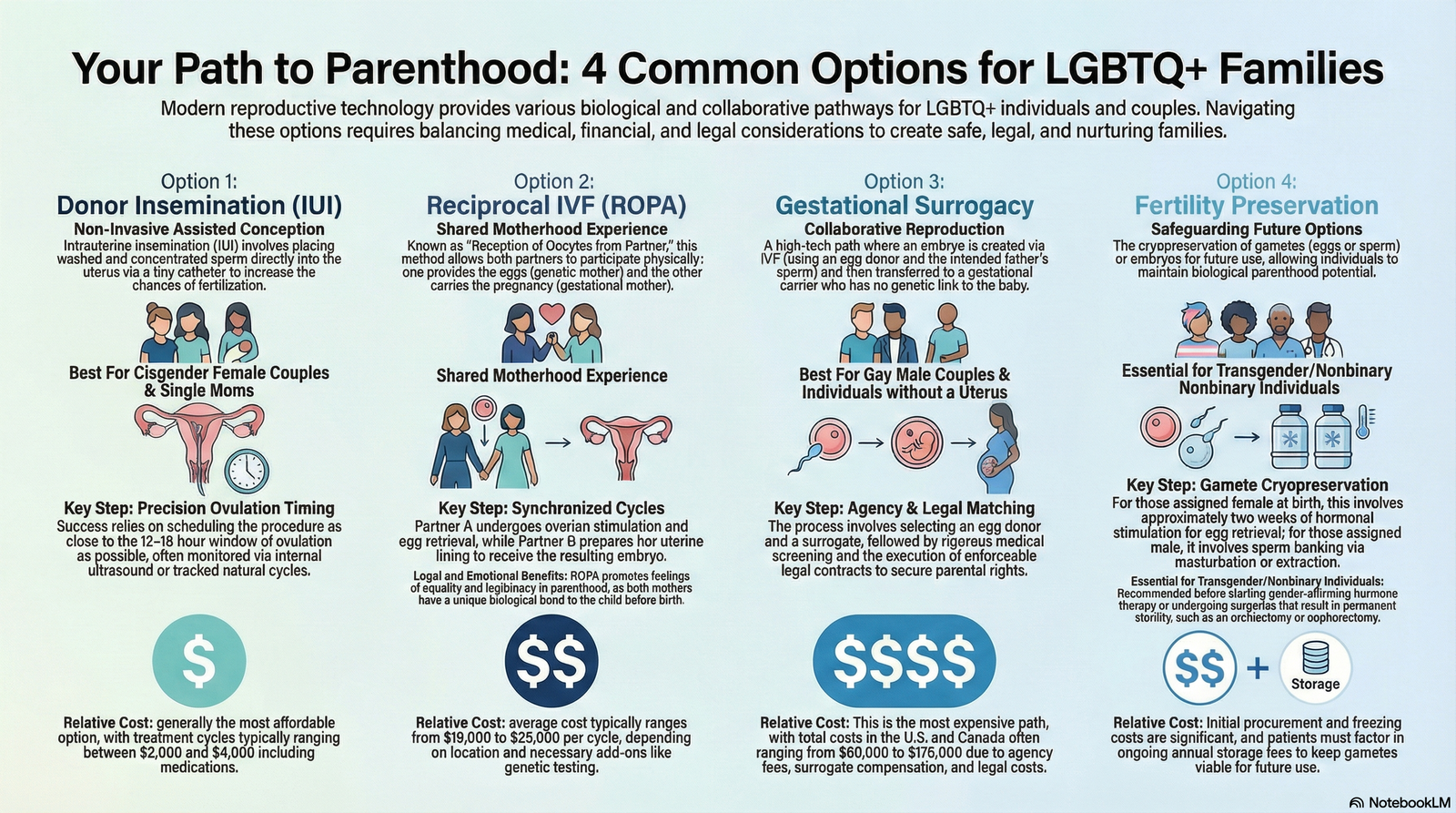
Common LGBTQ+ paths to parenthood: donor insemination, reciprocal IVF, surrogacy, and fertility preservation.
Shared Motherhood and Reciprocal IVF
If you are a couple in which both partners were assigned female at birth and at least one of you can carry a pregnancy, reciprocal IVF (also called the ROPA method) can let you both share in the biological creation of your child. One partner provides the eggs, and the other carries the baby, so you both play a direct, visible role in how your child is born.
The process usually starts with a full health check and fertility work-up for both of you. Your team uses this information to design a protocol that fits your hormone levels, ovarian reserve, and medical history. The partner who provides the eggs takes medications for around two weeks to stimulate the ovaries and mature multiple eggs. A doctor then retrieves those eggs during a short procedure. At the same time, the partner who will carry the pregnancy takes hormones to help the uterine lining thicken so it is ready for an embryo.
After retrieval, the eggs are fertilized with donor sperm in the lab. If you decide to freeze embryos, you gain more control over timing, and your doctor can schedule the transfer for the moment your uterus looks most receptive. Success rates for reciprocal IVF are similar to those for standard IVF cycles. Cumulative pregnancy rates can reach high levels for people under 35 when you look at more than one transfer, and they decline with age, especially after 40.
Emotional Impact of Shared Motherhood
Many couples describe reciprocal IVF as deeply bonding. One of you experiences the physical side of egg retrieval, and the other takes on the physical experience of pregnancy. When you introduce your child to others, you can both point to a clear role in conception and birth, which often helps quiet outside doubts and strengthens your sense of being equal parents.
Surrogacy Pathways for Gay and Bisexual Men
If you are a single man or part of a male couple and want a biological child, gestational surrogacy is often your main medical path. In this model, an egg donor provides the eggs and a gestational carrier carries the pregnancy. The carrier does not use her eggs, so she has no genetic link to the baby.
When you choose an egg donor, most intended fathers put health and family history at the top of the list. When you choose a gestational carrier, a strong past pregnancy history and a clean bill of health matter most. Many couples decide to divide a batch of donor eggs so each partner can contribute sperm, which gives both of you the chance to have a genetic connection to at least one child.
It is common to feel drawn to the idea of twins, especially if you hope for two children and want to lower the number of cycles you go through. But carrying more than one baby raises the risk of complications for both the carrier and the babies. That is why most clinics now strongly encourage transferring a single embryo at a time, even in surrogacy journeys.
Building a Healthy Relationship With Your Surrogate
Your relationship with your surrogate can shape how supported you feel during pregnancy and after your child is born. Many intended parents stay in touch with their carrier for years and include her in important milestones. Think about whether you want a more private, structured relationship or a close, ongoing connection, and share that clearly with your agency from the start so they can match you with someone who prefers a similar level of contact.
Transgender and Nonbinary Fertility Preservation
If you are transgender or nonbinary and just starting to think about your future family, it is normal to feel torn between focusing on gender-affirming care and worrying about how hormones or surgery might affect your ability to have a genetic child later. You deserve clear, honest information before you make decisions that can permanently change your fertility.
For people who were assigned female at birth, egg or embryo freezing is usually the main option. Many clinics ask you to stop testosterone for a period so your body can return to an ovulatory pattern and your ovaries respond fully to stimulation medications. Today, there is growing experience with egg retrieval after the start of testosterone as well, as long as your ovaries are still present.
For people who were assigned male at birth, sperm banking is the standard approach. You usually get the best quality and quantity if you freeze sperm before starting puberty blockers or estrogen. If dysphoria makes masturbation impossible, a urologist can sometimes collect sperm through a small procedure on the testicle. Younger patients who have not yet reached puberty may be able to join experimental programs that freeze ovarian or testicular tissue for possible future use.
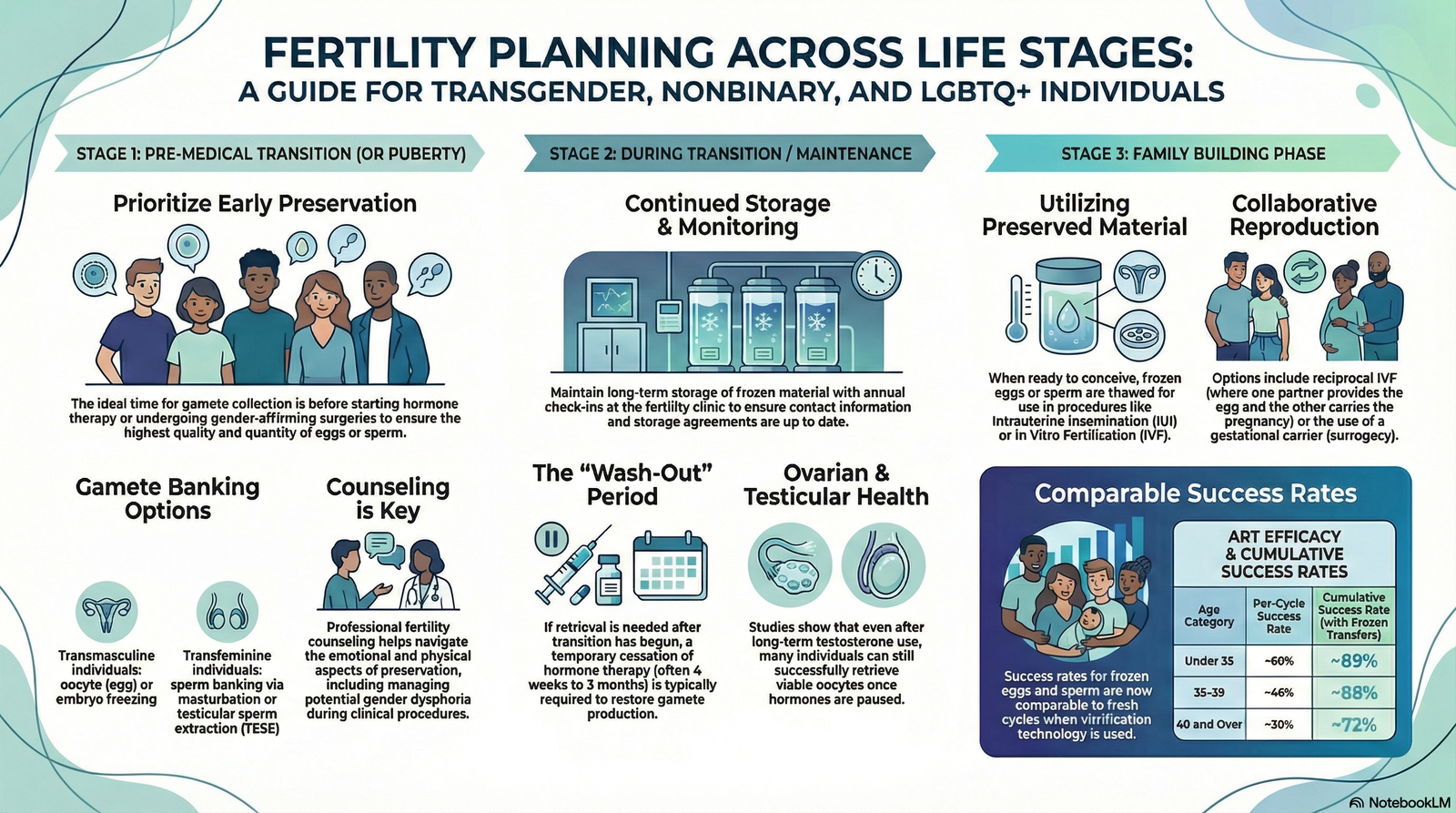
Planning ahead: how fertility preservation, IVF, and surrogacy can fit into your life at different stages.
Global Fertility Destinations for LGBTQ+ Parents
If your home country does not offer the legal or medical support you need, you might look abroad for care. Laws and attitudes vary widely, so it is worth taking time to understand how each country handles LGBTQ+ families and how parentage is recognized for non-biological parents.
In the United States, several states, such as California, Connecticut, Delaware, and Washington, have clear laws that support gestational surrogacy for same-sex couples and single intended parents. Courts in these states often issue pre-birth orders, which means your names appear on the birth certificate from the start. In Canada, altruistic surrogacy is allowed nationwide, and the law focuses on reimbursing reasonable expenses rather than paying a fee, while still recognizing same-sex parents on official documents.
Some European countries, such as Albania and Cyprus, do not have explicit bans on surrogacy, and clinics there often work with international LGBTQ+ couples. Costs in these regions can be significantly lower than in North America. Other countries, including Mexico and Colombia, also host surrogacy and IVF programs that work with LGBTQ+ parents, usually with the requirement that at least one parent has a genetic link to the child.
Choosing a Country and Clinic Abroad
When you compare international programs, look beyond the headline prices. Ask each clinic or agency to break down what is included in the package, which services require extra fees, and how they handle complications, multiple embryo transfers, or early return trips. You should also speak with a lawyer in your home country who has experience with cross-border reproductive care, so you understand how citizenship, passports, and parentage orders work before you commit.
Cost Breakdown for LGBTQ+ Family Building
To plan realistically, you need a clear picture of the typical costs involved in LGBTQ+ family building. Actual prices vary by clinic, city, and legal requirements, but the ranges below give you a starting point for budgeting and comparison.
| Service/Location | Estimated Cost (USD/EUR) | Notes |
|---|---|---|
| Reciprocal IVF (U.S./Canada) | $19,000 – $39,000+ | Often includes basic medications and legal fees. |
| Shared IVF (Europe) | Under €11,000 | Country-dependent option, medications often add extra fees. |
| Surrogacy (United States) | $100,000 – $175,000 | Includes agency, legal, and insurance-related costs. |
| Surrogacy (Canada) | $55,000 – $90,000 | Altruistic model, surrogacy-related expenses are reimbursed. |
| Surrogacy (Mexico) | $60,000 – $75,000 | High-risk care and NICU are often billed separately. |
| Surrogacy (Albania) | $50,000 – $70,000 | Competitive European option; however, legal advice is essential before proceeding with any arrangement. |
| Surrogacy (Colombia) | $60,000 – $119,000 | Usually requires having a genetic link to the baby. |
| Sperm Donation | $300 – $1,600 | Per vial, multiple vials are often needed. |
| Egg or Embryo Freezing | About $12,000 per cycle | Plus annual storage fees. |
| Frozen Embryo Transfer | $3,000 – $6,000 | Per additional transfer attempt. |
| PGT-A or Genetic Testing | Around $5,500 | Optional screening for chromosomal issues. |
Legal Planning and Protecting Your Parental Rights
Legal protection is one of the most important parts of LGBTQ+ family building. Biology, birth certificates, and day-to-day parenting do not always translate automatically into secure parentage in the eyes of the law. You want to know that if you travel, move, or face a crisis, your rights as a parent will stand up in court.
In many places, married heterosexual couples benefit from a presumption that both partners are legal parents. Same-sex couples often do not receive that automatic protection, even when both names appear on the birth certificate. A birth certificate can be challenged in court, while a court order is much harder to overturn. That is why many lawyers still recommend a confirmatory adoption or parentage order for the non-gestational or non-genetic parent.
In surrogacy, laws vary widely by state and country. In jurisdictions that support gestational surrogacy, you can often obtain a pre-birth or post-birth order that lists you as the legal parent. In less supportive places, the surrogate might be recognized as the initial legal parent, and you may have to complete adoption steps later. Some U.S. states have adopted versions of the Uniform Parentage Act to clarify how parentage works for children conceived through assisted reproduction, but these rules are not yet universal.
Working With an Experienced Family Lawyer
Before you sign any donor or surrogacy contracts, talk with a lawyer who has specific experience with LGBTQ+ family building in both your home state and any state or country where treatment will take place. Ask them to map out the full legal pathway from embryo creation to final parentage orders. This extra step adds cost, but it gives you a clear roadmap and reduces the chance of surprises later.
Religious exemption laws can also affect adoption and foster care. Some states allow agencies to turn away LGBTQ+ applicants based on religious beliefs, even when general anti-discrimination laws exist. This does not block all adoption paths, but it can limit your options and require more research to find agencies that will welcome your family. If you plan to adopt or foster, it helps to ask very direct questions about policies and prior placements with LGBTQ+ parents.
Want help comparing clinics and costs?
If this feels like a full-time job, and it often does, our advisors can collect clear, itemized quotes from verified clinics and walk you through timelines, legal steps, and likely total costs at no charge to you.

Why trust this guide? The OVU commitment
You are probably juggling hope, timelines, and a lot of tabs open in your browser. And you deserve clear, current, human advice. At OVU, we review clinic protocols, compare real quotes, and talk to people who have done this - intended parents and gestational carriers - so we can give you practical steps, not just theory. If you want help comparing options without sales pressure, we will gather itemized quotes and success data that match your exact situation. You decide, we will bring the info to your table.
Frequently Asked Questions
Is reciprocal IVF considered egg donation?
In most legal and clinical settings, reciprocal IVF for a same-sex female couple is not treated as standard egg donation. The eggs stay within the couple, and the law often views this as a shared parenting arrangement rather than a donation to a third party.
Can I still preserve my fertility if I have already started testosterone?
Yes. Many transgender men successfully undergo egg retrieval after starting testosterone. Your clinic will likely ask you to stop hormones for a period so your ovaries can respond fully, and your doctor can explain the trade-offs in detail based on your health and goals.
Do children of LGBTQ+ parents have different psychological outcomes?
Decades of research show that children raised by LGBTQ+ parents do just as well as those raised by heterosexual parents. Studies consistently find similar outcomes in mental health, social adjustment, and school performance.
Why is adoption sometimes more complicated for same-sex couples?
In practice, same-sex couples often face extra steps. Some states do not clearly ban discrimination based on sexual orientation in adoption, and some agencies use religious exemptions to turn away LGBTQ+ applicants. This can mean more searching, more paperwork, and sometimes longer wait times, even though adoption itself is legally possible.
What is the difference between traditional and gestational surrogacy?
In traditional surrogacy, the carrier uses her own egg, so she is genetically related to the child. In gestational surrogacy, the embryo comes from the intended parents or an egg donor, and the carrier has no genetic link. Because of the legal and emotional complications of traditional surrogacy, professional societies and many clinics strongly favor gestational arrangements.
Does insurance cover these treatments?
Coverage is inconsistent. Some states and countries have fertility coverage laws, but many define infertility in ways that assume heterosexual intercourse. At the same time, a growing number of employers and public programs are beginning to recognize social infertility for same-sex couples, so it is important to check the details of your specific plan.
Should we transfer one or two embryos in a surrogacy cycle?
Most specialists recommend transferring a single embryo to protect the health of the carrier and the baby. Twin pregnancies carry higher risks of preterm birth and complications, even though they might seem like a faster way to grow your family. You can still plan for more than one child by transferring embryos in separate cycles.
Reference List 4 sources
Journal Article (Research): [Authors]. Outcomes of reciprocal IVF cycles in same sex female couples. [Journal of Assisted Reproduction]. [Year];[Volume]([Issue]):[Pages]. doi: [DOI]. PMID: [PMID]. Available from: [URL]
Journal Article (Research): [Authors]. Gestational surrogacy for male couples: medical and psychological outcomes. [Fertility and Sterility]. [Year];[Volume]([Issue]):[Pages]. doi: [DOI]. PMID: [PMID]. Available from: [URL]
Committee Opinion (Guidance): American Society for Reproductive Medicine. Access to fertility services by transgender and nonbinary persons. [Fertility and Sterility]. [Year];[Volume]([Issue]):[Pages]. PMID: [PMID]. Available from: [URL]
Website/Report: [Organization]. Legal recognition of LGBTQ+ parents by state and country. [Year] report. Available from: [URL]
Final Thoughts
LGBTQ+ family building has moved from the margins into everyday life, and you are part of that change. The tools available today, such as reciprocal IVF, international surrogacy, and updated parentage laws, are a result of the efforts of individuals like you who advocated for improved options and rejected the notion that parenthood was unattainable.
You still face real obstacles, especially around cost, travel, and uneven legal protection, and it is completely normal to feel anxious or exhausted by the planning involved. With the right medical team, legal guidance, and support network, you can gradually navigate. You deserve clear information, respectful care, and a family structure that reflects who you are and how you love.
Ready to explore your next step
If you would like help comparing clinics, countries, or costs, you can speak with an OVU advisor who understands LGBTQ+ family building and can help you turn this information into a concrete plan.