


Dr. Sony Sherpa (MBBS)
In addition to her clinical experience, Dr. Sherpa is a published medical researcher and holistic health advocate. Her dual expertise in emergency care and alternative therapies brings a unique lens to medically reviewed content—ensuring it is both accurate and accessible.
When you are staring at a mountain of fertility research and wondering if your dream of parenthood is still possible, Ukraine often stands out as one of the clearest options. You want more than a clinic: you want a path that feels legally secure, medically sound, and financially transparent.
You might have tried multiple IVF cycles, faced painful setbacks, or been told that pregnancy is too risky for your health. At the same time, you see that surrogacy programs with donor eggs can reach success rates close to 90% across a full package, and that well-screened surrogates have serious complications in only about 2 out of 100 pregnancies compared with about 6 out of 100 in other IVF pregnancies. Those numbers matter when deciding whether to continue.
Ukraine has one of the clearest legal frameworks for surrogacy, backed by its Family Code and Ministry of Health rules. This guide walks you through what that actually means for you in 2026: who qualifies, how the law protects your parental rights, what real-world programs cost, and how the medical process unfolds from first email to flying home with your baby.
Surrogacy in Ukraine is legal for married heterosexual couples who have a medical reason to avoid pregnancy and at least one genetic link to the baby. Total costs usually range from $35,000 to $90,000+, depending on whether you use donor eggs and how many attempts are included in the bundle and covered by the initial cost. The law recognizes you as the legal parents from birth, and well-run programs can reach very high overall success rates, especially when you use donor eggs or genetically tested embryos.
Next step: Confirm that you and your partner meet Ukraine’s legal and medical criteria, then compare 2–3 clinics or agencies on costs, guarantees, and support level. Once compared, book the interviews with their consultants to learn more about the programs they offer, waiting lists, matching timeframes, pool of pre-screened surrogate mothers they have, potential fees, hidden costs, legal nuances and hurdles you may experience during the arrangement, and process from your first travel to exit with a baby.
What the Latest Research Shows About Surrogacy Safety
Large studies of tens of thousands of surrogate pregnancies have found that outcomes are similar to or better than other IVF pregnancies when clinics carefully screen surrogates and limit the number of embryos transferred per trial. One major review of about 28,000 surrogate pregnancies found that most risks came from IVF itself and from twin pregnancies, not from surrogacy as a concept.
Other research shows that when donor-egg embryos go to surrogates instead of intended parents, live birth rates rise by about 11 percentage points, and babies are roughly half as likely to have low birthweight. Serious complications affect about 2 in 100 surrogates, compared with about 6 in 100 other IVF patients.
These findings give you a clear message: the safety of surrogacy depends most on gestational carrier screening, embryo selection, and transfer strategy (as in most cycles, a PGT-screened embryo is preferred), as well as the high standards of the clinical team. Ultimately, safety is a blend of clinical excellence and ethical care protocols, rather than the nature of surrogacy itself.
In This Guide
- Ukraine Surrogacy Overview for 2026
- Legal Framework and Eligibility
- Cost Breakdown and Package Comparisons
- Medical Process and Timeline
- Is Surrogacy Safe? What Research Says
- Top Clinics and Program Types
- Travel, Logistics, and Wartime Planning
- Pros and Cons of Surrogacy in Ukraine
- Frequently Asked Questions
$35,000–$94,100+
Depends on donor use and guarantees
Up to 90%
For donor-egg guarantee programs
Fully regulated
Intended parents are listed as legal parents on the birth certificate from day one
Ukraine Surrogacy Overview for 2026
If you are looking at Ukraine as your ideal destination for your surrogacy arrangement from abroad, you are usually balancing three questions at once: is this legal and safe for your family, can you trust the clinics, and will the final cost match what you see in the brochure? Ukraine remains a leading destination because it provides a transparent legal framework and structured programs at a significantly lower cost than those found in the United States.
At the same time, you have to fit the programs offered by Ukrainian clinics within strict rules. Surrogacy is open to foreign couples, but only if you are a married heterosexual couple, you can show a medical reason for surrogacy, and at least one of you has a genetic link to the baby. If those boxes are ticked, Ukrainian law gives you strong protection as the child’s legal parents.
Latest Research Insights
28,300 Pregnancies – The Verdict: The largest review of surrogate pregnancies found outcomes were similar or better than other IVF pregnancies. The main risk factors were IVF itself and carrying twins, not the use of a surrogate. This means that with single embryo transfer and good clinic practices, your surrogate’s pregnancy is usually as safe as other IVF pregnancies. Source: JAMA Network Open (PMID: 39042408).
57% vs 46% – The Success Gap: When donor-egg embryos were transferred to surrogates instead of intended parents, live birth rates rose from about 46% to 57% per transfer. Babies were also much less likely to be born too small or too early. For you, this shows how a carefully chosen surrogate’s uterus can give your embryo a stronger chance to become a healthy baby. Source: Fertility and Sterility (PMID: 30316434).
2 in 100 vs 6 in 100 – The Safety Reality: A population study found serious pregnancy complications in about 1.7% of surrogates versus 5.5% of IVF pregnancies. Cesarean birth was also less common in surrogates. This suggests that well-screened surrogates usually handle pregnancy more safely than many intended parents would themselves. Source: Journal of Assisted Reproduction and Genetics (PMID: 33145724).
4x Higher Risk – Why Screening Protects: In one study, when surrogates did not meet medical guidelines, babies were nearly four times more likely to need special care after birth. Cesarean births were also more frequent. This is why top clinics and agencies are strict about age, health, and past pregnancy history, because following these rules directly protects your baby and your surrogate. Source: Obstetrics & Gynecology (PMID: 32649497).
These findings come from peer-reviewed research. Your results depend on your personal situation. Discuss what this means for you with your fertility specialist.
The Legal Framework and Who Qualifies
In many countries, surrogacy exists in a legal grey zone, and your final parental rights can depend on a judge’s decision. In contrast, in Ukraine, the rules are written into law. The Family Code of Ukraine (Article 123) and Ministry of Health Order No. 787 set out how surrogacy works and who is recognized as the legal parent.
When an embryo created by a married couple is transferred into another woman’s uterus, the law recognizes the couple as the legal parents. The surrogate has no genetic link to the child in a standard gestational surrogacy program. The birth certificate lists you and your partner as the parents from the start. You do not need to adopt your own child or go through a long court case after birth.
Eligibility Rules for Intended Parents
Ukraine is open to international patients, but clinics have to follow national rules about who can use surrogacy. You and your partner usually need to meet all of the following criteria:
- Married heterosexual couple: You must be in a registered marriage. If you live outside Ukraine, you must provide a marriage certificate with an apostille or proper legalization.
- Medical indication for surrogacy: You provide medical documentation that shows why pregnancy is unsafe or not possible. Common reasons include having no uterus, severe uterine problems, repeated IVF failures with healthy embryos, or serious health conditions that make pregnancy high-risk.
- Genetic link: At least one of you must have a genetic connection to the baby. You can use donor eggs, donor sperm, or both in some structures, but the law expects one intended parent to be biologically related.
Costs and Package Comparisons
Once you know you qualify legally, your next big question is the budget. You want to know what the real numbers are, not just the headline price. In Ukraine, you mostly pay for a bundle that includes medical care, surrogate compensation, logistics, and legal work. Costs change depending on whether you use your own eggs, donor eggs, or a full guarantee package that covers many attempts.
Agency and Clinic Package Overview
| Program | Type | Base Price | Key Features |
|---|---|---|---|
| Delivering Dreams Frozen Embryo | Own frozen embryos | $45,000 | Surrogate search, screening, and legal documents beyond the core surrogacy bundle. |
| Delivering Dreams Own Eggs | IVF + ICSI | $49,000 | IVF with ICSI and one embryo transfer attempt. |
| Delivering Dreams Donor Eggs | Donor oocytes | $53,000 | Donor compensation and donor procedures are included. |
| ICSI Clinic Own Eggs | Guaranteed unlimited | €70,600 | Unlimited attempts using own oocytes. |
| ICSI Clinic Donor Eggs | Guaranteed unlimited | €63,800 | Unlimited attempts using donor oocytes. |
| Vittoria Vita Guarantee | Premium guarantee | €60,000 | Unlimited IVF attempts, gender selection, preterm baby care. |
What the Numbers Mean for Your Surrogacy Plan
40,000+ Cycles – The Real-World Picture: A national review of more than 40,000 surrogate cycles showed that severe complications were still uncommon, even though these pregnancies had more risk than natural conceptions. Risks were mainly linked to IVF and multiple embryos, not to surrogacy alone. This tells you that careful embryo transfer choices, such as single embryo transfer, can lower risk while keeping strong success rates. Source: Journal of Assisted Reproduction and Genetics (PMID: 39565425).
Guideline-Compliant Care – Official Guidance: The American Society for Reproductive Medicine (ASRM) recommends that surrogates be healthy adults with at least one non-complicated and non-high-risk prior pregnancy, no major medical problems, and full psychological and legal counselling. Clinics should transfer as few embryos as safely possible, often one. For you, this means that choosing a program that follows ASRM rules is one of the most important safety decisions you can make. Source: ASRM Gestational Carrier Practice Guidelines.
Obesity Class I – No Extra Baby Risk: A 2024 study found that mildly obese surrogates, a bit above the “normal” weight range, had similar birth outcomes to normal-weight surrogates. Babies had similar rates of preterm birth and complications. This means your team can focus more on your surrogate’s overall health history and past pregnancies than on a single number on the scale. Source: Human Reproduction (PMID: 38636947).
Single Embryo Strategy – Safer Births: Research on surrogate cycles from 2014 to 2020 shows that transferring one embryo at a time greatly cuts the risk of twins, early birth, and newborn problems, while keeping high live birth rates. For you, this supports the “one healthy embryo per transfer” approach, especially when using donor eggs or tested embryos. Source: Fertility and Sterility (PMID: 38772812).
Ethics First – Official Guidance: ASRM’s Ethics Committee states that surrogacy is ethically acceptable when the surrogate is fully informed, freely consents, and has independent legal advice. Programs should protect the surrogate’s health and decision-making at every step. For you, this confirms that a well-run surrogacy program should centre both your dream of a child and your surrogate’s rights and safety. Source: ASRM Ethics Committee Opinion on Gestational Carriers.
Taken together, these studies and guidelines show that when you follow strict medical and ethical standards, surrogacy can offer high success rates with good safety for both your surrogate and your baby.
Variable and Extra Costs
Beyond your base package, it is essential to account for contingency expenses to cover unforeseen circumstances and varying clinical scenarios. For example, if a transfer results in a multiple pregnancy, the surrogate will require increased clinical care and more frequent prenatal visits than with a singleton pregnancy. Since these costs are rarely included in the initial quote, it is vital to review how they are structured within your contract.
| Item | Typical Range | When It Applies |
|---|---|---|
| Twin pregnancy surcharge | €3,000–€4,000 | If your surrogate carries twins. |
| Cesarean section surcharge | €1,184–€1,500 | For surgical delivery, including the scenarios when emergency Cesarean section is necessary. |
| PGD / NGS testing | €360–€2,500 | To analyze an embryo’s chromosomal health with high precision, with the purpose of identifying the most viable embryos suitable for transfer, in parallel reducing the risk of miscarriage and genetic conditions. |
Medical Process and Typical Timeline
Surrogacy is not a quick visit. It is a sequence of steps that stretches across months or even a year. When you see the full picture laid out as a timeline, it becomes easier to plan your travel, your work leave, and your emotional energy.
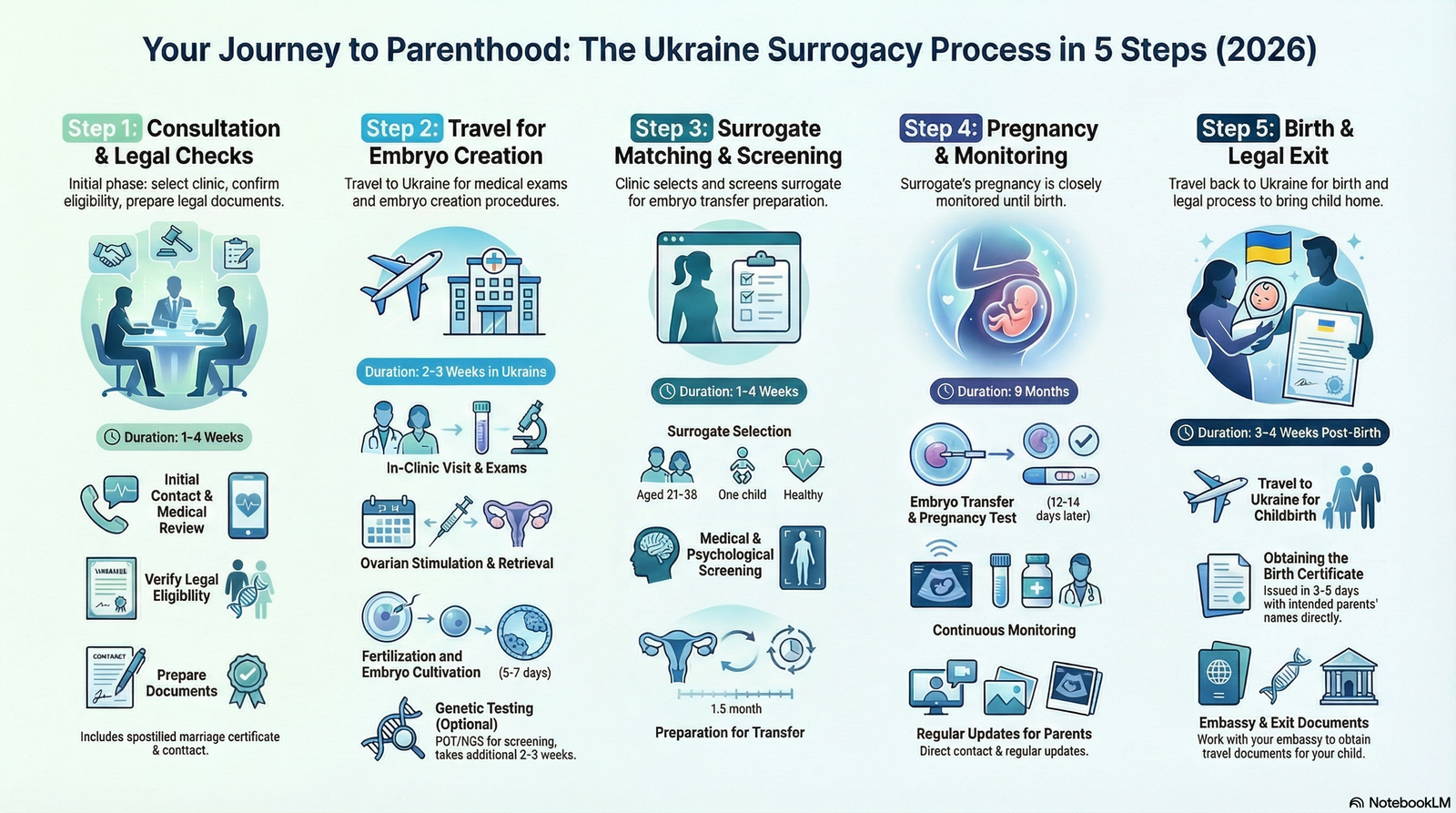
Typical timeline of the surrogacy process in Ukraine: from the first consultation to legal exit with a child
Step 1: Consultation and Document Check
You start your journey by sending your medical history, past IVF results, and basic tests to the clinic or agency. You then schedule an online consultation, which usually costs between €45 and €100. During this call, you share your goals, ask questions, and confirm that you meet legal and medical criteria. In parallel, you get your marriage certificate apostilled or legalized so it will be accepted in Ukraine.
Step 2: Travel for Embryo Creation
If you use your own eggs, you travel to Kyiv, Lviv, or another city where your clinic is based and stay for about two to three weeks. During that stay, you go through ovarian stimulation, egg retrieval, and embryo creation.
If you use donor eggs, your visit is much shorter. You often travel for one to three days, provide a sperm sample, and return home while the lab fertilizes and freezes embryos.
Step 3: Surrogate Screening and Matching
Ukrainian surrogates are usually women between 18 and 40 years old, sometimes capped at 38, who have given birth to at least one healthy child. Clinics screen them for infections, chronic diseases, and psychological readiness. Matching can be very fast if a surrogate is already approved, or it can take a few weeks while the clinic finds the right profile for your case.
Step 4: Embryo Transfer and Pregnancy Monitoring
The lab usually grows embryos to day 5 or day 6 and may test them with NGS if your program includes that. The clinic selects a strong embryo and transfers it to your surrogate’s uterus. About 12 days later, she had a blood test for pregnancy. If it is positive, you move into regular monitoring with bloodwork and ultrasound scans at key stages, such as the 11 to 13 week screening and the detailed anatomy scan at 18 to 21 weeks.
Step 5: Birth and Legal Exit
As the due date gets closer, you travel back to Ukraine. Your baby usually stays at the maternity hospital for 3 to 7 days, depending on health and local policies. During this time, the legal team or agency helps you secure a Ukrainian birth certificate, which often takes 3 to 5 days.
You then go to your country’s embassy or consulate. Most embassies request a DNA test to confirm the genetic link. After that, they issue a passport or travel document for your baby, and you fly home together.
Interpreting the Clinical and Emotional Risks
Clinical Risk Window: The highest medical risks for your surrogate and baby cluster around twin pregnancies, uncontrolled health conditions, and poor follow-up. Programs that use single embryo transfer, strict screening, and regular monitoring keep these risks low.
Emotional Risk Window: The hardest emotional periods for you are usually the wait for the first pregnancy test and the weeks leading up to birth and legal exit. Having clear communication routines with your agency and surrogate helps you feel less powerless during those stretches.
Why This Matters: When you know where the real medical and emotional pressure points sit on the timeline, you can plan support, time off work, and finances in a way that protects your own well-being as well as your baby’s.
Is Surrogacy Safe Compared with Other IVF Options?
You might worry that asking another woman to carry your baby adds new risks on top of regular IVF. The research picture is more reassuring than you might expect. When clinics follow guidelines and choose healthy surrogates with good past pregnancies, surrogate outcomes are often as good as or better than other IVF pregnancies.
At the same time, if clinics ignore age limits, health history, or embryo number rules, risks rise sharply. That is why you pay such close attention not just to the price of a package but to how seriously a program follows screening rules and embryo policies.
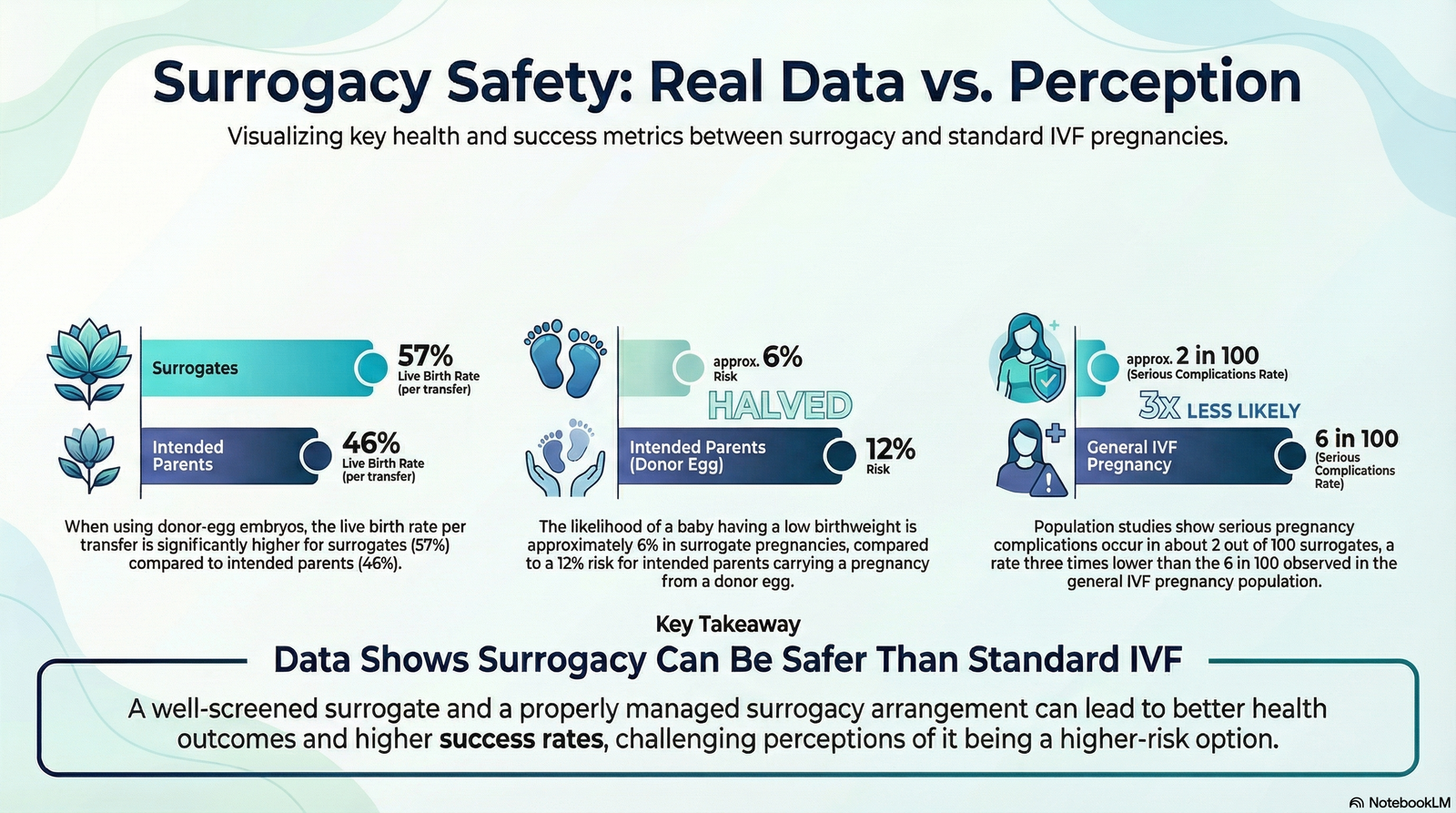
Which type of pregnancy is safer: gestational surrogacy or IVF?
Top Clinics and Program Styles in Ukraine
Choosing a clinic is a significant milestone. Every reputable clinic/agency possesses unique strengths, whether in advanced reproductive science or end-to-end logistical coordination. Aligning these strengths with your own priorities provides a clearer path forward.
IVMED
IVMED focuses on advanced lab options for patients with complex fertility histories. One example is nuclear transfer techniques for patients with very poor egg quality, which gives you a chance at a genetically related child when standard IVF has failed. The clinic also manages a large donor egg bank, with more than 12,000 frozen donor oocytes, which helps reduce waiting times for donor cycles. View IVMED on OVU.
ISIDA Clinic
ISIDA is a large centre for gynaecology, obstetrics, and reproductive medicine. Beyond IVF and surrogacy, ISIDA offers surgical packages and structured pregnancy monitoring, such as “Guaranteed Confidence,” which covers close medical follow-up for a set fee of about €2,750. This can appeal if you want a single team to manage everything from embryo transfer through birth. View ISIDA Clinic on OVU.
Vittoria Vita
Vittoria Vita combines agency support with clinic coordination. Their packages often include airport transfers, furnished apartments, and even local excursions to help you feel more settled during long visits. Nearly half of your payment goes directly to your surrogate’s compensation and support, which makes the financial breakdown clearer. View Vittoria Vita on OVU.
ICSI Clinic
ICSI stands out if you are focused on genetic planning, such as choosing embryo sex within what your local laws allow. Their “guaranteed unlimited” programs centre on detailed lab work, embryo testing, and a promise of a live birth within a series of attempts using either your own eggs or donor eggs. View ICSI Clinic on OVU.
See all surrogacy agencies in Ukraine on OVU
OVU Expert Guidance on Choosing a Program
Start With Legal Fit: Before you fall in love with any package, make sure you and your partner meet Ukraine’s legal and medical criteria. If not, you save yourself heartbreak by exploring other countries earlier.
Compare Total, Not Just Headline Cost: Look at the full financial picture, including twin surcharges, NICU daily rates, extra embryo testing, and travel. A “cheaper” package with many add-ons can end up costing you more than a clear, higher upfront fee.
Weigh Support vs Independence: Some parents want tight, daily support and translation. Others prefer more independence. Think about how much hand-holding you want before you choose an agency style.
Focus on Safety Policies, Not Just Success Rates: While many programs highlight high success rates, these figures are most meaningful when evaluated alongside specific screening and transfer protocols. To understand the true quality of care, inquire about their embryo transfer limits, surrogate screening rigour, and management of pregnancy complications. These details reveal how a clinic prioritizes the health and safety of both the surrogate and the baby.
Want help comparing Ukraine surrogacy clinics and costs?
If this feels like a full-time job, and many parents say it does, our advisors can collect clear, itemised quotes from verified clinics, check which programs match your legal situation, and map out your likely timeline at no cost to you.

Why trust this guide? The OVU commitment
You are probably juggling hope, timelines, and a lot of tabs open in your browser. And you deserve clear, current, human advice. At OVU, we review clinic protocols, compare real quotes, and talk to people who have done this - intended parents and gestational carriers - so we can give you practical steps, not just theory. If you want help comparing options without sales pressure, we will gather itemized quotes and success data that match your exact situation. You decide, we will bring the info to your table.
Frequently Asked Questions
Is surrogacy in Ukraine legal for foreign couples?
Yes. Ukrainian law allows foreign married heterosexual couples to use surrogacy if they meet medical and genetic criteria. You and your partner must provide a legalized marriage certificate and medical proof that pregnancy is unsafe or not possible.
Can we choose the gender of our baby in Ukraine?
Many Ukrainian clinics offer embryo testing with NGS that can reveal embryo sex. Whether you can choose sex in your contract depends on both Ukrainian rules and your home country’s laws. If this is important to you, raise the question about choosing the baby’s gender at the very first consultation, so your team can tell you what is allowed in your case.
What happens if our surrogate has a miscarriage?
Most guaranteed programs include the surrogate’s compensation, and the costs associated with multiple transfer attempts should an initial cycle fail. The agreement explicitly outlines the number of attempts included in your package and the protocols in place if a pregnancy ends prematurely. To ensure full financial transparency, it is essential to understand which services are covered under the fixed fee and which scenarios might trigger additional contingency costs before finalizing your contract.
Will our names be on the Ukrainian birth certificate?
Yes. Under Ukrainian surrogacy rules, the intended parents are listed as the mother and father on the birth certificate from the beginning. The surrogate is not listed as the legal parent and has no right to claim parenthood in court.
How much contact will we have with our surrogate?
The level of contact between intended parents and the surrogate is determined by mutual preference and agency protocols. Some programs facilitate direct engagement through scheduled video calls and messaging, while others utilize a dedicated coordinator to manage updates and maintain privacy boundaries. We recommend defining your communication expectations early in the process to ensure alignment with both the agency’s structure and the surrogate’s comfort level.
What if our baby needs intensive care after birth?
Some programs include NICU care and preterm support in their guarantee packages. Others charge a daily rate, often around €450 per day. Ask for these costs in writing and consider adding separate insurance, especially if you have a higher chance of preterm birth.
How do we bring our baby home after birth?
Once you receive the Ukrainian birth certificate, you go to your country’s embassy or consulate. They usually require a DNA test to prove a genetic link between your baby and one intended parent. After that, the embassy issues a passport or emergency travel document so you can return home with your child.
Reference List 9 sources
Journal Article (Systematic Review & Meta-Analysis): Matsuzaki S, Mandelbaum RS, Ouzounian JG, et al. Obstetric Characteristics and Outcomes of Gestational Carrier Pregnancies: A Systematic Review and Meta-Analysis. JAMA Network Open. 2024;7(7):e2422634. PMID: 39042408. Available from: https://pubmed.ncbi.nlm.nih.gov/39042408/
Journal Article (Research): Masjedi AD, Namath A, et al. National-level assessment of gestational carrier pregnancies in the United States. Journal of Assisted Reproduction and Genetics. 2024;41(XX):XXX–XXX. PMID: 39565425. Available from: https://pubmed.ncbi.nlm.nih.gov/39565425/
Journal Article (Research): Traub AM, et al. Gestational carrier cycles: embryology trends, national guideline compliance, and resultant perinatal outcomes in the United States, 2014–2020. Fertility and Sterility. 2024;XX(X):XXX–XXX. PMID: 38772812. Available from: https://pubmed.ncbi.nlm.nih.gov/38772812/
Journal Article (Research): Clain E, Kaizer L, Hoyos LR, et al. Mild obesity does not affect perinatal outcome in gestational carrier cycles. Human Reproduction. 2024;39(6):1316–1322. PMID: 38636947. Available from: https://pubmed.ncbi.nlm.nih.gov/38636947/
Journal Article (Comparative Study): Namath A, et al. How much does the uterus matter? Perinatal outcomes are improved when donor oocyte embryos are transferred to gestational carriers compared to intended parent recipients. Fertility and Sterility. 2019;XX(X):XXX–XXX. PMID: 30316434. Available from: https://pubmed.ncbi.nlm.nih.gov/30316434/
Journal Article (Research): Swanson K, Letourneau JM, Kuppermann M, Einerson BD. Obstetric morbidity in gestational carrier pregnancies: a population-based study. Journal of Assisted Reproduction and Genetics. 2021;38(1):177–183. PMID: 33145724. Available from: https://pubmed.ncbi.nlm.nih.gov/33145724/
Journal Article (Research): Einerson BD, et al. Association of Obstetric and Neonatal Outcomes With Deviation From Recommended Criteria in Gestational Carrier Pregnancies. Obstetrics & Gynecology. 2020;136(1):53–61. PMID: 32649497. Available from: https://pubmed.ncbi.nlm.nih.gov/32649497/
Committee Opinion (Guidance): Practice Committee of the American Society for Reproductive Medicine. Recommendations for practices using gestational carriers: a committee opinion. Fertility and Sterility. 2022;117(5):XXX–XXX. Available from: https://www.asrm.org/practice-guidance/practice-committee-documents/recommendations-for-practices-using-gestational-carriers-a-committee-opinion-2022/
Ethics Committee Opinion: Ethics Committee of the American Society for Reproductive Medicine. Consideration of the gestational carrier: an Ethics Committee opinion. Fertility and Sterility. 2023;XX(X):XXX–XXX. Available from: https://www.asrm.org/practice-guidance/ethics-opinions/consideration-of-the-gestational-carrier-an-ethics-committee-opinion-2023/
Final Thoughts
Deciding to initiate a surrogacy arrangement in Ukraine is more than a financial or medical choice; it is a profound step toward building your family when pregnancy is not a viable option. By exploring the facts – from legal protections and transparent costs to clinical safety data – you move away from uncertainty toward a structured, pre-blueprinted journey.
If you meet the necessary criteria and feel confident navigating international travel and the current wartime context, a well-chosen program offers a unique blend of legal certainty and clinical excellence. Your next step is to refine your shortlist and engage directly with potential teams regarding their medical protocols and safety policies. Ultimately, this journey is about choosing the clinic you trust to lead you from spreadsheets and contracts to the moment you hold your child in your arms.
Related articles

Gestational vs Traditional Surrogacy 2026: Complete Comparison Guide
Surrogacy & Family Building Your guide to gestational and traditional surrogacy Last Updated: 10 December 2025 Medically Reviewed 18 min read Evidence-based If you are thinking about surrogacy, you have probably already ridden the rollercoaster of fertility treatments, second opinions, and late‑night searches. It is completely normal if you feel hopeful and scared at the same time. You are trying to protect your heart, your future child, and your finances, all in one decision. Right now, your main choice is between gestational surrogacy and traditional surrogacy . Most modern surrogacy journeys, around 80% to 90%, use gestational carriers, and only
23 min read
How to Choose a Surrogate: 2026 Complete Matching & Screening Guide
Surrogacy & Fertility Your guide to surrogate matching Last Updated: 08 December 2025 Medically Reviewed 14 min read Evidence-based If you are thinking about using a surrogate to build your family, you are carrying a lot on your shoulders. You are hopeful, but you are also about to entrust someone else with a pregnancy you have long dreamed of. That blend of excitement and fear is completely normal. We understand how heavy this choice feels. Therefore, it is essential to take the time to prepare yourself emotionally and logistically for the path ahead. Remember that every moment of careful consideration
13 min read
International Surrogacy 2026: Complete Guide to Surrogacy Abroad
Surrogacy & Family Building Your guide to international surrogacy abroad Last Updated: 10 December 2025 Medically Reviewed 19 min read Evidence-based If you are considering international surrogacy, you are probably weighing one of the biggest decisions of your life. You might feel hopeful, worried about money, and unsure where to start, all at once. That blend of intensive and nuanced emotions is normal, especially when you are trying to build your family through a path that comes with legal and medical complexity, where someone else will be carrying your pregnancy to term. For many intended parents, especially if you are
20 min read