


Dr. Sony Sherpa (MBBS)
In addition to her clinical experience, Dr. Sherpa is a published medical researcher and holistic health advocate. Her dual expertise in emergency care and alternative therapies brings a unique lens to medically reviewed content—ensuring it is both accurate and accessible.
If you are considering surrogacy, you are starting one of the most personal and hopeful paths to parenthood. You might feel excited and also nervous at the same time, especially when you see the varying program costs, agency packages, and the expected expenses shared by other aspiring parents on dedicated forums and in reviews left on Google and other trustworthy sources. Feeling overwhelmed by the costs involved is very common, particularly if your initial budget is significantly lower than what other prospective parents in similar situations have negotiated and discussed. You may even find yourself intensely stressed, especially when reading respectful scientific journals, online newspapers, and articles that provide the detailed cost breakdowns of the entire journey, including agency fees, legal services, and compensation for the gestational carrier. Remember that this emotional and financial pressure is normal, but it is essential to take a deep breath, move beyond online estimates and seek transparent, detailed quotes directly from reputable surrogacy agencies and legal counsel to simplify the process and blueprint your ideal journey without hassle and bustle.
Surrogacy is not a single fixed price. Your final bill comes from a combination of coordinated services and expenses: background screenings and counselling, medical care, IVF, egg donation (if needed), legal work, agency services, insurance, travel arrangement expenses, and surrogate compensation. Your total depends on whether you use your own eggs, need an egg donor, wish to ship vitrified embryos from another country, stay in the U.S., or look abroad for a cross-border surrogacy arrangement instead of a domestic one.
This guide walks you through real numbers for 2026. For most people, a full surrogacy journey in the U.S. costs somewhere between $90,000 and $200,000. Premium guaranteed programs can go higher. The goal here is to give you clear ranges so you can plan with less guesswork and more confidence.
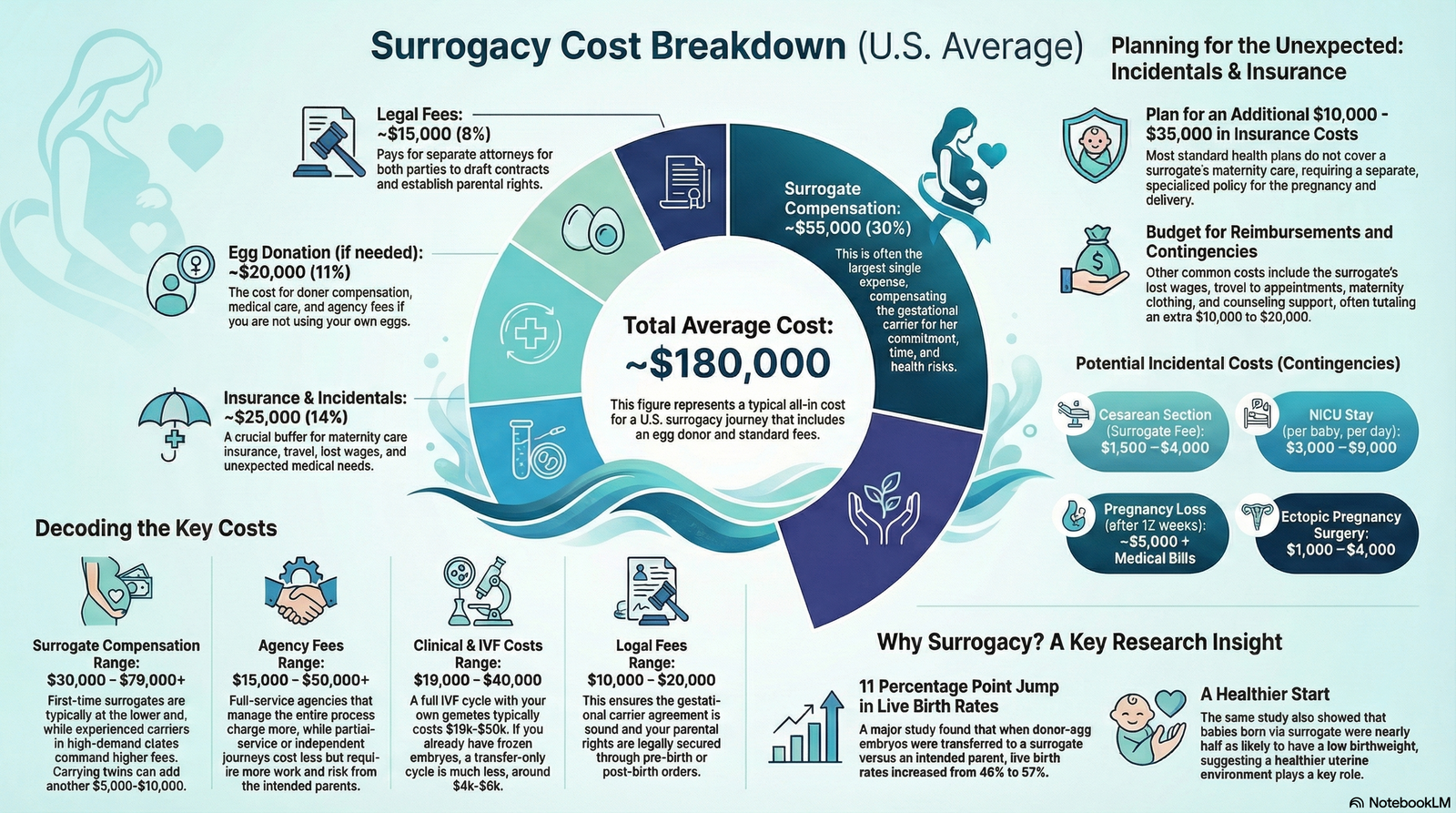
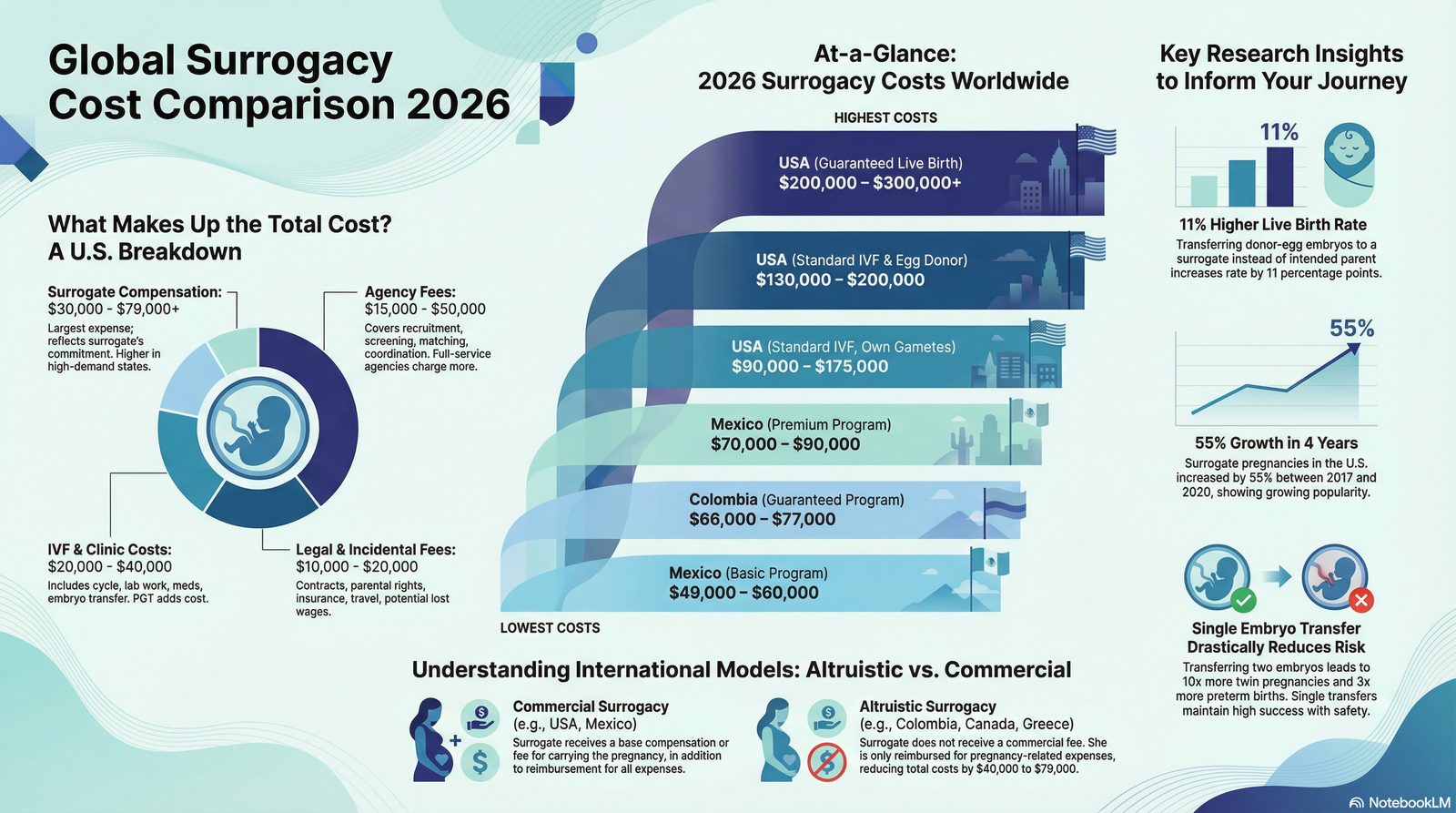
In 2026, a full gestational surrogacy journey in the U.S. usually costs $90,000 to $200,000 or more. The biggest pieces are surrogate compensation ($30k–$79k), agency fees ($15k–$50k), IVF and clinic costs ($20k–$40k), and legal fees ($10k–$20k). Programs in countries like Mexico or Colombia often start around $60,000, while U.S. guaranteed live birth packages can exceed $250,000.
Next step: Check your employer’s fertility benefits and talk with a few agencies to compare itemized cost breakdowns, not just headline prices. Take a focused afternoon to call your Human Resources department to get the fine-print details of your family-building coverage, and prepare a list of 10-15 specific questions to ask the first three agencies you speak with. If your employer does not offer fertility coverage, do not lose heart; immediately shift your focus to exploring third-party financing options such as specialized fertility loans, home equity lines of credit (HELOCs), and non-profit grants. As you review these opportunities and interview agencies, listen for the agency that makes you feel the most secure.
Latest Research Insights
57% vs 46%—Better Odds with a Surrogate: When donor–egg embryos were transferred to a surrogate instead of the intended parent, live birth rates jumped by 11 percentage points. Babies were also nearly half as likely to have low birthweight. A healthy surrogate’s uterus often provides a better environment for your embryo—especially if infertility has been a factor. Source: Fertility and Sterility (PMID: 30316434).
28,000 Pregnancies—Similar Outcomes to Other IVF: The largest review of surrogate pregnancies found that preterm birth and low birthweight rates were similar to other IVF pregnancies. Serious complications were rare. The bottom line? Well-screened surrogates have a risk profile closer to other IVF patients than to natural conceptions. Source: JAMA Network Open (PMID: 39042408).
10x More Twins—Why Single Embryo Transfer Matters: Transferring two embryos instead of one led to 10 times more twin pregnancies, 3 times more preterm births, and significantly more babies needing intensive care. Single embryo transfer keeps success rates high while dramatically reducing these risks—and the costs that come with NICU stays. Source: Fertility and Sterility (PMID: 33691932).
55% Growth in 4 Years—Surrogacy Is Becoming More Common: A U.S. study of 14 million deliveries found that surrogate pregnancies increased by 55% between 2017 and 2020. While still rare, surrogacy is growing—and outcomes are generally favourable. Surrogates had lower C-section rates than other mothers, though they did have higher rates of bleeding after delivery. Plan for these possibilities in your medical and financial budgeting. Source: Journal of Assisted Reproduction and Genetics (PMID: 39565425).
These findings come from peer-reviewed research. Your results depend on your surrogate's health, your clinic's approach, and your treatment plan. Discuss what this means for you with your fertility specialist.
In This Guide
Surrogacy 2026: timeline, main cost drivers, and U.S. vs global price ranges
Quick Facts: Surrogacy Cost Snapshot
The total cost of your surrogacy journey depends on where you have treatment, whether you need donor eggs or sperm, how many IVF cycles you need, and whether you choose a pay‑per‑attempt model or a guaranteed program.
| Program Type | Typical Cost Range | Key Inclusions |
|---|---|---|
| U.S. Gestational Surrogacy (Frozen Embryo) | $60,000 – $90,000 | Thawing, single transfer, surrogate compensation, legal fees. Agency fees usually separate. |
| U.S. IVF Surrogacy (Own Gametes) | $90,000 – $120,000 | IVF cycle, one transfer, surrogate compensation, legal fees, and basic agency fee. |
| U.S. IVF Surrogacy (with Egg Donor) | $130,000 – $200,000 | Egg donor compensation and fees, IVF, surrogate pay, legal and agency fees. |
| U.S. Guaranteed Live Birth Program | $200,000 – $300,000+ | Unlimited transfers (frozen), multiple fresh IVF cycles, surrogate compensation, egg donor fees, and coverage for major incidentals. |
| Mexico Surrogacy (Basic) | $49,000 – $60,000 | Egg donation is included in many programs, embryo creation or shipping of vitrified embryo(s) from abroad, surrogate compensation, first pregnancy‑related medical care. |
| Colombia Surrogacy (Altruistic Arrangement and IVF) | $60,000+ | IVF, full medical care, legal services. Surrogate receives expense reimbursement only (no commercial pay). |
Total Cost Breakdown: The $90,000 to $300,000+ Reality
In the U.S., many families end up in the $175,000 to $225,000 range once everything is done. That range includes a full IVF surrogacy journey, one or more embryo transfers, and the usual legal, medical, and agency costs.
If you already have frozen embryos, a Surrogacy Only program is usually the most affordable route inside the U.S. Prices for this type of program often fall between $60,000 and $90,000. By avoiding a new IVF cycle, you often save $20,000 or more compared with starting from scratch.
If you need IVF Surrogacy using your own eggs and sperm, costs tend to start around $90,000 and go up to roughly $120,000. That figure usually includes one IVF cycle, one transfer, and basic agency and legal support.
When you add an egg donor expenses, your overall budget climbs higher. Average totals land around $130,000, with many programs between $130,000 and $200,000. Male couples who need both an egg donor to create an embryo and a surrogate to gestate an embryo often see comparable totals, typically ranging from $120,000 to $180,000 in the U.S., depending on their choice of egg donor agency, egg donor (local or traveling, premium or standard, local or global), the type of donation (fresh or frozen, premium or core bundle), and clinic.
| Cost Driver | Typical Amount |
|---|---|
| Surrogate base compensation | About $55,000 (range $30,000 – $79,000+) |
| Agency fees | $15,000 – $50,000 |
| Clinical and IVF costs | $20,000 – $40,000 per journey |
| Legal and incidentals | $10,000 – $20,000 |
If you compare these ranges to international programs, a non‑guaranteed U.S. journey often costs at least $175,000, while some structured programs in Mexico or Colombia start closer to $60,000 to $90,000.
Decoding Agency Fees and Support
Your choice of agency shapes your experience and your bill. A strong agency handles recruitment, background checks, medical and psychological screening, matching, coordination with the clinic, and legal referrals. You are paying for time, clearly envisaged and preconfigured systems, and significant risk reduction.
In the U.S., agency fees usually fall between $15,000 and $39,000. In high-cost regions like New York and California, some large agencies charge up to $50,000 or more, especially if they bundle extra services or offer waiting lists of pre‑screened surrogates.
Full‑Service vs. Partial‑Service
Full‑service agencies manage almost everything. You pay more, but you get one point of contact and fewer tasks requiring your direct participation. Partial‑service agencies cost less, sometimes under $9,000, but you then handle pieces like finding a lawyer, organizing travel, or coordinating medical appointments yourself.
Independent surrogacy, where you find a surrogate without an agency, can save $20,000 to $49,000 in fees. The trade‑off is that you carry the work and the risk of recruitment failure (including when a potential surrogate says no after completing background checks and medical evaluation, or if the surrogate is not eligible according to established medical criteria), medical screening, negotiation, and problem‑solving if anything goes off track or complications arise.
If you choose a local agency and a local surrogate, you can also trim travel, hotel, and time‑off expenses for everyone involved, which helps keep your total lower.
Surrogate Compensation and Carrier Criteria
Surrogate compensation is often the single biggest line item in your budget. It reflects the time, health risks, and commitment your gestational carrier takes on.
Base Compensation
In the U.S., base compensation for gestational carriers generally ranges from $30,000 to $79,000. First‑time surrogates tend to sit near the lower end of that range. Experienced surrogates, especially with a history of successfully completed journeys, or those in high‑demand states like California, are compensated at the higher end of the range, with premium arrangements topping out between $90,000 and $100,000.
On top of base pay, you pay extra if your surrogate carries twins or more. For twins, the extra “multiples fee” often falls between $5,000 and $10,000 for that pregnancy. For triplets, programs often quote at least $20,000 more, and many clinics strongly discourage triplet pregnancies because of the higher risk of pregnancy and delivery complications.
Altruistic Surrogacy
Countries such as Canada, Colombia, Greece, and Portugal only allow altruistic surrogacy. That means the surrogate does not receive commercial pay. You still reimburse pregnancy‑related expenses, but not a full base compensation. Compared with U.S. rates, this approach can reduce your total by $40,000 to $79,000.
In Greece, for example, the law caps approved reimbursement at about €10,000. In Canada, practical median reimbursement often ranges from $16,000 to $36,000 CAD, once you cover lost wages, travel, and other costs.
Gestational Carrier Eligibility
The American Society for Reproductive Medicine (ASRM) sets clear safety guidelines. Clinics and agencies that follow them look for carriers who:
- Are between 21 and 45 years old.
- Have at least one previous uncomplicated term birth.
- Have fewer than five total deliveries.
- Have no more than three prior cesarean sections.
- Are free of major medical contraindications (e.g., chronic diseases, prior cancer diagnosis, or active viral infections) or psychiatric conditions.
- Do not use tobacco, illicit drugs, or misuse alcohol.
Many premium agencies narrow this even more. They may prefer surrogates between 24 and 36, with a body mass index (BMI) under 30, or even under 25 for their top‑tier programs, and only one prior C‑section.
Many families now reach parenthood through gestational surrogacy, both in the U.S. and abroad.
Why Strict Criteria Protect You
A Utah population-based study, followed by Swanson et al. (PMID: 32649497), looked at what happened when 361 GC pregnancies did not meet ASRM guidelines. About 16% fell outside the criteria because of age, medical issues, or delivery history. In this group, cesarean delivery rates rose from 23.4% to 36.2%, preterm birth rates roughly doubled after adjusting for twins, and neonatal complications were more than three times higher. This demonstrates that when programs disregard safety criteria, both medical risk and financial risk rise sharply.
Medical Costs, Egg Donation, and Legal Fees
Beyond surrogate compensation, your next consideration is the cluster of third-party costs. This includes clinic fees, IVF procedures, egg donor expenses (if applicable), and essential legal work. These costs are less visible than base pay but accumulate quickly to form a significant portion of your total surrogacy-tailored budget.
Medical and IVF Costs
Creating embryos with your own eggs and sperm usually sits in the $19,000 to $30,000 range for one full IVF cycle with medications. That figure goes up if you add lab techniques such as surgical sperm retrieval, MACS and other sperm selection techniques, ICSI (injecting sperm directly into the egg), assisted hatching, or preimplantation genetic testing (PGT).
If you already have frozen embryos and only need a frozen embryo transfer (FET) into the surrogate, clinic fees for that stage alone usually fall somewhere between $4,000 and $8,000 per transfer, depending on monitoring and medications, not including the cost of the surrogate’s medical screening and preparation.
Egg Donation
Frozen donor egg banks often charge a batch of six to eight eggs at about $16,900 to $25,000, with averages near $19,500. Fresh donor cycles cost more. You pay the donor compensation, her medical care and medications, and agency fees. A typical fresh cycle can end up near $29,000 for standard donors and closer to $50,000 in premium or guaranteed programs.
If your donor travels to the clinic, you also pay for flights, accommodation, time off work, and extra insurance. Factoring in these logistical expenses, international egg donor cycles requiring travel can increase your total budget by $36,000 to $69,000.
Legal Fees
Legal work protects your parental rights and reduces the chance of conflict later. In many U.S. surrogacy‑friendly states, you and your surrogate each have your own attorney.
Legal fees for surrogacy in the U.S. usually range from $10,000 to $20,000. This includes drafting and reviewing the gestational carrier agreement, establishing parental rights through a pre‑birth or post‑birth order, and coordinating with courts and vital records offices.
In New York, where the Child‑Parent Security Act sets detailed rules, full legal costs often range from $7,500 to $19,000, depending on complexity and whether you need extra court steps.
The Hidden Costs: Managing Incidentals and Multiples
On paper, many surrogacy programs look similar. The real difference often shows up in the contingency or “what if” line items. These costs do not appear in every case, but they represent critical financial risks you need to plan for.
Insurance and Maternity Care
Most U.S. health insurance plans for intended parents do not cover surrogacy‑related maternity care (the surrogate’s pregnancy and delivery care). You often need to secure a separate policy or a custom rider to cover these medical expenses.
- Surrogate health insurance policy: Usually $10,000 to $36,000 over the life of the pregnancy and covers the cost of medical care.
- Prenatal and delivery care (uninsured risk): Without an adequate policy, hospital and physician charges for management of high-risk pregnancy or a complicated birth can run into tens of thousands of dollars or more.
Unexpected Medical Events
Some examples of extra costs you should plan for:
| Incidental Expense | Typical Cost Range |
|---|---|
| Cesarean section (surrogate compensation) | $1,500 – $4,000 on top of base pay, plus hospital bills |
| NICU stay per baby | $3,000 – $9,000 per day |
| Pregnancy loss after 12 weeks | Around $5,000 in compensation plus medical costs |
| Ectopic pregnancy surgery | $1,000 – $4,000 in professional and facility fees |
| Embryo shipping overseas | $1,900 – $9,000 depending on distance and conditions |
Travel, Lost Wages, and Other Reimbursements
Besides the base pay, you reimburse your surrogate for the costs that come with being pregnant for you. Across a full pregnancy, these extra items often add another $10,000 to $20,000:
- Lost wages for your surrogate and sometimes her partner
- Travel to the clinic and monitoring appointments
- Maternity clothing and extra household help if needed
- Counselling support for everyone involved, which often totals around $8,000 across the journey
U.S. Surrogacy vs. Global Options: Finding Value
If you look at costs in different countries, you see very different price levels, legal rules, and what “all‑inclusive” really means. Lower prices are often tied to altruistic compensation models, different medical fee structures, or stricter eligibility rules.
Mexico
Mexico has become a major hub for same‑sex couples and international intended parents. Basic non‑guaranteed programs often range from $49,000 to $60,000. Premium programs that include repeated transfers and more bundled services usually land between $70,000 and $90,000.
Some clinics also offer “sibling guarantee” packages where two babies are planned with two different surrogates. Those programs often cost around $135,900 to $149,000.
Colombia
Colombia allows altruistic gestational surrogacy and accepts heterosexual couples, same‑sex couples, and singles. A non‑guaranteed IVF surrogacy program with a local clinic usually costs around $60,000.
Guaranteed programs with a local egg donor tend to start around $66,000 and go up to about $77,000. If you bring your own vitrified embryos, surrogacy packages usually start in the $50,000 to $59,000 range. Sibling packages with two surrogates often fall between $125,900 and $139,000.
Cyprus and Ukraine
Cyprus and Ukraine are known for guaranteed live‑birth programs that include unlimited IVF attempts or embryo transfers.
- Cyprus: many programs cost between €50,000 and €140,000. A singleton guaranteed package often ranges from €70,000 to €76,000. Twin packages with two surrogates can start around €122,000, and triple‑surrogate programs around €183,000.
- Ukraine: guaranteed packages with donor oocytes, ICSI, PGT, and unlimited transfers often start around €74,900. Ukraine currently restricts surrogacy to married heterosexual couples.
Other Destinations
Albania, Greece, Portugal, and the UAE all offer surrogacy under different legal and ethical frameworks. In many of these countries, you must be a citizen or legal resident, and in Portugal and the UAE you need a clear medical reason you cannot carry a pregnancy yourself.
Approximate starting points:
- Albania: non‑complicated journeys often cost between €50,000 and €100,000, with lower figures in informal altruistic arrangements.
- Greece: IVF surrogacy packages often start near $50,000 and can reach $100,000 for guaranteed plans.
- Portugal: mainly cross‑border arrangements for residents, often from €60,000 and up.
- UAE: for married couples who are citizens or residents with medical indications, estimates often start between $39,000 and $69,000 before extras.
Legal Snapshot by Country
Before you focus on price, check who qualifies and what local law says about parentage. For example, Mexico allows both altruistic and compensated gestational surrogacy and is open to single and LGBTQ+ parents. Colombia only allows altruistic surrogacy but is open to a wide range of family types. Ukraine offers commercial surrogacy but only for married heterosexual couples. Greece and Portugal restrict surrogacy to residents and to cases where pregnancy is medically impossible or unsafe. These rules matter as much as cost.
Want help comparing clinics and costs?
If this feels like a full‑time job, and honestly it can, our advisors can collect clear, itemized quotes from verified clinics and map your timeline at no cost to you.

Why trust this guide? The OVU commitment
You are probably juggling hope, timelines, and a lot of tabs open in your browser. And you deserve clear, current, human advice. At OVU, we review clinic protocols, compare real quotes, and talk to people who have done this - intended parents and gestational carriers - so we can give you practical steps, not just theory. If you want help comparing options without sales pressure, we will gather itemized quotes and success data that match your exact situation. You decide, we will bring the info to your table.
Frequently Asked Questions
What is the average total cost of surrogacy in the U.S.?
Many families in the U.S. spend between $175,000 and $225,000 by the end of their journey. Basic programs that use existing frozen embryos start at $60,000. Premium and guaranteed programs that include egg donation, several IVF cycles in case of failure, and incidentals can reach or exceed $300,000.
Does insurance cover surrogacy costs?
Most health plans do not cover surrogacy. Some cover parts of infertility testing or prenatal care, but they usually exclude IVF, egg donation, and surrogacy fees. You often need a separate policy for your surrogate, which can cost from $10,000 to $36,000. It is worth having a specialist review your plans line by line.
How much does the surrogate mother receive?
In the U.S., most gestational carriers receive base compensation between $30,000 and $79,000. Experienced surrogates or those in high‑demand regions can receive more. On top of base pay, you reimburse expenses and may pay extra fees for multiples, C‑sections, or invasive procedures.
How much do I need for embryo creation with IVF?
A full IVF cycle with your own eggs and sperm usually costs between $19,000 and $30,000 once you add medications and standard lab work. If you use an egg donor, lab and transfer costs commonly add $9,000 to $19,000 per cycle, on top of donor compensation and agency fees.
Why are premium guaranteed programs so expensive?
Guaranteed programs bundle several cycles of IVF, multiple transfers (using fresh and vitrified embryos), re-matching, and comprehensive coverage for many complications into one price. You invest more money upfront, but you know your absolute maximum cost. The clinic and agency then absorb the financial risk of repeated attempts. For many intended parents, that trade-off feels safer than facing a new substantial fee every time something is unsuccessful.
What if I want twins?
Most clinics now encourage single-embryo transfer because twins bring higher risks of preterm birth, low birth weight, and NICU stays. If you choose to transfer two embryos and both implant, you pay a multiples fee to your surrogate, and you should budget more for possible cesarean section, NICU care, and lost wages. Research shows that double-embryo transfers in GCs lead to far more complications than single-embryo transfers, even though they raise per-transfer success rates.
How long does the surrogacy journey take?
Most journeys take between 12 and 18 months from signing the contract to taking your baby home. In Mexico, a typical timeline is about 11 to 12 months, including one to two months for matching and screening, nine months of pregnancy, and time for local paperwork. In the U.S., some agencies match you with a pre-screened surrogate in as little as six to eight weeks, but you should still plan for at least a year in total.
Reference List 9 sources
Journal Article (Research): Masjedi AD, Mandelbaum RS, Erickson KV, Anderson ZS, Matsuzaki S, Ouzounian JG, et al. National-level assessment of gestational carrier pregnancies in the United States. J Assist Reprod Genet. 2025;42(1):201–211. PMID: 39565425. Available from: https://pubmed.ncbi.nlm.nih.gov/39565425/
Journal Article (Systematic Review & Meta-Analysis): Matsuzaki S, Masjedi AD, Matsuzaki S, Anderson ZS, Erickson KV, Mandelbaum RS, et al. Obstetric characteristics and outcomes of gestational carrier pregnancies: a systematic review and meta‑analysis. JAMA Netw Open. 2024;7(7):e2422634. PMID: 39042408. Available from: https://pubmed.ncbi.nlm.nih.gov/39042408/
Journal Article (Research): Shandley LM, DeSantis CE, Lee JC, Kawwass JF, Hipp HS. Trends and outcomes of assisted reproductive technology cycles using a gestational carrier between 2014 and 2020. JAMA. 2023;330(17):1691–1694. PMID: 37851614. Available from: https://pubmed.ncbi.nlm.nih.gov/37851614/
Journal Article (Comparative Study): Segal TR, Kim K, Mumford SL, Goldfarb JM, Weinerman RS. How much does the uterus matter? Perinatal outcomes are improved when donor oocyte embryos are transferred to gestational carriers compared to intended parent recipients. Fertil Steril. 2018;110(5):888–895. PMID: 30316434. Available from: https://pubmed.ncbi.nlm.nih.gov/30316434/
Journal Article (Comparative Study): Namath A, Jahandideh S, Devine K, O’Brien JE, Stillman RJ. Gestational carrier pregnancy outcomes from frozen embryo transfer depending on the number of embryos transferred and preimplantation genetic testing: a retrospective analysis. Fertil Steril. 2021;115(6):1471–1477. PMID: 33691932. Available from: https://pubmed.ncbi.nlm.nih.gov/33691932/
Journal Article (Research): Swanson K, Letourneau JM, Kuppermann M, Einerson BD. Obstetric morbidity in gestational carrier pregnancies: a population‑based study. J Assist Reprod Genet. 2021;38(1):177–183. PMID: 33145724. Available from: https://pubmed.ncbi.nlm.nih.gov/33145724/
Journal Article (Research): Swanson K, Letourneau JM, Kuppermann M, Einerson BD. Association of obstetric and neonatal outcomes with deviation from guidelines for gestational carriers. Obstet Gynecol. 2020;136(2):387–393. PMID: 32649497. Available from: https://pubmed.ncbi.nlm.nih.gov/32649497/
Committee Opinion (Guidance): Practice Committee of the American Society for Reproductive Medicine; Practice Committee of the Society for Assisted Reproductive Technology. Recommendations for practices using gestational carriers: a committee opinion. Fertil Steril. 2022;118(1):65–74. PMID: 35725121. Available from: https://pubmed.ncbi.nlm.nih.gov/35725121/
Journal Article (Systematic Review): Söderström‑Anttila V, Wennerholm UB, Loft A, Pinborg A, Aittomäki K, Bjercke S, et al. Surrogacy: outcomes for surrogate mothers, children and the resulting families, a systematic review. Hum Reprod Update. 2016;22(2):260–276. PMID: 26454266. Available from: https://pubmed.ncbi.nlm.nih.gov/26454266/
Final Thoughts
If you feel that every decision in surrogacy has a price tag attached, you are not alone. The numbers are big, and it is easy to worry about making a wrong move.
You can take this step by step. Start by learning the main cost drivers. Then look at your own situation, including age, egg quality, and whether you already have embryos. Ask clinics and agencies to show you detailed budgets, not just headline prices, and ask what happens if the first transfer does not work.
With clear information, a realistic budget, and the right team, you give yourself the best chance of bringing your baby home without feeling blindsided at each stage of the journey.