


Dr. Sony Sherpa (MBBS)
In addition to her clinical experience, Dr. Sherpa is a published medical researcher and holistic health advocate. Her dual expertise in emergency care and alternative therapies brings a unique lens to medically reviewed content—ensuring it is both accurate and accessible.
If you are weighing IVF, donor cycles, or surrogacy outside your home country, you are not alone, many singles and couples with diverse backgrounds are forced to opt for cross-border fertility care due to legal restrictions, financial options, or personal reasons. Before initiating any treatment cycle, there are several things to consider, the costs, laws, timelines, and success rates, all of which are dynamic due to the constant change of global economics and vary depending on the destination. Here is the upside: with clear criteria and itemized quotes, you can access high-quality care on a timeline and budget that fits you.
In this guide, you will compare leading destinations (Spain, Romania, Turkey, Albania, and the Balkans), see what is allowed where, and envisage a budget that includes pre-cycle infertility workup, medications, vitrification, storage, transfers, and PGT expenses. The European Society of Human Reproduction and Embryology tracks cross-border care, so you can understand these differences.
Clinics located in Spain and Balkan countries publish strong outcomes and often offer flexible protocols. Some centers also provide audited multicycle or guaranteed programs, which often include a cryotransfer, also known as a frozen embryo transfer backup covered by the initial fee announced for the bundle, to increase the possibility of a successful embryo implantation. This option is designed to increase the possibility of successful embryo implantation, particularly for patients facing potential post-transfer failure scenarios like an unviable pregnancy or early miscarriage after a fresh embryo transfer. However, while versatile bundles are available, the final choice is always limited: age and diagnosis still significantly influence possible outcomes. For this reason, fertility teams will usually not start with a seemingly ideal program right away. Instead, they will insist on an inclusive pre-cycle screening to correctly diagnose the underlying cause and tailor the program with personalized add-ons, ensuring a precise plan that boosts both your odds and your calm.
Fertility tourism reduces IVF costs to €1,800–€5,200 per cycle without fertility assessment, medication, vitrification, and other add-ons in popular hubs. Donor programs are widely available in Spain, Romania, Albania, and North Macedonia. Surrogacy is banned in most of Europe covered here. While not prohibited in Albania, its legal status is complex and unregulated under the Law on Reproductive Health, confirm current steps with local counsel before signing any contract.
Next step: Shortlist 2–3 clinics and request an itemized quote for medications, oocyte retrieval, ICSI, ET/FET, vitrification, storage, and per-embryo PGT. Additionally, ask about bundled packages, multicycle or guaranteed, and any current or upcoming discounts they may offer, such as for an additional frozen embryo transfer within several weeks or months, a complementary additional transfer, or a no-obligation follow-up consultation to review the cycle.
Saving on fertility treatment: Many clinics also offer specific promotional packages toward the end of the year or in early January to meet business goals. When requesting quotes, inquire about the different guarantees and premium packages available, such as an oocytes guarantee, especially for IVF with donor eggs, a blastocyst guarantee for any bundle, or premium bundles that include advanced lab technologies and add-ons at a single, fixed price.
Latest & Past Research Insights
Finding #1 (2025): Greece is positioned as a leading European fertility hub by combining liberal laws, competitive costs, and stability. A systematic review confirms Greece’s appeal is built on a unique foundation, a liberal legal framework, international clinic accreditation, and low costs. The study warns that sustained growth requires addressing structural risks. DOI: 10.3390/sci7040149.
Finding #2 (2023): Cost and access drive a global shift in fertility care from developed countries to new hubs worldwide. DOI: 10.1108/IJSSP-02-2023-0047.
Finding #3 (2022): Access to specialized techniques is a primary driver of inbound fertility travel to countries like the United States. Non-resident cycles show higher use of donation, surrogacy, and PGT. ASRM Ethics Committee.
Finding #4 (2018): Cross-border fertility care is driven by legal, economic, and ethical factors, with high costs and legal restrictions the most quantifiable reasons for travel. PMID: 29808382.
Note: These insights represent recent peer-reviewed research. Individual outcomes may vary based on personal health factors. Discuss these insights with your fertility specialist.
In This Guide
- Why Consider Treatment Abroad?
- Popular Destinations Overview
- Treatment Options by Country
- Cost Comparisons and Hidden Fees
- Legal Frameworks and Eligibility
- Success Rates by Destination
- How to Choose the Right Destination
- Planning Step-by-Step
- Risk Mitigation and Safety
- Practical Travel Tips
- Country-Specific Quick Guides
- Frequently Asked Questions
Introduction: Why Consider Fertility Treatment Abroad?
Most people explore fertility treatment options abroad for three core reasons, price, legal access, and speed, especially as Western systems can be costly or slow. The solution for those facing costly or slow Western systems lies abroad, Spain, Romania, Turkey, and several Balkan countries offer modern labs, broad donor access, country rules apply, and shorter timelines.
It is normal to feel overwhelmed and even nervous by cross-border rules and fees. To structure your search and compare clinics and the programs they offer transparently and effectively, use these essential filters, your eligibility according to legislation, the clinic’s adopted policies and your goals, using donor oocytes or sperm, PGT, gender selection, gestational surrogacy, a line-by-line budget, and your calendar, fresh transfer versus freeze-all embryos with a later FET.
A key part of the clinic comparison process is assessing the medical science behind their work. To ensure a cycle that is both effective and safe, review the clinical evidence on current ovarian stimulation protocols, optimal ovulation triggers for high mature oocyte yield, and techniques focused on preventing complications like Ovarian Hyperstimulation Syndrome, OHSS.
Latest Research Findings
- GnRH antagonist protocols lower OHSS risk versus agonist protocols (PMID: 37480081).
- The 90 day window before retrieval is when nutrition and lifestyle shape oocyte quality (PMID: 31455582).
- Well timed ovulation triggers raise mature oocyte yield (PMID: 32366146).
- Prevention of ovarian hyperstimulation syndrome remains central to safe protocols (PMID: 26074966). Prevention of moderate and severe ovarian hyperstimulation syndrome, Fertility and Sterility.
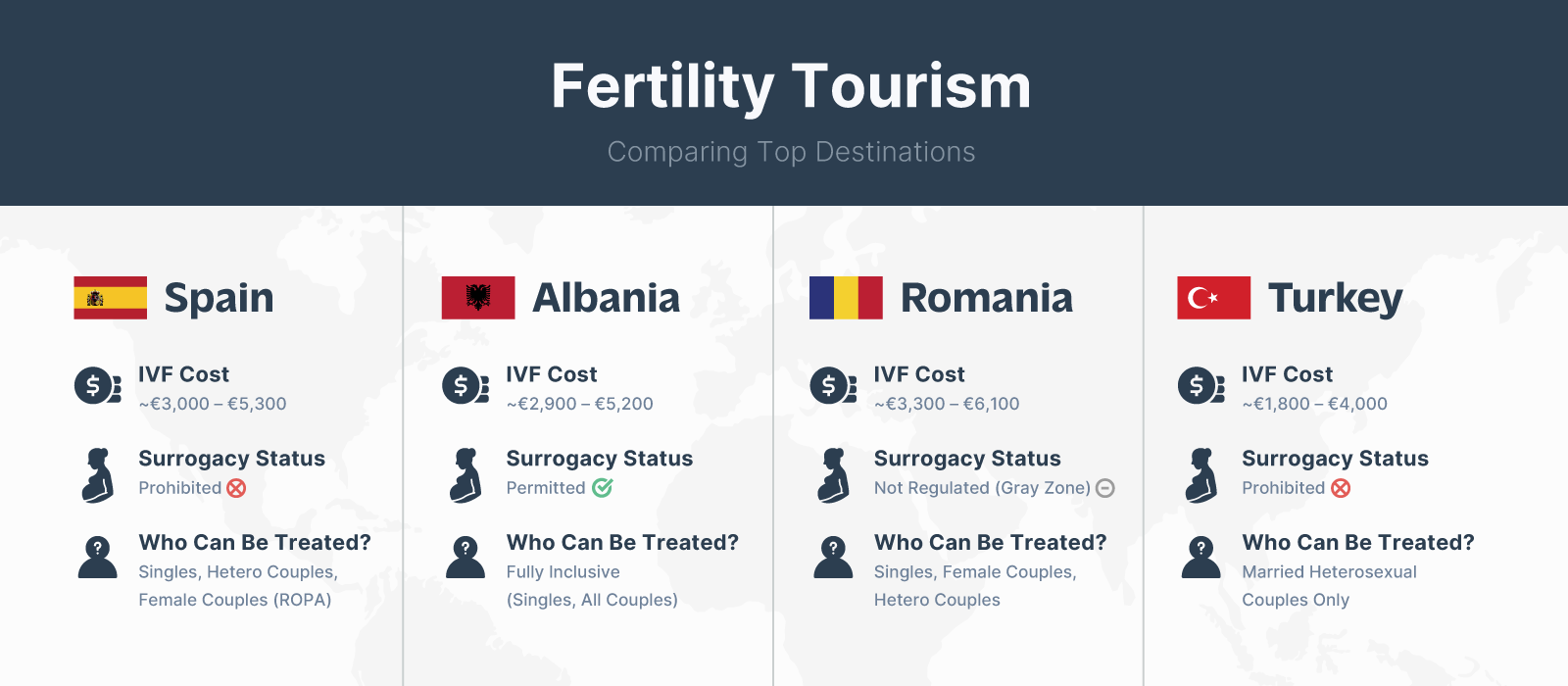
Fertility tourism at a glance, destination fit, legal access, and full-cycle costs.
Popular Fertility Tourism Destinations Overview
Here is a quick look at widely chosen hubs. Match them to your medical and legal preferences in the next sections.
- Spain: Anonymous donor programs, advanced tech, and ROPA, reciprocal IVF when both partners are involved in the IVF cycle, one donates her oocytes and the other gestates the fetus, for married female couples (Source: Law 14/2006 on Assisted Human Reproduction Techniques).
- Romania: Modern labs and fair pricing, single women and female couples can use donor sperm (Source: Law no. 95/2006 on Health Reform, Title VI, Art. 157).
- Turkey: Strong lab capabilities and competitive IVF pricing, donor programs and surrogacy are banned (Source: Turkish Regulation on Assisted Reproductive Treatment).
- Albania: Inclusive access with gestational surrogacy permitted (Source: Law No. 8876 on Reproductive Health).
- North Macedonia / Serbia / Montenegro: Lower costs, donor and double-donation rules vary, surrogacy is prohibited.
Treatment Options by Country
Use this matrix to check if a destination fits your procedures and eligibility.
| Country | IUI (Partner/Donor) | IVF (Own Eggs) | Egg Donation (ED) | Sperm Donation (SD) | Double Donation (DD) | Surrogacy | PGT (Genetic Testing) | Single Women/Female Couples Access |
|---|---|---|---|---|---|---|---|---|
| Albania | ✓ / ✓ | ✓ | ✓ | ✓ | ✓ | Permitted | ✓ PGT–A/M/SR | Inclusive |
| Bosnia & Herzegovina | ✓ / ✗ | ✓ | ✗ | ✗ | ✗ | Prohibited | ✓ PGT–A, PGT–M/SR prohibited | Restricted, married heterosexual couples only |
| Croatia | ✓ / ◐ | ✓ | ◐, Anonymous, max 3 children | ✓, Anonymous, max 3 children | ✗ | Prohibited | ✗, PGT–M/SR legal but not routine | Restricted, single women must prove infertility |
| Montenegro | ✓ / ✓ | ✓ | ✓ | ✓ | ✗ | Prohibited | ✓ PGT–A/M/SR | Single unmarried women allowed |
| North Macedonia | ✓ / ✓ | ✓ | ✓ | ✓ | ✓ | Prohibited | ✓ PGT–A/M/SR | Single unmarried women allowed |
| Romania | ✓ / ✓ | ✓ | ✓ | ✓ | ✓ | Not explicitly regulated, gray zone | ✓ PGT–A/M/SR | Single women and female couples allowed |
| Serbia | ✓ / ✓ | ✓ | ✓ | ✓ | ✗ | Prohibited | ✓ PGT–A/M/SR | Single unmarried women allowed |
| Slovenia | ✓ / ✓ | ✓ | ✓ | ✓ | ✗ | Prohibited | ✓ PGT–M/SR, PGT–A restricted | Restricted, access for single or female couples pending after court ruling |
| Spain | ✓ / ✓ | ✓ | ✓, Anonymous | ✓, Anonymous | ✓ | Prohibited | ✓ PGT, PGS/PGD | Single women, female couples, ROPA for married |
| Turkey | ✓ / ✗ | ✓ | ✗ | ✗ | ✗ | Prohibited | ✓ PGT, PGS/PGD | Restricted, typically married heterosexual couples |
Cost Comparisons: What You Will Really Pay
Headline prices rarely include medications, PGT, vitrification, storage, or separate ET/FET fees. The difference between the initially announced or negotiated price tag and the final one may double, turning your experience into surprising rather than seamless. Therefore, it is strongly recommended to top up your initial budget with at least 30% to cover extra services that might be necessary to cover undesirable scenarios, for example additional testing, medication, switching to Double Stimulation protocol instead of Single Stimulation, or moving to a more expensive option like a Tandem IVF cycle or Oocyte Donation. These figures come from clinic reports and vary by protocol and clinic.
IVF, Own Oocytes and Partner Sperm, Base Cost
| Country | Currency | Low Range (Base Package) | High Range (Complex/Inclusive) | Notes on Meds/Extras |
|---|---|---|---|---|
| Turkey | EUR/USD | $1,750 / €2,250 | $4,300 / €5,250 | Meds/PGT excluded |
| Romania | EUR | €3,275–€3,315 | €6,064.75, DuoStim | Add €1,500–€4,000 for meds, diagnostics, embryo storage |
| Albania | EUR | €2,900 | €6,669 | Meds cost €769–€1,500 extra |
| Serbia | EUR | €1,707, Natural / €2,560, Stimulated | €6,000, DuoStim | Meds cost €500–€1,000 extra |
| Bosnia & Herzegovina | EUR | €1,540, Natural / €2,155, Stimulated | €2,949, Inclusive | Donor options are prohibited |
| North Macedonia | EUR | €2,000 | €3,000 | Plan minimum €3,969 including extras |
| Slovenia | EUR | €1,600, Natural ICSI / €2,000, Stimulated ICSI | €4,000+, All in | FET about €500 |
| Croatia | EUR | €1,300, Natural | €5,779, Comprehensive | IUI base cost about €1,169 |
| Spain | EUR | €2,999.00 | €5,250.00 | Guaranteed packages €14,500–€19,300, under 38 |
Donor Egg IVF Costs
| Country | Currency | Range (Includes Donor Fees + IVF Services) | Notes |
|---|---|---|---|
| Spain | EUR | €4,900–€10,800 | Guaranteed programs are available |
| Albania | EUR | €5,500–€6,900 | Least expensive programs often use vitrified oocytes, fresh donor oocytes from €6,500 |
| Romania | EUR | €2,370–€2,500 | Clinic services, donor eggs priced separately |
| Bulgaria | EUR | €2,350–€4,450 | — |
| Montenegro | EUR | €7,269–€25,369 | Varies by donor type, local, traveling, premium, or vitrified oocytes via egg bank |
| Serbia | EUR | €5,000–€23,000 | — |
IUI Costs
| Country | IUI (Partner Sperm) Range (Full Cycle) | IUI (Donor Sperm) Range (Full Cycle) | Notes |
|---|---|---|---|
| Romania | €400–€952.50 | €993.00+ | Donor sperm fees charged by vial, shipping and import extra |
| Serbia | €700–€1,000 | €950–€3,500 | Donor cost varies by source |
| Albania | €779–€969 | +€1,000 | Single insemination procedure €200–€379 |
| Croatia | €1,169–€2,000 | Restricted/N/A | Single insemination procedure about €200 |
| Slovenia | €779–€1,369 | €800–€4,669 | Single insemination procedure about €200 |
Legal Frameworks and What Is Allowed Where
Rules change at the border. The legal frameworks are constantly transforming, with one country adopting more inclusive policies, for example broader donor access, eligibility of single women and female couples, while others become more restrictive, for example limiting age or services. Confirm current law with your clinic and, for surrogacy, with local counsel.
Patient Eligibility and Age Limits, Women
| Country | Eligible Patients (Non-Citizens Welcome) | Upper Age Limit (Women) |
|---|---|---|
| Albania | Hetero couples, single women, female couples, single men, male couples via surrogacy | No legal cap, clinics often under 54 |
| Romania | Hetero couples, single women, female couples | No official limit, clinical discretion |
| Spain | Hetero couples, single women, female couples, ROPA available for married women-only couples | No statutory limit, clinical discretion |
| Turkey | Primarily married heterosexual couples | Clinic discretion |
| Serbia | Hetero couples, single unmarried women | No official limit, clinical discretion |
| Croatia | Hetero couples, single women with infertility diagnosis | No official limit, clinical discretion |
| North Macedonia | Hetero couples, single unmarried women | Up to age 50 |
| Montenegro | Hetero couples, single unmarried women | No official limit, clinical discretion |
| Bosnia & Herzegovina | Married heterosexual couples only | No official limit, clinical discretion |
| Slovenia | Hetero couples, access expanding | No official limit, clinical discretion |
- Donor identity rules: Spain uses anonymous donation, Serbia gives access to non-identifying health info, Slovenia allows donor identity disclosure to donor-conceived children when they reach 18 in specific cases.
- Surrogacy: Permitted in Albania, prohibited or precarious in most others here. Get legal advice early.
- Double donation: Allowed in Albania, Romania, North Macedonia, and Spain, prohibited in Bosnia & Herzegovina, Croatia, Montenegro, Serbia, and Slovenia.
- PGT and sex selection: PGT is available with indication limits that vary by country, non-medical sex selection is banned.
Success Rates by Destination
Use audited and cohort-specific results. Ask about success rates and failures for your age group and diagnosis. Clinic-reported figures are often inconsistent and highly variable, making them potentially misleading, as reporting standards vary widely. Always seek external validation, national registries offer the best benchmarks by consolidating and verifying outcomes across an entire country.
Spain, Representative Data
The Spanish Fertility Society, SEF, publishes national results. Per-transfer success often ranges 35–55% by age and transfer type, with higher rates in oocyte donation cycles. Source: SEF National Registry.
Turkey, North Macedonia, and Albania, Representative Data
Outcomes are broadly in line with European averages. Leading clinics report between 40% and 60% clinical pregnancy per transfer for women under 35, with age-related decline. Most data is clinic-reported rather than sourced from national registers, making the audit status essential.
North Macedonia and Albania report competitive rates at select centers. Confirm how each clinic defines results, positive pregnancy test, clinical pregnancy, or live birth, and whether their data is audited.
How to Choose the Right Destination
- Match your profile to the law: Check eligibility by relationship status, age, and procedure. Reciprocal IVF designed for female couples is available in Spain, while surrogacy arrangements are possible in Albania.
- Filter by procedure: Donor eggs or sperm, PGT–A/M/SR, gender selection, DuoStim protocol with two oocyte retrievals, delayed transfer using a vitrified embryo, hybrid cycle using own and donated oocytes, surgical sperm retrieval, confirm availability.
- Demand itemized quotes: Separate lines for meds, ICSI, ET, FET, vitrification, storage, year 1 and renewal, and per-embryo PGT.
- Decide on donor identity: Anonymous versus ID-release with future access to donor info, get policies in writing.
- Check logistics: International patient coordinators, program coordinator, accountant, in-house counsel, translation support, assistance with embryo shipping and paperwork, and travel support, confirm the fresh versus freeze-all timeline.
Planning Your Treatment Abroad: Step-by-Step
- Consultations and screening: Share your history and tests with 2–3 clinics, many fertility centres offer a free first consult.
- Protocol and quote: Review a personalized plan with a full cost breakdown and calendar.
- Local monitoring: Do scans and labs near home when appropriate, travel for retrieval and transfer.
- Travel coordination: Confirm airport transfers, interpreters, and accommodation help if offered.
- Treatment: Retrieval under light anesthesia, culture to day 3–5, fresh ET or freeze-all per plan.
- Follow-up: Beta hCG timing, early ultrasound, and planning for FET if needed.
If you want complementary, no-obligation personalized quotes, our advisors collect and compare proposals so you see true totals, not just base packages.
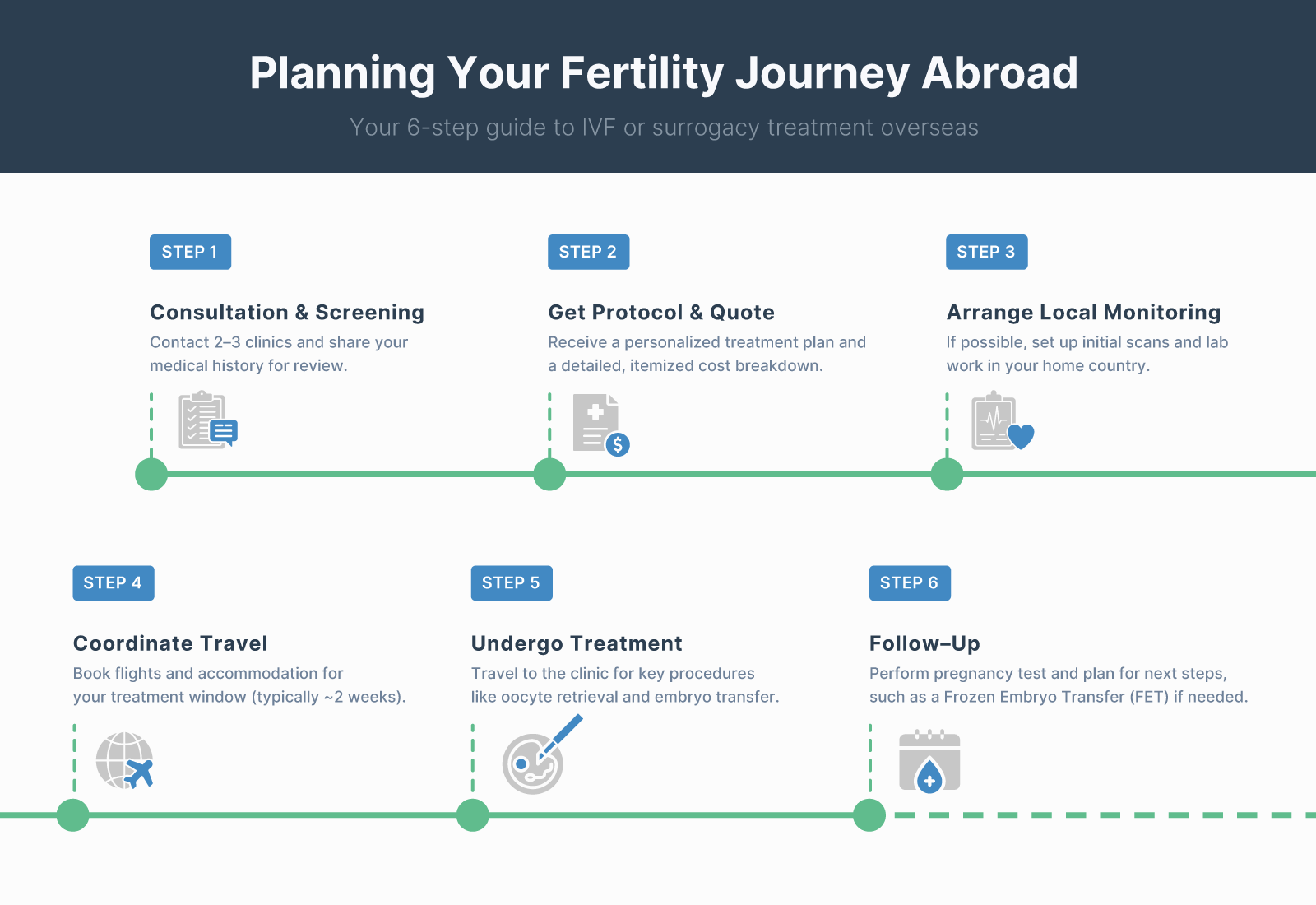
Fertility Abroad, planning timeline from consult to transfer and FET.
Want help comparing clinics and costs?
If this feels like a full-time job, and it can, our advisors can collect clear, itemized quotes from verified clinics and map your timeline at no cost to you.

Why trust this guide? The OVU commitment
You are probably juggling hope, timelines, and a lot of tabs open in your browser. And you deserve clear, current, human advice. At OVU, we review clinic protocols, compare real quotes, and talk to people who have done this - intended parents and gestational carriers - so we can give you practical steps, not just theory. If you want help comparing options without sales pressure, we will gather itemized quotes and success data that match your exact situation. You decide, we will bring the info to your table.
Frequently Asked Questions
Is fertility treatment abroad safe?
Yes. Top clinics run ISO or JCI aligned systems, experienced teams, and standard practices like eSET to reduce multiples. Check certifications, ask for complication rates, and confirm lab tools, time-lapse culture, PGT workflow, surgical sperm retrieval if needed.
How much can I realistically save by traveling for IVF?
Standard stimulated IVF starts around €1,800–€2,900 in Turkey, Albania, and the Balkans. Add meds, €500–€2,000+, FET, €800–€1,800, and PGT where needed. Real savings come from a clean, itemized bill, not just a low base price.
What hidden costs should I expect?
Meds, vitrification, storage and renewals, ET or FET fees, and donor shipping. In Romania, initial freezing plus one year storage runs €542.50–€703.25, in Spain, FET often costs €1,000–€1,800. Get every line in writing.
Can I rely on reported success rates?
Use them to ask better questions. Favor audited stats and request outcomes by age and diagnosis. Clarify embryos per transfer and whether results are per transfer, per cycle, or cumulative after multiple transfers. National registries like Spain’s SEF are solid benchmarks.
Which destinations are most inclusive for single women and LGBTQ+ couples?
Albania is highly inclusive, including surrogacy with counsel. Romania and Spain support single women and female couples, Spain offers ROPA for married couples. North Macedonia, Serbia, and Montenegro allow single unmarried women. Check current rules before you book.
How many trips are typical for an IVF cycle abroad?
Plan 10–14 days for a fresh cycle. Freeze-all with PGT usually means one trip for retrieval and a second, shorter trip for FET. You can often do early monitoring locally to shorten your stay.
Reference List 14 sources
Journal Article (Systematic Review): Strickland P, Ratten V. Fertility tourism, a systematic review. Int J Sociol Soc Policy. 2023. doi: 10.1108/IJSSP-02-2023-0047. Available from: https://www.researchgate.net/publication/369919155_Fertility_tourism_A_systematic_review
Journal Article (Systematic Review & Critical Review): Salama M, et al. Cross border reproductive care, a growing global phenomenon. J Assist Reprod Genet. 2018;35(7):1277–1288. PMID: 29808382. Available from: https://pmc.ncbi.nlm.nih.gov/articles/PMC6063838/
Committee Opinion (Guidance): ASRM Ethics Committee. Cross-border reproductive care, an Ethics Committee opinion. Fertil Steril. 2022. Available from: https://www.asrm.org/practice-guidance/ethics-opinions/cross-border-reproductive-care-an-ethics-committee-opinion-2022/
Journal Article (Comparative/Market Analysis): Paraskou A, George B. The market for reproductive tourism with reference to Greece. Glob Health Res Policy. 2017. Available from: https://www.researchgate.net/publication/317549380_The_market_for_reproductive_tourism_an_analysis_with_special_reference_to_Greece
Journal Article (Review): Christoforidis C, Anastasiadou SD. Assisted Reproduction in Greece in the context of medical tourism. Sci. 2025;7(4):149. doi: 10.3390/sci7040149. Available from: https://www.mdpi.com/2413-4155/7/4/149
Journal Article (Systematic Umbrella Review): Palomba S, et al. Interventions to prevent OHSS, systematic umbrella review. Reprod Biol Endocrinol. 2023;21(1):67. PMID: 37480081. Available from: https://pmc.ncbi.nlm.nih.gov/articles/PMC10360244/
Journal Article (Research): Parrella A, et al. High proportion of immature oocytes reduces outcomes following ICSI. Reprod Biomed Online. 2019;39(4):580–587. PMID: 31455582. Available from: https://pubmed.ncbi.nlm.nih.gov/31455582/
Journal Article (Review): Castillo JC, et al. GnRH agonist for ovulation trigger, OHSS prevention. Ups J Med Sci. 2020;125(2):131–137. PMID: 32366146. Available from: https://pubmed.ncbi.nlm.nih.gov/32366146/
Journal Article (Review): Smith V, et al. Prevention of Ovarian Hyperstimulation Syndrome. Obstet Gynecol Int. 2015:514159. PMID: 26074966. Available from: https://pubmed.ncbi.nlm.nih.gov/26074966/
Committee Opinion (Guidance): ASRM Practice Committee. Prevention of moderate and severe OHSS, guideline. Fertil Steril. 2024;121(2):230-245. Available from: https://www.fertstert.org/article/S0015-0282(23)02002-2/fulltext
Legislation: Spanish Government. Law 14/2006 of 26 May on Assisted Human Reproduction Techniques. Available from: https://www.boe.es/buscar/act.php?id=BOE-A-2006-9292
Website/Report: European Commission. Law no. 95/2006 on Health Reform, Romania, Title VI, Art. 157. Available from: https://economy-finance.ec.europa.eu/document/download/1cb59a04-e1b4-401f-a347-b95698402785_en?filename=joint-report_ro_en.pdf
Government Pricing Tool/Legislation: Turkish Ministry of Health. Legislation on Assisted Reproductive Techniques and Centres. Available from: https://www.resmigazete.gov.tr/eskiler/2014/09/20140930-4.htm
Government Website: Government of Albania. Law No. 8876 on Reproductive Health. Available from: http://www.qbz.gov.al/botime/fletore_zyrtare/2002/PDF-2002/42-2002.pdf
Final Thoughts
Align your eligibility, procedures, and total costs, and the right destination becomes clear. Spain offers audited outcomes and guaranteed bundles. Romania and Albania deliver broad access to fertility care to single women, female couples, and heterosexual couples at fair prices. Turkey provides strong lab capabilities with your own gametes. If you need surrogacy, Albania stands out here, confirm the legal steps with counsel, as gestational surrogate motherhood is still in a gray zone here. The country allows single men and male couples to create embryos using egg donation services and continue with surrogacy arrangements, as well as adapt the processes for others pursuing a baby via surrogate.
Preparation wins, demand detailed quotes for every line, confirm legal fit, and map your calendar. Solid information brings calm, and helps you spend wisely without surprises.