


Dr. Sony Sherpa (MBBS)
In addition to her clinical experience, Dr. Sherpa is a published medical researcher and holistic health advocate. Her dual expertise in emergency care and alternative therapies brings a unique lens to medically reviewed content—ensuring it is both accurate and accessible.
Thinking about egg freezing in your early thirties or early forties? Or perhaps considering oocyte vitrification at just 25? The decision about timing can feel both urgent and overwhelming. Whether you are booking a consultation or rushing to your first ultrasound scan in the middle of the midday office hustle, you might find yourself feeling overwhelmed and anxious. It is common to feel a deep sense of exhaustion, actually the kind of fatigue that no amount of sleep can cure, as you spend countless midnights searching for information and comparing oocyte vitrification bundles in your own country versus options on another continent. You might find yourself typing endless lines into a notebook, trying to determine which in-bundle services best suit your unique case. Before you invest financially in a specific bundle or start injections, you deserve a clear picture of what egg freezing involves, what it really costs, and what it gives you in return.
Egg freezing, also called “oocyte cryopreservation”, lets you store younger eggs for later. While it isn’t a guaranteed promise of having a genetically yours baby in the future, it can protect some of your fertility from age, medical interventions, or life delays that are outside your control. For many people, freezing eggs is less about chasing perfection and more about keeping the door open for a future family on a timeline that works for real life.
Age still matters. Outcomes are strongest when you freeze in your early to mid-thirties. For example, some economic models show that freezing at 33 and using those eggs later can cut total family building costs roughly in half compared with waiting and doing IVF at older ages. At the same time, studies find only about 10 to 15 percent of women actually return to use their frozen eggs, so you want to understand both the benefits and the trade-offs before you commit.
A single egg-freezing cycle typically takes 4 to 6 weeks from the first consultation to retrieval. In the United States, you can expect to pay $10,000 to $20,000 per cycle, including medications and cryostorage fees. In countries such as Mexico and in Europe (Bulgaria, Croatia, Serbia, Slovakia, and the Czech Republic), complete cycles can cost from $ 2,000 to $7,000. Your best fertility window for strong results and cost-efficiency is usually before age 35, when one or two cycles often yield 15 to 20 eggs and a roughly 70 percent chance of at least one baby later.
Next step: Use this guide to decide when to freeze, where to have treatment, and how many cycles and oocytes you are likely to need for your family goals.
What the Latest Research Shows
Large studies using national data sets now show that planned egg freezing can both increase your chance of having a baby later and lower the cost per live birth when you freeze in your early to mid-thirties. Economic models that compare freezing at 33 to waiting and IVF at 40 to 43 find higher live birth rates and tens of thousands of dollars in savings per family. Recent reviews also suggest that storing 20 or more mature eggs before age 38 gives roughly a 70 percent chance of at least one live birth from those eggs. (PMID: 36175208 and PMID: 25813281).
At the same time, real-world clinical data indicate that use rates remain low. Only around one in ten women who freeze eggs return to thaw and fertilize them within the current follow-up periods. This means egg freezing is more like an insurance policy than a guaranteed plan, and you should weigh it carefully against the financial and emotional costs of treatment. (PMID: 35974356).
In This Guide
Strongest results when you freeze before 35
Reasonable benefit up to about 37
15–20 mature eggs if you are under 38
Aim for 2+ cycles if older
USA: $10,000–$20,000 total
EU / Mexico: €2,000–€7,000 total
How Age Shapes Your Success and Your Budget
If you are deciding whether to freeze now or wait, age is the single biggest factor to consider. You can freeze at many ages, but both egg quality and egg count drop steadily through your thirties and more sharply in your forties.
When doctors talk about success rates, they often refer to live births per IVF cycle using eggs of a given age. Those numbers are not specific to egg freezing but give you a realistic frame for what frozen eggs from each age band are likely to do later.
Typical live birth rates per IVF cycle by age
| Age group | Approx. live birth per cycle | Notes |
|---|---|---|
| Under 34 | Around 74% | Higher egg quality and higher egg count available for retrieval and fertilization per cycle. |
| 35–37 | Around 55% | Good potential, however, fertility decline starts to show, thus, less chromosomally normal oocytes can be collected during the cycle. |
| 38–40 | About 18–26% | Lower egg quality, more cycles often needed to achieve a live birth. |
| 41–42 | About 2–6% | High aneuploidy rates, very low success with own eggs, therefore, using donor eggs is highly recommended. |
| 43+ | Approaches 0% | Rare successes using own eggs, many clinics strongly recommend using donor eggs to create an embryo. |
Latest Research Insights
73% vs. 50% – Cost-Effective Family Planning: In one large modelling study, women who froze eggs at 33 and used them at 40–43 had a 73 percent chance of having at least one baby. Women who skipped freezing and relied on IVF with genetic testing at 43 had a 50 percent chance. Average total costs per person fell from 62,000 dollars to 30,000 dollars when eggs were frozen earlier. This means that if you know you want children and plan to try later, egg freezing in your early thirties can both raise your chances and lower your overall spend. Source: Fertility and Sterility (PMID: 36175208).
$40k vs. $55k – Cheaper Baby at 35: Another analysis looking at women who plan to start trying at 40 found that freezing eggs at 35 dropped the average cost per baby from 55,000 dollars to 40,000 dollars. The chance of having a baby rose from 42 percent without freezing to 62 percent with freezing. For many people who expect to delay pregnancy to 40, egg freezing before 38 makes each live birth less expensive in the long run. Source: Fertility and Sterility (PMID: 25813281).
70% Chance – 20 Eggs Before 38: A 2023 review of planned egg freezing found that storing 20 or more mature eggs before age 38 gave roughly a 70 percent chance of at least one live birth from those eggs. Outcomes looked similar to IVF with fresh eggs of the same age, and no extra safety problems were seen in babies. This helps you and your doctor set realistic targets for how many eggs to bank at different ages. Source: Reproductive BioMedicine Online (PMID: 37804606).
These findings come from peer-reviewed research and give you a broad picture. Your own results will depend on your age, ovarian reserve, and health, so discuss these numbers with your fertility specialist.
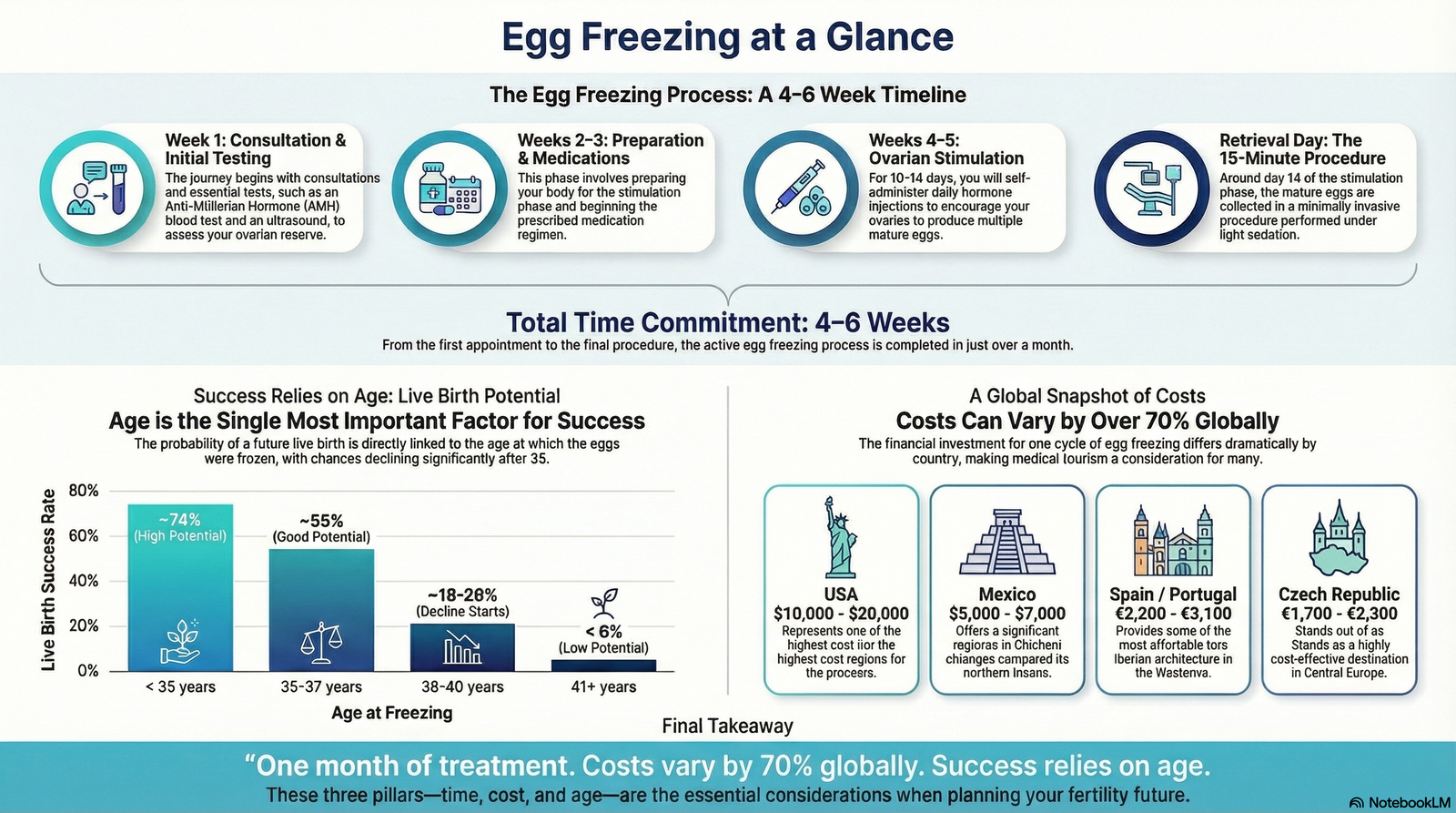
Egg freezing at a glance: 4–6 week timeline, age bands, and cost differences between regions.
Egg count per cycle matters as much as percentages. If you are under 35, one stimulated cycle often yields 10 to 20 mature eggs. For women over 40, a similar protocol may yield only 3 to 5 eggs. That gap is the main reason people in their late thirties and early forties sometimes need two or three retrievals to reach a safer egg number.
Several cost-effectiveness studies highlight the same pattern. When you freeze eggs in your early to mid-thirties and use them later, you usually need fewer retrievals, fewer IVF cycles, and fewer transfers. That is where a lot of the cost savings come from, even when you add storage fees and later thaw costs.
Egg Freezing Process and Timeline
If you are trying to picture what your month would look like with egg freezing, it helps to break the process into clear steps. In most clinics, one cycle of oocyte vitrification from the first consultation to retrieval takes around 4 to 6 weeks.
Week-by-week timeline
| Phase | Timing | What happens |
|---|---|---|
| Consult & testing | Week 1 | Medical history review, AMH and hormone labs, pelvic ultrasound, and completion of infectious disease screening. |
| Preparation | Week 2–3 | Finalization of the stimulation plan, ordering necessary medications from the pharmacy, and attendance of injection teaching. |
| Stimulation | 10–14 days | Daily hormone injections, clinic monitoring visits every 2–4 days. |
| Trigger & retrieval | Day 12–14 of shots | Trigger shot, egg retrieval under sedation in 34–36 hours later. |
| Vitrification | Same day | Mature eggs flash-frozen in liquid nitrogen and moved to long-term storage. |
In the first week, you usually have your consultation, baseline ultrasound, and blood work. The clinic checks your ovarian reserve, screens for infections, and confirms that egg freezing is medically reasonable for you. Many people also meet a financial counsellor at this point so that costs are clear before they start injections.
Stimulation is the most intense part of the process. For 10 to 14 days, you give yourself injections once or twice a day. You come into the clinic every few days for blood tests and an ultrasound scan to track your ovarian response to stimulative medications. The team adjusts your doses and timing based on how your follicles respond. Once several follicles reach 18 to 20 millimeters, you take a final trigger shot that ripens the eggs for collection.
Egg retrieval is a short procedure. You arrive fasting, change into a gown, and the anesthesiologist starts an IV. Under ultrasound guidance, your doctor passes a thin needle through the vaginal wall and gently draws out fluid from each follicle. You do not feel this while you are sedated. Most people rest for an hour or two afterwards, then go home with someone to drive them.
In the lab, embryologists identify mature eggs, expose them to protective solutions, and then vitrify them at extremely low temperatures. At that point, your eggs stop aging. They can stay in storage for many years without further damage.
What Real-World Egg Freezing Shows
3x Higher Cost – Freezing After 40: In a large single-center study, women who froze eggs at 40 or later spent 35,600 dollars per live birth, compared with 11,700 dollars when eggs were frozen at 35 or younger. Live birth per thawed case dropped from 64 percent in the youngest group to 18 percent in those 40 and over. This shows that waiting until 40 plus often means spending much more for a much lower chance of success. Source: Reproductive Biology and Endocrinology (PMID: 35974356).
52% vs. 19% – Age at Freezing Matters: A 2024 review that pooled 8,750 women found that those who froze eggs at 35 or younger had a 52 percent chance of a baby once they came back to use their eggs. Women who froze at 40 or older had only a 19 percent chance. This gap shows how strongly the age at freezing shapes your future live birth odds, even when the total egg number looks similar. Source: Human Reproduction Update (PMID: 38654466).
11% vs. 8% – Who Actually Uses Frozen Eggs: Across those same datasets, only about 11 percent of women returned to thaw their eggs. In a separate single-center series, the overall use rate was 8.4 percent. Among those who did return, roughly one-third had at least one baby. This means egg freezing behaves more like an insurance policy than a plan most people end up using. Source: Human Reproduction Update (PMID: 38654466) and Reproductive Biology and Endocrinology (PMID: 35974356).
Ethically Permissible – Professional Backing: The American Society for Reproductive Medicine (ASRM) states that planned egg freezing to reduce the chance of age-related infertility is ethically acceptable, as long as you have clear counselling on success rates, unknowns, risks, and costs. This means the main professional body in the United States views egg freezing as a reasonable option when you understand the trade-off. Source: ASRM Ethics Committee Opinion (PMID: 38430080).
These findings come from peer-reviewed research and guidelines. Your personal situation may differ, so use these numbers as a starting point for a detailed conversation on your unique case and options with your doctor.
Global Egg Freezing Cost Breakdown by Region
If you are budgeting for egg freezing, you will likely find that the list price on a clinic website often hides as much as it reveals. To compare options fairly and understand how much you should expect to pay for a bundle of services, you need to look at the full picture, including base cycle fees, medications, storage, and future thaw and transfer costs.
United States: Highest prices, broadest access
In the United States, egg freezing is still mostly paid out of pocket unless you have a generous employer benefit or a clear medical reason, such as cancer treatment. The total cost for one cycle commonly lands between 10,000 and 20,000 dollars.
| Cost component | Typical range (USD) | What is included |
|---|---|---|
| Base cycle fee | $4,500–$11,925 | Monitoring visits, bloodwork, ultrasound, retrieval procedure, and lab work. |
| Medications | $3,000–$6,000+ | Stimulation hormones, a trigger shot, and support meds. |
| Anesthesia | $500–$1,400 | Anesthesiologist fee and medications necessary for egg retrieval. |
| Storage | $500–$1,000 per year | Long-term storage of frozen eggs in liquid nitrogen. |
Some U.S.-based clinics, such as high-volume egg freezing centers, offer flat rate packages that include the first year of storage and medications. Others bill each piece separately. When you compare clinics, ask them to walk you through the total out-of-pocket cost for one and for two cycles, not just the base fee on the website.
Mexico: Lower prices with solid clinics
Mexico has become a huge hub for cross-border fertility care, especially for people traveling from the United States and Canada. Prices here are usually 65 to 70 percent lower than U.S. averages, and many clinics offer all-inclusive bundles, covering a single or multiple oocyte vitrification cycles.
- Ingenes (Tijuana, Mexico City): The core cost for the bundle of egg freezing services is around 10,373 dollars for a three-cycle package with genetic testing and a shared risk money-back guarantee policy; medications are usually charged additionally.
- The Fertility Center (Tijuana): The basic bundle costs 6,600 dollars for an all-inclusive cycle that covers consults, monitoring, retrieval, medications, and one year of storage.
- Enlistalo Fertilidad: The initial cost for egg freezing is 5,000 dollars for monitoring, retrieval, and vitrification, with medications typically costing 1,500 to 3,500 dollars on top.
If you live near the border or can travel easily, Mexico can allow you to complete two or three cycles for the cost of one full U.S. cycle, which matters if your ovarian reserve is low or you are trying to bank a larger egg number for having a possibility to have more than one child in the future.
Spain and Portugal: Established European hubs
Spain and Portugal attract many international patients because of strong IVF outcomes, liberal laws for single women in some cases, and transparent pricing.
- Spain (EUGIN, Fertilab, IVI, and others): egg freezing bundles often cost 2,200 to 3,100 euros and include 2 to 5 years of storage.
- Portugal (Ferticentro, Procriar): typical bundles are 2,700 to 3,100 euros with about 5 years of storage included.
If you already live in Europe or can travel there, these mid-priced options can give you high-quality labs without U.S. level costs.
The Czech Republic and Slovakia: Lower fees, no long wait
The Czech Republic and Slovakia have built strong reputations for good outcomes, reasonable prices, and fewer delays.
- Czech Republic (Gennet, IVF Cube, and others): single retrieval starting around 1,690 to 2,300 euros, with some three-cycle packages at 4,600 to 4,790 euros.
- Slovakia (ReproMedica, Gyn FIV): packages often cost 1,300 to 1,500 euros per cycle.
Many clinics in these countries include several years of storage in the base price and offer English-speaking coordinators to support international patients.
Southeastern Europe (Balkans): Lowest European prices
This region offers some of the lowest published prices for egg freezing in Europe, helped by lower living and staffing costs.
- Bulgaria: stimulated cycles around 1,500 to 1,600 euros. Natural, unmedicated cycles can be as low as 750 euros.
- Greece: stimulation cycles with 12 months of storage often cost 2,225 to 2,500 euros.
- Romania: vitrification of oocytes typically costs 1,400 to 1,500 euros.
If you have family connections or travel ties to this area, these clinics can stretch your budget further, especially if you expect to need more than one cycle.
Other regions to know about
- Caribbean (Barbados, Cayman Islands): packages start at approximately 4,950 dollars.
- United Arab Emirates (UAE): roughly 1,000 to 6,500 euros, depending on clinic and inclusions.
- India: commonly 2,650 to 3,000 euros for a cycle.
Hidden Costs You Need To Plan For
When you compare clinics, it is easy to focus on the main price tag and miss everything around it. To build a realistic budget, you want to add four more categories.
Medications: 1,500 to 6,000 dollars
Drug costs vary by country and by the doses you need. If your ovarian reserve is low, you often need higher doses, which means more vials. In some countries, such as Turkey, branded drugs like Gonal F have much lower pharmacy prices than in the United States, where many women pay several thousand dollars per cycle even with discount cards.
Pre-cycle testing: 300 to 1,200 dollars
Most clinics bill basic workups separately. That usually includes infectious disease screening for HIV, hepatitis B and C, and syphilis, hormone labs such as AMH and FSH, and standard blood tests. You may be able to do some of these exams through your regular doctor or insurance coverage, which can reduce out-of-pocket spending.
Annual storage: 200 to 1,000 dollars or euros per year
Many clinics include the first year of storage in the base cycle fee. Thereafter, you pay yearly for the tank space and monitoring.
- Spain: about 300 euros per year.
- Slovakia: about 150 euros per year.
- United States: 500 to 1,000 dollars per year.
If you freeze in your early thirties and expect to store eggs for five to ten years, storage can add several thousand dollars to your total. Ask about discounts for multi-year prepayment or paying out of a health savings account if you have one.
Future costs: thaw, fertilization, transfer, and possible testing
Freezing the eggs covers only the first half of the journey. When you want to use those eggs later, you pay new fees for thawing and IVF or ICSI.
- Thaw and ICSI: often 1,200 to 2,500 euros in European clinics, higher in the United States.
- Embryo transfer: commonly 1,000 to 1,500 euros or dollars per transfer.
- Genetic testing (PGT-A): about 2,000 to 6,000 dollars, depending on the number of embryos and the lab used.
When you compare the idea of freezing now with the option of doing IVF later, you will want to include these future costs on both sides of the equation so that you are not surprised when it is time to build your family.
Special Situations: Cancer, Endometriosis, Transgender Care
Not everyone comes to egg freezing from the same place. Your medical history, gender identity, or diagnosis can change which option fits you best.
Oncofertility: before cancer treatment
If you are about to start chemotherapy or radiation, time really matters. Sometimes you can safely fit in a full stimulation cycle before treatment. In other cases, your oncology team wants to begin therapy within days.
When there is not enough time for standard egg freezing, doctors may offer ovarian tissue cryopreservation. In this procedure, a surgeon removes part or all of an ovary in a short operation, and the tissue is frozen. Later, doctors can sometimes reimplant the tissue to restore hormonal function and the chance of pregnancy. This approach is currently the only option for girls who have not yet gone through puberty.
Endometriosis: freezing before surgery
If you have endometriosis, especially large ovarian cysts called endometriomas, surgery can reduce the number of eggs you have left. Many specialists now suggest that you at least discuss egg freezing before planned ovarian surgery. In some situations, doing one or two freezing cycles first protects some of your egg supply, then you proceed with surgery for pain or other symptoms.
Transgender patients
For transgender men, testosterone therapy and surgical transition can lower or end egg production. Professional societies support offering egg freezing before long-term hormones or operations that remove the ovaries. That usually means a separate fertility consultation and a plan for how long you would pause hormones to go through stimulation and retrieval.
Minimal or soft stimulation when the reserve or budget is low
If your ovarian reserve is low or your budget is limited, some clinics offer mild stimulation protocols. These use lower drug doses, fewer injections, and often fewer monitoring visits. You get fewer eggs per cycle, but each round costs less.
In Mexico and Turkey, for example, some mini-IVF-style packages for egg freezing are priced around 3,100 to 4,200 dollars. These can be a practical choice if high-dose medications would be too hard on your body or your finances, and you are comfortable doing more than one retrieval.
Clinic and Country Cost Comparison Table
This table pulls together some example price structures so that you can see how base fees, medications, and storage line up between regions. Use it as a starting point for your own clinic shortlist and always confirm current pricing directly with the clinic.
| Clinic / Region | Base cycle fee | Medications | Storage (annual) | Notes |
|---|---|---|---|---|
| Extend Fertility (New York, USA) | $9,000+ | $4,000–$6,000 | Included first year | High-volume egg freezing specialist center |
| CCRM Fertility (USA) | $9,215–$11,925 | $4,000–$10,800 | Extra | Multi-cycle discounts are often available |
| Adore Fertility (USA) | $5,500 | Included | Included the first year | Flat rate, all-inclusive cycle |
| Serum IVF (Greece) | €2,500 | €1,000–€2,000 | €100 per straw | Includes vitrification of two straws, up to eight eggs in total |
| Bahçeci Group (Turkey) | $3,800–$4,950 | $1,500–$3,000 | $255 | Often includes methods to improve egg quality and lab outcomes |
| Prague IVF (Czechia) | €1,900–€3,100 | From €600 | First 3 years free | Popular option for EU-based patients |
| Ferticentro (Portugal) | €3,100 | Extra | First 5 years free | Strong focus on international patients |
| The Fertility Center (Mexico) | $6,600 | Included | First year free | Fully bundled package, including monitoring and retrieval |
How to Choose Where and When to Freeze
By this point, you have seen how much age, location, and clinic model can change both your odds and your costs. The next step is to make a plan that fits your life.
If you are under 35 and know you want children someday but are not ready yet, you sit in the sweet spot where one or two cycles can often bank 15 to 20 eggs with good quality. In that band, your main question is usually whether you can afford to act now, not whether it is biologically worth it.
If you are 35 to 38, egg freezing can still give real benefits, but you should expect slightly fewer eggs per cycle and possibly more than one retrieval. If you are 39 or above, your doctor may raise donor eggs as a backup option, especially if testing shows low reserve.
Clinic choice often comes down to a trade-off between travel and cost. You might decide to stay local for convenience, to travel to a mid-cost European hub for a balance of price and access, or to choose a lower-cost region such as Mexico, Czechia, or parts of the Balkans so that you can afford extra cycles if needed. There is no single right answer. The best choice is the one that gives you enough eggs for your goals without breaking you financially or emotionally.
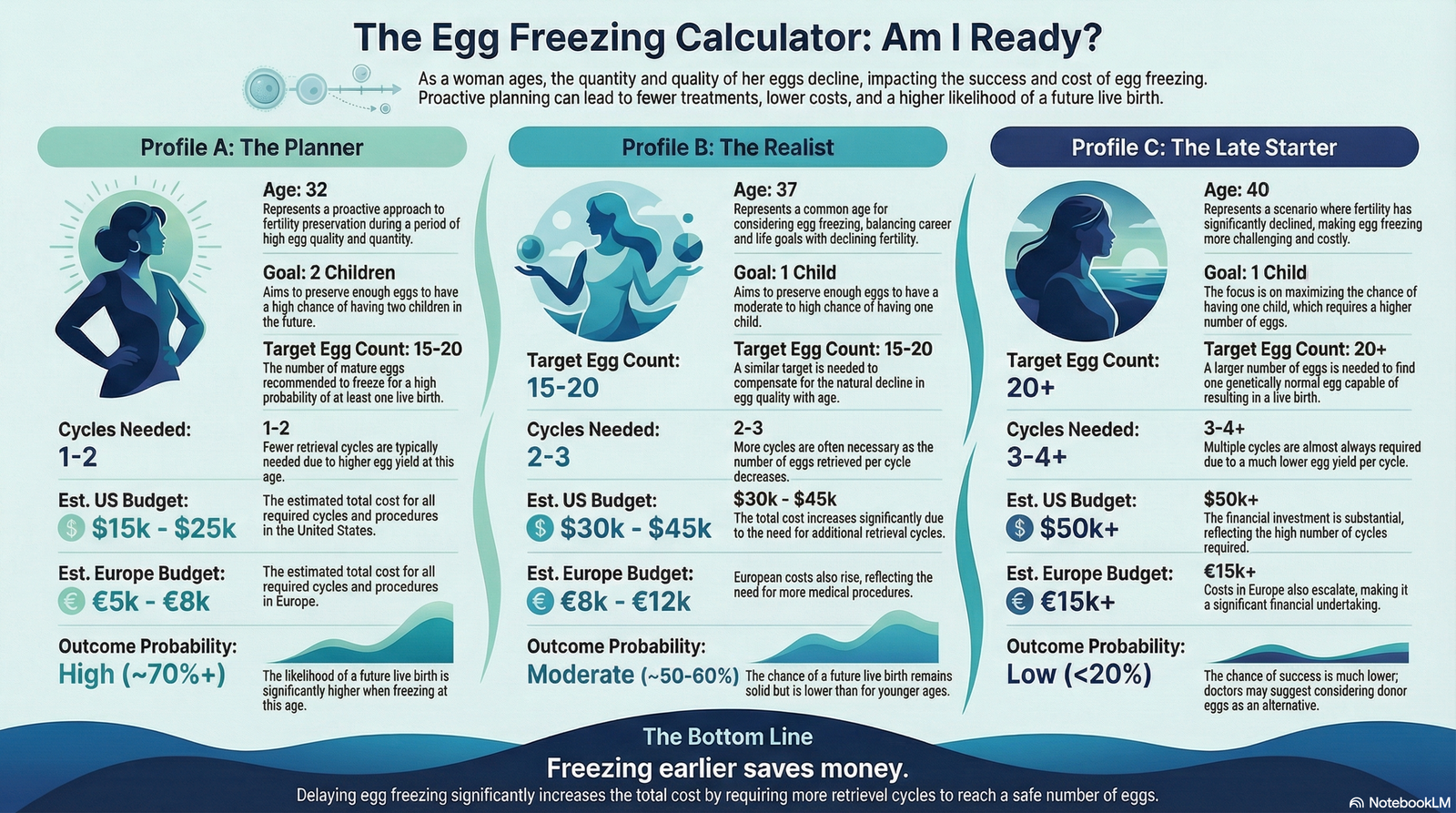
Putting it together: how age, egg targets, and regional pricing shape your total egg freezing budget.
OVU Expert Guidance: Turning Data Into a Plan
If you are under 35 and hope to have one or two children in the future, many specialists suggest aiming for 15 to 20 eggs, often achievable in one or two cycles. Between 35 and 38, you may need two cycles to reach that range. At 39 and above, the numbers become more personal and often depend on your ovarian reserve tests, how aggressively you want to pursue treatment, and how open you are to donor eggs later.
It can feel like a full-time job to compare clinics, currencies, and protocols across countries while also living your daily life. Working with a neutral advisor who knows current prices and outcomes in different regions can save you weeks of research and costly missteps.
Want help comparing clinics and costs?
If this feels like a full-time job, and honestly it can, our advisors can collect clear, itemized quotes from verified clinics and map your egg freezing timeline at no cost to you.

Why trust this guide? The OVU commitment
You are probably juggling hope, timelines, and a lot of tabs open in your browser. And you deserve clear, current, human advice. At OVU, we review clinic protocols, compare real quotes, and talk to people who have done this - intended parents and gestational carriers - so we can give you practical steps, not just theory. If you want help comparing options without sales pressure, we will gather itemized quotes and success data that match your exact situation. You decide, we will bring the info to your table.
Frequently Asked Questions
Does insurance cover egg freezing?
In most places, and especially in the United States, insurance only covers egg freezing when there is a clear medical indication, such as upcoming chemotherapy. Coverage for so-called “social freezing” is still rare, but global companies now offer it as a benefit for their employees. Roughly one in five large tech and finance companies includes some egg freezing coverage for hired women. It is worth checking with your HR team or reading through your benefits guide instead of assuming the answer is no.
How long can my eggs stay frozen?
Eggs stored at around –196 degrees Celsius do not age in the tank. Studies have reported healthy births from eggs frozen for more than 10 to 15 years. In practice, clinic policies or local laws about maximum storage time are more likely to limit how long you can keep them than any problem with the eggs themselves.
Is the egg retrieval procedure painful?
You are asleep or deeply sedated for the retrieval itself, so you do not feel the needle. Afterwards, many people describe a sore, bloated feeling similar to heavy period cramps. That usually eases over a few days. The stimulation phase beforehand can bring mood swings, bloating, and breast tenderness because your hormone levels are much higher than usual.
What are the main risks of egg freezing?
The most talked about medical risk is ovarian hyperstimulation syndrome, when the ovaries respond very strongly to the medications. Severe cases are less common now because clinics use safer protocols, especially for people with PCOS. There are also small risks of bleeding, infection, or injury around the time of retrieval. On the outcome side, there is a real possibility that egg freezing will not lead to a baby later, especially at older ages or with very low egg counts. Your doctor should talk through all of these with you based on your personal profile.
Should I freeze eggs or embryos?
If you do not have a partner or are not ready to choose a sperm donor, freezing eggs keeps your options open. If you have a partner and both of you agree, freezing embryos often gives slightly clearer odds because the lab can see which eggs fertilize and develop. Laws in your country about who controls stored embryos also matter. This is a personal decision, and many couples take time to talk through what would happen to embryos in different future scenarios before they choose.
Can I freeze eggs if I have PCOS?
Yes. Many women with PCOS freeze eggs. PCOS ovaries often produce a lot of follicles, which can help you get more eggs, but that also raises the risk of hyperstimulation. Clinics use specific protocols and monitoring plans for PCOS patients to keep things as safe as possible. Make sure your doctor knows about any history of very irregular cycles, very high AMH levels, or past strong responses to fertility drugs.
Is egg freezing really an insurance policy?
Egg freezing works more like buying extra chances than buying a guarantee. If you bank 20 good-quality eggs before 35, some models suggest your chance of at least one baby can reach 70 to 90 percent. That is a strong bump, but there is still a gap between that number and 100 percent. If you think of it as paying today for better odds and more choices later, rather than as a promise, you are more likely to feel at peace with whatever outcome you get.
Reference List 6 sources
Journal Article (Cost-Effectiveness Study): Bakkensen JB, Flannagan KSJ, Mumford SL, Hutchinson AP, Cheung EO, Moreno PI, et al. A SART data cost-effectiveness analysis of planned oocyte cryopreservation versus in vitro fertilization with pre-implantation genetic testing for aneuploidy considering ideal family size. Fertility and Sterility. 2022;118(5):875–884. PMID: 36175208. Available from: https://pubmed.ncbi.nlm.nih.gov/36175208/
Journal Article (Cost-Effectiveness Study): Devine K, Mumford SL, Goldman KN, Hodes-Wertz B, Druckenmiller S, Propst AM, et al. Baby budgeting: oocyte cryopreservation in women delaying reproduction can reduce cost per live birth. Fertility and Sterility. 2015;103(6):1446–1453.e2. PMID: 25813281. Available from: https://pubmed.ncbi.nlm.nih.gov/25813281/
Journal Article (Research): Yang IJ, Wu MY, Chao KH, Wei SY, Tsai YY, Huang TC, et al. Usage and cost-effectiveness of elective oocyte freezing: a retrospective observational study. Reproductive Biology and Endocrinology. 2022;20:123. PMID: 35974356. Available from: https://pubmed.ncbi.nlm.nih.gov/35974356/
Ethics Committee Opinion: Ethics Committee of the American Society for Reproductive Medicine. Planned oocyte cryopreservation to preserve future reproductive potential. Fertility and Sterility. 2023;119(4):617–622. PMID: 38430080. Available from: https://pubmed.ncbi.nlm.nih.gov/38430080/
Journal Article (Review): Song BB, Quinn MM. Planned oocyte cryopreservation: the state of the ART. Reproductive BioMedicine Online. 2023;47(6):104–117. PMID: 37804606. Available from: https://pubmed.ncbi.nlm.nih.gov/37804606/
Journal Article (Systematic Review & Meta-Analysis): Hirsch A, Hirsh Raccah B, Rotem R, Hyman JH, Ben-Ami I, Tsafrir A. Planned oocyte cryopreservation: a systematic review and meta-regression analysis. Human Reproduction Update. 2024;30(5):558–568. PMID: 38654466. Available from: https://pubmed.ncbi.nlm.nih.gov/38654466/
Final Thoughts
If you are reading this, you are already doing the hard and brave work of facing your fertility head-on. That alone is a big step. It is completely normal to feel scared, angry, or guilty that you did not think about this sooner. You are not behind. You are exactly where you are today, and you are allowed to make the best decision you can with the information you have now.
Egg freezing is not just a bill or a medical procedure. It is a way to store some of your younger eggs so that your future self has more choices, even if life, work, or health pull you in other directions first. The process can feel intense, both physically and emotionally, and the price tag is real. When you understand the timeline, the real costs, and the realistic success rates, you give yourself the chance to choose from a place of clarity instead of panic.
If you are under 35 and seriously considering children someday, your window for the most biologically and financially efficient egg freezing is open right now. If you are older, that window is narrower, but there may still be a path that fits your goals and budget. A thoughtful conversation with a fertility specialist can help you turn all these numbers and regions into a plan that fits your life.
It can help to think of egg freezing like travel insurance for a trip you might take years from now. You pay for protection today so that, if the weather of your natural fertility turns rough later, you are not starting from zero. You have younger eggs waiting, and that can make a real difference when your body, your life, and your plans finally line up.
Ready to explore your egg freezing options?
If you want a clear, side by side view of clinics, costs, and likely outcomes based on your age and goals, book a free call with an OVU fertility advisor. Together you can map the timing, budget, and clinic short list that makes the most sense for you.
Related articles

Embryo Freezing (Cryopreservation): Costs, Timelines, Success Rates and What to Expect
Fertility Preservation & IVF Your guide to embryo freezing and frozen embryo transfer Last Updated: 23 February 2026 Medically Reviewed 15 min read Evidence-based You are not alone if you are thinking about your future plans while also considering your age. Many people now freeze embryos in their late twenties, thirties, or early forties to keep more options open for the future. You might be in the middle of IVF, about to start chemotherapy, or simply not ready to be pregnant yet. It is perfectly normal to feel torn between your own timeline and your body’s timeline. With modern vitrification,
18 min read
Sperm Banking Guide: Costs, Process, and Success Rates
Fertility Preservation Your guide to sperm banking and fertility preservation Last Updated: 19 February 2026 Medically Reviewed 14 min read Evidence-based If you are thinking about sperm banking, you are probably balancing a lot at once. You might be facing a new cancer diagnosis, planning gender-affirming treatment, or simply not ready for children yet. At the same time, you do not want to close the door on a future family while you focus on survival, transition, career, or finding the right partner. That is why sperm banking matters. Studies have reported healthy births from sperm stored for 21 to 40
17 min read
Egg Freezing Success Rates by Age: How Timing Shapes Your Chances
Fertility Preservation & Egg Freezing Your guide to egg freezing success rates by age and how timing, costs, and clinic choice affect your future options. Last Updated: 16 February 2026 Medically Reviewed 17 min read Evidence-based If you are wondering about oocyte vitrification and whether to do it soon, you may feel rushed, anxious, or frustrated that your ideal partner hasn’t shown up. You may be thinking about how motherhood right now might interfere with new career possibilities; perhaps you are starting a business from scratch and need time to become a leader in your niche, or you may be
18 min read