


Dr. Sony Sherpa (MBBS)
In addition to her clinical experience, Dr. Sherpa is a published medical researcher and holistic health advocate. Her dual expertise in emergency care and alternative therapies brings a unique lens to medically reviewed content—ensuring it is both accurate and accessible.
If you are thinking about sperm banking, you are probably balancing a lot at once. You might be facing a new cancer diagnosis, planning gender-affirming treatment, or simply not ready for children yet. At the same time, you do not want to close the door on a future family while you focus on survival, transition, career, or finding the right partner.
That is why sperm banking matters. Studies have reported healthy births from sperm stored for 21 to 40 years, and modern freezing methods keep roughly 92 percent to 98 percent of sperm alive after thawing. When clinics use techniques like intracytoplasmic sperm injection, or ICSI, pregnancy rates can reach about 30 percent to 35 percent per cycle with frozen sperm, compared with around 9 percent with intrauterine insemination, or IUI, using banked sperm.
Professional groups such as the American Society for Reproductive Medicine and the American Society of Clinical Oncology recommend that postpubertal males who face cancer treatment be offered sperm cryopreservation before therapy starts. This guide walks you through what that actually looks like in real life, what it tends to cost in different regions, who should consider it, and how banked sperm is used later if you need it.
Sperm banking means freezing and storing your sperm in liquid nitrogen so you can use it for fertility treatment in the future. You usually have a consultation, provide one or more semen samples, and pay an initial freezing fee plus a yearly storage fee. In the United States, total first-year costs often range from $1,000 to $4,000, with yearly storage fees around $250 to $500. Long-term studies show healthy children born from sperm stored for decades, and modern ICSI techniques can achieve pregnancy even with very low sperm numbers.
Next step: If you know cancer treatment, hormone therapy, vasectomy, or major surgery is coming, talk with a fertility clinic as early as possible so you do not miss your window to bank sperm.
What the Latest Research Shows
Large studies on sperm banking for cancer patients and other high-risk groups show three key themes. First, sperm freezing is effective, with pregnancy and birth rates for IVF and ICSI that are similar whether sperm is fresh or frozen. Second, only about 3 percent to 9 percent of men actually return to use their banked sperm, often because fertility recovers, but for those who remain infertile, stored sperm is their only option for a biological child. Third, long-term storage in liquid nitrogen does not appear to harm the molecular pathways that matter for sperm function, even after many years.
These findings come from registry studies, meta-analyses, and laboratory work on sperm survival and DNA quality after freezing and thawing.
In This Guide
Healthy births from sperm stored 21 to 40 years.
Legal storage limits vary by country.
Motility often drops about 50 percent.
ICSI can still work with very low counts.
US first year: about $1,000 to $4,000.
Eastern Europe: about €200 to €500 per year.
Why sperm banking matters
When you are hit with a serious diagnosis or a big life change, it is easy to live day to day. Thinking about future children can feel distant or even wrong when you are trying to stay healthy or finally feel at home in your body. At the same time, many people who survive cancer, complete transition, or move through their forties later wish they had kept the door open for a biological child.
Cancer therapies such as chemotherapy and radiation can damage or destroy the stem cells in your testes that make sperm. Some drugs, including alkylating agents like cyclophosphamide, have a well-documented risk of long-term infertility. Pelvic or testicular radiation can have similar effects. The hit to fertility often starts with the first cycles of treatment.
On top of this, cancers like testicular cancer and Hodgkin lymphoma can harm sperm quality even before you start therapy. Many men already have low counts, poor motility, or even azoospermia at the time of diagnosis. Studies suggest that 13 percent to 30 percent of men with these cancers have no sperm in their ejaculate at diagnosis. A fair number recover sperm production in the years after treatment, but about 15 percent to 30 percent stay infertile. For them, banked sperm is the only path to a biological child.
Key Research Insights on Sperm Banking
9% Use Rate, 28% Pregnancy Rate: A meta-analysis of 69 studies and more than 32,000 men with cancer found that around 9 percent eventually used their frozen sperm. When they did, about 28 percent of treatment cycles led to pregnancy and about 20 percent to live birth. This shows that although not everyone will need their banked sperm, it works well when they do. (PMID: 38389980).
Over 7000 Men Tracked: A registry following 7,044 men over 30 years found that men who banked for male factor infertility used their samples in about 42 percent of cases, while cancer patients used theirs in around 9 percent of cases. Younger patients were less likely to return. This highlights that banking is real insurance, even if you never need to claim it. (PMID: 40002282).
Storage Time Does Not Harm Pathways: Molecular work comparing sperm stored for one week versus a median of nine years found only small changes in a few transcripts and no disruption of the key pathways involved in fertility. That supports the idea that long-term storage is biologically safe for sperm. (PMID: 39285325).
These studies support sperm banking as a practical way to protect your chance at a biological child when fertility is at risk.
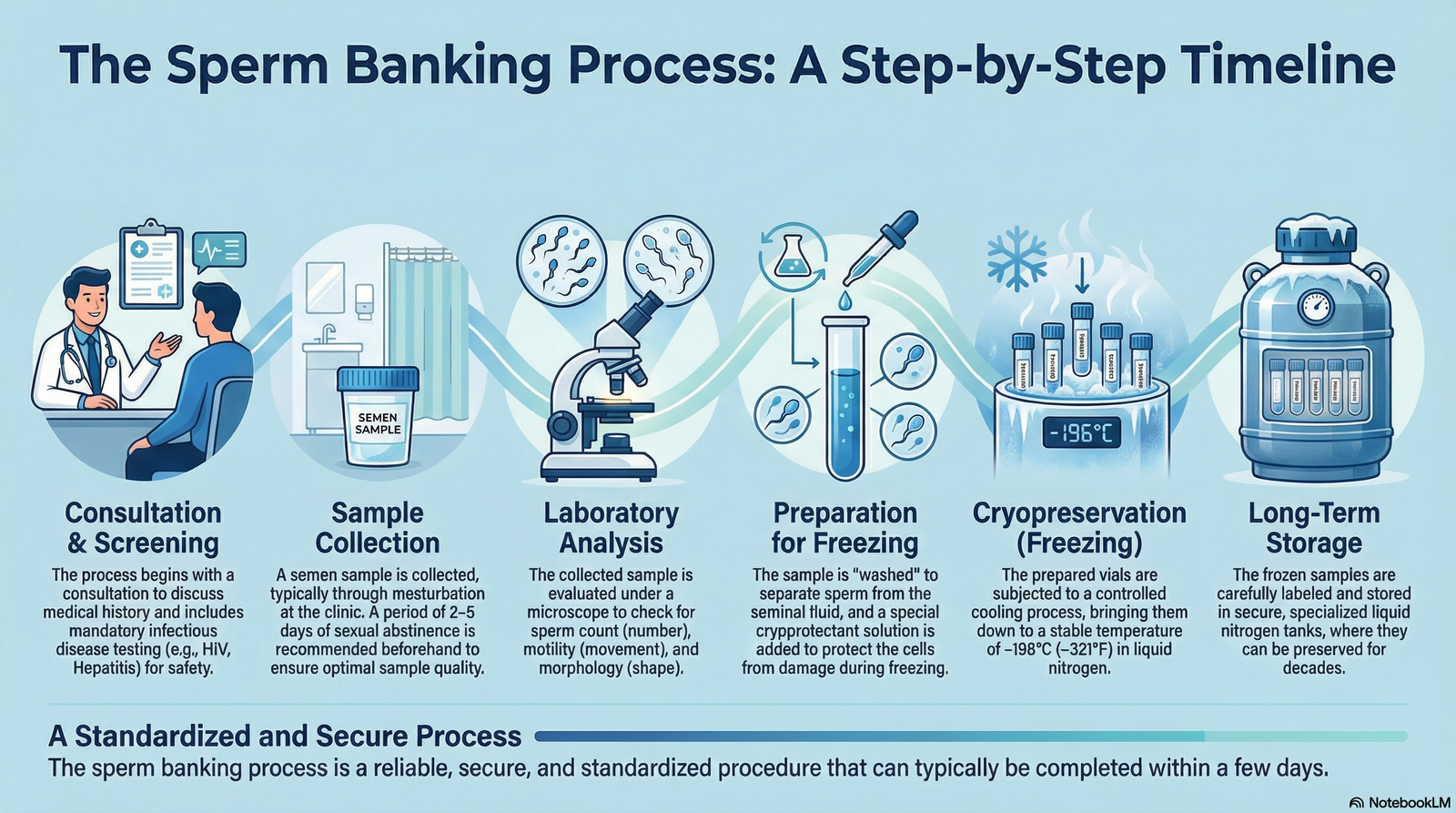
Sperm banking timeline: from the first consultation to long-term storage of frozen sperm in liquid nitrogen.
Who should consider sperm banking?
You might benefit from sperm banking in more than one situation. Here are the main groups of people who tend to use it.
Cancer and other medical diagnoses
If you are about to start chemotherapy, radiotherapy, a stem cell transplant, or surgery that involves the testes, sperm banking should be on your list. This includes treatment for testicular cancer, lymphoma, leukemia, sarcomas, autoimmune disease that needs high-dose cyclophosphamide, and some bone marrow conditions.
Guidelines from ASRM and ASCO recommend that doctors talk about fertility preservation early and offer sperm banking to postpubertal males before gonadotoxic therapy begins. That conversation sometimes gets rushed in the scramble to plan treatment, so you may need to raise it yourself.
Trans women before gender affirming treatment
If you are a trans woman planning estrogen therapy, anti-androgen therapy, or orchiectomy, this is also the time to think about sperm banking. Hormone therapy lowers testosterone and can shut down sperm production. Orchiectomy removes the testes and stops sperm production completely.
Some surgical studies still find spermatozoa in tissue from trans women on hormones, but the degree of damage is unpredictable. If you know you might want a biological child in the future, the safest path is to bank sperm before you start full hormone doses or undergo testicular surgery.
Men delaying parenthood or planning a vasectomy
More men are choosing to freeze sperm in their late twenties or thirties as a way to lock in current sperm quality. You might be doing well in your career, not ready to parent yet, or still waiting to meet the right partner. You also know that age, illness, environmental toxins, and lifestyle can all chip away at sperm quality over time.
Others bank sperm before a planned vasectomy. Reversal surgery does not always restore sperm to the ejaculate, and it is more complex and expensive than using stored sperm with IVF and ICSI. Banking before a vasectomy gives you a clear backup if life plans change.
Men with trouble ejaculating or with obstructive azoospermia
You may not be able to produce a semen sample at will, or your semen may not carry sperm out of the testes even though they are still being made. In those cases, surgeons can retrieve sperm directly from your reproductive tract with procedures such as TESE, TESA, MESA, or micro TESE. The lab can then freeze the retrieved sperm for later ICSI.
Global cost breakdown
Knowing the price of sperm banking upfront helps you make a clear plan. You face two kinds of costs. The first is a one-off fee for consultation, tests, and freezing. The second is an ongoing storage fee, usually billed yearly or every six months.
| Region | Initial Freezing and Setup | Storage Fees |
|---|---|---|
| United States | $500–$1,000 for freezing only; $1,000–$4,000 including consult and tests | $250– $500 per year |
| Caribbean (examples) | $550 for a freezing pack | $550 per extra year |
| Central and Eastern Europe | About €100–€500 depending on country and package | Often included for 12–36 months, then about €140–€400 per period |
| Australia | About $526.50 for initial freezing | About $280 every six months |
| Portugal | About €105 for semen analysis and about €750 for freezing | Varies by clinic |
| Germany | Around €350 for cryopreservation | About €180 every six months |
These ranges come from published clinic fee schedules. Individual quotes will vary, especially if your insurance covers part of the cost, or if you qualify for special programs as a cancer patient.
How to Read the Cost Numbers
First Year vs. Long Term: Your first year is always the most expensive because it includes consultations, tests, and at least one freezing session. Later years are less expensive, because you only pay an annual fee for storage.
Country Comparisons: Prices in Central and Eastern Europe are often lower than in the United States or Australia. For example, some Romanian and Greek clinics list full first-year costs around €200 to €500, while U.S. clinics often charge four to eight times that.
Treatment Planning: Remember that banking sperm is only one part of the long-term cost of treatment. IVF and ICSI cycles carry separate fees, so you should look at the full picture, not only the cryopreservation and storage price.
Step-by-step sperm banking process
Once you decide to bank sperm, the actual process is fairly straightforward. Most clinics can complete it within a few days, and many cancer centers fast-track urgent cases so that treatment is not delayed.
1. Consultation and screening
You first meet with a male fertility specialist or a consultant andrologist. During your first consultation, you will discuss your medical history, medications, family plans, and timing. The clinic orders blood tests to screen for infections such as HIV, hepatitis B and C, and syphilis. These tests are standard for anyone storing germ cells or tissue.
2. Semen collection
Most men produce a sample by masturbation in a private room at the clinic. Staff give you a sterile container and clear instructions. You usually need to avoid ejaculation for two to five days before the visit to get the best sample.
If you collect at home, the clinic will tell you exactly how to store and transport the sample. In many cases, you must deliver it within an hour, keep it at room or body temperature, and use the container they provide.
3. Laboratory analysis
After you hand in the sample, the lab measures semen volume, sperm concentration, motility, and morphology. They compare the numbers with World Health Organization reference ranges. If your count is very low or if no sperm are seen, the team may recommend a repeat sample or a surgical retrieval like TESE or TESA.
4. Preparation and cryoprotectant
The lab then processes the sample. They separate the sperm from the seminal fluid, white blood cells, and debris, and concentrate the healthiest sperm. They add a cryoprotectant solution that helps protect cells from ice crystal damage during freezing.
5. Freezing and storage
The embryologist loads the prepared sperm into labeled vials or straws. They cool the samples in a controlled way, often in nitrogen vapor, then immerse them in liquid nitrogen at minus 196 degrees Celsius. The clinic stores your samples in secure tanks and logs each vial in its system.
In many centers, staff split your samples between different tanks or locations so that a single tank failure cannot destroy everything. You will sign consent forms that explain how long your samples can be stored, what happens if you stop paying the annual storage fees, or what should be done with the sperm samples if you decide not to use them. These forms usually outline your options to either discard the samples, donate them to research, or, in some jurisdictions, donate them to another person for their own fertility journey.
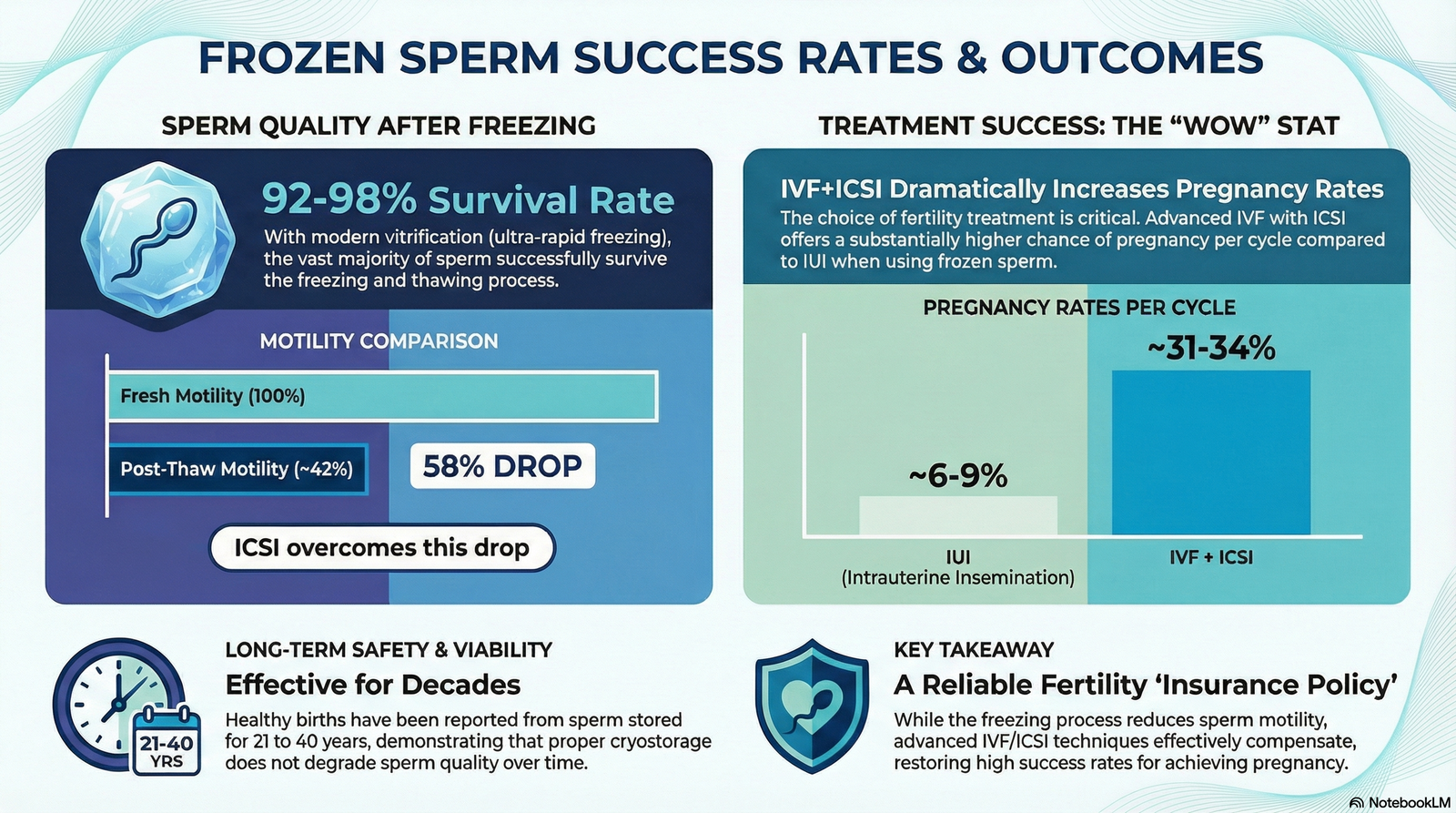
Frozen sperm survival and treatment outcomes: high post-thaw survival and stronger results with ICSI than with IUI.
Success rates and sperm quality after freezing
The main fear many people have is that frozen sperm will not work as well as fresh sperm. However, the research is reassuring. Freezing does reduce the number of moving sperm. In one long-term Canadian series, progressive motile sperm dropped by 58 percent after thawing. Even so, IVF and ICSI outcomes with frozen sperm were strong.
In that Canadian center, 81 men came back to use their banked sperm over 20 years. Among the 67 couples whose full records were available, 53.7 percent achieved at least one clinical pregnancy. The clinical pregnancy rate per IUI cycle was around 6.6 percent. The clinical pregnancy rate per embryo transfer with IVF and ICSI was about 31 percent.
The larger meta-analysis across 69 studies found overall pregnancy rates around 28 percent and delivery rates around 20 percent per treatment cycle using banked sperm in cancer survivors. ICSI produced the highest pregnancy and delivery rates, followed by IVF, with IUI being the least effective option when using frozen samples.
On the biological side, freezing can increase DNA fragmentation in some sperm cells, especially in those already under oxidative stress. Even so, sperm stored for nearly three decades have shown normal binding to the zona pellucida, and molecular work has not found major damage to the pathways involved in fertility. The main impact appears in motility, not in the deeper machinery of fertilization.
Choosing a sperm bank or fertility clinic
OVU Expert Guidance for Choosing a Clinic
Look Beyond Price Alone: Low-cost storage is helpful, but you should also ask about lab methods, success rates, and support for cancer and trans patients. A clinic that offers vitrification, clear counseling, and coordination with your oncology or gender team may save you far more stress later than a slightly cheaper storage fee in another city.
Ask About Long-Term Stability: You are trusting a center with genetic material you might want twenty years from now. Look for established clinics with stable ownership, robust tank monitoring systems, and written policies for what happens if they merge, move, or close.
Use Expert Help: Comparing international prices, laws, and clinic quality alone can feel like a full-time job. Independent advisory services can help you collect written quotes and understand the trade-offs between countries and centers.
When you compare sperm banks and clinics, it is easy to get lost in the numbers. Here are practical questions that keep you focused on what matters.
- What freezing method do you use? Ask whether they use slow freezing, vitrification, or both, and how their survival and motility numbers look in real practice.
- How long have you stored sperm successfully? Centers with decades of experience and documented births from long-stored samples give extra reassurance.
- Do you have experience with my situation? If you are a teenager, a man with very low sperm counts, or a trans woman, ask how often they work with patients like you.
- How do you handle emergencies and power outages? Reputable centers should have redundant monitoring systems, alarms, and backup plans for their storage tanks.
- What are the legal rules in your country? Storage limits, consent rules, and posthumous use vary widely. Make sure you are comfortable with the law in the country where your sperm will sit.
Want help comparing clinics and costs?
If this feels like a full time job, and many people say it does, our advisors can collect clear, itemized quotes from verified clinics and map your likely timeline at no cost to you.

Why trust this guide? The OVU commitment
You are probably juggling hope, timelines, and a lot of tabs open in your browser. And you deserve clear, current, human advice. At OVU, we review clinic protocols, compare real quotes, and talk to people who have done this - intended parents and gestational carriers - so we can give you practical steps, not just theory. If you want help comparing options without sales pressure, we will gather itemized quotes and success data that match your exact situation. You decide, we will bring the info to your table.
Frequently Asked Questions
How long can my sperm stay frozen?
Sperm can stay frozen for decades if the storage tanks are maintained. Cases of healthy births from sperm stored 21 to 40 years are published. The legal storage limit depends on local law. In the United Kingdom, you can currently store sperm for up to 55 years if you renew written consent every 10 years. Your clinic will explain the rules in your country.
Does freezing increase the risk of birth defects?
Large follow-up studies have not found higher rates of birth defects or developmental problems in children conceived with frozen sperm compared with children conceived naturally or with fresh sperm. Most of the risk comes from parental age, underlying health, and genetics, not from the freezing process itself.
Is sperm banking covered by insurance?
Coverage varies. In some regions, laws require insurers to cover fertility preservation for cancer patients. Many employers now offer separate fertility benefits. You will need to check your own policy or ask the clinic’s financial counselor to help you confirm what is covered before you start.
Can I bank sperm if I have a low count?
Yes. Men with low counts or poor motility still bank sperm. The lab may use special freezing tools that handle very small numbers of sperm, and later, the clinic will use ICSI to inject one sperm into each egg. You might need to give several samples to build a useful number of vials.
What is the difference between slow freezing and vitrification?
Slow freezing cools sperm over several hours, and survival rates after thawing are usually around 76 percent to 84 percent. Vitrification cools sperm very quickly and tends to give higher survival rates around 92 percent to 98 percent, with better motility and less DNA damage. Not every bank uses vitrification yet, so you can ask which method your clinic uses.
Can my sperm be used after I die?
Posthumous use depends on the law and on what you have written in your consent forms. Many countries require explicit written permission that names your partner and sets a clear time frame. Without that, clinics often cannot release sperm for use after death. Talk with your doctor and lawyer if you want this option.
How many samples should I freeze?
If your semen analysis is within normal ranges and you have some time, many clinics suggest freezing at least two or three samples. This gives the lab enough material to create multiple vials, which can support several IUI, IVF, or ICSI attempts if needed. If you are rushing to start cancer treatment, your doctors will help you make the best plan with the time you have.
Reference List 8 sources
Journal Article (Systematic Review & Meta-Analysis): Li Q, Lan QY, Zhu WB, Fan LQ, Huang C. Fertility preservation in adult male patients with cancer: a systematic review and meta-analysis. Hum Reprod Open. 2024;2024(1):hoae006. PMID: 38389980. Available from: https://pubmed.ncbi.nlm.nih.gov/38389980/
Journal Article (Research): Graziani A, Grande G, Martin M, et al. Fertility preservation in more than 7000 male patients: a single-center, tertiary care registry study over 30 years. Cancers (Basel). 2025;17(4):689. PMID: 40002282. Available from: https://pubmed.ncbi.nlm.nih.gov/40002282/
Journal Article (Research): Stigliani S, Amaro A, Reggiani F, et al. The storage time of cryopreserved human spermatozoa does not affect pathways involved in fertility. Basic Clin Androl. 2024;34:15. PMID: 39285325. Available from: https://pubmed.ncbi.nlm.nih.gov/39285325/
Journal Article (Research): Chen T, Hamilton S, Liu KE. Twenty-year oncology sperm banking experience at a Canadian academic fertility centre: a retrospective study examining the usage and reproductive outcomes from oncology patients. BMJ Open. 2024;14(8):e088112. PMID: 39142683. Available from: https://pubmed.ncbi.nlm.nih.gov/39142683/
Journal Article (Research): Stigliani S, Massarotti C, De Leo C, et al. Fifteen year regional center experience in sperm banking for cancer patients: use and reproductive outcomes in survivors. Cancers (Basel). 2021;13(1):116. PMID: 33401381. Available from: https://pubmed.ncbi.nlm.nih.gov/33401381/
Committee Opinion (Guidance): Practice Committee of the American Society for Reproductive Medicine. Fertility preservation in patients undergoing gonadotoxic therapy or gonadectomy: a committee opinion. Fertil Steril. 2019;112(6):1022–1033. PMID: 31843073. Available from: https://pubmed.ncbi.nlm.nih.gov/31843073/
Committee Opinion (Guidance): Oktay K, Harvey BE, Partridge AH, et al. Fertility preservation in patients with cancer: ASCO clinical practice guideline update. J Clin Oncol. 2018;36(19):1994–2001. PMID: 29620997. Available from: https://pubmed.ncbi.nlm.nih.gov/29620997/
Committee Opinion (Guidance): ESHRE Working Group on Fertility Preservation in Boys and Adolescent Males. ESHRE good practice recommendations on fertility preservation in prepubertal boys and adolescent males facing gonadotoxic treatment. Hum Reprod. 2025;40(2):early online. PMID: 40574354. Available from: https://pubmed.ncbi.nlm.nih.gov/40574354/
Final thoughts
Sperm banking gives you something that illness, age, or big life changes often take away, a sense of control. You are not promising that you will want children, or that you will use every vial you store. You are simply keeping that option alive for your future self, at a time when your present self has a lot to carry.
If you know cancer treatment, hormone therapy, vasectomy, or major surgery is ahead, this is the time to at least explore sperm banking. A short appointment with a fertility specialist can turn a vague fear into a concrete plan. You deserve clear information, honest numbers, and a team that respects both your health today and your hopes for tomorrow.
Think of sperm freezing like pressing the save button on a video game. The game, your fertility, pauses exactly where it is. The storage system has to stay safe, but your progress does not slip while it is on hold. When you are ready to pick up that part of your life again, you can load that saved state and continue.