


Dr. Sony Sherpa (MBBS)
In addition to her clinical experience, Dr. Sherpa is a published medical researcher and holistic health advocate. Her dual expertise in emergency care and alternative therapies brings a unique lens to medically reviewed content—ensuring it is both accurate and accessible.
If you are wondering about oocyte vitrification and whether to do it soon, you may feel rushed, anxious, or frustrated that your ideal partner hasn’t shown up. You may be thinking about how motherhood right now might interfere with new career possibilities; perhaps you are starting a business from scratch and need time to become a leader in your niche, or you may be dealing with a medical diagnosis that leaves you with less time to decide. It is completely normal to feel nervous as you try to manage daily hurdles while simultaneously learning about your options, exploring the legal nuances of fertility preservation, and booking travel and accommodation for cross-border fertility care.
Egg freezing, also called “oocyte cryopreservation”, lets you save healthy oocytes with a higher potential of being fertilized and developed into healthy embryos. When you do this, you are not freezing your ability to get pregnant at a certain age, you are freezing the quality of your eggs on the day they are collected. Large studies show that your age at freezing, not your age during pregnancy, is the main driver of your chances with those eggs later.
In real-world data, the difference is big. Women who froze eggs at 35 or younger have seen live birth rates around half or more when they later used those eggs, while women who froze at 40 or older had live birth rates closer to one in five. This guide walks you through what those numbers actually mean for you, how many eggs you may want to freeze, what the process costs, and how to make a plan that fits your life.
Egg freezing works best when you do it in your early to mid-30s and freeze enough eggs for your age. Many women under 35 aim for about 14 to 20 mature eggs to get close to a 70% chance of at least one live birth in the future. The process usually takes 4 to 6 weeks per cycle, with survival rates around 80% to 90% when eggs are thawed later.
If you are over 35 or want more than one child, you may need two or more cycles to reach a safe egg count. A fertility specialist can map out what these numbers look like for you.
Timing matters within each cycle too: our free ovulation calculator shows when you are likely to ovulate from your last period and cycle length.
What the latest research shows about age and egg freezing
Recent research on thousands of women who froze eggs for age-related reasons now gives much clearer estimates of success. These studies look at real outcomes, not just lab measures, and show how both age and egg number shape your chance of a future live birth.
Guidelines from professional societies, including the American Society for Reproductive Medicine (ASRM), now recognize egg freezing as an established fertility care option. They still stress that it is not a guarantee, and that honest counselling about age and realistic egg targets is essential.
In This Guide
Strongest results when you freeze before 35.
Outcomes drop sharply after 38.
30–34 years: ~14 eggs.
38–40 years: ~26+ eggs.
One cycle: 4–6 weeks.
Egg survival after thaw: 80–90%.
Egg freezing success rates by age
If you are wondering whether this is worth doing now or waiting a few years, the age data is the best place to start. Studies now follow thousands of women from the time they freeze their eggs to the time they come back to use them. These numbers are not perfect predictions for you, but they give a solid frame for decision-making.
Across one large meta-analysis of planned egg freezing, the overall live birth rate per woman who returned to use her eggs was about 28%. When the researchers split women by age at freezing, they found bigger differences.
- Women who froze at 35 or younger had live birth rates around 52% per woman.
- Women who froze at 40 or older had live birth rates around 19% per woman.
So two women who both get pregnant at 40 can have very different chances with frozen eggs, depending on how old they were when those eggs were collected. Your age at freezing sets the baseline quality of the eggs in storage.
Latest Research Insights
52% vs. 19% – Age at freezing matters: In a review of 8,750 women who froze eggs for age-related reasons, 52 out of 100 women who froze at 35 or younger had a baby when they later used their eggs, compared with 19 out of 100 who froze at 40 or older. Freezing eggs earlier gave women a much higher chance that those eggs would one day lead to a live birth. The result matters because your age at freezing, not just at pregnancy, strongly shapes what your frozen eggs can do for you later. Source: Human Reproduction Update (PMID: 38654466).
70%+ live birth chance – 20 eggs before 38: A 2024 study found that women who thawed 20 or more mature eggs that were frozen before age 38 had over a 70% chance of an ongoing pregnancy or live birth. The overall chance across all ages was 43%, but it climbed sharply with more eggs and younger freezing age. This figure matters because it gives you a concrete target: if you freeze earlier and aim for around 20 mature eggs, your odds of a baby from those eggs are high. Source: Journal of Assisted Reproduction and Genetics (PMID: 38955888).
58% to 82% – More eggs, better odds: In an egg freezing-focused clinic, the chance of an ongoing pregnancy or live birth after thawing eggs rose from about 58% when 1 to 9 mature eggs were warmed to almost 82% when more than 20 eggs were warmed in women who froze at 40 or younger. Survival and fertilization rates were also high, with over 9 in 10 eggs surviving thaw and about 3 in 4 fertilizing. This matters because if you can safely collect more eggs in fewer cycles, your future chances improve a lot. Source: Fertility and Sterility (PMID: 41352516).
70% chance – 20 eggs, under 38: A major 2023 review concluded that banking at least 20 mature eggs before age 38 gives roughly a 70% chance of one live birth. It also found that pregnancies from frozen eggs look very similar to pregnancies from fresh IVF eggs in terms of success and safety. This matters because it supports egg freezing as a real, evidence-based way to protect your future options when used at the right age and egg number. Source: Reproductive Biomedicine Online (PMID: 37804606).
These findings come from peer-reviewed research. Your own chances depend on your age, egg number, and health. Always review your personal numbers with your fertility specialist.
How many eggs would you want to freeze
When you sit down in a consultation, one of the first questions you will ask is, “How many eggs are enough for me?” There is no single number that fits everyone, but we now have practical age-based targets built from real outcomes, not just lab survival rates.
To get close to a 70% estimated chance of one live birth from your stored eggs, studies and modelling suggest the following ballpark targets:
- Age 30 to 34: ~14 mature eggs.
- Age 35 to 37: ~15 mature eggs.
- Age 38 to 40: ~26 or more mature eggs.
Many reviews and expert papers now use 20 mature eggs before age 38 as a simple shorthand goal. If you are under 35 and have good ovarian reserve, one or two cycles may suffice. You might require more cycles to achieve the same safety margin if you are older or have lower AMH and follicle counts.
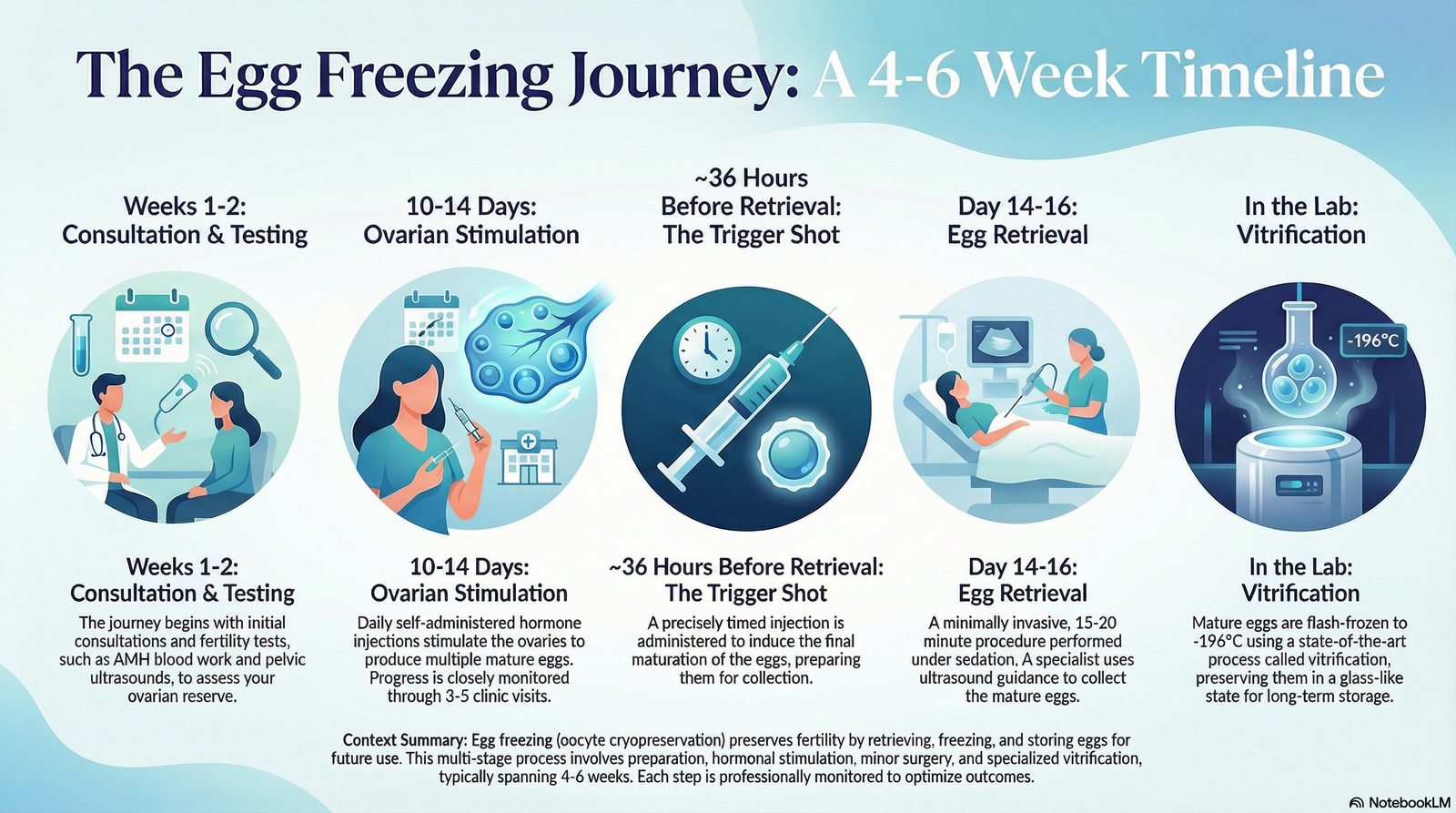
Egg freezing at a glance: from consultation and stimulation to retrieval and vitrification.
| Age at freezing | Suggested egg target | Estimated chance of one live birth |
|---|---|---|
| 30–34 | Around 14 mature eggs | Close to 70% |
| 35–37 | Around 15 mature eggs | Around 70% |
| 38–40 | Around 26 or more eggs | Around 65–70% |
These figures are averages. Your plan should also consider your family goals. If you would like two children later and you are already in your late 30s, your doctor may suggest aiming higher or planning for more than one cycle so you are not forced to repeat egg freezing at an even older age.
Egg freezing step-by-step: what your month looks like
If you are considering freezing, you probably want to know what your daily life will look like during a cycle. Egg freezing is essentially the first half of an IVF cycle. You stimulate your ovaries to grow a group of eggs, then your doctor retrieves and freezes them. There is no embryo transfer at this stage.
- Consultation and testing: Your doctor orders blood tests such as AMH, FSH, and oestradiol, and performs a transvaginal ultrasound to count small antral follicles. This gives a starting picture of your ovarian reserve.
- Ovarian stimulation (10–14 days): You give yourself daily hormone injections that encourage your ovaries to grow many follicles instead of the single one they would usually select.
- Monitoring: Every few days, you go in for blood tests and ultrasounds so your team can track follicle growth and adjust your medication doses to keep things safe and effective.
- Trigger shot: When most follicles reach around 18 to 20 millimetres, you take a final injection to mature the eggs. Timing is important because retrieval happens about 34 to 36 hours later.
- Egg retrieval (15–20 minutes): You come to the clinic for a short procedure under sedation. Guided by ultrasound, your doctor passes a thin needle into each ovary and gently aspirates the follicle fluid that contains the eggs.
- Vitrification: In the lab, the embryology team identifies mature eggs, exposes them to cryoprotectant solution, and freezes them rapidly in liquid nitrogen at around minus 196 degrees Celsius.
- Recovery: Most people feel bloated and crampy for a day or two and then return to normal activities. Your period usually starts within about two weeks.
It can feel like a lot to manage on top of work and personal life. Many women find it helpful to tell a close friend or family member and to block off retrieval day and the next day so they can rest. The emotional side of this month can be just as intense as the physical side, and that is normal.
More Evidence on Age and Egg Numbers
28% overall – but big age gaps: Across nearly 1,500 women who came back to use their frozen eggs, the overall live birth rate per woman was 28%. Women who froze at 35 or younger had about a 52% live birth rate, while those freezing at 40 or older were closer to 19%. This disparity because “average success rate” numbers can be misleading; your age at freezing can almost triple your personal odds. Source: Human Reproduction Update (PMID: 38654466).
14–26 eggs – age-based targets: Earlier data summarized by ASRM suggest that to reach about a 70% chance of one live birth, women aged 30–34 may need around 14 mature eggs frozen, 35–37-year-olds about 15 eggs, and 38–40-year-olds around 26 eggs. These numbers are estimates, not guarantees, but they come from real outcome data. This matters because you can use both your age and your planned egg count to decide whether one cycle is enough or additional cycles are worth it. Source: Fertility and Sterility guideline (PMID: 34148587).
38.3 to 35.4 years – freezing is getting earlier: In two large IVF centres, the average age at the first egg freezing cycle dropped from 38.3 years in 2011 to 35.4 years in 2023. The share of women freezing before 36 jumped from 14% to 54%. This matters because more people are choosing to freeze eggs at an age when the eggs are still strong, which can significantly improve later success rates. Source: Journal of Assisted Reproduction and Genetics (PMID: 39235517).
Comparable outcomes – frozen vs. fresh eggs: ASRM’s evidence review found that when frozen eggs are used in IVF, pregnancy rates per transfer are similar to using fresh eggs, and babies appear just as healthy. For donor eggs, live birth rates with frozen eggs are close to those with fresh eggs in experienced programs. This matters because you can feel more confident that embryos from frozen eggs are not second best compared with fresh IVF. Source: Fertility and Sterility guideline (PMID: 34148587).
Ethics panel – not a guarantee policy: ASRM’s Ethics Committee calls elective egg freezing an ethically acceptable way to try to avoid future infertility, but stresses that it cannot promise a future baby. They highlight that success still depends heavily on your age at freezing and how many eggs you store. This matters because you deserve honest counselling: egg freezing can improve your chances later, but it is not an insurance policy. Source: Fertility and Sterility ethics opinion (PMID: 38430080).
These findings come from peer-reviewed research and official guidelines. Your clinic can translate these numbers into a personalized plan based on your age and ovarian reserve.
Egg freezing costs and price comparisons
Sticker prices for egg freezing can be confusing. One clinic might advertise a “cycle price” that looks affordable until you add medications and storage. Another might bundle more into one fee. It helps to think in layers: the cost to freeze, the cost to store, and the cost to use the eggs later.
| Region or country | Core cycle fee | Medications and extras |
|---|---|---|
| USA | $6,000 to $15,000 | $3,000 to $10,800 for medications |
| UK | £3,500 to £12,380 | From about £2,000 for medications |
| Canada | 5,000 to 6,000 CAD | 3,500 to 5,000 CAD for medications |
| Mexico | $5,000 to $6,600 USD | $1,500 to $3,500 USD for medications |
| Spain | €2,200 to €3,000 | €600 to €1,200 for medications |
| Greece | €2,400 to €2,500 | €1,000 to €2,000 for medications |
| Bulgaria | €1,500 to €1,725 | €600 to €1,000 for medications |
| Slovakia | €1,250 to €2,500 | Around €1,000 for medications |
| Caribbean | $4,950 USD | Medication costs vary |
On top of cycle and medication costs, you will also have to pay ongoing storage and eventual use fees.
- Storage fees: After the first bundled year, yearly storage often runs $500 to $1,000, or €200 to €550.
- Thaw and transfer: Later, thawing the eggs, fertilizing them with ICSI, growing embryos, and transferring them often costs another $3,000 to $5,000, or €1,200 to €1,500.
- Embryo testing (PGT-A): If you choose to test embryos for chromosome number, expect roughly $3,000 to $6,000, or €1,500 to €2,000.
When you compare clinics or countries, try to work out a realistic all-in estimate for the number of cycles you are likely to need, plus storage and a future thawing and fertilization cycle, not just the headline price for one round.
Risks, limits, and what to expect from your frozen eggs
No fertility treatment is risk-free, and egg freezing is no exception. The good news is that the biggest medical risks are now much less common with modern protocols. The more subtle risks are emotional and financial.
Medical risks: The main medical concern is ovarian hyperstimulation syndrome. With careful monitoring and the use of an agonist trigger in high-response cycles, severe cases are now rare. Retrieval itself carries small risks of bleeding, infection, or injury to nearby structures, but these complications are uncommon in experienced centres.
Emotional risks: The month of injections, monitoring, and waiting is intense. Many women describe a mix of hope, fear, and pressure to “get enough eggs” in one round. Later, when you come back to use the eggs, it can be painful if thawing, fertilization, or embryo development does not go as well as you hoped.
Limitations of the science: Even with improved data, there is still uncertainty. We do not yet have full lifetime outcome data for all age groups. Some women never return to use their eggs, so their true needs and benefits are difficult to measure. Models tend to assume average embryo transfer practices and do not capture every individual story.
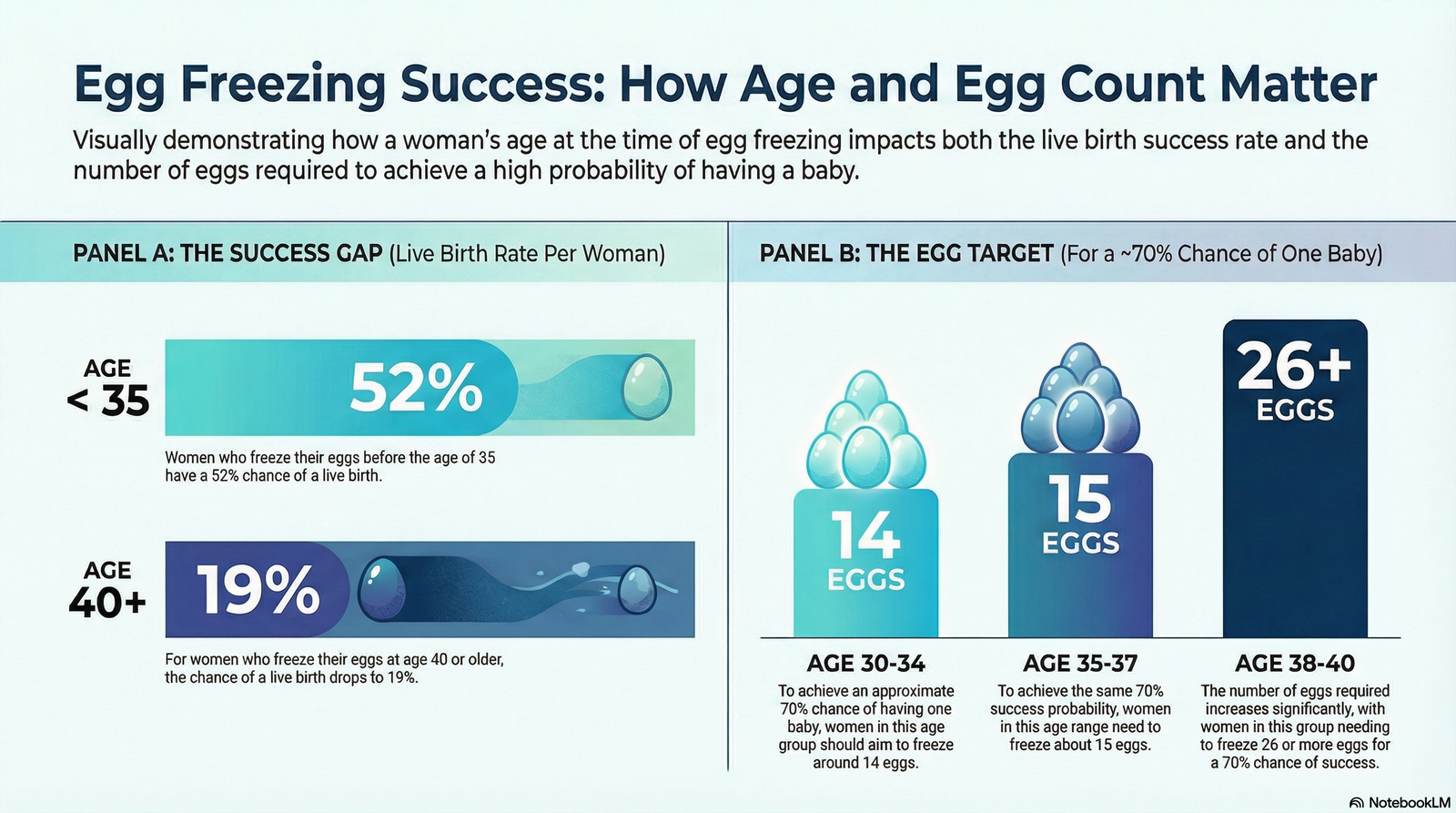
Egg-freezing success is strongest when you freeze earlier and reach realistic egg targets for your age.
Where to freeze your eggs and how to choose a clinic
Once you know your goals and rough budget, the next step is choosing where to freeze your eggs. You might look at local clinics, fertility preservation programs attached to hospitals, or trusted centres abroad that offer lower prices or package deals.
When you compare clinics, focus on a few key questions.
- How many egg freezing cycles does the clinic do each year, and for women in your age group?
- What are their reported survival, fertilization, and blastocyst formation rates for frozen eggs?
- Do they have clear, written pricing for cycle fees, medications, storage, and thaw cycles?
- Will the same clinic likely still be available and stable when you are ready to use your eggs?
- How do you feel about the communication style and support from the team?
OVU expert guidance: turning numbers into a personal plan
If you are looking at all of these numbers and feeling overwhelmed, that is very common. The point of age-based targets and survival rates is not to push you into treatment but to give you a clear, honest picture of what egg freezing can and cannot do for you.
A good clinic should sit with you, go over your age, your test results, and your family goals, and then show you a realistic range of outcomes. Get a second opinion if you ever feel rushed, pressured, or sold an unrealistic story.
Want help comparing clinics and costs?
If this already feels like a full time research project, you are not imagining it. Our advisors can collect clear, itemized quotes from verified clinics, explain what they include, and help you map out timelines that fit your life.

Why trust this guide? The OVU commitment
You are probably juggling hope, timelines, and a lot of tabs open in your browser. And you deserve clear, current, human advice. At OVU, we review clinic protocols, compare real quotes, and talk to people who have done this - intended parents and gestational carriers - so we can give you practical steps, not just theory. If you want help comparing options without sales pressure, we will gather itemized quotes and success data that match your exact situation. You decide, we will bring the info to your table.
Frequently Asked Questions
Does freezing my eggs reduce my natural supply?
No. Each month, your ovaries recruit many follicles and then naturally let most of them die off. Stimulation medications rescue that month’s group and bring more of them to maturity. You are not pulling eggs from future months or using up eggs you would otherwise have had later.
How long can my eggs stay frozen?
Eggs can stay frozen in liquid nitrogen for many years without losing quality. There are healthy babies born from eggs that were frozen for 10 to 15 years. The bigger constraint is usually your age and health when you are ready to carry a pregnancy, not how long the eggs were stored.
Is the egg retrieval procedure painful?
You are under sedation or anaesthesia during the retrieval, so you do not feel the procedure itself. Afterwards, most people describe period-like cramping and bloating. These symptoms usually improve over a few days with rest, fluids, and simple pain relief.
Will my insurance cover egg freezing?
Coverage varies a lot. In the United States, some large employers now cover elective egg freezing, but many do not. Coverage is more common when egg freezing is medically indicated, for example, before chemotherapy. In other countries, funding can depend on national or regional health policies. It is worth checking both your health insurance plan and any separate fertility benefits.
What is the biggest risk of egg freezing?
Medically, the main risk is ovarian hyperstimulation, which can usually be managed or avoided with modern protocols. The risk that many women feel most strongly is emotional. You invest time, money, and hope, and there is still a chance that thawing and fertilizing the eggs later will not lead to a pregnancy. Honest counselling about likely outcomes can help you prepare for this.
Can I still try to conceive naturally if I freeze my eggs?
Yes. Egg freezing does not reduce your ability to try for a natural pregnancy in the future. Many women who freeze their eggs go on to meet a partner and conceive without using their stored eggs. You can consider frozen eggs to be as a backup plan, not a replacement for natural conception.
Should I plan on more than one egg freezing cycle?
That depends on your age, your first cycle results, and your goals. If you are 32 and retrieve 18 mature eggs in one cycle, you might feel comfortable stopping. If you are 37, want two children, and get 8 mature eggs from the first cycle, your doctor will likely suggest another round so your stored egg count better matches your plans.
Reference List 8 sources
Journal Article (Systematic Review & Meta-Analysis): Hirsch A, Hirsh Raccah B, Rotem R, Hyman JH, Ben-Ami I, Tsafrir A. Planned oocyte cryopreservation: a systematic review and meta-regression analysis. Human Reproduction Update. 2024;30(5):558–568. PMID: 38654466. Available from: https://pubmed.ncbi.nlm.nih.gov/38654466/
Journal Article (Research): Cascante SD, Grifo JA, Licciardi F, Parra CM, Kelly A, Berkeley AS. The effects of age, mature oocyte number, and cycle number on cumulative live birth rates after planned oocyte cryopreservation. Journal of Assisted Reproduction and Genetics. 2024;41(11):2979–2985. PMID: 38955888. Available from: https://pubmed.ncbi.nlm.nih.gov/38955888/
Journal Article (Research): Kudesia JU, et al. Freezing First: insights from 8 years of planned oocyte cryopreservation at an egg freezing clinic. Fertility and Sterility. 2025;Epub ahead of print. PMID: 41352516. Available from: https://pubmed.ncbi.nlm.nih.gov/41352516/
Journal Article (Research): Tsafrir A, Hirsch A, Hirsh Raccah B, Rotem R, Ben-Ami I. Trends in patient age at planned oocyte cryopreservation. Journal of Assisted Reproduction and Genetics. 2024;Epub ahead of print. PMID: 39235517. Available from: https://pubmed.ncbi.nlm.nih.gov/39235517/
Journal Article (Review): Cascante SD, Berkeley AS, Licciardi F, McCaffrey C, Grifo JA. Planned oocyte cryopreservation: the state of the ART. Reproductive Biomedicine Online. 2023;47:103367. PMID: 37804606. Available from: https://pubmed.ncbi.nlm.nih.gov/37804606/
Guideline (Evidence-Based): Practice Committee of the American Society for Reproductive Medicine. Evidence-based outcomes after oocyte cryopreservation for donor oocyte in vitro fertilization and planned oocyte cryopreservation: a guideline. Fertility and Sterility. 2021;116(1):36–47. PMID: 34148587. Available from: https://pubmed.ncbi.nlm.nih.gov/34148587/ and ASRM: ASRM guideline
Ethics Committee Opinion: Ethics Committee of the American Society for Reproductive Medicine. Planned oocyte cryopreservation to preserve future reproductive potential: an Ethics Committee opinion. Fertility and Sterility. 2023;Epub ahead of print. PMID: 38430080. Available from: https://pubmed.ncbi.nlm.nih.gov/38430080/ and ASRM: ASRM Ethics Opinion
Journal Article (Modeling Study): Doyle JO, Richter KS, Lim J, Stillman RJ, Graham JR, Tucker MJ. Successful elective and medically indicated oocyte vitrification and warming for autologous in vitro fertilization, with predicted birth probabilities for fertility preservation according to number of cryopreserved oocytes and age at retrieval. Fertility and Sterility. 2016;105(2):459–466.e2. PMID: 26604065. Available from: https://pubmed.ncbi.nlm.nih.gov/26604065/
Final thoughts
Deciding whether to freeze your eggs is not just a medical question. It touches your career, your relationships, your finances, and your hopes for the future. Egg freezing does not promise a baby, but when you do it at the right time and with realistic egg numbers, it can give you stronger options later than doing nothing at all.
If you are still unsure, start with three simple questions. How important is it to you to have a biological child, if that is medically possible? Where are you today in terms of age and ovarian reserve? And what level of cost and treatment are you comfortable with? When you have honest answers to those questions and clear numbers from your doctor, the next step usually becomes easier to see.
You do not have to make this decision alone. A good medical team or independent advisor can help you understand your personal statistics, compare clinics and countries, and put together a plan that respects both your present life and your future family.
Related articles

Embryo Freezing (Cryopreservation): Costs, Timelines, Success Rates and What to Expect
Fertility Preservation & IVF Your guide to embryo freezing and frozen embryo transfer Last Updated: 23 February 2026 Medically Reviewed 15 min read Evidence-based You are not alone if you are thinking about your future plans while also considering your age. Many people now freeze embryos in their late twenties, thirties, or early forties to keep more options open for the future. You might be in the middle of IVF, about to start chemotherapy, or simply not ready to be pregnant yet. It is perfectly normal to feel torn between your own timeline and your body’s timeline. With modern vitrification,
18 min read
Sperm Banking Guide: Costs, Process, and Success Rates
Fertility Preservation Your guide to sperm banking and fertility preservation Last Updated: 19 February 2026 Medically Reviewed 14 min read Evidence-based If you are thinking about sperm banking, you are probably balancing a lot at once. You might be facing a new cancer diagnosis, planning gender-affirming treatment, or simply not ready for children yet. At the same time, you do not want to close the door on a future family while you focus on survival, transition, career, or finding the right partner. That is why sperm banking matters. Studies have reported healthy births from sperm stored for 21 to 40
17 min read
Egg Freezing Costs Breakdown: Timeline, Prices, and Your Real Odds
Egg Freezing & Fertility Preservation Your guide to egg freezing costs and success rates Last Updated: 13 February 2026 Medically Reviewed 20 min read Evidence-based Thinking about egg freezing in your early thirties or early forties? Or perhaps considering oocyte vitrification at just 25? The decision about timing can feel both urgent and overwhelming. Whether you are booking a consultation or rushing to your first ultrasound scan in the middle of the midday office hustle, you might find yourself feeling overwhelmed and anxious. It is common to feel a deep sense of exhaustion, actually the kind of fatigue that no
23 min read