


Dr. Sony Sherpa (MBBS)
In addition to her clinical experience, Dr. Sherpa is a published medical researcher and holistic health advocate. Her dual expertise in emergency care and alternative therapies brings a unique lens to medically reviewed content—ensuring it is both accurate and accessible.
You are not alone if you are thinking about your future plans while also considering your age. Many people now freeze embryos in their late twenties, thirties, or early forties to keep more options open for the future. You might be in the middle of IVF, about to start chemotherapy, or simply not ready to be pregnant yet. It is perfectly normal to feel torn between your own timeline and your body’s timeline.
With modern vitrification, 95–100% of high-quality embryos successfully survive freezing and thawing. Large studies covering more than 170,000 births show that babies from frozen embryo transfers often have lower risks of being born too early or too small compared with babies from fresh transfers. Professional societies now treat vitrification as the standard of care for embryo and egg freezing.
This guide walks you through how embryo freezing works, the costs associated with it in different countries, the duration for which embryos can be stored, the success rates by age, and what you can expect at each step. Our goal is to give you clear, practical information so you can make decisions that fit your life and your comfort level.
Embryo freezing uses a rapid-freezing method called vitrification to store embryos in liquid nitrogen at –196°C (–321°F). With current techniques, 95–99% of frozen blastocysts (day 5 embryos) survive thawing, and pregnancy rates from frozen transfers are similar to fresh transfers. While a full IVF cycle with embryo freezing and one year of storage can cost around $16,000 or more in the United States, a similar bundle offered by European or Mexican fertility clinics can cost 30–70% less.
Next step: Consult your fertility specialist about whether to freeze embryos now, whether to proceed with preimplantation genetic testing (PGT) before freezing, and how many cycles of vitrification and transfer you may need based on your age and goals, especially if you desire to have siblings in the future.
What recent research shows
Large studies and clinical guidelines consistently support the safety and effectiveness of embryo vitrification. A meta-analysis of more than 233,000 embryos found that using frozen embryos within 12 months was linked with higher live birth rates than waiting longer, while neonatal outcomes remained consistent regardless of storage duration. Furthermore, a 2024 review of over 170,000 births found that babies from frozen transfers had lower risks of preterm birth and low birth weight than those from fresh transfers.
The American Society for Reproductive Medicine (ASRM) now suggests that vitrification is the best method for freezing human embryos and eggs, with nearly 100% survival rates after they are thawed in top accredited labs.
In This Guide
95–99% of vitrified blastocysts survive warming in modern labs.
Healthy births reported from embryos frozen for 20–30 years.
While a full IVF cycle with embryo vitrification can exceed $16,000 in the United States, a similar cycle in Mexico or Europe may cost 30–70% less.
Embryo freezing in simple terms
If you are new to IVF, the idea of freezing embryos can feel technical and distant. In reality, embryo freezing is one of the most practical tools in fertility care. After your eggs are fertilized in the lab, the embryos grow for several days. The strongest ones reach the blastocyst stage on Day 5 or 6. These are the embryos that clinics usually choose for transfer or freezing.
In the past, labs used slow freezing. The embryo cooled a few degrees at a time before finally reaching -196°C. This method worked but allowed ice crystals to form, which could damage cells. With vitrification, the lab briefly exposes the embryo to concentrated cryoprotectant solutions and then cools it almost instantly. The water inside and around the embryo turns into a glass-like solid with no ice crystals.
Latest research insights
15–25% Higher Live Births in First Year – Timing Sweet Spot: A review of more than 233,000 embryos found that when frozen embryos were transferred within the first 12 months of storage, live birth, clinical pregnancy, and positive pregnancy tests were all about 15–25% more likely than when embryos were used after longer storage. Baby outcomes at birth were similar regardless of storage time. This suggests that, when you have a choice, using embryos within the first year can give you a modest boost in success without adding risk for your baby. Source: Journal of Assisted Reproduction and Genetics (PMID: 39425814).
Lower Preterm Birth and Low Birthweight – Baby-Friendly Profile: A 2024 review of over 170,000 IVF births found that singleton babies from frozen embryo transfer were less likely to be born early, less likely to have low birthweight, and less likely to be small for gestational age compared with babies from fresh transfers. Babies from frozen transfers were more likely to be larger, and clinics can plan care around that. For you, this study points to a tradeoff: frozen transfer tends to reduce the number of very small, fragile babies and slightly increases the chance of a bigger baby that needs extra monitoring. Source: Medicina (PMID: 39202656).
Near-Perfect Survival – Vitrification as a Standard: Modern rapid freezing (vitrification) now reaches embryo survival rates after warming that can approach 100% in experienced IVF laboratories. Professional guidelines recommend vitrification as the standard method for cryopreservation of oocytes and embryos because pregnancy rates after warming are similar to, or better than, fresh transfers. This means you can feel confident that frozen embryos are a reliable part of your treatment plan. Source: Fertility and Sterility (ASRM Committee Opinion, 2021).
These findings come from peer-reviewed research. Your personal results depend on your age, medical history, and clinic. Discuss with your fertility specialist how this data applies to your unique case and your budget.
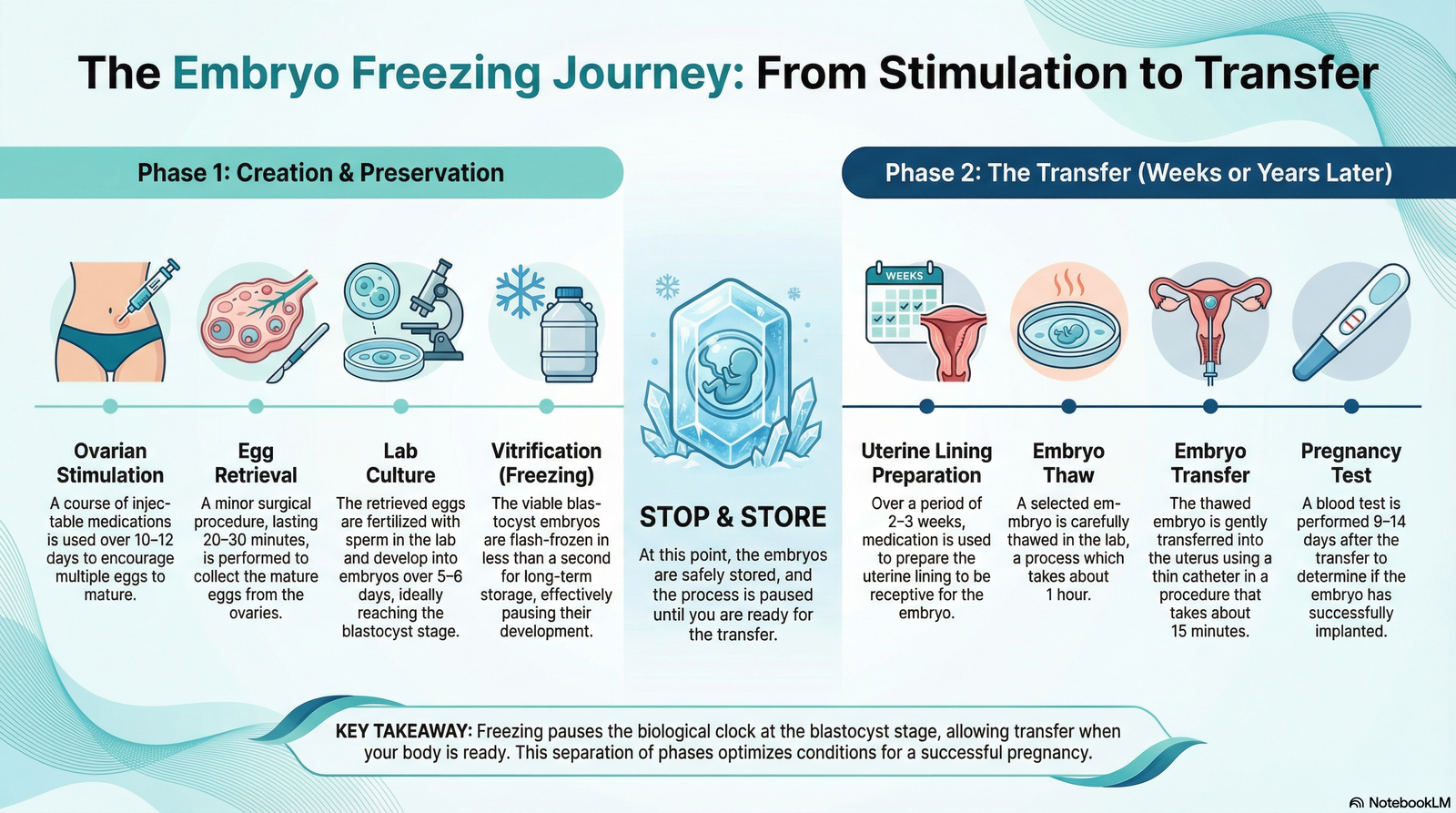
Embryo freezing and frozen transfer timeline: from hormone stimulation to pregnancy test.
| Stage | What happens | Typical duration |
|---|---|---|
| Ovarian stimulation | You take hormone injections to grow multiple follicles. | 10–12 days |
| Egg retrieval | Your doctor collects eggs under light sedation. | 20–30 minutes |
| Fertilization | Eggs are mixed with sperm or injected with a single sperm (ICSI). | Day 1 after retrieval |
| Embryo culture | Embryos grow in the lab until Day 5–6 (blastocyst stage). | 4–5 days |
| Vitrification | Good–quality embryos are rapidly frozen and stored at –196°C. | Same day as blastocyst assessment |
| Frozen transfer | Embryo is thawed and transferred into your uterus. | 10–15 minute procedure |
| Pregnancy test | Blood test checks beta-hCG level after transfer. | 9–14 days after transfer |
Who benefits most from embryo freezing?
If you are wondering whether embryo freezing is right for you, it helps to review the most common clinical scenarios. Many patients freeze embryos because they have a surplus of high-quality embryos after a single retrieval. Many people freeze embryos because they have more good embryos than they want to transfer in one cycle. Others freeze because they need to delay transfer for medical or personal reasons.
You might be a strong candidate for embryo freezing if you:
- Make several good-quality embryos in a single IVF cycle and want children in the future.
- You need to wait to transfer embryos because your hormones are out of range or your uterine lining is not ideal.
- Plan preimplantation genetic testing (PGT) for chromosome problems or specific inherited conditions.
- Are about to start chemotherapy, radiation, or surgery that can reduce or remove fertility.
- Are in your thirties and not ready to carry a pregnancy yet, but want to preserve your current egg quality.
- Are a transgender person planning hormone therapy or surgery that affects fertility, and wanting future genetic children.
We know it can feel odd to make choices about future kids when you haven't even decided about your job or relationship next year. Freezing embryos does not force you to use them. It simply keeps more doors open for the future you.
Success rates and the role of age
The strongest predictor of success with frozen embryos is your age when the eggs were retrieved. The embryo keeps track of the egg’s age at the moment of retrieval. If you freeze embryos at 32 and use them at 39, those embryos still behave like 32‑year‑old eggs.
With modern vitrification, blastocyst survival after thaw is consistently high, often in the 95–99% range in good laboratories. The real variation comes from how likely each embryo is to implant and grow once transferred.
| Age at retrieval | Clinical pregnancy per frozen transfer | Typical live birth per frozen transfer |
|---|---|---|
| Under 35 | About 55–74% | About 45–60% |
| 35–37 | About 47–52% | About 35–45% |
| 38–40 | About 38–44% | About 25–35% |
| Over 40 | About 15–27% | Often under 20% |
Understanding what these numbers mean for you
If you are under 35, these success rates mean that a single high-quality frozen blastocyst has a realistic chance of leading to a baby, and several embryos give you multiple attempts. In your late thirties and early forties, freezing embryos can still help, but you usually need more embryos to reach the same overall chance of success. If you are over 40 and using your eggs, a frank discussion with your doctor about realistic expectations and donor options can save you time, money, and heartache.
Cumulative success over several transfers is often more important than any one transfer. At some clinics, three frozen transfers with your own eggs can lead to over 90% cumulative pregnancy in younger patients, and donor egg programs can reach even higher numbers. Talk with your specialist about how many embryos they recommend for your age and diagnosis.
How safe is embryo freezing for you and your baby?
It is normal to worry that freezing might somehow harm an embryo or change your child’s health. Years of data now give a fairly consistent picture. For most people, the main medical risks come from the IVF cycle itself and from pregnancy, not from the act of freezing and thawing embryos.
Large birth registries that compare fresh and frozen transfers have found that babies from frozen transfers are less likely to be born preterm, less likely to have low birthweight, and less likely to be small for their gestational age. Babies from frozen transfers are more likely to be larger or large for gestational age, which can influence decisions about birth planning, but this pattern has not translated into major differences in overall health.
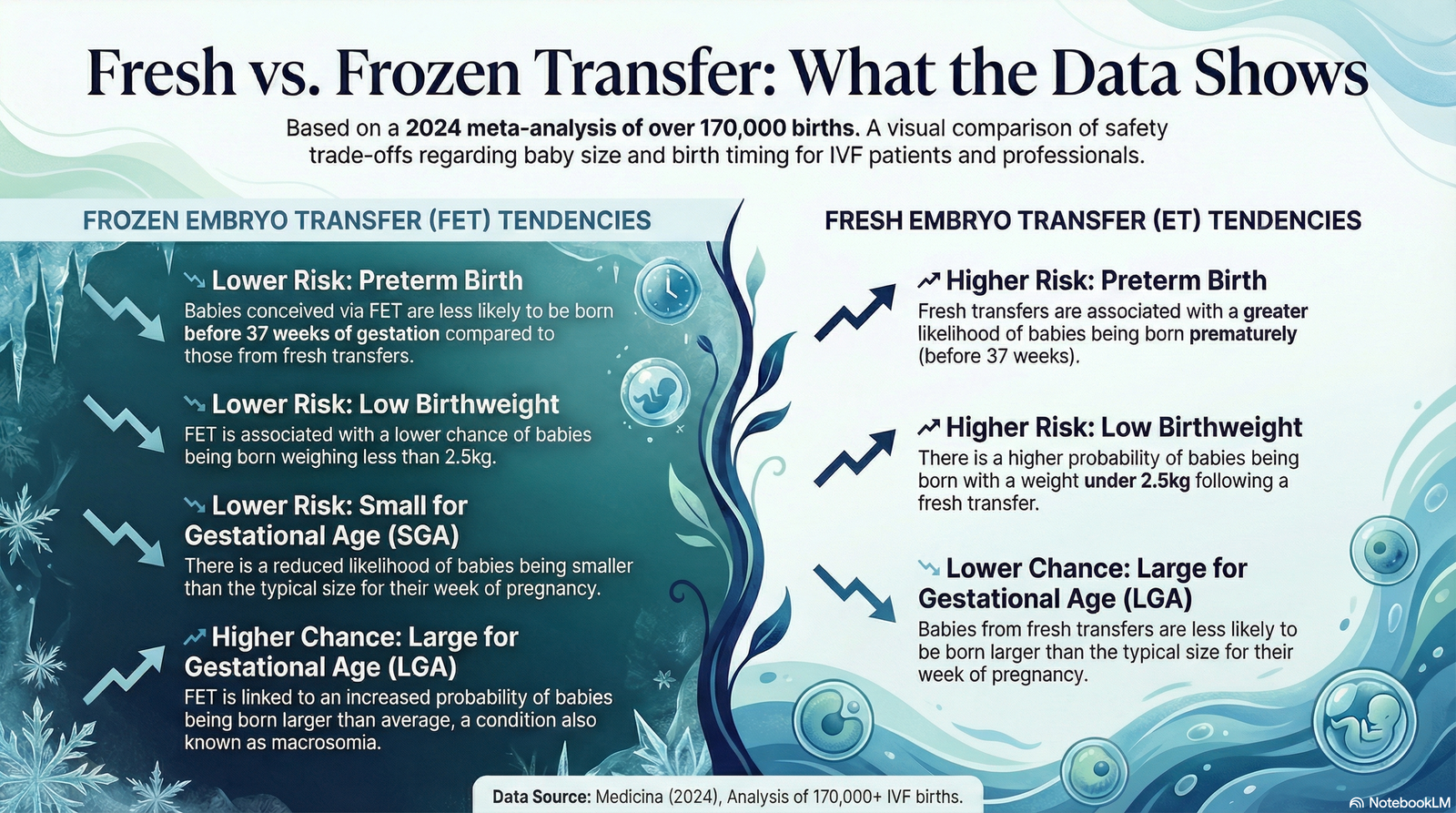
Fresh vs. frozen embryo transfer: patterns in birthweight and prematurity.
What research says about storage time and safety
In several large cohorts, embryos stored for longer than a year had slightly lower pregnancy and live birth rates than embryos used within the first 12 months. At the same time, no clear differences in prematurity, low birthweight, or congenital malformations were seen between babies from short‑term and long‑term storage. In other words, storage time seems to affect your chance of getting pregnant more than your baby’s health if the pregnancy succeeds.
Studies also show that concerns about infection spreading between samples in storage tanks have remained theoretical. Despite experiments that deliberately contaminated liquid nitrogen, there are no reported cases of human embryos becoming infected through cross-contamination when clinics follow standard safety procedures.
Costs of embryo freezing and frozen transfer
Talking about money can feel uncomfortable, but cost is often a major source of stress. It helps to break everything into pieces so you can see where each part of the budget goes. In most countries, costs are divided into four areas: the IVF cycle itself, medications, freezing and storage fees, and future frozen embryo transfers.
| Location | Main components | Typical total for one full cycle |
|---|---|---|
| United States | IVF cycle with fresh transfer, embryo freezing, PGT for several embryos, medications, and one year of storage. | $16,000 or more |
| Mexico | IVF package with freezing included, medications, low‑cost storage, and one frozen transfer. | $4,000–$8,200 in many programs |
| Spain | Vitrification fee, one frozen embryo transfer, one year of storage, and medications are separate. | €3,000–€5,000 depending on clinic and drugs |
| Balkan region | IVF, embryo freezing, one FET and one year of storage in lower‑cost settings. | Often 30–60% lower than Western Europe |
On top of this, you need to plan for annual storage fees and the cost of each future frozen embryo transfer. Most clinics charge a yearly storage fee between about €100 and $600. A frozen transfer cycle itself usually costs less than a full IVF cycle, because you are not paying again for stimulation and egg retrieval.
Step-by-step: embryo freezing and frozen transfer
If you decide to freeze embryos, your path usually follows the same main steps, even if the details differ from clinic to clinic. Understanding these steps can make you feel more prepared and less caught off guard.
Step 1: Ovarian stimulation (about 10–12 days). You give yourself hormone injections to grow more follicles than in a natural cycle. Your clinic does regular ultrasounds and blood tests to track how your ovaries are responding. Your doctor adjusts doses to keep you in a safe range.
Step 2: Egg retrieval (about 20–30 minutes). When your follicles reach the right size, you take a trigger shot. Around 36 hours later, you go in for egg retrieval. You receive light sedation so you do not feel what is happening. The doctor uses a thin needle, guided by ultrasound, to collect eggs from your ovaries. Most people go home the same day.
Step 3: Fertilization (Day 1). In the lab, your eggs are either placed with sperm or injected one by one with a single sperm using intracytoplasmic sperm injection (ICSI). The lab checks the next day to see how many eggs were fertilized.
Step 4: Embryo culture (Days 2–6). The fertilized eggs divide over several days. The lab scores their growth and appearance. Many clinics now routinely culture embryos to the blastocyst stage on Day 5 or 6, because blastocysts tend to implant better than earlier embryos.
Step 5: Vitrification and storage. The embryologist chooses the embryos that look strongest and prepares them for freezing with vitrification. Each embryo or small group of embryos is loaded into a tiny carrier, exposed briefly to cryoprotectant solutions, and dropped into liquid nitrogen at –196°C. Your embryos stay in labelled tanks with alarms and back-up systems.
Step 6: Lining preparation and frozen transfer. When you are ready for a frozen embryo transfer, your doctor plans either a natural cycle or a medicated cycle. In a natural cycle, the clinic times transfer around your ovulation. In a medicated cycle, you take estrogen and progesterone to build and support the uterine lining. On transfer day, the lab warms the embryo and confirms survival before transferring it.
Step 7: Pregnancy testing and early checks. About 9–14 days after transfer, you do a blood test to measure beta‑hCG. If it is positive, the clinic schedules an early ultrasound, often around 6–7 weeks, to look for a heartbeat. If it is negative, your team can review the cycle with you and plan next steps using the remaining embryos if you have them.
Interpreting the data during your own treatment
It is easy to get lost in statistics and forget that every IVF cycle also has small details that matter, like embryo grading, sperm quality, and lining thickness. If your first frozen transfer does not work, that does not mean freezing was the problem. Your doctor can often adjust medications, timing, or transfer technique in the next cycle.
We understand that every negative test is painful and can shake your confidence. When you have frozen embryos in storage, you do not need to restart from zero each time. You and your team can learn from each attempt while still using embryos that match the age and quality of your frozen eggs.
Choosing countries and clinics for embryo freezing
If you live in a country with high costs or strict rules, you may be considering travelling for treatment. TThis choice may increase your flights, time off work, and logistics, but it can also reduce your total cost or provide access to opportunities that are unavailable at home. Clinic choice matters as much as country choice.
OVU expert guidance on clinic selection
When you compare clinics for embryo freezing, look beyond headline success rates and package prices. Ask about their vitrification survival rates, how they report outcomes, how many embryos you might reasonably need for your age, and what happens if you need help transferring embryos to another clinic later. A slightly more expensive clinic with transparent data and strong lab protocols often saves you money and stress in the long run.
It is also important to check law and policy details, such as who is allowed to receive treatment, age limits, rules about single women and same‑sex couples, and how long embryos can stay in storage before local law requires a decision.
The Balkans (Albania, Bulgaria, Romania). These countries have become attractive for people who want modern labs with more flexible access and lower prices. Many centres treat single women and female couples. Albania also allows gestational surrogacy. Costs are often significantly lower than in Western Europe.
Czech Republic and Slovakia. Clinics in these countries are known for experienced staff and good success rates. The Czech Republic usually requires treatment within a male–female partnership. Prices are often in the mid‑range for Europe, with shorter waiting lists for donor programs than in some Western countries.
Spain and Greece. Spain has long experience with donor egg programs and high‑volume vitrification labs. Many people in their forties travel there for treatment. Greece combines high success rates with more moderate pricing, particularly attractive for people over 40 using either their own eggs or donors.
Mexico. For many people in the United States and Canada, Mexico offers similar or better laboratory standards at a much lower cost. Many private clinics have English‑speaking staff. Package prices that include several cycles and even “refund if no baby”-style programs are more common here than in some other regions.
Whichever country you consider, it helps to read detailed clinic information, talk with previous patients, and get independent advice rather than relying solely on marketing pages.
Want help comparing clinics and costs?
If this feels like a full-time job, and it often does, our advisors can collect clear, itemized quotes from verified clinics and map out realistic timelines with you at no cost.

Why trust this guide? The OVU commitment
You are probably juggling hope, timelines, and a lot of tabs open in your browser. And you deserve clear, current, human advice. At OVU, we review clinic protocols, compare real quotes, and talk to people who have done this - intended parents and gestational carriers - so we can give you practical steps, not just theory. If you want help comparing options without sales pressure, we will gather itemized quotes and success data that match your exact situation. You decide, we will bring the info to your table.
Frequently Asked Questions
How long can my embryos stay frozen?
Embryos can stay frozen safely for many years. Healthy births have been reported after 20–30 years of cryostorage. Most clinics and countries set legal or policy limits on storage time, often 10 years or more, and then ask you to renew consent. Storage time affects pregnancy rates over the very long-term, but has not been shown to harm the baby’s health at birth.
What is the survival rate of embryos after thawing?
With vitrification in a good laboratory, around 95–99% of blastocysts survive thawing. Your clinic can tell you its own survival rate for frozen embryos. Survival is only the first step, though. The quality of the embryo and your uterine environment still determine whether a pregnancy develops.
Does freezing increase the risk of birth defects?
Large registry studies have not found a higher overall risk of birth defects in babies born from frozen embryos compared with those from fresh transfers. Some reviews suggest that frozen transfers may reduce certain complications, such as very low birth weight. Your doctor can help put these findings into context for your individual case.
How many embryos should I transfer at once from frozen storage?
Most guidelines now recommend transferring a single embryo for many patients, especially if you are younger or using donor eggs. This is called elective single embryo transfer. It keeps twin and triplet pregnancies rare, which protects both you and your baby. In some older age groups or specific medical situations, your doctor may discuss transferring more than one embryo, but this should be a clear, shared decision.
Can I move my embryos to another clinic or another country later?
Yes. Embryos can be shipped between clinics in special containers called cryoshippers, which maintain liquid nitrogen temperatures during transport. You need to sign consent forms with both clinics and pay for shipping, which can range from a few hundred to more than a thousand euros or dollars, depending on distance and service. It is a good idea to ask about export and import rules before you start treatment in a new country.
Reference List 8 sources
Journal Article (Research): Fattahpour SF, Hakimi P, Tabatabaei F, Hejazad M, Amoozadeh M, Sadeghi L, et al. Comparison of live birth rate and fetal outcomes between fresh embryo and frozen-thawed embryo transfers: a prospective study. BMC Pregnancy and Childbirth. 2025;25:122. PMID: 39910459. Available from: https://pmc.ncbi.nlm.nih.gov/articles/PMC11800545/
Journal Article (Systematic Review & Meta-Analysis): Zolfaroli I, Romeu Villarroya M, Serralta García LB, Rubio Rubio JM, Monzó Miralles A. Impact of prolonged embryo storage on reproductive and neonatal outcomes: a systematic review and meta-analysis. Journal of Assisted Reproduction and Genetics. 2024;41(10):2691–2700. PMID: 39425814. Available from: https://pmc.ncbi.nlm.nih.gov/articles/PMC11534939/
Journal Article (Systematic Review & Meta-Analysis): Tocariu R, Niculae LE, Niculae AȘ, Carp-Velișcu A, Brătilă E. Fresh versus Frozen Embryo Transfer in In Vitro Fertilization/Intracytoplasmic Sperm Injection Cycles: A Systematic Review and Meta-Analysis of Neonatal Outcomes. Medicina. 2024;60(8):1373. PMID: 39202656. Available from: https://www.mdpi.com/1648-9144/60/8/1373
Journal Article (Research): Li J, Yin M, Wang B, Lin J, Chen Q, Wang N, et al. The effect of storage time after vitrification on pregnancy and neonatal outcomes among 24,698 patients following the first embryo transfer cycles. Human Reproduction. 2020;35(8):1675–1684. PMID: 32575120. Available from: https://pubmed.ncbi.nlm.nih.gov/32575120/
Journal Article (Research): Cui M, Dong X, Lyu S, Zheng Y, Ai J. The impact of embryo storage time on pregnancy and perinatal outcomes and the time limit of vitrification: a retrospective cohort study. Frontiers in Endocrinology. 2021;12:724853. PMID: 34777241. Available from: https://pmc.ncbi.nlm.nih.gov/articles/PMC8579853/
Committee Opinion (Guidance): Practice Committee of the American Society for Reproductive Medicine; Society of Reproductive Biologists and Technologists. A review of best practices of rapid-cooling vitrification for oocytes and embryos: a committee opinion. Fertility and Sterility. 2021;115(2):305–310. Available from: https://www.asrm.org/practice-guidance/practice-committee-documents/a-review-of-best-practices-of-rapid-cooling-vitrication-for-oocytes-and-embryos-a-committee-opinion-2021/
Journal Article (Systematic Review & Meta-Analysis): Zaat T, Zagers M, Mol F, Goddijn M, van Wely M, Mastenbroek S. Fresh versus frozen embryo transfers in assisted reproduction. Cochrane Database of Systematic Reviews. 2021;2:CD011184. PMID: 33539543. Available from: https://pubmed.ncbi.nlm.nih.gov/33539543/
Journal Article (Systematic Review & Meta-Analysis): Maheshwari A, Pandey S, Amalraj Raja E, Shetty A, Hamilton M, Bhattacharya S. Is frozen embryo transfer better for mothers and babies? Can cumulative meta-analysis provide a definitive answer? Human Reproduction Update. 2018;24(1):35–58. PMID: 29155965. Available from: https://pubmed.ncbi.nlm.nih.gov/29155965/
Final thoughts
Embryo freezing does not make decisions for you, but it provides the valuable gift of time. Whether you wish to delay motherhood, plan for a future sibling, or schedule a frozen embryo transfer once your body has recovered from ovarian hyperstimulation, having embryos safely stored can reduce uncertainty and anxiety. If you are facing medical treatment that could impact your fertility, or you simply are not ready to be pregnant now, these stored embryos represent your future options.
Use this information as a starting point for conversations with your partner, your doctor, and, if you want, a counsellor who understands fertility care. Ask every question you have, even if it feels small. You deserve clear answers, realistic expectations, and a plan that respects both your medical needs and your emotional well-being.
Related articles

Sperm Banking Guide: Costs, Process, and Success Rates
Fertility Preservation Your guide to sperm banking and fertility preservation Last Updated: 19 February 2026 Medically Reviewed 14 min read Evidence-based If you are thinking about sperm banking, you are probably balancing a lot at once. You might be facing a new cancer diagnosis, planning gender-affirming treatment, or simply not ready for children yet. At the same time, you do not want to close the door on a future family while you focus on survival, transition, career, or finding the right partner. That is why sperm banking matters. Studies have reported healthy births from sperm stored for 21 to 40
17 min read
Egg Freezing Success Rates by Age: How Timing Shapes Your Chances
Fertility Preservation & Egg Freezing Your guide to egg freezing success rates by age and how timing, costs, and clinic choice affect your future options. Last Updated: 16 February 2026 Medically Reviewed 17 min read Evidence-based If you are wondering about oocyte vitrification and whether to do it soon, you may feel rushed, anxious, or frustrated that your ideal partner hasn’t shown up. You may be thinking about how motherhood right now might interfere with new career possibilities; perhaps you are starting a business from scratch and need time to become a leader in your niche, or you may be
18 min read
Egg Freezing Costs Breakdown: Timeline, Prices, and Your Real Odds
Egg Freezing & Fertility Preservation Your guide to egg freezing costs and success rates Last Updated: 13 February 2026 Medically Reviewed 20 min read Evidence-based Thinking about egg freezing in your early thirties or early forties? Or perhaps considering oocyte vitrification at just 25? The decision about timing can feel both urgent and overwhelming. Whether you are booking a consultation or rushing to your first ultrasound scan in the middle of the midday office hustle, you might find yourself feeling overwhelmed and anxious. It is common to feel a deep sense of exhaustion, actually the kind of fatigue that no
23 min read