


Dr. Sony Sherpa (MBBS)
In addition to her clinical experience, Dr. Sherpa is a published medical researcher and holistic health advocate. Her dual expertise in emergency care and alternative therapies brings a unique lens to medically reviewed content—ensuring it is both accurate and accessible.
If you are considering In Vitro Fertilization (IVF), you are taking the first, long–awaited step toward bringing the new bundle of joy into the world to make your family complete. While IVF offers a deeply sophisticated and promising solution for many fertility issues, it swiftly introduces a significant concern that can be overwhelming: the high associated costs per cycle, especially when multiple attempts are necessary to achieve a successful pregnancy.
Exploring the bundle’s services and associated costs can make you feel confused and anxious about the sheer uncertainty of the financial commitment. This challenge is often worsened by a lack of transparency regarding services included and not included in the bundles and fees, making it hard to grasp the true financial commitment required.
To decode this financial uncertainty and empower your decision–making, our team has compiled the most current data available. This guide breaks down the real numbers for 2026—including the price tag of a single cycle, required medications, and commonly used lab add–ons—so you can move forward with blueprinting your budget according to your unique needs and preferences.
In 2025, a single IVF cycle in the United States ranges between $15,000 and $25,000 when you include medications and common extras (Source: FertilityIQ). The clinic’s base fee is $10,000–$20,000. Medications standardly add $3,000–$7,000 to the final price tag. PGT–A adds another $3,000–$10,000 to the core cost, resulting in $17,100–$23,950 for the initial bundle “IVF freeze all with Biopsy & CCA/PGT–A” and a frozen embryo transfer bundle with an estimated dynamic price between $4,330 and $6,940 to complete the cycle with embryo transfer (Source: CCRM Fertility).
In 2026, the estimated core cost for a single round of IVF for US citizens is expected to be fixed between $10,000 and $21,500, a potential reduction from the current $15,000–$25,000 for self–pay patients, representing a potential reduction on the lower end. New discounts on EMD Serono drugs (like GONAL–F) via TrumpRx.gov are expected to save women up to $2,200 per cycle. Medications are typically 20% of the total cost.
Despite per–cycle savings, be aware that the average total cost to achieve a live birth can range from $30,000 to $63,000+, as multiple cycles (with a median of two in younger patients and three in older patients or those with highly complex infertility cases requiring sophisticated strategies and more medical services to resolve them) often required.
Next step: Select several clinics suitable for your case. Explore the programs they offer. Compare in–the–bundle and out–the–bundle services. Ask each clinic for an itemized cost breakdown with every line item and add–on listed for each bundle you want to learn more about. Negotiate on the possibility to adjust the program to your preferences and cover the diverse scenarios like DuoStim protocol if the ovarian response is low, embryo vitrification instead of fresh transfer, and cancellation policies. Learn more about pricing, payment plans, and insurance before signing the papers and proceeding with payment.
Latest Research Insights
PGT–A May Be Advantageous for Patients Aged ≥38 (2024): A study published in the Journal of Obstetrics and Gynaecology Canada assessed the costs and benefits of preimplantation genetic testing for aneuploidy (PGT–A) across different age groups. Researchers found that while morphology alone was a good predictor of a top–quality euploid embryo 78% of the time in the <35 age group, this reliability dropped significantly to only 32% in the ≥38 age group.
Based on their cost analysis, the authors concluded that incorporating PGT–A may be financially advantageous for women aged ≥ 38 due to the lower financial costs associated with avoiding multiple unsuccessful transfers per cycle and the low likelihood of transferring a euploid embryo on the first attempt (Davis OS, et al. J Obstet Gynaecol Can 46(5):102361. PMID: 38272217).
PGT–A Is Not Cost–Effective for Low–Risk Patients Aged 26–34 (2024): The mathematical model published in Fertility and Sterility analyzed the cost–effectiveness of PGT–A for a single frozen embryo transfer (FET) in patients aged 26–34 years old (those at low risk of aneuploidy). The model calculated that using PGT–A resulted in a $3,819 increased cost per live birth, leading to an incremental cost–effectiveness ratio (ICER) of $104,571. Since this ratio is above the assumed willingness–to–pay threshold of $50,000, the study concluded that IVF with PGT–A should not be routinely used for patients aged 26–34 years old, suggesting it only becomes cost–effective beyond the age of 37 (Dunn A, et al. Fertil Steril 122(1), Suppl e25–e26. PMID: 38871329).
PGT–A Is Not Cost–Effective in Fresh Donor Oocyte Cycles (2020): A theoretical cost–effectiveness study analyzed whether PGT–A is worthwhile in fresh donor oocyte IVF cycles compared to IVF alone. The model found that using PGT–A added an extra $6,018.66 to the total cycle cost. This resulted in an incremental cost–effectiveness ratio (ICER) of $119,606.59 per additional live birth, indicating that the procedure is not cost–effective for donor egg cycles at the standard willingness–to–pay threshold. This suggests that the high success rates already achieved with donor oocytes limit the value added by PGT–A screening (Antero MF, et al. F S Rep 2(1):36–42. PMID: 34223271).
PGT–A Cost–Effective for Advanced Maternal Age Over Multiple Cycles (2019): Analyzing real–world data from 2,093 women aged ≥37 undergoing up to three complete cycles, a study from Australia found that PGT–A yielded a higher cumulative live–birth rate (CLBR) (30.90% vs. 26.77% for morphological assessment). The analysis resulted in an incremental cost–effectiveness ratio (ICER) of $28,103 for an additional live birth with PGT–A. At a willingness–to–pay (WTP) threshold of $50,000 and above, the probability of PGT–A being cost–effective was over 80% from a healthcare perspective, suggesting PGT–A is a cost–effective strategy for older women over multiple cycles (Lee E, et al. Aust N Z J Obstet Gynaecol 59(4):573–579. PMID: 31106861).
Financial Burden is the Top Reason for Stopping Treatment (2024): A nationwide cross–sectional survey of U.S. patients characterized the patient experience and reasons for discontinuing fertility treatment. The most commonly cited reason for treatment discontinuation was financial burden (62%), followed closely by psychological burden/treatment fatigue (58%). Furthermore, patients without insurance coverage for infertility services had significantly higher odds of treatment discontinuation (aOR 2.08) compared with those who had coverage. This indicates that financial barriers, particularly lack of insurance, remain the most significant non–clinical reason for patients abandoning their journey before achieving pregnancy (Collura B, et al. J Patient Exp 11: 23743735241229380. PMID: 38414755).
Guideline on Single Embryo Transfer to Reduce Costs (2021): The American Society for Reproductive Medicine (ASRM) updated its guidance on the limits to the number of embryos to transfer, reinforcing its recommendation for single embryo transfer in most cases, especially in younger women (Source: ASRM Practice Committee Documents). This approach aims to reduce the high medical costs and health risks associated with twin or triplet pregnancies.
Note: These insights represent recent peer–reviewed research and clinical guidelines. Individual outcomes may vary based on personal health factors. Discuss these insights with your fertility specialist.
In This Guide
Base Fee: $10k–$20k
With Meds: $15k–$25k+
Medications: $3k–$7k
PGT–A: $3k–$10k
FET Cycle: $3k–$8k
Annual Storage: $300–$750
What’s Included in a Single IVF Cycle Cost?
The US–based clinics quote for one IVF cycle ranges dynamically between $10,000 and $20,000. The number matters less than what it covers—and what it leaves out. Standardly, the core IVF bundle for own oocytes and the partner’s sperm includes initial consultation, clinical management of the ovarian stimulation phase (ultrasound scans and follow–up consults), oocyte retrieval and collection, sperm sample preparation, conventional or ICSI fertilization, and fresh embryo transfer. Fewer packages may also include assisted hatching and/or vitrification of embryos and their 12–month storage. A few bundles can cover a frozen embryo transfer back–up in case the fresh transfer fails. However, you must be aware that the costs for necessary add–ons, like PGT–A testing, medication (often $3,000–$7,000), or multiple frozen embryo transfers (FETs), are usually excluded from this quoted core price, significantly increasing the final price tag.
What’s Usually Included in the Base Fee
The base price covers the core steps for a fresh cycle:
- Clinical Management & Monitoring: Ultrasounds and bloodwork while you stimulate your ovaries to grow multiple oocyte–containing follicles.
- Oocyte (Egg) Retrieval: The procedure to collect your eggs, plus anesthesia and facility costs.
- Sperm Preparation: Washing and preparing the sample for fertilization.
- Conventional Fertilization & Culture: Creating embryos and growing them in the lab.
- Fresh Embryo Transfer: Placing one or more fresh embryos into your uterus.
- Follow–Up Care: The pregnancy blood test is scheduled between day 10 and 14 after the transfer.
What’s Almost Always an Extra Cost
These line items push a cycle into the $15,000–$25,000 range:
- Medications: Budget $3,000–$7,000 for stimulation hormones. Source: GoodRx. You pay for the medications directly to the pharmacy.
- Pre–Cycle Diagnostics: $500–$1,500 for the consult, labs (AMH, hormones), ultrasound, and semen analysis.
- Anesthesia: Some clinics bill the anesthesiologist fees separately: $500–$1,000.
| IVF Cost Component | Average Price Range (USA) | What It Covers |
|---|---|---|
| Base IVF Cycle Fee | $10,000–$20,000 | Monitoring of controlled ovarian stimulation, retrieval, standard fertilization, and fresh transfer. |
| Injectable Medications | $3,000–$7,000 | Hormones for ovarian stimulation (e.g., Follistim, Gonal–F). |
| Pre–Cycle Screening | $500–$1,500 | Initial consultation, blood tests, ultrasounds, and semen analysis. |
Overwhelmed Comparing Fertility Clinics & Costs?
It feels like a full-time job (and it is). Let our advisors do the hard work. We'll listen to your unique needs and personally match you with top-verified providers suited for your journey. At no cost to you.
Get My Free ConsultationNo payment. No pressure. Just clarity.
Costs for Advanced Techniques: ICSI and PGT–A
Your doctor may recommend extra lab work to improve fertilization or check the embryo chromosomes. These add to the bill, so plan ahead.
Intracytoplasmic Sperm Injection (ICSI)
ICSI is a hands–on method where the embryologist injects a single sperm into the egg to fertilize it. It’s common with male factor infertility. If it isn’t in your base price, ICSI costs $1,000–$3,000. Source: FertilityIQ.
Preimplantation Genetic Testing (PGT–A)
PGT–A checks embryos for chromosomal issues before transfer and can lower miscarriage risk. Plan for $3,000–$10,000, including biopsy and lab testing. Source: FertilityIQ.
Latest Research Findings
PGT–A Speeds Up Treatment Timeline Even with Few Blastocysts (2025): A propensity–score matched study compared PGT–A to non–PGT–A cycles where only one or two blastocysts were obtained. While the cumulative live–birth rate (CLBR) was similar between groups, PGT–A achieved cycle conclusion in a dramatically shorter timeframe (74 days vs.131 days). PGT–A also reduced the miscarriage rate (MR) per patient (4.5% vs. 9.5%) and increased the live birth rate per embryo transfer (LBR/ET) (41.5% vs. 16.2%). The incremental cost–effectiveness ratio (CER) of PGT–A for the months saved was EUR 499 overall, suggesting clinical value in reducing time–to–conclusion even in low–yield cycles (Cimadomo D, et al. Ultrasound Obstet Gynecol 65(1):106–113. PMID: 39644516).
New High–Resolution PGT–A Detects Microdeletions/Duplications (2025): Researchers successfully implemented a modified PGT–A method using high–density SNP analysis to accurately detect microdeletion and microduplication syndromes, which are difficult to identify with older PGT–A technologies. Initial clinical findings from $3,000 preimplantation embryos suggest the prevalence of these segmental copy number variations may be higher than previously reported in live births. This advancement provides a method to deliver more complete genetic results to patients, further informing embryo transfer decisions (Weier C. Hum Reprod 40(Suppl 1): deaf097.872. Published: June 23, 2025).
PGT–A Does Not Improve Cumulative Live Birth Rate in Recurrent Pregnancy Loss (RPL) Patients (2025): A retrospective comparative study analyzed RPL patients and found no significant difference in the cumulative live birth rate (CLBR) between the PGT–A group and the conventional IVF/ICSI group after three single–blastocyst transfers. Furthermore, the PGT–A group had a significantly longer time to live birth (adjusted hazard ratio approx. 0.56), suggesting that the additional steps required for PGT–A prolong the treatment timeline without providing a superior overall outcome for this patient population (Li PX, et al. J Ovarian Res 18(1):141. PMID: 40611317).
PGT–A Shifted from Binary to Refined Classification (2020): This review details the evolution of PGT–A from early, limited screening to contemporary methods capable of high–resolution detection of chromosomal mosaicism and segmental abnormalities (PGT–SR). The review emphasizes that the traditional binary (normal/abnormal) result is insufficient, and the technology now demands a four–category classification (euploid, aneuploid, mosaic, and segmental abnormal) to improve outcome prediction and avoid discarding potentially competent embryos (Viotti M. Genes (Basel) 11(6):602. PMID: 32485954).
Embryo Freezing & FET Costs
If you have extra embryos left after a fresh cycle and wish to avoid a full round of in vitro fertilization, you can freeze these extra embryos as a cohort or one–per–vial. Freezing gives you more chances to have a new embryo transfer without another stimulation cycle and egg retrieval procedure as an effective alternative. Modern cryopreservation protocols use an ultra–rapid cooling technique called vitrification. Vitrification enables cooling and warming embryos with far less cryo–damage than the slow freeze technique.
Cryopreservation and Storage
Freezing plus the first year of storage costs between $1,000 and $2,500. Ongoing storage is $300–$750 per year.
Frozen Embryo Transfer (FET) Cycle
When you’re ready to use a frozen embryo, you’ll prepare the uterine lining and schedule the transfer. A FET cycle costs $3,000–$8,000 plus $400–$1,500 for meds (Source: CNY Fertility National Average Data).
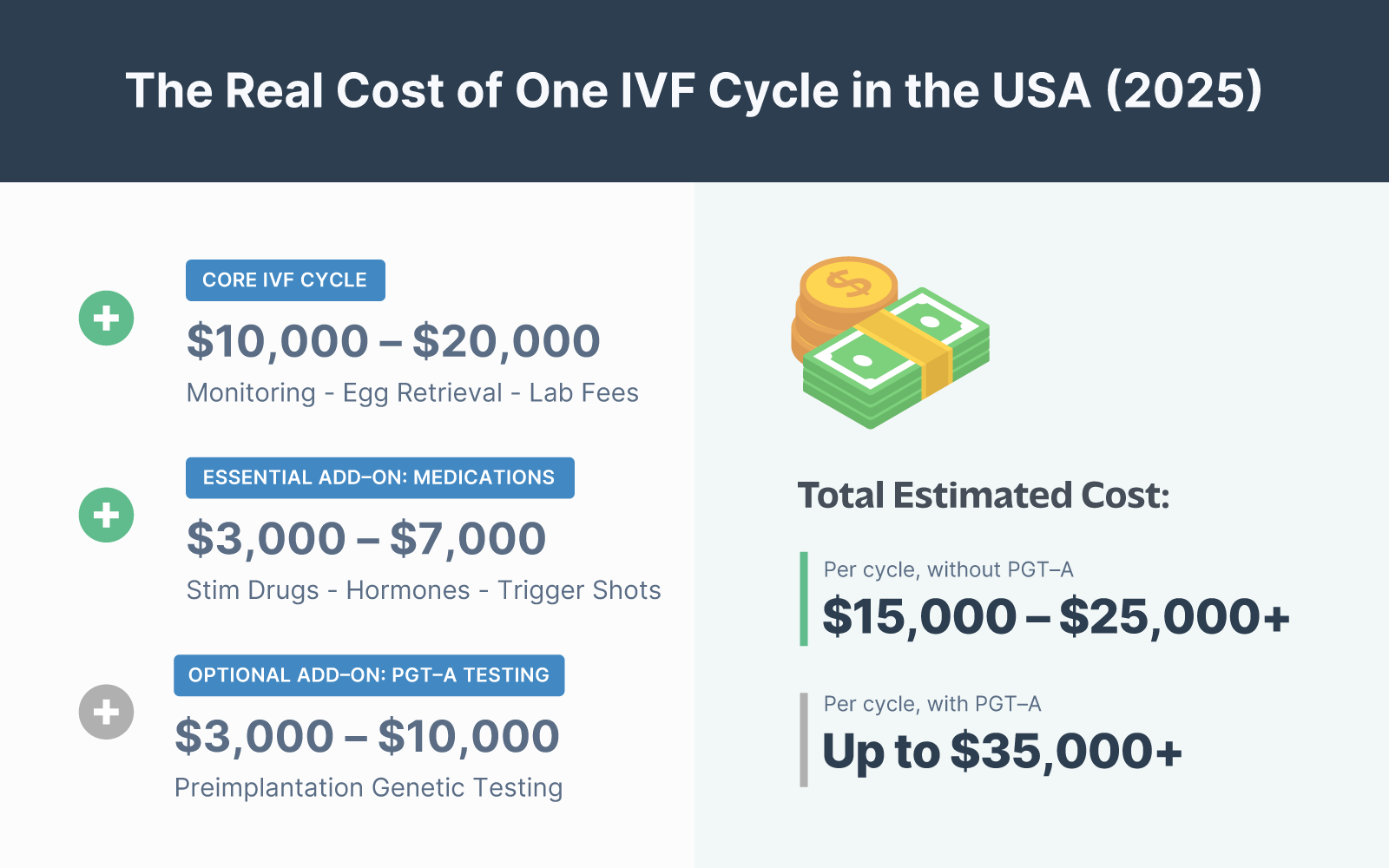
A visual breakdown of potential IVF costs you may encounter.
Cost–Saving Strategies & Low–Cost IVF
The totals can feel big. You have options that can bring costs down and still keep you on track.
Mini IVF and Natural IVF
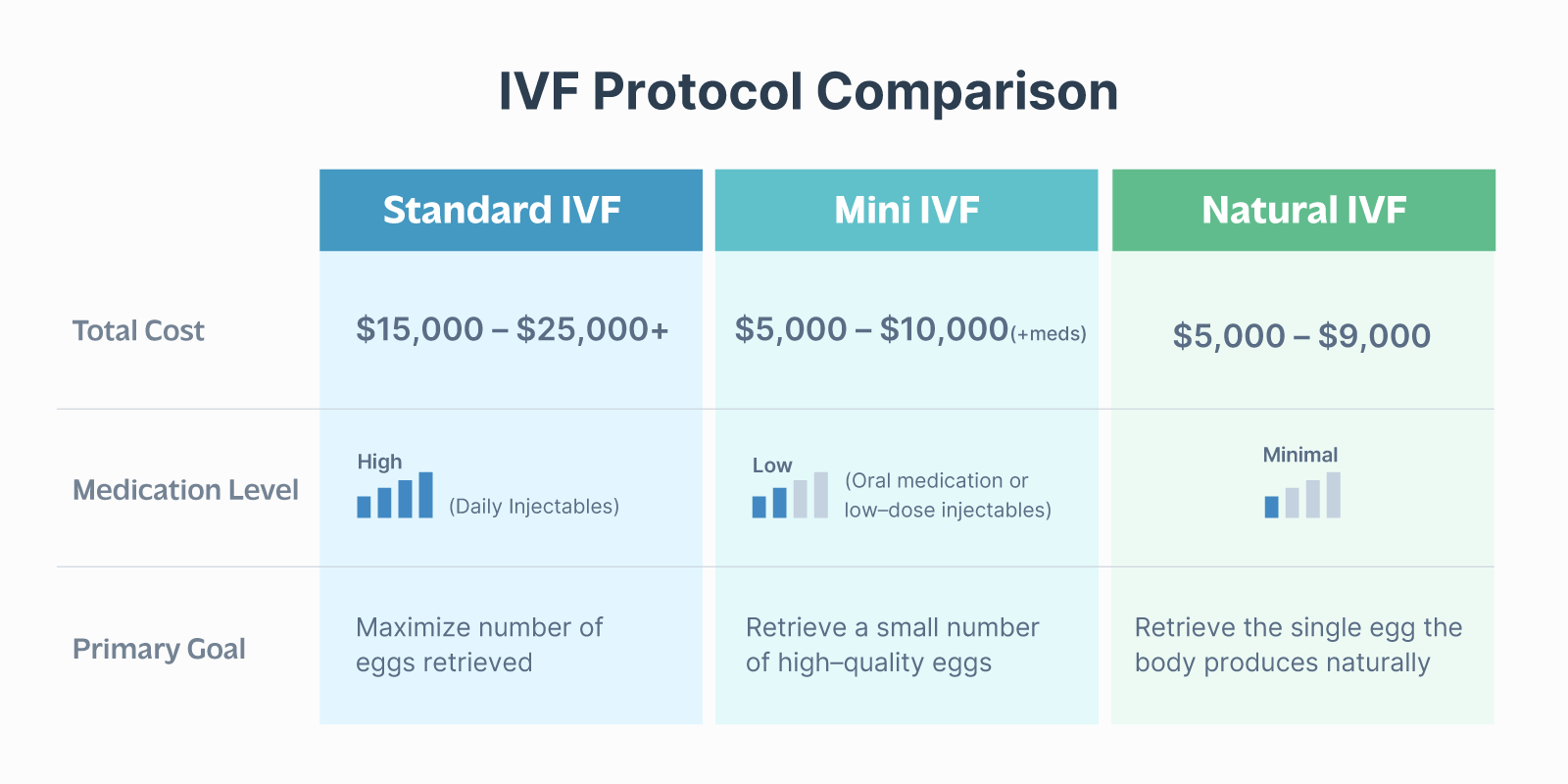
If controlled ovarian hyperstimulation (COH) isn’t right for you, lighter protocols can help.
- Mini IVF: Lower doses of fertility drugs, fewer oocytes, and lower price. Expect $5,000–$10,000 plus meds ($200–$2,500).
- Natural IVF: Works with your single natural egg. Expect $5,000–$9,000 with minimal medication costs.
Multi–Cycle and Shared Risk Programs
To manage uncertainty, many clinics bundle 2–3 IVF cycles for $15,000–$30,000, excluding meds. Some offer shared–risk plans with a partial or full refund if you don’t bring home a baby after the agreed–upon attempts. Ask for the fine print: eligibility, refund rules, and what’s included.
Latest Research Insights
Minimal Stimulation (MS–IVF) is Cost–Effective for Poor Responders Due to Medication Savings (2023): An economic evaluation comparing Minimal Stimulation IVF (MS–IVF) to Conventional IVF (C–IVF) in poor responders found no significant difference in overall pregnancy rate between the two protocols. However, MS–IVF significantly reduced medication costs by an average of EUR 1260 per cycle due to lower hormone dosages. Because of these large cost savings, the study found that MS–IVF was highly likely to be cost–effective (up to 100% probability at a EUR 0 willingness–to–pay threshold), suggesting it can enable couples to afford more cycles for the same total investment (Oliveira de Souza T, et al. JBRA Assist Reprod 27(2):204–214. PMID: 36107034).
Mild vs. Conventional Stimulation Protocols Show Similar Live Birth Rates Across All Patient Types (2020): A systematic review and meta–analysis of 31 randomized controlled trials (RCTs) compared Mild Stimulation IVF (MD–IVF, ≤150 IU daily dose) to Conventional IVF (CD–IVF) in poor, normal, and hyper–responders. The review found no significant difference in Live Birth Rates or Cumulative Live Birth Rates for any patient group (e.g., normal responders: RR 0.88; poor responders: RR 0.91). However, MD–IVF significantly reduced the risk of Ovarian Hyperstimulation Syndrome (OHSS) in both normal and hyper–responders (RR 0.22 and 0.47, respectively) and was consistently associated with lower total cost and gonadotrophin use for poor and normal responders (Datta AK, et al. Hum Reprod Update27(2):229–253. PMID: 33146690).
ASRM Opinion on Financial Risk–Sharing/Refund Programs (2024): The Ethics Committee of the American Society for Reproductive Medicine (ASRM) analyzed the ethical issues surrounding financial risk–sharing (refund) programs. The Committee concluded that while these programs offer financial protection for patients without insurance, they are only ethically acceptable if clinics maintain strict transparency (clear eligibility, refund rules, and excluded costs like medication) and adhere to all ASRM clinical guidelines, ensuring providers do not take medically inappropriate risks to avoid paying a refund. Ultimately, the Committee reaffirmed that health insurance coverage is the ideal and preferred model for financial risk mitigation (Ethics Committee of the ASRM. Fertil Steril 121(5): 783–786. PMID: 38276940).
DuoStim Protocol Significantly Improves Success for Complex PGT Patients (2024): A propensity–score matched study compared the DuoStim approach (two stimulations in the same ovarian cycle) versus a conventional approach in couples requiring both PGT for Monogenic conditions (PGT–M) and PGT–A. For couples who obtained ≤5 blastocysts in the first retrieval, DuoStim resulted in a significantly higher 1–year Cumulative Live Birth Rate (cLBR) (39% vs. 22%) and successfully minimized treatment discontinuation (only 0% discontinuation versus 85% discontinuation in the conventional group after the first failed cycle). The study concludes that DuoStim increases the probability of obtaining transferable blastocysts and decreases the treatment dropout rate for these complex cases (Vaiarelli A, et al. Eur J Obstet Gynecol Reprod Biol 303:272–278. PMID: 39509926).
Note: These findings represent recent peer–reviewed research and clinical guidelines. Individual outcomes may vary based on personal health factors. Discuss these findings with your fertility specialist.
What to Expect: Your IVF Timeline
From the start of stimulation to the pregnancy test, plan for about 4–6 weeks. Here’s the flow:
- Ovarian Stimulation (10–14 days): You take injections and come in for monitoring every few days.
- Egg Retrieval (Day 12–16): A brief procedure under sedation to collect your eggs.
- Fertilization & Embryo Culture (5–6 days): Eggs are fertilized and embryos grow in the lab.
- Embryo Transfer (Day 18–22): Your doctor transfers the selected embryo into your uterus. No anesthesia is needed, as this procedure is non–invasive and painless.
- The Two–Week Wait: Then the pregnancy test. This timeframe is emotionally challenging, therefore, set specific boundaries for when to allow yourself to analyze symptoms and research outcomes and when to deliberately shift your focus to distracting activities, such as hobbies or social connections, to mitigate emotional distress.
Final Thoughts
Seeing the full cost picture helps you plan a realistic budget—not only for the core bundle you select, but also for any additional services you may need. These can include advanced genetic testing, embryo vitrification instead of a fresh transfer, a backup cryotransfer, or even a hybrid cycle that uses both your own oocytes and donor eggs.
In the United States, one IVF cycle—including medications and common add–ons—typically costs $15,000–$25,000. Even when clinics quote prices in this range, the final price tag can vary based on what is actually included.
Ask every clinic for itemized pricing, clarify what each package covers, and identify what falls outside the quoted fee. Compare single–cycle, multi–cycle, and premium programs, and explore financing or payment–plan options. With transparent numbers and a plan that fits your budget, you stay in control and can move confidently toward your goal.

Why trust this guide? The OVU commitment
You are probably juggling hope, timelines, and a lot of tabs open in your browser. And you deserve clear, current, human advice. At OVU, we review clinic protocols, compare real quotes, and talk to people who have done this - intended parents and gestational carriers - so we can give you practical steps, not just theory. If you want help comparing options without sales pressure, we will gather itemized quotes and success data that match your exact situation. You decide, we will bring the info to your table.
Reference List 21 sources
Journal Article (Research): Davis OS, Favetta LA, Deniz S, Faghih M, Amin S, Karnis M, Neal MS. Potential Costs and Benefits of Incorporating PGT-A Across Age Groups: A Canadian Clinic Perspective. J Obstet Gynaecol Can. 2024 May;46(5):102361. doi: 10.1016/j.jogc.2024.102361. PMID: 38272217. Available from: https://www.jogc.com/article/S1701-2163(24)00037-9/fulltext
Journal Abstract (Cost-Effectiveness Analysis): Dunn A, Hunkler K, Torrealday S, Lewis T, DeCherney A, Hill M, Combs J. Cost-effectiveness analysis of PGT-A in good prognosis patients. Fertil Steril. 2024 Jul;122(1 Suppl):e25-e26. PMID: 38871329. Available from: https://www.fertstert.org/article/S0015-0282(24)00352-2/fulltext
Journal Article (Cost-Effectiveness Analysis): Antero MF, Singh B, Pradhan A, Gornet M, Kearns WG, Baker V, Christianson MS. Cost-effectiveness of preimplantation genetic testing for aneuploidy for fresh donor oocyte cycles. F S Rep. 2020 Dec 9;2(1):36-42. doi: 10.1016/j.xfre.2020.11.005. PMID: 34223271. Available from: https://pmc.ncbi.nlm.nih.gov/articles/PMC8244284/
Journal Article (Cost-Effectiveness Analysis): Lee E, Costello MF, Botha WC, Illingworth P, Chambers GM. A cost-effectiveness analysis of preimplantation genetic testing for aneuploidy (PGT-A) for up to three complete assisted reproductive technology cycles in women of advanced maternal age. Aust N Z J Obstet Gynaecol. 2019 Aug;59(4):573-579. doi: 10.1111/ajo.12988. PMID: 31106861. Available from: https://pubmed.ncbi.nlm.nih.gov/31106861/
Journal Article (Survey): Collura B, Hayward B, Modrzejewski KA, Mottla GL, Richter KS, Catherino AB. Identifying Factors Associated with Discontinuation of Infertility Treatment Prior to Achieving Pregnancy: Results of a Nationwide Survey. J Patient Exp. 2024 Feb 26;11:23743735241229380. doi: 10.1177/23743735241229380. PMID: 38414755. Available from: https://journals.sagepub.com/doi/10.1177/23743735241229380
Committee Opinion (Guidance): Practice Committee of the American Society for Reproductive Medicine. Guidance on the limits to the number of embryos to transfer: a committee opinion. Fertil Steril. 2021 Jul;116(1):55-65. Available from: https://www.asrm.org/practice-guidance/practice-committee-documents/guidance-on-the-limits-to-the-number-of-embryos-to-transfer-a---committee-opinion-2021/
Journal Article (Cost-Effectiveness Study): Cimadomo D, Taggi M, Cimadomo V, Innocenti F, Albricci L, Colamaria S, Argento C, Giuliani M, Ferrero S, Borini A, Guido M, Campitiello MR, Ubaldi FM, Capalbo A, Rienzi L, Gennarelli G, Vaiarelli A. Value of PGT-A when only one or two blastocysts are obtained: propensity-score matching and cost-effectiveness study. Ultrasound Obstet Gynecol. 2025 Jan;65(1):106-113. doi: 10.1002/uog.29148. PMID: 39644516. Available from: https://obgyn.onlinelibrary.wiley.com/doi/10.1002/uog.29148
Journal Abstract (Research): Weier C. P-566 The first use of high resolution PGT-A in a large clinical cohort to detect nine common microdeletion and microduplication syndromes. Hum Reprod. 2025 Jun;40(Suppl 1):deaf097.872. doi: 10.1093/humrep/deaf097.872. Available from: https://academic.oup.com/humrep/article/40/Supplement_1/deaf097.872/8170630
Journal Article (Comparative Study): Li PX, Han JY, Zheng W, Shen R, Meng N, Ren BN, Yan YX, Yang Y, Hu MY, Guan YC. Comparative analysis of cumulative live birth rates in patients with recurrent pregnancy loss undergoing preimplantation genetic testing for aneuploidy versus conventional in vitro fertilisation/intracytoplasmic sperm injection: a retrospective study. J Ovarian Res. 2025 Jul 3;18(1):141. doi: 10.1186/s13048-025-01721-3. PMID: 40611317. Available from: https://ovarianresearch.biomedcentral.com/articles/10.1186/s13048-025-01721-3
Journal Article (Review): Viotti M. Preimplantation Genetic Testing for Chromosomal Abnormalities: Aneuploidy, Mosaicism, and Structural Rearrangements. Genes (Basel). 2020 May 29;11(6):602. doi: 10.3390/genes11060602. PMID: 32485954. Available from: https://pmc.ncbi.nlm.nih.gov/articles/PMC7349251/
Journal Article (Cost-Effectiveness Study): de Souza TO, Ben AJ, van Dongen JM, Bosmans JE, da Cunha-Filho JS. Effectiveness and Cost-effectiveness of Minimal Ovarian Stimulation in-vitro Fertilization versus Conventional Ovarian Stimulation in Poor Responders: Economic Evaluation Alongside a Propensity Score Adjusted Prospective Observational Study. JBRA Assist Reprod. 2023 Apr-Jun;27(2):204-214. doi: 10.5935/1518-0557.20220025. PMID: 36107034. Available from: https://pmc.ncbi.nlm.nih.gov/articles/PMC10279446/
Journal Article (Systematic Review & Meta-Analysis): Datta AK, Maheshwari A, Felix N, Campbell S, Nargund G. Mild versus conventional ovarian stimulation for IVF in poor, normal and hyper-responders: a systematic review and meta-analysis. Hum Reprod Update. 2020 Nov 4;27(2):229-253. doi: 10.1093/humupd/dmaa035. PMID: 33146690. Available from: https://pmc.ncbi.nlm.nih.gov/articles/PMC7902993/
Ethics Committee Opinion: Ethics Committee of the American Society for Reproductive Medicine. Financial "risk-sharing" or refund programs in assisted reproduction: an Ethics Committee opinion. Fertil Steril. 2024 May;121(5):783-786. doi: 10.1016/j.fertnstert.2023.12.032. PMID: 38276940. Available from: https://www.fertstert.org/article/S0015-0282(23)02103-9/fulltext
Journal Article (Case Series): Vaiarelli A, Cimadomo D, Blancafort C, Trabucco E, Alviggi E, Vallefuoco R, Livi C, Benini F, Canosa S, Llácer J, Ruffa A, Borini A, Capalbo A, Rienzi L, Gennarelli G, Ubaldi FM. A multi-cycle approach via DuoStim is beneficial to treat couples indicated to PGT-M plus PGT-A. A propensity score matching-based case series. Eur J Obstet Gynecol Reprod Biol. 2024 Dec;303:272-278. doi: 10.1016/j.ejogrb.2024.11.003. PMID: 39509926. Available from: https://www.fertstert.org/article/S0015-0282(23)00372-2/fulltext
Website/Report: FertilityIQ. The Cost of IVF By City. [Internet]. [Cited November 14, 2025]. Available from: https://www.fertilityiq.com/fertilityiq/ivf-in-vitro-fertilization/costs-of-ivf
Website/Report: CCRM Fertility. IVF Costs: How much does IVF cost out-of-pocket? [Internet]. [Cited November 14, 2025]. Available from: https://www.ccrmivf.com/resources/fertility-financing-options/ivf-cost/
Government Pricing Tool: TrumpRx. (Connects patients directly with the best prices, increasing transparency and cutting out costly third-party markups) [Internet]. [Cited November 14, 2025]. Available from: https://trumprx.gov/
Website/Report: GoodRx. How Much Do In Vitro Fertilization (IVF) Medications Cost? [Internet]. [Cited November 14, 2025]. Available from: https://www.goodrx.com/conditions/fertility/ivf-in-vitro-fertilization-medications-cost
Website/Report: FertilityIQ. Costs of PGT-A. [Internet]. [Cited November 14, 2025]. Available from: https://www.fertilityiq.com/fertilityiq/pgs-embryo-genetic-screening/costs-of-pgs
Website/Report: FertilityIQ. Understanding ICSI's Costs. [Internet]. [Cited November 14, 2025]. Available from: https://www.fertilityiq.com/fertilityiq/icsi/understanding-incis-costs
Website/Report: CNY Fertility. The Real Cost of IVF: What You'll Actually Pay & How to Save. [Internet]. [Cited November 14, 2025]. Available from: https://www.cnyfertility.com/ivf-cost/
Frequently Asked Questions
How much should I budget for IVF medications?
Plan for $3,000–$7,000 per cycle for injectable gonadotropins. This is separate from the clinic fee and can make up a large share of your total cost.
What does a Frozen Embryo Transfer (FET) cost?
An FET cycle is $3,000–$8,000, plus $400–$1,500 for medications to prep the lining. Ask whether monitoring and the embryo thaw are included.
How much does PGT-A add?
PGT-A adds $3,000–$10,000 for biopsy and testing, often billed by an outside lab. Confirm per‑embryo fees and shipping costs if used.
Are there cheaper alternatives to standard IVF?
Yes. Natural IVF runs $5,000–$9,000 and uses your single natural egg. Mini IVF runs $5,000–$10,000 plus meds and uses lower stimulation. Your doctor can advise which fits your case.
Related articles

Employer Fertility Benefits: How to Read the Fine Print and Protect Your Budget
Fertility Benefits & Financing Your guide to understanding employer fertility benefits, costs, and coverage gaps Last Updated: 22 July 2026 Medically Reviewed 14 min read Evidence-based If you are trying to build your family and running into roadblocks, it probably feels like you are living in two worlds. In one, friends seem to get pregnant without thinking about it. In the other, you are juggling clinic visits, lab results, and bills that look more like a mortgage down payment than a medical copay. It is an exhausting place to live. The numbers behind what you are feeling are stark. The
19 min read
Fertility Grants & Scholarships: How to Actually Afford IVF
Fertility Costs & Financing Your guide to fertility grants, IVF costs, and real-world budgeting Last Updated: 19 July 2026 Medically Reviewed 16 min read Evidence-based I know the sticker price of fertility treatment is terrifying. When you first get that folder from your clinic, it is easy to feel completely overwhelmed. Very few of us can easily set aside $25,000 for a single IVF cycle, especially when that investment comes with no guarantees. This financial pressure forces a difficult internal dialogue: “How are we going to pay for this?” or even worse, “Are we paying for treatment or paying to
16 min read
Fertility Financing Options: How To Pay For IVF Without Losing Your Mind
Fertility Costs & Financing Your guide to fertility treatment costs and financing options Last Updated: 16 July 2026 Medically Reviewed 20 min read Evidence-based If you have just opened a clinic estimate and seen figures like $20,000 or $30,000, you might feel a wave of embarrassment or anxiety. It is natural to hesitate before rushing into treatment when your mind is overwhelmed by the thought of affording it all without taking on a second job or starting a side business just to cover the costs. You aren’t just thinking about the medications and procedures; you’re wondering how to pay for
16 min read