


Dr. Sony Sherpa (MBBS)
In addition to her clinical experience, Dr. Sherpa is a published medical researcher and holistic health advocate. Her dual expertise in emergency care and alternative therapies brings a unique lens to medically reviewed content—ensuring it is both accurate and accessible.
If you are staring at clinic websites and flight prices and wondering whether IVF in Spain is really worth it, you are not alone. You might be weighing up another cycle at home that has already failed, or a fresh start somewhere that treats thousands of international patients every year. That decision feels big, and it is.
Spain now performs tens of thousands of IVF and egg donation cycles each year, and in some regions, around one in eight babies are born after assisted reproduction. That volume translates into experience, especially with donor eggs, older patients, and international treatment plans. When you understand how costs, success rates, and the law work together, your choice starts to feel less like a gamble and more like a planned move.
Most major Spanish programs follow European guidelines on safety and embryo transfer, and many contribute data to registries used by groups such as ESHRE. You get the benefit of that structured approach, while still working with clinics that know how to talk to you as a person, not just as a case file.
IVF in Spain typically costs €4,300 to €6,000 with your own eggs and €5,900 to €9,500 with donor eggs, before medication. Success rates are highest with donor eggs, where many clinics report around 70% pregnancy rates in the first cycle and over 90% after several attempts.
The main trade-offs are cost, fully anonymous donation, and the practical side of traveling for treatment. Once you know which of those matters most to you, it becomes much easier to choose a clinic and build a realistic plan.
Research highlights at a glance
European registry data show that frozen embryo transfers now achieve clinical pregnancy rates in the mid-30% range per transfer, similar to fresh transfers but with greater control over timing. Large studies also show that cumulative live birth rates can approach 70% for women under 35 after several IVF cycles, and that donor egg cycles keep high success even at older ages.
Guidelines from professional bodies such as ESHRE and ASRM support single embryo transfer in most cases, especially when embryos are tested or come from young donors, to cut the risk of twins and preterm birth.
In This Guide
Own eggs: €4,300–€6,000
Donor eggs: €5,900–€9,500
Open to single women
And heterosexual or lesbian couples
Fully anonymous donors
Strict single embryo focus
IVF in Spain at a Glance: Why So Many Patients Travel
When you first hear that Spain is the “donor egg capital” of Europe, it can sound like marketing. In reality, it reflects the sheer number of donor cycles performed each year and the size of the donor pool. That volume means very short waiting times, even if you want a close physical match or need specific blood group matching.
You also see a clear pattern in who chooses Spain. Many patients are in their late thirties or forties, have already had failed cycles at home, or live in countries where single women and same-sex couples face legal barriers. Others come because anonymous donation fits their family values, and they want to keep their child’s genetic story private outside the immediate family.
Latest Data: Why Volume Matters
15% of European IVF: Spain now performs approximately 15% of all IVF cycles in Europe. This massive volume drives high expertise in complex cases. Source: Instituto Bernabeu.
12% of National Births: Assisted reproduction accounts for roughly 12% of all births in Spain, making fertility treatment a normalized, highly developed part of the healthcare system. Source: Instituto Bernabeu.
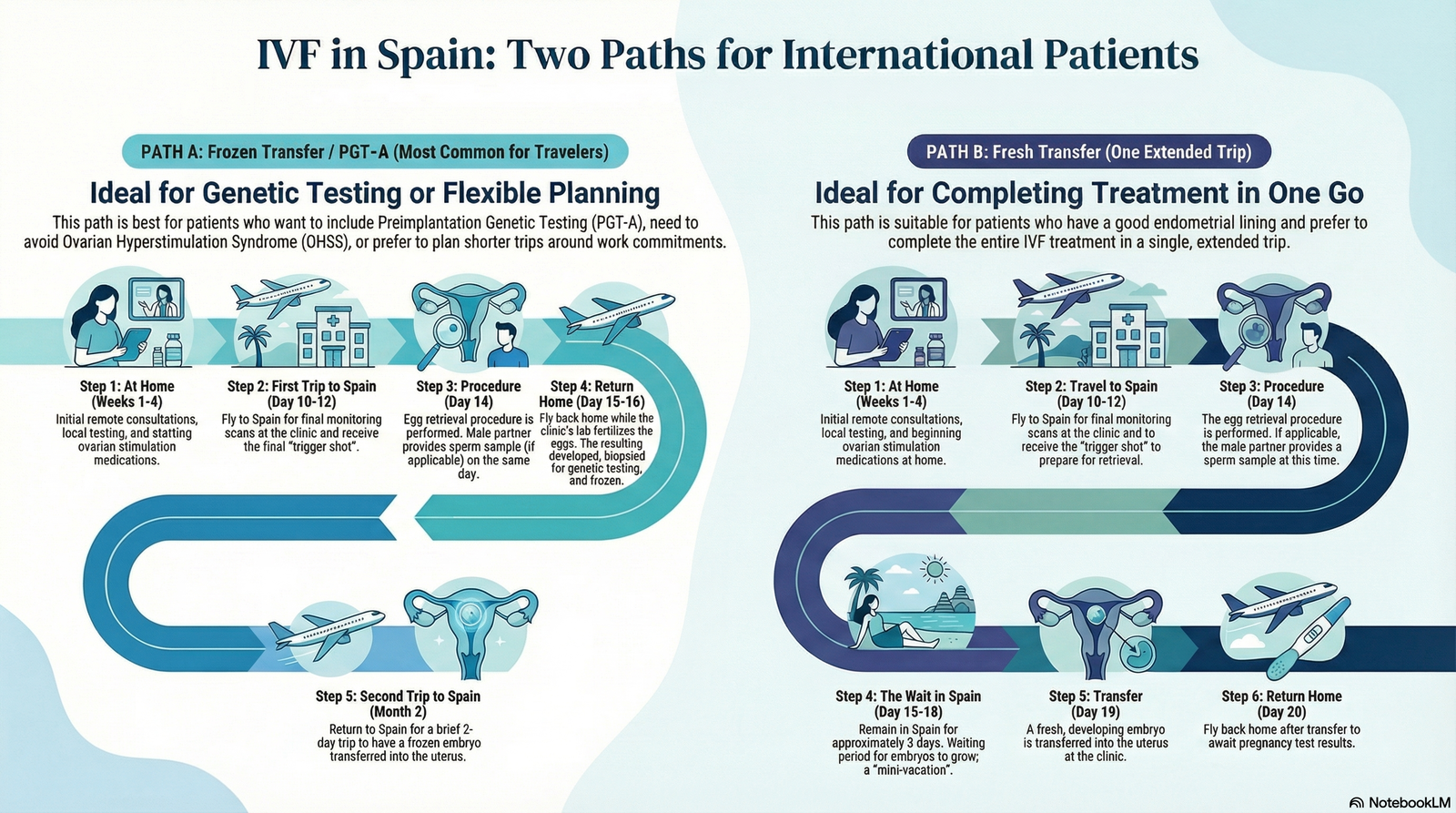
Typical pathway for IVF in Spain, from first consultation through egg collection and embryo transfer.
IVF Costs in Spain (Own Eggs, Donor Eggs, ROPA, IUI)
Once you start collecting clinic quotes, it can feel like you are comparing apples, oranges, and a few mystery fruits. The base fee often looks similar, but what is included varies a lot. You want to know three separate numbers: clinic fees, medication costs, and any extra lab services such as PGT-A or embryo freezing.
Below is a simple way to frame the main treatment types most international patients use.
| Treatment Type | Typical Clinic Fee | What It Includes |
|---|---|---|
| IVF with your own eggs | €4,300–€6,000 | Monitoring, egg collection, lab work, embryo transfer, and often ICSI. |
| Egg donation IVF | €5,900–€9,500 | Donor screening, donor medications, lab work, transfer, and sometimes embryo guarantees (guarantee of 1 to 3 good–quality blastocysts). |
| ROPA (reciprocal IVF) | €5,400–€6,500 | Stimulation of one partner, donor sperm, laboratory fees (including fertilization and cultivation of fertilized cohort until the cleavage stage (Day 3), or blastocyst stage (Day 5 and Day 6), and embryo transfer to the other partner. |
| IUI (partner or donor sperm) | €600–€1,700 | Basic monitoring, sperm prep, and insemination procedure. |
Medication is the most common “surprise” cost. For a full IVF stimulation, you usually add around €1,000 to €2,000 in drugs on top of clinic fees. Donor cycles may include the donor’s medication but not your lining preparation medication, so always ask each clinic to list drug costs for you and for the donor separately.
If you are considering refund or “baby guarantee” programs, you pay more at the start but spread that risk over several cycles. Clinics only offer these when your medical history suggests a reasonable chance of success across the program, so full clearance usually needs blood work and scan results.
Treatment Steps and Travel Logistics
If you live outside Spain, one of your biggest worries is how many trips you will need to make and how long you will need to stay. The good news is that most clinics have clear workflows for international patients, and you can often do much of the early monitoring close to home.
A typical IVF cycle with your own eggs looks like this:
- Remote or in-person consultation: You share your history, blood tests, and scan reports. The clinic suggests a protocol and sends a treatment calendar.
- Stimulation at home: You inject stimulation medication for about 10 to 12 days. Local clinics handle scans and send reports to Spain.
- Egg collection trip: You arrive in Spain a day or two before the trigger shot, have egg collection under sedation, and often fly home two or three days later.
- Embryo transfer: If you have a fresh transfer, this happens about five days after egg collection. Many clinics prefer to freeze embryos and bring you back for a frozen transfer in a calmer cycle.
Egg donation cycles are often even easier to plan a trip. The clinic stimulates the donor locally, synchronizes your preparation of the endometrial lining, and then schedules your arrival for a shorter window around embryo transfer. The ROPA method for female couples follows a similar pattern to any IVF cycle involving the use of donor sperm, with stimulation of one partner and transfer to the other.
Making travel work for your life
Short, focused trips: With good planning, many patients do only one or two short trips per cycle. You keep your normal routines at home for most of the process and then travel to the Spanish clinic to complete several milestones at once.
Shared care with local doctors: Spanish clinics are used to reading scan reports and blood tests from other countries. You save money and time by doing the monitoring near home.
Real-time updates from the lab: Some centres offer apps that show embryo development in incubators. This can help you feel connected to the process even when you fly home between steps.
Success Rates, Age, and When to Consider Donor Eggs
Success rates are usually the hardest numbers to look at, because they bring your age and past losses into sharp focus. It helps to split the conversation into two parts: your own eggs and donor eggs.
With your own eggs, age at egg collection is the main driver. Under 35, many Spanish clinics report clinical pregnancy rates around the mid 50% range per fresh transfer. Between 35 and 39, that number drops but often stays close to 50%. Once you reach 40 and older, the chances per transfer fall into the teens or low twenties, even in good clinics.
Donor eggs change that picture. Because donors are usually under 35, success becomes much less tied to your age. Per transfer, many centres report pregnancy rates around 60% to 70%. Over several transfers, cumulative pregnancy rates often pass 90% for patients who keep going.
Key Safety & Success Stats
91% Singleton Births: Over 91% of IVF births in Europe are now singletons. This shift significantly lowers health risks for both mother and baby compared to twin pregnancies.
<1% OHSS Risk: Thanks to modern stimulation protocols, severe Ovarian Hyperstimulation Syndrome (OHSS) now affects less than 1% of patients.
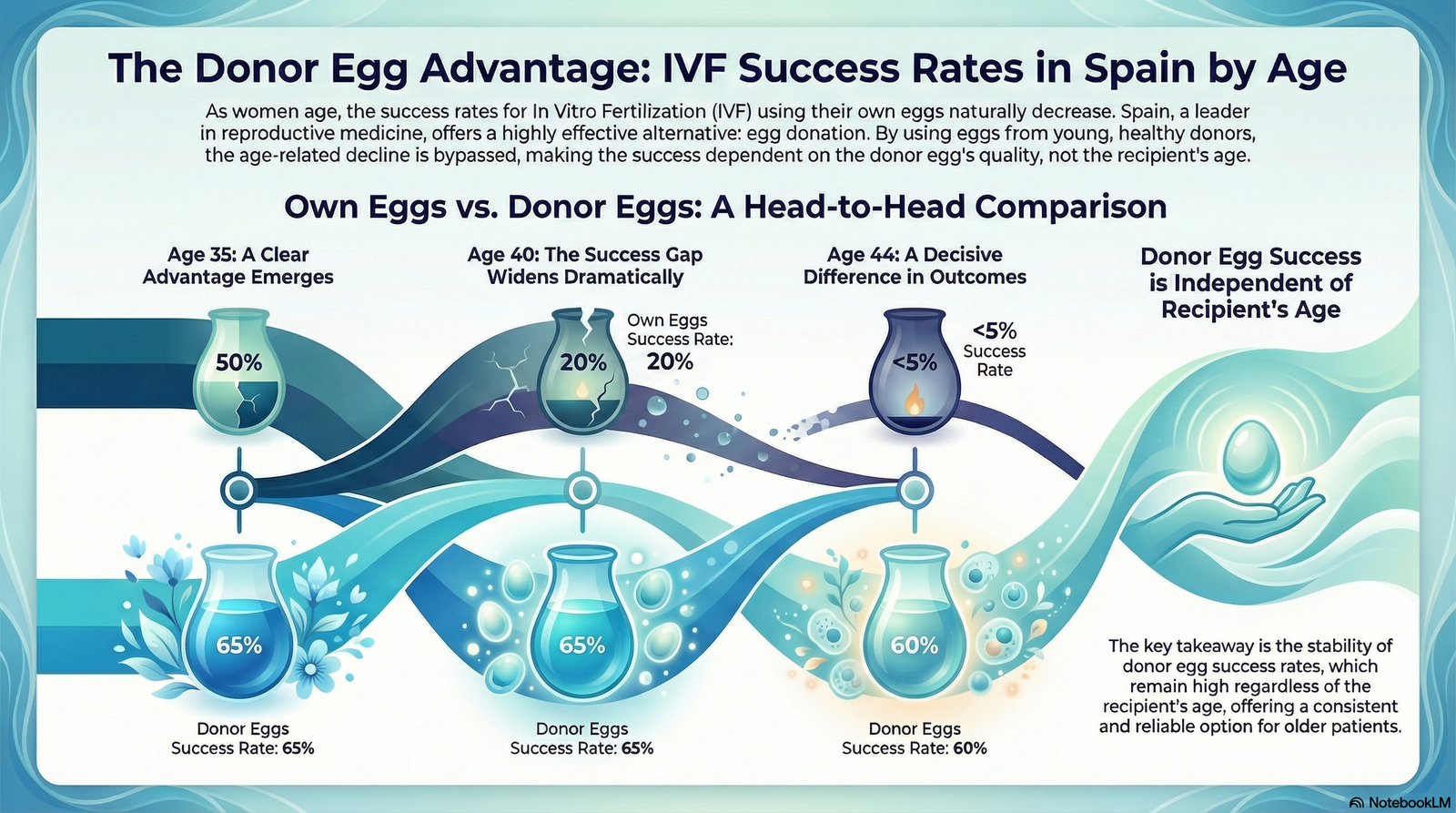
How success rates shift from own eggs to donor eggs as age increases.
You also have the option of adding PGT-A, which checks embryos for major chromosomal problems before transfer. For women in their late thirties or early forties, research shows that PGT-A can raise cumulative live birth rates and cut the number of transfers and early miscarriages needed to reach a single healthy pregnancy.
If you are already in your forties and feel drained by repeated failed cycles, donor eggs can be a way to give your body a break while keeping strong odds of success. This choice is not easy emotionally, and you are allowed to take time to grieve the loss of a genetic connection if that matters to you. Good clinics and counsellors will walk through both the numbers and the feelings with you before you decide.
How to Choose a Spanish Clinic
Once you know that Spain fits your legal and emotional needs, the next challenge is choosing between big brand groups and smaller specialist centers. This is where your personal preferences matter as much as any success rate chart.
Large groups such as IVI or Dexeus offer broad hospital support, multiple locations, and large data sets. Smaller centers such as URE Centro Gutenberg or Fertilab Barcelona often feel more personal and can be easier to reach by email or phone.
How to read clinic promises
Look for per transfer rates by age: Focus on clinical pregnancy or live birth per transfer, split by age group. That tells you more than a single overall number.
Check what is included in packages: Two clinics with the same base price may include very different things. Always ask them to list what is and is not included in writing.
Ask who will actually follow your case: You will feel calmer if you know who reviews your scans, answers urgent questions, and adjusts your medications during stimulation.
Here is a simple way to think about location and style:
- Barcelona: Best if you want many clinic options in one city and easy flights. Home to Eugin, Fertilab, Dexeus, Reproclinic, Rainbow, Instituto Marquès, and others.
- Valencia: Often slightly cheaper for living costs. Hosts IVI, FIV Valencia, and CREA.
- Alicante: Suits you if you want a quieter coastal base, with Instituto Bernabeu as a major cenre.
- Málaga: Good for combining treatment with a slower pace by the sea, with URE Centro Gutenberg as a reference clinic.
Key Pros and Cons of IVF in Spain
| Pros | Cons |
|---|---|
| Very large donor pool and short waiting times, even for specific matches | Fully anonymous donation, no option for open donors or future contact |
| Legal access for single women and lesbian couples, including ROPA | Higher costs than some Eastern European destinations, though usually lower than the US or UK |
| Modern lab technology widely available, often built into standard packages | Medication, freezing, and add ons can raise the final bill if you do not check details in advance |
| Clinics are used to international patients and remote monitoring | Follow-up care happens at home, so you need a clear handover between the clinic and your local doctor |
Want help comparing clinics and costs?
If this already feels like a full time job, you are not imagining it. Our advisors can gather clear, itemized quotes from trusted Spanish clinics, explain how success rates apply to your age and history, and help you plan realistic timelines.

Why trust this guide? The OVU commitment
You are probably juggling hope, timelines, and a lot of tabs open in your browser. And you deserve clear, current, human advice. At OVU, we review clinic protocols, compare real quotes, and talk to people who have done this - intended parents and gestational carriers - so we can give you practical steps, not just theory. If you want help comparing options without sales pressure, we will gather itemized quotes and success data that match your exact situation. You decide, we will bring the info to your table.
Frequently Asked Questions
Can I choose my baby’s sex in Spain?
No. Sex selection for non-medical reasons is not allowed in Spain. Doctors can look at embryo sex only to avoid serious sex-linked genetic diseases. You cannot choose a boy or a girl for personal reasons.
Is PGT-A testing standard in Spanish clinics?
PGT-A is widely available but usually offered as an add-on, especially for women over 35 or with repeated failed transfers. It can raise your chance of a baby per transfer and reduce miscarriages in some age groups, but it also adds cost, so you and your doctor should decide whether it fits your case.
How many embryos will a Spanish clinic transfer?
Most top clinics in Spain now recommend single embryo transfer in most cycles, especially for donor eggs or PGT-A tested embryos. This protects you and your baby from the additional risks of conceiving twins while still maintaining high success rates across multiple transfers.
What happens if I do not get pregnant?
With a standard single round of IVF, you pay for that attempt, whatever the outcome. Refund and baby guarantee programs spread that risk over several cycles and return part or all of your fee if you do not have a live birth by the end of the program. Clinics only offer these when your medical situation makes success over several cycles likely enough to be fair for both sides.
Is there an age limit for IVF in Spain?
Most clinics set an upper age limit of around 50 to 52 years for the person carrying the pregnancy. For own egg IVF, many centres strongly discourage treatment past the early forties because success rates are very low. Donor eggs remain an option later, but each case is assessed on medical grounds, not solely on age.
Will I be able to speak English with my care team?
Yes. Spanish clinics that work with international patients almost always have English-speaking doctors and coordinators. Many can also support other languages such as French, German, or Italian. It is reasonable to ask who your main contact will be and which languages they speak before you commit.
Reference List 9 sources
Journal Article (Research): European IVF Monitoring Consortium for ESHRE. ART in Europe 2020. Human Reproduction. 2025;Volume(Issue):Pages. doi: n/a. PMID: n/a. Available from: https://academic.oup.com/humrep
Journal Article (Research): ESHRE. IVF and IUI pregnancy rates remain stable across Europe. Focus on Reproduction. 2024. Available from: https://www.focusonreproduction.eu
Committee Opinion (Guidance): ESHRE Guideline Group on Ovarian Stimulation. Ovarian stimulation for IVF/ICSI. Human Reproduction Open. 2024. Available from: https://www.eshre.eu
Committee Opinion (Guidance): Practice Committee of the American Society for Reproductive Medicine. The use of preimplantation genetic testing for aneuploidy (PGT-A): a committee opinion. Fertility and Sterility. 2024. Available from: https://www.asrm.org
Journal Article (Research): Smeenk J, et al. Assisted reproductive technology in Europe 2019. Human Reproduction. 2023;Volume(Issue):Pages. doi: n/a. PMID: n/a. Available from: https://academic.oup.com/humrep
Journal Article (Review): Silvestris E, et al. Pregnancy by oocyte donation and maternal risks. International Journal of Molecular Sciences. 2023;Volume(Issue):Pages. doi: n/a. PMID: n/a. Available from: https://www.mdpi.com/journal/ijms
Journal Article (Research): Beebeejaun Y, et al. Preimplantation genetic testing for aneuploidy in women aged 35 to 42. Journal of Clinical Medicine. 2025;Volume(Issue):Pages. doi: n/a. PMID: n/a. Available from: https://www.mdpi.com/journal/jcm
Journal Article (Research): Cuevas Saiz I, et al. Demographic impact of IVF in Spain. Medicina Reproductiva y Embriología Clínica. 2022;Volume(Issue):Pages. doi: n/a. PMID: n/a. Available from: https://www.elsevier.es/es-revista-medicina-reproductiva-embriologia-clinica-400
Website/Report: Multiple Spanish clinic price lists and outcome reports (Reproclinic, CREA Valencia, Dexeus Mujer, Eugin, Fertilab Barcelona, FIV Valencia, Instituto Bernabeu, Instituto Marquès, IVI Fertility, Next Fertility, Rainbow Fertility, URE Centro Gutenberg, Wilson Fertility). 2025. Available from: https://ovu.com
Final thoughts
Stepping outside your home country for IVF is a big emotional and practical decision. You are not just comparing prices; you are choosing the team that will handle your eggs, embryos, and hopes. Spain offers strong success rates, clear legal protection for intended parents, and deep experience with donor eggs, international cases, and same-sex couples.
You deserve space to weigh that against the cost, the reality of anonymous donation, and the demands of travel. When you slow the decision down, ask each clinic the same questions, and keep your own limits in mind, you give yourself the best chance of feeling at peace with whatever you choose next.
Ready to map out your options?
If you want a clear side by side view of Spanish clinics, you can share your age, diagnosis, and budget with our advisory team. Together you can narrow down realistic options, understand likely success rates for your situation, and turn a vague idea into a step by step plan.
Related articles

How to Choose Fertility Clinics Abroad: Complete Vetting Guide 2026
Fertility Tourism & Global Care Your guide to fertility treatment abroad Last Updated: 31 December 2025 Medically Reviewed 14 min read Evidence-based If you are staring at Spain’s IVF prices and wondering if the flight is worth it, or checking Mexico and trying to decide if “affordable” also means “safe”, you are not alone in being forced to explore the alternative destinations offering less expensive options. Infertility now affects 1 in 6 people worldwide, and that pressure has pushed more people to look outside their home country for treatment. By 2024, over 60% of fertility patients said they were considering
21 min read
IVF in Ukraine 2026: Costs, Clinics, Success Rates & Surrogacy Options
IVF Abroad & Surrogacy Your guide to IVF in Ukraine, donor eggs, and surrogacy options Last Updated: 24 December 2025 Medically Reviewed 18 min read Evidence-based If you are looking at IVF or surrogacy in Ukraine, you are probably already tired, worried about money, and wondering how much longer you can keep going. It is a significant step to leave your home country for treatment, and it helps to see clearly what you are getting into before booking a single flight. The good news is that Ukraine has been a major destination for donor-egg IVF and gestational surrogacy, with some
14 min read
IVF in Mexico 2026: Medical Tourism, Costs & Fertility Clinic Guide
IVF & Fertility Treatments Your guide to IVF in Mexico , part of our cross-border fertility care series Last Updated: 22 December 2025 Medically Reviewed 18 min read Evidence-based If you are looking at IVF prices in the United States or Canada and wondering how you will ever afford treatment, you are not alone. Many couples and single parents in your position start to look at Mexico when the numbers at home simply do not add up. You might be imagining yourself boarding a plane or crossing the border, scheduling clinic visits and post-clinic activities, and hoping this trip is
15 min read